Contact:
Jump to: conclusion
Images from Wikipedia/Wikimedia and from Geograph are used and licensed for reuse under the Creative Commons Licence.
This page uses images which re-size to maintain a constant appearance across all browsers and resolutions. Please allow scripts or ActiveX controls to run if asked.
This page is reserved for places in the Potter books for which either little positional information can be deduced, or little needs to be deduced because their real-world location has been stated fairly precisely.
Jump to: [ Upper Flagley ][ Great & Little Hangleton ][ Malfoy Manor ][ Forest of Dean ]
'You never know,' was Ron's constant refrain. 'Upper Flagley is a wizarding village, he might've wanted to live there. Let's go and have a poke around.' [DH ch. #22; p. 354]
We are told nothing of the mixed wizard/Muggle village of Upper Flagley except that it is in Yorkshire. The name implies the existence of a Lower Flagley, or perhaps just a Flagley, and that Upper Flagley is the higher of the two: it could well be on the east (Yorkshire-facing) side of the Pennines, the high north-south range of hills which bisects the north of England; or on the edge of the high moors, with Lower Flagley in a dale below it.
Since a ley or lea is a grassy meadow, it is also quite possible that Upper and Lower Flagley are so called because they are set amidst meadow-land on the upper and lower stretches of a river or stream called the Flag – although that would still mean that Upper Flagley was on at least slightly higher ground.
There was a flash of green light, a rushing sound, and Frank Bryce crumpled. He was dead before he hit the floor. Two hundred miles away, the boy called Harry Potter woke with a start. [GoF ch. #01; p. 19]
'The third and final task will take place at dusk on the twenty-fourth of June,' continued Bagman. [GoF ch. #26; p. 440]
He gave a short blast on his whistle and Harry and Cedric hurried forwards into the maze. [cut] Harry kept looking behind him. The old feeling that he was being watched was upon him. The maze was growing darker with every passing minute as the sky overhead deepened to navy. [GoF ch. #31; p. 539/540]
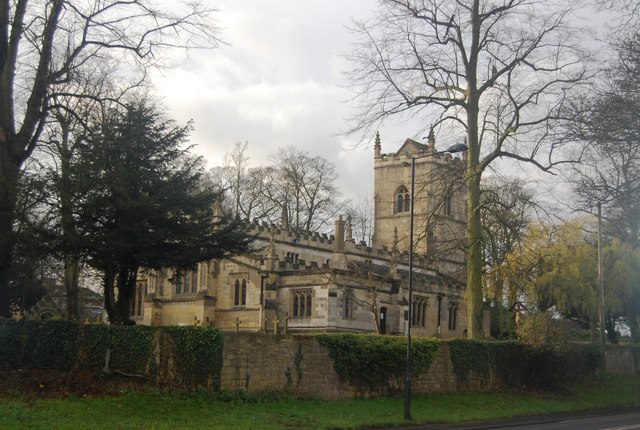
They had left the Hogwarts grounds completely; they had obviously travelled miles -- perhaps hundreds of miles -- for even the mountains surrounding the castle were gone. They were standing instead in a dark and overgrown graveyard; the black outline of a small church was visible beyond a large yew tree to their right. A hill rose above them to their left. Harry could just make out the outline of a fine old house on the hillside [GoF ch. #32; p. 552]
The short man in the cloak had put down his bundle, lit his wand, and was dragging Harry towards the marble headstone. Harry saw the name upon it flickering in the wand-light before he was forced around and slammed against it.
Cedric's body was lying some twenty feet away. Some way beyond him, glinting in the starlight, lay the Triwizard Cup. [GoF ch. #32; p. 554]
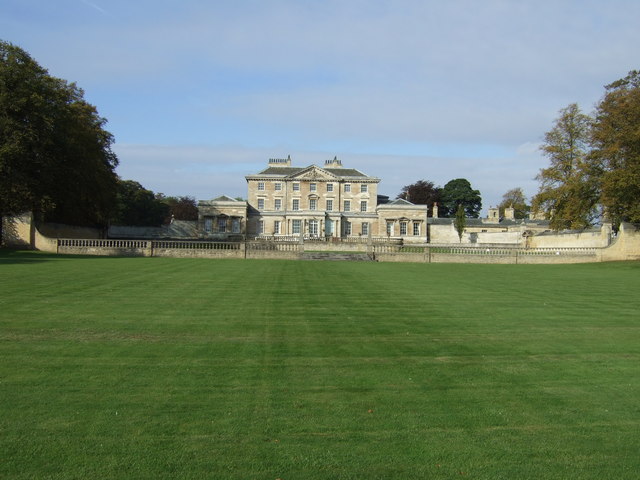
As they passed the wooden sign, Harry looked up at its two arms. The one pointing back the way they had come read: 'Great Hangleton, 5 miles'. The arm pointing after Ogden said: 'Little Hangleton, 1 mile'. They walked a short way with nothing to see but the hedgerows, the wide blue sky overhead and the swishing, frock-coated figure ahead, then the lane curved to the left and fell away, sloping steeply down a hillside, so that they had a sudden, unexpected view of a whole valley laid out in front of them. Harry could see a village, undoubtedly Little Hangleton, nestled between two steep hills, its church and graveyard clearly visible. Across the valley, set on the opposite hillside, was a handsome manor house surrounded by a wide expanse of velvety green lawn. [HBP ch. #10; p. 189]
Of the location of Little Hangleton we also know little. We know that the name sounds English, and that Little Hangleton is not more than six miles from Great Hangleton. It could be somewhat closer than that if the signpost Harry saw was off to one side, rather than on a line between the two villages.
We know that when the Portkey jerks Harry from the Triwizard maze to the graveyard where he meets the Death Eaters, he is going to Little Hangleton, because he sees the grave of Tom Riddle Senior and we know Riddle was buried in the churchyard at Little Hangleton. Harry believes his point of arrival is hundreds, plural, of miles from Hogwarts.
From the description of the site where Harry meets the Death Eaters, we know that Little Hangleton includes its own church and graveyard within or next to the village, and that it lies between two steep hills, at the side of a valley, and the Riddles’ manor house is on a hillside on the far side of the valley from the village, and surrounded by lush green lawns. So we can rule out anywhere very flat like (famously) Norfolk, and probably anywhere very windy or bleak which would make it hard to grow such a fine lawn.
The sun sets early at Hogwarts because it is surrounded by mountains, but Little Hangleton is in a valley so it too may well have an early sunset; and since it is already growing dark just after Harry enters the maze, by the time he is Portkeyed to Little Hangleton it’s probably the middle of the night. However, it's a clear night, because Harry sees starlight glimmering on the fallen Cup, and that makes it very unlikely that Little Hangleton is north of Hogwarts, especially hundreds of miles north of Hogwarts, because so close to the summer solstice the far north of Scotland barely gets dark at all, even at midnight. It would take extremely high mountains to change this and you'd expect they'd be mentioned, especially as Harry notes that he has left the lea of the mountains around Hogwarts.
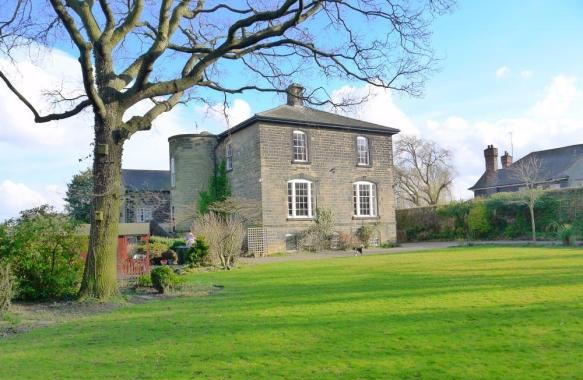
Thanks to Tonks-is-cool for pointing out the comment in chapter 1 of GoF, which places the Riddle manor house two hundred miles from Little Whinging – and this is the authorial voice, not Harry's thoughts, so it must be true unless there is very strong canon evidence to contradict it. If we draw a circle around the likely position of Little Whinging (i.e. near Heathrow airport) with a radius of two hundred miles, that places the Hangletons either in Cornwall in the St Austell/Newquay area, or in the far west or north-west of Wales, or on an arc across northern England from just above Liverpool to just above Hull. Hickleton Hall, Hickleton, Doncaster, South Yorkshire © Jthomas at Geograph Hickleton Church © SMJ at Geograph Regency manor house at Thrybergh, Rotherham, South Yorkshire, from RightMove
Looking at images on Geograph, the far north-west corner of Wales looks a bit too rugged, although the area west of Carmarthen looks OK. Central Cornwall has some suitable locations but both Cornwall and west/north-west Wales tend to have obviously Cornish or Welsh place-names. South Yorkshire is probably a good bet, and it may be that the Hangletons are quite near Upper Flagley, and that's why the Gaunts were living in the area.
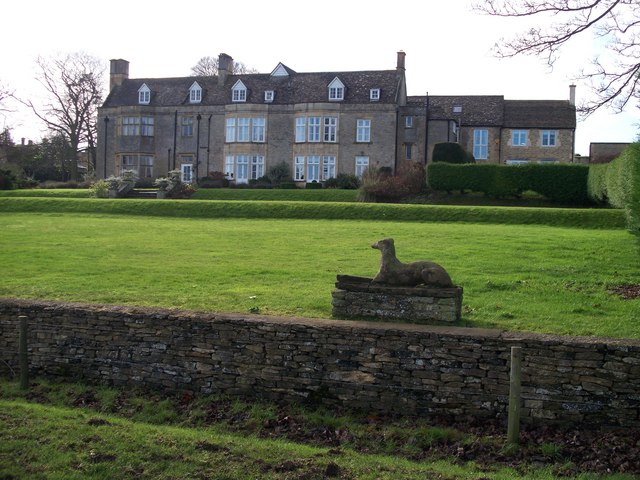
Rowling may well have been thinking of manor houses she had seen in Gloucestershire, close to where she lived as a teenager – rich green countryside, not too flat, with plenty of suitable houses – although in practice Gloucestershire is too close to Little Whinging to qualify. Bear in mind incidentally that the word "manor" on its own does not strictly speaking refer to a house. A manor is or used to be an estate with tenant farms and sometimes whole tenant villages, and the manor house was where the family that owned and let the manor lived, but that house did not necessarily include the word "manor" in its name – although nowadays it seems to be common to refer to the house, sloppily, as if it were the manor itself.
'Good day to you, Mr Borgin, I'll expect you at the manor tomorrow to pick up the goods.' The moment the door had closed, Mr Borgin dropped his oily manner. 'Good day yourself, Mister Malfoy, and if the stories are true, you haven't sold me half of what's hidden in your manor ...' [CoS ch. #04; p. 44]
'You know the Ministry of Magic raided our Manor last week?' [cut] 'Yeah ...' said Malfoy. 'Luckily, they didn't find much. Father's got some very valuable Dark Arts stuff. But luckily, we've got our own secret chamber under the drawing-room floor –-' [CoS ch. #12; p. 167]
'"I feel much easier in my mind now that I know Dumbledore is being subjected to fair and objective evaluation," said Mr Lucius Malfoy, 41, speaking from his Wiltshire mansion last night.' [OotP ch. #15; p. 275]
The lane was bordered on the left by wild, low-growing brambles, on the right by a high, neatly manicured hedge. [cut] [cut] the branches of overhanging trees broke the moonlight. [cut] [cut] They turned right, into a wide driveway that led off the lane. The high hedge curved with them, running off into the distance beyond the pair of impressive wrought-iron gates barring the men's way. [cut] The yew hedges muffled the sound of the men's footsteps. There was a rustle somewhere to their right: [cut] the source of the noise proved to be nothing more than a pure white peacock, strutting majestically along the top of the hedge. 'He always did himself well, Lucius. Peacocks ...' Yaxley thrust his wand back under his cloak with a snort.; A handsome manor house grew out of the darkness at the end of the straight drive, lights glinting in the diamond-paned downstairs windows. Somewhere in the dark garden beyond the hedge, a fountain was playing. Gravel crackled beneath their feet [cut] The hallway was large, dimly lit and sumptuously decorated, with a magnificent carpet covering most of the stone floor. The eyes of the pale-faced portraits on the walls followed Snape and Yaxley as they strode past. The two men halted at a heavy wooden door leading into the next room, [cut] then Snape turned the bronze handle. The drawing room was full of silent people, sitting at a long and ornate table. The room's usual furniture had been pushed carelessly up against the walls, illumination came from a roaring fire beneath a handsome marble mantelpiece surmounted by a gilded mirror; [DH ch. #01; p. 09/10]
[cut] a sudden wail sounded, a terrible, drawn-out cry of misery and pain. Many of those at the table looked downwards, startled, for the sound had seemed to issue from below their feet. 'Wormtail,' said Voldemort, [cut] 'have I not spoken to you about keeping our prisoner quiet?' [DH ch. #01; p. 13/14]
[cut] saw a long room, lit only by firelight, and the great, blond Death Eater on the floor, screaming and writhing, and a slighter figure standing over him, [cut] [cut] 'Draco, give Rowle another taste of our displeasure ...' [DH ch. #09; p. 145]
[cut] they landed in a country lane. [cut] he saw a pair of wrought-iron gates at the foot of what looked like a long drive. [cut] [cut] The iron was contorting, twisting itself out of the abstract furls and coils into a frightening face, [cut] [cut] the prisoners were shunted through the gates and up the drive, between high hedges that muffled their footsteps. Harry saw a ghostly white shape above him, and realised it was an albino peacock. [cut] [cut] as the prisoners were pushed over gravel. [cut] Harry and the others were shoved and kicked up broad stone steps, into a hallway lined with portraits. [cut] The drawing room dazzled after the darkness outside; even with his eyes almost closed Harry could make out the wide proportions of the room. A crystal chandelier hung from the ceiling, more portraits against the dark purple walls. Two figures rose from chairs in front of an ornate marble fireplace [cut] Harry was facing a mirror over the fireplace, a great gilded thing with an intricately scrolled frame. [DH ch. #23; p. 368-371]
'Take these prisoners down to the cellar, Greyback.' [cut] [cut] 'Take them down¬stairs, Greyback,' [cut] [cut] Greyback forced the rest of them to shuffle across to another door, into a dark passageway, [cut] [cut] he forced them along the corridor. [cut] &nbs p;[cut] They were forced down a steep flight of stairs, [cut] At the bottom was a heavy door. Greyback unlocked it with a tap of his wand, then forced them into a dank and musty room and left them in total darkness. The echoing bang of the slammed cellar door had not died away before there was a terrible, drawn-out scream from directly above them. [cut] [cut] There was a sound of movement close by them, then Harry saw a shadow moving closer. [cut] 'Mr Ollivander?' Harry could hear Luna saying. [cut] Harry [cut] turned [cut] to see Ron running around the cellar, looking up at the low ceiling, searching for a trapdoor. [DH ch. #23; p. 375-377]
[cut] ran up the stairs and back into the shadowy passageway leading to the drawing room. Cautiously they crept along it, until they reached the drawing-room door, which was ajar. Now they had a clear view of Bellatrix [cut] [cut] All of them looked upwards in time to see the crystal chandelier tremble; then, with a creak and an ominous jingling, it began to fall. [cut] The chandelier crashed to the floor in an explosion of crystal and chains, falling on top of Hermione and the goblin. [DH ch. #23; p. 381-383]
He was standing in a dimly lit room, and a semi-circle of wizards faced him, [cut] [cut] And he strode from the room, through the hall and out into the dark garden where the fountain played; [DH ch. #27; p. 442-445]
By the seventeenth century, any witch or wizard who chose to fraternise with Muggles became suspect; [cut] [cut] Influential wizards of the day, such as Brutus Malfoy, editor of Warlock at War, an anti-Muggle periodical, [BtB ch. #01; p. 15]
[cut] a descendant of Brutus Malfoy [cut] Mr Lucius Malfoy. [BtB ch. #02; p. 40]
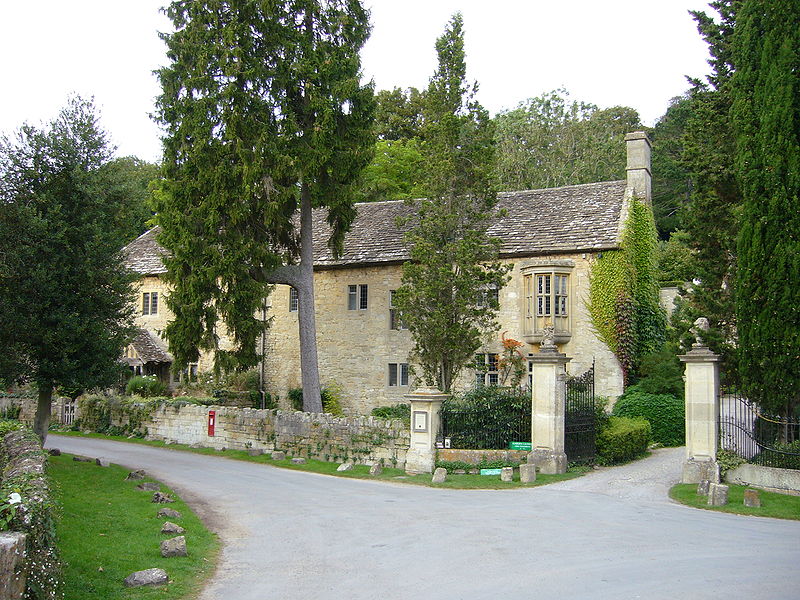
Malfoy Manor – with or without estate and tenant farms – is we are told in Wiltshire. It is referred to generally as "the manor". The gates to the grounds of the manor house are wrought iron in (usually) a curling, abstract design. They let onto one side of a country lane which has a high, neatly-trimmed yew hedge on the Malfoy side and rather wild brambles and overhanging trees on the other. The hedges curl inwards to edge a long, wide, straight, gravel-floored driveway leading up to the house, and seem to be flat-topped – peacocks walk about on top of them. Beyond the hedge there is a garden with a fountain, big enough to be quite audible.
The house itself is described as "handsome" but the downstairs windows have diamond panes – if these aren't original then they are the very height of naffness. We are nowhere told that the house is particularly large, as manor houses go: the word "mansion" implies a house of some size, but the Prophet may be exaggerating for dramatic effect. Broad stone steps lead up to a large, stone-floored hallway, richly and expensively decorated and carpeted, and lined with pale-faced presumably ancestral portraits. A heavy wooden door with a bronze handle leads to "the next room" which suggests the layout of the ground floor isn't very complex.
This "next room" is a wide drawing room with dark purple walls bearing more portraits. There is an ornate marble fireplace which has a very large, twiddly gilded mirror over it, and a chandelier of crystal and chains – not an especially big one, since it lands on Hermione and Griphook and doesn't do them much damage.
Despite the reputation of Malfoy Manor in fanfiction, there evidently isn't a dungeon on the premises. We know Ollivander is a prisoner there for months – he's heard being tortured downstairs in a scene set during July and is still there the following Easter – yet he, and Luna, are being kept in an ordinary cellar: one which evidently has a small window, since once Harry's eyes have adjusted he is able to make out shadowy figures. This cellar is directly under the drawing room, and it sounds as though it, or an annexe of it, doubles as the secret chamber under the drawing-room floor where the Malfoys hide stuff they don't want the Ministry to know about.
We also know that the Dark Lord has complained before about having his torture-victim making noises underneath the meeting room, yet Ollivander hasn't been moved to another underground room, which suggests there isn't one. You would expect there to be basement rooms more or less all the way underneath the old part of the house, yet there seems to be a cellar or cellars only under the drawing room – so although it's not absolute, it sounds as though the drawing room occupies most of the ground floor and Malfoy Manor really isn't very large. It has at least two large, handsome rooms, but probably not all that many rooms: when you take into account that a manor house would usually be only two or three storeys (plus cellars), the Malfoys probably have less living space than the Weasleys.
This is supported by the fact that we never definitely see any room at Malfoy Manor mentioned except for the hall, drawing room and cellar. The long, firelit room where Draco was compelled to torture Rowle might or might not be the drawing room but the large room (big enough for quite a large gathering to kneel around their lord) opening off the hall, where Voldemort had his hissy fit and killed several followers after he learned that the Hufflepuff cup had been stolen, probably is.
How old is Malfoy Manor? According to Pottermore the Malfoys came over with William the Conqueror and were given their core piece of land in Wiltshire at that time, later adding to it and forming a manor by buying up neighbouring Muggle lands. So the current manor house, or a previous building on the same site, has been in the family for a thousand years.
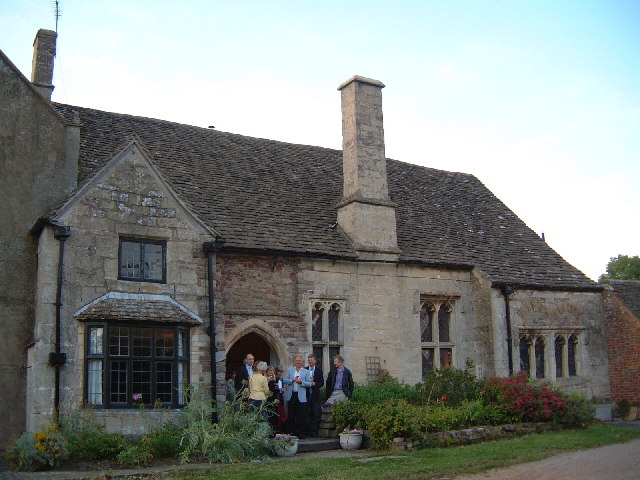
They are said to be one of the richest wizarding families (how rich is that?), which sits oddly with Yaxley's comment that the peacocks show Lucius is "doing himself well", which rather suggests that the Malfoys have come up in the world, fairly recently. Perhaps they went through a thin patch – they might well, like many landowning families, have suffered a period in the 19th or 20th C when they were "land rich but cash poor", when their lands weren't bringing in much rent and they had no actual spending money unless they sold off part of their inheritance. [At its most extreme, one of my Victorian relatives in Ireland was a major local landlord in County Kerry who ended up going into the workhouse to save himself from starvation, because a political dispute meant that his tenants weren't paying their rent, and nobody would buy the land from him if it wasn't bringing in rent.] Wanswell Court, a Mediaeval manor house in Gloucestershire (note diamond-paned windows) © David Exworth at Geograph Pottermore calls the Malfoys one of "many other progenitors of noble English families" but the evidence suggests that while they are landed gentry, "society", they aren't aristocracy. There's no mention of any of them having a title, and according to Pottermore they made their money through financial wheeler-dealing and trading in Muggle stocks, not through being granted extra lands in return for good service over the centuries. And even as landed gentry, they weren't all "gentlemen" – at least one of Lucius's direct male ancestors was in trade (newspapers) in the seventeenth century. Their snooty manner also suggests they are upper middle class with pretensions. There's a saying about class here in Britain that "The people who matter don't mind, and the people who mind don't matter" – and the Malfoys mind about class far too much to actually have any. Nevertheless, owning a very old house does confer social cachet, and the manor house may be very old, if not quite as old as their possession of the land it stands on. The current house could be at least partly ancient, or they could have pulled down the original and replaced it with a new build at some point, as so many wealthy families have done over the centuries. The decor in the drawing room, with the marble fireplace and the twiddly mirror, sounds eighteenth century or even Victorian, but the rather simple plan, the diamond panes (if they are original and not fake) and the presence of house-elves make it sound a lot older than that. Victorian drawing of Road Hill House –note single-storey extension at side The way the big drawing room is spoken of as if it is the only room off the hall, and the corridor which leads to the cellars is accessed by going through the drawing room, may mean that this was once a Mediaeval-style hall house with only one huge room plus vestibule on the ground floor, in which case the diamond-paned windows would be authentic. Some eighteenth century houses were also built with only a few rooms on the ground floor of the main block: for example Road Hill (now Langham) House, a Georgian country house in Wiltshire which was the scene of a notorious Victorian murder, consists of a square three-storey house the ground floor of which is almost entirely taken up by the entrance hall, a medium-sized drawing room, a library and the foot of the main stair, and then the dining room and the kitchen, laundry etc. form an adjacent single-storey extension with a door off the hall, and which wraps around the right side and part of the back of the main block. Iford Manor (see below), also in Wiltshire, a Tudor house which was extensively re-worked and given a new facade in the eighteenth century, has a similar-looking though smaller extension which may well house a dining room. So, whether Malfoy Manor is a genuinely Mediaeval or Tudor house which was re-worked and re-decorated in the eighteenth or nineteenth century, or an eighteenth or nineteenth century house fitted with fake Mediaeval windows, either way it probably has a main building consisting of two or three above-ground storeys with very few but large rooms on the ground floor (and only the one cellar under that main block), and then the dining room, kitchen and other work-rooms in a single-storey block at the side. The stair down to the cellar is probably part of the main block: the bottom end of a small back stair intended for use by servants living in the attic. The hallway lets onto the drawing room and the front stairs and probably nothing else; then there is another door from the drawing room onto a corridor which gives access to the kitchen/dining-room block, as well as to the steps down to the cellar. You would expect there to be at least a small library, but the way the drawing room is described as "the next room", as if the hall leads to the drawing room and nowhere else, probably means that the library too is accessed through the drawing room. 17thC facade of Iford Manor © Phil Williams at Geograph Tudor side view of Iford Manor © David Anstiss at Geograph Gates leading to Iford Manor, by Nabakov at Wikipedia There do not seem to be very many manors in Wiltshire – it's really not manor territory – but it's possible Malfoy Manor was at least partially modelled on Iford Manor, which has a famously beautiful early twentieth century Italianate garden called the Peto Garden. Of course, the details are different – Iford Manor has a Georgian front and a Tudor back, whereas Malfoy Manor seems to have a partially Tudor or even Mediaeval exterior and a Georgian interior. But whether it's the model for Malfoy Manor or a happy coincidence, Iford gives us something to work from when envisioning the Malfoys' probably-not-all-that-big, mixed-period Wiltshire manor house, complete with single-storey extension. 'Where are we?' he asked, peering around at a fresh mass of trees [cut] 'The Forest of Dean,' she said. 'I came camping here once, with my mum and dad.' [DH ch. #19; p. 296/297] [cut] the light became blinding, the trees in front of it pitch black in silhouette, and still the thing came closer ... And then the source of the light stepped out from behind an oak. It was a silver-white doe [DH ch. #19; p. 298] [cut] all that was there was a small, frozen pool, its cracked, black surface glittering [cut] [cut] he directed the wand at the surrounding trees and bushes, [DH ch. #19; p. 299/300] He could hardly breathe; trembling so violently the waters lapped over the edges of the pool, he felt for the blade with his numb feet. [cut] Harry kicked out wildly, trying to push himself back to the surface, but merely propelled himself into the rocky side of the pool. [DH ch. #19; p. 301] The two oaks grew close together; there was a gap of only a few inches between the trunks at eye-level, [cut] [cut] Harry looked around [cut] and saw the place: a flattish rock lying in the shadow of a sycamore tree. [DH ch. #19; p. 303/304] Astonbridge Inclosure, Forest of Dean © Jonathan Billinger at Geograph The Forest of Dean where Harry sees the silver doe and retrieves the sword from the pool is of course an entirely real forest in Gloucestershire at the southern end of the border between England and Wales, very near where JK Rowling lived as a teenager. Parts of the forest are fenced off in "inclosures" to protect growing trees but this would be no barrier to Apparition, and in any case the forest covers 42.5 square miles. All we know about the Trio's specific location within the forest is that there are oaks both at the campsite and near the pool, there are bushes, a flattish rock and a sycamore near the pool and the pool is deep enough to submerge yourself in but shallow enough to stand in with your head above water, and has a rocky side. Pool near Mirystock Bridge in the Forest of Dean © Philip Halling at Geograph Pool in Coverham Inclosure, Forest of Dean © Derek Harper at Geograph
Pottermore calls the Malfoys one of "many other progenitors of noble English families" but the evidence suggests that while they are landed gentry, "society", they aren't aristocracy. There's no mention of any of them having a title, and according to Pottermore they made their money through financial wheeler-dealing and trading in Muggle stocks, not through being granted extra lands in return for good service over the centuries. And even as landed gentry, they weren't all "gentlemen" – at least one of Lucius's direct male ancestors was in trade (newspapers) in the seventeenth century.
Their snooty manner also suggests they are upper middle class with pretensions. There's a saying about class here in Britain that "The people who matter don't mind, and the people who mind don't matter" – and the Malfoys mind about class far too much to actually have any.
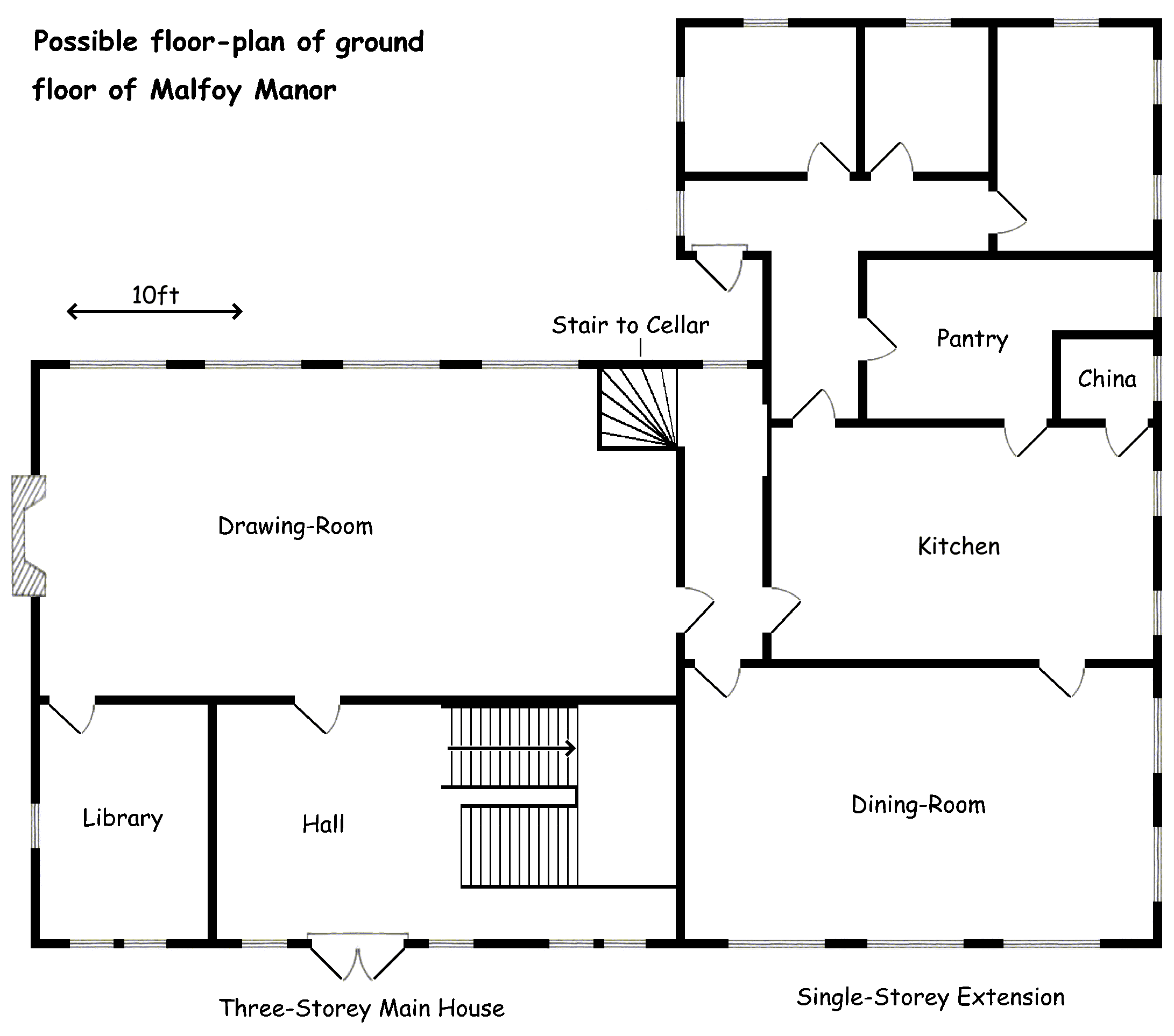
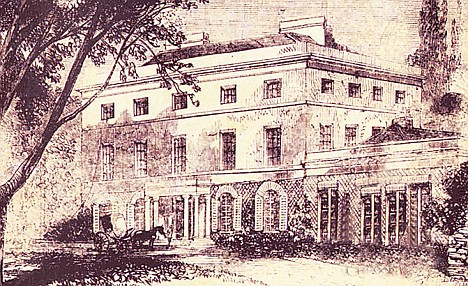
Nevertheless, owning a very old house does confer social cachet, and the manor house may be very old, if not quite as old as their possession of the land it stands on. The current house could be at least partly ancient, or they could have pulled down the original and replaced it with a new build at some point, as so many wealthy families have done over the centuries. The decor in the drawing room, with the marble fireplace and the twiddly mirror, sounds eighteenth century or even Victorian, but the rather simple plan, the diamond panes (if they are original and not fake) and the presence of house-elves make it sound a lot older than that. Victorian drawing of Road Hill House –note single-storey extension at side The way the big drawing room is spoken of as if it is the only room off the hall, and the corridor which leads to the cellars is accessed by going through the drawing room, may mean that this was once a Mediaeval-style hall house with only one huge room plus vestibule on the ground floor, in which case the diamond-paned windows would be authentic. Some eighteenth century houses were also built with only a few rooms on the ground floor of the main block: for example Road Hill (now Langham) House, a Georgian country house in Wiltshire which was the scene of a notorious Victorian murder, consists of a square three-storey house the ground floor of which is almost entirely taken up by the entrance hall, a medium-sized drawing room, a library and the foot of the main stair, and then the dining room and the kitchen, laundry etc. form an adjacent single-storey extension with a door off the hall, and which wraps around the right side and part of the back of the main block. Iford Manor (see below), also in Wiltshire, a Tudor house which was extensively re-worked and given a new facade in the eighteenth century, has a similar-looking though smaller extension which may well house a dining room. So, whether Malfoy Manor is a genuinely Mediaeval or Tudor house which was re-worked and re-decorated in the eighteenth or nineteenth century, or an eighteenth or nineteenth century house fitted with fake Mediaeval windows, either way it probably has a main building consisting of two or three above-ground storeys with very few but large rooms on the ground floor (and only the one cellar under that main block), and then the dining room, kitchen and other work-rooms in a single-storey block at the side. The stair down to the cellar is probably part of the main block: the bottom end of a small back stair intended for use by servants living in the attic. The hallway lets onto the drawing room and the front stairs and probably nothing else; then there is another door from the drawing room onto a corridor which gives access to the kitchen/dining-room block, as well as to the steps down to the cellar. You would expect there to be at least a small library, but the way the drawing room is described as "the next room", as if the hall leads to the drawing room and nowhere else, probably means that the library too is accessed through the drawing room. 17thC facade of Iford Manor © Phil Williams at Geograph Tudor side view of Iford Manor © David Anstiss at Geograph Gates leading to Iford Manor, by Nabakov at Wikipedia There do not seem to be very many manors in Wiltshire – it's really not manor territory – but it's possible Malfoy Manor was at least partially modelled on Iford Manor, which has a famously beautiful early twentieth century Italianate garden called the Peto Garden. Of course, the details are different – Iford Manor has a Georgian front and a Tudor back, whereas Malfoy Manor seems to have a partially Tudor or even Mediaeval exterior and a Georgian interior. But whether it's the model for Malfoy Manor or a happy coincidence, Iford gives us something to work from when envisioning the Malfoys' probably-not-all-that-big, mixed-period Wiltshire manor house, complete with single-storey extension. 'Where are we?' he asked, peering around at a fresh mass of trees [cut] 'The Forest of Dean,' she said. 'I came camping here once, with my mum and dad.' [DH ch. #19; p. 296/297] [cut] the light became blinding, the trees in front of it pitch black in silhouette, and still the thing came closer ... And then the source of the light stepped out from behind an oak. It was a silver-white doe [DH ch. #19; p. 298] [cut] all that was there was a small, frozen pool, its cracked, black surface glittering [cut] [cut] he directed the wand at the surrounding trees and bushes, [DH ch. #19; p. 299/300] He could hardly breathe; trembling so violently the waters lapped over the edges of the pool, he felt for the blade with his numb feet. [cut] Harry kicked out wildly, trying to push himself back to the surface, but merely propelled himself into the rocky side of the pool. [DH ch. #19; p. 301] The two oaks grew close together; there was a gap of only a few inches between the trunks at eye-level, [cut] [cut] Harry looked around [cut] and saw the place: a flattish rock lying in the shadow of a sycamore tree. [DH ch. #19; p. 303/304] Astonbridge Inclosure, Forest of Dean © Jonathan Billinger at Geograph The Forest of Dean where Harry sees the silver doe and retrieves the sword from the pool is of course an entirely real forest in Gloucestershire at the southern end of the border between England and Wales, very near where JK Rowling lived as a teenager. Parts of the forest are fenced off in "inclosures" to protect growing trees but this would be no barrier to Apparition, and in any case the forest covers 42.5 square miles. All we know about the Trio's specific location within the forest is that there are oaks both at the campsite and near the pool, there are bushes, a flattish rock and a sycamore near the pool and the pool is deep enough to submerge yourself in but shallow enough to stand in with your head above water, and has a rocky side. Pool near Mirystock Bridge in the Forest of Dean © Philip Halling at Geograph Pool in Coverham Inclosure, Forest of Dean © Derek Harper at Geograph
The way the big drawing room is spoken of as if it is the only room off the hall, and the corridor which leads to the cellars is accessed by going through the drawing room, may mean that this was once a Mediaeval-style hall house with only one huge room plus vestibule on the ground floor, in which case the diamond-paned windows would be authentic. Some eighteenth century houses were also built with only a few rooms on the ground floor of the main block: for example Road Hill (now Langham) House, a Georgian country house in Wiltshire which was the scene of a notorious Victorian murder, consists of a square three-storey house the ground floor of which is almost entirely taken up by the entrance hall, a medium-sized drawing room, a library and the foot of the main stair, and then the dining room and the kitchen, laundry etc. form an adjacent single-storey extension with a door off the hall, and which wraps around the right side and part of the back of the main block. Iford Manor (see below), also in Wiltshire, a Tudor house which was extensively re-worked and given a new facade in the eighteenth century, has a similar-looking though smaller extension which may well house a dining room.
So, whether Malfoy Manor is a genuinely Mediaeval or Tudor house which was re-worked and re-decorated in the eighteenth or nineteenth century, or an eighteenth or nineteenth century house fitted with fake Mediaeval windows, either way it probably has a main building consisting of two or three above-ground storeys with very few but large rooms on the ground floor (and only the one cellar under that main block), and then the dining room, kitchen and other work-rooms in a single-storey block at the side. The stair down to the cellar is probably part of the main block: the bottom end of a small back stair intended for use by servants living in the attic. The hallway lets onto the drawing room and the front stairs and probably nothing else; then there is another door from the drawing room onto a corridor which gives access to the kitchen/dining-room block, as well as to the steps down to the cellar. You would expect there to be at least a small library, but the way the drawing room is described as "the next room", as if the hall leads to the drawing room and nowhere else, probably means that the library too is accessed through the drawing room. 17thC facade of Iford Manor © Phil Williams at Geograph Tudor side view of Iford Manor © David Anstiss at Geograph Gates leading to Iford Manor, by Nabakov at Wikipedia There do not seem to be very many manors in Wiltshire – it's really not manor territory – but it's possible Malfoy Manor was at least partially modelled on Iford Manor, which has a famously beautiful early twentieth century Italianate garden called the Peto Garden. Of course, the details are different – Iford Manor has a Georgian front and a Tudor back, whereas Malfoy Manor seems to have a partially Tudor or even Mediaeval exterior and a Georgian interior. But whether it's the model for Malfoy Manor or a happy coincidence, Iford gives us something to work from when envisioning the Malfoys' probably-not-all-that-big, mixed-period Wiltshire manor house, complete with single-storey extension.
There do not seem to be very many manors in Wiltshire – it's really not manor territory – but it's possible Malfoy Manor was at least partially modelled on Iford Manor, which has a famously beautiful early twentieth century Italianate garden called the Peto Garden. Of course, the details are different – Iford Manor has a Georgian front and a Tudor back, whereas Malfoy Manor seems to have a partially Tudor or even Mediaeval exterior and a Georgian interior. But whether it's the model for Malfoy Manor or a happy coincidence, Iford gives us something to work from when envisioning the Malfoys' probably-not-all-that-big, mixed-period Wiltshire manor house, complete with single-storey extension.
[cut] the light became blinding, the trees in front of it pitch black in silhouette, and still the thing came closer ... And then the source of the light stepped out from behind an oak. It was a silver-white doe [DH ch. #19; p. 298]
[cut] all that was there was a small, frozen pool, its cracked, black surface glittering [cut] [cut] he directed the wand at the surrounding trees and bushes, [DH ch. #19; p. 299/300]
He could hardly breathe; trembling so violently the waters lapped over the edges of the pool, he felt for the blade with his numb feet. [cut] Harry kicked out wildly, trying to push himself back to the surface, but merely propelled himself into the rocky side of the pool. [DH ch. #19; p. 301]
The two oaks grew close together; there was a gap of only a few inches between the trunks at eye-level, [cut] [cut] Harry looked around [cut] and saw the place: a flattish rock lying in the shadow of a sycamore tree. [DH ch. #19; p. 303/304]
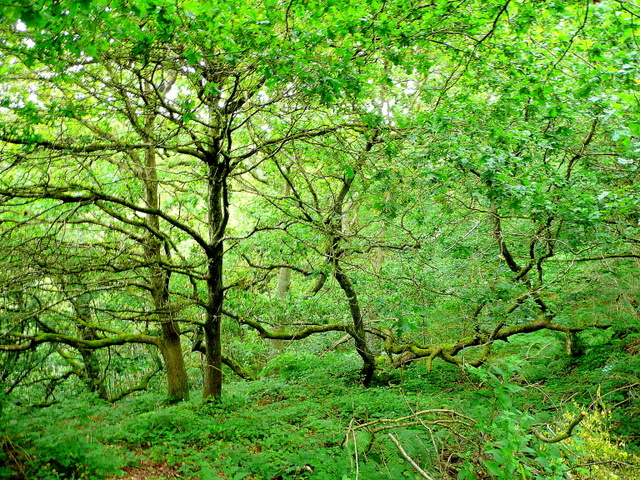
The Forest of Dean where Harry sees the silver doe and retrieves the sword from the pool is of course an entirely real forest in Gloucestershire at the southern end of the border between England and Wales, very near where JK Rowling lived as a teenager.
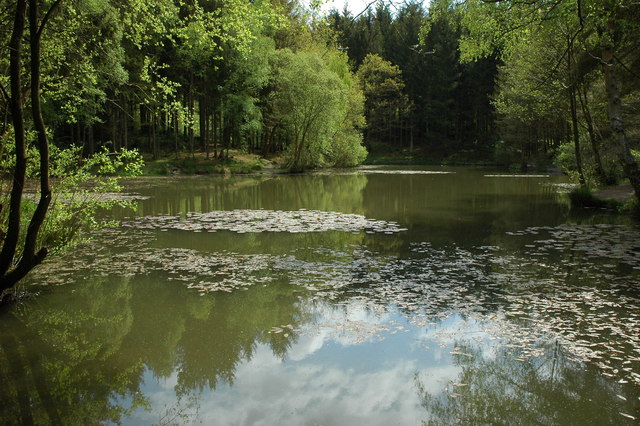
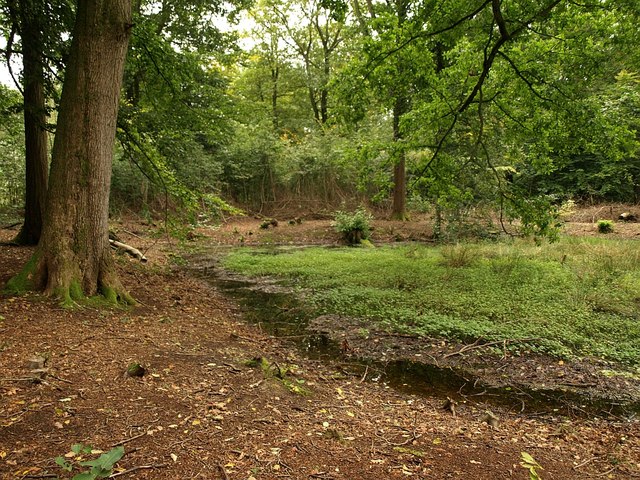
Parts of the forest are fenced off in "inclosures" to protect growing trees but this would be no barrier to Apparition, and in any case the forest covers 42.5 square miles. All we know about the Trio's specific location within the forest is that there are oaks both at the campsite and near the pool, there are bushes, a flattish rock and a sycamore near the pool and the pool is deep enough to submerge yourself in but shallow enough to stand in with your head above water, and has a rocky side. Pool near Mirystock Bridge in the Forest of Dean © Philip Halling at Geograph Pool in Coverham Inclosure, Forest of Dean © Derek Harper at Geograph