|
All rats rely on smell more than eyesight, and may nip if you suddenly stick your fingers through the bars - especially if you've been handling food, or another rat whom they don't like. It is best to wash your hands between handling rats from different groups - and vital to do so if your hands have been in contact with some greasy, strong-smelling food such as chicken fat or cheese.
It is hard to teach small children not to poke their fingers through the bars, and they may also keep pestering and grabbing at animals. Therefore it is probably best for parents of young children to keep their rats in cages with very close-set bars, or even in a tank provided it is well-ventilated; and to place the cage high up where children can't get at the animals except under supervision.
|
|
|
Some rats don't like to feel that you are trapping them, and will bite if you try to pick them up from a confined space, such as e.g. if you put your hand into a nest-box or under a shelf with them. With such an animal it is best to open the space up as much as possible - take the lid off the nest-box, open up the front of the cage or whatever - before picking them up: or just wait until they wander into a more open area.
|
|
|
Nearly all rats are safe to handle provided you don't make them feel cornered; but about 1 buck in 30 and 1 doe in 70 may turn out to be a serious biter (which compares well with the percentage of aggressive dogs and cats). In bucks this is normally due to over-dominance (i.e. excessive testosterone) rather than nervousness or spite: they usually grow out of it by about 9 months, but if not, castration is an effective solution, although one which I personally don't like. Some does become very fierce while nursing a litter, but in this case the aggression just goes away once the babies are weaned at 4-5 weeks.
|
|
|
|
|
|
Even if an aggressive rat stays that way all its life, there's no call to have it put down. It's not like having a fierce dog that may escape into the street and kill a child. You can usually avoid being bitten by even a very fierce rat if you manage it properly, and even if it does succeed in getting you it's never going to inflict a very serious injury: it's just too small. At its worst a rat-bite is never going to be as serious as a serious rabbit-bite - and when it comes down to it a high pain-threshhold is always a useful attribute for anyone intending to keep rodents or rabbits. One has to accept a certain amount of risk in keeping anything with teeth and claws - just as one accepts a certain risk of injury in carpentry, or growing roses. There's no point getting worked up about it.
|
|
|
Cage-cleaning is always a sore point with aggressive rats: they don't like to feel you are invading their territory and removing their scent-marks. You may have to block them up one end of the cage, or winkle them out and stick them in a holding-cage: though I did have a borderline-case called Monkey who would bite me if I cleaned his cage while he was running loose, but went all soft and cuddly if held - so I used to clean his cage with him clamped firmly in my armpit. In very severe cases it may be desirable to slip the rat a mild sedative before cleaning the cage: your vet should be able to supply something suitable, such as the tranquilizers used to calm nervous cats and dogs before long journeys.
|
|
|
Some aggressive rats don't even like you putting your hand in the cage to change their food and water. Again in very severe cases it may be neccessary to make a baffle which can be used to lock the animal into one end of the cage: but it is usually enough just to stuff their mouth full with chocolate drops.
|
|
|
Aggressive bucks, like nettles, are best grasped firmly. Indeed, some perfectly nice rats become scratchy and snappy if handled in a nervous, tentative way, because it makes them feel insecure.
|
|
|
|
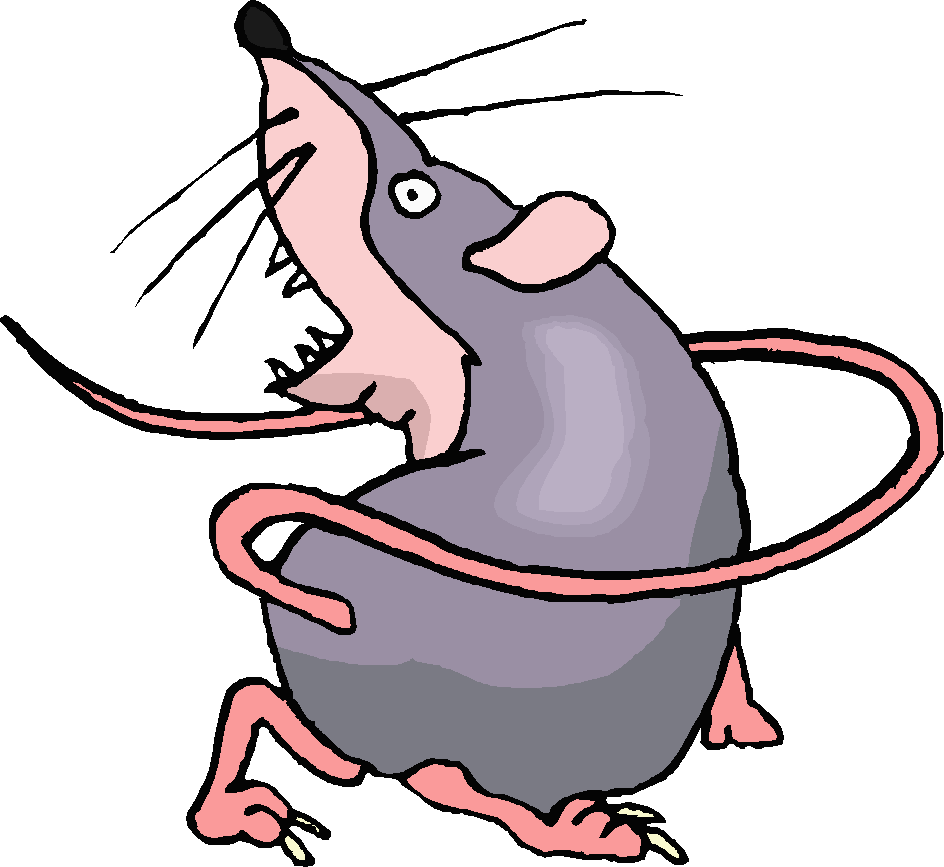
Fierce rats do at least usually give you fair warning of their intention to bite, and plenty of time to take evasive action, by arching the back, spiking their fur, hissing - which is roughly equivalent to a dog's growl - and sometimes lashing the tail. Even the most bitey rats seldom bite without warning, unless you startle them by suddenly sticking your hand into a confined space with them.
|
|
|
Even if he isn't a biter, a dominant buck may become excessively territorial and go round scent-marking everything - including you - by rubbing the scent-glands in his back along it and/or urinating on it. This behaviour is harmless, if sticky.
|
|
|
Even the most aggressive bucks don't kill each other (I've only heard of one case in 20 years - and the rat concerned had gone mad, possibly due to a brain-tumour). Buck-fights are all nip and scratch and rolling around beating each other up - even strange adult bucks won't kill each other, though they can inflict some nasty gashes, and occasionally try to castrate each other.
However very, very rarely you get a doe who will attack and kill strange half-grown rat kittens - or even her own half-grown kittens - or even adult bucks - after appearing to be perfectly all right with them. When you introduce new rats together they are often quite friendly at first and then start fighting after an hour or two, when they realize that this stranger isn't going to go away and will therefore have to be dominated. With these killer-does this sudden rush of aggression can have tragic consequences.
If you have a highly-strung doe who hasn't been introduced to strange rats before, it is probably best not to leave her alone overnight with any new additions immediately: put them together during the day under supervision and then separate them at night, until you are sure they are getting on OK. Once a doe has been introduced to one strange rat and has behaved normally (i.e. a couple of days of sporadic shoulder-barging, chasing and force-grooming, but no actual injury worse than minor scratches) you can assume she will be safe with others.
|