All animals shown are mine unless otherwise specified.
Return to Entertaining Norwegians start-page
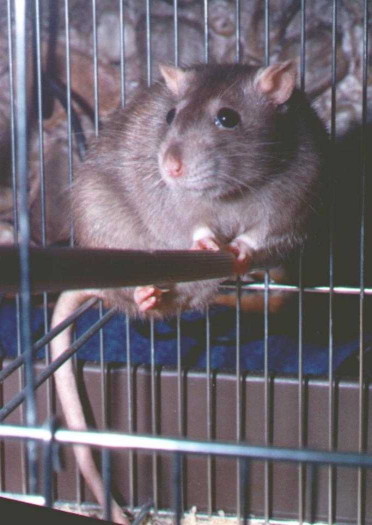
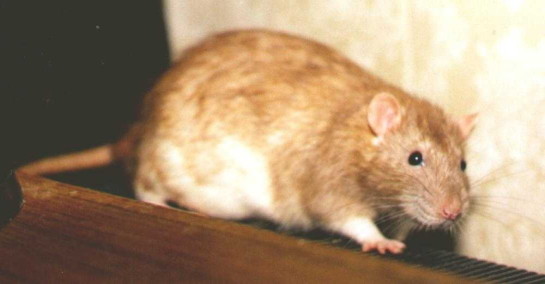
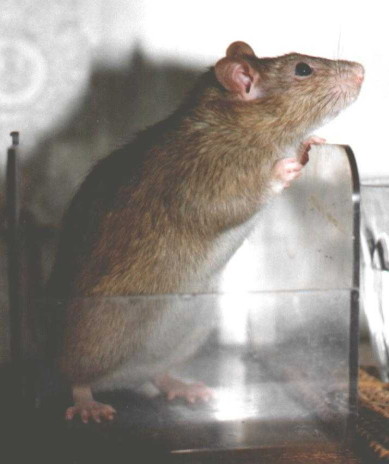
Dulcie, my first ever rat - a fine self mink doe. She particularly liked to gaze into my eyes and commune with me.
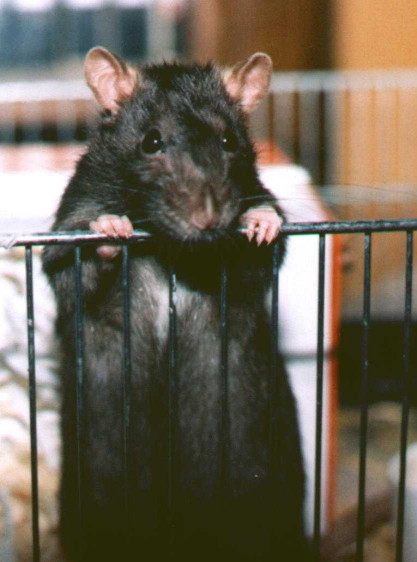
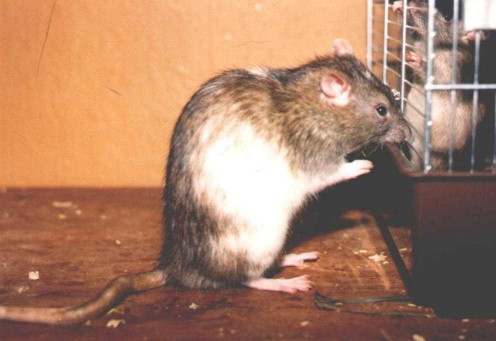
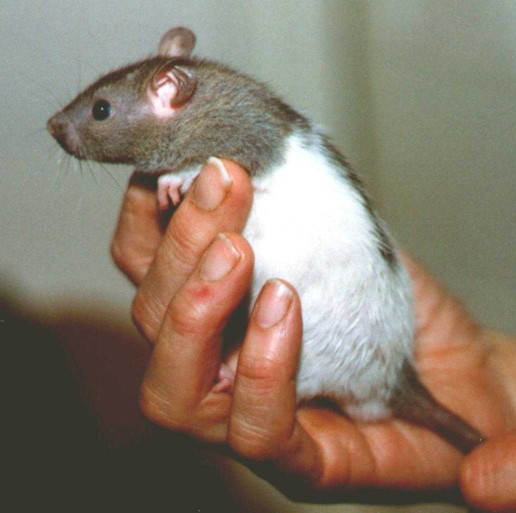
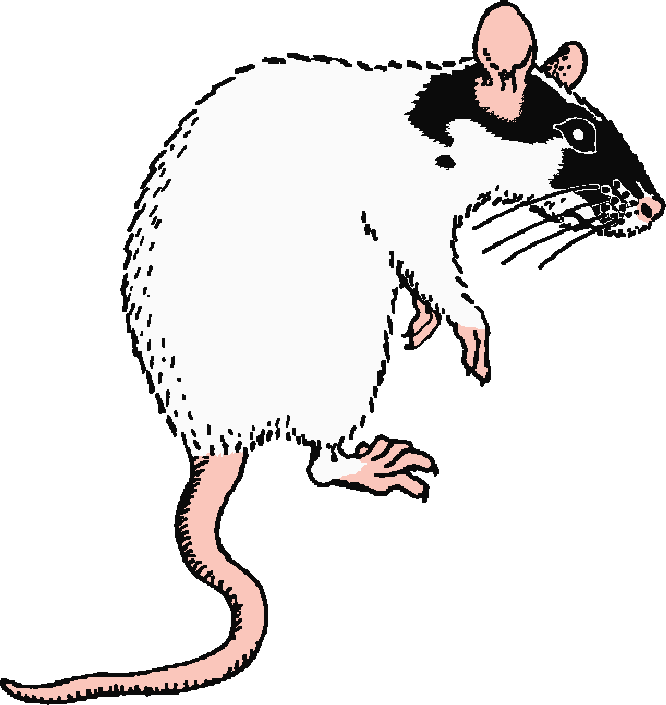
Valentine, my second rat, a mismarked black capped buck with the slightly faded colouration which sometimes occurs in capped and masked rats - one of the nicest men I've ever met.
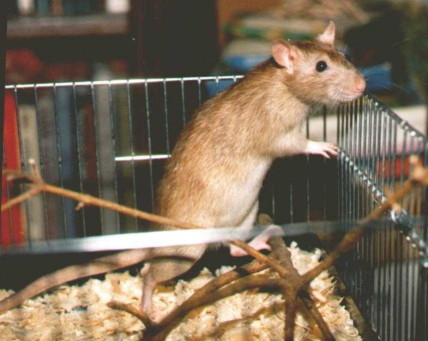
Signy Mallory, a cinnamon doe of good female "type" (i.e. conformation), saved from being snake-food - folk-music fan and amateur mountaineer.
Fan, a black Irish doe - Signy's cage-mate, who sadly died after a pregnancy which went disastrously wrong.
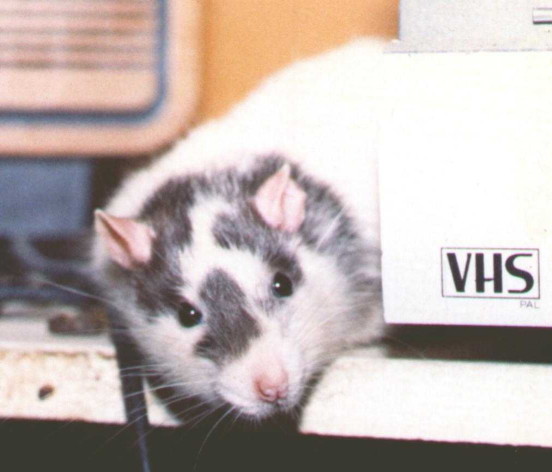
Valentine and Signy's son Oak, a cinnamon Berkshire who seemed to have what are known as Essex or "robert" markings - reverse variegation, in which white flecks spread up the sides against a solid-coloured ground. Also a very sweet fellow.
Oak's litter-brother Thorn, a.k.a. Genghis - a dark agouti variegated (i.e. with coloured freckles on a white ground - though he had too much solid colour on his back for show purposes) - a benevolent pack-leader but so aggressive towards humans that he once chased my mother onto the kitchen table and then climbed up after her.
Valentine's lunatic, hyperactive hamster-sized black-capped daughter and granddaughter Badger, a.k.a. Bodgit & Scarper or The Bodge, who had no sense of fear whatsoever and was sexually attracted to cats.
Badger's litter-brother Little Saint Niven, a mismarked faded-black capped. Tiny for a buck, he nevertheless had great self-confidence and a nice line in practical jokes, and was exceptionally intelligent. I once saw him creep up on his sleeping brother/uncle Thorn, bite his ear and then whisk away so fast that by the time Thorn woke up Niven was sitting gazing out of the nest-box door as if butter wouldn't melt in his mouth. It was Niven who put me off letting rats out while I am eating, after he took to sitting on my bust and helping himself off the fork as it went past.
The late great Biting Bernard, a cinnamon buck with ideal male "type" (= conformation) and an outstanding character. He hated to be picked up and would bite to the bone if you tried it, but he was in other respects very obliging - for example if he was chewing something he shouldn't I had only to call his name and then point to his chewing-stick, and he would look where I was pointing and then shuffle over and chew that instead. As intelligent as a dog, he was so pernickety that he combed his hay into parallel lines and had special places for stacking bones and empty sunflower seed husks. Ancestor of a high proportion of the fancy rats in England (via his sons Motley and Definitely Horsa) - fortunately many of his descendants inherited his beauty, brains and longevity, few inherited his temper and none inherited his chronic arthritis.
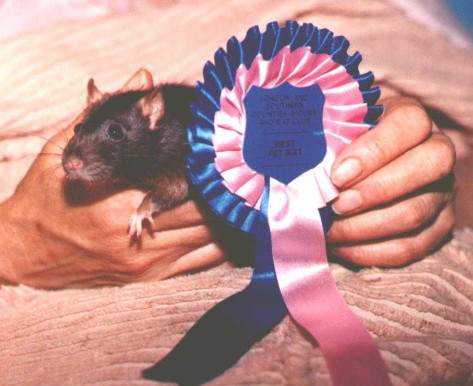
Bernard's mate (and co-ancestor of most of his descendants) Bridget-the-Fidget, a silver-grey (i.e. black sprinkled with white hairs) doe, at the moment of her triumph as Best Pet at a major show.
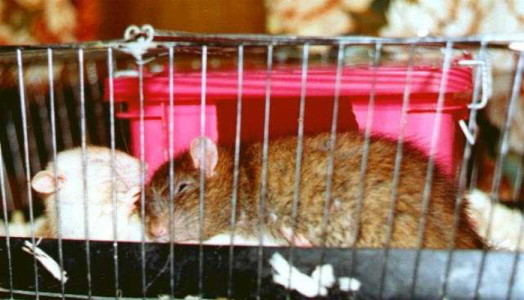
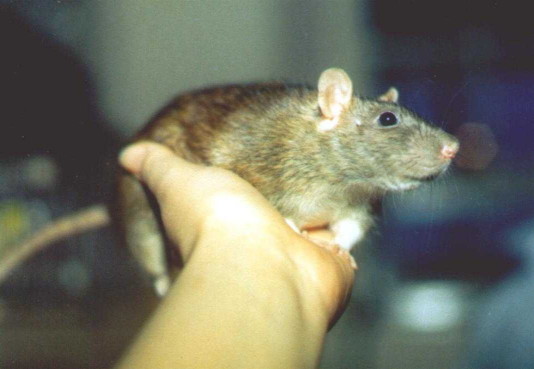
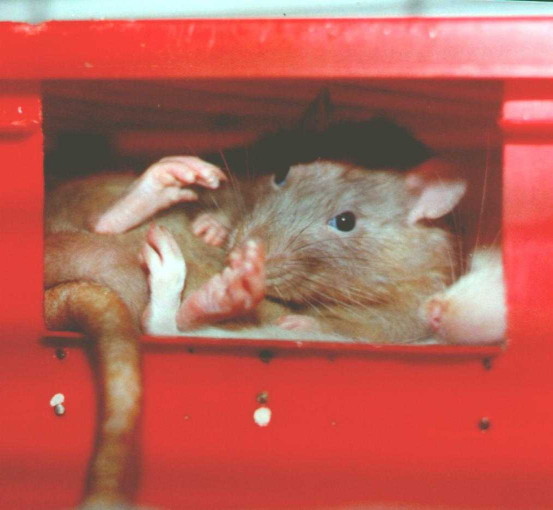
Menacing Dennis, one of Bernard's descendants, using his girlfriend Teazel-the-Weasel's stomach as a pillow. Dennis is agouti and Teazel is pearl - a sort of oatmeal colour.
Dennis was actually quite nice-natured and never bit anybody - he just had a tendency towards spike-furred macho posturing, especially after a teaspoonful of cider.
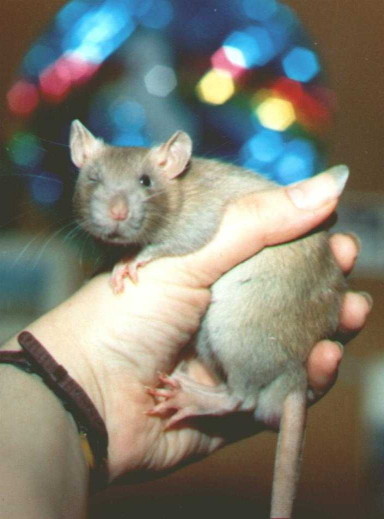
A young cinnamon buck called Edmund (there was nothing wrong with his eye - that's just a wink).
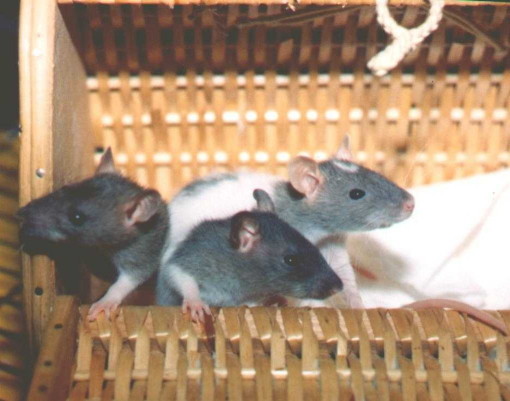
Lark, Ladybird and Robin Pointnose, newly arrived from the petshop.
"Nermal, the world's cutest kitten".
Charlotte, one of Bernard's descendants - an agouti Berkshire doe.
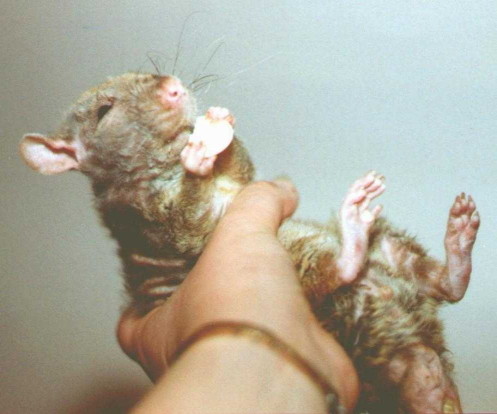
Another of Bernard's line, Chalmers, an ageing, balding agouti rex, doing his party-trick. He was quite happy to eat in this position, and could even do so one-handed.
This is either Meredith or Madoc, self mink buck, with pearl friend - both also descended from Bernard.
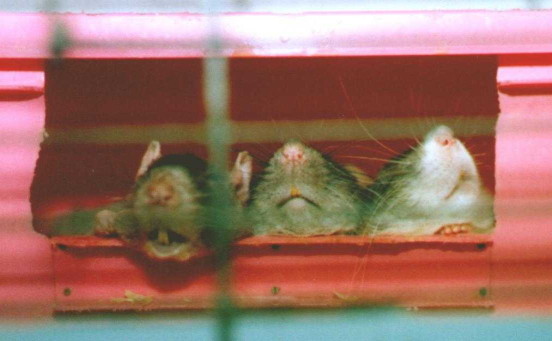
I can't remember whom these noses belong to, except that they are bucks.
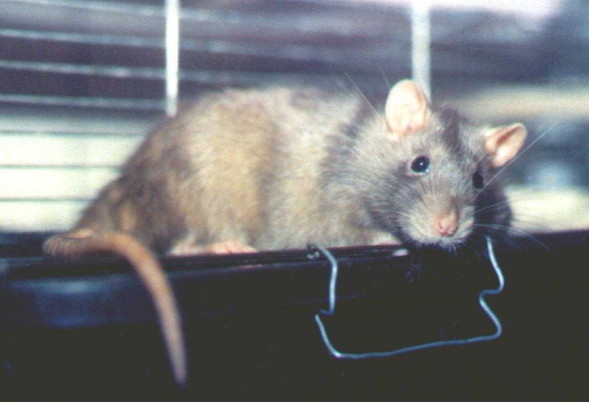
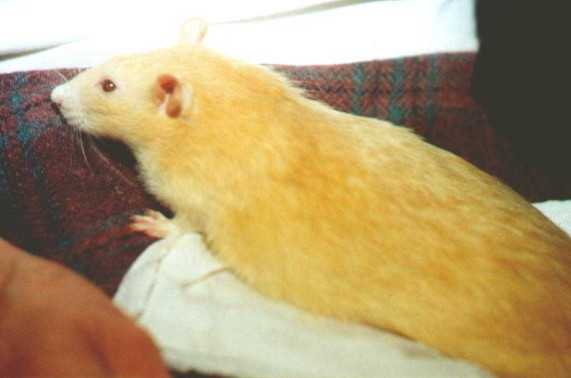
Millicent, yet another of Bernard's line, showing mink coat fading to ginger in middle age, especially towards the tail.
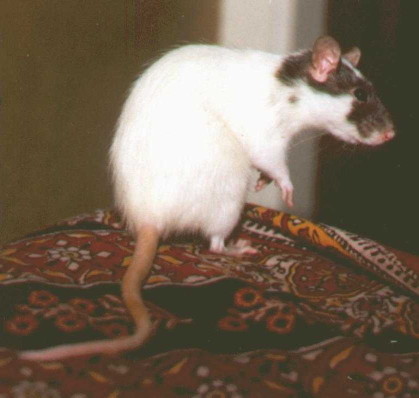
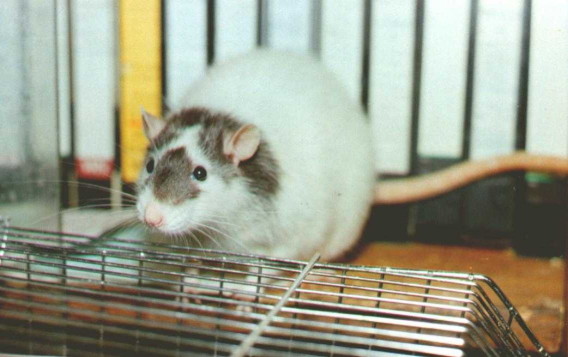
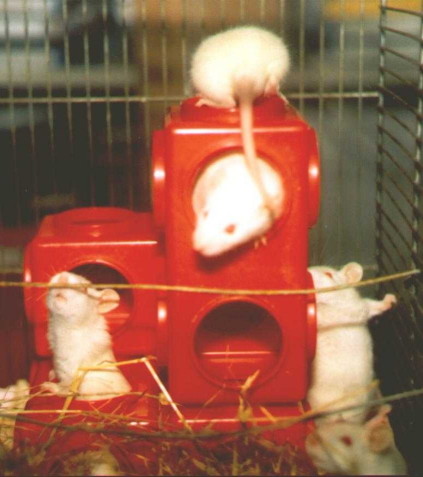
Mixed PEW (pink-eyed white) and Himalayan babies: one of these is Isobel, a.k.a. Dizzy Izzy, who proved to be a great character and very fond of humans. The cross-wires normally supported an upper shelf.
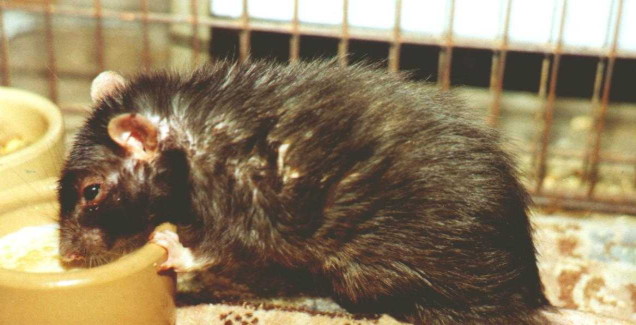
Scooby at three years old, showing typical appearance of geriatric buck - i.e. resembling a moth-eaten sofa.
Yet another of Bernard's descendants: Portly, a topaz buck (though ideally a topaz should have darker eyes) and a very nice fellow. He suffered from genetic obesity accompanied by other metabolic problems and a depressed immune system, and sadly died quite young.
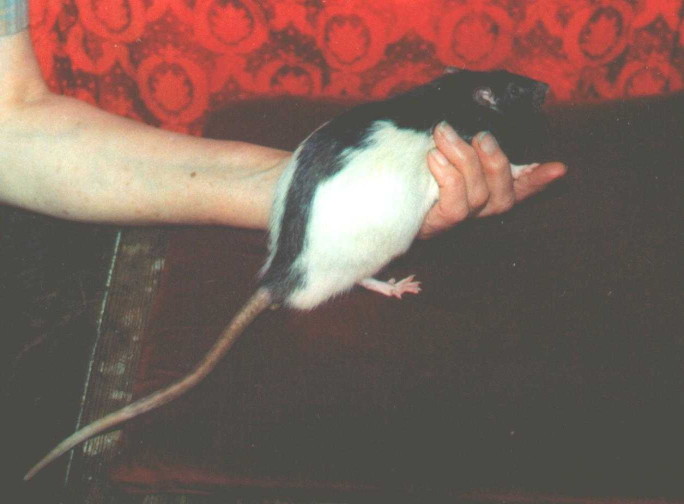
Push, a well-marked black hooded buck - though to be perfectly marked his stripe should have completely straight edges.
Clementine, a faded silver fawn doe, with her third-birthday cake. Note cataracts, which are sometimes seen in older animals: rats cope very well with blindness, since their primary sense is smell, and sight for them is a secondary sense - as smell is for us.
One of the Twins (if she was prepared to sit still, even when held, it's probably Sensible Pyjamas rather than her excitable sister Flighty Nightie), a milk-cream doe. The genetics of creams are still being worked out, but this milk-cream is probably the cream gene plus homozygous self.
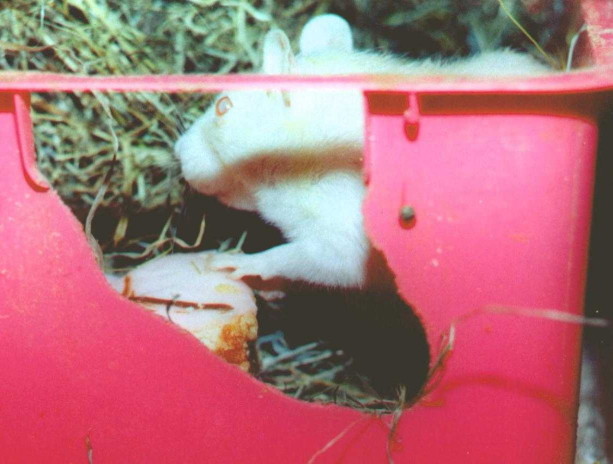
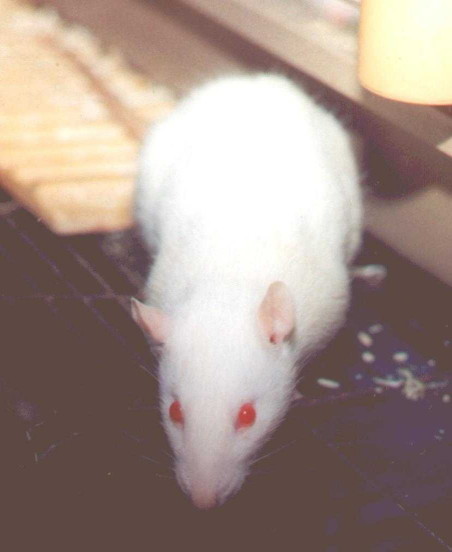
Cranberry, a PEW (pink-eyed white or albino) doe, who got her name because of her brilliantly red eyes.
Magnolia, a dark-eyed Himalayan - one Himalayan (Siamese) and one cream gene.
Magnolia's niece Fawner (so called because she's more fawn than her white sister Flora), a biscuit-cream hooded doe - probably the cream gene combined with agouti or cinnamon.
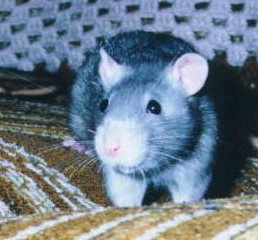
Sarah Ivy Rumage's blue boy Justin, named after the brave young officer-rat in Mrs Frisby and the Rats of NIMH. To see more photo's of Justin and his curly side-kick Templeton, go to Sarah's The Literary Rats page.
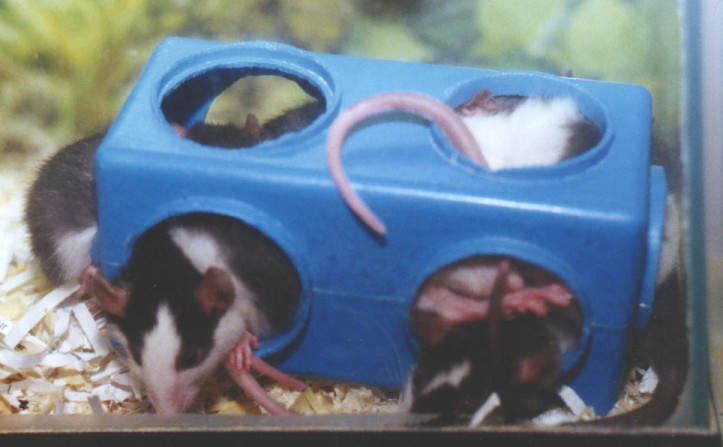
Baby black husky rats (belonging to Donald Dickson of Capital Pets, Edinburgh) showing dense black coats prior to first moult, and "badger-face" blaze.
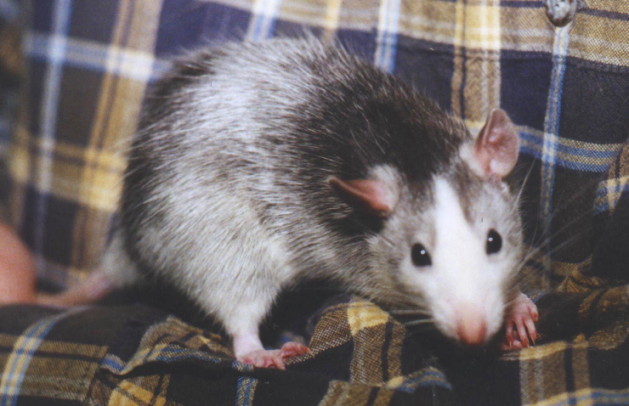
Donald Dickson's black husky doe Mavis, aged about four months, showing "badger-face" blaze and heavy roaning. There is another type of husky pattern, found in the American midwest, which is similar in appearance but is a form of chinchillation (removal of red from the coat) rather than roaning: this midwestern husky marking cannot occur in black rats, who have no red to remove.
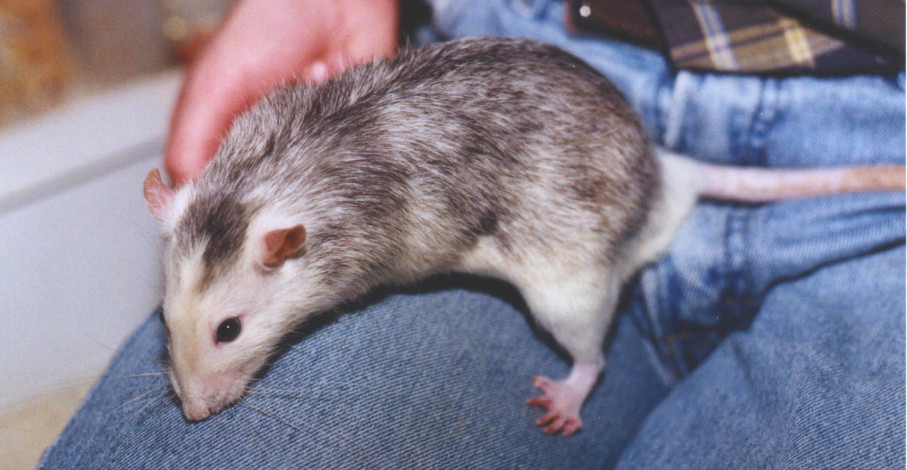
Donald Dickson's black husky stud-buck Haggis, Mavis' sire or uncle, aged about ten months. Note white spreading up the limbs, flanks and face, erasing most of the badger-blaze, and roaning so heavy the coat appears grey. In old huskies the white has spread so far up that they look as if someone took a pure white rat and painted a two-inch wide grey stripe down it, from the crown of the head to the tail.
In the original photograph it is possible to see that Haggis has a blue iris surrounding the open black pupil of his eye - but the scanner doesn't seem to have picked this up.