Go to text version Return to Hello Sailor start-page
Photographers:
[N.B. Many of the photographs have been slightly tweaked. The light at Deshnok is evidently very strong and most photographs taken there end up with very bright highlights and very dark shadows: so many of these images have been adjusted to lighten the dark areas while leaving the highlights untouched, to maximize the amount of visible detail.
There are a few more photographs which will be added later if and when I get permission to use them.]
Adam R Lee, a Professor of English teaching in South Korea: images from his collection of pictures of Southern Asia.
Mark Harris: images from the Bikaner section of his A Travel Picture Gallery, which covers much of the Far East, Middle East, Central and South America and Uzbekistan.
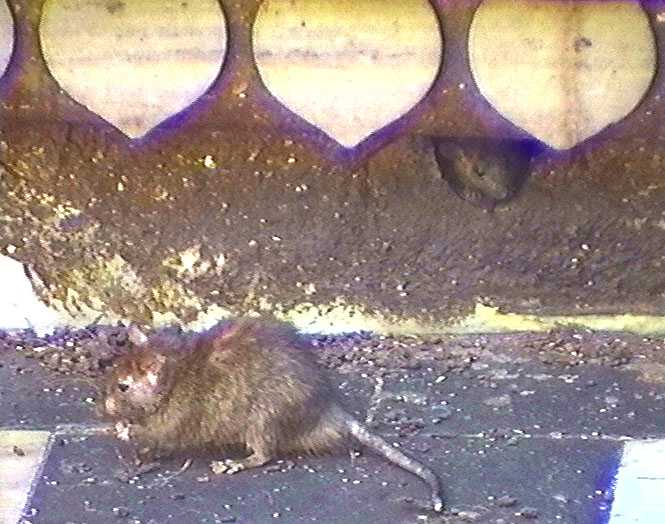
Francoise Cooperman, beer-expert and proprietor of Vermin Brewing, which has an excellent website devoted in equal parts to beer and rats, provided numerous stills taken from a video of her trip to Deshnok, plus very helpful descriptions of various aspects of the site.
Mike Meaney, Irish programmer and web designer, from the India - Large section of his photo' directory of images from his 2½ year trip round the world. Note that the India - Large page contains 60 high-resolution photographs - the standard is very high, but if you don't want to spend 40 minutes downloading all the images you can go to Mike's thumbnails page to pick the photo' of your choice.
Janet and Chris Beaudin and Susan Romeril - image from the India Pictures section of their the big trip website, which chronicles their journeys through Nepal, India, and South East Asia between October 1998 and July 1999.
Kees van Duyn, a.k.a. duke0123, a former soldier, now telecomm administrator, living in Assen, The Netherlands and aiming to break into web design: from his Fascinating India page at the Virtual Tourist site.
David Montouroy, from Deshnok page of his French-language site Mon Voyage en Inde: this site is elegant and sophisticated in design and worth a look even if you can't read the text.
Matt Long and Heidi Thoren, from the Mandawa & Bikaner page of their Our Passage to India site.
Prominent BBC wildlife-photographer John Downer: photo's taken from the Rat Relatives section of Mr Downer's book Lifesense, and used with the permission of John Downer Productions Ltd..
Rainer Stalvik, who has a Swedish-language site on "Worldwide Advanced Trekking" with images from his travels around India, the Far East, Northern Europe and South America.
Frédéric Hemmer, from the Deshnoke, Temple des Rats page of his French-language site L'Inde en 1001 Photos.
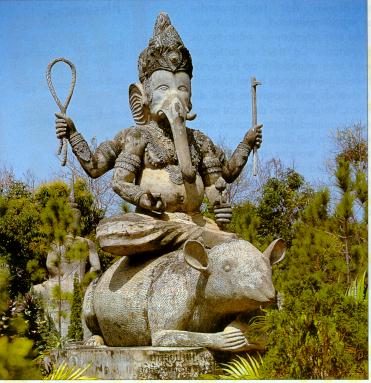
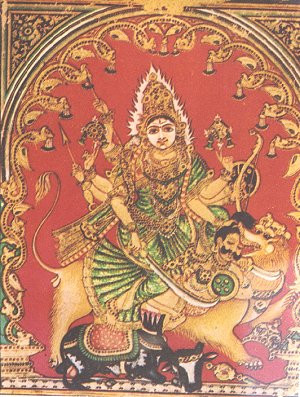
First two photographs of religious pictures of Ganesh, and picture of Durgha, are Copyright © 1996-current year Kamat's Potpourri - The History, Mystery, and Diversity of India (All Rights Reserved). This is a very lively, chatty, well-designed site full of all sorts of information and images - worth a visit even if you didn't know you were going to be so interested in India.
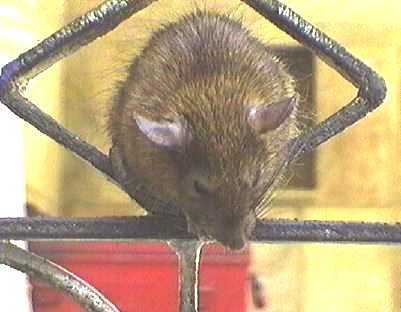
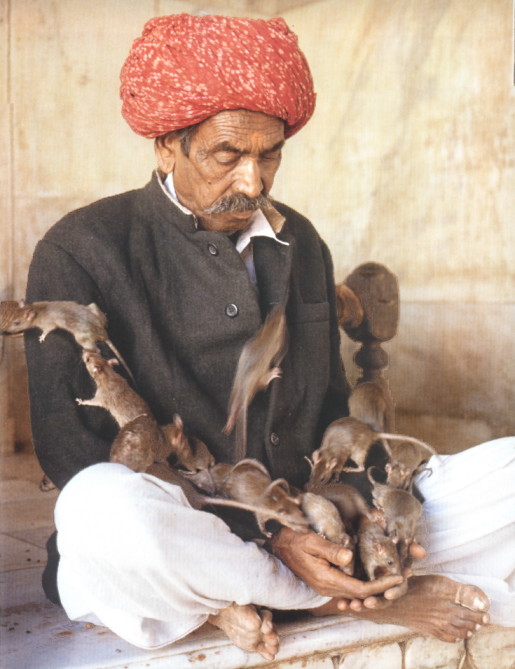
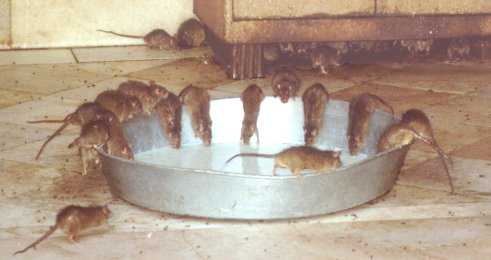
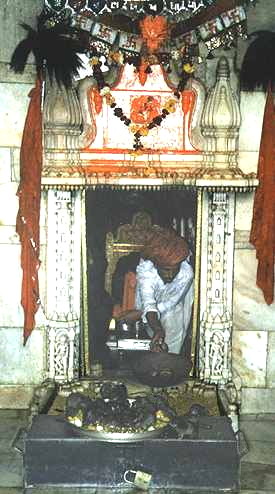
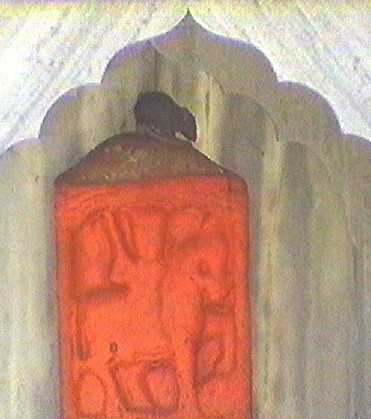
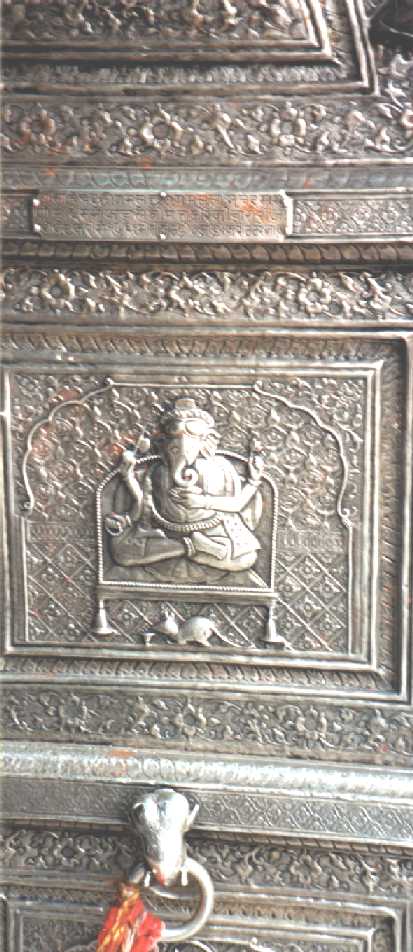
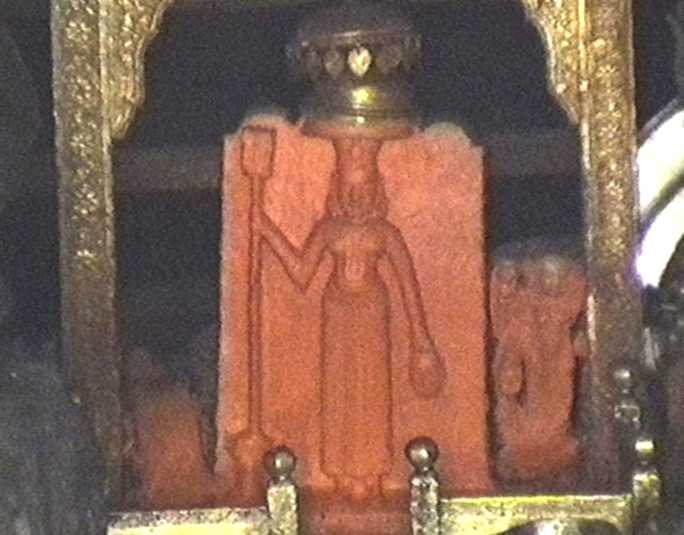
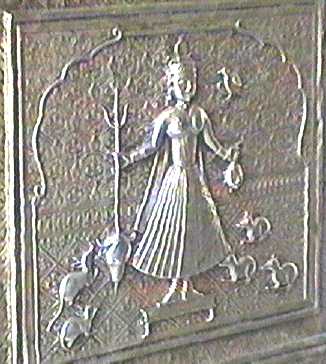
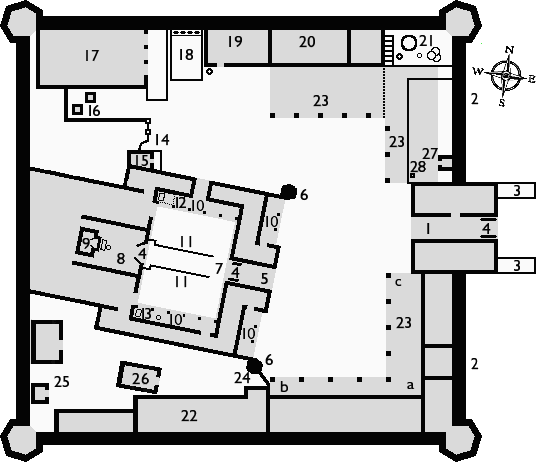
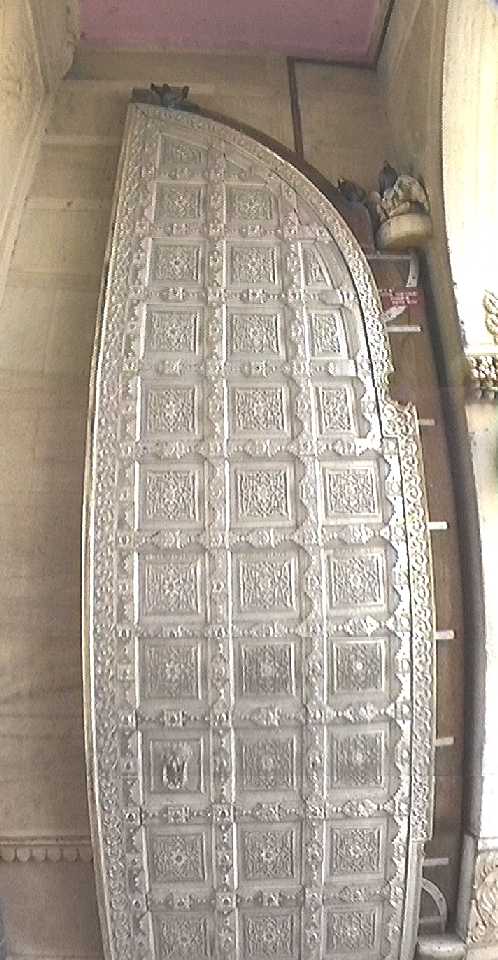
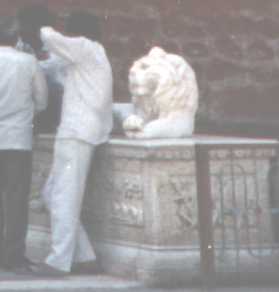
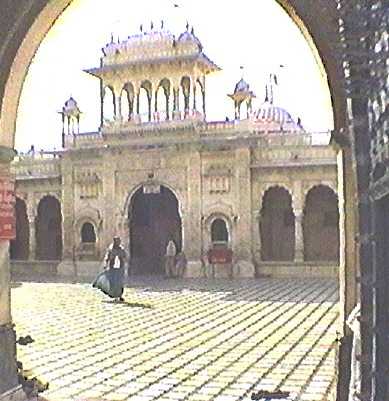
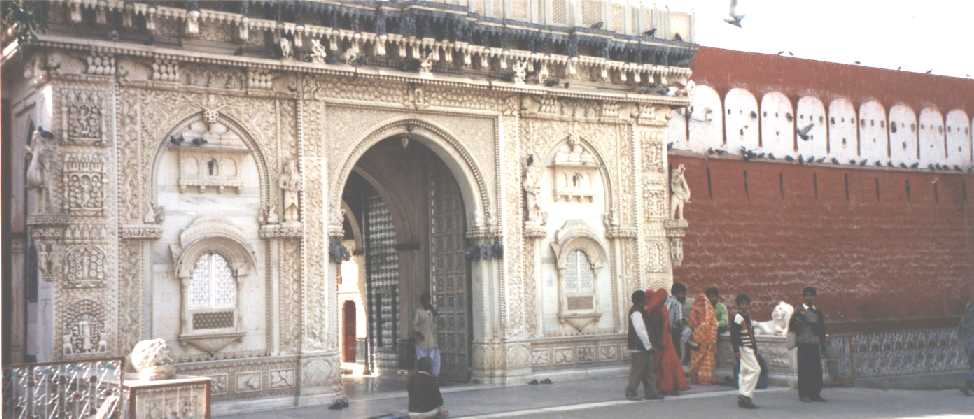
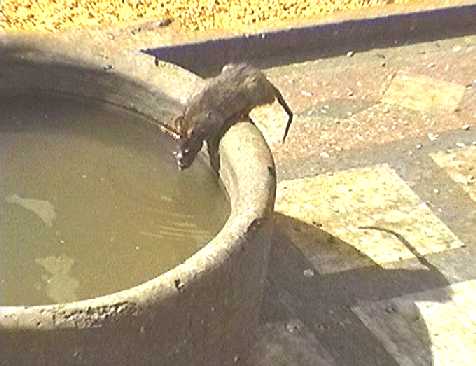
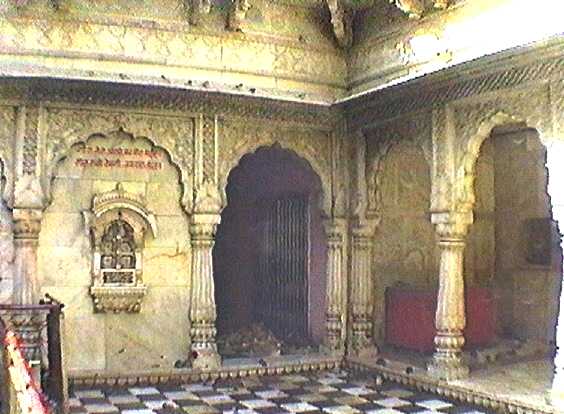
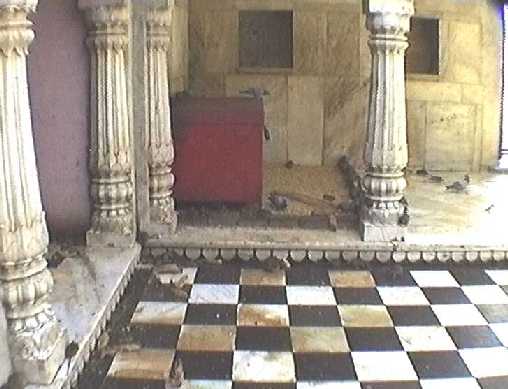
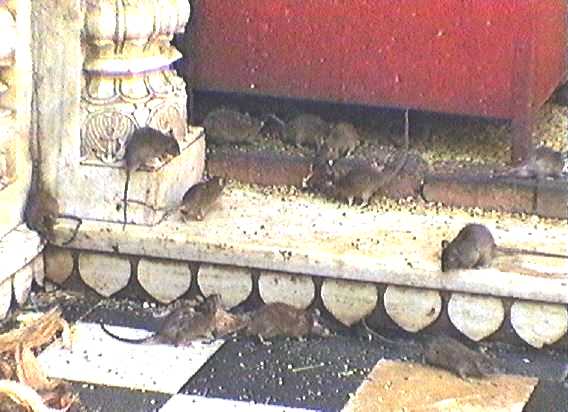
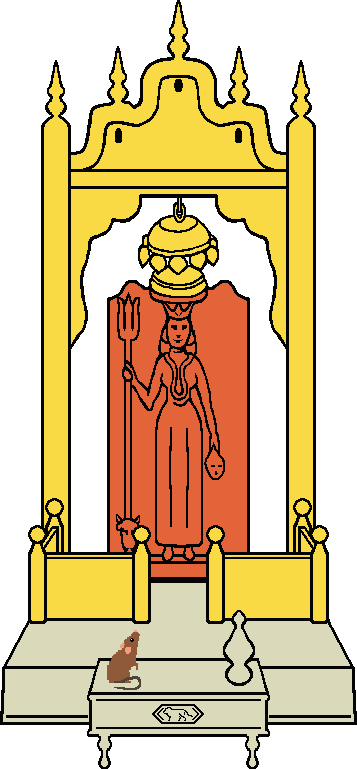
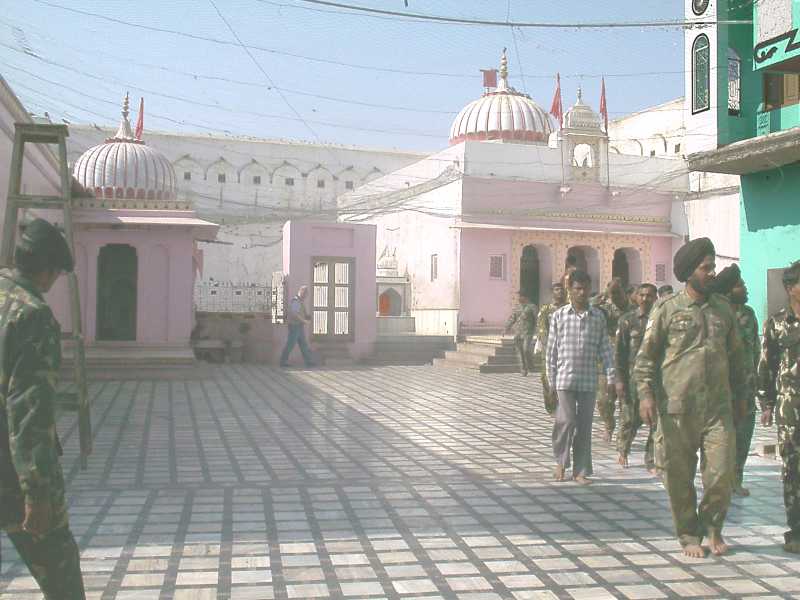
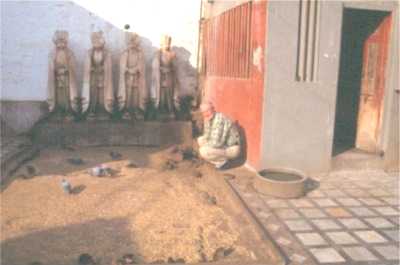
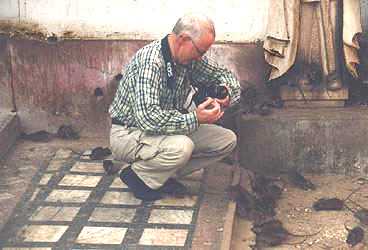
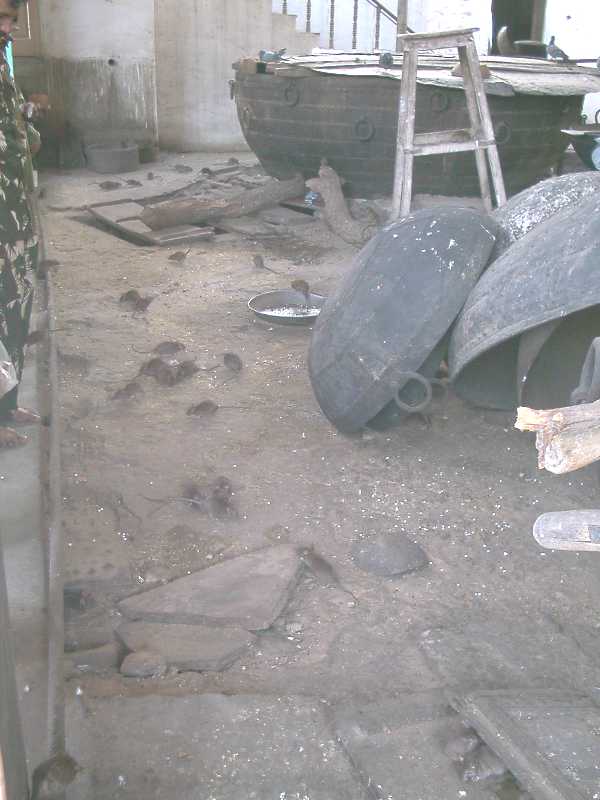
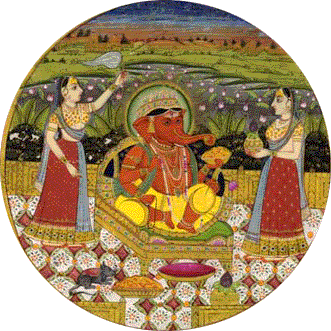
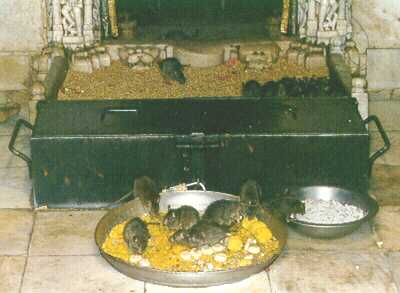
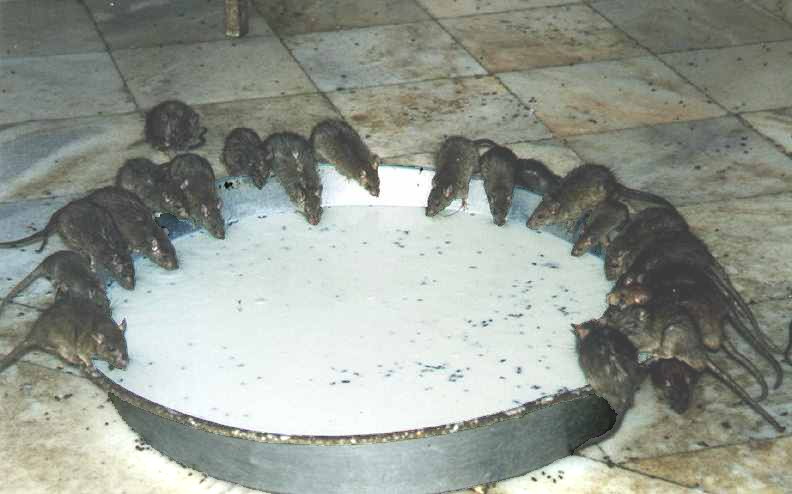
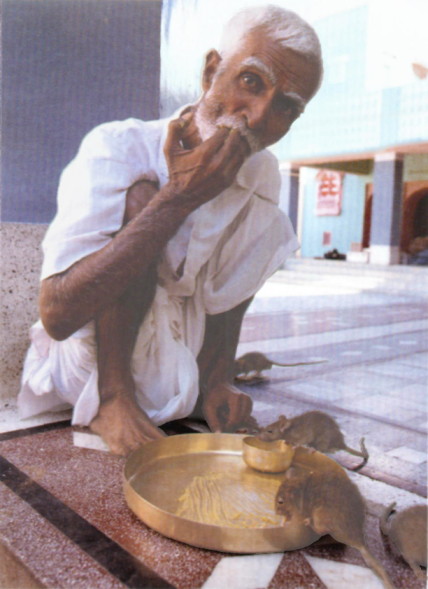
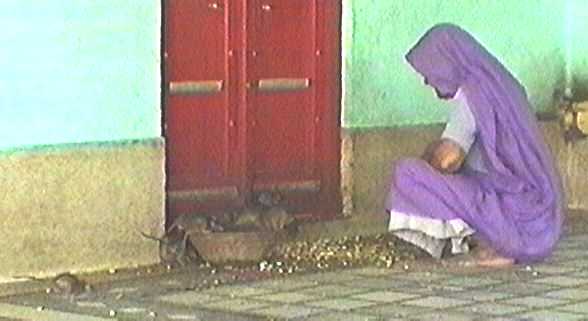
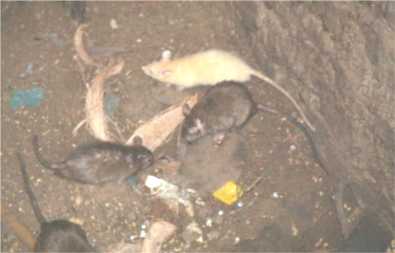
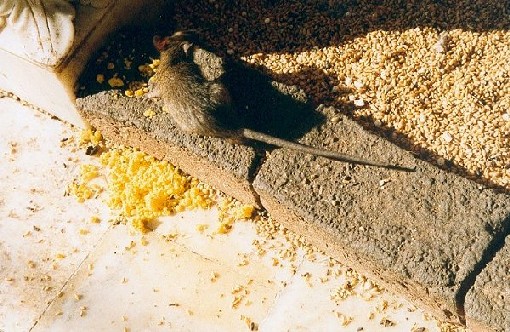
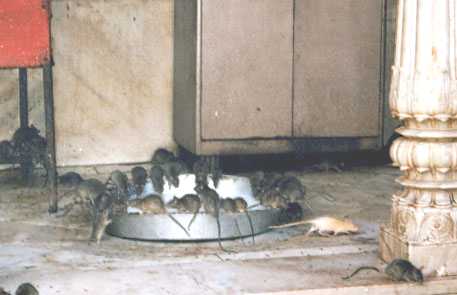
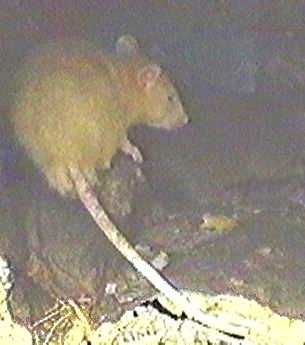
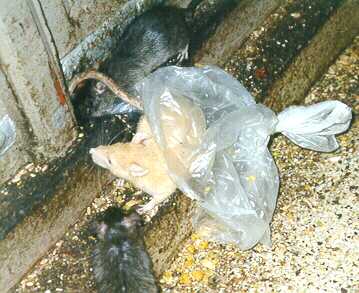
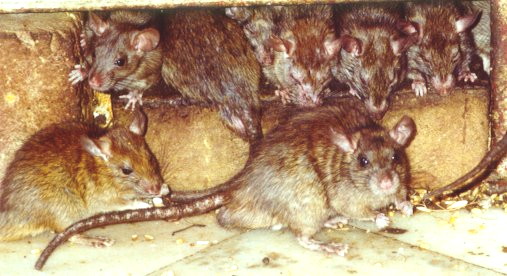
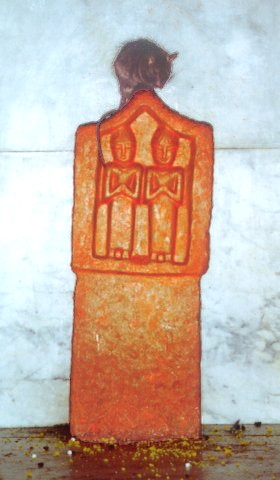
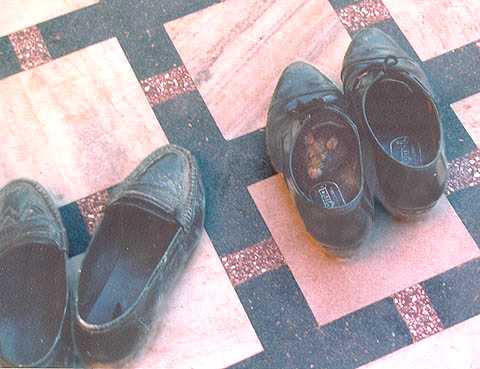
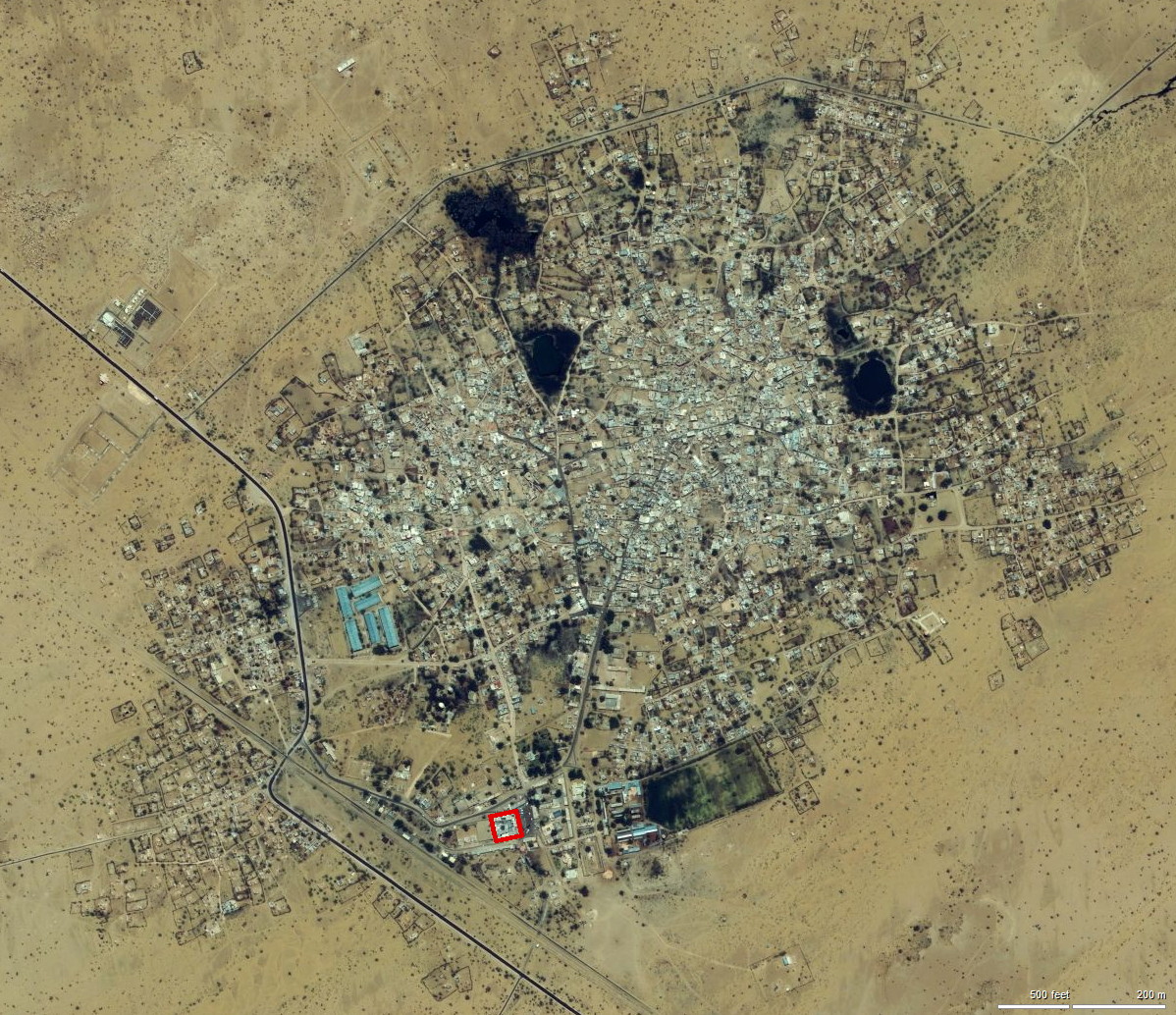
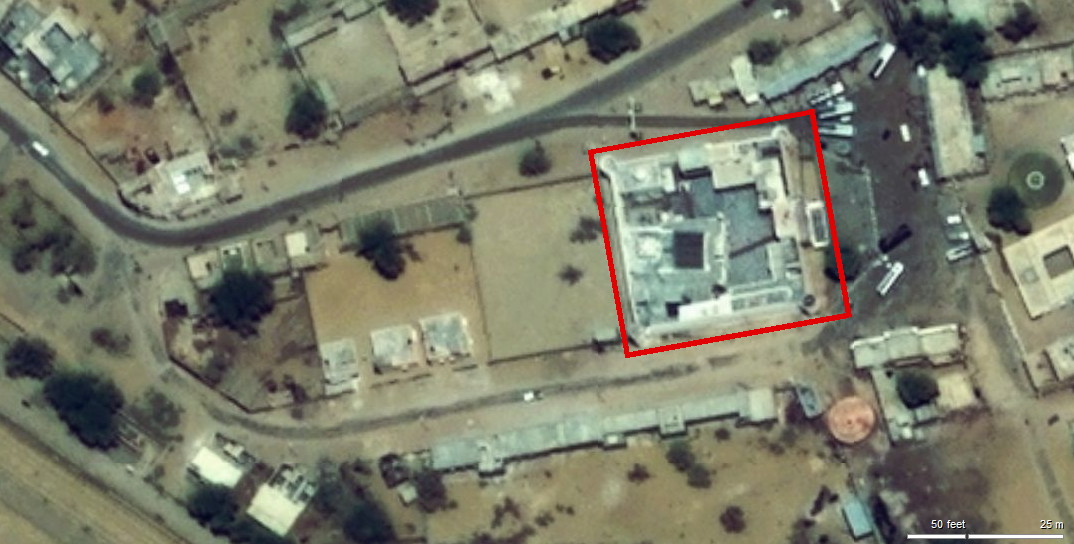
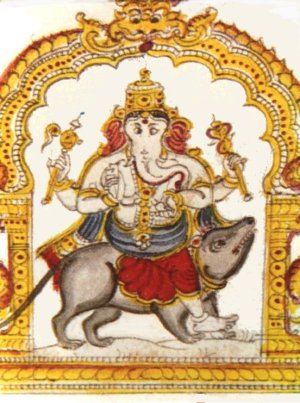
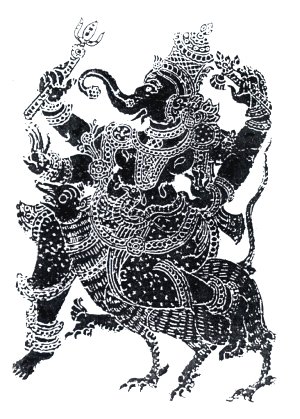
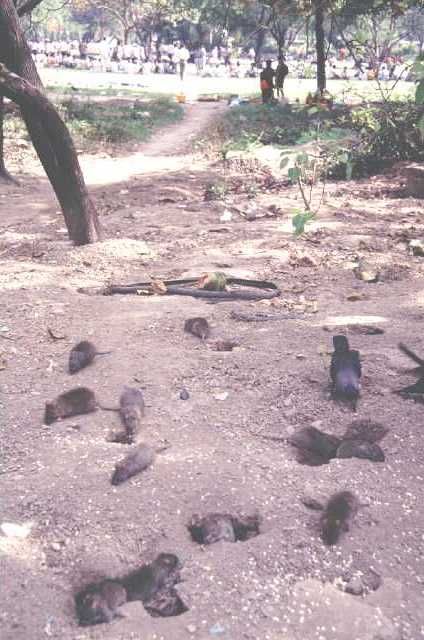
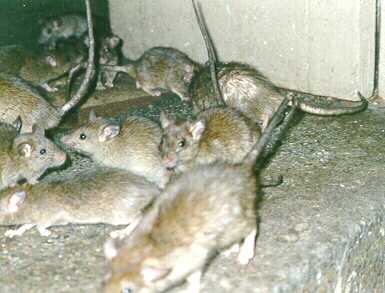
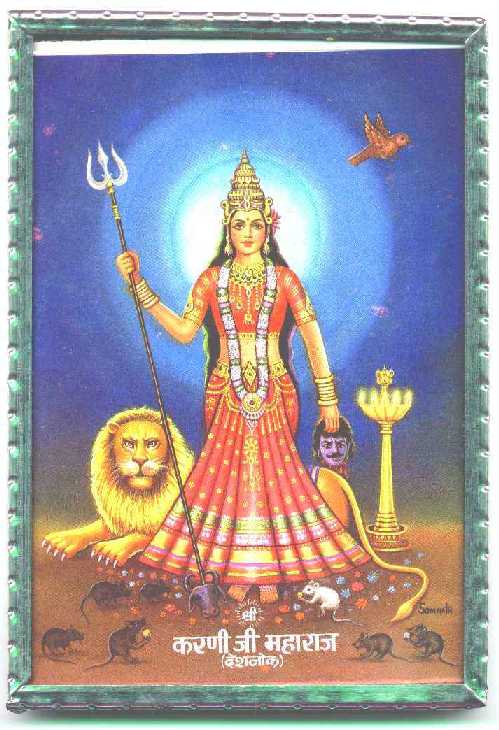
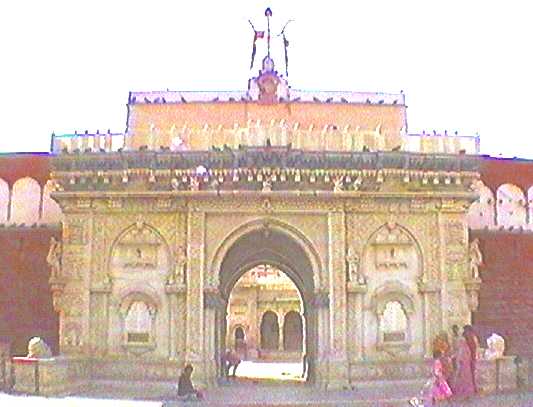
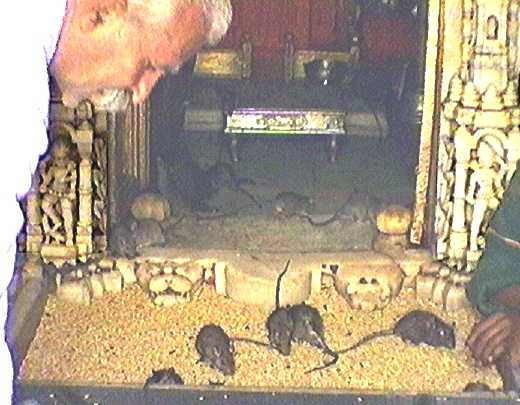
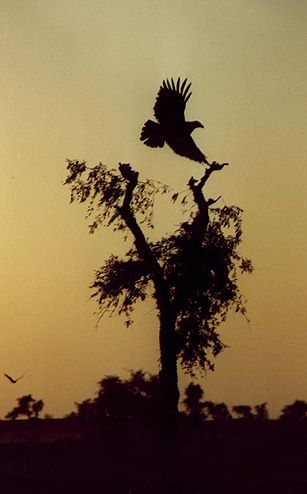
Photograph of painted rondel showing Ganesh and his rat eating laddus is from the Invocation page of Repainting the Past: A Golden Jubilee Exhibition Of Post-colonial Indian Miniatures. This exhibition, of mid to late 20th C religious miniatures/illuminations painted in Rajasthan in traditional mid-18th C style, was held in 1997 at Saint Xavier University's SXU Gallery in Chicago, to mark the 50th anniversary of India's independence from the Raj. The curater was Michael D. Rabe, Ph.D., Associate Professor of Art History at Saint Xavier University, Chicago. Click on the rondel of Ganesh to read about this particular painting's meaning and history. The rat in Hindu tradition The history of humanity’s treatment of animals normally regarded as pests is unedifying: but Hindus tend to be refreshingly reluctant to harm other life-forms - even ones found raiding the kitchen. This is also true of Buddhism and, even more so, of Jainism (a primarily Indian faith theologically intermediate between Hinduism and Buddhism, which broke away from Hinduism in the 6thC BC). Problems with rodent-born diseases etc. mean that the Indian government officially takes a very dim view of rats, especially following an outbreak of bubonic plague in the 1990s; but Indian villagers still catch marauding rats in live-traps and carry them away from their homes to release them into the wild, rather than killing them, and someone once told me that many Indian sailors regard ocean-going rats more as pets than as pests. South Indian religious art - from Kamat's Potpourri A few of the ancient, indigenous tribes in India regard rats much as Westerners regard rabbits - cute and edible. The Irula (or Arula or Eravallon), a forest-dwelling people related to the Tamil, live (or used to live) in thatched houses of wood, mud and straw in the Nilgiri hills in the south-west of India, subsisting on the produce of the forest and their small gardens. Technically mostly Hindu, they still follow many elements of their own private, local religion, and regularly kill rats and roast them with spices. The Mushahar, whose name even means "rat food" or "mouse food", are another indigenous "ethnic" tribe living in Bihar in the north-east of India, and in neighbouring Nepal. They are poor, regarded as low caste "untouchables", living as landless labourers and sharecroppers and by fishing and gathering wild roots. They regularly eat rats to supplement their meagre diet. Mainstream Hindus, however, tend to at least respect and often like rats the way Westerners like squirrels, as attractive creatures in their own right; and they not only do not eat rats but as far as possible avoid killing them. Rats are said to represent foresight and prudence, as well as darkness (in the sense of "nighttime" rather than evil) and the sense of smell. A rat is the traditional vehicle or vahana of the merry elephant-headed Hindu deity Lord Ganesh or Ganapati, god of new beginnings and of fire, knowledge, wisdom, literature and worldly success. Ganesh is a major power, who may have started out as a Dravidian (aboriginal) solar deity (Richard Carlyon, A Guide to the Gods): gana pati means "Lord of Hosts" and he is also called the Lord of Dharma or natural law. He is also a very popular figure who (unlike most other gods) is recognized and revered by nearly all Hindu sects, and so rats benefit partly by association: "It is a sin to kill the companion of our God" [Amita Roy, of Vasant Kunj, New Delhi]. Exactly how Ganesh, who is portrayed as a very large, fat man with four arms and the head of an elephant, could ride on a rat is never fully explained. When Ganesh is dismounted his mount is shown as about the size of his foot (usually wearing a dinky little rat-sized red saddle-cloth); but when he rides his rat is proportionately as big as a small pony, and it's not clear whether the rat gets bigger or Ganesh gets smaller. Kavi wall mural of Ganapati - from Kamat's Potpourri The mount of Ganesh is most commonly called Mooshika, "Little Hoarder"; and occasionally Mooshikam, Minjur or Akhu. Accounts vary as to whether "Mooshika" is a personal name or a descriptive term ("mousie" - really), and what sex he/she is, though male seems to be the more usual choice - some pictures show him complete with un-rattily tiny testicles. Accounts also vary as to whether Mooshika is a rat or a mouse (but then like the Romans Indians may well regard the ship rat as just a big mouse, which is pretty-much what it is); and, if a rat, whether he is a Norway, ship or bandicoot (large murines of genus Nesokia, not related to the marsupial bandicoots of Australia) rat. Some sources even say that the mount of Ganesh is more properly a shrew: but certainly it's normally nowadays believed to be a rat, or sometimes a mouse. It may be that a major and much-loved deity was credited with riding on a rat's back because rats were already well-liked. Although the rat of Ganesh is there as a symbol of something, he's still portrayed affectionately as a very real, ratty rat, often nibbling from his own private platter of food, and seems to be credited with far more character, and far more active collaboration with his master, than any other vahana except Shiva's white bull Nandi ("Joy-Giver" - probably so-called because of his association with male sexual equipment!). Mooshika acts as his master's agent, venturing into the tiny spaces where his roly-poly rider could never fit, and even as his advizer or co-conspirator. According to one story, Lord Shiva once held a contest to see which of his sons could circle the universe the fastest. Swift-footed Kumari, god of war, set off to race around everything that was; but tubby, slow-moving Ganesh consulted his rat, who told him to circle his parents and then tell them they were the universe. It was for this piece of theological insight/blatant flattery that Shiva granted Ganesh the title "Lord of Auspicious Beginnings". Statue of Ganesh: note wishing-jewel held in the rat's paws. Photo' found on the web, in several locations - photographer unknown, but looks as if it was scanned from a magazine In an article entitled Rats in Hinduism: Ganapati's Rat Karen Yang recounts many legends associated with Mooshika. In one version, he was once a mighty but slow-moving demon whom Ganesh defeated in battle: he offered to become Ganesh's faithful servant if the god would only turn him into the most agile creature on earth, so Ganesh made him into a rat (a ship rat, presumably). Ganesh is Lord of Obstacles, both placing and removing them: and he and his rat make a perfect team for the removal of obstacles; since those which don't respond to being charged and battered, elephant-style, can be gradually ground away by the rat's teeth. Mooshika makes sure his master remembers the tiny things as well as the large, down to the smallest atom: and he is the guardian of the Wishing Jewel. This magical gem granted its owner his or her every wish, and thereby corrupted its human wielders into greed and power-mania: so Ganesh gave it into the keeping of his rat because the wishes of a rat - food, sex, companionship and safety from predators, a little territory to play in, a warm nest to sleep in - are pure-hearted, homely and harmless. [This particular bit of the mythos suggests Mooshika is a Norway rat - since the wishes of male ship rats tend to include world domination and getting to urinate on absolutely everybody.] Curzon Park, Calcutta: photo' by Mike Meaney Tea in the park... [N.B. this is a Scottish joke. T in the Park is an annual Glaswegian pop-concert.] Calcutta has its own special rat park, located at the northern end of the Maidan, Calcutta's great green complex of gardens and sports-grounds. Curzon Park, a small area of trees and fenced-off patches of greenery, is near the tram terminus and close to the square called Binay, Badel & Dinesh Bag (a.k.a. B.B.D. Bag) at the heart of the city. It contains a large colony of fat and very happy rats. The rats are said to "...take shelter at the base of a statue of a mighty industrialist." Some descriptions say the rats are contained within a wire enclosure, but there's a photograph of it at the Catch Cal Calcutta tourist-site, and it couldn't possibly keep them in - it just seems to be there to protect their burrows from trampling human feet. Writing on the Soul of India travel-writing site, Kenneth Wilson describes their colony thus: "The normally nocturnal disease-carriers [sic] were scuttling about the dusty earth, from which every blade of grass had been scraped away, in and out of the trenches and burrows that made the ground look like a miniature battle field." These rats, who have dug themselves a warren under the trees, certainly aren't Rattus rattus - since they have comparatively small ears and short tails. They could be Norway rats, who build extensive tunnel-systems in the wild, or could be Nesokia indica, the bandicoot rat, which is also an habitual burrower. Local office workers spend their lunch-hours feeding them, exactly the way people in Edinburgh feed the grey squirrels in Princes Street Gardens, except that here there is a religious element. Juliet Clough, writing in The Observer on 8th October 2000, refers to the Maidan's "feeders of sacred rats." Kenneth Wilson likewise quotes a local taxi driver who told him "Don't miss our enormous rats... So many people worship God in this form. It is because Ganesha travels on a rat. So we have the biggest rats, and the biggest rat colony in the world..." This last must be debatable - considering the size of India's own rival colony of sacred ship rats. Mother Karni 20 miles south of Bikaner (pronounced Bickn-air), near Nokha in the province of Rajasthan (which itself is in north-west India, bordering Pakistan), is a small desert town called Deshnok or Deshnoke. Deshnok's best-known feature is a small white marble Hindu temple sacred to Karni Mata, a 14th-15th C female mystic and political figure. Karni is also sometimes called Karani Mata or Karniji ("Mata" means "mother"; "ji" is an all-purpose honorific signifying respect). She is believed to be an incarnation of the goddess Durgha, "The Inaccessible" - a striding warrior-woman manifestation of the Divine Mother Devi-Ma. In some stories Durgha is the mother of Ganesh, although this is more usually attributed to Parvati, another aspect of Devi-Ma. Karni Mata is revered by the local people, the Charans: a tribe who traditionally were pious and peaceful bards, writers, traditional storytellers and genaeologists. Because - like most bards in most cultures anywhere in the world - they produced panegyrics in praise of their masters, they are regarded in some circles as archetypal sycophants, but this is almost certainly unfair. In the best bardic tradition Charan bards seem to have been quite capable of being obliquely but devastatingly rude about their masters when the occasion warranted - and they were considered to be so effective at laying curses that they used to accompany armies in order to hex their opponents. It is reported that Charans threaten defaulting debtors thus: "Pay what you owe me, or I shall starve to death on your doorstep and haunt you forever." A photo'-essay by photographer Jeff Rotman, which appeared in the British broadsheet paper The Observer on 18th February 1996 to mark the Chinese New Year of the Rat, refers to them as the "poet-king" caste. The daughter of Meha Ji Kiniya (father) and Dewal (mother), Karni was born on 28th September 1387AD at a village called Suvap, in the Phalodi tehsil [a tehsil is an administrative sub-division of a district] of Jodhpur, and was married to a man named Depa. The foundation of Deshnok was laid by her on Baisakh Sudi Dwitiya Samvat 1476 - that is, on the second lunar day (Dwitiya) of the first fortnight (Sudi) of the lunar month Baisakh (13th or 14th April to mid-May) in the Samvat (year of Vikram Samvat calendar) 1476. The Vikram Samvat calendar is 57 years ahead of the Gregorian one, so this would be 15th or 16th April 1419AD. Goddess Durgha slaying a demon - from Kamat's Potpourri: the griffin-head of the lion probably means this image is from eastern India or Bengal Karni was an ascetic who dedicated herself to serving and uplifting the poor and downtrodden of all communities, and made Deshnok a sanctuary where those accused of crimes could seek asylum and absolution (so far as I know it no longer serves this function). She also used her influence to reduce the exploitation of women by the Mughal emperors. According to RealBikaner.com she witnessed the accession of three consecutive generations of royal rulers, Rao Ridmal, Rao Jodha and Rao Bika, and was instrumental in enabling them to come to power. All three sought her advice for their troubles: Rao Bika in particular asked her advice, and followed her instructions, on every important issue, and sought her blessing before conquering the city which he seized and re-named Bikaner in 1486AD - at which point Karni would have been nearly 100. According to Exquisite India: "Taking offence at a stray comment that his father made, [Rao Bika] left with a small band of horsemen to set up his own kingdom in the desert of the north. Spurred by the blessing of a great female mystic, Karni Mata, whom he had met along the way and who had predicted that his fame and glory would someday exceed that of his father, Rao Bika fought the local desert clans for thirty years, and ultimately carved out a kingdom approximately the size of England." This suggests Karni made her prediction, and launched Rao Bika on the road to glory, in the mid 1450s when she herself was about 70 - which seems more probable. However, legend says she actually laid the foundation-stones of the forts of Jodhpur and Bikaner, which implies she was indeed still around and operational when Rao Bika seized and began re-building the city in 1486. Indeed, some versions of the legend say she lived to be over 150 - which is unlikely but not totally impossible, since in many mammals the maximum recorded age is a bit over twice the normal age at death (cats normally live to be about 15 but the oldest cat on record was 36; horses normally live into their mid to late 20s but the oldest horse known was 63; Norway rats normally only live around 28 months but the oldest known was over 7 years, and so on). The Garbh Griha or sactum sanctorum of the temple at Deshnok is also reported to have been founded by Karni herself. There are temples to Karni in Jodhpur and Bikaner as well, but Deshnok is the centre of her cult: it was her main base of operations when alive, and it still is. She is believed to have had divine powers, and became a goddess to the Charans and a patron deity to the rulers of Bikaner. It is said that she arranged Rao Bika's marriage with the daughter of Bhati Rao Shekha of Pugal, and since the ceremony required that the girl's father be present, and since he was at that time in prison in Multan, Karni flew to his prison in the form of an eagle and fetched him to his daughter's wedding. It is also said that when Karni churned curds using wooden implements the dead, dry wood sprang to life again and became growing vegetation. KarniMata.com says that Karni stuck a dry stick in the ground about a mile west of Deshnok and sprinkled curd on it and it sprang to life and grew into a tall evergreen tree, under which she used to sit; this tree still lives, and at its foot is a statue of Karni and a small shrine called Shri Nehriji, a photo' of which can be seen at KarniMata.com. Her cult is associated with a benign "green" attitude to nature, and acording to RealBikaner.com Deshnok has its own oran, an island of vegetation set aside by the Bishnoi people of Rajasthan (described as "the first environmentalists") for worship under community protection and management. No trees may be cut in the oran. Although she is called "Mother Karni", and some aspects of her legend portray her as a sort of vegetable-fertility deity, the legend also says that she never had sexual relations with her husband; instead encouraging him to take a second Charan wife, from whom many of the townsfolk of Deshnok are descended. According to KarniMata.com it was her own younger sister, Gulab, whom she advized Depa to marry: Depa and Gulab had four sons called Naga, Puna, Shitha and Lakhan, who became the ancestors of the Charans - who are therefore Karni's great-to-the-nth nieces and nephews. To my mind the mere fact that this detail doesn't seem to "go" with the rest of the legend makes it more likely to be true. What is not clear, 600 years down the line, is whether Karni desired sex but rejected it for some reason connected with her mysticism; or did in fact have sex but was sterile; or didn't fancy men in general (or her husband specifically) anyway; or had had an off-putting experience (such as watching a close relative die messily in childbirth) - or whether, like Elizabeth I whom in some respects she seems rather to have resembled, she just felt that pregnancy and lactation would cramp her political style. The lady of the rats Charan priest with rat relatives, sitting in the left side of the antechamber of the inner shrine (position #8 on floor-plan): photo' by and courtesy of BBC wildlife-photographer John Downer Photo' by Kees van Duyn, a.k.a. duke0123 However, in another sense she had plenty of children - tens of thousands of them. Karniji's temple at Deshnok is home to (at peak population) more than 20,000 little Rattus rattus, who swarm all over any proffered food, and sometimes over humans (ones they know, anyway), in the manner of the pigeons in Trafalgar Square. Male and female rats in that area are called chuhas and chuhiyas - but the rats of Karni Mata are called kabas, Marwari for "little children", and if a visitor accidentally treads on and kills one (which is made less likely by the fact that visitors are required to take their shoes off before entering - though socks are permitted), he or she must atone for the death by presenting the temple with a lifesize model rat made of solid gold (according to most sources - though The Observer says solid silver). Visitors say that most of the time - in the heat of the day, anyway - the temple compound isn't obviously heaving with rats, except in the inner courtyard. At first glance you see only a few: but the more you look the more there are, and every shadow is full of eyes and tails. Rats drinking milk by cloister cupboard and lurking under it (position #13 on floor-plan): photo' by Adam R Lee The Indian Patriots Council has a long but not very sympathetic (in that it regards devotees of the Karni Mata cult as gullible fools) article about the rat temple. It states that: “Legend has it that rats have been revered ever since Karnidevi’s ["devi" just means "goddess"] stepson Laxman drowned in a tank and Yama, the god of death, refused to concede her request for Laxman’s rebirth, saying that he had already been reborn as a rat. Instead Yama promised her that from then onwards her male descendants would be born as rats in her temple at Deshnok. And once they give up their life as rats, they would be born again as human beings in the family of Depavats, as her descendants are known today. The rats here are sacred as they are regarded as incarnations of Karnidevi’s descendants. Altar and entrance to inner sanctum at Deshnok, seen from antechamber (position #8 on floor-plan): photo' by Mark Harris "The temple is looked after by the Depavats. There are 513 Depavat families altogether. The male members of these families take turns as priests, following a centuries-old tradi¬tion. And all families get an equal share of the offerings at the temple. Ten per cent is kept apart for the needy among the Depavats. 40 per cent of the rest is divided among the 513 Depavat families and the rest kept in a fund that is used for the temple’s upkeep and developmental works." According to another site, the portion of the offering which is distributed to the priests and workers is called Dwar Bhent, and that which goes on the maintenance and development of the temple is called Kalash Bhent. The Observer says that there are more than 700 families of the poet-king caste, and that every month a priest is appointed from one of them. During his tenure he lives day and night with the rats. There seem to be a number of slightly different versions of the story of how the temple rats became sacred, though all agree that they are vessels for human souls. In the version quoted above Yama/Death comes across as being quite helpful and on good terms with Karni Mata. But according to the above-mentioned February 1996 article in The Observer, the dead child was Karni's own son and called Lakkan (according to other sources Lakkan or Lakhan was both her stepson and her nephew); what she had asked for was not his rebirth but that he should be revived as Lakkan, in his original body, but this could not be done because his soul had already passed on very rapidly (which makes more sense both of what Karni was asking and why it couldn't be done) and been reborn into a rat; and in rage she swore that all her descendants would henceforth pass into rats when they died, and never spend time in Yama's kingdom. Yatraindia likewise gives a version in which Yama and Karni Mata appear to be at odds, although in their version the lost child is not presented as a close relative of Karni's, and has already been re-born not as a rat but as a human: Icon of Karni Mata, with rats: photo' by Francoise Cooperman "Apparently Karni Mata once tried to restore a dead child of a storyteller back to life but failed, as Yama, the god of death had already accepted his soul and re-incarnated him in human form. Karni Mata, famed for her legendary temper, was so inflamed by her failure that she announced that no one from her tribe would fall into Yama’s hands again. Instead, when they died all of them would temporarily inhabit the body of a rat before being reborn into the tribe. Hence the mousy creatures... are considered to be incarnations of storytellers and are much revered." [It is probably this "legendary temper", combined with the fact that she seems to have acted as a military as well as a political adviser to the local rulers, which caused Karni to be associated with weapon-wielding Durgha rather than with one of the more placid, fertility-and-vegetation aspects of the goddess.] Similarly, a page (no longer in existence) which used to depend from the allindia.com website reports that: Carved tablet in small shrine at Deshnok temple, with rat (position #16 on floor-plan): photo' by Francoise Cooperman "IN heraldic Rajasthan, genealogy is the warp of life and so the Bhatt and Charan bards are respected as keepers of racial memories. The bards, in turn revere a woman who was a mystic and is now worshipped as Karni Mata. In the temple of Karni Mata in Deshnok many believe that the Charans are reincarnated as holy rats who scamper and squeek and nibble around the trident-wielding image of Karni Mata enshrined as the Mother Goddess Durga. The reincarnated rodents are an answer to a boon granted to Karni Mata. Her clan never descends into the kingdom of the god of death, Yama, but waits out its time till next human life in the bodies of these rats, secure in her protection." However, The Rat in the East (which also seems to be no longer extant) gives a somewhat different version, saying that: "During Karni Mata's life a terrible fever came upon the land and thousands of children in the area died. The parents came and begged the goddess to ask the god of death to give their children back to them. The negotiations led to a compromise. For each offering to a rat, a child would be reincarnated in a rodent." Despite these different versions of how the kabas came to have human souls, there seems to be a general agreement that this interim incarnation into rats ensures that Charans will always spend their human lives as Charans, rather than being reborn into other peoples and places. Theologically, I suppose the temple rats are seen as a sort of holding area where dead Charans can wait until another Charan body becomes available - without ever having to face the judgment of Yama or take the chance of ending up in Heaven or Hell. This is rather different from the mainstream Hindu belief in incarnation into a wide variety of human and non-human bodies and locations, according to one's accumulated karma: if the Charans believe in karma in the usual Hindu sense, then evidently they don't mean to have much to do with it. This may indicate that their unusual belief-system predates Karni, and perhaps Hinduism itself. It's not clear whether the Charans believe that all the temple rats have been and will be human, or only some of them: but they certainly believe that any given rat at the temple might be a fellow Charan. And the Charans do sound like the sort of people ship rats would be, if they happened to be reborn as primate people rather than rodent people. The shrine of Karniji Entrance to temple compound at Deshnok: photo' by Francoise Cooperman Yatraindia describes Shri Karni Mata ("temple of Karni Mata") thus: "The temple itself was erected by Maharaja Ganga Singh in the early 20th century [sic - in fact the inner shrine is mostly 16th C] and is built in the late Mughal style. The entrance to the temple complex has beautifully sculpted marble panelling, with intricate patterns, a tribute to the fine workmanship of the artisans who constructed it. It is lavishly decorated, especially the delicately worked doorways, colonnades, pavilions and balconies. Petalled domes rise over the sanctuary. The sanctum sanctorum of the temple depicts Karni Mata resplendent in her arrogance after slaying the buffalo-demon Mahishasura. Her inverted trident depicts the head of the demon impaled at one end." Ganesh with rat feeding from dish, from silver doors of shrine: photo' by Francoise Cooperman This militant statue is elsewhere described as being the work of a blind sculptor and being 2ft tall or a little over, standing on a 3" platform. Actually a bas relief panel rather than a free-standing figure, it is dark orange-red and shows Karni Mata adorned with earrings, with a garland round her neck and wearing a strange tall crown, narrow at the forehead but with a wide brim around the top, capped with gold. In her right hand she carries a trident, points upwards, with the severed head of the buffalo-demon impaled on the butt end; from her left hand the severed head of a manlike demon dangles by the hair. Karni Mata flanked by smaller statues: photo' by Francoise Cooperman The sculptor seems to have been ambiguous about whether to portray Karni as a mortal woman or a goddess: the statue shows her carrying Durgha's weapon and having slain demons that Durgha slew, but with the two arms of a flesh-and-blood woman rather than Durgha's usual eighteen. Perhaps because the sculptor was blind, or perhaps because it is very old, the statue of Karniji does not have the sinuously ornate look one associates with most Hindu art: instead it has the stark simplicity of an archaic, early or pre-Mediaeval European figure of the Virgin. Karni Mata surrounded by rats and a pigeon, from silver doors of shrine: photo' by Francoise Cooperman She is flanked by seven smaller statues, which appear from photographs to be bizarrely-carved stump-like red blocks, and are variously described as either all sisters of Karni Mata, or as Karni Mata's sisters and the sisters of Avad Mata. These seven small statues are presumably a variation on the Sapta Matrika, the Seven Mothers venerated in rural, village Hinduism. Now usually regarded as the consorts and shakti or female energy of the major male gods, these were originally rather ambiguous and sinister figures, believed to be both the bringers of potentially fatal childhood diseases and the powers appealed to for prevention or cure of those diseases: not so much the Seven Mothers as the Seven Baby-Snatchers, they liked children so much they came and stole them away. Avad Mata may be a female personification of the localized land-soul of the area between the Ganges and Jamuna rivers, called Avadh or Oudh - in the same way that Kathleen, the Daughter of Hoolihan is a female personification of the land-soul of Ireland. Or she may have something to do with the actual meaning of the word avadh, which is "boundary" or "limit". The temple complex The temple is also known as Madh. This word has several meanings including "mother" and "madam", and seems to be added as a suffix to temples associated with mother-goddesses. One source says that shrines to Durgha are called madh, and GujratiInfo.com says that “…the Shakti cult, which existed during the prehistoric times… had… a ritualistic dance for fertility, wherein an unfertile lady takes a small wooden structure of temple called ‘madh’ on her head and dances in the middle encircled by other ladies.” Yatraindia's reference to the temple having been built in the early 20th C is misleading. Other sources say that the inner sanctum was begun by Karni Mata herself (i.e. in the 15th C) and completed in the 16th or 17th C, and the rats have been living there ever since. The main building-work on the outer, larger temple was done in the 19th C, though it may well not have been finished until the early 20th C. Approximate floor-plan of temple, based on Google maps' aerial view and on a sketch by Francoise Cooperman. Areas shown in grey are roofed over: areas shown in white are open to the sky. The interior of all or most buildings is barred to tourists 1: Main entrance 2: Curtain-wall, painted red or pink 3: Marble lions 4: Silver doors 5: Entrance to inner temple 6: Corner pillar 7: Chequered inner courtyard 8: Antechamber 9: Inner sanctum and altar 10: Raised cloister 11: Bannister 12: Brick barrier holding grain & box 13: Milk-dish & box on bricks 14: Ornamental fence 15: Shrine 16: Small shrines with red tablets 17: Large shrine building 18: Statues and area of bare earth 19: Functional blocky building 20: Building with veranda & steps 21: Large bowls and water-pots 22: Long building with balcony 23: L-shaped verandas 24: Diagonal step up 25: Shrine & yellow building 26: Shrine 27: Small shrine 28: Ornamental railing Silver door on right side of main entrance (somewhat distorted by the lens: the left side should be straight): photo' by Francoise Cooperman Lion on right side of main entrance: photo' by Francoise Cooperman Entrance to inner temple, seen from main gate: the top of the dome over the inner sanctum can just be made out at the back of the temple. The facade of the temple has three arches on either side and terminates in pillars to left and right, here blocked from view by the archway. Photo' by Francoise Cooperman The main entrance, which somewhat resembles Marble Arch, is set in a long curtain wall which surrounds the compound and gives it rather the appearance of a small fort: especially as it has squat hexagonal towers at the corners. The front face of this outer fortification is brightly painted, sometimes terracotta and sometimes pale raspberry pink. The entrance is flanked by two lifesize white marble carvings of Durgha's mount, an Asiatic lion (though some sources say she rides a tiger): both lions are portrayed lying down, the one on the left with his head resting on his paws, and the one on the right with his head raised. The massive main doors are of silver embossed with geomotric patterns. These plain, geometric doors are in keeping with the Mughal style, which is Islamic in origin and therefore avoids representations of living forms: although the marble around the doors is richly carved with figurative images of humans, elephants, rats and roses. An excellent article from The Tribune newspaper of India says that: "The main entrance is in fact a beautiful piece of architecture. The carving is tasteful and ingenuous. The qualified craftsmen have chosen white marble on the entrance gate. Intricate patterns with white marble clearly exhibit the fine workmanship. "Amazingly one row of kabas (rats) running from base of entrance across the entire structure can be seen on the main entrance gate. They are shown in uniform size except on the upper portion where rats bigger in size have been shown with downward faces. The master craftsmen have woven the artistically intricate pattern in such a manner that a closer look is required to recognise the kabas (rats) in white marble. Architecturally, the entrance is nicely proportioned as befits the dignity of the holy shrine. Entrance to temple compound at Deshnok: photo' by Francoise Cooperman. There is a decorative border of tiny rats - mice, really, from their size - carved around the edge of the entrance, but they are too small to see on this scale. "As you enter inside from the main gate there is an open space. The floor is made up of bricks except the area near to the sanctum sanctorum which is made up of white grey marble. The floor is oily at some places. Small pieces of sweetmeats, rice and prasad [vegetarian food offered to and blessed by a god] is seen scattered at several places. Large number of rats scuttle in groups and devour food on the floor. Rat drinking from water-tub by bare ground in front of statues (position #18 on floor-plan): photo' by Francoise Cooperman "On the right corner three pots full of water are kept. The rats take water from these pots. The leftover water is considered as holy water and is used like Charanamrit [water or milk used to wash the feet of an idol or saint, and believed to have great healing and spiritually renewing powers] by the devotees." [A close-up photograph of some of the carving around the gate, showing the crispness and delicacy of the workmanship, can be see at Travel Jini.] The Tribune says that within the red wall the main open-air compound is floored with brick, except in areas near the sanctum sanctorum where the floor is of grey marble: but this is either out-of-date information or linguistic confusion. Photographs show that most of the compound is covered with squares of pale pink marble separated by narrow bands of dark grey stone, apart from a couple of areas which have been deliberately left as bare ground. Facade and entrance of inner temple: photo' by Frédéric Hemmer, from his French-language site L'Inde en 1001 Photos. The original photo' was very much distorted, as is common when a large building is, of neccessity, filmed from very close up: this version has been straightened up using Adobe PhotoShop, but is still a little lop-sided in places. Facing the main gate and slightly to the left is the entrance to the temple proper, which is made of intricately worked white marble and is at a 12° angle to the outer walls. The front part of the temple is more or less square and flat-roofed, like an iced wedding-cake, very roughly about 60ft to a side, with a square central well edged with a balustrade: this well is open to the sky but covered with a strong metal grid to keep out birds of prey. The floor of this well is a courtyard, flagged with chequerboard black and white marble slabs. Behind this section, the shrine itself extends back to the curtain wall. The entrance to the temple and the entrance to the shrine itself face each other across the chequered courtyard, with a double row of ornamental bannister (described by Francoise Cooperman as "an open metal waist-high fence with a round, metal, red-painted top rail") running across the courtyard, funnelling pilgrims into the entrance to the shrine. In the heat of the day the rats roost in the loops of this bannister, and of the ornamental fences which decorate some of the shrines; apparently appreciating the air circulating under their bellies, and oblivious to the hordes of humans tramping past on either side. Courtyard of inner temple: note part of bannister showing at bottom-left, and red grain-box standing in the covered cloister at middle-right, with a niche in the back wall just above and to the right. Photo' by Francoise Cooperman The other two sides of the courtyard are lined with covered cloisters, edged with white, elaborate arches and pillars and with a raised floor flagged with soft-grey, veined marble. There are five arches to a side: for every archway there is a square niche halfway up the back wall of the cloister, except the centre arch on the right which leads to a passageway to the outside, and the front-most arch on the left, which frames a doorway into the interior of the building. The ground the temple stands on is evidently slightly sloping, as the difference in height between the floor of the courtyard and the raised floor of the cloister is several inches greater at the front of the courtyard than at the back. On the front face of the inner temple, facing towards the main gate on either side of the entrance which leads to the courtyard, are similar, shorter cloisters, each consisting of three pillared arches with their square niches at the back. These fill the space between the entrance itself and large hexagonal pillars at the corners of the temple. The entire temple is carved with flowers and leaves, geometric patterns and elegantly calligraphed texts. In fact in some respects it reminds me of the 15th C Rosslyn Chapel in Scotland - but Shri Karni Mata is more restrained, and doesn't look quite so much as if somebody ran amok with an icing-bag. The cool, geometric Islamic Mughal style has been combined with Hindu religious requirements, to very good and elegant effect. Rats around the grain-box with its brick barrier (position #12 on floor-plan) - photo's by Francoise Cooperman As you stand in the courtyard facing the entrance to the shrine, the cloister on the left contains a large dish of milk for the rats, and several boxes of various kinds, including a tatty-looking brown metal cupboard which they love to lurk under. Against the wall nearest the shrine is a legless red box lifted off the ground on bricks: this played a starring rôle in the BBC series Lifesense, when photographer John Downer placed a camera under it to film the rats on their own level. At the far end of the cloister on the right, against the wall nearest the shrine, is a red metal box on legs, with a thick layer of grain lying around and underneath it. This is surrounded by a single row of bricks, which stop the grain from spreading all over the floor. There are several of these red metal chests on legs scattered around the temple: but only this one stands in a sea of grain. The entrance to the temple/courtyard forms a fairly long passage, with a sort of secondary door-frame halfway down it, with a red-painted relief of Ganesh above the lintel and a pair of embossed silver doors. At the entrance to the shrine itself, facing across the courtyard and between the rows of bannisters, is a second pair of ornate silver doors. These pairs of temple doors are less geometric and more figurative than the doors of the main gate, being embossed with images of deities associated with rats - Karni Mata surrounded by a pack of stylized ratlets, Lord Ganesh with his rat feeding from a dish beneath his couch - surrounded by borders of flowers. The courtyard and shrine doors show the same scenes, treated slightly differently, with the work on the shrine doors being finer and more realistic. Each door has a central boss in the form of an animal-head with a large ring in its mouth, presumably used as door-handles: the doors to the courtyard have lion heads, and the doors to the shrine itself have elephant heads. Statue of Karni Mata, based on various tiny, fuzzy photographs and on video by Francoise Cooperman - with rat to scale Beyond the silver doors to the shrine lies an antechamber where pilgrims congregate in front of an altar in the form of a shallow tray, set into the top of a platform about 10" high. Behind the altar golden shutters open on a window into the sanctum sanctorum, where the statue of Karni Mata stands framed by a canopy and panels of gold, and with a curious object like a golden flying saucer suspended above her head, hung with a fringe of tinkly gold leaves. The statue itself is a deep orange - probably pale stone stained with vermillion paste, which Hindus commonly use to decorate holy images - and stands on a platform which looks as if it is covered in silver: in front stands a small, low silver table with a lion embossed on the front edge. To the left of the altar is a small, dark doorway which leads into a passage which passes down the side of the inner sanctum and around behind it. Altar and window into inner sanctum - photo' by Francoise Cooperman The edge of the altar nearest the sanctum is decorated with what looks like a stylized serpent's head and tail, or possibly two tiger or lion heads one of which is badly damaged, carved from creamy stone. Immediately in front of the altar, on the floor of the antechamber, is a long low black-painted, padlocked metal box with handles. The rats are fed grain from the tray-like top of the altar, and sweetmeats from dishes placed on the metal box and on the antechamber floor in front of it. The walls of the antechamber are decorated with images of Karni Mata and of rats. Francoise Cooperman reports that on entering the antechamber worshippers ring a bell which is located behind the left-hand silver door, chant a few words and then repeatedly touch the floor, pictures and statue. She saw people reach into the inner shrine but did not see anybody actually inside it. Pilgrims then enter the small dark doorway to the left of the altar, which leads into a passage which goes round behind the inner sanctum. They emerge into the courtyard from an opening to the right of the entrance to the antechamber. [Angela Clarence reports that the narrow passageway is rather smelly; this is not surprizing since the rats not only live but also, presumably, die in their own passages through the walls and under the floor.] Tourists are not normally allowed to enter the antechamber and pass round behind the inner shrine, but are sometimes permitted to do so if the temple has few visitors; and according to Bhaskar Gupta at karnimata.com worship of Karniji is permitted to all sexes, tribes, religions and castes. According to The Observer only rats and priests may enter the inner shrine, the sanctum sanctorum itself; but this is contradicted by other accounts which speak of pilgrims bringing children to sit at the feet of the statue etc. - since the statue is in the inner sanctum and seems to stay there. If The Observer is correct it may be that these children really sit out in the antechamber, by the altar - or it may be that only pilgrims who are also Charans, and therefore of the priestly caste if not actually priests per se, are allowed in. North-west corner of compound to rear and right of main temple (positions #14 to #20 on floor-plan): note anti-hawk netting, and shrine with red tablet at centre, and the shadow of the inner temple with its corner pillar. Photo' by David Montouroy Above the sanctum sanctorum a small white turret like a separate shrine, with a red door opening onto the roof and an ornate, petalled dome, protrudes from the otherwise mainly flat roof of the temple (a rather fuzzy photograph of the temple roof can be seen at the India Travel Promotion Network site). This dome and others around the site are roofed with silver and gold. The roof of the sanctum is uncemented, made of logs of jal wood. The outer curtain wall surrounds a lot more than just the temple, but the rest of the complex is somewhat less beautiful. In her article The Sacred Rats of India Francoise Cooperman describes the other areas of the compound thus: "...most of this area was rather run down. It was comprised of an odd combination of statues, small shrines, enormous brass bowls, and buildings which were painted in very bright colors ranging from hot pink to bright sky blue." Rainer Stalvik by statues and ??washhouse?? on right of compound (positions #18 & #19 on floor-plan) - note water-tub Some of these outlying areas of the temple compound have no finished floor, the surface being bare earth and a few broken stone slabs. However, the complex as a whole is kept fairly clean - fortunately, since visitors have to go barefoot - though there are some splendid centuries-old build-ups of black, acrid ship rat scent-marking grease. One visitor did report finding the floor suspiciously sticky: this is not neccessarily rat-urine, as they seemed to assume, but may have more to do with the rats' habit of walking through dishes of milk, sugar, vegetable curry etc. and not wiping their feet. Large bowls (position #21 on floor-plan), with water-tub by stairs at extreme rear of shot; rats, pigeons and spectators: photo' by David Montouroy Inside the front wall of the compound, to the right of the main entrance as you enter, is a covered veranda with a gap between it and the inside of the wall: in this lighted strip close to the wall there is at least one small shrine, surrounded by an ornamental railing. At the far end of this veranda, in the north-east corner ofthe shrine, is an area with a floor of bare earth, old beams and broken flagstones, containing enormous overturned bowls and heavy tubs like sections of barrel, which seem to be the water-dishes mentioned by The Tribune. The giant bowls (at least one of which is the size of a small rowing-boat, appears to be made from old, dark bronze and is so heavy it is covered with metal rings to use as carrying-handles) look as though they might be something left over from before the present temple was built. Statues on right side of compound, and strange blocky building with washing drying down the side of it (positions #18, #19 & #20 on floor-plan) - note corner-pillar of temple. Photo' by Francoise Cooperman, taken in 1998: the building with the veranda (#20 on the floor-plan) had been repainted with green pillars and balcony by the time David Montouroy took his picture of the same area. Along the right or north side of the compound is a large building, with a pillared veranda at the front and a stairway to the right. Left of that is a curious blocky little building which may be the priests' washhouse (since Francoise Cooperman's video shows someone's washing hanging on the line down the side of it!), and beyond that is a group of four statues with elaborate carved drapes. In front of the statues is an oblong of bare ground - probably scattered with grain and/or food-offerings to the statues, to judge from the interest the rats and pigeons take in it. Small shrines along back wall to right of temple (position #16 on floor-plan): note anti-hawk netting, and baby rat sitting on top of foremost tablet (as seen in a previous shot). Photo' by Francoise Cooperman. At the back wall, to the right of the temple proper, are shrines of various sizes - a very large one on the right with a triple-arched entrance and a medium-sized one on the left, both with a raised marble platform in front, and between them an ornamental fence and a walled enclosure containing two tiny shrines - mere stone boxes to hold images, rather than actual buildings - containing red, carved tablets, probably stone stained with vermillion. Aside from the putative washhouse, all the buildings to the right of the temple are higher than the marble flags, with three or four steps leading up to them. Building with veranda to left of main entrance, as seen from inside the temple courtyard (position #23c on floor-plan, seen from position #7): photo' by Francoise Cooperman Along the front and part of the side walls of the compound to the left of the temple is an L-shaped painted building, fronted by a veranda at the top of a shallow flight of steps. The pillars which support the roof of the veranda are absolutely plain in shape, but the whole building and veranda is decorated with strong, bright colours. Along both legs of the L, regularly-spaced red doors open on a variety of odd interiors: a steep stair; a dark, rough-walled, rat-and-pigeon-haunted room. Left side of front of temple, with three arches and corner-pillar; building with veranda; long building with balcony and small shrine down side of temple (positions #22, #23b, #24 & #25 on floor-plan): note diagonal step up between veranda and pillar. Photo' by Francoise Cooperman. Beyond the veranda is a similar painted building, without the veranda but with the regularly-spaced red doors, plus a first-floor balcony, extends along the rest of the left-hand wall. This looks as though it probably contains living-quarters for the resident priest(s). In the triangular space between this building and the side of the temple are a smallish shrine aligned parallel to the temple proper, and then further back close to the outer wall are a medium-sized shrine containing two red tablets, and a slightly larger building which is painted yellow (or was in 1998) and seems to serve some purely practical purpose, since it looks too scruffy and un-cared-for to be a shrine. Rather than these buildings being accessed from steps, the entire flagged floor of the compound is higher in this area, with a step up running diagonally from the corner of the veranda to the corner-pillar of the temple. This confirms that the ground the compound stands on is higher at the back than the front and, probably, higher on the left than the right. Rat peering from one of the built-in holes around the edges of the courtyard: photo' by Francoise Cooperman Ratty royalty The temple itself has been designed for the rats' convenience, with built-in holes for them to scamper in and out of: some leading under the floor of the courtyard cloister, tucked in under the marble leaf-pattern around the edge of the raised floor; others piercing the base of the wall at the back of the cloister itself. A net of bronze mesh covers the whole compound to keep off birds of prey - said to have been erected after a Maharaja of Bikaner, probably the same Ganga Singh who built most of the present temple in the 19th and early 20th Century, had a vision in which the goddess herself asked him to protect her rats. Some of the rats use it as a hammock. The inner shrine (or the whole temple - the description wasn't clear on that point) has been made without mortar, so the rats can lurk in the gaps between stone blocks and structural timbers. They eat out of silver dishes on a marble floor, or from a platform under a golden canopy, while priests chant hymns and play cymbals. Post-colonial Indian religious miniature in traditional style, from Repainting the Past exhibition. Note rat on floor near couch, complete with tiny saddle-cloth and his own dish of sweetmeats. Click on picture for fuller information. Rats eating laddus in front of altar: photo' by Kees van Duyn, a.k.a. duke0123 The rats are fed milk and coconut (including the fibrous husk, which they presumably use as bedding), fruit, oatmeal and grain, sugar and Indian sweetmeats. At the shrine itself they are offered grain on the altar and, in front of the altar, a plate of yellow, globular, garlic-pod shaped sweets called laddus or modakas, the favourite sweet of Lord Ganesh, and similar sweets made of white paste. Rats being rats, they probably supplement this purely vegetarian diet by knocking off the occasional pigeon on the sly. Rats feeding on cloister floor (position #13 on floor-plan): photo' by Mark Harris Family meal on the veranda (position #23b on floor-plan, with #23c in background): photo' by and courtesy of BBC wildlife-photographer John Downer Elderly woman feeding rats (position #23a on floor-plan, by front wall of compound): photo' by Francoise Cooperman Pilgrims touch the ground where the rats have walked and bring them offerings of food: and those whose prayers are answered bring silver and gold. They not only feed the rats, believing it lucky to have a rat eat from their hand, but also themselves eat some of the food which the rats have already nibbled, or sit down and eat with them from the same dish - considering it blessed to share a meal with the "little children" in this way. They seem to do so with genuine affection: not just because they hope Karni Mata will bless them. After all, if the pilgims are from the local area then they believe not only that the rats are their own dead relatives and neighbours, their ancestors and their own children who died in infancy, having a "holiday life" between human incarnations; but that they themselves were rats before they were born, and when they die they will come again to spend a few years as a rat among their past and future comrades, the "little children" of Shri Karni Mata. The reverence shown to the rats does go beyond what one would expect the Charans to show to their human relatives, however. Pilgrims touch the rats themselves and the ground where the rats have walked, as if they are all living icons. Seemingly in their rat form they are all seen as agents and expressions of the goddess: which of course means the Charans believe that they themselves, as humans, have this special relationship with Karni and will pass into her four-legged service between human lives. Creamy-white rat, like the buck Francoise saw: photo' by Rainer Stalvik Catching a glimpse of a white or pale fawn rat is particularly prized - said to be a good augury for spiritual progress, and a promise of life-long luck. Some temple guides say that the white rats are reincarnations of Karni herself. It's difficult to see how this would work, since there are several white rats at any one time: perhaps they mean only one of these rats is Karni or, conversely, that since she is believed to be an aspect of the goddess she can be in several bodies at once. Many devotees go to the temple hoping to see such a white rat before undertaking some important project - perhaps a reference to the rat's association with Ganesh, Lord of Auspicious Beginnings, even though Lord Ganesh's own rat-mount is portrayed as dark grey. Even just having a normal-coloured rat scamper across your bare foot is believed to be lucky - though some pilgrims get rather more contact than that, as an on-heat doe and 15 ardent suitors skid across the marble floor at breakneck speed and swarm up and over them as if they were mobile trees. Colourful characters Rat by grain-bin (position #12 on floor-plan), showing unusually pale tail for a ship rat: photo' by Frédéric Hemmer, from his French-language site L'Inde en 1001 Photos Rats feeding by cupboard in cloister (position #13 on floor-plan): note not only the white or fawn doe but also the pale-sided brown animal to left of centre of the dish, who looks like a chocolate-dilute steel. Photo' by Janet and Chris Beaudin and Susan Romeril Most of the rats at the temple seem to be of the alexandrinus colour, i.e. grey-bellied agouti, generally with the belly not much lighter than the back. Many of them seem, so far as one can tell from photographs, to have slightly paler tails than the ship rat norm - medium grey-brown rather than dark charcoal grey. There are a few steels (grey bellies, brownish-grey, heavily ticked sides and black backs), quite a few who look like chocolate-dilute steels (similar to an alexandrinus, but with the sides obviously a lot paler than the back), and a small number of black (a.k.a. "rattus") animals. Black rats will only be generated when steel mates with steel: and since steels are themselves very much in the minority, it's not surprizing black individuals are rare in this population. This fellow could be a dirty white: he is lurking under one of the bowls at position #21 on the floor-plan. Photo' by Francoise Cooperman There are also a scattering of more unusual variations, such as an even dove grey - which may be black plus a dilution factor. In particular there are the handful of special, doubly-sacred animals collectively described as being white, although most in fact look like pale silver-fawns (a light apricot colour with pink eyes, common in the fancy rat). If they really are albinos then all I can say is that they must be incredibly grubby ones. Fawn or very dirty white rat (certainly with extremely grubby tail) and two probable steels: photo' by Kees van Duyn, a.k.a. duke0123 The normal size of a wild ship rat colony has been estimated - I'm not sure how reliably - as about 600 individuals. Estimates of the size of the temple colony vary from 6,000 to 20,000+, yet the thousands-strong temple rats form a cohesive and exclusive 500-year-old super-pack, neither leaving the temple nor permitting other rats to come in, and there is little or no serious aggression within the pack - though many bucks have minor injuries got in kick-boxing sessions over sex or territory. Predators are also excluded: quite aside from the anti-hawk net, cats are never seen in the temple, nor anywhere near it (though there are plenty of pigeons - appropriately enough, since they are sometimes called "rats of the skies"). It's hard to be sure from photographs, because to some extent apparent differences between the colours of rats in different shots are illusions created by different cameras and lighting, but it does look as if the rats tend to group together by colour: dark agouti with dark agouti; ginger with ginger; steel with steel. If this appearance is genuine it could mean that they tend to seek out their own colour, as has been observed in domestic rats; but it may also mean that the population isn't as homogenous as it appears, and in fact distinct families of rats hold their own territories in different areas of the temple, and tend to stick together more than they mix with other groups. Greasy-looking rats at Deshnok: photo' by Adam R Lee The temple rats are small, but full of vim and vigour. Many have a rather motheaten, greasy coat and a scabby tail - The Observer reports tumours, alopecia and unhealing wounds which it attributes to their excessively sugary diet. However, to a large extent this tatty appearance will simply be because of their unique population demographics. Unlike captive-bred colonies they are allowed to expand and compete indefinitely without any reduction in numbers, and unlike rats in fully wild colonies they live to grow old - whilst still being semi-wild and not having the benefits of veterinary care. The elderly get to dodder on into decrepit old age; and the sick hang around to die or recover as best they may, infecting their pack-mates en route: rather than being picked off by predators at the first sign of slowness. It's not surprizing that they should have a high incidence of minor complaints such as skin diseases ("alopecia" probably equals either extreme age or mange and "tumours" = abscesses) which will be encouraged by crowding - and a pattern of age-related problems unknown in any other free-ranging population. Major epidemics affecting rats elsewhere in India seem to pass them by: to some degree this will be due to being an isolated group but they aren't all that isolated, since they are in contact with both humans and pigeons who come and go freely. The local people believe their plague-free status is proof of their miraculous nature: it certainly suggests they are a basically healthy population. As a group they are good-natured, inquisitive and bold, which likewise suggests that they feel well in themselves. KarniMata.com claims that there is, miraculously, no sign of baby rats at Deshnok: all individuals being of the same size. This is certainly not true - there are plenty of baby rats in evidence, including one in a photo' on the very page that claims there aren't any! - but it is true that the proportion of babies in the population is small. Presumably this means the Deshnok ship rats have the same built-in population-control as Norway rats: when they hit a certain population-density their own pheromones cause most litters to be re-absorbed, resulting in a stable population which stays within its available resources. Cute kid! - photo' by Francoise Cooperman. The afore-mentioned article from The Tribune reports that: "The rats jump and play hide-and-seek. They move freely in groups. If you have something to offer (grain or sweetmeats) these pious creatures shall flock around you. "They are disciplined. If you show love and affection they will respond quickly and won’t hesitate climbing on you. I was told that no case of rat bite has ever occurred in this holy place." The rats show neither fear nor aggression towards humans, since they have never had a bad experience with one, and are cockily confident that they have the right of way. Some will alow themselves to be stroked, at least when feeling sleepy. They happily swarm all over visitors and any interesting bags which look as if they might have food inside, and have abandoned the ship rat's normal nocturnal lifestyle in favour of being awake and alert during the day to greet/scrounge off their guests. They are so bold and inquisitive that they have been known to pick holes in bags in order to see what's inside, and strip the insulation off the cables of camera-equipment. Sacred space Carving at Deshnok temple, with rat: photo' by Adam R Lee Although the rat-temple has become quite famous as a tourist sight, this is a serious, working religious building, equivalent to the sort of Christian chapel which is both a working church and a site of architectural interest, and as such should be approached with respect. Every morning Charan priests perform the Mangla-Ki-Aarti service [presumably the same as mangala-arati, literally "auspicious before-night", a Hindu service performed before sunrise and usually involving chanting and the waving of lamps before the image of the deity] and make food-offerings. Newborns and newly-weds come to be blessed: the Rajputs bring their children to sit at the feet of the statue of Karni Mata on jadula, the day of their first hair-cut. Twice a year pilgrims, who come mainly from the Bikaner, Hanumangarh, Ganganagar and Churu Districts, flock to the Karni Mata Fair, which is held on the nine-day Hindu Nav Ratra (="nine night") festivals. These occur in March-April and September-October, the spring festival being bigger than the autumn one. At night, a priest brings a bowl of fire to burn before the statue of Karni Mata, wielded by means of a long pole-handle which the rats, inevitably, use as a perch. According to the BBC book Lifesense by John Downer, "As night falls... a priest carrying a flaming torch, fuelled by melted butter, enters the inner sanctum... Accompanied by the clanging rhythm of an ancient mechanical music-maker and the chants of pilgrims, he raises a shroud of muslin in front of the flames. Ghostly silhouettes appear on the diaphanous cloth and as these spectral outlines dance and shimmer they eventually coalesce to form the unmistakeable shapes of rats." These ghostly shapes are not patterns printed on the cloth but real rats, skipping between the cloth and the flame. Access According to marwaris.com - the Raja’s Sthan on the Net the temple is open only after 5pm (and there is nothing else to see in Deshnok!). Conversely, the India Travel Promotion Network says the temple opens to visitors at 4am for the Mangla-Ki-Aarti service: though it's not clear whether it means the temple opens at that hour all year round, or only during the Karni Mata Fair(s). According to 1up TRAVEL.com the temple is open from 4am to 10pm. Photo' © Matt Long and/or Heidi Thoren:reproductions prohibited without permission Western visitors are welcomed, as is photography, though there is a small entrance fee, and another for using cameras inside the temple: 1up TRAVEL.com says the fee is 10 rupees for a camera and 25 for a video-camera, though that may be out of date. Tourists - as opposed to genuine pilgrims - are not normally allowed into the Karni Mata shrine itself, but are permitted to look, and photograph, through its open door. Shoes and any leather items must be left at the entrance to the temple, but socks are permitted. It is advisable to check your shoes, leather bags etc. carefully before putting them back on, in case any small furry persons are using them as a rat-sized sleeping-bag. Prasad, ritual food suitable for offering to the rats, may be purchased at the temple itself - though personally if I ever get there I think I'll take the rats a bale of hay, as they seem to have plenty of food but not much in the way of nesting material. Little boys sometimes pick the rats up - by the tail! - and place them on your shoulder, for which service a handsome tip is presumably in order. In addition to Shri Karni Mata itself, KarniMata.com states that opposite the temple there is a museum dedicated to its history, containing 22 antique paintings depicting the life of Karniji. This museum is open from early morning to evening. About a mile west of Deshnok is Shri Nehriji, the small shrine built in front of the ancient but still flourishing evergreen tree under which Karni used to sit. Aerial views of Deshnok showing the location of the temple marked in red, adapted from Bing Maps Deshnok is sited about 15 miles south of Bikaner, and is connected by rail and/or road with Bikaner, Nagaur, Jodhpur and Jaipur. mapsofindia.com has a detailed route-map of the area: Deshnok isn't actually marked on the map, but it lies on a main road about 5 miles south of Palana, which is marked. Regular buses ply these routes: a bus leaves for Deshnok from Bikaner at least every hour - 1up TRAVEL.com says every quarter-hour, but "Taxi drivers don’t seem keen to make this journey. You’ll have to bargain hard for the round trip and this goes a little higher taken into consideration the waiting time at the temple which is around half an hour at bare minimum." During the larger, spring Karni Mata Fair extra buses and trains are laid on for the pilgrims. I can find no mention of any accommodation in Deshnok itself: all tourist sites assume that Western visitors will stay in Bikaner (which has some magnificent and beautifully-preserved late-Mediaeval architecture) and only pay Deshnok a flying visit. Deshnok is a popular destination for Hindu pilgrims, but they may simply camp out, as they commonly do elsewhere. There's probably somewhere in Deshnok where one can get food, at least during the biannual influx of pilgrims, but as far as accommodation - or even lavatories! - goes if you want to stay in Deshnok itself it would be advisable to take a camper-van. Since Bikaner is less than 20 miles away and there are regular buses, unless you are doing the Grand Tour and have a camper-van with you anyway, it probably is easier just to stay in Bikaner and put up with the commute. There's a page at KarniMata.com which lists suitable hotels and restaurants in Bikaner, as well as major train connections. Further reading/viewing/whatever The 6-part BBC wildlife series Lifesense, about how humans interact with other animals and how other animals perceive us, includes about 5 minutes of superb film of rats at Deshnok, shot by John Downer. If you want to see ship rats at their daftest and most hyperactive, this is where to look: I especially liked the bit where an outrageously cute baby rat is trying to gaze soulfully at the camera whilst being pummelled by a litter-mate. A double video-tape of the series is available in British-format (PAL) from The Video Shop, and in US-format (NTSC) from Walmart.com (select the Movies tab and then search on "Lifesense"). The Deshnok rats appear in the episode Life and Soul, which is the first section on the second tape. The Tribune newspaper of India has an excellent long article on the architectural, historical and religious significance of Shri Karni Mata. The Cairo Times has a very nice and sympathetic "colour" piece about the temple, describing the behaviour of some of the rats. The karnimata.com site examines the history of Shri Karni Mata and of Karni herself: there are few photographs of the rats, but some nice ones of the building and of iconic paintings of Karni Mata and furry friends. The Rats Have Rights campaign reprints a vivid description of The Sacred Rats of India by Francoise Cooperman (the same lady who took several of the photographs on this page). This article originally appeared in the September/October 1998 issue of the Rat & Mouse Gazette of the Rat & Mouse Club of America. Worryingly, it reports a massive drop in the number of rats at the temple during 1996 and 1997, owing to an outbreak of disease. Sunset near Deshnok: photo' by Mark Harris Francoise has another account of her visit to Deshnok on her own Vermin Brewing website. Frédéric Hemmer has several good photographs of rats frolicking around the grain-bin on the Deshnoke, Temple des Rats page of his French-language site L'Inde en 1001 Photos. A site called TEXTILE INDIA Online has a set of several photographs of architectural details of the temple of Karni Mata. Unfortunately the resolution of these images is very poor: a pity, as they include shots of features one doesn't often see, such as a couple of the other shrines within the temple compound, and one of the lions at the gate. Blue Mountain has a wonderful animated e-card of Lord Ganesh and his rat, with the rat actually skipping about by his master's feet. The Hindu Net and the French-language site Ganesh, symbole et présence (which is in the process of providing English translations - of a sort) have collections of pictures of Ganesh, some of which show the rat being ridden, or feeding from his own dish of sweets. www.indiahandicraft.net, a.k.a. Artha Enterprise, offers Indian hand-carved rat figurines in grey-green granite.
The rat in Hindu tradition
The history of humanity’s treatment of animals normally regarded as pests is unedifying: but Hindus tend to be refreshingly reluctant to harm other life-forms - even ones found raiding the kitchen. This is also true of Buddhism and, even more so, of Jainism (a primarily Indian faith theologically intermediate between Hinduism and Buddhism, which broke away from Hinduism in the 6thC BC). Problems with rodent-born diseases etc. mean that the Indian government officially takes a very dim view of rats, especially following an outbreak of bubonic plague in the 1990s; but Indian villagers still catch marauding rats in live-traps and carry them away from their homes to release them into the wild, rather than killing them, and someone once told me that many Indian sailors regard ocean-going rats more as pets than as pests. South Indian religious art - from Kamat's Potpourri A few of the ancient, indigenous tribes in India regard rats much as Westerners regard rabbits - cute and edible. The Irula (or Arula or Eravallon), a forest-dwelling people related to the Tamil, live (or used to live) in thatched houses of wood, mud and straw in the Nilgiri hills in the south-west of India, subsisting on the produce of the forest and their small gardens. Technically mostly Hindu, they still follow many elements of their own private, local religion, and regularly kill rats and roast them with spices. The Mushahar, whose name even means "rat food" or "mouse food", are another indigenous "ethnic" tribe living in Bihar in the north-east of India, and in neighbouring Nepal. They are poor, regarded as low caste "untouchables", living as landless labourers and sharecroppers and by fishing and gathering wild roots. They regularly eat rats to supplement their meagre diet. Mainstream Hindus, however, tend to at least respect and often like rats the way Westerners like squirrels, as attractive creatures in their own right; and they not only do not eat rats but as far as possible avoid killing them. Rats are said to represent foresight and prudence, as well as darkness (in the sense of "nighttime" rather than evil) and the sense of smell. A rat is the traditional vehicle or vahana of the merry elephant-headed Hindu deity Lord Ganesh or Ganapati, god of new beginnings and of fire, knowledge, wisdom, literature and worldly success. Ganesh is a major power, who may have started out as a Dravidian (aboriginal) solar deity (Richard Carlyon, A Guide to the Gods): gana pati means "Lord of Hosts" and he is also called the Lord of Dharma or natural law. He is also a very popular figure who (unlike most other gods) is recognized and revered by nearly all Hindu sects, and so rats benefit partly by association: "It is a sin to kill the companion of our God" [Amita Roy, of Vasant Kunj, New Delhi]. Exactly how Ganesh, who is portrayed as a very large, fat man with four arms and the head of an elephant, could ride on a rat is never fully explained. When Ganesh is dismounted his mount is shown as about the size of his foot (usually wearing a dinky little rat-sized red saddle-cloth); but when he rides his rat is proportionately as big as a small pony, and it's not clear whether the rat gets bigger or Ganesh gets smaller. Kavi wall mural of Ganapati - from Kamat's Potpourri The mount of Ganesh is most commonly called Mooshika, "Little Hoarder"; and occasionally Mooshikam, Minjur or Akhu. Accounts vary as to whether "Mooshika" is a personal name or a descriptive term ("mousie" - really), and what sex he/she is, though male seems to be the more usual choice - some pictures show him complete with un-rattily tiny testicles. Accounts also vary as to whether Mooshika is a rat or a mouse (but then like the Romans Indians may well regard the ship rat as just a big mouse, which is pretty-much what it is); and, if a rat, whether he is a Norway, ship or bandicoot (large murines of genus Nesokia, not related to the marsupial bandicoots of Australia) rat. Some sources even say that the mount of Ganesh is more properly a shrew: but certainly it's normally nowadays believed to be a rat, or sometimes a mouse. It may be that a major and much-loved deity was credited with riding on a rat's back because rats were already well-liked. Although the rat of Ganesh is there as a symbol of something, he's still portrayed affectionately as a very real, ratty rat, often nibbling from his own private platter of food, and seems to be credited with far more character, and far more active collaboration with his master, than any other vahana except Shiva's white bull Nandi ("Joy-Giver" - probably so-called because of his association with male sexual equipment!). Mooshika acts as his master's agent, venturing into the tiny spaces where his roly-poly rider could never fit, and even as his advizer or co-conspirator. According to one story, Lord Shiva once held a contest to see which of his sons could circle the universe the fastest. Swift-footed Kumari, god of war, set off to race around everything that was; but tubby, slow-moving Ganesh consulted his rat, who told him to circle his parents and then tell them they were the universe. It was for this piece of theological insight/blatant flattery that Shiva granted Ganesh the title "Lord of Auspicious Beginnings". Statue of Ganesh: note wishing-jewel held in the rat's paws. Photo' found on the web, in several locations - photographer unknown, but looks as if it was scanned from a magazine In an article entitled Rats in Hinduism: Ganapati's Rat Karen Yang recounts many legends associated with Mooshika. In one version, he was once a mighty but slow-moving demon whom Ganesh defeated in battle: he offered to become Ganesh's faithful servant if the god would only turn him into the most agile creature on earth, so Ganesh made him into a rat (a ship rat, presumably). Ganesh is Lord of Obstacles, both placing and removing them: and he and his rat make a perfect team for the removal of obstacles; since those which don't respond to being charged and battered, elephant-style, can be gradually ground away by the rat's teeth. Mooshika makes sure his master remembers the tiny things as well as the large, down to the smallest atom: and he is the guardian of the Wishing Jewel. This magical gem granted its owner his or her every wish, and thereby corrupted its human wielders into greed and power-mania: so Ganesh gave it into the keeping of his rat because the wishes of a rat - food, sex, companionship and safety from predators, a little territory to play in, a warm nest to sleep in - are pure-hearted, homely and harmless. [This particular bit of the mythos suggests Mooshika is a Norway rat - since the wishes of male ship rats tend to include world domination and getting to urinate on absolutely everybody.] Curzon Park, Calcutta: photo' by Mike Meaney Tea in the park... [N.B. this is a Scottish joke. T in the Park is an annual Glaswegian pop-concert.] Calcutta has its own special rat park, located at the northern end of the Maidan, Calcutta's great green complex of gardens and sports-grounds. Curzon Park, a small area of trees and fenced-off patches of greenery, is near the tram terminus and close to the square called Binay, Badel & Dinesh Bag (a.k.a. B.B.D. Bag) at the heart of the city. It contains a large colony of fat and very happy rats. The rats are said to "...take shelter at the base of a statue of a mighty industrialist." Some descriptions say the rats are contained within a wire enclosure, but there's a photograph of it at the Catch Cal Calcutta tourist-site, and it couldn't possibly keep them in - it just seems to be there to protect their burrows from trampling human feet. Writing on the Soul of India travel-writing site, Kenneth Wilson describes their colony thus: "The normally nocturnal disease-carriers [sic] were scuttling about the dusty earth, from which every blade of grass had been scraped away, in and out of the trenches and burrows that made the ground look like a miniature battle field." These rats, who have dug themselves a warren under the trees, certainly aren't Rattus rattus - since they have comparatively small ears and short tails. They could be Norway rats, who build extensive tunnel-systems in the wild, or could be Nesokia indica, the bandicoot rat, which is also an habitual burrower. Local office workers spend their lunch-hours feeding them, exactly the way people in Edinburgh feed the grey squirrels in Princes Street Gardens, except that here there is a religious element. Juliet Clough, writing in The Observer on 8th October 2000, refers to the Maidan's "feeders of sacred rats." Kenneth Wilson likewise quotes a local taxi driver who told him "Don't miss our enormous rats... So many people worship God in this form. It is because Ganesha travels on a rat. So we have the biggest rats, and the biggest rat colony in the world..." This last must be debatable - considering the size of India's own rival colony of sacred ship rats. Mother Karni 20 miles south of Bikaner (pronounced Bickn-air), near Nokha in the province of Rajasthan (which itself is in north-west India, bordering Pakistan), is a small desert town called Deshnok or Deshnoke. Deshnok's best-known feature is a small white marble Hindu temple sacred to Karni Mata, a 14th-15th C female mystic and political figure. Karni is also sometimes called Karani Mata or Karniji ("Mata" means "mother"; "ji" is an all-purpose honorific signifying respect). She is believed to be an incarnation of the goddess Durgha, "The Inaccessible" - a striding warrior-woman manifestation of the Divine Mother Devi-Ma. In some stories Durgha is the mother of Ganesh, although this is more usually attributed to Parvati, another aspect of Devi-Ma. Karni Mata is revered by the local people, the Charans: a tribe who traditionally were pious and peaceful bards, writers, traditional storytellers and genaeologists. Because - like most bards in most cultures anywhere in the world - they produced panegyrics in praise of their masters, they are regarded in some circles as archetypal sycophants, but this is almost certainly unfair. In the best bardic tradition Charan bards seem to have been quite capable of being obliquely but devastatingly rude about their masters when the occasion warranted - and they were considered to be so effective at laying curses that they used to accompany armies in order to hex their opponents. It is reported that Charans threaten defaulting debtors thus: "Pay what you owe me, or I shall starve to death on your doorstep and haunt you forever." A photo'-essay by photographer Jeff Rotman, which appeared in the British broadsheet paper The Observer on 18th February 1996 to mark the Chinese New Year of the Rat, refers to them as the "poet-king" caste. The daughter of Meha Ji Kiniya (father) and Dewal (mother), Karni was born on 28th September 1387AD at a village called Suvap, in the Phalodi tehsil [a tehsil is an administrative sub-division of a district] of Jodhpur, and was married to a man named Depa. The foundation of Deshnok was laid by her on Baisakh Sudi Dwitiya Samvat 1476 - that is, on the second lunar day (Dwitiya) of the first fortnight (Sudi) of the lunar month Baisakh (13th or 14th April to mid-May) in the Samvat (year of Vikram Samvat calendar) 1476. The Vikram Samvat calendar is 57 years ahead of the Gregorian one, so this would be 15th or 16th April 1419AD. Goddess Durgha slaying a demon - from Kamat's Potpourri: the griffin-head of the lion probably means this image is from eastern India or Bengal Karni was an ascetic who dedicated herself to serving and uplifting the poor and downtrodden of all communities, and made Deshnok a sanctuary where those accused of crimes could seek asylum and absolution (so far as I know it no longer serves this function). She also used her influence to reduce the exploitation of women by the Mughal emperors. According to RealBikaner.com she witnessed the accession of three consecutive generations of royal rulers, Rao Ridmal, Rao Jodha and Rao Bika, and was instrumental in enabling them to come to power. All three sought her advice for their troubles: Rao Bika in particular asked her advice, and followed her instructions, on every important issue, and sought her blessing before conquering the city which he seized and re-named Bikaner in 1486AD - at which point Karni would have been nearly 100. According to Exquisite India: "Taking offence at a stray comment that his father made, [Rao Bika] left with a small band of horsemen to set up his own kingdom in the desert of the north. Spurred by the blessing of a great female mystic, Karni Mata, whom he had met along the way and who had predicted that his fame and glory would someday exceed that of his father, Rao Bika fought the local desert clans for thirty years, and ultimately carved out a kingdom approximately the size of England." This suggests Karni made her prediction, and launched Rao Bika on the road to glory, in the mid 1450s when she herself was about 70 - which seems more probable. However, legend says she actually laid the foundation-stones of the forts of Jodhpur and Bikaner, which implies she was indeed still around and operational when Rao Bika seized and began re-building the city in 1486. Indeed, some versions of the legend say she lived to be over 150 - which is unlikely but not totally impossible, since in many mammals the maximum recorded age is a bit over twice the normal age at death (cats normally live to be about 15 but the oldest cat on record was 36; horses normally live into their mid to late 20s but the oldest horse known was 63; Norway rats normally only live around 28 months but the oldest known was over 7 years, and so on). The Garbh Griha or sactum sanctorum of the temple at Deshnok is also reported to have been founded by Karni herself. There are temples to Karni in Jodhpur and Bikaner as well, but Deshnok is the centre of her cult: it was her main base of operations when alive, and it still is. She is believed to have had divine powers, and became a goddess to the Charans and a patron deity to the rulers of Bikaner. It is said that she arranged Rao Bika's marriage with the daughter of Bhati Rao Shekha of Pugal, and since the ceremony required that the girl's father be present, and since he was at that time in prison in Multan, Karni flew to his prison in the form of an eagle and fetched him to his daughter's wedding. It is also said that when Karni churned curds using wooden implements the dead, dry wood sprang to life again and became growing vegetation. KarniMata.com says that Karni stuck a dry stick in the ground about a mile west of Deshnok and sprinkled curd on it and it sprang to life and grew into a tall evergreen tree, under which she used to sit; this tree still lives, and at its foot is a statue of Karni and a small shrine called Shri Nehriji, a photo' of which can be seen at KarniMata.com. Her cult is associated with a benign "green" attitude to nature, and acording to RealBikaner.com Deshnok has its own oran, an island of vegetation set aside by the Bishnoi people of Rajasthan (described as "the first environmentalists") for worship under community protection and management. No trees may be cut in the oran. Although she is called "Mother Karni", and some aspects of her legend portray her as a sort of vegetable-fertility deity, the legend also says that she never had sexual relations with her husband; instead encouraging him to take a second Charan wife, from whom many of the townsfolk of Deshnok are descended. According to KarniMata.com it was her own younger sister, Gulab, whom she advized Depa to marry: Depa and Gulab had four sons called Naga, Puna, Shitha and Lakhan, who became the ancestors of the Charans - who are therefore Karni's great-to-the-nth nieces and nephews. To my mind the mere fact that this detail doesn't seem to "go" with the rest of the legend makes it more likely to be true. What is not clear, 600 years down the line, is whether Karni desired sex but rejected it for some reason connected with her mysticism; or did in fact have sex but was sterile; or didn't fancy men in general (or her husband specifically) anyway; or had had an off-putting experience (such as watching a close relative die messily in childbirth) - or whether, like Elizabeth I whom in some respects she seems rather to have resembled, she just felt that pregnancy and lactation would cramp her political style. The lady of the rats Charan priest with rat relatives, sitting in the left side of the antechamber of the inner shrine (position #8 on floor-plan): photo' by and courtesy of BBC wildlife-photographer John Downer Photo' by Kees van Duyn, a.k.a. duke0123 However, in another sense she had plenty of children - tens of thousands of them. Karniji's temple at Deshnok is home to (at peak population) more than 20,000 little Rattus rattus, who swarm all over any proffered food, and sometimes over humans (ones they know, anyway), in the manner of the pigeons in Trafalgar Square. Male and female rats in that area are called chuhas and chuhiyas - but the rats of Karni Mata are called kabas, Marwari for "little children", and if a visitor accidentally treads on and kills one (which is made less likely by the fact that visitors are required to take their shoes off before entering - though socks are permitted), he or she must atone for the death by presenting the temple with a lifesize model rat made of solid gold (according to most sources - though The Observer says solid silver). Visitors say that most of the time - in the heat of the day, anyway - the temple compound isn't obviously heaving with rats, except in the inner courtyard. At first glance you see only a few: but the more you look the more there are, and every shadow is full of eyes and tails. Rats drinking milk by cloister cupboard and lurking under it (position #13 on floor-plan): photo' by Adam R Lee The Indian Patriots Council has a long but not very sympathetic (in that it regards devotees of the Karni Mata cult as gullible fools) article about the rat temple. It states that: “Legend has it that rats have been revered ever since Karnidevi’s ["devi" just means "goddess"] stepson Laxman drowned in a tank and Yama, the god of death, refused to concede her request for Laxman’s rebirth, saying that he had already been reborn as a rat. Instead Yama promised her that from then onwards her male descendants would be born as rats in her temple at Deshnok. And once they give up their life as rats, they would be born again as human beings in the family of Depavats, as her descendants are known today. The rats here are sacred as they are regarded as incarnations of Karnidevi’s descendants. Altar and entrance to inner sanctum at Deshnok, seen from antechamber (position #8 on floor-plan): photo' by Mark Harris "The temple is looked after by the Depavats. There are 513 Depavat families altogether. The male members of these families take turns as priests, following a centuries-old tradi¬tion. And all families get an equal share of the offerings at the temple. Ten per cent is kept apart for the needy among the Depavats. 40 per cent of the rest is divided among the 513 Depavat families and the rest kept in a fund that is used for the temple’s upkeep and developmental works." According to another site, the portion of the offering which is distributed to the priests and workers is called Dwar Bhent, and that which goes on the maintenance and development of the temple is called Kalash Bhent. The Observer says that there are more than 700 families of the poet-king caste, and that every month a priest is appointed from one of them. During his tenure he lives day and night with the rats. There seem to be a number of slightly different versions of the story of how the temple rats became sacred, though all agree that they are vessels for human souls. In the version quoted above Yama/Death comes across as being quite helpful and on good terms with Karni Mata. But according to the above-mentioned February 1996 article in The Observer, the dead child was Karni's own son and called Lakkan (according to other sources Lakkan or Lakhan was both her stepson and her nephew); what she had asked for was not his rebirth but that he should be revived as Lakkan, in his original body, but this could not be done because his soul had already passed on very rapidly (which makes more sense both of what Karni was asking and why it couldn't be done) and been reborn into a rat; and in rage she swore that all her descendants would henceforth pass into rats when they died, and never spend time in Yama's kingdom. Yatraindia likewise gives a version in which Yama and Karni Mata appear to be at odds, although in their version the lost child is not presented as a close relative of Karni's, and has already been re-born not as a rat but as a human: Icon of Karni Mata, with rats: photo' by Francoise Cooperman "Apparently Karni Mata once tried to restore a dead child of a storyteller back to life but failed, as Yama, the god of death had already accepted his soul and re-incarnated him in human form. Karni Mata, famed for her legendary temper, was so inflamed by her failure that she announced that no one from her tribe would fall into Yama’s hands again. Instead, when they died all of them would temporarily inhabit the body of a rat before being reborn into the tribe. Hence the mousy creatures... are considered to be incarnations of storytellers and are much revered." [It is probably this "legendary temper", combined with the fact that she seems to have acted as a military as well as a political adviser to the local rulers, which caused Karni to be associated with weapon-wielding Durgha rather than with one of the more placid, fertility-and-vegetation aspects of the goddess.] Similarly, a page (no longer in existence) which used to depend from the allindia.com website reports that: Carved tablet in small shrine at Deshnok temple, with rat (position #16 on floor-plan): photo' by Francoise Cooperman "IN heraldic Rajasthan, genealogy is the warp of life and so the Bhatt and Charan bards are respected as keepers of racial memories. The bards, in turn revere a woman who was a mystic and is now worshipped as Karni Mata. In the temple of Karni Mata in Deshnok many believe that the Charans are reincarnated as holy rats who scamper and squeek and nibble around the trident-wielding image of Karni Mata enshrined as the Mother Goddess Durga. The reincarnated rodents are an answer to a boon granted to Karni Mata. Her clan never descends into the kingdom of the god of death, Yama, but waits out its time till next human life in the bodies of these rats, secure in her protection." However, The Rat in the East (which also seems to be no longer extant) gives a somewhat different version, saying that: "During Karni Mata's life a terrible fever came upon the land and thousands of children in the area died. The parents came and begged the goddess to ask the god of death to give their children back to them. The negotiations led to a compromise. For each offering to a rat, a child would be reincarnated in a rodent." Despite these different versions of how the kabas came to have human souls, there seems to be a general agreement that this interim incarnation into rats ensures that Charans will always spend their human lives as Charans, rather than being reborn into other peoples and places. Theologically, I suppose the temple rats are seen as a sort of holding area where dead Charans can wait until another Charan body becomes available - without ever having to face the judgment of Yama or take the chance of ending up in Heaven or Hell. This is rather different from the mainstream Hindu belief in incarnation into a wide variety of human and non-human bodies and locations, according to one's accumulated karma: if the Charans believe in karma in the usual Hindu sense, then evidently they don't mean to have much to do with it. This may indicate that their unusual belief-system predates Karni, and perhaps Hinduism itself. It's not clear whether the Charans believe that all the temple rats have been and will be human, or only some of them: but they certainly believe that any given rat at the temple might be a fellow Charan. And the Charans do sound like the sort of people ship rats would be, if they happened to be reborn as primate people rather than rodent people. The shrine of Karniji Entrance to temple compound at Deshnok: photo' by Francoise Cooperman Yatraindia describes Shri Karni Mata ("temple of Karni Mata") thus: "The temple itself was erected by Maharaja Ganga Singh in the early 20th century [sic - in fact the inner shrine is mostly 16th C] and is built in the late Mughal style. The entrance to the temple complex has beautifully sculpted marble panelling, with intricate patterns, a tribute to the fine workmanship of the artisans who constructed it. It is lavishly decorated, especially the delicately worked doorways, colonnades, pavilions and balconies. Petalled domes rise over the sanctuary. The sanctum sanctorum of the temple depicts Karni Mata resplendent in her arrogance after slaying the buffalo-demon Mahishasura. Her inverted trident depicts the head of the demon impaled at one end." Ganesh with rat feeding from dish, from silver doors of shrine: photo' by Francoise Cooperman This militant statue is elsewhere described as being the work of a blind sculptor and being 2ft tall or a little over, standing on a 3" platform. Actually a bas relief panel rather than a free-standing figure, it is dark orange-red and shows Karni Mata adorned with earrings, with a garland round her neck and wearing a strange tall crown, narrow at the forehead but with a wide brim around the top, capped with gold. In her right hand she carries a trident, points upwards, with the severed head of the buffalo-demon impaled on the butt end; from her left hand the severed head of a manlike demon dangles by the hair. Karni Mata flanked by smaller statues: photo' by Francoise Cooperman The sculptor seems to have been ambiguous about whether to portray Karni as a mortal woman or a goddess: the statue shows her carrying Durgha's weapon and having slain demons that Durgha slew, but with the two arms of a flesh-and-blood woman rather than Durgha's usual eighteen. Perhaps because the sculptor was blind, or perhaps because it is very old, the statue of Karniji does not have the sinuously ornate look one associates with most Hindu art: instead it has the stark simplicity of an archaic, early or pre-Mediaeval European figure of the Virgin. Karni Mata surrounded by rats and a pigeon, from silver doors of shrine: photo' by Francoise Cooperman She is flanked by seven smaller statues, which appear from photographs to be bizarrely-carved stump-like red blocks, and are variously described as either all sisters of Karni Mata, or as Karni Mata's sisters and the sisters of Avad Mata. These seven small statues are presumably a variation on the Sapta Matrika, the Seven Mothers venerated in rural, village Hinduism. Now usually regarded as the consorts and shakti or female energy of the major male gods, these were originally rather ambiguous and sinister figures, believed to be both the bringers of potentially fatal childhood diseases and the powers appealed to for prevention or cure of those diseases: not so much the Seven Mothers as the Seven Baby-Snatchers, they liked children so much they came and stole them away. Avad Mata may be a female personification of the localized land-soul of the area between the Ganges and Jamuna rivers, called Avadh or Oudh - in the same way that Kathleen, the Daughter of Hoolihan is a female personification of the land-soul of Ireland. Or she may have something to do with the actual meaning of the word avadh, which is "boundary" or "limit". The temple complex The temple is also known as Madh. This word has several meanings including "mother" and "madam", and seems to be added as a suffix to temples associated with mother-goddesses. One source says that shrines to Durgha are called madh, and GujratiInfo.com says that “…the Shakti cult, which existed during the prehistoric times… had… a ritualistic dance for fertility, wherein an unfertile lady takes a small wooden structure of temple called ‘madh’ on her head and dances in the middle encircled by other ladies.” Yatraindia's reference to the temple having been built in the early 20th C is misleading. Other sources say that the inner sanctum was begun by Karni Mata herself (i.e. in the 15th C) and completed in the 16th or 17th C, and the rats have been living there ever since. The main building-work on the outer, larger temple was done in the 19th C, though it may well not have been finished until the early 20th C. Approximate floor-plan of temple, based on Google maps' aerial view and on a sketch by Francoise Cooperman. Areas shown in grey are roofed over: areas shown in white are open to the sky. The interior of all or most buildings is barred to tourists 1: Main entrance 2: Curtain-wall, painted red or pink 3: Marble lions 4: Silver doors 5: Entrance to inner temple 6: Corner pillar 7: Chequered inner courtyard 8: Antechamber 9: Inner sanctum and altar 10: Raised cloister 11: Bannister 12: Brick barrier holding grain & box 13: Milk-dish & box on bricks 14: Ornamental fence 15: Shrine 16: Small shrines with red tablets 17: Large shrine building 18: Statues and area of bare earth 19: Functional blocky building 20: Building with veranda & steps 21: Large bowls and water-pots 22: Long building with balcony 23: L-shaped verandas 24: Diagonal step up 25: Shrine & yellow building 26: Shrine 27: Small shrine 28: Ornamental railing Silver door on right side of main entrance (somewhat distorted by the lens: the left side should be straight): photo' by Francoise Cooperman Lion on right side of main entrance: photo' by Francoise Cooperman Entrance to inner temple, seen from main gate: the top of the dome over the inner sanctum can just be made out at the back of the temple. The facade of the temple has three arches on either side and terminates in pillars to left and right, here blocked from view by the archway. Photo' by Francoise Cooperman The main entrance, which somewhat resembles Marble Arch, is set in a long curtain wall which surrounds the compound and gives it rather the appearance of a small fort: especially as it has squat hexagonal towers at the corners. The front face of this outer fortification is brightly painted, sometimes terracotta and sometimes pale raspberry pink. The entrance is flanked by two lifesize white marble carvings of Durgha's mount, an Asiatic lion (though some sources say she rides a tiger): both lions are portrayed lying down, the one on the left with his head resting on his paws, and the one on the right with his head raised. The massive main doors are of silver embossed with geomotric patterns. These plain, geometric doors are in keeping with the Mughal style, which is Islamic in origin and therefore avoids representations of living forms: although the marble around the doors is richly carved with figurative images of humans, elephants, rats and roses. An excellent article from The Tribune newspaper of India says that: "The main entrance is in fact a beautiful piece of architecture. The carving is tasteful and ingenuous. The qualified craftsmen have chosen white marble on the entrance gate. Intricate patterns with white marble clearly exhibit the fine workmanship. "Amazingly one row of kabas (rats) running from base of entrance across the entire structure can be seen on the main entrance gate. They are shown in uniform size except on the upper portion where rats bigger in size have been shown with downward faces. The master craftsmen have woven the artistically intricate pattern in such a manner that a closer look is required to recognise the kabas (rats) in white marble. Architecturally, the entrance is nicely proportioned as befits the dignity of the holy shrine. Entrance to temple compound at Deshnok: photo' by Francoise Cooperman. There is a decorative border of tiny rats - mice, really, from their size - carved around the edge of the entrance, but they are too small to see on this scale. "As you enter inside from the main gate there is an open space. The floor is made up of bricks except the area near to the sanctum sanctorum which is made up of white grey marble. The floor is oily at some places. Small pieces of sweetmeats, rice and prasad [vegetarian food offered to and blessed by a god] is seen scattered at several places. Large number of rats scuttle in groups and devour food on the floor. Rat drinking from water-tub by bare ground in front of statues (position #18 on floor-plan): photo' by Francoise Cooperman "On the right corner three pots full of water are kept. The rats take water from these pots. The leftover water is considered as holy water and is used like Charanamrit [water or milk used to wash the feet of an idol or saint, and believed to have great healing and spiritually renewing powers] by the devotees." [A close-up photograph of some of the carving around the gate, showing the crispness and delicacy of the workmanship, can be see at Travel Jini.] The Tribune says that within the red wall the main open-air compound is floored with brick, except in areas near the sanctum sanctorum where the floor is of grey marble: but this is either out-of-date information or linguistic confusion. Photographs show that most of the compound is covered with squares of pale pink marble separated by narrow bands of dark grey stone, apart from a couple of areas which have been deliberately left as bare ground. Facade and entrance of inner temple: photo' by Frédéric Hemmer, from his French-language site L'Inde en 1001 Photos. The original photo' was very much distorted, as is common when a large building is, of neccessity, filmed from very close up: this version has been straightened up using Adobe PhotoShop, but is still a little lop-sided in places. Facing the main gate and slightly to the left is the entrance to the temple proper, which is made of intricately worked white marble and is at a 12° angle to the outer walls. The front part of the temple is more or less square and flat-roofed, like an iced wedding-cake, very roughly about 60ft to a side, with a square central well edged with a balustrade: this well is open to the sky but covered with a strong metal grid to keep out birds of prey. The floor of this well is a courtyard, flagged with chequerboard black and white marble slabs. Behind this section, the shrine itself extends back to the curtain wall. The entrance to the temple and the entrance to the shrine itself face each other across the chequered courtyard, with a double row of ornamental bannister (described by Francoise Cooperman as "an open metal waist-high fence with a round, metal, red-painted top rail") running across the courtyard, funnelling pilgrims into the entrance to the shrine. In the heat of the day the rats roost in the loops of this bannister, and of the ornamental fences which decorate some of the shrines; apparently appreciating the air circulating under their bellies, and oblivious to the hordes of humans tramping past on either side. Courtyard of inner temple: note part of bannister showing at bottom-left, and red grain-box standing in the covered cloister at middle-right, with a niche in the back wall just above and to the right. Photo' by Francoise Cooperman The other two sides of the courtyard are lined with covered cloisters, edged with white, elaborate arches and pillars and with a raised floor flagged with soft-grey, veined marble. There are five arches to a side: for every archway there is a square niche halfway up the back wall of the cloister, except the centre arch on the right which leads to a passageway to the outside, and the front-most arch on the left, which frames a doorway into the interior of the building. The ground the temple stands on is evidently slightly sloping, as the difference in height between the floor of the courtyard and the raised floor of the cloister is several inches greater at the front of the courtyard than at the back. On the front face of the inner temple, facing towards the main gate on either side of the entrance which leads to the courtyard, are similar, shorter cloisters, each consisting of three pillared arches with their square niches at the back. These fill the space between the entrance itself and large hexagonal pillars at the corners of the temple. The entire temple is carved with flowers and leaves, geometric patterns and elegantly calligraphed texts. In fact in some respects it reminds me of the 15th C Rosslyn Chapel in Scotland - but Shri Karni Mata is more restrained, and doesn't look quite so much as if somebody ran amok with an icing-bag. The cool, geometric Islamic Mughal style has been combined with Hindu religious requirements, to very good and elegant effect. Rats around the grain-box with its brick barrier (position #12 on floor-plan) - photo's by Francoise Cooperman As you stand in the courtyard facing the entrance to the shrine, the cloister on the left contains a large dish of milk for the rats, and several boxes of various kinds, including a tatty-looking brown metal cupboard which they love to lurk under. Against the wall nearest the shrine is a legless red box lifted off the ground on bricks: this played a starring rôle in the BBC series Lifesense, when photographer John Downer placed a camera under it to film the rats on their own level. At the far end of the cloister on the right, against the wall nearest the shrine, is a red metal box on legs, with a thick layer of grain lying around and underneath it. This is surrounded by a single row of bricks, which stop the grain from spreading all over the floor. There are several of these red metal chests on legs scattered around the temple: but only this one stands in a sea of grain. The entrance to the temple/courtyard forms a fairly long passage, with a sort of secondary door-frame halfway down it, with a red-painted relief of Ganesh above the lintel and a pair of embossed silver doors. At the entrance to the shrine itself, facing across the courtyard and between the rows of bannisters, is a second pair of ornate silver doors. These pairs of temple doors are less geometric and more figurative than the doors of the main gate, being embossed with images of deities associated with rats - Karni Mata surrounded by a pack of stylized ratlets, Lord Ganesh with his rat feeding from a dish beneath his couch - surrounded by borders of flowers. The courtyard and shrine doors show the same scenes, treated slightly differently, with the work on the shrine doors being finer and more realistic. Each door has a central boss in the form of an animal-head with a large ring in its mouth, presumably used as door-handles: the doors to the courtyard have lion heads, and the doors to the shrine itself have elephant heads. Statue of Karni Mata, based on various tiny, fuzzy photographs and on video by Francoise Cooperman - with rat to scale Beyond the silver doors to the shrine lies an antechamber where pilgrims congregate in front of an altar in the form of a shallow tray, set into the top of a platform about 10" high. Behind the altar golden shutters open on a window into the sanctum sanctorum, where the statue of Karni Mata stands framed by a canopy and panels of gold, and with a curious object like a golden flying saucer suspended above her head, hung with a fringe of tinkly gold leaves. The statue itself is a deep orange - probably pale stone stained with vermillion paste, which Hindus commonly use to decorate holy images - and stands on a platform which looks as if it is covered in silver: in front stands a small, low silver table with a lion embossed on the front edge. To the left of the altar is a small, dark doorway which leads into a passage which passes down the side of the inner sanctum and around behind it. Altar and window into inner sanctum - photo' by Francoise Cooperman The edge of the altar nearest the sanctum is decorated with what looks like a stylized serpent's head and tail, or possibly two tiger or lion heads one of which is badly damaged, carved from creamy stone. Immediately in front of the altar, on the floor of the antechamber, is a long low black-painted, padlocked metal box with handles. The rats are fed grain from the tray-like top of the altar, and sweetmeats from dishes placed on the metal box and on the antechamber floor in front of it. The walls of the antechamber are decorated with images of Karni Mata and of rats. Francoise Cooperman reports that on entering the antechamber worshippers ring a bell which is located behind the left-hand silver door, chant a few words and then repeatedly touch the floor, pictures and statue. She saw people reach into the inner shrine but did not see anybody actually inside it. Pilgrims then enter the small dark doorway to the left of the altar, which leads into a passage which goes round behind the inner sanctum. They emerge into the courtyard from an opening to the right of the entrance to the antechamber. [Angela Clarence reports that the narrow passageway is rather smelly; this is not surprizing since the rats not only live but also, presumably, die in their own passages through the walls and under the floor.] Tourists are not normally allowed to enter the antechamber and pass round behind the inner shrine, but are sometimes permitted to do so if the temple has few visitors; and according to Bhaskar Gupta at karnimata.com worship of Karniji is permitted to all sexes, tribes, religions and castes. According to The Observer only rats and priests may enter the inner shrine, the sanctum sanctorum itself; but this is contradicted by other accounts which speak of pilgrims bringing children to sit at the feet of the statue etc. - since the statue is in the inner sanctum and seems to stay there. If The Observer is correct it may be that these children really sit out in the antechamber, by the altar - or it may be that only pilgrims who are also Charans, and therefore of the priestly caste if not actually priests per se, are allowed in. North-west corner of compound to rear and right of main temple (positions #14 to #20 on floor-plan): note anti-hawk netting, and shrine with red tablet at centre, and the shadow of the inner temple with its corner pillar. Photo' by David Montouroy Above the sanctum sanctorum a small white turret like a separate shrine, with a red door opening onto the roof and an ornate, petalled dome, protrudes from the otherwise mainly flat roof of the temple (a rather fuzzy photograph of the temple roof can be seen at the India Travel Promotion Network site). This dome and others around the site are roofed with silver and gold. The roof of the sanctum is uncemented, made of logs of jal wood. The outer curtain wall surrounds a lot more than just the temple, but the rest of the complex is somewhat less beautiful. In her article The Sacred Rats of India Francoise Cooperman describes the other areas of the compound thus: "...most of this area was rather run down. It was comprised of an odd combination of statues, small shrines, enormous brass bowls, and buildings which were painted in very bright colors ranging from hot pink to bright sky blue." Rainer Stalvik by statues and ??washhouse?? on right of compound (positions #18 & #19 on floor-plan) - note water-tub Some of these outlying areas of the temple compound have no finished floor, the surface being bare earth and a few broken stone slabs. However, the complex as a whole is kept fairly clean - fortunately, since visitors have to go barefoot - though there are some splendid centuries-old build-ups of black, acrid ship rat scent-marking grease. One visitor did report finding the floor suspiciously sticky: this is not neccessarily rat-urine, as they seemed to assume, but may have more to do with the rats' habit of walking through dishes of milk, sugar, vegetable curry etc. and not wiping their feet. Large bowls (position #21 on floor-plan), with water-tub by stairs at extreme rear of shot; rats, pigeons and spectators: photo' by David Montouroy Inside the front wall of the compound, to the right of the main entrance as you enter, is a covered veranda with a gap between it and the inside of the wall: in this lighted strip close to the wall there is at least one small shrine, surrounded by an ornamental railing. At the far end of this veranda, in the north-east corner ofthe shrine, is an area with a floor of bare earth, old beams and broken flagstones, containing enormous overturned bowls and heavy tubs like sections of barrel, which seem to be the water-dishes mentioned by The Tribune. The giant bowls (at least one of which is the size of a small rowing-boat, appears to be made from old, dark bronze and is so heavy it is covered with metal rings to use as carrying-handles) look as though they might be something left over from before the present temple was built. Statues on right side of compound, and strange blocky building with washing drying down the side of it (positions #18, #19 & #20 on floor-plan) - note corner-pillar of temple. Photo' by Francoise Cooperman, taken in 1998: the building with the veranda (#20 on the floor-plan) had been repainted with green pillars and balcony by the time David Montouroy took his picture of the same area. Along the right or north side of the compound is a large building, with a pillared veranda at the front and a stairway to the right. Left of that is a curious blocky little building which may be the priests' washhouse (since Francoise Cooperman's video shows someone's washing hanging on the line down the side of it!), and beyond that is a group of four statues with elaborate carved drapes. In front of the statues is an oblong of bare ground - probably scattered with grain and/or food-offerings to the statues, to judge from the interest the rats and pigeons take in it. Small shrines along back wall to right of temple (position #16 on floor-plan): note anti-hawk netting, and baby rat sitting on top of foremost tablet (as seen in a previous shot). Photo' by Francoise Cooperman. At the back wall, to the right of the temple proper, are shrines of various sizes - a very large one on the right with a triple-arched entrance and a medium-sized one on the left, both with a raised marble platform in front, and between them an ornamental fence and a walled enclosure containing two tiny shrines - mere stone boxes to hold images, rather than actual buildings - containing red, carved tablets, probably stone stained with vermillion. Aside from the putative washhouse, all the buildings to the right of the temple are higher than the marble flags, with three or four steps leading up to them. Building with veranda to left of main entrance, as seen from inside the temple courtyard (position #23c on floor-plan, seen from position #7): photo' by Francoise Cooperman Along the front and part of the side walls of the compound to the left of the temple is an L-shaped painted building, fronted by a veranda at the top of a shallow flight of steps. The pillars which support the roof of the veranda are absolutely plain in shape, but the whole building and veranda is decorated with strong, bright colours. Along both legs of the L, regularly-spaced red doors open on a variety of odd interiors: a steep stair; a dark, rough-walled, rat-and-pigeon-haunted room. Left side of front of temple, with three arches and corner-pillar; building with veranda; long building with balcony and small shrine down side of temple (positions #22, #23b, #24 & #25 on floor-plan): note diagonal step up between veranda and pillar. Photo' by Francoise Cooperman. Beyond the veranda is a similar painted building, without the veranda but with the regularly-spaced red doors, plus a first-floor balcony, extends along the rest of the left-hand wall. This looks as though it probably contains living-quarters for the resident priest(s). In the triangular space between this building and the side of the temple are a smallish shrine aligned parallel to the temple proper, and then further back close to the outer wall are a medium-sized shrine containing two red tablets, and a slightly larger building which is painted yellow (or was in 1998) and seems to serve some purely practical purpose, since it looks too scruffy and un-cared-for to be a shrine. Rather than these buildings being accessed from steps, the entire flagged floor of the compound is higher in this area, with a step up running diagonally from the corner of the veranda to the corner-pillar of the temple. This confirms that the ground the compound stands on is higher at the back than the front and, probably, higher on the left than the right. Rat peering from one of the built-in holes around the edges of the courtyard: photo' by Francoise Cooperman Ratty royalty The temple itself has been designed for the rats' convenience, with built-in holes for them to scamper in and out of: some leading under the floor of the courtyard cloister, tucked in under the marble leaf-pattern around the edge of the raised floor; others piercing the base of the wall at the back of the cloister itself. A net of bronze mesh covers the whole compound to keep off birds of prey - said to have been erected after a Maharaja of Bikaner, probably the same Ganga Singh who built most of the present temple in the 19th and early 20th Century, had a vision in which the goddess herself asked him to protect her rats. Some of the rats use it as a hammock. The inner shrine (or the whole temple - the description wasn't clear on that point) has been made without mortar, so the rats can lurk in the gaps between stone blocks and structural timbers. They eat out of silver dishes on a marble floor, or from a platform under a golden canopy, while priests chant hymns and play cymbals. Post-colonial Indian religious miniature in traditional style, from Repainting the Past exhibition. Note rat on floor near couch, complete with tiny saddle-cloth and his own dish of sweetmeats. Click on picture for fuller information. Rats eating laddus in front of altar: photo' by Kees van Duyn, a.k.a. duke0123 The rats are fed milk and coconut (including the fibrous husk, which they presumably use as bedding), fruit, oatmeal and grain, sugar and Indian sweetmeats. At the shrine itself they are offered grain on the altar and, in front of the altar, a plate of yellow, globular, garlic-pod shaped sweets called laddus or modakas, the favourite sweet of Lord Ganesh, and similar sweets made of white paste. Rats being rats, they probably supplement this purely vegetarian diet by knocking off the occasional pigeon on the sly. Rats feeding on cloister floor (position #13 on floor-plan): photo' by Mark Harris Family meal on the veranda (position #23b on floor-plan, with #23c in background): photo' by and courtesy of BBC wildlife-photographer John Downer Elderly woman feeding rats (position #23a on floor-plan, by front wall of compound): photo' by Francoise Cooperman Pilgrims touch the ground where the rats have walked and bring them offerings of food: and those whose prayers are answered bring silver and gold. They not only feed the rats, believing it lucky to have a rat eat from their hand, but also themselves eat some of the food which the rats have already nibbled, or sit down and eat with them from the same dish - considering it blessed to share a meal with the "little children" in this way. They seem to do so with genuine affection: not just because they hope Karni Mata will bless them. After all, if the pilgims are from the local area then they believe not only that the rats are their own dead relatives and neighbours, their ancestors and their own children who died in infancy, having a "holiday life" between human incarnations; but that they themselves were rats before they were born, and when they die they will come again to spend a few years as a rat among their past and future comrades, the "little children" of Shri Karni Mata. The reverence shown to the rats does go beyond what one would expect the Charans to show to their human relatives, however. Pilgrims touch the rats themselves and the ground where the rats have walked, as if they are all living icons. Seemingly in their rat form they are all seen as agents and expressions of the goddess: which of course means the Charans believe that they themselves, as humans, have this special relationship with Karni and will pass into her four-legged service between human lives. Creamy-white rat, like the buck Francoise saw: photo' by Rainer Stalvik Catching a glimpse of a white or pale fawn rat is particularly prized - said to be a good augury for spiritual progress, and a promise of life-long luck. Some temple guides say that the white rats are reincarnations of Karni herself. It's difficult to see how this would work, since there are several white rats at any one time: perhaps they mean only one of these rats is Karni or, conversely, that since she is believed to be an aspect of the goddess she can be in several bodies at once. Many devotees go to the temple hoping to see such a white rat before undertaking some important project - perhaps a reference to the rat's association with Ganesh, Lord of Auspicious Beginnings, even though Lord Ganesh's own rat-mount is portrayed as dark grey. Even just having a normal-coloured rat scamper across your bare foot is believed to be lucky - though some pilgrims get rather more contact than that, as an on-heat doe and 15 ardent suitors skid across the marble floor at breakneck speed and swarm up and over them as if they were mobile trees. Colourful characters Rat by grain-bin (position #12 on floor-plan), showing unusually pale tail for a ship rat: photo' by Frédéric Hemmer, from his French-language site L'Inde en 1001 Photos Rats feeding by cupboard in cloister (position #13 on floor-plan): note not only the white or fawn doe but also the pale-sided brown animal to left of centre of the dish, who looks like a chocolate-dilute steel. Photo' by Janet and Chris Beaudin and Susan Romeril Most of the rats at the temple seem to be of the alexandrinus colour, i.e. grey-bellied agouti, generally with the belly not much lighter than the back. Many of them seem, so far as one can tell from photographs, to have slightly paler tails than the ship rat norm - medium grey-brown rather than dark charcoal grey. There are a few steels (grey bellies, brownish-grey, heavily ticked sides and black backs), quite a few who look like chocolate-dilute steels (similar to an alexandrinus, but with the sides obviously a lot paler than the back), and a small number of black (a.k.a. "rattus") animals. Black rats will only be generated when steel mates with steel: and since steels are themselves very much in the minority, it's not surprizing black individuals are rare in this population. This fellow could be a dirty white: he is lurking under one of the bowls at position #21 on the floor-plan. Photo' by Francoise Cooperman There are also a scattering of more unusual variations, such as an even dove grey - which may be black plus a dilution factor. In particular there are the handful of special, doubly-sacred animals collectively described as being white, although most in fact look like pale silver-fawns (a light apricot colour with pink eyes, common in the fancy rat). If they really are albinos then all I can say is that they must be incredibly grubby ones. Fawn or very dirty white rat (certainly with extremely grubby tail) and two probable steels: photo' by Kees van Duyn, a.k.a. duke0123 The normal size of a wild ship rat colony has been estimated - I'm not sure how reliably - as about 600 individuals. Estimates of the size of the temple colony vary from 6,000 to 20,000+, yet the thousands-strong temple rats form a cohesive and exclusive 500-year-old super-pack, neither leaving the temple nor permitting other rats to come in, and there is little or no serious aggression within the pack - though many bucks have minor injuries got in kick-boxing sessions over sex or territory. Predators are also excluded: quite aside from the anti-hawk net, cats are never seen in the temple, nor anywhere near it (though there are plenty of pigeons - appropriately enough, since they are sometimes called "rats of the skies"). It's hard to be sure from photographs, because to some extent apparent differences between the colours of rats in different shots are illusions created by different cameras and lighting, but it does look as if the rats tend to group together by colour: dark agouti with dark agouti; ginger with ginger; steel with steel. If this appearance is genuine it could mean that they tend to seek out their own colour, as has been observed in domestic rats; but it may also mean that the population isn't as homogenous as it appears, and in fact distinct families of rats hold their own territories in different areas of the temple, and tend to stick together more than they mix with other groups. Greasy-looking rats at Deshnok: photo' by Adam R Lee The temple rats are small, but full of vim and vigour. Many have a rather motheaten, greasy coat and a scabby tail - The Observer reports tumours, alopecia and unhealing wounds which it attributes to their excessively sugary diet. However, to a large extent this tatty appearance will simply be because of their unique population demographics. Unlike captive-bred colonies they are allowed to expand and compete indefinitely without any reduction in numbers, and unlike rats in fully wild colonies they live to grow old - whilst still being semi-wild and not having the benefits of veterinary care. The elderly get to dodder on into decrepit old age; and the sick hang around to die or recover as best they may, infecting their pack-mates en route: rather than being picked off by predators at the first sign of slowness. It's not surprizing that they should have a high incidence of minor complaints such as skin diseases ("alopecia" probably equals either extreme age or mange and "tumours" = abscesses) which will be encouraged by crowding - and a pattern of age-related problems unknown in any other free-ranging population. Major epidemics affecting rats elsewhere in India seem to pass them by: to some degree this will be due to being an isolated group but they aren't all that isolated, since they are in contact with both humans and pigeons who come and go freely. The local people believe their plague-free status is proof of their miraculous nature: it certainly suggests they are a basically healthy population. As a group they are good-natured, inquisitive and bold, which likewise suggests that they feel well in themselves. KarniMata.com claims that there is, miraculously, no sign of baby rats at Deshnok: all individuals being of the same size. This is certainly not true - there are plenty of baby rats in evidence, including one in a photo' on the very page that claims there aren't any! - but it is true that the proportion of babies in the population is small. Presumably this means the Deshnok ship rats have the same built-in population-control as Norway rats: when they hit a certain population-density their own pheromones cause most litters to be re-absorbed, resulting in a stable population which stays within its available resources. Cute kid! - photo' by Francoise Cooperman. The afore-mentioned article from The Tribune reports that: "The rats jump and play hide-and-seek. They move freely in groups. If you have something to offer (grain or sweetmeats) these pious creatures shall flock around you. "They are disciplined. If you show love and affection they will respond quickly and won’t hesitate climbing on you. I was told that no case of rat bite has ever occurred in this holy place." The rats show neither fear nor aggression towards humans, since they have never had a bad experience with one, and are cockily confident that they have the right of way. Some will alow themselves to be stroked, at least when feeling sleepy. They happily swarm all over visitors and any interesting bags which look as if they might have food inside, and have abandoned the ship rat's normal nocturnal lifestyle in favour of being awake and alert during the day to greet/scrounge off their guests. They are so bold and inquisitive that they have been known to pick holes in bags in order to see what's inside, and strip the insulation off the cables of camera-equipment. Sacred space Carving at Deshnok temple, with rat: photo' by Adam R Lee Although the rat-temple has become quite famous as a tourist sight, this is a serious, working religious building, equivalent to the sort of Christian chapel which is both a working church and a site of architectural interest, and as such should be approached with respect. Every morning Charan priests perform the Mangla-Ki-Aarti service [presumably the same as mangala-arati, literally "auspicious before-night", a Hindu service performed before sunrise and usually involving chanting and the waving of lamps before the image of the deity] and make food-offerings. Newborns and newly-weds come to be blessed: the Rajputs bring their children to sit at the feet of the statue of Karni Mata on jadula, the day of their first hair-cut. Twice a year pilgrims, who come mainly from the Bikaner, Hanumangarh, Ganganagar and Churu Districts, flock to the Karni Mata Fair, which is held on the nine-day Hindu Nav Ratra (="nine night") festivals. These occur in March-April and September-October, the spring festival being bigger than the autumn one. At night, a priest brings a bowl of fire to burn before the statue of Karni Mata, wielded by means of a long pole-handle which the rats, inevitably, use as a perch. According to the BBC book Lifesense by John Downer, "As night falls... a priest carrying a flaming torch, fuelled by melted butter, enters the inner sanctum... Accompanied by the clanging rhythm of an ancient mechanical music-maker and the chants of pilgrims, he raises a shroud of muslin in front of the flames. Ghostly silhouettes appear on the diaphanous cloth and as these spectral outlines dance and shimmer they eventually coalesce to form the unmistakeable shapes of rats." These ghostly shapes are not patterns printed on the cloth but real rats, skipping between the cloth and the flame. Access According to marwaris.com - the Raja’s Sthan on the Net the temple is open only after 5pm (and there is nothing else to see in Deshnok!). Conversely, the India Travel Promotion Network says the temple opens to visitors at 4am for the Mangla-Ki-Aarti service: though it's not clear whether it means the temple opens at that hour all year round, or only during the Karni Mata Fair(s). According to 1up TRAVEL.com the temple is open from 4am to 10pm. Photo' © Matt Long and/or Heidi Thoren:reproductions prohibited without permission Western visitors are welcomed, as is photography, though there is a small entrance fee, and another for using cameras inside the temple: 1up TRAVEL.com says the fee is 10 rupees for a camera and 25 for a video-camera, though that may be out of date. Tourists - as opposed to genuine pilgrims - are not normally allowed into the Karni Mata shrine itself, but are permitted to look, and photograph, through its open door. Shoes and any leather items must be left at the entrance to the temple, but socks are permitted. It is advisable to check your shoes, leather bags etc. carefully before putting them back on, in case any small furry persons are using them as a rat-sized sleeping-bag. Prasad, ritual food suitable for offering to the rats, may be purchased at the temple itself - though personally if I ever get there I think I'll take the rats a bale of hay, as they seem to have plenty of food but not much in the way of nesting material. Little boys sometimes pick the rats up - by the tail! - and place them on your shoulder, for which service a handsome tip is presumably in order. In addition to Shri Karni Mata itself, KarniMata.com states that opposite the temple there is a museum dedicated to its history, containing 22 antique paintings depicting the life of Karniji. This museum is open from early morning to evening. About a mile west of Deshnok is Shri Nehriji, the small shrine built in front of the ancient but still flourishing evergreen tree under which Karni used to sit. Aerial views of Deshnok showing the location of the temple marked in red, adapted from Bing Maps Deshnok is sited about 15 miles south of Bikaner, and is connected by rail and/or road with Bikaner, Nagaur, Jodhpur and Jaipur. mapsofindia.com has a detailed route-map of the area: Deshnok isn't actually marked on the map, but it lies on a main road about 5 miles south of Palana, which is marked. Regular buses ply these routes: a bus leaves for Deshnok from Bikaner at least every hour - 1up TRAVEL.com says every quarter-hour, but "Taxi drivers don’t seem keen to make this journey. You’ll have to bargain hard for the round trip and this goes a little higher taken into consideration the waiting time at the temple which is around half an hour at bare minimum." During the larger, spring Karni Mata Fair extra buses and trains are laid on for the pilgrims. I can find no mention of any accommodation in Deshnok itself: all tourist sites assume that Western visitors will stay in Bikaner (which has some magnificent and beautifully-preserved late-Mediaeval architecture) and only pay Deshnok a flying visit. Deshnok is a popular destination for Hindu pilgrims, but they may simply camp out, as they commonly do elsewhere. There's probably somewhere in Deshnok where one can get food, at least during the biannual influx of pilgrims, but as far as accommodation - or even lavatories! - goes if you want to stay in Deshnok itself it would be advisable to take a camper-van. Since Bikaner is less than 20 miles away and there are regular buses, unless you are doing the Grand Tour and have a camper-van with you anyway, it probably is easier just to stay in Bikaner and put up with the commute. There's a page at KarniMata.com which lists suitable hotels and restaurants in Bikaner, as well as major train connections. Further reading/viewing/whatever The 6-part BBC wildlife series Lifesense, about how humans interact with other animals and how other animals perceive us, includes about 5 minutes of superb film of rats at Deshnok, shot by John Downer. If you want to see ship rats at their daftest and most hyperactive, this is where to look: I especially liked the bit where an outrageously cute baby rat is trying to gaze soulfully at the camera whilst being pummelled by a litter-mate. A double video-tape of the series is available in British-format (PAL) from The Video Shop, and in US-format (NTSC) from Walmart.com (select the Movies tab and then search on "Lifesense"). The Deshnok rats appear in the episode Life and Soul, which is the first section on the second tape. The Tribune newspaper of India has an excellent long article on the architectural, historical and religious significance of Shri Karni Mata. The Cairo Times has a very nice and sympathetic "colour" piece about the temple, describing the behaviour of some of the rats. The karnimata.com site examines the history of Shri Karni Mata and of Karni herself: there are few photographs of the rats, but some nice ones of the building and of iconic paintings of Karni Mata and furry friends. The Rats Have Rights campaign reprints a vivid description of The Sacred Rats of India by Francoise Cooperman (the same lady who took several of the photographs on this page). This article originally appeared in the September/October 1998 issue of the Rat & Mouse Gazette of the Rat & Mouse Club of America. Worryingly, it reports a massive drop in the number of rats at the temple during 1996 and 1997, owing to an outbreak of disease. Sunset near Deshnok: photo' by Mark Harris Francoise has another account of her visit to Deshnok on her own Vermin Brewing website. Frédéric Hemmer has several good photographs of rats frolicking around the grain-bin on the Deshnoke, Temple des Rats page of his French-language site L'Inde en 1001 Photos. A site called TEXTILE INDIA Online has a set of several photographs of architectural details of the temple of Karni Mata. Unfortunately the resolution of these images is very poor: a pity, as they include shots of features one doesn't often see, such as a couple of the other shrines within the temple compound, and one of the lions at the gate. Blue Mountain has a wonderful animated e-card of Lord Ganesh and his rat, with the rat actually skipping about by his master's feet. The Hindu Net and the French-language site Ganesh, symbole et présence (which is in the process of providing English translations - of a sort) have collections of pictures of Ganesh, some of which show the rat being ridden, or feeding from his own dish of sweets. www.indiahandicraft.net, a.k.a. Artha Enterprise, offers Indian hand-carved rat figurines in grey-green granite.
A few of the ancient, indigenous tribes in India regard rats much as Westerners regard rabbits - cute and edible. The Irula (or Arula or Eravallon), a forest-dwelling people related to the Tamil, live (or used to live) in thatched houses of wood, mud and straw in the Nilgiri hills in the south-west of India, subsisting on the produce of the forest and their small gardens. Technically mostly Hindu, they still follow many elements of their own private, local religion, and regularly kill rats and roast them with spices. The Mushahar, whose name even means "rat food" or "mouse food", are another indigenous "ethnic" tribe living in Bihar in the north-east of India, and in neighbouring Nepal. They are poor, regarded as low caste "untouchables", living as landless labourers and sharecroppers and by fishing and gathering wild roots. They regularly eat rats to supplement their meagre diet.
Mainstream Hindus, however, tend to at least respect and often like rats the way Westerners like squirrels, as attractive creatures in their own right; and they not only do not eat rats but as far as possible avoid killing them. Rats are said to represent foresight and prudence, as well as darkness (in the sense of "nighttime" rather than evil) and the sense of smell. A rat is the traditional vehicle or vahana of the merry elephant-headed Hindu deity Lord Ganesh or Ganapati, god of new beginnings and of fire, knowledge, wisdom, literature and worldly success. Ganesh is a major power, who may have started out as a Dravidian (aboriginal) solar deity (Richard Carlyon, A Guide to the Gods): gana pati means "Lord of Hosts" and he is also called the Lord of Dharma or natural law. He is also a very popular figure who (unlike most other gods) is recognized and revered by nearly all Hindu sects, and so rats benefit partly by association: "It is a sin to kill the companion of our God" [Amita Roy, of Vasant Kunj, New Delhi].
Exactly how Ganesh, who is portrayed as a very large, fat man with four arms and the head of an elephant, could ride on a rat is never fully explained. When Ganesh is dismounted his mount is shown as about the size of his foot (usually wearing a dinky little rat-sized red saddle-cloth); but when he rides his rat is proportionately as big as a small pony, and it's not clear whether the rat gets bigger or Ganesh gets smaller. Kavi wall mural of Ganapati - from Kamat's Potpourri The mount of Ganesh is most commonly called Mooshika, "Little Hoarder"; and occasionally Mooshikam, Minjur or Akhu. Accounts vary as to whether "Mooshika" is a personal name or a descriptive term ("mousie" - really), and what sex he/she is, though male seems to be the more usual choice - some pictures show him complete with un-rattily tiny testicles. Accounts also vary as to whether Mooshika is a rat or a mouse (but then like the Romans Indians may well regard the ship rat as just a big mouse, which is pretty-much what it is); and, if a rat, whether he is a Norway, ship or bandicoot (large murines of genus Nesokia, not related to the marsupial bandicoots of Australia) rat. Some sources even say that the mount of Ganesh is more properly a shrew: but certainly it's normally nowadays believed to be a rat, or sometimes a mouse. It may be that a major and much-loved deity was credited with riding on a rat's back because rats were already well-liked. Although the rat of Ganesh is there as a symbol of something, he's still portrayed affectionately as a very real, ratty rat, often nibbling from his own private platter of food, and seems to be credited with far more character, and far more active collaboration with his master, than any other vahana except Shiva's white bull Nandi ("Joy-Giver" - probably so-called because of his association with male sexual equipment!). Mooshika acts as his master's agent, venturing into the tiny spaces where his roly-poly rider could never fit, and even as his advizer or co-conspirator. According to one story, Lord Shiva once held a contest to see which of his sons could circle the universe the fastest. Swift-footed Kumari, god of war, set off to race around everything that was; but tubby, slow-moving Ganesh consulted his rat, who told him to circle his parents and then tell them they were the universe. It was for this piece of theological insight/blatant flattery that Shiva granted Ganesh the title "Lord of Auspicious Beginnings". Statue of Ganesh: note wishing-jewel held in the rat's paws. Photo' found on the web, in several locations - photographer unknown, but looks as if it was scanned from a magazine In an article entitled Rats in Hinduism: Ganapati's Rat Karen Yang recounts many legends associated with Mooshika. In one version, he was once a mighty but slow-moving demon whom Ganesh defeated in battle: he offered to become Ganesh's faithful servant if the god would only turn him into the most agile creature on earth, so Ganesh made him into a rat (a ship rat, presumably). Ganesh is Lord of Obstacles, both placing and removing them: and he and his rat make a perfect team for the removal of obstacles; since those which don't respond to being charged and battered, elephant-style, can be gradually ground away by the rat's teeth. Mooshika makes sure his master remembers the tiny things as well as the large, down to the smallest atom: and he is the guardian of the Wishing Jewel. This magical gem granted its owner his or her every wish, and thereby corrupted its human wielders into greed and power-mania: so Ganesh gave it into the keeping of his rat because the wishes of a rat - food, sex, companionship and safety from predators, a little territory to play in, a warm nest to sleep in - are pure-hearted, homely and harmless. [This particular bit of the mythos suggests Mooshika is a Norway rat - since the wishes of male ship rats tend to include world domination and getting to urinate on absolutely everybody.] Curzon Park, Calcutta: photo' by Mike Meaney Tea in the park... [N.B. this is a Scottish joke. T in the Park is an annual Glaswegian pop-concert.] Calcutta has its own special rat park, located at the northern end of the Maidan, Calcutta's great green complex of gardens and sports-grounds. Curzon Park, a small area of trees and fenced-off patches of greenery, is near the tram terminus and close to the square called Binay, Badel & Dinesh Bag (a.k.a. B.B.D. Bag) at the heart of the city. It contains a large colony of fat and very happy rats. The rats are said to "...take shelter at the base of a statue of a mighty industrialist." Some descriptions say the rats are contained within a wire enclosure, but there's a photograph of it at the Catch Cal Calcutta tourist-site, and it couldn't possibly keep them in - it just seems to be there to protect their burrows from trampling human feet. Writing on the Soul of India travel-writing site, Kenneth Wilson describes their colony thus: "The normally nocturnal disease-carriers [sic] were scuttling about the dusty earth, from which every blade of grass had been scraped away, in and out of the trenches and burrows that made the ground look like a miniature battle field." These rats, who have dug themselves a warren under the trees, certainly aren't Rattus rattus - since they have comparatively small ears and short tails. They could be Norway rats, who build extensive tunnel-systems in the wild, or could be Nesokia indica, the bandicoot rat, which is also an habitual burrower. Local office workers spend their lunch-hours feeding them, exactly the way people in Edinburgh feed the grey squirrels in Princes Street Gardens, except that here there is a religious element. Juliet Clough, writing in The Observer on 8th October 2000, refers to the Maidan's "feeders of sacred rats." Kenneth Wilson likewise quotes a local taxi driver who told him "Don't miss our enormous rats... So many people worship God in this form. It is because Ganesha travels on a rat. So we have the biggest rats, and the biggest rat colony in the world..." This last must be debatable - considering the size of India's own rival colony of sacred ship rats. Mother Karni 20 miles south of Bikaner (pronounced Bickn-air), near Nokha in the province of Rajasthan (which itself is in north-west India, bordering Pakistan), is a small desert town called Deshnok or Deshnoke. Deshnok's best-known feature is a small white marble Hindu temple sacred to Karni Mata, a 14th-15th C female mystic and political figure. Karni is also sometimes called Karani Mata or Karniji ("Mata" means "mother"; "ji" is an all-purpose honorific signifying respect). She is believed to be an incarnation of the goddess Durgha, "The Inaccessible" - a striding warrior-woman manifestation of the Divine Mother Devi-Ma. In some stories Durgha is the mother of Ganesh, although this is more usually attributed to Parvati, another aspect of Devi-Ma. Karni Mata is revered by the local people, the Charans: a tribe who traditionally were pious and peaceful bards, writers, traditional storytellers and genaeologists. Because - like most bards in most cultures anywhere in the world - they produced panegyrics in praise of their masters, they are regarded in some circles as archetypal sycophants, but this is almost certainly unfair. In the best bardic tradition Charan bards seem to have been quite capable of being obliquely but devastatingly rude about their masters when the occasion warranted - and they were considered to be so effective at laying curses that they used to accompany armies in order to hex their opponents. It is reported that Charans threaten defaulting debtors thus: "Pay what you owe me, or I shall starve to death on your doorstep and haunt you forever." A photo'-essay by photographer Jeff Rotman, which appeared in the British broadsheet paper The Observer on 18th February 1996 to mark the Chinese New Year of the Rat, refers to them as the "poet-king" caste. The daughter of Meha Ji Kiniya (father) and Dewal (mother), Karni was born on 28th September 1387AD at a village called Suvap, in the Phalodi tehsil [a tehsil is an administrative sub-division of a district] of Jodhpur, and was married to a man named Depa. The foundation of Deshnok was laid by her on Baisakh Sudi Dwitiya Samvat 1476 - that is, on the second lunar day (Dwitiya) of the first fortnight (Sudi) of the lunar month Baisakh (13th or 14th April to mid-May) in the Samvat (year of Vikram Samvat calendar) 1476. The Vikram Samvat calendar is 57 years ahead of the Gregorian one, so this would be 15th or 16th April 1419AD. Goddess Durgha slaying a demon - from Kamat's Potpourri: the griffin-head of the lion probably means this image is from eastern India or Bengal Karni was an ascetic who dedicated herself to serving and uplifting the poor and downtrodden of all communities, and made Deshnok a sanctuary where those accused of crimes could seek asylum and absolution (so far as I know it no longer serves this function). She also used her influence to reduce the exploitation of women by the Mughal emperors. According to RealBikaner.com she witnessed the accession of three consecutive generations of royal rulers, Rao Ridmal, Rao Jodha and Rao Bika, and was instrumental in enabling them to come to power. All three sought her advice for their troubles: Rao Bika in particular asked her advice, and followed her instructions, on every important issue, and sought her blessing before conquering the city which he seized and re-named Bikaner in 1486AD - at which point Karni would have been nearly 100. According to Exquisite India: "Taking offence at a stray comment that his father made, [Rao Bika] left with a small band of horsemen to set up his own kingdom in the desert of the north. Spurred by the blessing of a great female mystic, Karni Mata, whom he had met along the way and who had predicted that his fame and glory would someday exceed that of his father, Rao Bika fought the local desert clans for thirty years, and ultimately carved out a kingdom approximately the size of England." This suggests Karni made her prediction, and launched Rao Bika on the road to glory, in the mid 1450s when she herself was about 70 - which seems more probable. However, legend says she actually laid the foundation-stones of the forts of Jodhpur and Bikaner, which implies she was indeed still around and operational when Rao Bika seized and began re-building the city in 1486. Indeed, some versions of the legend say she lived to be over 150 - which is unlikely but not totally impossible, since in many mammals the maximum recorded age is a bit over twice the normal age at death (cats normally live to be about 15 but the oldest cat on record was 36; horses normally live into their mid to late 20s but the oldest horse known was 63; Norway rats normally only live around 28 months but the oldest known was over 7 years, and so on). The Garbh Griha or sactum sanctorum of the temple at Deshnok is also reported to have been founded by Karni herself. There are temples to Karni in Jodhpur and Bikaner as well, but Deshnok is the centre of her cult: it was her main base of operations when alive, and it still is. She is believed to have had divine powers, and became a goddess to the Charans and a patron deity to the rulers of Bikaner. It is said that she arranged Rao Bika's marriage with the daughter of Bhati Rao Shekha of Pugal, and since the ceremony required that the girl's father be present, and since he was at that time in prison in Multan, Karni flew to his prison in the form of an eagle and fetched him to his daughter's wedding. It is also said that when Karni churned curds using wooden implements the dead, dry wood sprang to life again and became growing vegetation. KarniMata.com says that Karni stuck a dry stick in the ground about a mile west of Deshnok and sprinkled curd on it and it sprang to life and grew into a tall evergreen tree, under which she used to sit; this tree still lives, and at its foot is a statue of Karni and a small shrine called Shri Nehriji, a photo' of which can be seen at KarniMata.com. Her cult is associated with a benign "green" attitude to nature, and acording to RealBikaner.com Deshnok has its own oran, an island of vegetation set aside by the Bishnoi people of Rajasthan (described as "the first environmentalists") for worship under community protection and management. No trees may be cut in the oran. Although she is called "Mother Karni", and some aspects of her legend portray her as a sort of vegetable-fertility deity, the legend also says that she never had sexual relations with her husband; instead encouraging him to take a second Charan wife, from whom many of the townsfolk of Deshnok are descended. According to KarniMata.com it was her own younger sister, Gulab, whom she advized Depa to marry: Depa and Gulab had four sons called Naga, Puna, Shitha and Lakhan, who became the ancestors of the Charans - who are therefore Karni's great-to-the-nth nieces and nephews. To my mind the mere fact that this detail doesn't seem to "go" with the rest of the legend makes it more likely to be true. What is not clear, 600 years down the line, is whether Karni desired sex but rejected it for some reason connected with her mysticism; or did in fact have sex but was sterile; or didn't fancy men in general (or her husband specifically) anyway; or had had an off-putting experience (such as watching a close relative die messily in childbirth) - or whether, like Elizabeth I whom in some respects she seems rather to have resembled, she just felt that pregnancy and lactation would cramp her political style. The lady of the rats Charan priest with rat relatives, sitting in the left side of the antechamber of the inner shrine (position #8 on floor-plan): photo' by and courtesy of BBC wildlife-photographer John Downer Photo' by Kees van Duyn, a.k.a. duke0123 However, in another sense she had plenty of children - tens of thousands of them. Karniji's temple at Deshnok is home to (at peak population) more than 20,000 little Rattus rattus, who swarm all over any proffered food, and sometimes over humans (ones they know, anyway), in the manner of the pigeons in Trafalgar Square. Male and female rats in that area are called chuhas and chuhiyas - but the rats of Karni Mata are called kabas, Marwari for "little children", and if a visitor accidentally treads on and kills one (which is made less likely by the fact that visitors are required to take their shoes off before entering - though socks are permitted), he or she must atone for the death by presenting the temple with a lifesize model rat made of solid gold (according to most sources - though The Observer says solid silver). Visitors say that most of the time - in the heat of the day, anyway - the temple compound isn't obviously heaving with rats, except in the inner courtyard. At first glance you see only a few: but the more you look the more there are, and every shadow is full of eyes and tails. Rats drinking milk by cloister cupboard and lurking under it (position #13 on floor-plan): photo' by Adam R Lee The Indian Patriots Council has a long but not very sympathetic (in that it regards devotees of the Karni Mata cult as gullible fools) article about the rat temple. It states that: “Legend has it that rats have been revered ever since Karnidevi’s ["devi" just means "goddess"] stepson Laxman drowned in a tank and Yama, the god of death, refused to concede her request for Laxman’s rebirth, saying that he had already been reborn as a rat. Instead Yama promised her that from then onwards her male descendants would be born as rats in her temple at Deshnok. And once they give up their life as rats, they would be born again as human beings in the family of Depavats, as her descendants are known today. The rats here are sacred as they are regarded as incarnations of Karnidevi’s descendants. Altar and entrance to inner sanctum at Deshnok, seen from antechamber (position #8 on floor-plan): photo' by Mark Harris "The temple is looked after by the Depavats. There are 513 Depavat families altogether. The male members of these families take turns as priests, following a centuries-old tradi¬tion. And all families get an equal share of the offerings at the temple. Ten per cent is kept apart for the needy among the Depavats. 40 per cent of the rest is divided among the 513 Depavat families and the rest kept in a fund that is used for the temple’s upkeep and developmental works." According to another site, the portion of the offering which is distributed to the priests and workers is called Dwar Bhent, and that which goes on the maintenance and development of the temple is called Kalash Bhent. The Observer says that there are more than 700 families of the poet-king caste, and that every month a priest is appointed from one of them. During his tenure he lives day and night with the rats. There seem to be a number of slightly different versions of the story of how the temple rats became sacred, though all agree that they are vessels for human souls. In the version quoted above Yama/Death comes across as being quite helpful and on good terms with Karni Mata. But according to the above-mentioned February 1996 article in The Observer, the dead child was Karni's own son and called Lakkan (according to other sources Lakkan or Lakhan was both her stepson and her nephew); what she had asked for was not his rebirth but that he should be revived as Lakkan, in his original body, but this could not be done because his soul had already passed on very rapidly (which makes more sense both of what Karni was asking and why it couldn't be done) and been reborn into a rat; and in rage she swore that all her descendants would henceforth pass into rats when they died, and never spend time in Yama's kingdom. Yatraindia likewise gives a version in which Yama and Karni Mata appear to be at odds, although in their version the lost child is not presented as a close relative of Karni's, and has already been re-born not as a rat but as a human: Icon of Karni Mata, with rats: photo' by Francoise Cooperman "Apparently Karni Mata once tried to restore a dead child of a storyteller back to life but failed, as Yama, the god of death had already accepted his soul and re-incarnated him in human form. Karni Mata, famed for her legendary temper, was so inflamed by her failure that she announced that no one from her tribe would fall into Yama’s hands again. Instead, when they died all of them would temporarily inhabit the body of a rat before being reborn into the tribe. Hence the mousy creatures... are considered to be incarnations of storytellers and are much revered." [It is probably this "legendary temper", combined with the fact that she seems to have acted as a military as well as a political adviser to the local rulers, which caused Karni to be associated with weapon-wielding Durgha rather than with one of the more placid, fertility-and-vegetation aspects of the goddess.] Similarly, a page (no longer in existence) which used to depend from the allindia.com website reports that: Carved tablet in small shrine at Deshnok temple, with rat (position #16 on floor-plan): photo' by Francoise Cooperman "IN heraldic Rajasthan, genealogy is the warp of life and so the Bhatt and Charan bards are respected as keepers of racial memories. The bards, in turn revere a woman who was a mystic and is now worshipped as Karni Mata. In the temple of Karni Mata in Deshnok many believe that the Charans are reincarnated as holy rats who scamper and squeek and nibble around the trident-wielding image of Karni Mata enshrined as the Mother Goddess Durga. The reincarnated rodents are an answer to a boon granted to Karni Mata. Her clan never descends into the kingdom of the god of death, Yama, but waits out its time till next human life in the bodies of these rats, secure in her protection." However, The Rat in the East (which also seems to be no longer extant) gives a somewhat different version, saying that: "During Karni Mata's life a terrible fever came upon the land and thousands of children in the area died. The parents came and begged the goddess to ask the god of death to give their children back to them. The negotiations led to a compromise. For each offering to a rat, a child would be reincarnated in a rodent." Despite these different versions of how the kabas came to have human souls, there seems to be a general agreement that this interim incarnation into rats ensures that Charans will always spend their human lives as Charans, rather than being reborn into other peoples and places. Theologically, I suppose the temple rats are seen as a sort of holding area where dead Charans can wait until another Charan body becomes available - without ever having to face the judgment of Yama or take the chance of ending up in Heaven or Hell. This is rather different from the mainstream Hindu belief in incarnation into a wide variety of human and non-human bodies and locations, according to one's accumulated karma: if the Charans believe in karma in the usual Hindu sense, then evidently they don't mean to have much to do with it. This may indicate that their unusual belief-system predates Karni, and perhaps Hinduism itself. It's not clear whether the Charans believe that all the temple rats have been and will be human, or only some of them: but they certainly believe that any given rat at the temple might be a fellow Charan. And the Charans do sound like the sort of people ship rats would be, if they happened to be reborn as primate people rather than rodent people. The shrine of Karniji Entrance to temple compound at Deshnok: photo' by Francoise Cooperman Yatraindia describes Shri Karni Mata ("temple of Karni Mata") thus: "The temple itself was erected by Maharaja Ganga Singh in the early 20th century [sic - in fact the inner shrine is mostly 16th C] and is built in the late Mughal style. The entrance to the temple complex has beautifully sculpted marble panelling, with intricate patterns, a tribute to the fine workmanship of the artisans who constructed it. It is lavishly decorated, especially the delicately worked doorways, colonnades, pavilions and balconies. Petalled domes rise over the sanctuary. The sanctum sanctorum of the temple depicts Karni Mata resplendent in her arrogance after slaying the buffalo-demon Mahishasura. Her inverted trident depicts the head of the demon impaled at one end." Ganesh with rat feeding from dish, from silver doors of shrine: photo' by Francoise Cooperman This militant statue is elsewhere described as being the work of a blind sculptor and being 2ft tall or a little over, standing on a 3" platform. Actually a bas relief panel rather than a free-standing figure, it is dark orange-red and shows Karni Mata adorned with earrings, with a garland round her neck and wearing a strange tall crown, narrow at the forehead but with a wide brim around the top, capped with gold. In her right hand she carries a trident, points upwards, with the severed head of the buffalo-demon impaled on the butt end; from her left hand the severed head of a manlike demon dangles by the hair. Karni Mata flanked by smaller statues: photo' by Francoise Cooperman The sculptor seems to have been ambiguous about whether to portray Karni as a mortal woman or a goddess: the statue shows her carrying Durgha's weapon and having slain demons that Durgha slew, but with the two arms of a flesh-and-blood woman rather than Durgha's usual eighteen. Perhaps because the sculptor was blind, or perhaps because it is very old, the statue of Karniji does not have the sinuously ornate look one associates with most Hindu art: instead it has the stark simplicity of an archaic, early or pre-Mediaeval European figure of the Virgin. Karni Mata surrounded by rats and a pigeon, from silver doors of shrine: photo' by Francoise Cooperman She is flanked by seven smaller statues, which appear from photographs to be bizarrely-carved stump-like red blocks, and are variously described as either all sisters of Karni Mata, or as Karni Mata's sisters and the sisters of Avad Mata. These seven small statues are presumably a variation on the Sapta Matrika, the Seven Mothers venerated in rural, village Hinduism. Now usually regarded as the consorts and shakti or female energy of the major male gods, these were originally rather ambiguous and sinister figures, believed to be both the bringers of potentially fatal childhood diseases and the powers appealed to for prevention or cure of those diseases: not so much the Seven Mothers as the Seven Baby-Snatchers, they liked children so much they came and stole them away. Avad Mata may be a female personification of the localized land-soul of the area between the Ganges and Jamuna rivers, called Avadh or Oudh - in the same way that Kathleen, the Daughter of Hoolihan is a female personification of the land-soul of Ireland. Or she may have something to do with the actual meaning of the word avadh, which is "boundary" or "limit". The temple complex The temple is also known as Madh. This word has several meanings including "mother" and "madam", and seems to be added as a suffix to temples associated with mother-goddesses. One source says that shrines to Durgha are called madh, and GujratiInfo.com says that “…the Shakti cult, which existed during the prehistoric times… had… a ritualistic dance for fertility, wherein an unfertile lady takes a small wooden structure of temple called ‘madh’ on her head and dances in the middle encircled by other ladies.” Yatraindia's reference to the temple having been built in the early 20th C is misleading. Other sources say that the inner sanctum was begun by Karni Mata herself (i.e. in the 15th C) and completed in the 16th or 17th C, and the rats have been living there ever since. The main building-work on the outer, larger temple was done in the 19th C, though it may well not have been finished until the early 20th C. Approximate floor-plan of temple, based on Google maps' aerial view and on a sketch by Francoise Cooperman. Areas shown in grey are roofed over: areas shown in white are open to the sky. The interior of all or most buildings is barred to tourists 1: Main entrance 2: Curtain-wall, painted red or pink 3: Marble lions 4: Silver doors 5: Entrance to inner temple 6: Corner pillar 7: Chequered inner courtyard 8: Antechamber 9: Inner sanctum and altar 10: Raised cloister 11: Bannister 12: Brick barrier holding grain & box 13: Milk-dish & box on bricks 14: Ornamental fence 15: Shrine 16: Small shrines with red tablets 17: Large shrine building 18: Statues and area of bare earth 19: Functional blocky building 20: Building with veranda & steps 21: Large bowls and water-pots 22: Long building with balcony 23: L-shaped verandas 24: Diagonal step up 25: Shrine & yellow building 26: Shrine 27: Small shrine 28: Ornamental railing Silver door on right side of main entrance (somewhat distorted by the lens: the left side should be straight): photo' by Francoise Cooperman Lion on right side of main entrance: photo' by Francoise Cooperman Entrance to inner temple, seen from main gate: the top of the dome over the inner sanctum can just be made out at the back of the temple. The facade of the temple has three arches on either side and terminates in pillars to left and right, here blocked from view by the archway. Photo' by Francoise Cooperman The main entrance, which somewhat resembles Marble Arch, is set in a long curtain wall which surrounds the compound and gives it rather the appearance of a small fort: especially as it has squat hexagonal towers at the corners. The front face of this outer fortification is brightly painted, sometimes terracotta and sometimes pale raspberry pink. The entrance is flanked by two lifesize white marble carvings of Durgha's mount, an Asiatic lion (though some sources say she rides a tiger): both lions are portrayed lying down, the one on the left with his head resting on his paws, and the one on the right with his head raised. The massive main doors are of silver embossed with geomotric patterns. These plain, geometric doors are in keeping with the Mughal style, which is Islamic in origin and therefore avoids representations of living forms: although the marble around the doors is richly carved with figurative images of humans, elephants, rats and roses. An excellent article from The Tribune newspaper of India says that: "The main entrance is in fact a beautiful piece of architecture. The carving is tasteful and ingenuous. The qualified craftsmen have chosen white marble on the entrance gate. Intricate patterns with white marble clearly exhibit the fine workmanship. "Amazingly one row of kabas (rats) running from base of entrance across the entire structure can be seen on the main entrance gate. They are shown in uniform size except on the upper portion where rats bigger in size have been shown with downward faces. The master craftsmen have woven the artistically intricate pattern in such a manner that a closer look is required to recognise the kabas (rats) in white marble. Architecturally, the entrance is nicely proportioned as befits the dignity of the holy shrine. Entrance to temple compound at Deshnok: photo' by Francoise Cooperman. There is a decorative border of tiny rats - mice, really, from their size - carved around the edge of the entrance, but they are too small to see on this scale. "As you enter inside from the main gate there is an open space. The floor is made up of bricks except the area near to the sanctum sanctorum which is made up of white grey marble. The floor is oily at some places. Small pieces of sweetmeats, rice and prasad [vegetarian food offered to and blessed by a god] is seen scattered at several places. Large number of rats scuttle in groups and devour food on the floor. Rat drinking from water-tub by bare ground in front of statues (position #18 on floor-plan): photo' by Francoise Cooperman "On the right corner three pots full of water are kept. The rats take water from these pots. The leftover water is considered as holy water and is used like Charanamrit [water or milk used to wash the feet of an idol or saint, and believed to have great healing and spiritually renewing powers] by the devotees." [A close-up photograph of some of the carving around the gate, showing the crispness and delicacy of the workmanship, can be see at Travel Jini.] The Tribune says that within the red wall the main open-air compound is floored with brick, except in areas near the sanctum sanctorum where the floor is of grey marble: but this is either out-of-date information or linguistic confusion. Photographs show that most of the compound is covered with squares of pale pink marble separated by narrow bands of dark grey stone, apart from a couple of areas which have been deliberately left as bare ground. Facade and entrance of inner temple: photo' by Frédéric Hemmer, from his French-language site L'Inde en 1001 Photos. The original photo' was very much distorted, as is common when a large building is, of neccessity, filmed from very close up: this version has been straightened up using Adobe PhotoShop, but is still a little lop-sided in places. Facing the main gate and slightly to the left is the entrance to the temple proper, which is made of intricately worked white marble and is at a 12° angle to the outer walls. The front part of the temple is more or less square and flat-roofed, like an iced wedding-cake, very roughly about 60ft to a side, with a square central well edged with a balustrade: this well is open to the sky but covered with a strong metal grid to keep out birds of prey. The floor of this well is a courtyard, flagged with chequerboard black and white marble slabs. Behind this section, the shrine itself extends back to the curtain wall. The entrance to the temple and the entrance to the shrine itself face each other across the chequered courtyard, with a double row of ornamental bannister (described by Francoise Cooperman as "an open metal waist-high fence with a round, metal, red-painted top rail") running across the courtyard, funnelling pilgrims into the entrance to the shrine. In the heat of the day the rats roost in the loops of this bannister, and of the ornamental fences which decorate some of the shrines; apparently appreciating the air circulating under their bellies, and oblivious to the hordes of humans tramping past on either side. Courtyard of inner temple: note part of bannister showing at bottom-left, and red grain-box standing in the covered cloister at middle-right, with a niche in the back wall just above and to the right. Photo' by Francoise Cooperman The other two sides of the courtyard are lined with covered cloisters, edged with white, elaborate arches and pillars and with a raised floor flagged with soft-grey, veined marble. There are five arches to a side: for every archway there is a square niche halfway up the back wall of the cloister, except the centre arch on the right which leads to a passageway to the outside, and the front-most arch on the left, which frames a doorway into the interior of the building. The ground the temple stands on is evidently slightly sloping, as the difference in height between the floor of the courtyard and the raised floor of the cloister is several inches greater at the front of the courtyard than at the back. On the front face of the inner temple, facing towards the main gate on either side of the entrance which leads to the courtyard, are similar, shorter cloisters, each consisting of three pillared arches with their square niches at the back. These fill the space between the entrance itself and large hexagonal pillars at the corners of the temple. The entire temple is carved with flowers and leaves, geometric patterns and elegantly calligraphed texts. In fact in some respects it reminds me of the 15th C Rosslyn Chapel in Scotland - but Shri Karni Mata is more restrained, and doesn't look quite so much as if somebody ran amok with an icing-bag. The cool, geometric Islamic Mughal style has been combined with Hindu religious requirements, to very good and elegant effect. Rats around the grain-box with its brick barrier (position #12 on floor-plan) - photo's by Francoise Cooperman As you stand in the courtyard facing the entrance to the shrine, the cloister on the left contains a large dish of milk for the rats, and several boxes of various kinds, including a tatty-looking brown metal cupboard which they love to lurk under. Against the wall nearest the shrine is a legless red box lifted off the ground on bricks: this played a starring rôle in the BBC series Lifesense, when photographer John Downer placed a camera under it to film the rats on their own level. At the far end of the cloister on the right, against the wall nearest the shrine, is a red metal box on legs, with a thick layer of grain lying around and underneath it. This is surrounded by a single row of bricks, which stop the grain from spreading all over the floor. There are several of these red metal chests on legs scattered around the temple: but only this one stands in a sea of grain. The entrance to the temple/courtyard forms a fairly long passage, with a sort of secondary door-frame halfway down it, with a red-painted relief of Ganesh above the lintel and a pair of embossed silver doors. At the entrance to the shrine itself, facing across the courtyard and between the rows of bannisters, is a second pair of ornate silver doors. These pairs of temple doors are less geometric and more figurative than the doors of the main gate, being embossed with images of deities associated with rats - Karni Mata surrounded by a pack of stylized ratlets, Lord Ganesh with his rat feeding from a dish beneath his couch - surrounded by borders of flowers. The courtyard and shrine doors show the same scenes, treated slightly differently, with the work on the shrine doors being finer and more realistic. Each door has a central boss in the form of an animal-head with a large ring in its mouth, presumably used as door-handles: the doors to the courtyard have lion heads, and the doors to the shrine itself have elephant heads. Statue of Karni Mata, based on various tiny, fuzzy photographs and on video by Francoise Cooperman - with rat to scale Beyond the silver doors to the shrine lies an antechamber where pilgrims congregate in front of an altar in the form of a shallow tray, set into the top of a platform about 10" high. Behind the altar golden shutters open on a window into the sanctum sanctorum, where the statue of Karni Mata stands framed by a canopy and panels of gold, and with a curious object like a golden flying saucer suspended above her head, hung with a fringe of tinkly gold leaves. The statue itself is a deep orange - probably pale stone stained with vermillion paste, which Hindus commonly use to decorate holy images - and stands on a platform which looks as if it is covered in silver: in front stands a small, low silver table with a lion embossed on the front edge. To the left of the altar is a small, dark doorway which leads into a passage which passes down the side of the inner sanctum and around behind it. Altar and window into inner sanctum - photo' by Francoise Cooperman The edge of the altar nearest the sanctum is decorated with what looks like a stylized serpent's head and tail, or possibly two tiger or lion heads one of which is badly damaged, carved from creamy stone. Immediately in front of the altar, on the floor of the antechamber, is a long low black-painted, padlocked metal box with handles. The rats are fed grain from the tray-like top of the altar, and sweetmeats from dishes placed on the metal box and on the antechamber floor in front of it. The walls of the antechamber are decorated with images of Karni Mata and of rats. Francoise Cooperman reports that on entering the antechamber worshippers ring a bell which is located behind the left-hand silver door, chant a few words and then repeatedly touch the floor, pictures and statue. She saw people reach into the inner shrine but did not see anybody actually inside it. Pilgrims then enter the small dark doorway to the left of the altar, which leads into a passage which goes round behind the inner sanctum. They emerge into the courtyard from an opening to the right of the entrance to the antechamber. [Angela Clarence reports that the narrow passageway is rather smelly; this is not surprizing since the rats not only live but also, presumably, die in their own passages through the walls and under the floor.] Tourists are not normally allowed to enter the antechamber and pass round behind the inner shrine, but are sometimes permitted to do so if the temple has few visitors; and according to Bhaskar Gupta at karnimata.com worship of Karniji is permitted to all sexes, tribes, religions and castes. According to The Observer only rats and priests may enter the inner shrine, the sanctum sanctorum itself; but this is contradicted by other accounts which speak of pilgrims bringing children to sit at the feet of the statue etc. - since the statue is in the inner sanctum and seems to stay there. If The Observer is correct it may be that these children really sit out in the antechamber, by the altar - or it may be that only pilgrims who are also Charans, and therefore of the priestly caste if not actually priests per se, are allowed in. North-west corner of compound to rear and right of main temple (positions #14 to #20 on floor-plan): note anti-hawk netting, and shrine with red tablet at centre, and the shadow of the inner temple with its corner pillar. Photo' by David Montouroy Above the sanctum sanctorum a small white turret like a separate shrine, with a red door opening onto the roof and an ornate, petalled dome, protrudes from the otherwise mainly flat roof of the temple (a rather fuzzy photograph of the temple roof can be seen at the India Travel Promotion Network site). This dome and others around the site are roofed with silver and gold. The roof of the sanctum is uncemented, made of logs of jal wood. The outer curtain wall surrounds a lot more than just the temple, but the rest of the complex is somewhat less beautiful. In her article The Sacred Rats of India Francoise Cooperman describes the other areas of the compound thus: "...most of this area was rather run down. It was comprised of an odd combination of statues, small shrines, enormous brass bowls, and buildings which were painted in very bright colors ranging from hot pink to bright sky blue." Rainer Stalvik by statues and ??washhouse?? on right of compound (positions #18 & #19 on floor-plan) - note water-tub Some of these outlying areas of the temple compound have no finished floor, the surface being bare earth and a few broken stone slabs. However, the complex as a whole is kept fairly clean - fortunately, since visitors have to go barefoot - though there are some splendid centuries-old build-ups of black, acrid ship rat scent-marking grease. One visitor did report finding the floor suspiciously sticky: this is not neccessarily rat-urine, as they seemed to assume, but may have more to do with the rats' habit of walking through dishes of milk, sugar, vegetable curry etc. and not wiping their feet. Large bowls (position #21 on floor-plan), with water-tub by stairs at extreme rear of shot; rats, pigeons and spectators: photo' by David Montouroy Inside the front wall of the compound, to the right of the main entrance as you enter, is a covered veranda with a gap between it and the inside of the wall: in this lighted strip close to the wall there is at least one small shrine, surrounded by an ornamental railing. At the far end of this veranda, in the north-east corner ofthe shrine, is an area with a floor of bare earth, old beams and broken flagstones, containing enormous overturned bowls and heavy tubs like sections of barrel, which seem to be the water-dishes mentioned by The Tribune. The giant bowls (at least one of which is the size of a small rowing-boat, appears to be made from old, dark bronze and is so heavy it is covered with metal rings to use as carrying-handles) look as though they might be something left over from before the present temple was built. Statues on right side of compound, and strange blocky building with washing drying down the side of it (positions #18, #19 & #20 on floor-plan) - note corner-pillar of temple. Photo' by Francoise Cooperman, taken in 1998: the building with the veranda (#20 on the floor-plan) had been repainted with green pillars and balcony by the time David Montouroy took his picture of the same area. Along the right or north side of the compound is a large building, with a pillared veranda at the front and a stairway to the right. Left of that is a curious blocky little building which may be the priests' washhouse (since Francoise Cooperman's video shows someone's washing hanging on the line down the side of it!), and beyond that is a group of four statues with elaborate carved drapes. In front of the statues is an oblong of bare ground - probably scattered with grain and/or food-offerings to the statues, to judge from the interest the rats and pigeons take in it. Small shrines along back wall to right of temple (position #16 on floor-plan): note anti-hawk netting, and baby rat sitting on top of foremost tablet (as seen in a previous shot). Photo' by Francoise Cooperman. At the back wall, to the right of the temple proper, are shrines of various sizes - a very large one on the right with a triple-arched entrance and a medium-sized one on the left, both with a raised marble platform in front, and between them an ornamental fence and a walled enclosure containing two tiny shrines - mere stone boxes to hold images, rather than actual buildings - containing red, carved tablets, probably stone stained with vermillion. Aside from the putative washhouse, all the buildings to the right of the temple are higher than the marble flags, with three or four steps leading up to them. Building with veranda to left of main entrance, as seen from inside the temple courtyard (position #23c on floor-plan, seen from position #7): photo' by Francoise Cooperman Along the front and part of the side walls of the compound to the left of the temple is an L-shaped painted building, fronted by a veranda at the top of a shallow flight of steps. The pillars which support the roof of the veranda are absolutely plain in shape, but the whole building and veranda is decorated with strong, bright colours. Along both legs of the L, regularly-spaced red doors open on a variety of odd interiors: a steep stair; a dark, rough-walled, rat-and-pigeon-haunted room. Left side of front of temple, with three arches and corner-pillar; building with veranda; long building with balcony and small shrine down side of temple (positions #22, #23b, #24 & #25 on floor-plan): note diagonal step up between veranda and pillar. Photo' by Francoise Cooperman. Beyond the veranda is a similar painted building, without the veranda but with the regularly-spaced red doors, plus a first-floor balcony, extends along the rest of the left-hand wall. This looks as though it probably contains living-quarters for the resident priest(s). In the triangular space between this building and the side of the temple are a smallish shrine aligned parallel to the temple proper, and then further back close to the outer wall are a medium-sized shrine containing two red tablets, and a slightly larger building which is painted yellow (or was in 1998) and seems to serve some purely practical purpose, since it looks too scruffy and un-cared-for to be a shrine. Rather than these buildings being accessed from steps, the entire flagged floor of the compound is higher in this area, with a step up running diagonally from the corner of the veranda to the corner-pillar of the temple. This confirms that the ground the compound stands on is higher at the back than the front and, probably, higher on the left than the right. Rat peering from one of the built-in holes around the edges of the courtyard: photo' by Francoise Cooperman Ratty royalty The temple itself has been designed for the rats' convenience, with built-in holes for them to scamper in and out of: some leading under the floor of the courtyard cloister, tucked in under the marble leaf-pattern around the edge of the raised floor; others piercing the base of the wall at the back of the cloister itself. A net of bronze mesh covers the whole compound to keep off birds of prey - said to have been erected after a Maharaja of Bikaner, probably the same Ganga Singh who built most of the present temple in the 19th and early 20th Century, had a vision in which the goddess herself asked him to protect her rats. Some of the rats use it as a hammock. The inner shrine (or the whole temple - the description wasn't clear on that point) has been made without mortar, so the rats can lurk in the gaps between stone blocks and structural timbers. They eat out of silver dishes on a marble floor, or from a platform under a golden canopy, while priests chant hymns and play cymbals. Post-colonial Indian religious miniature in traditional style, from Repainting the Past exhibition. Note rat on floor near couch, complete with tiny saddle-cloth and his own dish of sweetmeats. Click on picture for fuller information. Rats eating laddus in front of altar: photo' by Kees van Duyn, a.k.a. duke0123 The rats are fed milk and coconut (including the fibrous husk, which they presumably use as bedding), fruit, oatmeal and grain, sugar and Indian sweetmeats. At the shrine itself they are offered grain on the altar and, in front of the altar, a plate of yellow, globular, garlic-pod shaped sweets called laddus or modakas, the favourite sweet of Lord Ganesh, and similar sweets made of white paste. Rats being rats, they probably supplement this purely vegetarian diet by knocking off the occasional pigeon on the sly. Rats feeding on cloister floor (position #13 on floor-plan): photo' by Mark Harris Family meal on the veranda (position #23b on floor-plan, with #23c in background): photo' by and courtesy of BBC wildlife-photographer John Downer Elderly woman feeding rats (position #23a on floor-plan, by front wall of compound): photo' by Francoise Cooperman Pilgrims touch the ground where the rats have walked and bring them offerings of food: and those whose prayers are answered bring silver and gold. They not only feed the rats, believing it lucky to have a rat eat from their hand, but also themselves eat some of the food which the rats have already nibbled, or sit down and eat with them from the same dish - considering it blessed to share a meal with the "little children" in this way. They seem to do so with genuine affection: not just because they hope Karni Mata will bless them. After all, if the pilgims are from the local area then they believe not only that the rats are their own dead relatives and neighbours, their ancestors and their own children who died in infancy, having a "holiday life" between human incarnations; but that they themselves were rats before they were born, and when they die they will come again to spend a few years as a rat among their past and future comrades, the "little children" of Shri Karni Mata. The reverence shown to the rats does go beyond what one would expect the Charans to show to their human relatives, however. Pilgrims touch the rats themselves and the ground where the rats have walked, as if they are all living icons. Seemingly in their rat form they are all seen as agents and expressions of the goddess: which of course means the Charans believe that they themselves, as humans, have this special relationship with Karni and will pass into her four-legged service between human lives. Creamy-white rat, like the buck Francoise saw: photo' by Rainer Stalvik Catching a glimpse of a white or pale fawn rat is particularly prized - said to be a good augury for spiritual progress, and a promise of life-long luck. Some temple guides say that the white rats are reincarnations of Karni herself. It's difficult to see how this would work, since there are several white rats at any one time: perhaps they mean only one of these rats is Karni or, conversely, that since she is believed to be an aspect of the goddess she can be in several bodies at once. Many devotees go to the temple hoping to see such a white rat before undertaking some important project - perhaps a reference to the rat's association with Ganesh, Lord of Auspicious Beginnings, even though Lord Ganesh's own rat-mount is portrayed as dark grey. Even just having a normal-coloured rat scamper across your bare foot is believed to be lucky - though some pilgrims get rather more contact than that, as an on-heat doe and 15 ardent suitors skid across the marble floor at breakneck speed and swarm up and over them as if they were mobile trees. Colourful characters Rat by grain-bin (position #12 on floor-plan), showing unusually pale tail for a ship rat: photo' by Frédéric Hemmer, from his French-language site L'Inde en 1001 Photos Rats feeding by cupboard in cloister (position #13 on floor-plan): note not only the white or fawn doe but also the pale-sided brown animal to left of centre of the dish, who looks like a chocolate-dilute steel. Photo' by Janet and Chris Beaudin and Susan Romeril Most of the rats at the temple seem to be of the alexandrinus colour, i.e. grey-bellied agouti, generally with the belly not much lighter than the back. Many of them seem, so far as one can tell from photographs, to have slightly paler tails than the ship rat norm - medium grey-brown rather than dark charcoal grey. There are a few steels (grey bellies, brownish-grey, heavily ticked sides and black backs), quite a few who look like chocolate-dilute steels (similar to an alexandrinus, but with the sides obviously a lot paler than the back), and a small number of black (a.k.a. "rattus") animals. Black rats will only be generated when steel mates with steel: and since steels are themselves very much in the minority, it's not surprizing black individuals are rare in this population. This fellow could be a dirty white: he is lurking under one of the bowls at position #21 on the floor-plan. Photo' by Francoise Cooperman There are also a scattering of more unusual variations, such as an even dove grey - which may be black plus a dilution factor. In particular there are the handful of special, doubly-sacred animals collectively described as being white, although most in fact look like pale silver-fawns (a light apricot colour with pink eyes, common in the fancy rat). If they really are albinos then all I can say is that they must be incredibly grubby ones. Fawn or very dirty white rat (certainly with extremely grubby tail) and two probable steels: photo' by Kees van Duyn, a.k.a. duke0123 The normal size of a wild ship rat colony has been estimated - I'm not sure how reliably - as about 600 individuals. Estimates of the size of the temple colony vary from 6,000 to 20,000+, yet the thousands-strong temple rats form a cohesive and exclusive 500-year-old super-pack, neither leaving the temple nor permitting other rats to come in, and there is little or no serious aggression within the pack - though many bucks have minor injuries got in kick-boxing sessions over sex or territory. Predators are also excluded: quite aside from the anti-hawk net, cats are never seen in the temple, nor anywhere near it (though there are plenty of pigeons - appropriately enough, since they are sometimes called "rats of the skies"). It's hard to be sure from photographs, because to some extent apparent differences between the colours of rats in different shots are illusions created by different cameras and lighting, but it does look as if the rats tend to group together by colour: dark agouti with dark agouti; ginger with ginger; steel with steel. If this appearance is genuine it could mean that they tend to seek out their own colour, as has been observed in domestic rats; but it may also mean that the population isn't as homogenous as it appears, and in fact distinct families of rats hold their own territories in different areas of the temple, and tend to stick together more than they mix with other groups. Greasy-looking rats at Deshnok: photo' by Adam R Lee The temple rats are small, but full of vim and vigour. Many have a rather motheaten, greasy coat and a scabby tail - The Observer reports tumours, alopecia and unhealing wounds which it attributes to their excessively sugary diet. However, to a large extent this tatty appearance will simply be because of their unique population demographics. Unlike captive-bred colonies they are allowed to expand and compete indefinitely without any reduction in numbers, and unlike rats in fully wild colonies they live to grow old - whilst still being semi-wild and not having the benefits of veterinary care. The elderly get to dodder on into decrepit old age; and the sick hang around to die or recover as best they may, infecting their pack-mates en route: rather than being picked off by predators at the first sign of slowness. It's not surprizing that they should have a high incidence of minor complaints such as skin diseases ("alopecia" probably equals either extreme age or mange and "tumours" = abscesses) which will be encouraged by crowding - and a pattern of age-related problems unknown in any other free-ranging population. Major epidemics affecting rats elsewhere in India seem to pass them by: to some degree this will be due to being an isolated group but they aren't all that isolated, since they are in contact with both humans and pigeons who come and go freely. The local people believe their plague-free status is proof of their miraculous nature: it certainly suggests they are a basically healthy population. As a group they are good-natured, inquisitive and bold, which likewise suggests that they feel well in themselves. KarniMata.com claims that there is, miraculously, no sign of baby rats at Deshnok: all individuals being of the same size. This is certainly not true - there are plenty of baby rats in evidence, including one in a photo' on the very page that claims there aren't any! - but it is true that the proportion of babies in the population is small. Presumably this means the Deshnok ship rats have the same built-in population-control as Norway rats: when they hit a certain population-density their own pheromones cause most litters to be re-absorbed, resulting in a stable population which stays within its available resources. Cute kid! - photo' by Francoise Cooperman. The afore-mentioned article from The Tribune reports that: "The rats jump and play hide-and-seek. They move freely in groups. If you have something to offer (grain or sweetmeats) these pious creatures shall flock around you. "They are disciplined. If you show love and affection they will respond quickly and won’t hesitate climbing on you. I was told that no case of rat bite has ever occurred in this holy place." The rats show neither fear nor aggression towards humans, since they have never had a bad experience with one, and are cockily confident that they have the right of way. Some will alow themselves to be stroked, at least when feeling sleepy. They happily swarm all over visitors and any interesting bags which look as if they might have food inside, and have abandoned the ship rat's normal nocturnal lifestyle in favour of being awake and alert during the day to greet/scrounge off their guests. They are so bold and inquisitive that they have been known to pick holes in bags in order to see what's inside, and strip the insulation off the cables of camera-equipment. Sacred space Carving at Deshnok temple, with rat: photo' by Adam R Lee Although the rat-temple has become quite famous as a tourist sight, this is a serious, working religious building, equivalent to the sort of Christian chapel which is both a working church and a site of architectural interest, and as such should be approached with respect. Every morning Charan priests perform the Mangla-Ki-Aarti service [presumably the same as mangala-arati, literally "auspicious before-night", a Hindu service performed before sunrise and usually involving chanting and the waving of lamps before the image of the deity] and make food-offerings. Newborns and newly-weds come to be blessed: the Rajputs bring their children to sit at the feet of the statue of Karni Mata on jadula, the day of their first hair-cut. Twice a year pilgrims, who come mainly from the Bikaner, Hanumangarh, Ganganagar and Churu Districts, flock to the Karni Mata Fair, which is held on the nine-day Hindu Nav Ratra (="nine night") festivals. These occur in March-April and September-October, the spring festival being bigger than the autumn one. At night, a priest brings a bowl of fire to burn before the statue of Karni Mata, wielded by means of a long pole-handle which the rats, inevitably, use as a perch. According to the BBC book Lifesense by John Downer, "As night falls... a priest carrying a flaming torch, fuelled by melted butter, enters the inner sanctum... Accompanied by the clanging rhythm of an ancient mechanical music-maker and the chants of pilgrims, he raises a shroud of muslin in front of the flames. Ghostly silhouettes appear on the diaphanous cloth and as these spectral outlines dance and shimmer they eventually coalesce to form the unmistakeable shapes of rats." These ghostly shapes are not patterns printed on the cloth but real rats, skipping between the cloth and the flame. Access According to marwaris.com - the Raja’s Sthan on the Net the temple is open only after 5pm (and there is nothing else to see in Deshnok!). Conversely, the India Travel Promotion Network says the temple opens to visitors at 4am for the Mangla-Ki-Aarti service: though it's not clear whether it means the temple opens at that hour all year round, or only during the Karni Mata Fair(s). According to 1up TRAVEL.com the temple is open from 4am to 10pm. Photo' © Matt Long and/or Heidi Thoren:reproductions prohibited without permission Western visitors are welcomed, as is photography, though there is a small entrance fee, and another for using cameras inside the temple: 1up TRAVEL.com says the fee is 10 rupees for a camera and 25 for a video-camera, though that may be out of date. Tourists - as opposed to genuine pilgrims - are not normally allowed into the Karni Mata shrine itself, but are permitted to look, and photograph, through its open door. Shoes and any leather items must be left at the entrance to the temple, but socks are permitted. It is advisable to check your shoes, leather bags etc. carefully before putting them back on, in case any small furry persons are using them as a rat-sized sleeping-bag. Prasad, ritual food suitable for offering to the rats, may be purchased at the temple itself - though personally if I ever get there I think I'll take the rats a bale of hay, as they seem to have plenty of food but not much in the way of nesting material. Little boys sometimes pick the rats up - by the tail! - and place them on your shoulder, for which service a handsome tip is presumably in order. In addition to Shri Karni Mata itself, KarniMata.com states that opposite the temple there is a museum dedicated to its history, containing 22 antique paintings depicting the life of Karniji. This museum is open from early morning to evening. About a mile west of Deshnok is Shri Nehriji, the small shrine built in front of the ancient but still flourishing evergreen tree under which Karni used to sit. Aerial views of Deshnok showing the location of the temple marked in red, adapted from Bing Maps Deshnok is sited about 15 miles south of Bikaner, and is connected by rail and/or road with Bikaner, Nagaur, Jodhpur and Jaipur. mapsofindia.com has a detailed route-map of the area: Deshnok isn't actually marked on the map, but it lies on a main road about 5 miles south of Palana, which is marked. Regular buses ply these routes: a bus leaves for Deshnok from Bikaner at least every hour - 1up TRAVEL.com says every quarter-hour, but "Taxi drivers don’t seem keen to make this journey. You’ll have to bargain hard for the round trip and this goes a little higher taken into consideration the waiting time at the temple which is around half an hour at bare minimum." During the larger, spring Karni Mata Fair extra buses and trains are laid on for the pilgrims. I can find no mention of any accommodation in Deshnok itself: all tourist sites assume that Western visitors will stay in Bikaner (which has some magnificent and beautifully-preserved late-Mediaeval architecture) and only pay Deshnok a flying visit. Deshnok is a popular destination for Hindu pilgrims, but they may simply camp out, as they commonly do elsewhere. There's probably somewhere in Deshnok where one can get food, at least during the biannual influx of pilgrims, but as far as accommodation - or even lavatories! - goes if you want to stay in Deshnok itself it would be advisable to take a camper-van. Since Bikaner is less than 20 miles away and there are regular buses, unless you are doing the Grand Tour and have a camper-van with you anyway, it probably is easier just to stay in Bikaner and put up with the commute. There's a page at KarniMata.com which lists suitable hotels and restaurants in Bikaner, as well as major train connections. Further reading/viewing/whatever The 6-part BBC wildlife series Lifesense, about how humans interact with other animals and how other animals perceive us, includes about 5 minutes of superb film of rats at Deshnok, shot by John Downer. If you want to see ship rats at their daftest and most hyperactive, this is where to look: I especially liked the bit where an outrageously cute baby rat is trying to gaze soulfully at the camera whilst being pummelled by a litter-mate. A double video-tape of the series is available in British-format (PAL) from The Video Shop, and in US-format (NTSC) from Walmart.com (select the Movies tab and then search on "Lifesense"). The Deshnok rats appear in the episode Life and Soul, which is the first section on the second tape. The Tribune newspaper of India has an excellent long article on the architectural, historical and religious significance of Shri Karni Mata. The Cairo Times has a very nice and sympathetic "colour" piece about the temple, describing the behaviour of some of the rats. The karnimata.com site examines the history of Shri Karni Mata and of Karni herself: there are few photographs of the rats, but some nice ones of the building and of iconic paintings of Karni Mata and furry friends. The Rats Have Rights campaign reprints a vivid description of The Sacred Rats of India by Francoise Cooperman (the same lady who took several of the photographs on this page). This article originally appeared in the September/October 1998 issue of the Rat & Mouse Gazette of the Rat & Mouse Club of America. Worryingly, it reports a massive drop in the number of rats at the temple during 1996 and 1997, owing to an outbreak of disease. Sunset near Deshnok: photo' by Mark Harris Francoise has another account of her visit to Deshnok on her own Vermin Brewing website. Frédéric Hemmer has several good photographs of rats frolicking around the grain-bin on the Deshnoke, Temple des Rats page of his French-language site L'Inde en 1001 Photos. A site called TEXTILE INDIA Online has a set of several photographs of architectural details of the temple of Karni Mata. Unfortunately the resolution of these images is very poor: a pity, as they include shots of features one doesn't often see, such as a couple of the other shrines within the temple compound, and one of the lions at the gate. Blue Mountain has a wonderful animated e-card of Lord Ganesh and his rat, with the rat actually skipping about by his master's feet. The Hindu Net and the French-language site Ganesh, symbole et présence (which is in the process of providing English translations - of a sort) have collections of pictures of Ganesh, some of which show the rat being ridden, or feeding from his own dish of sweets. www.indiahandicraft.net, a.k.a. Artha Enterprise, offers Indian hand-carved rat figurines in grey-green granite.
The mount of Ganesh is most commonly called Mooshika, "Little Hoarder"; and occasionally Mooshikam, Minjur or Akhu. Accounts vary as to whether "Mooshika" is a personal name or a descriptive term ("mousie" - really), and what sex he/she is, though male seems to be the more usual choice - some pictures show him complete with un-rattily tiny testicles. Accounts also vary as to whether Mooshika is a rat or a mouse (but then like the Romans Indians may well regard the ship rat as just a big mouse, which is pretty-much what it is); and, if a rat, whether he is a Norway, ship or bandicoot (large murines of genus Nesokia, not related to the marsupial bandicoots of Australia) rat. Some sources even say that the mount of Ganesh is more properly a shrew: but certainly it's normally nowadays believed to be a rat, or sometimes a mouse.
It may be that a major and much-loved deity was credited with riding on a rat's back because rats were already well-liked. Although the rat of Ganesh is there as a symbol of something, he's still portrayed affectionately as a very real, ratty rat, often nibbling from his own private platter of food, and seems to be credited with far more character, and far more active collaboration with his master, than any other vahana except Shiva's white bull Nandi ("Joy-Giver" - probably so-called because of his association with male sexual equipment!). Mooshika acts as his master's agent, venturing into the tiny spaces where his roly-poly rider could never fit, and even as his advizer or co-conspirator. According to one story, Lord Shiva once held a contest to see which of his sons could circle the universe the fastest. Swift-footed Kumari, god of war, set off to race around everything that was; but tubby, slow-moving Ganesh consulted his rat, who told him to circle his parents and then tell them they were the universe. It was for this piece of theological insight/blatant flattery that Shiva granted Ganesh the title "Lord of Auspicious Beginnings".
In an article entitled Rats in Hinduism: Ganapati's Rat Karen Yang recounts many legends associated with Mooshika. In one version, he was once a mighty but slow-moving demon whom Ganesh defeated in battle: he offered to become Ganesh's faithful servant if the god would only turn him into the most agile creature on earth, so Ganesh made him into a rat (a ship rat, presumably). Ganesh is Lord of Obstacles, both placing and removing them: and he and his rat make a perfect team for the removal of obstacles; since those which don't respond to being charged and battered, elephant-style, can be gradually ground away by the rat's teeth. Mooshika makes sure his master remembers the tiny things as well as the large, down to the smallest atom: and he is the guardian of the Wishing Jewel. This magical gem granted its owner his or her every wish, and thereby corrupted its human wielders into greed and power-mania: so Ganesh gave it into the keeping of his rat because the wishes of a rat - food, sex, companionship and safety from predators, a little territory to play in, a warm nest to sleep in - are pure-hearted, homely and harmless. [This particular bit of the mythos suggests Mooshika is a Norway rat - since the wishes of male ship rats tend to include world domination and getting to urinate on absolutely everybody.]
Tea in the park...
[N.B. this is a Scottish joke. T in the Park is an annual Glaswegian pop-concert.]
Calcutta has its own special rat park, located at the northern end of the Maidan, Calcutta's great green complex of gardens and sports-grounds. Curzon Park, a small area of trees and fenced-off patches of greenery, is near the tram terminus and close to the square called Binay, Badel & Dinesh Bag (a.k.a. B.B.D. Bag) at the heart of the city. It contains a large colony of fat and very happy rats.
The rats are said to "...take shelter at the base of a statue of a mighty industrialist." Some descriptions say the rats are contained within a wire enclosure, but there's a photograph of it at the Catch Cal Calcutta tourist-site, and it couldn't possibly keep them in - it just seems to be there to protect their burrows from trampling human feet. Writing on the Soul of India travel-writing site, Kenneth Wilson describes their colony thus: "The normally nocturnal disease-carriers [sic] were scuttling about the dusty earth, from which every blade of grass had been scraped away, in and out of the trenches and burrows that made the ground look like a miniature battle field."
These rats, who have dug themselves a warren under the trees, certainly aren't Rattus rattus - since they have comparatively small ears and short tails. They could be Norway rats, who build extensive tunnel-systems in the wild, or could be Nesokia indica, the bandicoot rat, which is also an habitual burrower. Local office workers spend their lunch-hours feeding them, exactly the way people in Edinburgh feed the grey squirrels in Princes Street Gardens, except that here there is a religious element. Juliet Clough, writing in The Observer on 8th October 2000, refers to the Maidan's "feeders of sacred rats." Kenneth Wilson likewise quotes a local taxi driver who told him "Don't miss our enormous rats... So many people worship God in this form. It is because Ganesha travels on a rat. So we have the biggest rats, and the biggest rat colony in the world..." This last must be debatable - considering the size of India's own rival colony of sacred ship rats. Mother Karni 20 miles south of Bikaner (pronounced Bickn-air), near Nokha in the province of Rajasthan (which itself is in north-west India, bordering Pakistan), is a small desert town called Deshnok or Deshnoke. Deshnok's best-known feature is a small white marble Hindu temple sacred to Karni Mata, a 14th-15th C female mystic and political figure. Karni is also sometimes called Karani Mata or Karniji ("Mata" means "mother"; "ji" is an all-purpose honorific signifying respect). She is believed to be an incarnation of the goddess Durgha, "The Inaccessible" - a striding warrior-woman manifestation of the Divine Mother Devi-Ma. In some stories Durgha is the mother of Ganesh, although this is more usually attributed to Parvati, another aspect of Devi-Ma. Karni Mata is revered by the local people, the Charans: a tribe who traditionally were pious and peaceful bards, writers, traditional storytellers and genaeologists. Because - like most bards in most cultures anywhere in the world - they produced panegyrics in praise of their masters, they are regarded in some circles as archetypal sycophants, but this is almost certainly unfair. In the best bardic tradition Charan bards seem to have been quite capable of being obliquely but devastatingly rude about their masters when the occasion warranted - and they were considered to be so effective at laying curses that they used to accompany armies in order to hex their opponents. It is reported that Charans threaten defaulting debtors thus: "Pay what you owe me, or I shall starve to death on your doorstep and haunt you forever." A photo'-essay by photographer Jeff Rotman, which appeared in the British broadsheet paper The Observer on 18th February 1996 to mark the Chinese New Year of the Rat, refers to them as the "poet-king" caste. The daughter of Meha Ji Kiniya (father) and Dewal (mother), Karni was born on 28th September 1387AD at a village called Suvap, in the Phalodi tehsil [a tehsil is an administrative sub-division of a district] of Jodhpur, and was married to a man named Depa. The foundation of Deshnok was laid by her on Baisakh Sudi Dwitiya Samvat 1476 - that is, on the second lunar day (Dwitiya) of the first fortnight (Sudi) of the lunar month Baisakh (13th or 14th April to mid-May) in the Samvat (year of Vikram Samvat calendar) 1476. The Vikram Samvat calendar is 57 years ahead of the Gregorian one, so this would be 15th or 16th April 1419AD. Goddess Durgha slaying a demon - from Kamat's Potpourri: the griffin-head of the lion probably means this image is from eastern India or Bengal Karni was an ascetic who dedicated herself to serving and uplifting the poor and downtrodden of all communities, and made Deshnok a sanctuary where those accused of crimes could seek asylum and absolution (so far as I know it no longer serves this function). She also used her influence to reduce the exploitation of women by the Mughal emperors. According to RealBikaner.com she witnessed the accession of three consecutive generations of royal rulers, Rao Ridmal, Rao Jodha and Rao Bika, and was instrumental in enabling them to come to power. All three sought her advice for their troubles: Rao Bika in particular asked her advice, and followed her instructions, on every important issue, and sought her blessing before conquering the city which he seized and re-named Bikaner in 1486AD - at which point Karni would have been nearly 100. According to Exquisite India: "Taking offence at a stray comment that his father made, [Rao Bika] left with a small band of horsemen to set up his own kingdom in the desert of the north. Spurred by the blessing of a great female mystic, Karni Mata, whom he had met along the way and who had predicted that his fame and glory would someday exceed that of his father, Rao Bika fought the local desert clans for thirty years, and ultimately carved out a kingdom approximately the size of England." This suggests Karni made her prediction, and launched Rao Bika on the road to glory, in the mid 1450s when she herself was about 70 - which seems more probable. However, legend says she actually laid the foundation-stones of the forts of Jodhpur and Bikaner, which implies she was indeed still around and operational when Rao Bika seized and began re-building the city in 1486. Indeed, some versions of the legend say she lived to be over 150 - which is unlikely but not totally impossible, since in many mammals the maximum recorded age is a bit over twice the normal age at death (cats normally live to be about 15 but the oldest cat on record was 36; horses normally live into their mid to late 20s but the oldest horse known was 63; Norway rats normally only live around 28 months but the oldest known was over 7 years, and so on). The Garbh Griha or sactum sanctorum of the temple at Deshnok is also reported to have been founded by Karni herself. There are temples to Karni in Jodhpur and Bikaner as well, but Deshnok is the centre of her cult: it was her main base of operations when alive, and it still is. She is believed to have had divine powers, and became a goddess to the Charans and a patron deity to the rulers of Bikaner. It is said that she arranged Rao Bika's marriage with the daughter of Bhati Rao Shekha of Pugal, and since the ceremony required that the girl's father be present, and since he was at that time in prison in Multan, Karni flew to his prison in the form of an eagle and fetched him to his daughter's wedding. It is also said that when Karni churned curds using wooden implements the dead, dry wood sprang to life again and became growing vegetation. KarniMata.com says that Karni stuck a dry stick in the ground about a mile west of Deshnok and sprinkled curd on it and it sprang to life and grew into a tall evergreen tree, under which she used to sit; this tree still lives, and at its foot is a statue of Karni and a small shrine called Shri Nehriji, a photo' of which can be seen at KarniMata.com. Her cult is associated with a benign "green" attitude to nature, and acording to RealBikaner.com Deshnok has its own oran, an island of vegetation set aside by the Bishnoi people of Rajasthan (described as "the first environmentalists") for worship under community protection and management. No trees may be cut in the oran. Although she is called "Mother Karni", and some aspects of her legend portray her as a sort of vegetable-fertility deity, the legend also says that she never had sexual relations with her husband; instead encouraging him to take a second Charan wife, from whom many of the townsfolk of Deshnok are descended. According to KarniMata.com it was her own younger sister, Gulab, whom she advized Depa to marry: Depa and Gulab had four sons called Naga, Puna, Shitha and Lakhan, who became the ancestors of the Charans - who are therefore Karni's great-to-the-nth nieces and nephews. To my mind the mere fact that this detail doesn't seem to "go" with the rest of the legend makes it more likely to be true. What is not clear, 600 years down the line, is whether Karni desired sex but rejected it for some reason connected with her mysticism; or did in fact have sex but was sterile; or didn't fancy men in general (or her husband specifically) anyway; or had had an off-putting experience (such as watching a close relative die messily in childbirth) - or whether, like Elizabeth I whom in some respects she seems rather to have resembled, she just felt that pregnancy and lactation would cramp her political style. The lady of the rats Charan priest with rat relatives, sitting in the left side of the antechamber of the inner shrine (position #8 on floor-plan): photo' by and courtesy of BBC wildlife-photographer John Downer Photo' by Kees van Duyn, a.k.a. duke0123 However, in another sense she had plenty of children - tens of thousands of them. Karniji's temple at Deshnok is home to (at peak population) more than 20,000 little Rattus rattus, who swarm all over any proffered food, and sometimes over humans (ones they know, anyway), in the manner of the pigeons in Trafalgar Square. Male and female rats in that area are called chuhas and chuhiyas - but the rats of Karni Mata are called kabas, Marwari for "little children", and if a visitor accidentally treads on and kills one (which is made less likely by the fact that visitors are required to take their shoes off before entering - though socks are permitted), he or she must atone for the death by presenting the temple with a lifesize model rat made of solid gold (according to most sources - though The Observer says solid silver). Visitors say that most of the time - in the heat of the day, anyway - the temple compound isn't obviously heaving with rats, except in the inner courtyard. At first glance you see only a few: but the more you look the more there are, and every shadow is full of eyes and tails. Rats drinking milk by cloister cupboard and lurking under it (position #13 on floor-plan): photo' by Adam R Lee The Indian Patriots Council has a long but not very sympathetic (in that it regards devotees of the Karni Mata cult as gullible fools) article about the rat temple. It states that: “Legend has it that rats have been revered ever since Karnidevi’s ["devi" just means "goddess"] stepson Laxman drowned in a tank and Yama, the god of death, refused to concede her request for Laxman’s rebirth, saying that he had already been reborn as a rat. Instead Yama promised her that from then onwards her male descendants would be born as rats in her temple at Deshnok. And once they give up their life as rats, they would be born again as human beings in the family of Depavats, as her descendants are known today. The rats here are sacred as they are regarded as incarnations of Karnidevi’s descendants. Altar and entrance to inner sanctum at Deshnok, seen from antechamber (position #8 on floor-plan): photo' by Mark Harris "The temple is looked after by the Depavats. There are 513 Depavat families altogether. The male members of these families take turns as priests, following a centuries-old tradi¬tion. And all families get an equal share of the offerings at the temple. Ten per cent is kept apart for the needy among the Depavats. 40 per cent of the rest is divided among the 513 Depavat families and the rest kept in a fund that is used for the temple’s upkeep and developmental works." According to another site, the portion of the offering which is distributed to the priests and workers is called Dwar Bhent, and that which goes on the maintenance and development of the temple is called Kalash Bhent. The Observer says that there are more than 700 families of the poet-king caste, and that every month a priest is appointed from one of them. During his tenure he lives day and night with the rats. There seem to be a number of slightly different versions of the story of how the temple rats became sacred, though all agree that they are vessels for human souls. In the version quoted above Yama/Death comes across as being quite helpful and on good terms with Karni Mata. But according to the above-mentioned February 1996 article in The Observer, the dead child was Karni's own son and called Lakkan (according to other sources Lakkan or Lakhan was both her stepson and her nephew); what she had asked for was not his rebirth but that he should be revived as Lakkan, in his original body, but this could not be done because his soul had already passed on very rapidly (which makes more sense both of what Karni was asking and why it couldn't be done) and been reborn into a rat; and in rage she swore that all her descendants would henceforth pass into rats when they died, and never spend time in Yama's kingdom. Yatraindia likewise gives a version in which Yama and Karni Mata appear to be at odds, although in their version the lost child is not presented as a close relative of Karni's, and has already been re-born not as a rat but as a human: Icon of Karni Mata, with rats: photo' by Francoise Cooperman "Apparently Karni Mata once tried to restore a dead child of a storyteller back to life but failed, as Yama, the god of death had already accepted his soul and re-incarnated him in human form. Karni Mata, famed for her legendary temper, was so inflamed by her failure that she announced that no one from her tribe would fall into Yama’s hands again. Instead, when they died all of them would temporarily inhabit the body of a rat before being reborn into the tribe. Hence the mousy creatures... are considered to be incarnations of storytellers and are much revered." [It is probably this "legendary temper", combined with the fact that she seems to have acted as a military as well as a political adviser to the local rulers, which caused Karni to be associated with weapon-wielding Durgha rather than with one of the more placid, fertility-and-vegetation aspects of the goddess.] Similarly, a page (no longer in existence) which used to depend from the allindia.com website reports that: Carved tablet in small shrine at Deshnok temple, with rat (position #16 on floor-plan): photo' by Francoise Cooperman "IN heraldic Rajasthan, genealogy is the warp of life and so the Bhatt and Charan bards are respected as keepers of racial memories. The bards, in turn revere a woman who was a mystic and is now worshipped as Karni Mata. In the temple of Karni Mata in Deshnok many believe that the Charans are reincarnated as holy rats who scamper and squeek and nibble around the trident-wielding image of Karni Mata enshrined as the Mother Goddess Durga. The reincarnated rodents are an answer to a boon granted to Karni Mata. Her clan never descends into the kingdom of the god of death, Yama, but waits out its time till next human life in the bodies of these rats, secure in her protection." However, The Rat in the East (which also seems to be no longer extant) gives a somewhat different version, saying that: "During Karni Mata's life a terrible fever came upon the land and thousands of children in the area died. The parents came and begged the goddess to ask the god of death to give their children back to them. The negotiations led to a compromise. For each offering to a rat, a child would be reincarnated in a rodent." Despite these different versions of how the kabas came to have human souls, there seems to be a general agreement that this interim incarnation into rats ensures that Charans will always spend their human lives as Charans, rather than being reborn into other peoples and places. Theologically, I suppose the temple rats are seen as a sort of holding area where dead Charans can wait until another Charan body becomes available - without ever having to face the judgment of Yama or take the chance of ending up in Heaven or Hell. This is rather different from the mainstream Hindu belief in incarnation into a wide variety of human and non-human bodies and locations, according to one's accumulated karma: if the Charans believe in karma in the usual Hindu sense, then evidently they don't mean to have much to do with it. This may indicate that their unusual belief-system predates Karni, and perhaps Hinduism itself. It's not clear whether the Charans believe that all the temple rats have been and will be human, or only some of them: but they certainly believe that any given rat at the temple might be a fellow Charan. And the Charans do sound like the sort of people ship rats would be, if they happened to be reborn as primate people rather than rodent people. The shrine of Karniji Entrance to temple compound at Deshnok: photo' by Francoise Cooperman Yatraindia describes Shri Karni Mata ("temple of Karni Mata") thus: "The temple itself was erected by Maharaja Ganga Singh in the early 20th century [sic - in fact the inner shrine is mostly 16th C] and is built in the late Mughal style. The entrance to the temple complex has beautifully sculpted marble panelling, with intricate patterns, a tribute to the fine workmanship of the artisans who constructed it. It is lavishly decorated, especially the delicately worked doorways, colonnades, pavilions and balconies. Petalled domes rise over the sanctuary. The sanctum sanctorum of the temple depicts Karni Mata resplendent in her arrogance after slaying the buffalo-demon Mahishasura. Her inverted trident depicts the head of the demon impaled at one end." Ganesh with rat feeding from dish, from silver doors of shrine: photo' by Francoise Cooperman This militant statue is elsewhere described as being the work of a blind sculptor and being 2ft tall or a little over, standing on a 3" platform. Actually a bas relief panel rather than a free-standing figure, it is dark orange-red and shows Karni Mata adorned with earrings, with a garland round her neck and wearing a strange tall crown, narrow at the forehead but with a wide brim around the top, capped with gold. In her right hand she carries a trident, points upwards, with the severed head of the buffalo-demon impaled on the butt end; from her left hand the severed head of a manlike demon dangles by the hair. Karni Mata flanked by smaller statues: photo' by Francoise Cooperman The sculptor seems to have been ambiguous about whether to portray Karni as a mortal woman or a goddess: the statue shows her carrying Durgha's weapon and having slain demons that Durgha slew, but with the two arms of a flesh-and-blood woman rather than Durgha's usual eighteen. Perhaps because the sculptor was blind, or perhaps because it is very old, the statue of Karniji does not have the sinuously ornate look one associates with most Hindu art: instead it has the stark simplicity of an archaic, early or pre-Mediaeval European figure of the Virgin. Karni Mata surrounded by rats and a pigeon, from silver doors of shrine: photo' by Francoise Cooperman She is flanked by seven smaller statues, which appear from photographs to be bizarrely-carved stump-like red blocks, and are variously described as either all sisters of Karni Mata, or as Karni Mata's sisters and the sisters of Avad Mata. These seven small statues are presumably a variation on the Sapta Matrika, the Seven Mothers venerated in rural, village Hinduism. Now usually regarded as the consorts and shakti or female energy of the major male gods, these were originally rather ambiguous and sinister figures, believed to be both the bringers of potentially fatal childhood diseases and the powers appealed to for prevention or cure of those diseases: not so much the Seven Mothers as the Seven Baby-Snatchers, they liked children so much they came and stole them away. Avad Mata may be a female personification of the localized land-soul of the area between the Ganges and Jamuna rivers, called Avadh or Oudh - in the same way that Kathleen, the Daughter of Hoolihan is a female personification of the land-soul of Ireland. Or she may have something to do with the actual meaning of the word avadh, which is "boundary" or "limit". The temple complex The temple is also known as Madh. This word has several meanings including "mother" and "madam", and seems to be added as a suffix to temples associated with mother-goddesses. One source says that shrines to Durgha are called madh, and GujratiInfo.com says that “…the Shakti cult, which existed during the prehistoric times… had… a ritualistic dance for fertility, wherein an unfertile lady takes a small wooden structure of temple called ‘madh’ on her head and dances in the middle encircled by other ladies.” Yatraindia's reference to the temple having been built in the early 20th C is misleading. Other sources say that the inner sanctum was begun by Karni Mata herself (i.e. in the 15th C) and completed in the 16th or 17th C, and the rats have been living there ever since. The main building-work on the outer, larger temple was done in the 19th C, though it may well not have been finished until the early 20th C. Approximate floor-plan of temple, based on Google maps' aerial view and on a sketch by Francoise Cooperman. Areas shown in grey are roofed over: areas shown in white are open to the sky. The interior of all or most buildings is barred to tourists 1: Main entrance 2: Curtain-wall, painted red or pink 3: Marble lions 4: Silver doors 5: Entrance to inner temple 6: Corner pillar 7: Chequered inner courtyard 8: Antechamber 9: Inner sanctum and altar 10: Raised cloister 11: Bannister 12: Brick barrier holding grain & box 13: Milk-dish & box on bricks 14: Ornamental fence 15: Shrine 16: Small shrines with red tablets 17: Large shrine building 18: Statues and area of bare earth 19: Functional blocky building 20: Building with veranda & steps 21: Large bowls and water-pots 22: Long building with balcony 23: L-shaped verandas 24: Diagonal step up 25: Shrine & yellow building 26: Shrine 27: Small shrine 28: Ornamental railing Silver door on right side of main entrance (somewhat distorted by the lens: the left side should be straight): photo' by Francoise Cooperman Lion on right side of main entrance: photo' by Francoise Cooperman Entrance to inner temple, seen from main gate: the top of the dome over the inner sanctum can just be made out at the back of the temple. The facade of the temple has three arches on either side and terminates in pillars to left and right, here blocked from view by the archway. Photo' by Francoise Cooperman The main entrance, which somewhat resembles Marble Arch, is set in a long curtain wall which surrounds the compound and gives it rather the appearance of a small fort: especially as it has squat hexagonal towers at the corners. The front face of this outer fortification is brightly painted, sometimes terracotta and sometimes pale raspberry pink. The entrance is flanked by two lifesize white marble carvings of Durgha's mount, an Asiatic lion (though some sources say she rides a tiger): both lions are portrayed lying down, the one on the left with his head resting on his paws, and the one on the right with his head raised. The massive main doors are of silver embossed with geomotric patterns. These plain, geometric doors are in keeping with the Mughal style, which is Islamic in origin and therefore avoids representations of living forms: although the marble around the doors is richly carved with figurative images of humans, elephants, rats and roses. An excellent article from The Tribune newspaper of India says that: "The main entrance is in fact a beautiful piece of architecture. The carving is tasteful and ingenuous. The qualified craftsmen have chosen white marble on the entrance gate. Intricate patterns with white marble clearly exhibit the fine workmanship. "Amazingly one row of kabas (rats) running from base of entrance across the entire structure can be seen on the main entrance gate. They are shown in uniform size except on the upper portion where rats bigger in size have been shown with downward faces. The master craftsmen have woven the artistically intricate pattern in such a manner that a closer look is required to recognise the kabas (rats) in white marble. Architecturally, the entrance is nicely proportioned as befits the dignity of the holy shrine. Entrance to temple compound at Deshnok: photo' by Francoise Cooperman. There is a decorative border of tiny rats - mice, really, from their size - carved around the edge of the entrance, but they are too small to see on this scale. "As you enter inside from the main gate there is an open space. The floor is made up of bricks except the area near to the sanctum sanctorum which is made up of white grey marble. The floor is oily at some places. Small pieces of sweetmeats, rice and prasad [vegetarian food offered to and blessed by a god] is seen scattered at several places. Large number of rats scuttle in groups and devour food on the floor. Rat drinking from water-tub by bare ground in front of statues (position #18 on floor-plan): photo' by Francoise Cooperman "On the right corner three pots full of water are kept. The rats take water from these pots. The leftover water is considered as holy water and is used like Charanamrit [water or milk used to wash the feet of an idol or saint, and believed to have great healing and spiritually renewing powers] by the devotees." [A close-up photograph of some of the carving around the gate, showing the crispness and delicacy of the workmanship, can be see at Travel Jini.] The Tribune says that within the red wall the main open-air compound is floored with brick, except in areas near the sanctum sanctorum where the floor is of grey marble: but this is either out-of-date information or linguistic confusion. Photographs show that most of the compound is covered with squares of pale pink marble separated by narrow bands of dark grey stone, apart from a couple of areas which have been deliberately left as bare ground. Facade and entrance of inner temple: photo' by Frédéric Hemmer, from his French-language site L'Inde en 1001 Photos. The original photo' was very much distorted, as is common when a large building is, of neccessity, filmed from very close up: this version has been straightened up using Adobe PhotoShop, but is still a little lop-sided in places. Facing the main gate and slightly to the left is the entrance to the temple proper, which is made of intricately worked white marble and is at a 12° angle to the outer walls. The front part of the temple is more or less square and flat-roofed, like an iced wedding-cake, very roughly about 60ft to a side, with a square central well edged with a balustrade: this well is open to the sky but covered with a strong metal grid to keep out birds of prey. The floor of this well is a courtyard, flagged with chequerboard black and white marble slabs. Behind this section, the shrine itself extends back to the curtain wall. The entrance to the temple and the entrance to the shrine itself face each other across the chequered courtyard, with a double row of ornamental bannister (described by Francoise Cooperman as "an open metal waist-high fence with a round, metal, red-painted top rail") running across the courtyard, funnelling pilgrims into the entrance to the shrine. In the heat of the day the rats roost in the loops of this bannister, and of the ornamental fences which decorate some of the shrines; apparently appreciating the air circulating under their bellies, and oblivious to the hordes of humans tramping past on either side. Courtyard of inner temple: note part of bannister showing at bottom-left, and red grain-box standing in the covered cloister at middle-right, with a niche in the back wall just above and to the right. Photo' by Francoise Cooperman The other two sides of the courtyard are lined with covered cloisters, edged with white, elaborate arches and pillars and with a raised floor flagged with soft-grey, veined marble. There are five arches to a side: for every archway there is a square niche halfway up the back wall of the cloister, except the centre arch on the right which leads to a passageway to the outside, and the front-most arch on the left, which frames a doorway into the interior of the building. The ground the temple stands on is evidently slightly sloping, as the difference in height between the floor of the courtyard and the raised floor of the cloister is several inches greater at the front of the courtyard than at the back. On the front face of the inner temple, facing towards the main gate on either side of the entrance which leads to the courtyard, are similar, shorter cloisters, each consisting of three pillared arches with their square niches at the back. These fill the space between the entrance itself and large hexagonal pillars at the corners of the temple. The entire temple is carved with flowers and leaves, geometric patterns and elegantly calligraphed texts. In fact in some respects it reminds me of the 15th C Rosslyn Chapel in Scotland - but Shri Karni Mata is more restrained, and doesn't look quite so much as if somebody ran amok with an icing-bag. The cool, geometric Islamic Mughal style has been combined with Hindu religious requirements, to very good and elegant effect. Rats around the grain-box with its brick barrier (position #12 on floor-plan) - photo's by Francoise Cooperman As you stand in the courtyard facing the entrance to the shrine, the cloister on the left contains a large dish of milk for the rats, and several boxes of various kinds, including a tatty-looking brown metal cupboard which they love to lurk under. Against the wall nearest the shrine is a legless red box lifted off the ground on bricks: this played a starring rôle in the BBC series Lifesense, when photographer John Downer placed a camera under it to film the rats on their own level. At the far end of the cloister on the right, against the wall nearest the shrine, is a red metal box on legs, with a thick layer of grain lying around and underneath it. This is surrounded by a single row of bricks, which stop the grain from spreading all over the floor. There are several of these red metal chests on legs scattered around the temple: but only this one stands in a sea of grain. The entrance to the temple/courtyard forms a fairly long passage, with a sort of secondary door-frame halfway down it, with a red-painted relief of Ganesh above the lintel and a pair of embossed silver doors. At the entrance to the shrine itself, facing across the courtyard and between the rows of bannisters, is a second pair of ornate silver doors. These pairs of temple doors are less geometric and more figurative than the doors of the main gate, being embossed with images of deities associated with rats - Karni Mata surrounded by a pack of stylized ratlets, Lord Ganesh with his rat feeding from a dish beneath his couch - surrounded by borders of flowers. The courtyard and shrine doors show the same scenes, treated slightly differently, with the work on the shrine doors being finer and more realistic. Each door has a central boss in the form of an animal-head with a large ring in its mouth, presumably used as door-handles: the doors to the courtyard have lion heads, and the doors to the shrine itself have elephant heads. Statue of Karni Mata, based on various tiny, fuzzy photographs and on video by Francoise Cooperman - with rat to scale Beyond the silver doors to the shrine lies an antechamber where pilgrims congregate in front of an altar in the form of a shallow tray, set into the top of a platform about 10" high. Behind the altar golden shutters open on a window into the sanctum sanctorum, where the statue of Karni Mata stands framed by a canopy and panels of gold, and with a curious object like a golden flying saucer suspended above her head, hung with a fringe of tinkly gold leaves. The statue itself is a deep orange - probably pale stone stained with vermillion paste, which Hindus commonly use to decorate holy images - and stands on a platform which looks as if it is covered in silver: in front stands a small, low silver table with a lion embossed on the front edge. To the left of the altar is a small, dark doorway which leads into a passage which passes down the side of the inner sanctum and around behind it. Altar and window into inner sanctum - photo' by Francoise Cooperman The edge of the altar nearest the sanctum is decorated with what looks like a stylized serpent's head and tail, or possibly two tiger or lion heads one of which is badly damaged, carved from creamy stone. Immediately in front of the altar, on the floor of the antechamber, is a long low black-painted, padlocked metal box with handles. The rats are fed grain from the tray-like top of the altar, and sweetmeats from dishes placed on the metal box and on the antechamber floor in front of it. The walls of the antechamber are decorated with images of Karni Mata and of rats. Francoise Cooperman reports that on entering the antechamber worshippers ring a bell which is located behind the left-hand silver door, chant a few words and then repeatedly touch the floor, pictures and statue. She saw people reach into the inner shrine but did not see anybody actually inside it. Pilgrims then enter the small dark doorway to the left of the altar, which leads into a passage which goes round behind the inner sanctum. They emerge into the courtyard from an opening to the right of the entrance to the antechamber. [Angela Clarence reports that the narrow passageway is rather smelly; this is not surprizing since the rats not only live but also, presumably, die in their own passages through the walls and under the floor.] Tourists are not normally allowed to enter the antechamber and pass round behind the inner shrine, but are sometimes permitted to do so if the temple has few visitors; and according to Bhaskar Gupta at karnimata.com worship of Karniji is permitted to all sexes, tribes, religions and castes. According to The Observer only rats and priests may enter the inner shrine, the sanctum sanctorum itself; but this is contradicted by other accounts which speak of pilgrims bringing children to sit at the feet of the statue etc. - since the statue is in the inner sanctum and seems to stay there. If The Observer is correct it may be that these children really sit out in the antechamber, by the altar - or it may be that only pilgrims who are also Charans, and therefore of the priestly caste if not actually priests per se, are allowed in. North-west corner of compound to rear and right of main temple (positions #14 to #20 on floor-plan): note anti-hawk netting, and shrine with red tablet at centre, and the shadow of the inner temple with its corner pillar. Photo' by David Montouroy Above the sanctum sanctorum a small white turret like a separate shrine, with a red door opening onto the roof and an ornate, petalled dome, protrudes from the otherwise mainly flat roof of the temple (a rather fuzzy photograph of the temple roof can be seen at the India Travel Promotion Network site). This dome and others around the site are roofed with silver and gold. The roof of the sanctum is uncemented, made of logs of jal wood. The outer curtain wall surrounds a lot more than just the temple, but the rest of the complex is somewhat less beautiful. In her article The Sacred Rats of India Francoise Cooperman describes the other areas of the compound thus: "...most of this area was rather run down. It was comprised of an odd combination of statues, small shrines, enormous brass bowls, and buildings which were painted in very bright colors ranging from hot pink to bright sky blue." Rainer Stalvik by statues and ??washhouse?? on right of compound (positions #18 & #19 on floor-plan) - note water-tub Some of these outlying areas of the temple compound have no finished floor, the surface being bare earth and a few broken stone slabs. However, the complex as a whole is kept fairly clean - fortunately, since visitors have to go barefoot - though there are some splendid centuries-old build-ups of black, acrid ship rat scent-marking grease. One visitor did report finding the floor suspiciously sticky: this is not neccessarily rat-urine, as they seemed to assume, but may have more to do with the rats' habit of walking through dishes of milk, sugar, vegetable curry etc. and not wiping their feet. Large bowls (position #21 on floor-plan), with water-tub by stairs at extreme rear of shot; rats, pigeons and spectators: photo' by David Montouroy Inside the front wall of the compound, to the right of the main entrance as you enter, is a covered veranda with a gap between it and the inside of the wall: in this lighted strip close to the wall there is at least one small shrine, surrounded by an ornamental railing. At the far end of this veranda, in the north-east corner ofthe shrine, is an area with a floor of bare earth, old beams and broken flagstones, containing enormous overturned bowls and heavy tubs like sections of barrel, which seem to be the water-dishes mentioned by The Tribune. The giant bowls (at least one of which is the size of a small rowing-boat, appears to be made from old, dark bronze and is so heavy it is covered with metal rings to use as carrying-handles) look as though they might be something left over from before the present temple was built. Statues on right side of compound, and strange blocky building with washing drying down the side of it (positions #18, #19 & #20 on floor-plan) - note corner-pillar of temple. Photo' by Francoise Cooperman, taken in 1998: the building with the veranda (#20 on the floor-plan) had been repainted with green pillars and balcony by the time David Montouroy took his picture of the same area. Along the right or north side of the compound is a large building, with a pillared veranda at the front and a stairway to the right. Left of that is a curious blocky little building which may be the priests' washhouse (since Francoise Cooperman's video shows someone's washing hanging on the line down the side of it!), and beyond that is a group of four statues with elaborate carved drapes. In front of the statues is an oblong of bare ground - probably scattered with grain and/or food-offerings to the statues, to judge from the interest the rats and pigeons take in it. Small shrines along back wall to right of temple (position #16 on floor-plan): note anti-hawk netting, and baby rat sitting on top of foremost tablet (as seen in a previous shot). Photo' by Francoise Cooperman. At the back wall, to the right of the temple proper, are shrines of various sizes - a very large one on the right with a triple-arched entrance and a medium-sized one on the left, both with a raised marble platform in front, and between them an ornamental fence and a walled enclosure containing two tiny shrines - mere stone boxes to hold images, rather than actual buildings - containing red, carved tablets, probably stone stained with vermillion. Aside from the putative washhouse, all the buildings to the right of the temple are higher than the marble flags, with three or four steps leading up to them. Building with veranda to left of main entrance, as seen from inside the temple courtyard (position #23c on floor-plan, seen from position #7): photo' by Francoise Cooperman Along the front and part of the side walls of the compound to the left of the temple is an L-shaped painted building, fronted by a veranda at the top of a shallow flight of steps. The pillars which support the roof of the veranda are absolutely plain in shape, but the whole building and veranda is decorated with strong, bright colours. Along both legs of the L, regularly-spaced red doors open on a variety of odd interiors: a steep stair; a dark, rough-walled, rat-and-pigeon-haunted room. Left side of front of temple, with three arches and corner-pillar; building with veranda; long building with balcony and small shrine down side of temple (positions #22, #23b, #24 & #25 on floor-plan): note diagonal step up between veranda and pillar. Photo' by Francoise Cooperman. Beyond the veranda is a similar painted building, without the veranda but with the regularly-spaced red doors, plus a first-floor balcony, extends along the rest of the left-hand wall. This looks as though it probably contains living-quarters for the resident priest(s). In the triangular space between this building and the side of the temple are a smallish shrine aligned parallel to the temple proper, and then further back close to the outer wall are a medium-sized shrine containing two red tablets, and a slightly larger building which is painted yellow (or was in 1998) and seems to serve some purely practical purpose, since it looks too scruffy and un-cared-for to be a shrine. Rather than these buildings being accessed from steps, the entire flagged floor of the compound is higher in this area, with a step up running diagonally from the corner of the veranda to the corner-pillar of the temple. This confirms that the ground the compound stands on is higher at the back than the front and, probably, higher on the left than the right. Rat peering from one of the built-in holes around the edges of the courtyard: photo' by Francoise Cooperman Ratty royalty The temple itself has been designed for the rats' convenience, with built-in holes for them to scamper in and out of: some leading under the floor of the courtyard cloister, tucked in under the marble leaf-pattern around the edge of the raised floor; others piercing the base of the wall at the back of the cloister itself. A net of bronze mesh covers the whole compound to keep off birds of prey - said to have been erected after a Maharaja of Bikaner, probably the same Ganga Singh who built most of the present temple in the 19th and early 20th Century, had a vision in which the goddess herself asked him to protect her rats. Some of the rats use it as a hammock. The inner shrine (or the whole temple - the description wasn't clear on that point) has been made without mortar, so the rats can lurk in the gaps between stone blocks and structural timbers. They eat out of silver dishes on a marble floor, or from a platform under a golden canopy, while priests chant hymns and play cymbals. Post-colonial Indian religious miniature in traditional style, from Repainting the Past exhibition. Note rat on floor near couch, complete with tiny saddle-cloth and his own dish of sweetmeats. Click on picture for fuller information. Rats eating laddus in front of altar: photo' by Kees van Duyn, a.k.a. duke0123 The rats are fed milk and coconut (including the fibrous husk, which they presumably use as bedding), fruit, oatmeal and grain, sugar and Indian sweetmeats. At the shrine itself they are offered grain on the altar and, in front of the altar, a plate of yellow, globular, garlic-pod shaped sweets called laddus or modakas, the favourite sweet of Lord Ganesh, and similar sweets made of white paste. Rats being rats, they probably supplement this purely vegetarian diet by knocking off the occasional pigeon on the sly. Rats feeding on cloister floor (position #13 on floor-plan): photo' by Mark Harris Family meal on the veranda (position #23b on floor-plan, with #23c in background): photo' by and courtesy of BBC wildlife-photographer John Downer Elderly woman feeding rats (position #23a on floor-plan, by front wall of compound): photo' by Francoise Cooperman Pilgrims touch the ground where the rats have walked and bring them offerings of food: and those whose prayers are answered bring silver and gold. They not only feed the rats, believing it lucky to have a rat eat from their hand, but also themselves eat some of the food which the rats have already nibbled, or sit down and eat with them from the same dish - considering it blessed to share a meal with the "little children" in this way. They seem to do so with genuine affection: not just because they hope Karni Mata will bless them. After all, if the pilgims are from the local area then they believe not only that the rats are their own dead relatives and neighbours, their ancestors and their own children who died in infancy, having a "holiday life" between human incarnations; but that they themselves were rats before they were born, and when they die they will come again to spend a few years as a rat among their past and future comrades, the "little children" of Shri Karni Mata. The reverence shown to the rats does go beyond what one would expect the Charans to show to their human relatives, however. Pilgrims touch the rats themselves and the ground where the rats have walked, as if they are all living icons. Seemingly in their rat form they are all seen as agents and expressions of the goddess: which of course means the Charans believe that they themselves, as humans, have this special relationship with Karni and will pass into her four-legged service between human lives. Creamy-white rat, like the buck Francoise saw: photo' by Rainer Stalvik Catching a glimpse of a white or pale fawn rat is particularly prized - said to be a good augury for spiritual progress, and a promise of life-long luck. Some temple guides say that the white rats are reincarnations of Karni herself. It's difficult to see how this would work, since there are several white rats at any one time: perhaps they mean only one of these rats is Karni or, conversely, that since she is believed to be an aspect of the goddess she can be in several bodies at once. Many devotees go to the temple hoping to see such a white rat before undertaking some important project - perhaps a reference to the rat's association with Ganesh, Lord of Auspicious Beginnings, even though Lord Ganesh's own rat-mount is portrayed as dark grey. Even just having a normal-coloured rat scamper across your bare foot is believed to be lucky - though some pilgrims get rather more contact than that, as an on-heat doe and 15 ardent suitors skid across the marble floor at breakneck speed and swarm up and over them as if they were mobile trees. Colourful characters Rat by grain-bin (position #12 on floor-plan), showing unusually pale tail for a ship rat: photo' by Frédéric Hemmer, from his French-language site L'Inde en 1001 Photos Rats feeding by cupboard in cloister (position #13 on floor-plan): note not only the white or fawn doe but also the pale-sided brown animal to left of centre of the dish, who looks like a chocolate-dilute steel. Photo' by Janet and Chris Beaudin and Susan Romeril Most of the rats at the temple seem to be of the alexandrinus colour, i.e. grey-bellied agouti, generally with the belly not much lighter than the back. Many of them seem, so far as one can tell from photographs, to have slightly paler tails than the ship rat norm - medium grey-brown rather than dark charcoal grey. There are a few steels (grey bellies, brownish-grey, heavily ticked sides and black backs), quite a few who look like chocolate-dilute steels (similar to an alexandrinus, but with the sides obviously a lot paler than the back), and a small number of black (a.k.a. "rattus") animals. Black rats will only be generated when steel mates with steel: and since steels are themselves very much in the minority, it's not surprizing black individuals are rare in this population. This fellow could be a dirty white: he is lurking under one of the bowls at position #21 on the floor-plan. Photo' by Francoise Cooperman There are also a scattering of more unusual variations, such as an even dove grey - which may be black plus a dilution factor. In particular there are the handful of special, doubly-sacred animals collectively described as being white, although most in fact look like pale silver-fawns (a light apricot colour with pink eyes, common in the fancy rat). If they really are albinos then all I can say is that they must be incredibly grubby ones. Fawn or very dirty white rat (certainly with extremely grubby tail) and two probable steels: photo' by Kees van Duyn, a.k.a. duke0123 The normal size of a wild ship rat colony has been estimated - I'm not sure how reliably - as about 600 individuals. Estimates of the size of the temple colony vary from 6,000 to 20,000+, yet the thousands-strong temple rats form a cohesive and exclusive 500-year-old super-pack, neither leaving the temple nor permitting other rats to come in, and there is little or no serious aggression within the pack - though many bucks have minor injuries got in kick-boxing sessions over sex or territory. Predators are also excluded: quite aside from the anti-hawk net, cats are never seen in the temple, nor anywhere near it (though there are plenty of pigeons - appropriately enough, since they are sometimes called "rats of the skies"). It's hard to be sure from photographs, because to some extent apparent differences between the colours of rats in different shots are illusions created by different cameras and lighting, but it does look as if the rats tend to group together by colour: dark agouti with dark agouti; ginger with ginger; steel with steel. If this appearance is genuine it could mean that they tend to seek out their own colour, as has been observed in domestic rats; but it may also mean that the population isn't as homogenous as it appears, and in fact distinct families of rats hold their own territories in different areas of the temple, and tend to stick together more than they mix with other groups. Greasy-looking rats at Deshnok: photo' by Adam R Lee The temple rats are small, but full of vim and vigour. Many have a rather motheaten, greasy coat and a scabby tail - The Observer reports tumours, alopecia and unhealing wounds which it attributes to their excessively sugary diet. However, to a large extent this tatty appearance will simply be because of their unique population demographics. Unlike captive-bred colonies they are allowed to expand and compete indefinitely without any reduction in numbers, and unlike rats in fully wild colonies they live to grow old - whilst still being semi-wild and not having the benefits of veterinary care. The elderly get to dodder on into decrepit old age; and the sick hang around to die or recover as best they may, infecting their pack-mates en route: rather than being picked off by predators at the first sign of slowness. It's not surprizing that they should have a high incidence of minor complaints such as skin diseases ("alopecia" probably equals either extreme age or mange and "tumours" = abscesses) which will be encouraged by crowding - and a pattern of age-related problems unknown in any other free-ranging population. Major epidemics affecting rats elsewhere in India seem to pass them by: to some degree this will be due to being an isolated group but they aren't all that isolated, since they are in contact with both humans and pigeons who come and go freely. The local people believe their plague-free status is proof of their miraculous nature: it certainly suggests they are a basically healthy population. As a group they are good-natured, inquisitive and bold, which likewise suggests that they feel well in themselves. KarniMata.com claims that there is, miraculously, no sign of baby rats at Deshnok: all individuals being of the same size. This is certainly not true - there are plenty of baby rats in evidence, including one in a photo' on the very page that claims there aren't any! - but it is true that the proportion of babies in the population is small. Presumably this means the Deshnok ship rats have the same built-in population-control as Norway rats: when they hit a certain population-density their own pheromones cause most litters to be re-absorbed, resulting in a stable population which stays within its available resources. Cute kid! - photo' by Francoise Cooperman. The afore-mentioned article from The Tribune reports that: "The rats jump and play hide-and-seek. They move freely in groups. If you have something to offer (grain or sweetmeats) these pious creatures shall flock around you. "They are disciplined. If you show love and affection they will respond quickly and won’t hesitate climbing on you. I was told that no case of rat bite has ever occurred in this holy place." The rats show neither fear nor aggression towards humans, since they have never had a bad experience with one, and are cockily confident that they have the right of way. Some will alow themselves to be stroked, at least when feeling sleepy. They happily swarm all over visitors and any interesting bags which look as if they might have food inside, and have abandoned the ship rat's normal nocturnal lifestyle in favour of being awake and alert during the day to greet/scrounge off their guests. They are so bold and inquisitive that they have been known to pick holes in bags in order to see what's inside, and strip the insulation off the cables of camera-equipment. Sacred space Carving at Deshnok temple, with rat: photo' by Adam R Lee Although the rat-temple has become quite famous as a tourist sight, this is a serious, working religious building, equivalent to the sort of Christian chapel which is both a working church and a site of architectural interest, and as such should be approached with respect. Every morning Charan priests perform the Mangla-Ki-Aarti service [presumably the same as mangala-arati, literally "auspicious before-night", a Hindu service performed before sunrise and usually involving chanting and the waving of lamps before the image of the deity] and make food-offerings. Newborns and newly-weds come to be blessed: the Rajputs bring their children to sit at the feet of the statue of Karni Mata on jadula, the day of their first hair-cut. Twice a year pilgrims, who come mainly from the Bikaner, Hanumangarh, Ganganagar and Churu Districts, flock to the Karni Mata Fair, which is held on the nine-day Hindu Nav Ratra (="nine night") festivals. These occur in March-April and September-October, the spring festival being bigger than the autumn one. At night, a priest brings a bowl of fire to burn before the statue of Karni Mata, wielded by means of a long pole-handle which the rats, inevitably, use as a perch. According to the BBC book Lifesense by John Downer, "As night falls... a priest carrying a flaming torch, fuelled by melted butter, enters the inner sanctum... Accompanied by the clanging rhythm of an ancient mechanical music-maker and the chants of pilgrims, he raises a shroud of muslin in front of the flames. Ghostly silhouettes appear on the diaphanous cloth and as these spectral outlines dance and shimmer they eventually coalesce to form the unmistakeable shapes of rats." These ghostly shapes are not patterns printed on the cloth but real rats, skipping between the cloth and the flame. Access According to marwaris.com - the Raja’s Sthan on the Net the temple is open only after 5pm (and there is nothing else to see in Deshnok!). Conversely, the India Travel Promotion Network says the temple opens to visitors at 4am for the Mangla-Ki-Aarti service: though it's not clear whether it means the temple opens at that hour all year round, or only during the Karni Mata Fair(s). According to 1up TRAVEL.com the temple is open from 4am to 10pm. Photo' © Matt Long and/or Heidi Thoren:reproductions prohibited without permission Western visitors are welcomed, as is photography, though there is a small entrance fee, and another for using cameras inside the temple: 1up TRAVEL.com says the fee is 10 rupees for a camera and 25 for a video-camera, though that may be out of date. Tourists - as opposed to genuine pilgrims - are not normally allowed into the Karni Mata shrine itself, but are permitted to look, and photograph, through its open door. Shoes and any leather items must be left at the entrance to the temple, but socks are permitted. It is advisable to check your shoes, leather bags etc. carefully before putting them back on, in case any small furry persons are using them as a rat-sized sleeping-bag. Prasad, ritual food suitable for offering to the rats, may be purchased at the temple itself - though personally if I ever get there I think I'll take the rats a bale of hay, as they seem to have plenty of food but not much in the way of nesting material. Little boys sometimes pick the rats up - by the tail! - and place them on your shoulder, for which service a handsome tip is presumably in order. In addition to Shri Karni Mata itself, KarniMata.com states that opposite the temple there is a museum dedicated to its history, containing 22 antique paintings depicting the life of Karniji. This museum is open from early morning to evening. About a mile west of Deshnok is Shri Nehriji, the small shrine built in front of the ancient but still flourishing evergreen tree under which Karni used to sit. Aerial views of Deshnok showing the location of the temple marked in red, adapted from Bing Maps Deshnok is sited about 15 miles south of Bikaner, and is connected by rail and/or road with Bikaner, Nagaur, Jodhpur and Jaipur. mapsofindia.com has a detailed route-map of the area: Deshnok isn't actually marked on the map, but it lies on a main road about 5 miles south of Palana, which is marked. Regular buses ply these routes: a bus leaves for Deshnok from Bikaner at least every hour - 1up TRAVEL.com says every quarter-hour, but "Taxi drivers don’t seem keen to make this journey. You’ll have to bargain hard for the round trip and this goes a little higher taken into consideration the waiting time at the temple which is around half an hour at bare minimum." During the larger, spring Karni Mata Fair extra buses and trains are laid on for the pilgrims. I can find no mention of any accommodation in Deshnok itself: all tourist sites assume that Western visitors will stay in Bikaner (which has some magnificent and beautifully-preserved late-Mediaeval architecture) and only pay Deshnok a flying visit. Deshnok is a popular destination for Hindu pilgrims, but they may simply camp out, as they commonly do elsewhere. There's probably somewhere in Deshnok where one can get food, at least during the biannual influx of pilgrims, but as far as accommodation - or even lavatories! - goes if you want to stay in Deshnok itself it would be advisable to take a camper-van. Since Bikaner is less than 20 miles away and there are regular buses, unless you are doing the Grand Tour and have a camper-van with you anyway, it probably is easier just to stay in Bikaner and put up with the commute. There's a page at KarniMata.com which lists suitable hotels and restaurants in Bikaner, as well as major train connections. Further reading/viewing/whatever The 6-part BBC wildlife series Lifesense, about how humans interact with other animals and how other animals perceive us, includes about 5 minutes of superb film of rats at Deshnok, shot by John Downer. If you want to see ship rats at their daftest and most hyperactive, this is where to look: I especially liked the bit where an outrageously cute baby rat is trying to gaze soulfully at the camera whilst being pummelled by a litter-mate. A double video-tape of the series is available in British-format (PAL) from The Video Shop, and in US-format (NTSC) from Walmart.com (select the Movies tab and then search on "Lifesense"). The Deshnok rats appear in the episode Life and Soul, which is the first section on the second tape. The Tribune newspaper of India has an excellent long article on the architectural, historical and religious significance of Shri Karni Mata. The Cairo Times has a very nice and sympathetic "colour" piece about the temple, describing the behaviour of some of the rats. The karnimata.com site examines the history of Shri Karni Mata and of Karni herself: there are few photographs of the rats, but some nice ones of the building and of iconic paintings of Karni Mata and furry friends. The Rats Have Rights campaign reprints a vivid description of The Sacred Rats of India by Francoise Cooperman (the same lady who took several of the photographs on this page). This article originally appeared in the September/October 1998 issue of the Rat & Mouse Gazette of the Rat & Mouse Club of America. Worryingly, it reports a massive drop in the number of rats at the temple during 1996 and 1997, owing to an outbreak of disease. Sunset near Deshnok: photo' by Mark Harris Francoise has another account of her visit to Deshnok on her own Vermin Brewing website. Frédéric Hemmer has several good photographs of rats frolicking around the grain-bin on the Deshnoke, Temple des Rats page of his French-language site L'Inde en 1001 Photos. A site called TEXTILE INDIA Online has a set of several photographs of architectural details of the temple of Karni Mata. Unfortunately the resolution of these images is very poor: a pity, as they include shots of features one doesn't often see, such as a couple of the other shrines within the temple compound, and one of the lions at the gate. Blue Mountain has a wonderful animated e-card of Lord Ganesh and his rat, with the rat actually skipping about by his master's feet. The Hindu Net and the French-language site Ganesh, symbole et présence (which is in the process of providing English translations - of a sort) have collections of pictures of Ganesh, some of which show the rat being ridden, or feeding from his own dish of sweets. www.indiahandicraft.net, a.k.a. Artha Enterprise, offers Indian hand-carved rat figurines in grey-green granite.
Mother Karni
20 miles south of Bikaner (pronounced Bickn-air), near Nokha in the province of Rajasthan (which itself is in north-west India, bordering Pakistan), is a small desert town called Deshnok or Deshnoke. Deshnok's best-known feature is a small white marble Hindu temple sacred to Karni Mata, a 14th-15th C female mystic and political figure. Karni is also sometimes called Karani Mata or Karniji ("Mata" means "mother"; "ji" is an all-purpose honorific signifying respect). She is believed to be an incarnation of the goddess Durgha, "The Inaccessible" - a striding warrior-woman manifestation of the Divine Mother Devi-Ma. In some stories Durgha is the mother of Ganesh, although this is more usually attributed to Parvati, another aspect of Devi-Ma.
Karni Mata is revered by the local people, the Charans: a tribe who traditionally were pious and peaceful bards, writers, traditional storytellers and genaeologists. Because - like most bards in most cultures anywhere in the world - they produced panegyrics in praise of their masters, they are regarded in some circles as archetypal sycophants, but this is almost certainly unfair. In the best bardic tradition Charan bards seem to have been quite capable of being obliquely but devastatingly rude about their masters when the occasion warranted - and they were considered to be so effective at laying curses that they used to accompany armies in order to hex their opponents. It is reported that Charans threaten defaulting debtors thus: "Pay what you owe me, or I shall starve to death on your doorstep and haunt you forever." A photo'-essay by photographer Jeff Rotman, which appeared in the British broadsheet paper The Observer on 18th February 1996 to mark the Chinese New Year of the Rat, refers to them as the "poet-king" caste.
The daughter of Meha Ji Kiniya (father) and Dewal (mother), Karni was born on 28th September 1387AD at a village called Suvap, in the Phalodi tehsil [a tehsil is an administrative sub-division of a district] of Jodhpur, and was married to a man named Depa. The foundation of Deshnok was laid by her on Baisakh Sudi Dwitiya Samvat 1476 - that is, on the second lunar day (Dwitiya) of the first fortnight (Sudi) of the lunar month Baisakh (13th or 14th April to mid-May) in the Samvat (year of Vikram Samvat calendar) 1476. The Vikram Samvat calendar is 57 years ahead of the Gregorian one, so this would be 15th or 16th April 1419AD. Goddess Durgha slaying a demon - from Kamat's Potpourri: the griffin-head of the lion probably means this image is from eastern India or Bengal Karni was an ascetic who dedicated herself to serving and uplifting the poor and downtrodden of all communities, and made Deshnok a sanctuary where those accused of crimes could seek asylum and absolution (so far as I know it no longer serves this function). She also used her influence to reduce the exploitation of women by the Mughal emperors. According to RealBikaner.com she witnessed the accession of three consecutive generations of royal rulers, Rao Ridmal, Rao Jodha and Rao Bika, and was instrumental in enabling them to come to power. All three sought her advice for their troubles: Rao Bika in particular asked her advice, and followed her instructions, on every important issue, and sought her blessing before conquering the city which he seized and re-named Bikaner in 1486AD - at which point Karni would have been nearly 100. According to Exquisite India: "Taking offence at a stray comment that his father made, [Rao Bika] left with a small band of horsemen to set up his own kingdom in the desert of the north. Spurred by the blessing of a great female mystic, Karni Mata, whom he had met along the way and who had predicted that his fame and glory would someday exceed that of his father, Rao Bika fought the local desert clans for thirty years, and ultimately carved out a kingdom approximately the size of England." This suggests Karni made her prediction, and launched Rao Bika on the road to glory, in the mid 1450s when she herself was about 70 - which seems more probable. However, legend says she actually laid the foundation-stones of the forts of Jodhpur and Bikaner, which implies she was indeed still around and operational when Rao Bika seized and began re-building the city in 1486. Indeed, some versions of the legend say she lived to be over 150 - which is unlikely but not totally impossible, since in many mammals the maximum recorded age is a bit over twice the normal age at death (cats normally live to be about 15 but the oldest cat on record was 36; horses normally live into their mid to late 20s but the oldest horse known was 63; Norway rats normally only live around 28 months but the oldest known was over 7 years, and so on). The Garbh Griha or sactum sanctorum of the temple at Deshnok is also reported to have been founded by Karni herself. There are temples to Karni in Jodhpur and Bikaner as well, but Deshnok is the centre of her cult: it was her main base of operations when alive, and it still is. She is believed to have had divine powers, and became a goddess to the Charans and a patron deity to the rulers of Bikaner. It is said that she arranged Rao Bika's marriage with the daughter of Bhati Rao Shekha of Pugal, and since the ceremony required that the girl's father be present, and since he was at that time in prison in Multan, Karni flew to his prison in the form of an eagle and fetched him to his daughter's wedding. It is also said that when Karni churned curds using wooden implements the dead, dry wood sprang to life again and became growing vegetation. KarniMata.com says that Karni stuck a dry stick in the ground about a mile west of Deshnok and sprinkled curd on it and it sprang to life and grew into a tall evergreen tree, under which she used to sit; this tree still lives, and at its foot is a statue of Karni and a small shrine called Shri Nehriji, a photo' of which can be seen at KarniMata.com. Her cult is associated with a benign "green" attitude to nature, and acording to RealBikaner.com Deshnok has its own oran, an island of vegetation set aside by the Bishnoi people of Rajasthan (described as "the first environmentalists") for worship under community protection and management. No trees may be cut in the oran. Although she is called "Mother Karni", and some aspects of her legend portray her as a sort of vegetable-fertility deity, the legend also says that she never had sexual relations with her husband; instead encouraging him to take a second Charan wife, from whom many of the townsfolk of Deshnok are descended. According to KarniMata.com it was her own younger sister, Gulab, whom she advized Depa to marry: Depa and Gulab had four sons called Naga, Puna, Shitha and Lakhan, who became the ancestors of the Charans - who are therefore Karni's great-to-the-nth nieces and nephews. To my mind the mere fact that this detail doesn't seem to "go" with the rest of the legend makes it more likely to be true. What is not clear, 600 years down the line, is whether Karni desired sex but rejected it for some reason connected with her mysticism; or did in fact have sex but was sterile; or didn't fancy men in general (or her husband specifically) anyway; or had had an off-putting experience (such as watching a close relative die messily in childbirth) - or whether, like Elizabeth I whom in some respects she seems rather to have resembled, she just felt that pregnancy and lactation would cramp her political style. The lady of the rats Charan priest with rat relatives, sitting in the left side of the antechamber of the inner shrine (position #8 on floor-plan): photo' by and courtesy of BBC wildlife-photographer John Downer Photo' by Kees van Duyn, a.k.a. duke0123 However, in another sense she had plenty of children - tens of thousands of them. Karniji's temple at Deshnok is home to (at peak population) more than 20,000 little Rattus rattus, who swarm all over any proffered food, and sometimes over humans (ones they know, anyway), in the manner of the pigeons in Trafalgar Square. Male and female rats in that area are called chuhas and chuhiyas - but the rats of Karni Mata are called kabas, Marwari for "little children", and if a visitor accidentally treads on and kills one (which is made less likely by the fact that visitors are required to take their shoes off before entering - though socks are permitted), he or she must atone for the death by presenting the temple with a lifesize model rat made of solid gold (according to most sources - though The Observer says solid silver). Visitors say that most of the time - in the heat of the day, anyway - the temple compound isn't obviously heaving with rats, except in the inner courtyard. At first glance you see only a few: but the more you look the more there are, and every shadow is full of eyes and tails. Rats drinking milk by cloister cupboard and lurking under it (position #13 on floor-plan): photo' by Adam R Lee The Indian Patriots Council has a long but not very sympathetic (in that it regards devotees of the Karni Mata cult as gullible fools) article about the rat temple. It states that: “Legend has it that rats have been revered ever since Karnidevi’s ["devi" just means "goddess"] stepson Laxman drowned in a tank and Yama, the god of death, refused to concede her request for Laxman’s rebirth, saying that he had already been reborn as a rat. Instead Yama promised her that from then onwards her male descendants would be born as rats in her temple at Deshnok. And once they give up their life as rats, they would be born again as human beings in the family of Depavats, as her descendants are known today. The rats here are sacred as they are regarded as incarnations of Karnidevi’s descendants. Altar and entrance to inner sanctum at Deshnok, seen from antechamber (position #8 on floor-plan): photo' by Mark Harris "The temple is looked after by the Depavats. There are 513 Depavat families altogether. The male members of these families take turns as priests, following a centuries-old tradi¬tion. And all families get an equal share of the offerings at the temple. Ten per cent is kept apart for the needy among the Depavats. 40 per cent of the rest is divided among the 513 Depavat families and the rest kept in a fund that is used for the temple’s upkeep and developmental works." According to another site, the portion of the offering which is distributed to the priests and workers is called Dwar Bhent, and that which goes on the maintenance and development of the temple is called Kalash Bhent. The Observer says that there are more than 700 families of the poet-king caste, and that every month a priest is appointed from one of them. During his tenure he lives day and night with the rats. There seem to be a number of slightly different versions of the story of how the temple rats became sacred, though all agree that they are vessels for human souls. In the version quoted above Yama/Death comes across as being quite helpful and on good terms with Karni Mata. But according to the above-mentioned February 1996 article in The Observer, the dead child was Karni's own son and called Lakkan (according to other sources Lakkan or Lakhan was both her stepson and her nephew); what she had asked for was not his rebirth but that he should be revived as Lakkan, in his original body, but this could not be done because his soul had already passed on very rapidly (which makes more sense both of what Karni was asking and why it couldn't be done) and been reborn into a rat; and in rage she swore that all her descendants would henceforth pass into rats when they died, and never spend time in Yama's kingdom. Yatraindia likewise gives a version in which Yama and Karni Mata appear to be at odds, although in their version the lost child is not presented as a close relative of Karni's, and has already been re-born not as a rat but as a human: Icon of Karni Mata, with rats: photo' by Francoise Cooperman "Apparently Karni Mata once tried to restore a dead child of a storyteller back to life but failed, as Yama, the god of death had already accepted his soul and re-incarnated him in human form. Karni Mata, famed for her legendary temper, was so inflamed by her failure that she announced that no one from her tribe would fall into Yama’s hands again. Instead, when they died all of them would temporarily inhabit the body of a rat before being reborn into the tribe. Hence the mousy creatures... are considered to be incarnations of storytellers and are much revered." [It is probably this "legendary temper", combined with the fact that she seems to have acted as a military as well as a political adviser to the local rulers, which caused Karni to be associated with weapon-wielding Durgha rather than with one of the more placid, fertility-and-vegetation aspects of the goddess.] Similarly, a page (no longer in existence) which used to depend from the allindia.com website reports that: Carved tablet in small shrine at Deshnok temple, with rat (position #16 on floor-plan): photo' by Francoise Cooperman "IN heraldic Rajasthan, genealogy is the warp of life and so the Bhatt and Charan bards are respected as keepers of racial memories. The bards, in turn revere a woman who was a mystic and is now worshipped as Karni Mata. In the temple of Karni Mata in Deshnok many believe that the Charans are reincarnated as holy rats who scamper and squeek and nibble around the trident-wielding image of Karni Mata enshrined as the Mother Goddess Durga. The reincarnated rodents are an answer to a boon granted to Karni Mata. Her clan never descends into the kingdom of the god of death, Yama, but waits out its time till next human life in the bodies of these rats, secure in her protection." However, The Rat in the East (which also seems to be no longer extant) gives a somewhat different version, saying that: "During Karni Mata's life a terrible fever came upon the land and thousands of children in the area died. The parents came and begged the goddess to ask the god of death to give their children back to them. The negotiations led to a compromise. For each offering to a rat, a child would be reincarnated in a rodent." Despite these different versions of how the kabas came to have human souls, there seems to be a general agreement that this interim incarnation into rats ensures that Charans will always spend their human lives as Charans, rather than being reborn into other peoples and places. Theologically, I suppose the temple rats are seen as a sort of holding area where dead Charans can wait until another Charan body becomes available - without ever having to face the judgment of Yama or take the chance of ending up in Heaven or Hell. This is rather different from the mainstream Hindu belief in incarnation into a wide variety of human and non-human bodies and locations, according to one's accumulated karma: if the Charans believe in karma in the usual Hindu sense, then evidently they don't mean to have much to do with it. This may indicate that their unusual belief-system predates Karni, and perhaps Hinduism itself. It's not clear whether the Charans believe that all the temple rats have been and will be human, or only some of them: but they certainly believe that any given rat at the temple might be a fellow Charan. And the Charans do sound like the sort of people ship rats would be, if they happened to be reborn as primate people rather than rodent people. The shrine of Karniji Entrance to temple compound at Deshnok: photo' by Francoise Cooperman Yatraindia describes Shri Karni Mata ("temple of Karni Mata") thus: "The temple itself was erected by Maharaja Ganga Singh in the early 20th century [sic - in fact the inner shrine is mostly 16th C] and is built in the late Mughal style. The entrance to the temple complex has beautifully sculpted marble panelling, with intricate patterns, a tribute to the fine workmanship of the artisans who constructed it. It is lavishly decorated, especially the delicately worked doorways, colonnades, pavilions and balconies. Petalled domes rise over the sanctuary. The sanctum sanctorum of the temple depicts Karni Mata resplendent in her arrogance after slaying the buffalo-demon Mahishasura. Her inverted trident depicts the head of the demon impaled at one end." Ganesh with rat feeding from dish, from silver doors of shrine: photo' by Francoise Cooperman This militant statue is elsewhere described as being the work of a blind sculptor and being 2ft tall or a little over, standing on a 3" platform. Actually a bas relief panel rather than a free-standing figure, it is dark orange-red and shows Karni Mata adorned with earrings, with a garland round her neck and wearing a strange tall crown, narrow at the forehead but with a wide brim around the top, capped with gold. In her right hand she carries a trident, points upwards, with the severed head of the buffalo-demon impaled on the butt end; from her left hand the severed head of a manlike demon dangles by the hair. Karni Mata flanked by smaller statues: photo' by Francoise Cooperman The sculptor seems to have been ambiguous about whether to portray Karni as a mortal woman or a goddess: the statue shows her carrying Durgha's weapon and having slain demons that Durgha slew, but with the two arms of a flesh-and-blood woman rather than Durgha's usual eighteen. Perhaps because the sculptor was blind, or perhaps because it is very old, the statue of Karniji does not have the sinuously ornate look one associates with most Hindu art: instead it has the stark simplicity of an archaic, early or pre-Mediaeval European figure of the Virgin. Karni Mata surrounded by rats and a pigeon, from silver doors of shrine: photo' by Francoise Cooperman She is flanked by seven smaller statues, which appear from photographs to be bizarrely-carved stump-like red blocks, and are variously described as either all sisters of Karni Mata, or as Karni Mata's sisters and the sisters of Avad Mata. These seven small statues are presumably a variation on the Sapta Matrika, the Seven Mothers venerated in rural, village Hinduism. Now usually regarded as the consorts and shakti or female energy of the major male gods, these were originally rather ambiguous and sinister figures, believed to be both the bringers of potentially fatal childhood diseases and the powers appealed to for prevention or cure of those diseases: not so much the Seven Mothers as the Seven Baby-Snatchers, they liked children so much they came and stole them away. Avad Mata may be a female personification of the localized land-soul of the area between the Ganges and Jamuna rivers, called Avadh or Oudh - in the same way that Kathleen, the Daughter of Hoolihan is a female personification of the land-soul of Ireland. Or she may have something to do with the actual meaning of the word avadh, which is "boundary" or "limit". The temple complex The temple is also known as Madh. This word has several meanings including "mother" and "madam", and seems to be added as a suffix to temples associated with mother-goddesses. One source says that shrines to Durgha are called madh, and GujratiInfo.com says that “…the Shakti cult, which existed during the prehistoric times… had… a ritualistic dance for fertility, wherein an unfertile lady takes a small wooden structure of temple called ‘madh’ on her head and dances in the middle encircled by other ladies.” Yatraindia's reference to the temple having been built in the early 20th C is misleading. Other sources say that the inner sanctum was begun by Karni Mata herself (i.e. in the 15th C) and completed in the 16th or 17th C, and the rats have been living there ever since. The main building-work on the outer, larger temple was done in the 19th C, though it may well not have been finished until the early 20th C. Approximate floor-plan of temple, based on Google maps' aerial view and on a sketch by Francoise Cooperman. Areas shown in grey are roofed over: areas shown in white are open to the sky. The interior of all or most buildings is barred to tourists 1: Main entrance 2: Curtain-wall, painted red or pink 3: Marble lions 4: Silver doors 5: Entrance to inner temple 6: Corner pillar 7: Chequered inner courtyard 8: Antechamber 9: Inner sanctum and altar 10: Raised cloister 11: Bannister 12: Brick barrier holding grain & box 13: Milk-dish & box on bricks 14: Ornamental fence 15: Shrine 16: Small shrines with red tablets 17: Large shrine building 18: Statues and area of bare earth 19: Functional blocky building 20: Building with veranda & steps 21: Large bowls and water-pots 22: Long building with balcony 23: L-shaped verandas 24: Diagonal step up 25: Shrine & yellow building 26: Shrine 27: Small shrine 28: Ornamental railing Silver door on right side of main entrance (somewhat distorted by the lens: the left side should be straight): photo' by Francoise Cooperman Lion on right side of main entrance: photo' by Francoise Cooperman Entrance to inner temple, seen from main gate: the top of the dome over the inner sanctum can just be made out at the back of the temple. The facade of the temple has three arches on either side and terminates in pillars to left and right, here blocked from view by the archway. Photo' by Francoise Cooperman The main entrance, which somewhat resembles Marble Arch, is set in a long curtain wall which surrounds the compound and gives it rather the appearance of a small fort: especially as it has squat hexagonal towers at the corners. The front face of this outer fortification is brightly painted, sometimes terracotta and sometimes pale raspberry pink. The entrance is flanked by two lifesize white marble carvings of Durgha's mount, an Asiatic lion (though some sources say she rides a tiger): both lions are portrayed lying down, the one on the left with his head resting on his paws, and the one on the right with his head raised. The massive main doors are of silver embossed with geomotric patterns. These plain, geometric doors are in keeping with the Mughal style, which is Islamic in origin and therefore avoids representations of living forms: although the marble around the doors is richly carved with figurative images of humans, elephants, rats and roses. An excellent article from The Tribune newspaper of India says that: "The main entrance is in fact a beautiful piece of architecture. The carving is tasteful and ingenuous. The qualified craftsmen have chosen white marble on the entrance gate. Intricate patterns with white marble clearly exhibit the fine workmanship. "Amazingly one row of kabas (rats) running from base of entrance across the entire structure can be seen on the main entrance gate. They are shown in uniform size except on the upper portion where rats bigger in size have been shown with downward faces. The master craftsmen have woven the artistically intricate pattern in such a manner that a closer look is required to recognise the kabas (rats) in white marble. Architecturally, the entrance is nicely proportioned as befits the dignity of the holy shrine. Entrance to temple compound at Deshnok: photo' by Francoise Cooperman. There is a decorative border of tiny rats - mice, really, from their size - carved around the edge of the entrance, but they are too small to see on this scale. "As you enter inside from the main gate there is an open space. The floor is made up of bricks except the area near to the sanctum sanctorum which is made up of white grey marble. The floor is oily at some places. Small pieces of sweetmeats, rice and prasad [vegetarian food offered to and blessed by a god] is seen scattered at several places. Large number of rats scuttle in groups and devour food on the floor. Rat drinking from water-tub by bare ground in front of statues (position #18 on floor-plan): photo' by Francoise Cooperman "On the right corner three pots full of water are kept. The rats take water from these pots. The leftover water is considered as holy water and is used like Charanamrit [water or milk used to wash the feet of an idol or saint, and believed to have great healing and spiritually renewing powers] by the devotees." [A close-up photograph of some of the carving around the gate, showing the crispness and delicacy of the workmanship, can be see at Travel Jini.] The Tribune says that within the red wall the main open-air compound is floored with brick, except in areas near the sanctum sanctorum where the floor is of grey marble: but this is either out-of-date information or linguistic confusion. Photographs show that most of the compound is covered with squares of pale pink marble separated by narrow bands of dark grey stone, apart from a couple of areas which have been deliberately left as bare ground. Facade and entrance of inner temple: photo' by Frédéric Hemmer, from his French-language site L'Inde en 1001 Photos. The original photo' was very much distorted, as is common when a large building is, of neccessity, filmed from very close up: this version has been straightened up using Adobe PhotoShop, but is still a little lop-sided in places. Facing the main gate and slightly to the left is the entrance to the temple proper, which is made of intricately worked white marble and is at a 12° angle to the outer walls. The front part of the temple is more or less square and flat-roofed, like an iced wedding-cake, very roughly about 60ft to a side, with a square central well edged with a balustrade: this well is open to the sky but covered with a strong metal grid to keep out birds of prey. The floor of this well is a courtyard, flagged with chequerboard black and white marble slabs. Behind this section, the shrine itself extends back to the curtain wall. The entrance to the temple and the entrance to the shrine itself face each other across the chequered courtyard, with a double row of ornamental bannister (described by Francoise Cooperman as "an open metal waist-high fence with a round, metal, red-painted top rail") running across the courtyard, funnelling pilgrims into the entrance to the shrine. In the heat of the day the rats roost in the loops of this bannister, and of the ornamental fences which decorate some of the shrines; apparently appreciating the air circulating under their bellies, and oblivious to the hordes of humans tramping past on either side. Courtyard of inner temple: note part of bannister showing at bottom-left, and red grain-box standing in the covered cloister at middle-right, with a niche in the back wall just above and to the right. Photo' by Francoise Cooperman The other two sides of the courtyard are lined with covered cloisters, edged with white, elaborate arches and pillars and with a raised floor flagged with soft-grey, veined marble. There are five arches to a side: for every archway there is a square niche halfway up the back wall of the cloister, except the centre arch on the right which leads to a passageway to the outside, and the front-most arch on the left, which frames a doorway into the interior of the building. The ground the temple stands on is evidently slightly sloping, as the difference in height between the floor of the courtyard and the raised floor of the cloister is several inches greater at the front of the courtyard than at the back. On the front face of the inner temple, facing towards the main gate on either side of the entrance which leads to the courtyard, are similar, shorter cloisters, each consisting of three pillared arches with their square niches at the back. These fill the space between the entrance itself and large hexagonal pillars at the corners of the temple. The entire temple is carved with flowers and leaves, geometric patterns and elegantly calligraphed texts. In fact in some respects it reminds me of the 15th C Rosslyn Chapel in Scotland - but Shri Karni Mata is more restrained, and doesn't look quite so much as if somebody ran amok with an icing-bag. The cool, geometric Islamic Mughal style has been combined with Hindu religious requirements, to very good and elegant effect. Rats around the grain-box with its brick barrier (position #12 on floor-plan) - photo's by Francoise Cooperman As you stand in the courtyard facing the entrance to the shrine, the cloister on the left contains a large dish of milk for the rats, and several boxes of various kinds, including a tatty-looking brown metal cupboard which they love to lurk under. Against the wall nearest the shrine is a legless red box lifted off the ground on bricks: this played a starring rôle in the BBC series Lifesense, when photographer John Downer placed a camera under it to film the rats on their own level. At the far end of the cloister on the right, against the wall nearest the shrine, is a red metal box on legs, with a thick layer of grain lying around and underneath it. This is surrounded by a single row of bricks, which stop the grain from spreading all over the floor. There are several of these red metal chests on legs scattered around the temple: but only this one stands in a sea of grain. The entrance to the temple/courtyard forms a fairly long passage, with a sort of secondary door-frame halfway down it, with a red-painted relief of Ganesh above the lintel and a pair of embossed silver doors. At the entrance to the shrine itself, facing across the courtyard and between the rows of bannisters, is a second pair of ornate silver doors. These pairs of temple doors are less geometric and more figurative than the doors of the main gate, being embossed with images of deities associated with rats - Karni Mata surrounded by a pack of stylized ratlets, Lord Ganesh with his rat feeding from a dish beneath his couch - surrounded by borders of flowers. The courtyard and shrine doors show the same scenes, treated slightly differently, with the work on the shrine doors being finer and more realistic. Each door has a central boss in the form of an animal-head with a large ring in its mouth, presumably used as door-handles: the doors to the courtyard have lion heads, and the doors to the shrine itself have elephant heads. Statue of Karni Mata, based on various tiny, fuzzy photographs and on video by Francoise Cooperman - with rat to scale Beyond the silver doors to the shrine lies an antechamber where pilgrims congregate in front of an altar in the form of a shallow tray, set into the top of a platform about 10" high. Behind the altar golden shutters open on a window into the sanctum sanctorum, where the statue of Karni Mata stands framed by a canopy and panels of gold, and with a curious object like a golden flying saucer suspended above her head, hung with a fringe of tinkly gold leaves. The statue itself is a deep orange - probably pale stone stained with vermillion paste, which Hindus commonly use to decorate holy images - and stands on a platform which looks as if it is covered in silver: in front stands a small, low silver table with a lion embossed on the front edge. To the left of the altar is a small, dark doorway which leads into a passage which passes down the side of the inner sanctum and around behind it. Altar and window into inner sanctum - photo' by Francoise Cooperman The edge of the altar nearest the sanctum is decorated with what looks like a stylized serpent's head and tail, or possibly two tiger or lion heads one of which is badly damaged, carved from creamy stone. Immediately in front of the altar, on the floor of the antechamber, is a long low black-painted, padlocked metal box with handles. The rats are fed grain from the tray-like top of the altar, and sweetmeats from dishes placed on the metal box and on the antechamber floor in front of it. The walls of the antechamber are decorated with images of Karni Mata and of rats. Francoise Cooperman reports that on entering the antechamber worshippers ring a bell which is located behind the left-hand silver door, chant a few words and then repeatedly touch the floor, pictures and statue. She saw people reach into the inner shrine but did not see anybody actually inside it. Pilgrims then enter the small dark doorway to the left of the altar, which leads into a passage which goes round behind the inner sanctum. They emerge into the courtyard from an opening to the right of the entrance to the antechamber. [Angela Clarence reports that the narrow passageway is rather smelly; this is not surprizing since the rats not only live but also, presumably, die in their own passages through the walls and under the floor.] Tourists are not normally allowed to enter the antechamber and pass round behind the inner shrine, but are sometimes permitted to do so if the temple has few visitors; and according to Bhaskar Gupta at karnimata.com worship of Karniji is permitted to all sexes, tribes, religions and castes. According to The Observer only rats and priests may enter the inner shrine, the sanctum sanctorum itself; but this is contradicted by other accounts which speak of pilgrims bringing children to sit at the feet of the statue etc. - since the statue is in the inner sanctum and seems to stay there. If The Observer is correct it may be that these children really sit out in the antechamber, by the altar - or it may be that only pilgrims who are also Charans, and therefore of the priestly caste if not actually priests per se, are allowed in. North-west corner of compound to rear and right of main temple (positions #14 to #20 on floor-plan): note anti-hawk netting, and shrine with red tablet at centre, and the shadow of the inner temple with its corner pillar. Photo' by David Montouroy Above the sanctum sanctorum a small white turret like a separate shrine, with a red door opening onto the roof and an ornate, petalled dome, protrudes from the otherwise mainly flat roof of the temple (a rather fuzzy photograph of the temple roof can be seen at the India Travel Promotion Network site). This dome and others around the site are roofed with silver and gold. The roof of the sanctum is uncemented, made of logs of jal wood. The outer curtain wall surrounds a lot more than just the temple, but the rest of the complex is somewhat less beautiful. In her article The Sacred Rats of India Francoise Cooperman describes the other areas of the compound thus: "...most of this area was rather run down. It was comprised of an odd combination of statues, small shrines, enormous brass bowls, and buildings which were painted in very bright colors ranging from hot pink to bright sky blue." Rainer Stalvik by statues and ??washhouse?? on right of compound (positions #18 & #19 on floor-plan) - note water-tub Some of these outlying areas of the temple compound have no finished floor, the surface being bare earth and a few broken stone slabs. However, the complex as a whole is kept fairly clean - fortunately, since visitors have to go barefoot - though there are some splendid centuries-old build-ups of black, acrid ship rat scent-marking grease. One visitor did report finding the floor suspiciously sticky: this is not neccessarily rat-urine, as they seemed to assume, but may have more to do with the rats' habit of walking through dishes of milk, sugar, vegetable curry etc. and not wiping their feet. Large bowls (position #21 on floor-plan), with water-tub by stairs at extreme rear of shot; rats, pigeons and spectators: photo' by David Montouroy Inside the front wall of the compound, to the right of the main entrance as you enter, is a covered veranda with a gap between it and the inside of the wall: in this lighted strip close to the wall there is at least one small shrine, surrounded by an ornamental railing. At the far end of this veranda, in the north-east corner ofthe shrine, is an area with a floor of bare earth, old beams and broken flagstones, containing enormous overturned bowls and heavy tubs like sections of barrel, which seem to be the water-dishes mentioned by The Tribune. The giant bowls (at least one of which is the size of a small rowing-boat, appears to be made from old, dark bronze and is so heavy it is covered with metal rings to use as carrying-handles) look as though they might be something left over from before the present temple was built. Statues on right side of compound, and strange blocky building with washing drying down the side of it (positions #18, #19 & #20 on floor-plan) - note corner-pillar of temple. Photo' by Francoise Cooperman, taken in 1998: the building with the veranda (#20 on the floor-plan) had been repainted with green pillars and balcony by the time David Montouroy took his picture of the same area. Along the right or north side of the compound is a large building, with a pillared veranda at the front and a stairway to the right. Left of that is a curious blocky little building which may be the priests' washhouse (since Francoise Cooperman's video shows someone's washing hanging on the line down the side of it!), and beyond that is a group of four statues with elaborate carved drapes. In front of the statues is an oblong of bare ground - probably scattered with grain and/or food-offerings to the statues, to judge from the interest the rats and pigeons take in it. Small shrines along back wall to right of temple (position #16 on floor-plan): note anti-hawk netting, and baby rat sitting on top of foremost tablet (as seen in a previous shot). Photo' by Francoise Cooperman. At the back wall, to the right of the temple proper, are shrines of various sizes - a very large one on the right with a triple-arched entrance and a medium-sized one on the left, both with a raised marble platform in front, and between them an ornamental fence and a walled enclosure containing two tiny shrines - mere stone boxes to hold images, rather than actual buildings - containing red, carved tablets, probably stone stained with vermillion. Aside from the putative washhouse, all the buildings to the right of the temple are higher than the marble flags, with three or four steps leading up to them. Building with veranda to left of main entrance, as seen from inside the temple courtyard (position #23c on floor-plan, seen from position #7): photo' by Francoise Cooperman Along the front and part of the side walls of the compound to the left of the temple is an L-shaped painted building, fronted by a veranda at the top of a shallow flight of steps. The pillars which support the roof of the veranda are absolutely plain in shape, but the whole building and veranda is decorated with strong, bright colours. Along both legs of the L, regularly-spaced red doors open on a variety of odd interiors: a steep stair; a dark, rough-walled, rat-and-pigeon-haunted room. Left side of front of temple, with three arches and corner-pillar; building with veranda; long building with balcony and small shrine down side of temple (positions #22, #23b, #24 & #25 on floor-plan): note diagonal step up between veranda and pillar. Photo' by Francoise Cooperman. Beyond the veranda is a similar painted building, without the veranda but with the regularly-spaced red doors, plus a first-floor balcony, extends along the rest of the left-hand wall. This looks as though it probably contains living-quarters for the resident priest(s). In the triangular space between this building and the side of the temple are a smallish shrine aligned parallel to the temple proper, and then further back close to the outer wall are a medium-sized shrine containing two red tablets, and a slightly larger building which is painted yellow (or was in 1998) and seems to serve some purely practical purpose, since it looks too scruffy and un-cared-for to be a shrine. Rather than these buildings being accessed from steps, the entire flagged floor of the compound is higher in this area, with a step up running diagonally from the corner of the veranda to the corner-pillar of the temple. This confirms that the ground the compound stands on is higher at the back than the front and, probably, higher on the left than the right. Rat peering from one of the built-in holes around the edges of the courtyard: photo' by Francoise Cooperman Ratty royalty The temple itself has been designed for the rats' convenience, with built-in holes for them to scamper in and out of: some leading under the floor of the courtyard cloister, tucked in under the marble leaf-pattern around the edge of the raised floor; others piercing the base of the wall at the back of the cloister itself. A net of bronze mesh covers the whole compound to keep off birds of prey - said to have been erected after a Maharaja of Bikaner, probably the same Ganga Singh who built most of the present temple in the 19th and early 20th Century, had a vision in which the goddess herself asked him to protect her rats. Some of the rats use it as a hammock. The inner shrine (or the whole temple - the description wasn't clear on that point) has been made without mortar, so the rats can lurk in the gaps between stone blocks and structural timbers. They eat out of silver dishes on a marble floor, or from a platform under a golden canopy, while priests chant hymns and play cymbals. Post-colonial Indian religious miniature in traditional style, from Repainting the Past exhibition. Note rat on floor near couch, complete with tiny saddle-cloth and his own dish of sweetmeats. Click on picture for fuller information. Rats eating laddus in front of altar: photo' by Kees van Duyn, a.k.a. duke0123 The rats are fed milk and coconut (including the fibrous husk, which they presumably use as bedding), fruit, oatmeal and grain, sugar and Indian sweetmeats. At the shrine itself they are offered grain on the altar and, in front of the altar, a plate of yellow, globular, garlic-pod shaped sweets called laddus or modakas, the favourite sweet of Lord Ganesh, and similar sweets made of white paste. Rats being rats, they probably supplement this purely vegetarian diet by knocking off the occasional pigeon on the sly. Rats feeding on cloister floor (position #13 on floor-plan): photo' by Mark Harris Family meal on the veranda (position #23b on floor-plan, with #23c in background): photo' by and courtesy of BBC wildlife-photographer John Downer Elderly woman feeding rats (position #23a on floor-plan, by front wall of compound): photo' by Francoise Cooperman Pilgrims touch the ground where the rats have walked and bring them offerings of food: and those whose prayers are answered bring silver and gold. They not only feed the rats, believing it lucky to have a rat eat from their hand, but also themselves eat some of the food which the rats have already nibbled, or sit down and eat with them from the same dish - considering it blessed to share a meal with the "little children" in this way. They seem to do so with genuine affection: not just because they hope Karni Mata will bless them. After all, if the pilgims are from the local area then they believe not only that the rats are their own dead relatives and neighbours, their ancestors and their own children who died in infancy, having a "holiday life" between human incarnations; but that they themselves were rats before they were born, and when they die they will come again to spend a few years as a rat among their past and future comrades, the "little children" of Shri Karni Mata. The reverence shown to the rats does go beyond what one would expect the Charans to show to their human relatives, however. Pilgrims touch the rats themselves and the ground where the rats have walked, as if they are all living icons. Seemingly in their rat form they are all seen as agents and expressions of the goddess: which of course means the Charans believe that they themselves, as humans, have this special relationship with Karni and will pass into her four-legged service between human lives. Creamy-white rat, like the buck Francoise saw: photo' by Rainer Stalvik Catching a glimpse of a white or pale fawn rat is particularly prized - said to be a good augury for spiritual progress, and a promise of life-long luck. Some temple guides say that the white rats are reincarnations of Karni herself. It's difficult to see how this would work, since there are several white rats at any one time: perhaps they mean only one of these rats is Karni or, conversely, that since she is believed to be an aspect of the goddess she can be in several bodies at once. Many devotees go to the temple hoping to see such a white rat before undertaking some important project - perhaps a reference to the rat's association with Ganesh, Lord of Auspicious Beginnings, even though Lord Ganesh's own rat-mount is portrayed as dark grey. Even just having a normal-coloured rat scamper across your bare foot is believed to be lucky - though some pilgrims get rather more contact than that, as an on-heat doe and 15 ardent suitors skid across the marble floor at breakneck speed and swarm up and over them as if they were mobile trees. Colourful characters Rat by grain-bin (position #12 on floor-plan), showing unusually pale tail for a ship rat: photo' by Frédéric Hemmer, from his French-language site L'Inde en 1001 Photos Rats feeding by cupboard in cloister (position #13 on floor-plan): note not only the white or fawn doe but also the pale-sided brown animal to left of centre of the dish, who looks like a chocolate-dilute steel. Photo' by Janet and Chris Beaudin and Susan Romeril Most of the rats at the temple seem to be of the alexandrinus colour, i.e. grey-bellied agouti, generally with the belly not much lighter than the back. Many of them seem, so far as one can tell from photographs, to have slightly paler tails than the ship rat norm - medium grey-brown rather than dark charcoal grey. There are a few steels (grey bellies, brownish-grey, heavily ticked sides and black backs), quite a few who look like chocolate-dilute steels (similar to an alexandrinus, but with the sides obviously a lot paler than the back), and a small number of black (a.k.a. "rattus") animals. Black rats will only be generated when steel mates with steel: and since steels are themselves very much in the minority, it's not surprizing black individuals are rare in this population. This fellow could be a dirty white: he is lurking under one of the bowls at position #21 on the floor-plan. Photo' by Francoise Cooperman There are also a scattering of more unusual variations, such as an even dove grey - which may be black plus a dilution factor. In particular there are the handful of special, doubly-sacred animals collectively described as being white, although most in fact look like pale silver-fawns (a light apricot colour with pink eyes, common in the fancy rat). If they really are albinos then all I can say is that they must be incredibly grubby ones. Fawn or very dirty white rat (certainly with extremely grubby tail) and two probable steels: photo' by Kees van Duyn, a.k.a. duke0123 The normal size of a wild ship rat colony has been estimated - I'm not sure how reliably - as about 600 individuals. Estimates of the size of the temple colony vary from 6,000 to 20,000+, yet the thousands-strong temple rats form a cohesive and exclusive 500-year-old super-pack, neither leaving the temple nor permitting other rats to come in, and there is little or no serious aggression within the pack - though many bucks have minor injuries got in kick-boxing sessions over sex or territory. Predators are also excluded: quite aside from the anti-hawk net, cats are never seen in the temple, nor anywhere near it (though there are plenty of pigeons - appropriately enough, since they are sometimes called "rats of the skies"). It's hard to be sure from photographs, because to some extent apparent differences between the colours of rats in different shots are illusions created by different cameras and lighting, but it does look as if the rats tend to group together by colour: dark agouti with dark agouti; ginger with ginger; steel with steel. If this appearance is genuine it could mean that they tend to seek out their own colour, as has been observed in domestic rats; but it may also mean that the population isn't as homogenous as it appears, and in fact distinct families of rats hold their own territories in different areas of the temple, and tend to stick together more than they mix with other groups. Greasy-looking rats at Deshnok: photo' by Adam R Lee The temple rats are small, but full of vim and vigour. Many have a rather motheaten, greasy coat and a scabby tail - The Observer reports tumours, alopecia and unhealing wounds which it attributes to their excessively sugary diet. However, to a large extent this tatty appearance will simply be because of their unique population demographics. Unlike captive-bred colonies they are allowed to expand and compete indefinitely without any reduction in numbers, and unlike rats in fully wild colonies they live to grow old - whilst still being semi-wild and not having the benefits of veterinary care. The elderly get to dodder on into decrepit old age; and the sick hang around to die or recover as best they may, infecting their pack-mates en route: rather than being picked off by predators at the first sign of slowness. It's not surprizing that they should have a high incidence of minor complaints such as skin diseases ("alopecia" probably equals either extreme age or mange and "tumours" = abscesses) which will be encouraged by crowding - and a pattern of age-related problems unknown in any other free-ranging population. Major epidemics affecting rats elsewhere in India seem to pass them by: to some degree this will be due to being an isolated group but they aren't all that isolated, since they are in contact with both humans and pigeons who come and go freely. The local people believe their plague-free status is proof of their miraculous nature: it certainly suggests they are a basically healthy population. As a group they are good-natured, inquisitive and bold, which likewise suggests that they feel well in themselves. KarniMata.com claims that there is, miraculously, no sign of baby rats at Deshnok: all individuals being of the same size. This is certainly not true - there are plenty of baby rats in evidence, including one in a photo' on the very page that claims there aren't any! - but it is true that the proportion of babies in the population is small. Presumably this means the Deshnok ship rats have the same built-in population-control as Norway rats: when they hit a certain population-density their own pheromones cause most litters to be re-absorbed, resulting in a stable population which stays within its available resources. Cute kid! - photo' by Francoise Cooperman. The afore-mentioned article from The Tribune reports that: "The rats jump and play hide-and-seek. They move freely in groups. If you have something to offer (grain or sweetmeats) these pious creatures shall flock around you. "They are disciplined. If you show love and affection they will respond quickly and won’t hesitate climbing on you. I was told that no case of rat bite has ever occurred in this holy place." The rats show neither fear nor aggression towards humans, since they have never had a bad experience with one, and are cockily confident that they have the right of way. Some will alow themselves to be stroked, at least when feeling sleepy. They happily swarm all over visitors and any interesting bags which look as if they might have food inside, and have abandoned the ship rat's normal nocturnal lifestyle in favour of being awake and alert during the day to greet/scrounge off their guests. They are so bold and inquisitive that they have been known to pick holes in bags in order to see what's inside, and strip the insulation off the cables of camera-equipment. Sacred space Carving at Deshnok temple, with rat: photo' by Adam R Lee Although the rat-temple has become quite famous as a tourist sight, this is a serious, working religious building, equivalent to the sort of Christian chapel which is both a working church and a site of architectural interest, and as such should be approached with respect. Every morning Charan priests perform the Mangla-Ki-Aarti service [presumably the same as mangala-arati, literally "auspicious before-night", a Hindu service performed before sunrise and usually involving chanting and the waving of lamps before the image of the deity] and make food-offerings. Newborns and newly-weds come to be blessed: the Rajputs bring their children to sit at the feet of the statue of Karni Mata on jadula, the day of their first hair-cut. Twice a year pilgrims, who come mainly from the Bikaner, Hanumangarh, Ganganagar and Churu Districts, flock to the Karni Mata Fair, which is held on the nine-day Hindu Nav Ratra (="nine night") festivals. These occur in March-April and September-October, the spring festival being bigger than the autumn one. At night, a priest brings a bowl of fire to burn before the statue of Karni Mata, wielded by means of a long pole-handle which the rats, inevitably, use as a perch. According to the BBC book Lifesense by John Downer, "As night falls... a priest carrying a flaming torch, fuelled by melted butter, enters the inner sanctum... Accompanied by the clanging rhythm of an ancient mechanical music-maker and the chants of pilgrims, he raises a shroud of muslin in front of the flames. Ghostly silhouettes appear on the diaphanous cloth and as these spectral outlines dance and shimmer they eventually coalesce to form the unmistakeable shapes of rats." These ghostly shapes are not patterns printed on the cloth but real rats, skipping between the cloth and the flame. Access According to marwaris.com - the Raja’s Sthan on the Net the temple is open only after 5pm (and there is nothing else to see in Deshnok!). Conversely, the India Travel Promotion Network says the temple opens to visitors at 4am for the Mangla-Ki-Aarti service: though it's not clear whether it means the temple opens at that hour all year round, or only during the Karni Mata Fair(s). According to 1up TRAVEL.com the temple is open from 4am to 10pm. Photo' © Matt Long and/or Heidi Thoren:reproductions prohibited without permission Western visitors are welcomed, as is photography, though there is a small entrance fee, and another for using cameras inside the temple: 1up TRAVEL.com says the fee is 10 rupees for a camera and 25 for a video-camera, though that may be out of date. Tourists - as opposed to genuine pilgrims - are not normally allowed into the Karni Mata shrine itself, but are permitted to look, and photograph, through its open door. Shoes and any leather items must be left at the entrance to the temple, but socks are permitted. It is advisable to check your shoes, leather bags etc. carefully before putting them back on, in case any small furry persons are using them as a rat-sized sleeping-bag. Prasad, ritual food suitable for offering to the rats, may be purchased at the temple itself - though personally if I ever get there I think I'll take the rats a bale of hay, as they seem to have plenty of food but not much in the way of nesting material. Little boys sometimes pick the rats up - by the tail! - and place them on your shoulder, for which service a handsome tip is presumably in order. In addition to Shri Karni Mata itself, KarniMata.com states that opposite the temple there is a museum dedicated to its history, containing 22 antique paintings depicting the life of Karniji. This museum is open from early morning to evening. About a mile west of Deshnok is Shri Nehriji, the small shrine built in front of the ancient but still flourishing evergreen tree under which Karni used to sit. Aerial views of Deshnok showing the location of the temple marked in red, adapted from Bing Maps Deshnok is sited about 15 miles south of Bikaner, and is connected by rail and/or road with Bikaner, Nagaur, Jodhpur and Jaipur. mapsofindia.com has a detailed route-map of the area: Deshnok isn't actually marked on the map, but it lies on a main road about 5 miles south of Palana, which is marked. Regular buses ply these routes: a bus leaves for Deshnok from Bikaner at least every hour - 1up TRAVEL.com says every quarter-hour, but "Taxi drivers don’t seem keen to make this journey. You’ll have to bargain hard for the round trip and this goes a little higher taken into consideration the waiting time at the temple which is around half an hour at bare minimum." During the larger, spring Karni Mata Fair extra buses and trains are laid on for the pilgrims. I can find no mention of any accommodation in Deshnok itself: all tourist sites assume that Western visitors will stay in Bikaner (which has some magnificent and beautifully-preserved late-Mediaeval architecture) and only pay Deshnok a flying visit. Deshnok is a popular destination for Hindu pilgrims, but they may simply camp out, as they commonly do elsewhere. There's probably somewhere in Deshnok where one can get food, at least during the biannual influx of pilgrims, but as far as accommodation - or even lavatories! - goes if you want to stay in Deshnok itself it would be advisable to take a camper-van. Since Bikaner is less than 20 miles away and there are regular buses, unless you are doing the Grand Tour and have a camper-van with you anyway, it probably is easier just to stay in Bikaner and put up with the commute. There's a page at KarniMata.com which lists suitable hotels and restaurants in Bikaner, as well as major train connections. Further reading/viewing/whatever The 6-part BBC wildlife series Lifesense, about how humans interact with other animals and how other animals perceive us, includes about 5 minutes of superb film of rats at Deshnok, shot by John Downer. If you want to see ship rats at their daftest and most hyperactive, this is where to look: I especially liked the bit where an outrageously cute baby rat is trying to gaze soulfully at the camera whilst being pummelled by a litter-mate. A double video-tape of the series is available in British-format (PAL) from The Video Shop, and in US-format (NTSC) from Walmart.com (select the Movies tab and then search on "Lifesense"). The Deshnok rats appear in the episode Life and Soul, which is the first section on the second tape. The Tribune newspaper of India has an excellent long article on the architectural, historical and religious significance of Shri Karni Mata. The Cairo Times has a very nice and sympathetic "colour" piece about the temple, describing the behaviour of some of the rats. The karnimata.com site examines the history of Shri Karni Mata and of Karni herself: there are few photographs of the rats, but some nice ones of the building and of iconic paintings of Karni Mata and furry friends. The Rats Have Rights campaign reprints a vivid description of The Sacred Rats of India by Francoise Cooperman (the same lady who took several of the photographs on this page). This article originally appeared in the September/October 1998 issue of the Rat & Mouse Gazette of the Rat & Mouse Club of America. Worryingly, it reports a massive drop in the number of rats at the temple during 1996 and 1997, owing to an outbreak of disease. Sunset near Deshnok: photo' by Mark Harris Francoise has another account of her visit to Deshnok on her own Vermin Brewing website. Frédéric Hemmer has several good photographs of rats frolicking around the grain-bin on the Deshnoke, Temple des Rats page of his French-language site L'Inde en 1001 Photos. A site called TEXTILE INDIA Online has a set of several photographs of architectural details of the temple of Karni Mata. Unfortunately the resolution of these images is very poor: a pity, as they include shots of features one doesn't often see, such as a couple of the other shrines within the temple compound, and one of the lions at the gate. Blue Mountain has a wonderful animated e-card of Lord Ganesh and his rat, with the rat actually skipping about by his master's feet. The Hindu Net and the French-language site Ganesh, symbole et présence (which is in the process of providing English translations - of a sort) have collections of pictures of Ganesh, some of which show the rat being ridden, or feeding from his own dish of sweets. www.indiahandicraft.net, a.k.a. Artha Enterprise, offers Indian hand-carved rat figurines in grey-green granite.
Karni was an ascetic who dedicated herself to serving and uplifting the poor and downtrodden of all communities, and made Deshnok a sanctuary where those accused of crimes could seek asylum and absolution (so far as I know it no longer serves this function). She also used her influence to reduce the exploitation of women by the Mughal emperors. According to RealBikaner.com she witnessed the accession of three consecutive generations of royal rulers, Rao Ridmal, Rao Jodha and Rao Bika, and was instrumental in enabling them to come to power. All three sought her advice for their troubles: Rao Bika in particular asked her advice, and followed her instructions, on every important issue, and sought her blessing before conquering the city which he seized and re-named Bikaner in 1486AD - at which point Karni would have been nearly 100.
According to Exquisite India: "Taking offence at a stray comment that his father made, [Rao Bika] left with a small band of horsemen to set up his own kingdom in the desert of the north. Spurred by the blessing of a great female mystic, Karni Mata, whom he had met along the way and who had predicted that his fame and glory would someday exceed that of his father, Rao Bika fought the local desert clans for thirty years, and ultimately carved out a kingdom approximately the size of England." This suggests Karni made her prediction, and launched Rao Bika on the road to glory, in the mid 1450s when she herself was about 70 - which seems more probable.
However, legend says she actually laid the foundation-stones of the forts of Jodhpur and Bikaner, which implies she was indeed still around and operational when Rao Bika seized and began re-building the city in 1486. Indeed, some versions of the legend say she lived to be over 150 - which is unlikely but not totally impossible, since in many mammals the maximum recorded age is a bit over twice the normal age at death (cats normally live to be about 15 but the oldest cat on record was 36; horses normally live into their mid to late 20s but the oldest horse known was 63; Norway rats normally only live around 28 months but the oldest known was over 7 years, and so on).
The Garbh Griha or sactum sanctorum of the temple at Deshnok is also reported to have been founded by Karni herself. There are temples to Karni in Jodhpur and Bikaner as well, but Deshnok is the centre of her cult: it was her main base of operations when alive, and it still is. She is believed to have had divine powers, and became a goddess to the Charans and a patron deity to the rulers of Bikaner. It is said that she arranged Rao Bika's marriage with the daughter of Bhati Rao Shekha of Pugal, and since the ceremony required that the girl's father be present, and since he was at that time in prison in Multan, Karni flew to his prison in the form of an eagle and fetched him to his daughter's wedding.
It is also said that when Karni churned curds using wooden implements the dead, dry wood sprang to life again and became growing vegetation. KarniMata.com says that Karni stuck a dry stick in the ground about a mile west of Deshnok and sprinkled curd on it and it sprang to life and grew into a tall evergreen tree, under which she used to sit; this tree still lives, and at its foot is a statue of Karni and a small shrine called Shri Nehriji, a photo' of which can be seen at KarniMata.com. Her cult is associated with a benign "green" attitude to nature, and acording to RealBikaner.com Deshnok has its own oran, an island of vegetation set aside by the Bishnoi people of Rajasthan (described as "the first environmentalists") for worship under community protection and management. No trees may be cut in the oran.
Although she is called "Mother Karni", and some aspects of her legend portray her as a sort of vegetable-fertility deity, the legend also says that she never had sexual relations with her husband; instead encouraging him to take a second Charan wife, from whom many of the townsfolk of Deshnok are descended. According to KarniMata.com it was her own younger sister, Gulab, whom she advized Depa to marry: Depa and Gulab had four sons called Naga, Puna, Shitha and Lakhan, who became the ancestors of the Charans - who are therefore Karni's great-to-the-nth nieces and nephews. To my mind the mere fact that this detail doesn't seem to "go" with the rest of the legend makes it more likely to be true. What is not clear, 600 years down the line, is whether Karni desired sex but rejected it for some reason connected with her mysticism; or did in fact have sex but was sterile; or didn't fancy men in general (or her husband specifically) anyway; or had had an off-putting experience (such as watching a close relative die messily in childbirth) - or whether, like Elizabeth I whom in some respects she seems rather to have resembled, she just felt that pregnancy and lactation would cramp her political style. The lady of the rats Charan priest with rat relatives, sitting in the left side of the antechamber of the inner shrine (position #8 on floor-plan): photo' by and courtesy of BBC wildlife-photographer John Downer
The lady of the rats
However, in another sense she had plenty of children - tens of thousands of them. Karniji's temple at Deshnok is home to (at peak population) more than 20,000 little Rattus rattus, who swarm all over any proffered food, and sometimes over humans (ones they know, anyway), in the manner of the pigeons in Trafalgar Square. Male and female rats in that area are called chuhas and chuhiyas - but the rats of Karni Mata are called kabas, Marwari for "little children", and if a visitor accidentally treads on and kills one (which is made less likely by the fact that visitors are required to take their shoes off before entering - though socks are permitted), he or she must atone for the death by presenting the temple with a lifesize model rat made of solid gold (according to most sources - though The Observer says solid silver).
Visitors say that most of the time - in the heat of the day, anyway - the temple compound isn't obviously heaving with rats, except in the inner courtyard. At first glance you see only a few: but the more you look the more there are, and every shadow is full of eyes and tails. Rats drinking milk by cloister cupboard and lurking under it (position #13 on floor-plan): photo' by Adam R Lee The Indian Patriots Council has a long but not very sympathetic (in that it regards devotees of the Karni Mata cult as gullible fools) article about the rat temple. It states that: “Legend has it that rats have been revered ever since Karnidevi’s ["devi" just means "goddess"] stepson Laxman drowned in a tank and Yama, the god of death, refused to concede her request for Laxman’s rebirth, saying that he had already been reborn as a rat. Instead Yama promised her that from then onwards her male descendants would be born as rats in her temple at Deshnok. And once they give up their life as rats, they would be born again as human beings in the family of Depavats, as her descendants are known today. The rats here are sacred as they are regarded as incarnations of Karnidevi’s descendants. Altar and entrance to inner sanctum at Deshnok, seen from antechamber (position #8 on floor-plan): photo' by Mark Harris "The temple is looked after by the Depavats. There are 513 Depavat families altogether. The male members of these families take turns as priests, following a centuries-old tradi¬tion. And all families get an equal share of the offerings at the temple. Ten per cent is kept apart for the needy among the Depavats. 40 per cent of the rest is divided among the 513 Depavat families and the rest kept in a fund that is used for the temple’s upkeep and developmental works." According to another site, the portion of the offering which is distributed to the priests and workers is called Dwar Bhent, and that which goes on the maintenance and development of the temple is called Kalash Bhent. The Observer says that there are more than 700 families of the poet-king caste, and that every month a priest is appointed from one of them. During his tenure he lives day and night with the rats. There seem to be a number of slightly different versions of the story of how the temple rats became sacred, though all agree that they are vessels for human souls. In the version quoted above Yama/Death comes across as being quite helpful and on good terms with Karni Mata. But according to the above-mentioned February 1996 article in The Observer, the dead child was Karni's own son and called Lakkan (according to other sources Lakkan or Lakhan was both her stepson and her nephew); what she had asked for was not his rebirth but that he should be revived as Lakkan, in his original body, but this could not be done because his soul had already passed on very rapidly (which makes more sense both of what Karni was asking and why it couldn't be done) and been reborn into a rat; and in rage she swore that all her descendants would henceforth pass into rats when they died, and never spend time in Yama's kingdom. Yatraindia likewise gives a version in which Yama and Karni Mata appear to be at odds, although in their version the lost child is not presented as a close relative of Karni's, and has already been re-born not as a rat but as a human: Icon of Karni Mata, with rats: photo' by Francoise Cooperman "Apparently Karni Mata once tried to restore a dead child of a storyteller back to life but failed, as Yama, the god of death had already accepted his soul and re-incarnated him in human form. Karni Mata, famed for her legendary temper, was so inflamed by her failure that she announced that no one from her tribe would fall into Yama’s hands again. Instead, when they died all of them would temporarily inhabit the body of a rat before being reborn into the tribe. Hence the mousy creatures... are considered to be incarnations of storytellers and are much revered." [It is probably this "legendary temper", combined with the fact that she seems to have acted as a military as well as a political adviser to the local rulers, which caused Karni to be associated with weapon-wielding Durgha rather than with one of the more placid, fertility-and-vegetation aspects of the goddess.] Similarly, a page (no longer in existence) which used to depend from the allindia.com website reports that: Carved tablet in small shrine at Deshnok temple, with rat (position #16 on floor-plan): photo' by Francoise Cooperman "IN heraldic Rajasthan, genealogy is the warp of life and so the Bhatt and Charan bards are respected as keepers of racial memories. The bards, in turn revere a woman who was a mystic and is now worshipped as Karni Mata. In the temple of Karni Mata in Deshnok many believe that the Charans are reincarnated as holy rats who scamper and squeek and nibble around the trident-wielding image of Karni Mata enshrined as the Mother Goddess Durga. The reincarnated rodents are an answer to a boon granted to Karni Mata. Her clan never descends into the kingdom of the god of death, Yama, but waits out its time till next human life in the bodies of these rats, secure in her protection." However, The Rat in the East (which also seems to be no longer extant) gives a somewhat different version, saying that: "During Karni Mata's life a terrible fever came upon the land and thousands of children in the area died. The parents came and begged the goddess to ask the god of death to give their children back to them. The negotiations led to a compromise. For each offering to a rat, a child would be reincarnated in a rodent." Despite these different versions of how the kabas came to have human souls, there seems to be a general agreement that this interim incarnation into rats ensures that Charans will always spend their human lives as Charans, rather than being reborn into other peoples and places. Theologically, I suppose the temple rats are seen as a sort of holding area where dead Charans can wait until another Charan body becomes available - without ever having to face the judgment of Yama or take the chance of ending up in Heaven or Hell. This is rather different from the mainstream Hindu belief in incarnation into a wide variety of human and non-human bodies and locations, according to one's accumulated karma: if the Charans believe in karma in the usual Hindu sense, then evidently they don't mean to have much to do with it. This may indicate that their unusual belief-system predates Karni, and perhaps Hinduism itself. It's not clear whether the Charans believe that all the temple rats have been and will be human, or only some of them: but they certainly believe that any given rat at the temple might be a fellow Charan. And the Charans do sound like the sort of people ship rats would be, if they happened to be reborn as primate people rather than rodent people. The shrine of Karniji Entrance to temple compound at Deshnok: photo' by Francoise Cooperman Yatraindia describes Shri Karni Mata ("temple of Karni Mata") thus: "The temple itself was erected by Maharaja Ganga Singh in the early 20th century [sic - in fact the inner shrine is mostly 16th C] and is built in the late Mughal style. The entrance to the temple complex has beautifully sculpted marble panelling, with intricate patterns, a tribute to the fine workmanship of the artisans who constructed it. It is lavishly decorated, especially the delicately worked doorways, colonnades, pavilions and balconies. Petalled domes rise over the sanctuary. The sanctum sanctorum of the temple depicts Karni Mata resplendent in her arrogance after slaying the buffalo-demon Mahishasura. Her inverted trident depicts the head of the demon impaled at one end." Ganesh with rat feeding from dish, from silver doors of shrine: photo' by Francoise Cooperman This militant statue is elsewhere described as being the work of a blind sculptor and being 2ft tall or a little over, standing on a 3" platform. Actually a bas relief panel rather than a free-standing figure, it is dark orange-red and shows Karni Mata adorned with earrings, with a garland round her neck and wearing a strange tall crown, narrow at the forehead but with a wide brim around the top, capped with gold. In her right hand she carries a trident, points upwards, with the severed head of the buffalo-demon impaled on the butt end; from her left hand the severed head of a manlike demon dangles by the hair. Karni Mata flanked by smaller statues: photo' by Francoise Cooperman The sculptor seems to have been ambiguous about whether to portray Karni as a mortal woman or a goddess: the statue shows her carrying Durgha's weapon and having slain demons that Durgha slew, but with the two arms of a flesh-and-blood woman rather than Durgha's usual eighteen. Perhaps because the sculptor was blind, or perhaps because it is very old, the statue of Karniji does not have the sinuously ornate look one associates with most Hindu art: instead it has the stark simplicity of an archaic, early or pre-Mediaeval European figure of the Virgin. Karni Mata surrounded by rats and a pigeon, from silver doors of shrine: photo' by Francoise Cooperman She is flanked by seven smaller statues, which appear from photographs to be bizarrely-carved stump-like red blocks, and are variously described as either all sisters of Karni Mata, or as Karni Mata's sisters and the sisters of Avad Mata. These seven small statues are presumably a variation on the Sapta Matrika, the Seven Mothers venerated in rural, village Hinduism. Now usually regarded as the consorts and shakti or female energy of the major male gods, these were originally rather ambiguous and sinister figures, believed to be both the bringers of potentially fatal childhood diseases and the powers appealed to for prevention or cure of those diseases: not so much the Seven Mothers as the Seven Baby-Snatchers, they liked children so much they came and stole them away. Avad Mata may be a female personification of the localized land-soul of the area between the Ganges and Jamuna rivers, called Avadh or Oudh - in the same way that Kathleen, the Daughter of Hoolihan is a female personification of the land-soul of Ireland. Or she may have something to do with the actual meaning of the word avadh, which is "boundary" or "limit". The temple complex The temple is also known as Madh. This word has several meanings including "mother" and "madam", and seems to be added as a suffix to temples associated with mother-goddesses. One source says that shrines to Durgha are called madh, and GujratiInfo.com says that “…the Shakti cult, which existed during the prehistoric times… had… a ritualistic dance for fertility, wherein an unfertile lady takes a small wooden structure of temple called ‘madh’ on her head and dances in the middle encircled by other ladies.” Yatraindia's reference to the temple having been built in the early 20th C is misleading. Other sources say that the inner sanctum was begun by Karni Mata herself (i.e. in the 15th C) and completed in the 16th or 17th C, and the rats have been living there ever since. The main building-work on the outer, larger temple was done in the 19th C, though it may well not have been finished until the early 20th C. Approximate floor-plan of temple, based on Google maps' aerial view and on a sketch by Francoise Cooperman. Areas shown in grey are roofed over: areas shown in white are open to the sky. The interior of all or most buildings is barred to tourists 1: Main entrance 2: Curtain-wall, painted red or pink 3: Marble lions 4: Silver doors 5: Entrance to inner temple 6: Corner pillar 7: Chequered inner courtyard 8: Antechamber 9: Inner sanctum and altar 10: Raised cloister 11: Bannister 12: Brick barrier holding grain & box 13: Milk-dish & box on bricks 14: Ornamental fence 15: Shrine 16: Small shrines with red tablets 17: Large shrine building 18: Statues and area of bare earth 19: Functional blocky building 20: Building with veranda & steps 21: Large bowls and water-pots 22: Long building with balcony 23: L-shaped verandas 24: Diagonal step up 25: Shrine & yellow building 26: Shrine 27: Small shrine 28: Ornamental railing Silver door on right side of main entrance (somewhat distorted by the lens: the left side should be straight): photo' by Francoise Cooperman Lion on right side of main entrance: photo' by Francoise Cooperman Entrance to inner temple, seen from main gate: the top of the dome over the inner sanctum can just be made out at the back of the temple. The facade of the temple has three arches on either side and terminates in pillars to left and right, here blocked from view by the archway. Photo' by Francoise Cooperman The main entrance, which somewhat resembles Marble Arch, is set in a long curtain wall which surrounds the compound and gives it rather the appearance of a small fort: especially as it has squat hexagonal towers at the corners. The front face of this outer fortification is brightly painted, sometimes terracotta and sometimes pale raspberry pink. The entrance is flanked by two lifesize white marble carvings of Durgha's mount, an Asiatic lion (though some sources say she rides a tiger): both lions are portrayed lying down, the one on the left with his head resting on his paws, and the one on the right with his head raised. The massive main doors are of silver embossed with geomotric patterns. These plain, geometric doors are in keeping with the Mughal style, which is Islamic in origin and therefore avoids representations of living forms: although the marble around the doors is richly carved with figurative images of humans, elephants, rats and roses. An excellent article from The Tribune newspaper of India says that: "The main entrance is in fact a beautiful piece of architecture. The carving is tasteful and ingenuous. The qualified craftsmen have chosen white marble on the entrance gate. Intricate patterns with white marble clearly exhibit the fine workmanship. "Amazingly one row of kabas (rats) running from base of entrance across the entire structure can be seen on the main entrance gate. They are shown in uniform size except on the upper portion where rats bigger in size have been shown with downward faces. The master craftsmen have woven the artistically intricate pattern in such a manner that a closer look is required to recognise the kabas (rats) in white marble. Architecturally, the entrance is nicely proportioned as befits the dignity of the holy shrine. Entrance to temple compound at Deshnok: photo' by Francoise Cooperman. There is a decorative border of tiny rats - mice, really, from their size - carved around the edge of the entrance, but they are too small to see on this scale. "As you enter inside from the main gate there is an open space. The floor is made up of bricks except the area near to the sanctum sanctorum which is made up of white grey marble. The floor is oily at some places. Small pieces of sweetmeats, rice and prasad [vegetarian food offered to and blessed by a god] is seen scattered at several places. Large number of rats scuttle in groups and devour food on the floor. Rat drinking from water-tub by bare ground in front of statues (position #18 on floor-plan): photo' by Francoise Cooperman "On the right corner three pots full of water are kept. The rats take water from these pots. The leftover water is considered as holy water and is used like Charanamrit [water or milk used to wash the feet of an idol or saint, and believed to have great healing and spiritually renewing powers] by the devotees." [A close-up photograph of some of the carving around the gate, showing the crispness and delicacy of the workmanship, can be see at Travel Jini.] The Tribune says that within the red wall the main open-air compound is floored with brick, except in areas near the sanctum sanctorum where the floor is of grey marble: but this is either out-of-date information or linguistic confusion. Photographs show that most of the compound is covered with squares of pale pink marble separated by narrow bands of dark grey stone, apart from a couple of areas which have been deliberately left as bare ground. Facade and entrance of inner temple: photo' by Frédéric Hemmer, from his French-language site L'Inde en 1001 Photos. The original photo' was very much distorted, as is common when a large building is, of neccessity, filmed from very close up: this version has been straightened up using Adobe PhotoShop, but is still a little lop-sided in places. Facing the main gate and slightly to the left is the entrance to the temple proper, which is made of intricately worked white marble and is at a 12° angle to the outer walls. The front part of the temple is more or less square and flat-roofed, like an iced wedding-cake, very roughly about 60ft to a side, with a square central well edged with a balustrade: this well is open to the sky but covered with a strong metal grid to keep out birds of prey. The floor of this well is a courtyard, flagged with chequerboard black and white marble slabs. Behind this section, the shrine itself extends back to the curtain wall. The entrance to the temple and the entrance to the shrine itself face each other across the chequered courtyard, with a double row of ornamental bannister (described by Francoise Cooperman as "an open metal waist-high fence with a round, metal, red-painted top rail") running across the courtyard, funnelling pilgrims into the entrance to the shrine. In the heat of the day the rats roost in the loops of this bannister, and of the ornamental fences which decorate some of the shrines; apparently appreciating the air circulating under their bellies, and oblivious to the hordes of humans tramping past on either side. Courtyard of inner temple: note part of bannister showing at bottom-left, and red grain-box standing in the covered cloister at middle-right, with a niche in the back wall just above and to the right. Photo' by Francoise Cooperman The other two sides of the courtyard are lined with covered cloisters, edged with white, elaborate arches and pillars and with a raised floor flagged with soft-grey, veined marble. There are five arches to a side: for every archway there is a square niche halfway up the back wall of the cloister, except the centre arch on the right which leads to a passageway to the outside, and the front-most arch on the left, which frames a doorway into the interior of the building. The ground the temple stands on is evidently slightly sloping, as the difference in height between the floor of the courtyard and the raised floor of the cloister is several inches greater at the front of the courtyard than at the back. On the front face of the inner temple, facing towards the main gate on either side of the entrance which leads to the courtyard, are similar, shorter cloisters, each consisting of three pillared arches with their square niches at the back. These fill the space between the entrance itself and large hexagonal pillars at the corners of the temple. The entire temple is carved with flowers and leaves, geometric patterns and elegantly calligraphed texts. In fact in some respects it reminds me of the 15th C Rosslyn Chapel in Scotland - but Shri Karni Mata is more restrained, and doesn't look quite so much as if somebody ran amok with an icing-bag. The cool, geometric Islamic Mughal style has been combined with Hindu religious requirements, to very good and elegant effect. Rats around the grain-box with its brick barrier (position #12 on floor-plan) - photo's by Francoise Cooperman As you stand in the courtyard facing the entrance to the shrine, the cloister on the left contains a large dish of milk for the rats, and several boxes of various kinds, including a tatty-looking brown metal cupboard which they love to lurk under. Against the wall nearest the shrine is a legless red box lifted off the ground on bricks: this played a starring rôle in the BBC series Lifesense, when photographer John Downer placed a camera under it to film the rats on their own level. At the far end of the cloister on the right, against the wall nearest the shrine, is a red metal box on legs, with a thick layer of grain lying around and underneath it. This is surrounded by a single row of bricks, which stop the grain from spreading all over the floor. There are several of these red metal chests on legs scattered around the temple: but only this one stands in a sea of grain. The entrance to the temple/courtyard forms a fairly long passage, with a sort of secondary door-frame halfway down it, with a red-painted relief of Ganesh above the lintel and a pair of embossed silver doors. At the entrance to the shrine itself, facing across the courtyard and between the rows of bannisters, is a second pair of ornate silver doors. These pairs of temple doors are less geometric and more figurative than the doors of the main gate, being embossed with images of deities associated with rats - Karni Mata surrounded by a pack of stylized ratlets, Lord Ganesh with his rat feeding from a dish beneath his couch - surrounded by borders of flowers. The courtyard and shrine doors show the same scenes, treated slightly differently, with the work on the shrine doors being finer and more realistic. Each door has a central boss in the form of an animal-head with a large ring in its mouth, presumably used as door-handles: the doors to the courtyard have lion heads, and the doors to the shrine itself have elephant heads. Statue of Karni Mata, based on various tiny, fuzzy photographs and on video by Francoise Cooperman - with rat to scale Beyond the silver doors to the shrine lies an antechamber where pilgrims congregate in front of an altar in the form of a shallow tray, set into the top of a platform about 10" high. Behind the altar golden shutters open on a window into the sanctum sanctorum, where the statue of Karni Mata stands framed by a canopy and panels of gold, and with a curious object like a golden flying saucer suspended above her head, hung with a fringe of tinkly gold leaves. The statue itself is a deep orange - probably pale stone stained with vermillion paste, which Hindus commonly use to decorate holy images - and stands on a platform which looks as if it is covered in silver: in front stands a small, low silver table with a lion embossed on the front edge. To the left of the altar is a small, dark doorway which leads into a passage which passes down the side of the inner sanctum and around behind it. Altar and window into inner sanctum - photo' by Francoise Cooperman The edge of the altar nearest the sanctum is decorated with what looks like a stylized serpent's head and tail, or possibly two tiger or lion heads one of which is badly damaged, carved from creamy stone. Immediately in front of the altar, on the floor of the antechamber, is a long low black-painted, padlocked metal box with handles. The rats are fed grain from the tray-like top of the altar, and sweetmeats from dishes placed on the metal box and on the antechamber floor in front of it. The walls of the antechamber are decorated with images of Karni Mata and of rats. Francoise Cooperman reports that on entering the antechamber worshippers ring a bell which is located behind the left-hand silver door, chant a few words and then repeatedly touch the floor, pictures and statue. She saw people reach into the inner shrine but did not see anybody actually inside it. Pilgrims then enter the small dark doorway to the left of the altar, which leads into a passage which goes round behind the inner sanctum. They emerge into the courtyard from an opening to the right of the entrance to the antechamber. [Angela Clarence reports that the narrow passageway is rather smelly; this is not surprizing since the rats not only live but also, presumably, die in their own passages through the walls and under the floor.] Tourists are not normally allowed to enter the antechamber and pass round behind the inner shrine, but are sometimes permitted to do so if the temple has few visitors; and according to Bhaskar Gupta at karnimata.com worship of Karniji is permitted to all sexes, tribes, religions and castes. According to The Observer only rats and priests may enter the inner shrine, the sanctum sanctorum itself; but this is contradicted by other accounts which speak of pilgrims bringing children to sit at the feet of the statue etc. - since the statue is in the inner sanctum and seems to stay there. If The Observer is correct it may be that these children really sit out in the antechamber, by the altar - or it may be that only pilgrims who are also Charans, and therefore of the priestly caste if not actually priests per se, are allowed in. North-west corner of compound to rear and right of main temple (positions #14 to #20 on floor-plan): note anti-hawk netting, and shrine with red tablet at centre, and the shadow of the inner temple with its corner pillar. Photo' by David Montouroy Above the sanctum sanctorum a small white turret like a separate shrine, with a red door opening onto the roof and an ornate, petalled dome, protrudes from the otherwise mainly flat roof of the temple (a rather fuzzy photograph of the temple roof can be seen at the India Travel Promotion Network site). This dome and others around the site are roofed with silver and gold. The roof of the sanctum is uncemented, made of logs of jal wood. The outer curtain wall surrounds a lot more than just the temple, but the rest of the complex is somewhat less beautiful. In her article The Sacred Rats of India Francoise Cooperman describes the other areas of the compound thus: "...most of this area was rather run down. It was comprised of an odd combination of statues, small shrines, enormous brass bowls, and buildings which were painted in very bright colors ranging from hot pink to bright sky blue." Rainer Stalvik by statues and ??washhouse?? on right of compound (positions #18 & #19 on floor-plan) - note water-tub Some of these outlying areas of the temple compound have no finished floor, the surface being bare earth and a few broken stone slabs. However, the complex as a whole is kept fairly clean - fortunately, since visitors have to go barefoot - though there are some splendid centuries-old build-ups of black, acrid ship rat scent-marking grease. One visitor did report finding the floor suspiciously sticky: this is not neccessarily rat-urine, as they seemed to assume, but may have more to do with the rats' habit of walking through dishes of milk, sugar, vegetable curry etc. and not wiping their feet. Large bowls (position #21 on floor-plan), with water-tub by stairs at extreme rear of shot; rats, pigeons and spectators: photo' by David Montouroy Inside the front wall of the compound, to the right of the main entrance as you enter, is a covered veranda with a gap between it and the inside of the wall: in this lighted strip close to the wall there is at least one small shrine, surrounded by an ornamental railing. At the far end of this veranda, in the north-east corner ofthe shrine, is an area with a floor of bare earth, old beams and broken flagstones, containing enormous overturned bowls and heavy tubs like sections of barrel, which seem to be the water-dishes mentioned by The Tribune. The giant bowls (at least one of which is the size of a small rowing-boat, appears to be made from old, dark bronze and is so heavy it is covered with metal rings to use as carrying-handles) look as though they might be something left over from before the present temple was built. Statues on right side of compound, and strange blocky building with washing drying down the side of it (positions #18, #19 & #20 on floor-plan) - note corner-pillar of temple. Photo' by Francoise Cooperman, taken in 1998: the building with the veranda (#20 on the floor-plan) had been repainted with green pillars and balcony by the time David Montouroy took his picture of the same area. Along the right or north side of the compound is a large building, with a pillared veranda at the front and a stairway to the right. Left of that is a curious blocky little building which may be the priests' washhouse (since Francoise Cooperman's video shows someone's washing hanging on the line down the side of it!), and beyond that is a group of four statues with elaborate carved drapes. In front of the statues is an oblong of bare ground - probably scattered with grain and/or food-offerings to the statues, to judge from the interest the rats and pigeons take in it. Small shrines along back wall to right of temple (position #16 on floor-plan): note anti-hawk netting, and baby rat sitting on top of foremost tablet (as seen in a previous shot). Photo' by Francoise Cooperman. At the back wall, to the right of the temple proper, are shrines of various sizes - a very large one on the right with a triple-arched entrance and a medium-sized one on the left, both with a raised marble platform in front, and between them an ornamental fence and a walled enclosure containing two tiny shrines - mere stone boxes to hold images, rather than actual buildings - containing red, carved tablets, probably stone stained with vermillion. Aside from the putative washhouse, all the buildings to the right of the temple are higher than the marble flags, with three or four steps leading up to them. Building with veranda to left of main entrance, as seen from inside the temple courtyard (position #23c on floor-plan, seen from position #7): photo' by Francoise Cooperman Along the front and part of the side walls of the compound to the left of the temple is an L-shaped painted building, fronted by a veranda at the top of a shallow flight of steps. The pillars which support the roof of the veranda are absolutely plain in shape, but the whole building and veranda is decorated with strong, bright colours. Along both legs of the L, regularly-spaced red doors open on a variety of odd interiors: a steep stair; a dark, rough-walled, rat-and-pigeon-haunted room. Left side of front of temple, with three arches and corner-pillar; building with veranda; long building with balcony and small shrine down side of temple (positions #22, #23b, #24 & #25 on floor-plan): note diagonal step up between veranda and pillar. Photo' by Francoise Cooperman. Beyond the veranda is a similar painted building, without the veranda but with the regularly-spaced red doors, plus a first-floor balcony, extends along the rest of the left-hand wall. This looks as though it probably contains living-quarters for the resident priest(s). In the triangular space between this building and the side of the temple are a smallish shrine aligned parallel to the temple proper, and then further back close to the outer wall are a medium-sized shrine containing two red tablets, and a slightly larger building which is painted yellow (or was in 1998) and seems to serve some purely practical purpose, since it looks too scruffy and un-cared-for to be a shrine. Rather than these buildings being accessed from steps, the entire flagged floor of the compound is higher in this area, with a step up running diagonally from the corner of the veranda to the corner-pillar of the temple. This confirms that the ground the compound stands on is higher at the back than the front and, probably, higher on the left than the right. Rat peering from one of the built-in holes around the edges of the courtyard: photo' by Francoise Cooperman Ratty royalty The temple itself has been designed for the rats' convenience, with built-in holes for them to scamper in and out of: some leading under the floor of the courtyard cloister, tucked in under the marble leaf-pattern around the edge of the raised floor; others piercing the base of the wall at the back of the cloister itself. A net of bronze mesh covers the whole compound to keep off birds of prey - said to have been erected after a Maharaja of Bikaner, probably the same Ganga Singh who built most of the present temple in the 19th and early 20th Century, had a vision in which the goddess herself asked him to protect her rats. Some of the rats use it as a hammock. The inner shrine (or the whole temple - the description wasn't clear on that point) has been made without mortar, so the rats can lurk in the gaps between stone blocks and structural timbers. They eat out of silver dishes on a marble floor, or from a platform under a golden canopy, while priests chant hymns and play cymbals. Post-colonial Indian religious miniature in traditional style, from Repainting the Past exhibition. Note rat on floor near couch, complete with tiny saddle-cloth and his own dish of sweetmeats. Click on picture for fuller information. Rats eating laddus in front of altar: photo' by Kees van Duyn, a.k.a. duke0123 The rats are fed milk and coconut (including the fibrous husk, which they presumably use as bedding), fruit, oatmeal and grain, sugar and Indian sweetmeats. At the shrine itself they are offered grain on the altar and, in front of the altar, a plate of yellow, globular, garlic-pod shaped sweets called laddus or modakas, the favourite sweet of Lord Ganesh, and similar sweets made of white paste. Rats being rats, they probably supplement this purely vegetarian diet by knocking off the occasional pigeon on the sly. Rats feeding on cloister floor (position #13 on floor-plan): photo' by Mark Harris Family meal on the veranda (position #23b on floor-plan, with #23c in background): photo' by and courtesy of BBC wildlife-photographer John Downer Elderly woman feeding rats (position #23a on floor-plan, by front wall of compound): photo' by Francoise Cooperman Pilgrims touch the ground where the rats have walked and bring them offerings of food: and those whose prayers are answered bring silver and gold. They not only feed the rats, believing it lucky to have a rat eat from their hand, but also themselves eat some of the food which the rats have already nibbled, or sit down and eat with them from the same dish - considering it blessed to share a meal with the "little children" in this way. They seem to do so with genuine affection: not just because they hope Karni Mata will bless them. After all, if the pilgims are from the local area then they believe not only that the rats are their own dead relatives and neighbours, their ancestors and their own children who died in infancy, having a "holiday life" between human incarnations; but that they themselves were rats before they were born, and when they die they will come again to spend a few years as a rat among their past and future comrades, the "little children" of Shri Karni Mata. The reverence shown to the rats does go beyond what one would expect the Charans to show to their human relatives, however. Pilgrims touch the rats themselves and the ground where the rats have walked, as if they are all living icons. Seemingly in their rat form they are all seen as agents and expressions of the goddess: which of course means the Charans believe that they themselves, as humans, have this special relationship with Karni and will pass into her four-legged service between human lives. Creamy-white rat, like the buck Francoise saw: photo' by Rainer Stalvik Catching a glimpse of a white or pale fawn rat is particularly prized - said to be a good augury for spiritual progress, and a promise of life-long luck. Some temple guides say that the white rats are reincarnations of Karni herself. It's difficult to see how this would work, since there are several white rats at any one time: perhaps they mean only one of these rats is Karni or, conversely, that since she is believed to be an aspect of the goddess she can be in several bodies at once. Many devotees go to the temple hoping to see such a white rat before undertaking some important project - perhaps a reference to the rat's association with Ganesh, Lord of Auspicious Beginnings, even though Lord Ganesh's own rat-mount is portrayed as dark grey. Even just having a normal-coloured rat scamper across your bare foot is believed to be lucky - though some pilgrims get rather more contact than that, as an on-heat doe and 15 ardent suitors skid across the marble floor at breakneck speed and swarm up and over them as if they were mobile trees. Colourful characters Rat by grain-bin (position #12 on floor-plan), showing unusually pale tail for a ship rat: photo' by Frédéric Hemmer, from his French-language site L'Inde en 1001 Photos Rats feeding by cupboard in cloister (position #13 on floor-plan): note not only the white or fawn doe but also the pale-sided brown animal to left of centre of the dish, who looks like a chocolate-dilute steel. Photo' by Janet and Chris Beaudin and Susan Romeril Most of the rats at the temple seem to be of the alexandrinus colour, i.e. grey-bellied agouti, generally with the belly not much lighter than the back. Many of them seem, so far as one can tell from photographs, to have slightly paler tails than the ship rat norm - medium grey-brown rather than dark charcoal grey. There are a few steels (grey bellies, brownish-grey, heavily ticked sides and black backs), quite a few who look like chocolate-dilute steels (similar to an alexandrinus, but with the sides obviously a lot paler than the back), and a small number of black (a.k.a. "rattus") animals. Black rats will only be generated when steel mates with steel: and since steels are themselves very much in the minority, it's not surprizing black individuals are rare in this population. This fellow could be a dirty white: he is lurking under one of the bowls at position #21 on the floor-plan. Photo' by Francoise Cooperman There are also a scattering of more unusual variations, such as an even dove grey - which may be black plus a dilution factor. In particular there are the handful of special, doubly-sacred animals collectively described as being white, although most in fact look like pale silver-fawns (a light apricot colour with pink eyes, common in the fancy rat). If they really are albinos then all I can say is that they must be incredibly grubby ones. Fawn or very dirty white rat (certainly with extremely grubby tail) and two probable steels: photo' by Kees van Duyn, a.k.a. duke0123 The normal size of a wild ship rat colony has been estimated - I'm not sure how reliably - as about 600 individuals. Estimates of the size of the temple colony vary from 6,000 to 20,000+, yet the thousands-strong temple rats form a cohesive and exclusive 500-year-old super-pack, neither leaving the temple nor permitting other rats to come in, and there is little or no serious aggression within the pack - though many bucks have minor injuries got in kick-boxing sessions over sex or territory. Predators are also excluded: quite aside from the anti-hawk net, cats are never seen in the temple, nor anywhere near it (though there are plenty of pigeons - appropriately enough, since they are sometimes called "rats of the skies"). It's hard to be sure from photographs, because to some extent apparent differences between the colours of rats in different shots are illusions created by different cameras and lighting, but it does look as if the rats tend to group together by colour: dark agouti with dark agouti; ginger with ginger; steel with steel. If this appearance is genuine it could mean that they tend to seek out their own colour, as has been observed in domestic rats; but it may also mean that the population isn't as homogenous as it appears, and in fact distinct families of rats hold their own territories in different areas of the temple, and tend to stick together more than they mix with other groups. Greasy-looking rats at Deshnok: photo' by Adam R Lee The temple rats are small, but full of vim and vigour. Many have a rather motheaten, greasy coat and a scabby tail - The Observer reports tumours, alopecia and unhealing wounds which it attributes to their excessively sugary diet. However, to a large extent this tatty appearance will simply be because of their unique population demographics. Unlike captive-bred colonies they are allowed to expand and compete indefinitely without any reduction in numbers, and unlike rats in fully wild colonies they live to grow old - whilst still being semi-wild and not having the benefits of veterinary care. The elderly get to dodder on into decrepit old age; and the sick hang around to die or recover as best they may, infecting their pack-mates en route: rather than being picked off by predators at the first sign of slowness. It's not surprizing that they should have a high incidence of minor complaints such as skin diseases ("alopecia" probably equals either extreme age or mange and "tumours" = abscesses) which will be encouraged by crowding - and a pattern of age-related problems unknown in any other free-ranging population. Major epidemics affecting rats elsewhere in India seem to pass them by: to some degree this will be due to being an isolated group but they aren't all that isolated, since they are in contact with both humans and pigeons who come and go freely. The local people believe their plague-free status is proof of their miraculous nature: it certainly suggests they are a basically healthy population. As a group they are good-natured, inquisitive and bold, which likewise suggests that they feel well in themselves. KarniMata.com claims that there is, miraculously, no sign of baby rats at Deshnok: all individuals being of the same size. This is certainly not true - there are plenty of baby rats in evidence, including one in a photo' on the very page that claims there aren't any! - but it is true that the proportion of babies in the population is small. Presumably this means the Deshnok ship rats have the same built-in population-control as Norway rats: when they hit a certain population-density their own pheromones cause most litters to be re-absorbed, resulting in a stable population which stays within its available resources. Cute kid! - photo' by Francoise Cooperman. The afore-mentioned article from The Tribune reports that: "The rats jump and play hide-and-seek. They move freely in groups. If you have something to offer (grain or sweetmeats) these pious creatures shall flock around you. "They are disciplined. If you show love and affection they will respond quickly and won’t hesitate climbing on you. I was told that no case of rat bite has ever occurred in this holy place." The rats show neither fear nor aggression towards humans, since they have never had a bad experience with one, and are cockily confident that they have the right of way. Some will alow themselves to be stroked, at least when feeling sleepy. They happily swarm all over visitors and any interesting bags which look as if they might have food inside, and have abandoned the ship rat's normal nocturnal lifestyle in favour of being awake and alert during the day to greet/scrounge off their guests. They are so bold and inquisitive that they have been known to pick holes in bags in order to see what's inside, and strip the insulation off the cables of camera-equipment. Sacred space Carving at Deshnok temple, with rat: photo' by Adam R Lee Although the rat-temple has become quite famous as a tourist sight, this is a serious, working religious building, equivalent to the sort of Christian chapel which is both a working church and a site of architectural interest, and as such should be approached with respect. Every morning Charan priests perform the Mangla-Ki-Aarti service [presumably the same as mangala-arati, literally "auspicious before-night", a Hindu service performed before sunrise and usually involving chanting and the waving of lamps before the image of the deity] and make food-offerings. Newborns and newly-weds come to be blessed: the Rajputs bring their children to sit at the feet of the statue of Karni Mata on jadula, the day of their first hair-cut. Twice a year pilgrims, who come mainly from the Bikaner, Hanumangarh, Ganganagar and Churu Districts, flock to the Karni Mata Fair, which is held on the nine-day Hindu Nav Ratra (="nine night") festivals. These occur in March-April and September-October, the spring festival being bigger than the autumn one. At night, a priest brings a bowl of fire to burn before the statue of Karni Mata, wielded by means of a long pole-handle which the rats, inevitably, use as a perch. According to the BBC book Lifesense by John Downer, "As night falls... a priest carrying a flaming torch, fuelled by melted butter, enters the inner sanctum... Accompanied by the clanging rhythm of an ancient mechanical music-maker and the chants of pilgrims, he raises a shroud of muslin in front of the flames. Ghostly silhouettes appear on the diaphanous cloth and as these spectral outlines dance and shimmer they eventually coalesce to form the unmistakeable shapes of rats." These ghostly shapes are not patterns printed on the cloth but real rats, skipping between the cloth and the flame. Access According to marwaris.com - the Raja’s Sthan on the Net the temple is open only after 5pm (and there is nothing else to see in Deshnok!). Conversely, the India Travel Promotion Network says the temple opens to visitors at 4am for the Mangla-Ki-Aarti service: though it's not clear whether it means the temple opens at that hour all year round, or only during the Karni Mata Fair(s). According to 1up TRAVEL.com the temple is open from 4am to 10pm. Photo' © Matt Long and/or Heidi Thoren:reproductions prohibited without permission Western visitors are welcomed, as is photography, though there is a small entrance fee, and another for using cameras inside the temple: 1up TRAVEL.com says the fee is 10 rupees for a camera and 25 for a video-camera, though that may be out of date. Tourists - as opposed to genuine pilgrims - are not normally allowed into the Karni Mata shrine itself, but are permitted to look, and photograph, through its open door. Shoes and any leather items must be left at the entrance to the temple, but socks are permitted. It is advisable to check your shoes, leather bags etc. carefully before putting them back on, in case any small furry persons are using them as a rat-sized sleeping-bag. Prasad, ritual food suitable for offering to the rats, may be purchased at the temple itself - though personally if I ever get there I think I'll take the rats a bale of hay, as they seem to have plenty of food but not much in the way of nesting material. Little boys sometimes pick the rats up - by the tail! - and place them on your shoulder, for which service a handsome tip is presumably in order. In addition to Shri Karni Mata itself, KarniMata.com states that opposite the temple there is a museum dedicated to its history, containing 22 antique paintings depicting the life of Karniji. This museum is open from early morning to evening. About a mile west of Deshnok is Shri Nehriji, the small shrine built in front of the ancient but still flourishing evergreen tree under which Karni used to sit. Aerial views of Deshnok showing the location of the temple marked in red, adapted from Bing Maps Deshnok is sited about 15 miles south of Bikaner, and is connected by rail and/or road with Bikaner, Nagaur, Jodhpur and Jaipur. mapsofindia.com has a detailed route-map of the area: Deshnok isn't actually marked on the map, but it lies on a main road about 5 miles south of Palana, which is marked. Regular buses ply these routes: a bus leaves for Deshnok from Bikaner at least every hour - 1up TRAVEL.com says every quarter-hour, but "Taxi drivers don’t seem keen to make this journey. You’ll have to bargain hard for the round trip and this goes a little higher taken into consideration the waiting time at the temple which is around half an hour at bare minimum." During the larger, spring Karni Mata Fair extra buses and trains are laid on for the pilgrims. I can find no mention of any accommodation in Deshnok itself: all tourist sites assume that Western visitors will stay in Bikaner (which has some magnificent and beautifully-preserved late-Mediaeval architecture) and only pay Deshnok a flying visit. Deshnok is a popular destination for Hindu pilgrims, but they may simply camp out, as they commonly do elsewhere. There's probably somewhere in Deshnok where one can get food, at least during the biannual influx of pilgrims, but as far as accommodation - or even lavatories! - goes if you want to stay in Deshnok itself it would be advisable to take a camper-van. Since Bikaner is less than 20 miles away and there are regular buses, unless you are doing the Grand Tour and have a camper-van with you anyway, it probably is easier just to stay in Bikaner and put up with the commute. There's a page at KarniMata.com which lists suitable hotels and restaurants in Bikaner, as well as major train connections. Further reading/viewing/whatever The 6-part BBC wildlife series Lifesense, about how humans interact with other animals and how other animals perceive us, includes about 5 minutes of superb film of rats at Deshnok, shot by John Downer. If you want to see ship rats at their daftest and most hyperactive, this is where to look: I especially liked the bit where an outrageously cute baby rat is trying to gaze soulfully at the camera whilst being pummelled by a litter-mate. A double video-tape of the series is available in British-format (PAL) from The Video Shop, and in US-format (NTSC) from Walmart.com (select the Movies tab and then search on "Lifesense"). The Deshnok rats appear in the episode Life and Soul, which is the first section on the second tape. The Tribune newspaper of India has an excellent long article on the architectural, historical and religious significance of Shri Karni Mata. The Cairo Times has a very nice and sympathetic "colour" piece about the temple, describing the behaviour of some of the rats. The karnimata.com site examines the history of Shri Karni Mata and of Karni herself: there are few photographs of the rats, but some nice ones of the building and of iconic paintings of Karni Mata and furry friends. The Rats Have Rights campaign reprints a vivid description of The Sacred Rats of India by Francoise Cooperman (the same lady who took several of the photographs on this page). This article originally appeared in the September/October 1998 issue of the Rat & Mouse Gazette of the Rat & Mouse Club of America. Worryingly, it reports a massive drop in the number of rats at the temple during 1996 and 1997, owing to an outbreak of disease. Sunset near Deshnok: photo' by Mark Harris Francoise has another account of her visit to Deshnok on her own Vermin Brewing website. Frédéric Hemmer has several good photographs of rats frolicking around the grain-bin on the Deshnoke, Temple des Rats page of his French-language site L'Inde en 1001 Photos. A site called TEXTILE INDIA Online has a set of several photographs of architectural details of the temple of Karni Mata. Unfortunately the resolution of these images is very poor: a pity, as they include shots of features one doesn't often see, such as a couple of the other shrines within the temple compound, and one of the lions at the gate. Blue Mountain has a wonderful animated e-card of Lord Ganesh and his rat, with the rat actually skipping about by his master's feet. The Hindu Net and the French-language site Ganesh, symbole et présence (which is in the process of providing English translations - of a sort) have collections of pictures of Ganesh, some of which show the rat being ridden, or feeding from his own dish of sweets. www.indiahandicraft.net, a.k.a. Artha Enterprise, offers Indian hand-carved rat figurines in grey-green granite.
The Indian Patriots Council has a long but not very sympathetic (in that it regards devotees of the Karni Mata cult as gullible fools) article about the rat temple. It states that:
“Legend has it that rats have been revered ever since Karnidevi’s ["devi" just means "goddess"] stepson Laxman drowned in a tank and Yama, the god of death, refused to concede her request for Laxman’s rebirth, saying that he had already been reborn as a rat. Instead Yama promised her that from then onwards her male descendants would be born as rats in her temple at Deshnok. And once they give up their life as rats, they would be born again as human beings in the family of Depavats, as her descendants are known today. The rats here are sacred as they are regarded as incarnations of Karnidevi’s descendants. Altar and entrance to inner sanctum at Deshnok, seen from antechamber (position #8 on floor-plan): photo' by Mark Harris "The temple is looked after by the Depavats. There are 513 Depavat families altogether. The male members of these families take turns as priests, following a centuries-old tradi¬tion. And all families get an equal share of the offerings at the temple. Ten per cent is kept apart for the needy among the Depavats. 40 per cent of the rest is divided among the 513 Depavat families and the rest kept in a fund that is used for the temple’s upkeep and developmental works." According to another site, the portion of the offering which is distributed to the priests and workers is called Dwar Bhent, and that which goes on the maintenance and development of the temple is called Kalash Bhent. The Observer says that there are more than 700 families of the poet-king caste, and that every month a priest is appointed from one of them. During his tenure he lives day and night with the rats. There seem to be a number of slightly different versions of the story of how the temple rats became sacred, though all agree that they are vessels for human souls. In the version quoted above Yama/Death comes across as being quite helpful and on good terms with Karni Mata. But according to the above-mentioned February 1996 article in The Observer, the dead child was Karni's own son and called Lakkan (according to other sources Lakkan or Lakhan was both her stepson and her nephew); what she had asked for was not his rebirth but that he should be revived as Lakkan, in his original body, but this could not be done because his soul had already passed on very rapidly (which makes more sense both of what Karni was asking and why it couldn't be done) and been reborn into a rat; and in rage she swore that all her descendants would henceforth pass into rats when they died, and never spend time in Yama's kingdom. Yatraindia likewise gives a version in which Yama and Karni Mata appear to be at odds, although in their version the lost child is not presented as a close relative of Karni's, and has already been re-born not as a rat but as a human: Icon of Karni Mata, with rats: photo' by Francoise Cooperman "Apparently Karni Mata once tried to restore a dead child of a storyteller back to life but failed, as Yama, the god of death had already accepted his soul and re-incarnated him in human form. Karni Mata, famed for her legendary temper, was so inflamed by her failure that she announced that no one from her tribe would fall into Yama’s hands again. Instead, when they died all of them would temporarily inhabit the body of a rat before being reborn into the tribe. Hence the mousy creatures... are considered to be incarnations of storytellers and are much revered." [It is probably this "legendary temper", combined with the fact that she seems to have acted as a military as well as a political adviser to the local rulers, which caused Karni to be associated with weapon-wielding Durgha rather than with one of the more placid, fertility-and-vegetation aspects of the goddess.] Similarly, a page (no longer in existence) which used to depend from the allindia.com website reports that: Carved tablet in small shrine at Deshnok temple, with rat (position #16 on floor-plan): photo' by Francoise Cooperman "IN heraldic Rajasthan, genealogy is the warp of life and so the Bhatt and Charan bards are respected as keepers of racial memories. The bards, in turn revere a woman who was a mystic and is now worshipped as Karni Mata. In the temple of Karni Mata in Deshnok many believe that the Charans are reincarnated as holy rats who scamper and squeek and nibble around the trident-wielding image of Karni Mata enshrined as the Mother Goddess Durga. The reincarnated rodents are an answer to a boon granted to Karni Mata. Her clan never descends into the kingdom of the god of death, Yama, but waits out its time till next human life in the bodies of these rats, secure in her protection." However, The Rat in the East (which also seems to be no longer extant) gives a somewhat different version, saying that: "During Karni Mata's life a terrible fever came upon the land and thousands of children in the area died. The parents came and begged the goddess to ask the god of death to give their children back to them. The negotiations led to a compromise. For each offering to a rat, a child would be reincarnated in a rodent." Despite these different versions of how the kabas came to have human souls, there seems to be a general agreement that this interim incarnation into rats ensures that Charans will always spend their human lives as Charans, rather than being reborn into other peoples and places. Theologically, I suppose the temple rats are seen as a sort of holding area where dead Charans can wait until another Charan body becomes available - without ever having to face the judgment of Yama or take the chance of ending up in Heaven or Hell. This is rather different from the mainstream Hindu belief in incarnation into a wide variety of human and non-human bodies and locations, according to one's accumulated karma: if the Charans believe in karma in the usual Hindu sense, then evidently they don't mean to have much to do with it. This may indicate that their unusual belief-system predates Karni, and perhaps Hinduism itself. It's not clear whether the Charans believe that all the temple rats have been and will be human, or only some of them: but they certainly believe that any given rat at the temple might be a fellow Charan. And the Charans do sound like the sort of people ship rats would be, if they happened to be reborn as primate people rather than rodent people. The shrine of Karniji Entrance to temple compound at Deshnok: photo' by Francoise Cooperman Yatraindia describes Shri Karni Mata ("temple of Karni Mata") thus: "The temple itself was erected by Maharaja Ganga Singh in the early 20th century [sic - in fact the inner shrine is mostly 16th C] and is built in the late Mughal style. The entrance to the temple complex has beautifully sculpted marble panelling, with intricate patterns, a tribute to the fine workmanship of the artisans who constructed it. It is lavishly decorated, especially the delicately worked doorways, colonnades, pavilions and balconies. Petalled domes rise over the sanctuary. The sanctum sanctorum of the temple depicts Karni Mata resplendent in her arrogance after slaying the buffalo-demon Mahishasura. Her inverted trident depicts the head of the demon impaled at one end." Ganesh with rat feeding from dish, from silver doors of shrine: photo' by Francoise Cooperman This militant statue is elsewhere described as being the work of a blind sculptor and being 2ft tall or a little over, standing on a 3" platform. Actually a bas relief panel rather than a free-standing figure, it is dark orange-red and shows Karni Mata adorned with earrings, with a garland round her neck and wearing a strange tall crown, narrow at the forehead but with a wide brim around the top, capped with gold. In her right hand she carries a trident, points upwards, with the severed head of the buffalo-demon impaled on the butt end; from her left hand the severed head of a manlike demon dangles by the hair. Karni Mata flanked by smaller statues: photo' by Francoise Cooperman The sculptor seems to have been ambiguous about whether to portray Karni as a mortal woman or a goddess: the statue shows her carrying Durgha's weapon and having slain demons that Durgha slew, but with the two arms of a flesh-and-blood woman rather than Durgha's usual eighteen. Perhaps because the sculptor was blind, or perhaps because it is very old, the statue of Karniji does not have the sinuously ornate look one associates with most Hindu art: instead it has the stark simplicity of an archaic, early or pre-Mediaeval European figure of the Virgin. Karni Mata surrounded by rats and a pigeon, from silver doors of shrine: photo' by Francoise Cooperman She is flanked by seven smaller statues, which appear from photographs to be bizarrely-carved stump-like red blocks, and are variously described as either all sisters of Karni Mata, or as Karni Mata's sisters and the sisters of Avad Mata. These seven small statues are presumably a variation on the Sapta Matrika, the Seven Mothers venerated in rural, village Hinduism. Now usually regarded as the consorts and shakti or female energy of the major male gods, these were originally rather ambiguous and sinister figures, believed to be both the bringers of potentially fatal childhood diseases and the powers appealed to for prevention or cure of those diseases: not so much the Seven Mothers as the Seven Baby-Snatchers, they liked children so much they came and stole them away. Avad Mata may be a female personification of the localized land-soul of the area between the Ganges and Jamuna rivers, called Avadh or Oudh - in the same way that Kathleen, the Daughter of Hoolihan is a female personification of the land-soul of Ireland. Or she may have something to do with the actual meaning of the word avadh, which is "boundary" or "limit". The temple complex The temple is also known as Madh. This word has several meanings including "mother" and "madam", and seems to be added as a suffix to temples associated with mother-goddesses. One source says that shrines to Durgha are called madh, and GujratiInfo.com says that “…the Shakti cult, which existed during the prehistoric times… had… a ritualistic dance for fertility, wherein an unfertile lady takes a small wooden structure of temple called ‘madh’ on her head and dances in the middle encircled by other ladies.” Yatraindia's reference to the temple having been built in the early 20th C is misleading. Other sources say that the inner sanctum was begun by Karni Mata herself (i.e. in the 15th C) and completed in the 16th or 17th C, and the rats have been living there ever since. The main building-work on the outer, larger temple was done in the 19th C, though it may well not have been finished until the early 20th C. Approximate floor-plan of temple, based on Google maps' aerial view and on a sketch by Francoise Cooperman. Areas shown in grey are roofed over: areas shown in white are open to the sky. The interior of all or most buildings is barred to tourists 1: Main entrance 2: Curtain-wall, painted red or pink 3: Marble lions 4: Silver doors 5: Entrance to inner temple 6: Corner pillar 7: Chequered inner courtyard 8: Antechamber 9: Inner sanctum and altar 10: Raised cloister 11: Bannister 12: Brick barrier holding grain & box 13: Milk-dish & box on bricks 14: Ornamental fence 15: Shrine 16: Small shrines with red tablets 17: Large shrine building 18: Statues and area of bare earth 19: Functional blocky building 20: Building with veranda & steps 21: Large bowls and water-pots 22: Long building with balcony 23: L-shaped verandas 24: Diagonal step up 25: Shrine & yellow building 26: Shrine 27: Small shrine 28: Ornamental railing Silver door on right side of main entrance (somewhat distorted by the lens: the left side should be straight): photo' by Francoise Cooperman Lion on right side of main entrance: photo' by Francoise Cooperman Entrance to inner temple, seen from main gate: the top of the dome over the inner sanctum can just be made out at the back of the temple. The facade of the temple has three arches on either side and terminates in pillars to left and right, here blocked from view by the archway. Photo' by Francoise Cooperman The main entrance, which somewhat resembles Marble Arch, is set in a long curtain wall which surrounds the compound and gives it rather the appearance of a small fort: especially as it has squat hexagonal towers at the corners. The front face of this outer fortification is brightly painted, sometimes terracotta and sometimes pale raspberry pink. The entrance is flanked by two lifesize white marble carvings of Durgha's mount, an Asiatic lion (though some sources say she rides a tiger): both lions are portrayed lying down, the one on the left with his head resting on his paws, and the one on the right with his head raised. The massive main doors are of silver embossed with geomotric patterns. These plain, geometric doors are in keeping with the Mughal style, which is Islamic in origin and therefore avoids representations of living forms: although the marble around the doors is richly carved with figurative images of humans, elephants, rats and roses. An excellent article from The Tribune newspaper of India says that: "The main entrance is in fact a beautiful piece of architecture. The carving is tasteful and ingenuous. The qualified craftsmen have chosen white marble on the entrance gate. Intricate patterns with white marble clearly exhibit the fine workmanship. "Amazingly one row of kabas (rats) running from base of entrance across the entire structure can be seen on the main entrance gate. They are shown in uniform size except on the upper portion where rats bigger in size have been shown with downward faces. The master craftsmen have woven the artistically intricate pattern in such a manner that a closer look is required to recognise the kabas (rats) in white marble. Architecturally, the entrance is nicely proportioned as befits the dignity of the holy shrine. Entrance to temple compound at Deshnok: photo' by Francoise Cooperman. There is a decorative border of tiny rats - mice, really, from their size - carved around the edge of the entrance, but they are too small to see on this scale. "As you enter inside from the main gate there is an open space. The floor is made up of bricks except the area near to the sanctum sanctorum which is made up of white grey marble. The floor is oily at some places. Small pieces of sweetmeats, rice and prasad [vegetarian food offered to and blessed by a god] is seen scattered at several places. Large number of rats scuttle in groups and devour food on the floor. Rat drinking from water-tub by bare ground in front of statues (position #18 on floor-plan): photo' by Francoise Cooperman "On the right corner three pots full of water are kept. The rats take water from these pots. The leftover water is considered as holy water and is used like Charanamrit [water or milk used to wash the feet of an idol or saint, and believed to have great healing and spiritually renewing powers] by the devotees." [A close-up photograph of some of the carving around the gate, showing the crispness and delicacy of the workmanship, can be see at Travel Jini.] The Tribune says that within the red wall the main open-air compound is floored with brick, except in areas near the sanctum sanctorum where the floor is of grey marble: but this is either out-of-date information or linguistic confusion. Photographs show that most of the compound is covered with squares of pale pink marble separated by narrow bands of dark grey stone, apart from a couple of areas which have been deliberately left as bare ground. Facade and entrance of inner temple: photo' by Frédéric Hemmer, from his French-language site L'Inde en 1001 Photos. The original photo' was very much distorted, as is common when a large building is, of neccessity, filmed from very close up: this version has been straightened up using Adobe PhotoShop, but is still a little lop-sided in places. Facing the main gate and slightly to the left is the entrance to the temple proper, which is made of intricately worked white marble and is at a 12° angle to the outer walls. The front part of the temple is more or less square and flat-roofed, like an iced wedding-cake, very roughly about 60ft to a side, with a square central well edged with a balustrade: this well is open to the sky but covered with a strong metal grid to keep out birds of prey. The floor of this well is a courtyard, flagged with chequerboard black and white marble slabs. Behind this section, the shrine itself extends back to the curtain wall. The entrance to the temple and the entrance to the shrine itself face each other across the chequered courtyard, with a double row of ornamental bannister (described by Francoise Cooperman as "an open metal waist-high fence with a round, metal, red-painted top rail") running across the courtyard, funnelling pilgrims into the entrance to the shrine. In the heat of the day the rats roost in the loops of this bannister, and of the ornamental fences which decorate some of the shrines; apparently appreciating the air circulating under their bellies, and oblivious to the hordes of humans tramping past on either side. Courtyard of inner temple: note part of bannister showing at bottom-left, and red grain-box standing in the covered cloister at middle-right, with a niche in the back wall just above and to the right. Photo' by Francoise Cooperman The other two sides of the courtyard are lined with covered cloisters, edged with white, elaborate arches and pillars and with a raised floor flagged with soft-grey, veined marble. There are five arches to a side: for every archway there is a square niche halfway up the back wall of the cloister, except the centre arch on the right which leads to a passageway to the outside, and the front-most arch on the left, which frames a doorway into the interior of the building. The ground the temple stands on is evidently slightly sloping, as the difference in height between the floor of the courtyard and the raised floor of the cloister is several inches greater at the front of the courtyard than at the back. On the front face of the inner temple, facing towards the main gate on either side of the entrance which leads to the courtyard, are similar, shorter cloisters, each consisting of three pillared arches with their square niches at the back. These fill the space between the entrance itself and large hexagonal pillars at the corners of the temple. The entire temple is carved with flowers and leaves, geometric patterns and elegantly calligraphed texts. In fact in some respects it reminds me of the 15th C Rosslyn Chapel in Scotland - but Shri Karni Mata is more restrained, and doesn't look quite so much as if somebody ran amok with an icing-bag. The cool, geometric Islamic Mughal style has been combined with Hindu religious requirements, to very good and elegant effect. Rats around the grain-box with its brick barrier (position #12 on floor-plan) - photo's by Francoise Cooperman As you stand in the courtyard facing the entrance to the shrine, the cloister on the left contains a large dish of milk for the rats, and several boxes of various kinds, including a tatty-looking brown metal cupboard which they love to lurk under. Against the wall nearest the shrine is a legless red box lifted off the ground on bricks: this played a starring rôle in the BBC series Lifesense, when photographer John Downer placed a camera under it to film the rats on their own level. At the far end of the cloister on the right, against the wall nearest the shrine, is a red metal box on legs, with a thick layer of grain lying around and underneath it. This is surrounded by a single row of bricks, which stop the grain from spreading all over the floor. There are several of these red metal chests on legs scattered around the temple: but only this one stands in a sea of grain. The entrance to the temple/courtyard forms a fairly long passage, with a sort of secondary door-frame halfway down it, with a red-painted relief of Ganesh above the lintel and a pair of embossed silver doors. At the entrance to the shrine itself, facing across the courtyard and between the rows of bannisters, is a second pair of ornate silver doors. These pairs of temple doors are less geometric and more figurative than the doors of the main gate, being embossed with images of deities associated with rats - Karni Mata surrounded by a pack of stylized ratlets, Lord Ganesh with his rat feeding from a dish beneath his couch - surrounded by borders of flowers. The courtyard and shrine doors show the same scenes, treated slightly differently, with the work on the shrine doors being finer and more realistic. Each door has a central boss in the form of an animal-head with a large ring in its mouth, presumably used as door-handles: the doors to the courtyard have lion heads, and the doors to the shrine itself have elephant heads. Statue of Karni Mata, based on various tiny, fuzzy photographs and on video by Francoise Cooperman - with rat to scale Beyond the silver doors to the shrine lies an antechamber where pilgrims congregate in front of an altar in the form of a shallow tray, set into the top of a platform about 10" high. Behind the altar golden shutters open on a window into the sanctum sanctorum, where the statue of Karni Mata stands framed by a canopy and panels of gold, and with a curious object like a golden flying saucer suspended above her head, hung with a fringe of tinkly gold leaves. The statue itself is a deep orange - probably pale stone stained with vermillion paste, which Hindus commonly use to decorate holy images - and stands on a platform which looks as if it is covered in silver: in front stands a small, low silver table with a lion embossed on the front edge. To the left of the altar is a small, dark doorway which leads into a passage which passes down the side of the inner sanctum and around behind it. Altar and window into inner sanctum - photo' by Francoise Cooperman The edge of the altar nearest the sanctum is decorated with what looks like a stylized serpent's head and tail, or possibly two tiger or lion heads one of which is badly damaged, carved from creamy stone. Immediately in front of the altar, on the floor of the antechamber, is a long low black-painted, padlocked metal box with handles. The rats are fed grain from the tray-like top of the altar, and sweetmeats from dishes placed on the metal box and on the antechamber floor in front of it. The walls of the antechamber are decorated with images of Karni Mata and of rats. Francoise Cooperman reports that on entering the antechamber worshippers ring a bell which is located behind the left-hand silver door, chant a few words and then repeatedly touch the floor, pictures and statue. She saw people reach into the inner shrine but did not see anybody actually inside it. Pilgrims then enter the small dark doorway to the left of the altar, which leads into a passage which goes round behind the inner sanctum. They emerge into the courtyard from an opening to the right of the entrance to the antechamber. [Angela Clarence reports that the narrow passageway is rather smelly; this is not surprizing since the rats not only live but also, presumably, die in their own passages through the walls and under the floor.] Tourists are not normally allowed to enter the antechamber and pass round behind the inner shrine, but are sometimes permitted to do so if the temple has few visitors; and according to Bhaskar Gupta at karnimata.com worship of Karniji is permitted to all sexes, tribes, religions and castes. According to The Observer only rats and priests may enter the inner shrine, the sanctum sanctorum itself; but this is contradicted by other accounts which speak of pilgrims bringing children to sit at the feet of the statue etc. - since the statue is in the inner sanctum and seems to stay there. If The Observer is correct it may be that these children really sit out in the antechamber, by the altar - or it may be that only pilgrims who are also Charans, and therefore of the priestly caste if not actually priests per se, are allowed in. North-west corner of compound to rear and right of main temple (positions #14 to #20 on floor-plan): note anti-hawk netting, and shrine with red tablet at centre, and the shadow of the inner temple with its corner pillar. Photo' by David Montouroy Above the sanctum sanctorum a small white turret like a separate shrine, with a red door opening onto the roof and an ornate, petalled dome, protrudes from the otherwise mainly flat roof of the temple (a rather fuzzy photograph of the temple roof can be seen at the India Travel Promotion Network site). This dome and others around the site are roofed with silver and gold. The roof of the sanctum is uncemented, made of logs of jal wood. The outer curtain wall surrounds a lot more than just the temple, but the rest of the complex is somewhat less beautiful. In her article The Sacred Rats of India Francoise Cooperman describes the other areas of the compound thus: "...most of this area was rather run down. It was comprised of an odd combination of statues, small shrines, enormous brass bowls, and buildings which were painted in very bright colors ranging from hot pink to bright sky blue." Rainer Stalvik by statues and ??washhouse?? on right of compound (positions #18 & #19 on floor-plan) - note water-tub Some of these outlying areas of the temple compound have no finished floor, the surface being bare earth and a few broken stone slabs. However, the complex as a whole is kept fairly clean - fortunately, since visitors have to go barefoot - though there are some splendid centuries-old build-ups of black, acrid ship rat scent-marking grease. One visitor did report finding the floor suspiciously sticky: this is not neccessarily rat-urine, as they seemed to assume, but may have more to do with the rats' habit of walking through dishes of milk, sugar, vegetable curry etc. and not wiping their feet. Large bowls (position #21 on floor-plan), with water-tub by stairs at extreme rear of shot; rats, pigeons and spectators: photo' by David Montouroy Inside the front wall of the compound, to the right of the main entrance as you enter, is a covered veranda with a gap between it and the inside of the wall: in this lighted strip close to the wall there is at least one small shrine, surrounded by an ornamental railing. At the far end of this veranda, in the north-east corner ofthe shrine, is an area with a floor of bare earth, old beams and broken flagstones, containing enormous overturned bowls and heavy tubs like sections of barrel, which seem to be the water-dishes mentioned by The Tribune. The giant bowls (at least one of which is the size of a small rowing-boat, appears to be made from old, dark bronze and is so heavy it is covered with metal rings to use as carrying-handles) look as though they might be something left over from before the present temple was built. Statues on right side of compound, and strange blocky building with washing drying down the side of it (positions #18, #19 & #20 on floor-plan) - note corner-pillar of temple. Photo' by Francoise Cooperman, taken in 1998: the building with the veranda (#20 on the floor-plan) had been repainted with green pillars and balcony by the time David Montouroy took his picture of the same area. Along the right or north side of the compound is a large building, with a pillared veranda at the front and a stairway to the right. Left of that is a curious blocky little building which may be the priests' washhouse (since Francoise Cooperman's video shows someone's washing hanging on the line down the side of it!), and beyond that is a group of four statues with elaborate carved drapes. In front of the statues is an oblong of bare ground - probably scattered with grain and/or food-offerings to the statues, to judge from the interest the rats and pigeons take in it. Small shrines along back wall to right of temple (position #16 on floor-plan): note anti-hawk netting, and baby rat sitting on top of foremost tablet (as seen in a previous shot). Photo' by Francoise Cooperman. At the back wall, to the right of the temple proper, are shrines of various sizes - a very large one on the right with a triple-arched entrance and a medium-sized one on the left, both with a raised marble platform in front, and between them an ornamental fence and a walled enclosure containing two tiny shrines - mere stone boxes to hold images, rather than actual buildings - containing red, carved tablets, probably stone stained with vermillion. Aside from the putative washhouse, all the buildings to the right of the temple are higher than the marble flags, with three or four steps leading up to them. Building with veranda to left of main entrance, as seen from inside the temple courtyard (position #23c on floor-plan, seen from position #7): photo' by Francoise Cooperman Along the front and part of the side walls of the compound to the left of the temple is an L-shaped painted building, fronted by a veranda at the top of a shallow flight of steps. The pillars which support the roof of the veranda are absolutely plain in shape, but the whole building and veranda is decorated with strong, bright colours. Along both legs of the L, regularly-spaced red doors open on a variety of odd interiors: a steep stair; a dark, rough-walled, rat-and-pigeon-haunted room. Left side of front of temple, with three arches and corner-pillar; building with veranda; long building with balcony and small shrine down side of temple (positions #22, #23b, #24 & #25 on floor-plan): note diagonal step up between veranda and pillar. Photo' by Francoise Cooperman. Beyond the veranda is a similar painted building, without the veranda but with the regularly-spaced red doors, plus a first-floor balcony, extends along the rest of the left-hand wall. This looks as though it probably contains living-quarters for the resident priest(s). In the triangular space between this building and the side of the temple are a smallish shrine aligned parallel to the temple proper, and then further back close to the outer wall are a medium-sized shrine containing two red tablets, and a slightly larger building which is painted yellow (or was in 1998) and seems to serve some purely practical purpose, since it looks too scruffy and un-cared-for to be a shrine. Rather than these buildings being accessed from steps, the entire flagged floor of the compound is higher in this area, with a step up running diagonally from the corner of the veranda to the corner-pillar of the temple. This confirms that the ground the compound stands on is higher at the back than the front and, probably, higher on the left than the right. Rat peering from one of the built-in holes around the edges of the courtyard: photo' by Francoise Cooperman Ratty royalty The temple itself has been designed for the rats' convenience, with built-in holes for them to scamper in and out of: some leading under the floor of the courtyard cloister, tucked in under the marble leaf-pattern around the edge of the raised floor; others piercing the base of the wall at the back of the cloister itself. A net of bronze mesh covers the whole compound to keep off birds of prey - said to have been erected after a Maharaja of Bikaner, probably the same Ganga Singh who built most of the present temple in the 19th and early 20th Century, had a vision in which the goddess herself asked him to protect her rats. Some of the rats use it as a hammock. The inner shrine (or the whole temple - the description wasn't clear on that point) has been made without mortar, so the rats can lurk in the gaps between stone blocks and structural timbers. They eat out of silver dishes on a marble floor, or from a platform under a golden canopy, while priests chant hymns and play cymbals. Post-colonial Indian religious miniature in traditional style, from Repainting the Past exhibition. Note rat on floor near couch, complete with tiny saddle-cloth and his own dish of sweetmeats. Click on picture for fuller information. Rats eating laddus in front of altar: photo' by Kees van Duyn, a.k.a. duke0123 The rats are fed milk and coconut (including the fibrous husk, which they presumably use as bedding), fruit, oatmeal and grain, sugar and Indian sweetmeats. At the shrine itself they are offered grain on the altar and, in front of the altar, a plate of yellow, globular, garlic-pod shaped sweets called laddus or modakas, the favourite sweet of Lord Ganesh, and similar sweets made of white paste. Rats being rats, they probably supplement this purely vegetarian diet by knocking off the occasional pigeon on the sly. Rats feeding on cloister floor (position #13 on floor-plan): photo' by Mark Harris Family meal on the veranda (position #23b on floor-plan, with #23c in background): photo' by and courtesy of BBC wildlife-photographer John Downer Elderly woman feeding rats (position #23a on floor-plan, by front wall of compound): photo' by Francoise Cooperman Pilgrims touch the ground where the rats have walked and bring them offerings of food: and those whose prayers are answered bring silver and gold. They not only feed the rats, believing it lucky to have a rat eat from their hand, but also themselves eat some of the food which the rats have already nibbled, or sit down and eat with them from the same dish - considering it blessed to share a meal with the "little children" in this way. They seem to do so with genuine affection: not just because they hope Karni Mata will bless them. After all, if the pilgims are from the local area then they believe not only that the rats are their own dead relatives and neighbours, their ancestors and their own children who died in infancy, having a "holiday life" between human incarnations; but that they themselves were rats before they were born, and when they die they will come again to spend a few years as a rat among their past and future comrades, the "little children" of Shri Karni Mata. The reverence shown to the rats does go beyond what one would expect the Charans to show to their human relatives, however. Pilgrims touch the rats themselves and the ground where the rats have walked, as if they are all living icons. Seemingly in their rat form they are all seen as agents and expressions of the goddess: which of course means the Charans believe that they themselves, as humans, have this special relationship with Karni and will pass into her four-legged service between human lives. Creamy-white rat, like the buck Francoise saw: photo' by Rainer Stalvik Catching a glimpse of a white or pale fawn rat is particularly prized - said to be a good augury for spiritual progress, and a promise of life-long luck. Some temple guides say that the white rats are reincarnations of Karni herself. It's difficult to see how this would work, since there are several white rats at any one time: perhaps they mean only one of these rats is Karni or, conversely, that since she is believed to be an aspect of the goddess she can be in several bodies at once. Many devotees go to the temple hoping to see such a white rat before undertaking some important project - perhaps a reference to the rat's association with Ganesh, Lord of Auspicious Beginnings, even though Lord Ganesh's own rat-mount is portrayed as dark grey. Even just having a normal-coloured rat scamper across your bare foot is believed to be lucky - though some pilgrims get rather more contact than that, as an on-heat doe and 15 ardent suitors skid across the marble floor at breakneck speed and swarm up and over them as if they were mobile trees. Colourful characters Rat by grain-bin (position #12 on floor-plan), showing unusually pale tail for a ship rat: photo' by Frédéric Hemmer, from his French-language site L'Inde en 1001 Photos Rats feeding by cupboard in cloister (position #13 on floor-plan): note not only the white or fawn doe but also the pale-sided brown animal to left of centre of the dish, who looks like a chocolate-dilute steel. Photo' by Janet and Chris Beaudin and Susan Romeril Most of the rats at the temple seem to be of the alexandrinus colour, i.e. grey-bellied agouti, generally with the belly not much lighter than the back. Many of them seem, so far as one can tell from photographs, to have slightly paler tails than the ship rat norm - medium grey-brown rather than dark charcoal grey. There are a few steels (grey bellies, brownish-grey, heavily ticked sides and black backs), quite a few who look like chocolate-dilute steels (similar to an alexandrinus, but with the sides obviously a lot paler than the back), and a small number of black (a.k.a. "rattus") animals. Black rats will only be generated when steel mates with steel: and since steels are themselves very much in the minority, it's not surprizing black individuals are rare in this population. This fellow could be a dirty white: he is lurking under one of the bowls at position #21 on the floor-plan. Photo' by Francoise Cooperman There are also a scattering of more unusual variations, such as an even dove grey - which may be black plus a dilution factor. In particular there are the handful of special, doubly-sacred animals collectively described as being white, although most in fact look like pale silver-fawns (a light apricot colour with pink eyes, common in the fancy rat). If they really are albinos then all I can say is that they must be incredibly grubby ones. Fawn or very dirty white rat (certainly with extremely grubby tail) and two probable steels: photo' by Kees van Duyn, a.k.a. duke0123 The normal size of a wild ship rat colony has been estimated - I'm not sure how reliably - as about 600 individuals. Estimates of the size of the temple colony vary from 6,000 to 20,000+, yet the thousands-strong temple rats form a cohesive and exclusive 500-year-old super-pack, neither leaving the temple nor permitting other rats to come in, and there is little or no serious aggression within the pack - though many bucks have minor injuries got in kick-boxing sessions over sex or territory. Predators are also excluded: quite aside from the anti-hawk net, cats are never seen in the temple, nor anywhere near it (though there are plenty of pigeons - appropriately enough, since they are sometimes called "rats of the skies"). It's hard to be sure from photographs, because to some extent apparent differences between the colours of rats in different shots are illusions created by different cameras and lighting, but it does look as if the rats tend to group together by colour: dark agouti with dark agouti; ginger with ginger; steel with steel. If this appearance is genuine it could mean that they tend to seek out their own colour, as has been observed in domestic rats; but it may also mean that the population isn't as homogenous as it appears, and in fact distinct families of rats hold their own territories in different areas of the temple, and tend to stick together more than they mix with other groups. Greasy-looking rats at Deshnok: photo' by Adam R Lee The temple rats are small, but full of vim and vigour. Many have a rather motheaten, greasy coat and a scabby tail - The Observer reports tumours, alopecia and unhealing wounds which it attributes to their excessively sugary diet. However, to a large extent this tatty appearance will simply be because of their unique population demographics. Unlike captive-bred colonies they are allowed to expand and compete indefinitely without any reduction in numbers, and unlike rats in fully wild colonies they live to grow old - whilst still being semi-wild and not having the benefits of veterinary care. The elderly get to dodder on into decrepit old age; and the sick hang around to die or recover as best they may, infecting their pack-mates en route: rather than being picked off by predators at the first sign of slowness. It's not surprizing that they should have a high incidence of minor complaints such as skin diseases ("alopecia" probably equals either extreme age or mange and "tumours" = abscesses) which will be encouraged by crowding - and a pattern of age-related problems unknown in any other free-ranging population. Major epidemics affecting rats elsewhere in India seem to pass them by: to some degree this will be due to being an isolated group but they aren't all that isolated, since they are in contact with both humans and pigeons who come and go freely. The local people believe their plague-free status is proof of their miraculous nature: it certainly suggests they are a basically healthy population. As a group they are good-natured, inquisitive and bold, which likewise suggests that they feel well in themselves. KarniMata.com claims that there is, miraculously, no sign of baby rats at Deshnok: all individuals being of the same size. This is certainly not true - there are plenty of baby rats in evidence, including one in a photo' on the very page that claims there aren't any! - but it is true that the proportion of babies in the population is small. Presumably this means the Deshnok ship rats have the same built-in population-control as Norway rats: when they hit a certain population-density their own pheromones cause most litters to be re-absorbed, resulting in a stable population which stays within its available resources. Cute kid! - photo' by Francoise Cooperman. The afore-mentioned article from The Tribune reports that: "The rats jump and play hide-and-seek. They move freely in groups. If you have something to offer (grain or sweetmeats) these pious creatures shall flock around you. "They are disciplined. If you show love and affection they will respond quickly and won’t hesitate climbing on you. I was told that no case of rat bite has ever occurred in this holy place." The rats show neither fear nor aggression towards humans, since they have never had a bad experience with one, and are cockily confident that they have the right of way. Some will alow themselves to be stroked, at least when feeling sleepy. They happily swarm all over visitors and any interesting bags which look as if they might have food inside, and have abandoned the ship rat's normal nocturnal lifestyle in favour of being awake and alert during the day to greet/scrounge off their guests. They are so bold and inquisitive that they have been known to pick holes in bags in order to see what's inside, and strip the insulation off the cables of camera-equipment. Sacred space Carving at Deshnok temple, with rat: photo' by Adam R Lee Although the rat-temple has become quite famous as a tourist sight, this is a serious, working religious building, equivalent to the sort of Christian chapel which is both a working church and a site of architectural interest, and as such should be approached with respect. Every morning Charan priests perform the Mangla-Ki-Aarti service [presumably the same as mangala-arati, literally "auspicious before-night", a Hindu service performed before sunrise and usually involving chanting and the waving of lamps before the image of the deity] and make food-offerings. Newborns and newly-weds come to be blessed: the Rajputs bring their children to sit at the feet of the statue of Karni Mata on jadula, the day of their first hair-cut. Twice a year pilgrims, who come mainly from the Bikaner, Hanumangarh, Ganganagar and Churu Districts, flock to the Karni Mata Fair, which is held on the nine-day Hindu Nav Ratra (="nine night") festivals. These occur in March-April and September-October, the spring festival being bigger than the autumn one. At night, a priest brings a bowl of fire to burn before the statue of Karni Mata, wielded by means of a long pole-handle which the rats, inevitably, use as a perch. According to the BBC book Lifesense by John Downer, "As night falls... a priest carrying a flaming torch, fuelled by melted butter, enters the inner sanctum... Accompanied by the clanging rhythm of an ancient mechanical music-maker and the chants of pilgrims, he raises a shroud of muslin in front of the flames. Ghostly silhouettes appear on the diaphanous cloth and as these spectral outlines dance and shimmer they eventually coalesce to form the unmistakeable shapes of rats." These ghostly shapes are not patterns printed on the cloth but real rats, skipping between the cloth and the flame. Access According to marwaris.com - the Raja’s Sthan on the Net the temple is open only after 5pm (and there is nothing else to see in Deshnok!). Conversely, the India Travel Promotion Network says the temple opens to visitors at 4am for the Mangla-Ki-Aarti service: though it's not clear whether it means the temple opens at that hour all year round, or only during the Karni Mata Fair(s). According to 1up TRAVEL.com the temple is open from 4am to 10pm. Photo' © Matt Long and/or Heidi Thoren:reproductions prohibited without permission Western visitors are welcomed, as is photography, though there is a small entrance fee, and another for using cameras inside the temple: 1up TRAVEL.com says the fee is 10 rupees for a camera and 25 for a video-camera, though that may be out of date. Tourists - as opposed to genuine pilgrims - are not normally allowed into the Karni Mata shrine itself, but are permitted to look, and photograph, through its open door. Shoes and any leather items must be left at the entrance to the temple, but socks are permitted. It is advisable to check your shoes, leather bags etc. carefully before putting them back on, in case any small furry persons are using them as a rat-sized sleeping-bag. Prasad, ritual food suitable for offering to the rats, may be purchased at the temple itself - though personally if I ever get there I think I'll take the rats a bale of hay, as they seem to have plenty of food but not much in the way of nesting material. Little boys sometimes pick the rats up - by the tail! - and place them on your shoulder, for which service a handsome tip is presumably in order. In addition to Shri Karni Mata itself, KarniMata.com states that opposite the temple there is a museum dedicated to its history, containing 22 antique paintings depicting the life of Karniji. This museum is open from early morning to evening. About a mile west of Deshnok is Shri Nehriji, the small shrine built in front of the ancient but still flourishing evergreen tree under which Karni used to sit. Aerial views of Deshnok showing the location of the temple marked in red, adapted from Bing Maps Deshnok is sited about 15 miles south of Bikaner, and is connected by rail and/or road with Bikaner, Nagaur, Jodhpur and Jaipur. mapsofindia.com has a detailed route-map of the area: Deshnok isn't actually marked on the map, but it lies on a main road about 5 miles south of Palana, which is marked. Regular buses ply these routes: a bus leaves for Deshnok from Bikaner at least every hour - 1up TRAVEL.com says every quarter-hour, but "Taxi drivers don’t seem keen to make this journey. You’ll have to bargain hard for the round trip and this goes a little higher taken into consideration the waiting time at the temple which is around half an hour at bare minimum." During the larger, spring Karni Mata Fair extra buses and trains are laid on for the pilgrims. I can find no mention of any accommodation in Deshnok itself: all tourist sites assume that Western visitors will stay in Bikaner (which has some magnificent and beautifully-preserved late-Mediaeval architecture) and only pay Deshnok a flying visit. Deshnok is a popular destination for Hindu pilgrims, but they may simply camp out, as they commonly do elsewhere. There's probably somewhere in Deshnok where one can get food, at least during the biannual influx of pilgrims, but as far as accommodation - or even lavatories! - goes if you want to stay in Deshnok itself it would be advisable to take a camper-van. Since Bikaner is less than 20 miles away and there are regular buses, unless you are doing the Grand Tour and have a camper-van with you anyway, it probably is easier just to stay in Bikaner and put up with the commute. There's a page at KarniMata.com which lists suitable hotels and restaurants in Bikaner, as well as major train connections. Further reading/viewing/whatever The 6-part BBC wildlife series Lifesense, about how humans interact with other animals and how other animals perceive us, includes about 5 minutes of superb film of rats at Deshnok, shot by John Downer. If you want to see ship rats at their daftest and most hyperactive, this is where to look: I especially liked the bit where an outrageously cute baby rat is trying to gaze soulfully at the camera whilst being pummelled by a litter-mate. A double video-tape of the series is available in British-format (PAL) from The Video Shop, and in US-format (NTSC) from Walmart.com (select the Movies tab and then search on "Lifesense"). The Deshnok rats appear in the episode Life and Soul, which is the first section on the second tape. The Tribune newspaper of India has an excellent long article on the architectural, historical and religious significance of Shri Karni Mata. The Cairo Times has a very nice and sympathetic "colour" piece about the temple, describing the behaviour of some of the rats. The karnimata.com site examines the history of Shri Karni Mata and of Karni herself: there are few photographs of the rats, but some nice ones of the building and of iconic paintings of Karni Mata and furry friends. The Rats Have Rights campaign reprints a vivid description of The Sacred Rats of India by Francoise Cooperman (the same lady who took several of the photographs on this page). This article originally appeared in the September/October 1998 issue of the Rat & Mouse Gazette of the Rat & Mouse Club of America. Worryingly, it reports a massive drop in the number of rats at the temple during 1996 and 1997, owing to an outbreak of disease. Sunset near Deshnok: photo' by Mark Harris Francoise has another account of her visit to Deshnok on her own Vermin Brewing website. Frédéric Hemmer has several good photographs of rats frolicking around the grain-bin on the Deshnoke, Temple des Rats page of his French-language site L'Inde en 1001 Photos. A site called TEXTILE INDIA Online has a set of several photographs of architectural details of the temple of Karni Mata. Unfortunately the resolution of these images is very poor: a pity, as they include shots of features one doesn't often see, such as a couple of the other shrines within the temple compound, and one of the lions at the gate. Blue Mountain has a wonderful animated e-card of Lord Ganesh and his rat, with the rat actually skipping about by his master's feet. The Hindu Net and the French-language site Ganesh, symbole et présence (which is in the process of providing English translations - of a sort) have collections of pictures of Ganesh, some of which show the rat being ridden, or feeding from his own dish of sweets. www.indiahandicraft.net, a.k.a. Artha Enterprise, offers Indian hand-carved rat figurines in grey-green granite.
"The temple is looked after by the Depavats. There are 513 Depavat families altogether. The male members of these families take turns as priests, following a centuries-old tradi¬tion. And all families get an equal share of the offerings at the temple. Ten per cent is kept apart for the needy among the Depavats. 40 per cent of the rest is divided among the 513 Depavat families and the rest kept in a fund that is used for the temple’s upkeep and developmental works."
According to another site, the portion of the offering which is distributed to the priests and workers is called Dwar Bhent, and that which goes on the maintenance and development of the temple is called Kalash Bhent.
The Observer says that there are more than 700 families of the poet-king caste, and that every month a priest is appointed from one of them. During his tenure he lives day and night with the rats.
There seem to be a number of slightly different versions of the story of how the temple rats became sacred, though all agree that they are vessels for human souls. In the version quoted above Yama/Death comes across as being quite helpful and on good terms with Karni Mata. But according to the above-mentioned February 1996 article in The Observer, the dead child was Karni's own son and called Lakkan (according to other sources Lakkan or Lakhan was both her stepson and her nephew); what she had asked for was not his rebirth but that he should be revived as Lakkan, in his original body, but this could not be done because his soul had already passed on very rapidly (which makes more sense both of what Karni was asking and why it couldn't be done) and been reborn into a rat; and in rage she swore that all her descendants would henceforth pass into rats when they died, and never spend time in Yama's kingdom.
Yatraindia likewise gives a version in which Yama and Karni Mata appear to be at odds, although in their version the lost child is not presented as a close relative of Karni's, and has already been re-born not as a rat but as a human: Icon of Karni Mata, with rats: photo' by Francoise Cooperman "Apparently Karni Mata once tried to restore a dead child of a storyteller back to life but failed, as Yama, the god of death had already accepted his soul and re-incarnated him in human form. Karni Mata, famed for her legendary temper, was so inflamed by her failure that she announced that no one from her tribe would fall into Yama’s hands again. Instead, when they died all of them would temporarily inhabit the body of a rat before being reborn into the tribe. Hence the mousy creatures... are considered to be incarnations of storytellers and are much revered." [It is probably this "legendary temper", combined with the fact that she seems to have acted as a military as well as a political adviser to the local rulers, which caused Karni to be associated with weapon-wielding Durgha rather than with one of the more placid, fertility-and-vegetation aspects of the goddess.] Similarly, a page (no longer in existence) which used to depend from the allindia.com website reports that: Carved tablet in small shrine at Deshnok temple, with rat (position #16 on floor-plan): photo' by Francoise Cooperman "IN heraldic Rajasthan, genealogy is the warp of life and so the Bhatt and Charan bards are respected as keepers of racial memories. The bards, in turn revere a woman who was a mystic and is now worshipped as Karni Mata. In the temple of Karni Mata in Deshnok many believe that the Charans are reincarnated as holy rats who scamper and squeek and nibble around the trident-wielding image of Karni Mata enshrined as the Mother Goddess Durga. The reincarnated rodents are an answer to a boon granted to Karni Mata. Her clan never descends into the kingdom of the god of death, Yama, but waits out its time till next human life in the bodies of these rats, secure in her protection." However, The Rat in the East (which also seems to be no longer extant) gives a somewhat different version, saying that: "During Karni Mata's life a terrible fever came upon the land and thousands of children in the area died. The parents came and begged the goddess to ask the god of death to give their children back to them. The negotiations led to a compromise. For each offering to a rat, a child would be reincarnated in a rodent." Despite these different versions of how the kabas came to have human souls, there seems to be a general agreement that this interim incarnation into rats ensures that Charans will always spend their human lives as Charans, rather than being reborn into other peoples and places. Theologically, I suppose the temple rats are seen as a sort of holding area where dead Charans can wait until another Charan body becomes available - without ever having to face the judgment of Yama or take the chance of ending up in Heaven or Hell. This is rather different from the mainstream Hindu belief in incarnation into a wide variety of human and non-human bodies and locations, according to one's accumulated karma: if the Charans believe in karma in the usual Hindu sense, then evidently they don't mean to have much to do with it. This may indicate that their unusual belief-system predates Karni, and perhaps Hinduism itself. It's not clear whether the Charans believe that all the temple rats have been and will be human, or only some of them: but they certainly believe that any given rat at the temple might be a fellow Charan. And the Charans do sound like the sort of people ship rats would be, if they happened to be reborn as primate people rather than rodent people. The shrine of Karniji Entrance to temple compound at Deshnok: photo' by Francoise Cooperman Yatraindia describes Shri Karni Mata ("temple of Karni Mata") thus: "The temple itself was erected by Maharaja Ganga Singh in the early 20th century [sic - in fact the inner shrine is mostly 16th C] and is built in the late Mughal style. The entrance to the temple complex has beautifully sculpted marble panelling, with intricate patterns, a tribute to the fine workmanship of the artisans who constructed it. It is lavishly decorated, especially the delicately worked doorways, colonnades, pavilions and balconies. Petalled domes rise over the sanctuary. The sanctum sanctorum of the temple depicts Karni Mata resplendent in her arrogance after slaying the buffalo-demon Mahishasura. Her inverted trident depicts the head of the demon impaled at one end." Ganesh with rat feeding from dish, from silver doors of shrine: photo' by Francoise Cooperman This militant statue is elsewhere described as being the work of a blind sculptor and being 2ft tall or a little over, standing on a 3" platform. Actually a bas relief panel rather than a free-standing figure, it is dark orange-red and shows Karni Mata adorned with earrings, with a garland round her neck and wearing a strange tall crown, narrow at the forehead but with a wide brim around the top, capped with gold. In her right hand she carries a trident, points upwards, with the severed head of the buffalo-demon impaled on the butt end; from her left hand the severed head of a manlike demon dangles by the hair. Karni Mata flanked by smaller statues: photo' by Francoise Cooperman The sculptor seems to have been ambiguous about whether to portray Karni as a mortal woman or a goddess: the statue shows her carrying Durgha's weapon and having slain demons that Durgha slew, but with the two arms of a flesh-and-blood woman rather than Durgha's usual eighteen. Perhaps because the sculptor was blind, or perhaps because it is very old, the statue of Karniji does not have the sinuously ornate look one associates with most Hindu art: instead it has the stark simplicity of an archaic, early or pre-Mediaeval European figure of the Virgin. Karni Mata surrounded by rats and a pigeon, from silver doors of shrine: photo' by Francoise Cooperman She is flanked by seven smaller statues, which appear from photographs to be bizarrely-carved stump-like red blocks, and are variously described as either all sisters of Karni Mata, or as Karni Mata's sisters and the sisters of Avad Mata. These seven small statues are presumably a variation on the Sapta Matrika, the Seven Mothers venerated in rural, village Hinduism. Now usually regarded as the consorts and shakti or female energy of the major male gods, these were originally rather ambiguous and sinister figures, believed to be both the bringers of potentially fatal childhood diseases and the powers appealed to for prevention or cure of those diseases: not so much the Seven Mothers as the Seven Baby-Snatchers, they liked children so much they came and stole them away. Avad Mata may be a female personification of the localized land-soul of the area between the Ganges and Jamuna rivers, called Avadh or Oudh - in the same way that Kathleen, the Daughter of Hoolihan is a female personification of the land-soul of Ireland. Or she may have something to do with the actual meaning of the word avadh, which is "boundary" or "limit". The temple complex The temple is also known as Madh. This word has several meanings including "mother" and "madam", and seems to be added as a suffix to temples associated with mother-goddesses. One source says that shrines to Durgha are called madh, and GujratiInfo.com says that “…the Shakti cult, which existed during the prehistoric times… had… a ritualistic dance for fertility, wherein an unfertile lady takes a small wooden structure of temple called ‘madh’ on her head and dances in the middle encircled by other ladies.” Yatraindia's reference to the temple having been built in the early 20th C is misleading. Other sources say that the inner sanctum was begun by Karni Mata herself (i.e. in the 15th C) and completed in the 16th or 17th C, and the rats have been living there ever since. The main building-work on the outer, larger temple was done in the 19th C, though it may well not have been finished until the early 20th C. Approximate floor-plan of temple, based on Google maps' aerial view and on a sketch by Francoise Cooperman. Areas shown in grey are roofed over: areas shown in white are open to the sky. The interior of all or most buildings is barred to tourists 1: Main entrance 2: Curtain-wall, painted red or pink 3: Marble lions 4: Silver doors 5: Entrance to inner temple 6: Corner pillar 7: Chequered inner courtyard 8: Antechamber 9: Inner sanctum and altar 10: Raised cloister 11: Bannister 12: Brick barrier holding grain & box 13: Milk-dish & box on bricks 14: Ornamental fence 15: Shrine 16: Small shrines with red tablets 17: Large shrine building 18: Statues and area of bare earth 19: Functional blocky building 20: Building with veranda & steps 21: Large bowls and water-pots 22: Long building with balcony 23: L-shaped verandas 24: Diagonal step up 25: Shrine & yellow building 26: Shrine 27: Small shrine 28: Ornamental railing Silver door on right side of main entrance (somewhat distorted by the lens: the left side should be straight): photo' by Francoise Cooperman Lion on right side of main entrance: photo' by Francoise Cooperman Entrance to inner temple, seen from main gate: the top of the dome over the inner sanctum can just be made out at the back of the temple. The facade of the temple has three arches on either side and terminates in pillars to left and right, here blocked from view by the archway. Photo' by Francoise Cooperman The main entrance, which somewhat resembles Marble Arch, is set in a long curtain wall which surrounds the compound and gives it rather the appearance of a small fort: especially as it has squat hexagonal towers at the corners. The front face of this outer fortification is brightly painted, sometimes terracotta and sometimes pale raspberry pink. The entrance is flanked by two lifesize white marble carvings of Durgha's mount, an Asiatic lion (though some sources say she rides a tiger): both lions are portrayed lying down, the one on the left with his head resting on his paws, and the one on the right with his head raised. The massive main doors are of silver embossed with geomotric patterns. These plain, geometric doors are in keeping with the Mughal style, which is Islamic in origin and therefore avoids representations of living forms: although the marble around the doors is richly carved with figurative images of humans, elephants, rats and roses. An excellent article from The Tribune newspaper of India says that: "The main entrance is in fact a beautiful piece of architecture. The carving is tasteful and ingenuous. The qualified craftsmen have chosen white marble on the entrance gate. Intricate patterns with white marble clearly exhibit the fine workmanship. "Amazingly one row of kabas (rats) running from base of entrance across the entire structure can be seen on the main entrance gate. They are shown in uniform size except on the upper portion where rats bigger in size have been shown with downward faces. The master craftsmen have woven the artistically intricate pattern in such a manner that a closer look is required to recognise the kabas (rats) in white marble. Architecturally, the entrance is nicely proportioned as befits the dignity of the holy shrine. Entrance to temple compound at Deshnok: photo' by Francoise Cooperman. There is a decorative border of tiny rats - mice, really, from their size - carved around the edge of the entrance, but they are too small to see on this scale. "As you enter inside from the main gate there is an open space. The floor is made up of bricks except the area near to the sanctum sanctorum which is made up of white grey marble. The floor is oily at some places. Small pieces of sweetmeats, rice and prasad [vegetarian food offered to and blessed by a god] is seen scattered at several places. Large number of rats scuttle in groups and devour food on the floor. Rat drinking from water-tub by bare ground in front of statues (position #18 on floor-plan): photo' by Francoise Cooperman "On the right corner three pots full of water are kept. The rats take water from these pots. The leftover water is considered as holy water and is used like Charanamrit [water or milk used to wash the feet of an idol or saint, and believed to have great healing and spiritually renewing powers] by the devotees." [A close-up photograph of some of the carving around the gate, showing the crispness and delicacy of the workmanship, can be see at Travel Jini.] The Tribune says that within the red wall the main open-air compound is floored with brick, except in areas near the sanctum sanctorum where the floor is of grey marble: but this is either out-of-date information or linguistic confusion. Photographs show that most of the compound is covered with squares of pale pink marble separated by narrow bands of dark grey stone, apart from a couple of areas which have been deliberately left as bare ground. Facade and entrance of inner temple: photo' by Frédéric Hemmer, from his French-language site L'Inde en 1001 Photos. The original photo' was very much distorted, as is common when a large building is, of neccessity, filmed from very close up: this version has been straightened up using Adobe PhotoShop, but is still a little lop-sided in places. Facing the main gate and slightly to the left is the entrance to the temple proper, which is made of intricately worked white marble and is at a 12° angle to the outer walls. The front part of the temple is more or less square and flat-roofed, like an iced wedding-cake, very roughly about 60ft to a side, with a square central well edged with a balustrade: this well is open to the sky but covered with a strong metal grid to keep out birds of prey. The floor of this well is a courtyard, flagged with chequerboard black and white marble slabs. Behind this section, the shrine itself extends back to the curtain wall. The entrance to the temple and the entrance to the shrine itself face each other across the chequered courtyard, with a double row of ornamental bannister (described by Francoise Cooperman as "an open metal waist-high fence with a round, metal, red-painted top rail") running across the courtyard, funnelling pilgrims into the entrance to the shrine. In the heat of the day the rats roost in the loops of this bannister, and of the ornamental fences which decorate some of the shrines; apparently appreciating the air circulating under their bellies, and oblivious to the hordes of humans tramping past on either side. Courtyard of inner temple: note part of bannister showing at bottom-left, and red grain-box standing in the covered cloister at middle-right, with a niche in the back wall just above and to the right. Photo' by Francoise Cooperman The other two sides of the courtyard are lined with covered cloisters, edged with white, elaborate arches and pillars and with a raised floor flagged with soft-grey, veined marble. There are five arches to a side: for every archway there is a square niche halfway up the back wall of the cloister, except the centre arch on the right which leads to a passageway to the outside, and the front-most arch on the left, which frames a doorway into the interior of the building. The ground the temple stands on is evidently slightly sloping, as the difference in height between the floor of the courtyard and the raised floor of the cloister is several inches greater at the front of the courtyard than at the back. On the front face of the inner temple, facing towards the main gate on either side of the entrance which leads to the courtyard, are similar, shorter cloisters, each consisting of three pillared arches with their square niches at the back. These fill the space between the entrance itself and large hexagonal pillars at the corners of the temple. The entire temple is carved with flowers and leaves, geometric patterns and elegantly calligraphed texts. In fact in some respects it reminds me of the 15th C Rosslyn Chapel in Scotland - but Shri Karni Mata is more restrained, and doesn't look quite so much as if somebody ran amok with an icing-bag. The cool, geometric Islamic Mughal style has been combined with Hindu religious requirements, to very good and elegant effect. Rats around the grain-box with its brick barrier (position #12 on floor-plan) - photo's by Francoise Cooperman As you stand in the courtyard facing the entrance to the shrine, the cloister on the left contains a large dish of milk for the rats, and several boxes of various kinds, including a tatty-looking brown metal cupboard which they love to lurk under. Against the wall nearest the shrine is a legless red box lifted off the ground on bricks: this played a starring rôle in the BBC series Lifesense, when photographer John Downer placed a camera under it to film the rats on their own level. At the far end of the cloister on the right, against the wall nearest the shrine, is a red metal box on legs, with a thick layer of grain lying around and underneath it. This is surrounded by a single row of bricks, which stop the grain from spreading all over the floor. There are several of these red metal chests on legs scattered around the temple: but only this one stands in a sea of grain. The entrance to the temple/courtyard forms a fairly long passage, with a sort of secondary door-frame halfway down it, with a red-painted relief of Ganesh above the lintel and a pair of embossed silver doors. At the entrance to the shrine itself, facing across the courtyard and between the rows of bannisters, is a second pair of ornate silver doors. These pairs of temple doors are less geometric and more figurative than the doors of the main gate, being embossed with images of deities associated with rats - Karni Mata surrounded by a pack of stylized ratlets, Lord Ganesh with his rat feeding from a dish beneath his couch - surrounded by borders of flowers. The courtyard and shrine doors show the same scenes, treated slightly differently, with the work on the shrine doors being finer and more realistic. Each door has a central boss in the form of an animal-head with a large ring in its mouth, presumably used as door-handles: the doors to the courtyard have lion heads, and the doors to the shrine itself have elephant heads. Statue of Karni Mata, based on various tiny, fuzzy photographs and on video by Francoise Cooperman - with rat to scale Beyond the silver doors to the shrine lies an antechamber where pilgrims congregate in front of an altar in the form of a shallow tray, set into the top of a platform about 10" high. Behind the altar golden shutters open on a window into the sanctum sanctorum, where the statue of Karni Mata stands framed by a canopy and panels of gold, and with a curious object like a golden flying saucer suspended above her head, hung with a fringe of tinkly gold leaves. The statue itself is a deep orange - probably pale stone stained with vermillion paste, which Hindus commonly use to decorate holy images - and stands on a platform which looks as if it is covered in silver: in front stands a small, low silver table with a lion embossed on the front edge. To the left of the altar is a small, dark doorway which leads into a passage which passes down the side of the inner sanctum and around behind it. Altar and window into inner sanctum - photo' by Francoise Cooperman The edge of the altar nearest the sanctum is decorated with what looks like a stylized serpent's head and tail, or possibly two tiger or lion heads one of which is badly damaged, carved from creamy stone. Immediately in front of the altar, on the floor of the antechamber, is a long low black-painted, padlocked metal box with handles. The rats are fed grain from the tray-like top of the altar, and sweetmeats from dishes placed on the metal box and on the antechamber floor in front of it. The walls of the antechamber are decorated with images of Karni Mata and of rats. Francoise Cooperman reports that on entering the antechamber worshippers ring a bell which is located behind the left-hand silver door, chant a few words and then repeatedly touch the floor, pictures and statue. She saw people reach into the inner shrine but did not see anybody actually inside it. Pilgrims then enter the small dark doorway to the left of the altar, which leads into a passage which goes round behind the inner sanctum. They emerge into the courtyard from an opening to the right of the entrance to the antechamber. [Angela Clarence reports that the narrow passageway is rather smelly; this is not surprizing since the rats not only live but also, presumably, die in their own passages through the walls and under the floor.] Tourists are not normally allowed to enter the antechamber and pass round behind the inner shrine, but are sometimes permitted to do so if the temple has few visitors; and according to Bhaskar Gupta at karnimata.com worship of Karniji is permitted to all sexes, tribes, religions and castes. According to The Observer only rats and priests may enter the inner shrine, the sanctum sanctorum itself; but this is contradicted by other accounts which speak of pilgrims bringing children to sit at the feet of the statue etc. - since the statue is in the inner sanctum and seems to stay there. If The Observer is correct it may be that these children really sit out in the antechamber, by the altar - or it may be that only pilgrims who are also Charans, and therefore of the priestly caste if not actually priests per se, are allowed in. North-west corner of compound to rear and right of main temple (positions #14 to #20 on floor-plan): note anti-hawk netting, and shrine with red tablet at centre, and the shadow of the inner temple with its corner pillar. Photo' by David Montouroy Above the sanctum sanctorum a small white turret like a separate shrine, with a red door opening onto the roof and an ornate, petalled dome, protrudes from the otherwise mainly flat roof of the temple (a rather fuzzy photograph of the temple roof can be seen at the India Travel Promotion Network site). This dome and others around the site are roofed with silver and gold. The roof of the sanctum is uncemented, made of logs of jal wood. The outer curtain wall surrounds a lot more than just the temple, but the rest of the complex is somewhat less beautiful. In her article The Sacred Rats of India Francoise Cooperman describes the other areas of the compound thus: "...most of this area was rather run down. It was comprised of an odd combination of statues, small shrines, enormous brass bowls, and buildings which were painted in very bright colors ranging from hot pink to bright sky blue." Rainer Stalvik by statues and ??washhouse?? on right of compound (positions #18 & #19 on floor-plan) - note water-tub Some of these outlying areas of the temple compound have no finished floor, the surface being bare earth and a few broken stone slabs. However, the complex as a whole is kept fairly clean - fortunately, since visitors have to go barefoot - though there are some splendid centuries-old build-ups of black, acrid ship rat scent-marking grease. One visitor did report finding the floor suspiciously sticky: this is not neccessarily rat-urine, as they seemed to assume, but may have more to do with the rats' habit of walking through dishes of milk, sugar, vegetable curry etc. and not wiping their feet. Large bowls (position #21 on floor-plan), with water-tub by stairs at extreme rear of shot; rats, pigeons and spectators: photo' by David Montouroy Inside the front wall of the compound, to the right of the main entrance as you enter, is a covered veranda with a gap between it and the inside of the wall: in this lighted strip close to the wall there is at least one small shrine, surrounded by an ornamental railing. At the far end of this veranda, in the north-east corner ofthe shrine, is an area with a floor of bare earth, old beams and broken flagstones, containing enormous overturned bowls and heavy tubs like sections of barrel, which seem to be the water-dishes mentioned by The Tribune. The giant bowls (at least one of which is the size of a small rowing-boat, appears to be made from old, dark bronze and is so heavy it is covered with metal rings to use as carrying-handles) look as though they might be something left over from before the present temple was built. Statues on right side of compound, and strange blocky building with washing drying down the side of it (positions #18, #19 & #20 on floor-plan) - note corner-pillar of temple. Photo' by Francoise Cooperman, taken in 1998: the building with the veranda (#20 on the floor-plan) had been repainted with green pillars and balcony by the time David Montouroy took his picture of the same area. Along the right or north side of the compound is a large building, with a pillared veranda at the front and a stairway to the right. Left of that is a curious blocky little building which may be the priests' washhouse (since Francoise Cooperman's video shows someone's washing hanging on the line down the side of it!), and beyond that is a group of four statues with elaborate carved drapes. In front of the statues is an oblong of bare ground - probably scattered with grain and/or food-offerings to the statues, to judge from the interest the rats and pigeons take in it. Small shrines along back wall to right of temple (position #16 on floor-plan): note anti-hawk netting, and baby rat sitting on top of foremost tablet (as seen in a previous shot). Photo' by Francoise Cooperman. At the back wall, to the right of the temple proper, are shrines of various sizes - a very large one on the right with a triple-arched entrance and a medium-sized one on the left, both with a raised marble platform in front, and between them an ornamental fence and a walled enclosure containing two tiny shrines - mere stone boxes to hold images, rather than actual buildings - containing red, carved tablets, probably stone stained with vermillion. Aside from the putative washhouse, all the buildings to the right of the temple are higher than the marble flags, with three or four steps leading up to them. Building with veranda to left of main entrance, as seen from inside the temple courtyard (position #23c on floor-plan, seen from position #7): photo' by Francoise Cooperman Along the front and part of the side walls of the compound to the left of the temple is an L-shaped painted building, fronted by a veranda at the top of a shallow flight of steps. The pillars which support the roof of the veranda are absolutely plain in shape, but the whole building and veranda is decorated with strong, bright colours. Along both legs of the L, regularly-spaced red doors open on a variety of odd interiors: a steep stair; a dark, rough-walled, rat-and-pigeon-haunted room. Left side of front of temple, with three arches and corner-pillar; building with veranda; long building with balcony and small shrine down side of temple (positions #22, #23b, #24 & #25 on floor-plan): note diagonal step up between veranda and pillar. Photo' by Francoise Cooperman. Beyond the veranda is a similar painted building, without the veranda but with the regularly-spaced red doors, plus a first-floor balcony, extends along the rest of the left-hand wall. This looks as though it probably contains living-quarters for the resident priest(s). In the triangular space between this building and the side of the temple are a smallish shrine aligned parallel to the temple proper, and then further back close to the outer wall are a medium-sized shrine containing two red tablets, and a slightly larger building which is painted yellow (or was in 1998) and seems to serve some purely practical purpose, since it looks too scruffy and un-cared-for to be a shrine. Rather than these buildings being accessed from steps, the entire flagged floor of the compound is higher in this area, with a step up running diagonally from the corner of the veranda to the corner-pillar of the temple. This confirms that the ground the compound stands on is higher at the back than the front and, probably, higher on the left than the right. Rat peering from one of the built-in holes around the edges of the courtyard: photo' by Francoise Cooperman Ratty royalty The temple itself has been designed for the rats' convenience, with built-in holes for them to scamper in and out of: some leading under the floor of the courtyard cloister, tucked in under the marble leaf-pattern around the edge of the raised floor; others piercing the base of the wall at the back of the cloister itself. A net of bronze mesh covers the whole compound to keep off birds of prey - said to have been erected after a Maharaja of Bikaner, probably the same Ganga Singh who built most of the present temple in the 19th and early 20th Century, had a vision in which the goddess herself asked him to protect her rats. Some of the rats use it as a hammock. The inner shrine (or the whole temple - the description wasn't clear on that point) has been made without mortar, so the rats can lurk in the gaps between stone blocks and structural timbers. They eat out of silver dishes on a marble floor, or from a platform under a golden canopy, while priests chant hymns and play cymbals. Post-colonial Indian religious miniature in traditional style, from Repainting the Past exhibition. Note rat on floor near couch, complete with tiny saddle-cloth and his own dish of sweetmeats. Click on picture for fuller information. Rats eating laddus in front of altar: photo' by Kees van Duyn, a.k.a. duke0123 The rats are fed milk and coconut (including the fibrous husk, which they presumably use as bedding), fruit, oatmeal and grain, sugar and Indian sweetmeats. At the shrine itself they are offered grain on the altar and, in front of the altar, a plate of yellow, globular, garlic-pod shaped sweets called laddus or modakas, the favourite sweet of Lord Ganesh, and similar sweets made of white paste. Rats being rats, they probably supplement this purely vegetarian diet by knocking off the occasional pigeon on the sly. Rats feeding on cloister floor (position #13 on floor-plan): photo' by Mark Harris Family meal on the veranda (position #23b on floor-plan, with #23c in background): photo' by and courtesy of BBC wildlife-photographer John Downer Elderly woman feeding rats (position #23a on floor-plan, by front wall of compound): photo' by Francoise Cooperman Pilgrims touch the ground where the rats have walked and bring them offerings of food: and those whose prayers are answered bring silver and gold. They not only feed the rats, believing it lucky to have a rat eat from their hand, but also themselves eat some of the food which the rats have already nibbled, or sit down and eat with them from the same dish - considering it blessed to share a meal with the "little children" in this way. They seem to do so with genuine affection: not just because they hope Karni Mata will bless them. After all, if the pilgims are from the local area then they believe not only that the rats are their own dead relatives and neighbours, their ancestors and their own children who died in infancy, having a "holiday life" between human incarnations; but that they themselves were rats before they were born, and when they die they will come again to spend a few years as a rat among their past and future comrades, the "little children" of Shri Karni Mata. The reverence shown to the rats does go beyond what one would expect the Charans to show to their human relatives, however. Pilgrims touch the rats themselves and the ground where the rats have walked, as if they are all living icons. Seemingly in their rat form they are all seen as agents and expressions of the goddess: which of course means the Charans believe that they themselves, as humans, have this special relationship with Karni and will pass into her four-legged service between human lives. Creamy-white rat, like the buck Francoise saw: photo' by Rainer Stalvik Catching a glimpse of a white or pale fawn rat is particularly prized - said to be a good augury for spiritual progress, and a promise of life-long luck. Some temple guides say that the white rats are reincarnations of Karni herself. It's difficult to see how this would work, since there are several white rats at any one time: perhaps they mean only one of these rats is Karni or, conversely, that since she is believed to be an aspect of the goddess she can be in several bodies at once. Many devotees go to the temple hoping to see such a white rat before undertaking some important project - perhaps a reference to the rat's association with Ganesh, Lord of Auspicious Beginnings, even though Lord Ganesh's own rat-mount is portrayed as dark grey. Even just having a normal-coloured rat scamper across your bare foot is believed to be lucky - though some pilgrims get rather more contact than that, as an on-heat doe and 15 ardent suitors skid across the marble floor at breakneck speed and swarm up and over them as if they were mobile trees. Colourful characters Rat by grain-bin (position #12 on floor-plan), showing unusually pale tail for a ship rat: photo' by Frédéric Hemmer, from his French-language site L'Inde en 1001 Photos Rats feeding by cupboard in cloister (position #13 on floor-plan): note not only the white or fawn doe but also the pale-sided brown animal to left of centre of the dish, who looks like a chocolate-dilute steel. Photo' by Janet and Chris Beaudin and Susan Romeril Most of the rats at the temple seem to be of the alexandrinus colour, i.e. grey-bellied agouti, generally with the belly not much lighter than the back. Many of them seem, so far as one can tell from photographs, to have slightly paler tails than the ship rat norm - medium grey-brown rather than dark charcoal grey. There are a few steels (grey bellies, brownish-grey, heavily ticked sides and black backs), quite a few who look like chocolate-dilute steels (similar to an alexandrinus, but with the sides obviously a lot paler than the back), and a small number of black (a.k.a. "rattus") animals. Black rats will only be generated when steel mates with steel: and since steels are themselves very much in the minority, it's not surprizing black individuals are rare in this population. This fellow could be a dirty white: he is lurking under one of the bowls at position #21 on the floor-plan. Photo' by Francoise Cooperman There are also a scattering of more unusual variations, such as an even dove grey - which may be black plus a dilution factor. In particular there are the handful of special, doubly-sacred animals collectively described as being white, although most in fact look like pale silver-fawns (a light apricot colour with pink eyes, common in the fancy rat). If they really are albinos then all I can say is that they must be incredibly grubby ones. Fawn or very dirty white rat (certainly with extremely grubby tail) and two probable steels: photo' by Kees van Duyn, a.k.a. duke0123 The normal size of a wild ship rat colony has been estimated - I'm not sure how reliably - as about 600 individuals. Estimates of the size of the temple colony vary from 6,000 to 20,000+, yet the thousands-strong temple rats form a cohesive and exclusive 500-year-old super-pack, neither leaving the temple nor permitting other rats to come in, and there is little or no serious aggression within the pack - though many bucks have minor injuries got in kick-boxing sessions over sex or territory. Predators are also excluded: quite aside from the anti-hawk net, cats are never seen in the temple, nor anywhere near it (though there are plenty of pigeons - appropriately enough, since they are sometimes called "rats of the skies"). It's hard to be sure from photographs, because to some extent apparent differences between the colours of rats in different shots are illusions created by different cameras and lighting, but it does look as if the rats tend to group together by colour: dark agouti with dark agouti; ginger with ginger; steel with steel. If this appearance is genuine it could mean that they tend to seek out their own colour, as has been observed in domestic rats; but it may also mean that the population isn't as homogenous as it appears, and in fact distinct families of rats hold their own territories in different areas of the temple, and tend to stick together more than they mix with other groups. Greasy-looking rats at Deshnok: photo' by Adam R Lee The temple rats are small, but full of vim and vigour. Many have a rather motheaten, greasy coat and a scabby tail - The Observer reports tumours, alopecia and unhealing wounds which it attributes to their excessively sugary diet. However, to a large extent this tatty appearance will simply be because of their unique population demographics. Unlike captive-bred colonies they are allowed to expand and compete indefinitely without any reduction in numbers, and unlike rats in fully wild colonies they live to grow old - whilst still being semi-wild and not having the benefits of veterinary care. The elderly get to dodder on into decrepit old age; and the sick hang around to die or recover as best they may, infecting their pack-mates en route: rather than being picked off by predators at the first sign of slowness. It's not surprizing that they should have a high incidence of minor complaints such as skin diseases ("alopecia" probably equals either extreme age or mange and "tumours" = abscesses) which will be encouraged by crowding - and a pattern of age-related problems unknown in any other free-ranging population. Major epidemics affecting rats elsewhere in India seem to pass them by: to some degree this will be due to being an isolated group but they aren't all that isolated, since they are in contact with both humans and pigeons who come and go freely. The local people believe their plague-free status is proof of their miraculous nature: it certainly suggests they are a basically healthy population. As a group they are good-natured, inquisitive and bold, which likewise suggests that they feel well in themselves. KarniMata.com claims that there is, miraculously, no sign of baby rats at Deshnok: all individuals being of the same size. This is certainly not true - there are plenty of baby rats in evidence, including one in a photo' on the very page that claims there aren't any! - but it is true that the proportion of babies in the population is small. Presumably this means the Deshnok ship rats have the same built-in population-control as Norway rats: when they hit a certain population-density their own pheromones cause most litters to be re-absorbed, resulting in a stable population which stays within its available resources. Cute kid! - photo' by Francoise Cooperman. The afore-mentioned article from The Tribune reports that: "The rats jump and play hide-and-seek. They move freely in groups. If you have something to offer (grain or sweetmeats) these pious creatures shall flock around you. "They are disciplined. If you show love and affection they will respond quickly and won’t hesitate climbing on you. I was told that no case of rat bite has ever occurred in this holy place." The rats show neither fear nor aggression towards humans, since they have never had a bad experience with one, and are cockily confident that they have the right of way. Some will alow themselves to be stroked, at least when feeling sleepy. They happily swarm all over visitors and any interesting bags which look as if they might have food inside, and have abandoned the ship rat's normal nocturnal lifestyle in favour of being awake and alert during the day to greet/scrounge off their guests. They are so bold and inquisitive that they have been known to pick holes in bags in order to see what's inside, and strip the insulation off the cables of camera-equipment. Sacred space Carving at Deshnok temple, with rat: photo' by Adam R Lee Although the rat-temple has become quite famous as a tourist sight, this is a serious, working religious building, equivalent to the sort of Christian chapel which is both a working church and a site of architectural interest, and as such should be approached with respect. Every morning Charan priests perform the Mangla-Ki-Aarti service [presumably the same as mangala-arati, literally "auspicious before-night", a Hindu service performed before sunrise and usually involving chanting and the waving of lamps before the image of the deity] and make food-offerings. Newborns and newly-weds come to be blessed: the Rajputs bring their children to sit at the feet of the statue of Karni Mata on jadula, the day of their first hair-cut. Twice a year pilgrims, who come mainly from the Bikaner, Hanumangarh, Ganganagar and Churu Districts, flock to the Karni Mata Fair, which is held on the nine-day Hindu Nav Ratra (="nine night") festivals. These occur in March-April and September-October, the spring festival being bigger than the autumn one. At night, a priest brings a bowl of fire to burn before the statue of Karni Mata, wielded by means of a long pole-handle which the rats, inevitably, use as a perch. According to the BBC book Lifesense by John Downer, "As night falls... a priest carrying a flaming torch, fuelled by melted butter, enters the inner sanctum... Accompanied by the clanging rhythm of an ancient mechanical music-maker and the chants of pilgrims, he raises a shroud of muslin in front of the flames. Ghostly silhouettes appear on the diaphanous cloth and as these spectral outlines dance and shimmer they eventually coalesce to form the unmistakeable shapes of rats." These ghostly shapes are not patterns printed on the cloth but real rats, skipping between the cloth and the flame. Access According to marwaris.com - the Raja’s Sthan on the Net the temple is open only after 5pm (and there is nothing else to see in Deshnok!). Conversely, the India Travel Promotion Network says the temple opens to visitors at 4am for the Mangla-Ki-Aarti service: though it's not clear whether it means the temple opens at that hour all year round, or only during the Karni Mata Fair(s). According to 1up TRAVEL.com the temple is open from 4am to 10pm. Photo' © Matt Long and/or Heidi Thoren:reproductions prohibited without permission Western visitors are welcomed, as is photography, though there is a small entrance fee, and another for using cameras inside the temple: 1up TRAVEL.com says the fee is 10 rupees for a camera and 25 for a video-camera, though that may be out of date. Tourists - as opposed to genuine pilgrims - are not normally allowed into the Karni Mata shrine itself, but are permitted to look, and photograph, through its open door. Shoes and any leather items must be left at the entrance to the temple, but socks are permitted. It is advisable to check your shoes, leather bags etc. carefully before putting them back on, in case any small furry persons are using them as a rat-sized sleeping-bag. Prasad, ritual food suitable for offering to the rats, may be purchased at the temple itself - though personally if I ever get there I think I'll take the rats a bale of hay, as they seem to have plenty of food but not much in the way of nesting material. Little boys sometimes pick the rats up - by the tail! - and place them on your shoulder, for which service a handsome tip is presumably in order. In addition to Shri Karni Mata itself, KarniMata.com states that opposite the temple there is a museum dedicated to its history, containing 22 antique paintings depicting the life of Karniji. This museum is open from early morning to evening. About a mile west of Deshnok is Shri Nehriji, the small shrine built in front of the ancient but still flourishing evergreen tree under which Karni used to sit. Aerial views of Deshnok showing the location of the temple marked in red, adapted from Bing Maps Deshnok is sited about 15 miles south of Bikaner, and is connected by rail and/or road with Bikaner, Nagaur, Jodhpur and Jaipur. mapsofindia.com has a detailed route-map of the area: Deshnok isn't actually marked on the map, but it lies on a main road about 5 miles south of Palana, which is marked. Regular buses ply these routes: a bus leaves for Deshnok from Bikaner at least every hour - 1up TRAVEL.com says every quarter-hour, but "Taxi drivers don’t seem keen to make this journey. You’ll have to bargain hard for the round trip and this goes a little higher taken into consideration the waiting time at the temple which is around half an hour at bare minimum." During the larger, spring Karni Mata Fair extra buses and trains are laid on for the pilgrims. I can find no mention of any accommodation in Deshnok itself: all tourist sites assume that Western visitors will stay in Bikaner (which has some magnificent and beautifully-preserved late-Mediaeval architecture) and only pay Deshnok a flying visit. Deshnok is a popular destination for Hindu pilgrims, but they may simply camp out, as they commonly do elsewhere. There's probably somewhere in Deshnok where one can get food, at least during the biannual influx of pilgrims, but as far as accommodation - or even lavatories! - goes if you want to stay in Deshnok itself it would be advisable to take a camper-van. Since Bikaner is less than 20 miles away and there are regular buses, unless you are doing the Grand Tour and have a camper-van with you anyway, it probably is easier just to stay in Bikaner and put up with the commute. There's a page at KarniMata.com which lists suitable hotels and restaurants in Bikaner, as well as major train connections. Further reading/viewing/whatever The 6-part BBC wildlife series Lifesense, about how humans interact with other animals and how other animals perceive us, includes about 5 minutes of superb film of rats at Deshnok, shot by John Downer. If you want to see ship rats at their daftest and most hyperactive, this is where to look: I especially liked the bit where an outrageously cute baby rat is trying to gaze soulfully at the camera whilst being pummelled by a litter-mate. A double video-tape of the series is available in British-format (PAL) from The Video Shop, and in US-format (NTSC) from Walmart.com (select the Movies tab and then search on "Lifesense"). The Deshnok rats appear in the episode Life and Soul, which is the first section on the second tape. The Tribune newspaper of India has an excellent long article on the architectural, historical and religious significance of Shri Karni Mata. The Cairo Times has a very nice and sympathetic "colour" piece about the temple, describing the behaviour of some of the rats. The karnimata.com site examines the history of Shri Karni Mata and of Karni herself: there are few photographs of the rats, but some nice ones of the building and of iconic paintings of Karni Mata and furry friends. The Rats Have Rights campaign reprints a vivid description of The Sacred Rats of India by Francoise Cooperman (the same lady who took several of the photographs on this page). This article originally appeared in the September/October 1998 issue of the Rat & Mouse Gazette of the Rat & Mouse Club of America. Worryingly, it reports a massive drop in the number of rats at the temple during 1996 and 1997, owing to an outbreak of disease. Sunset near Deshnok: photo' by Mark Harris Francoise has another account of her visit to Deshnok on her own Vermin Brewing website. Frédéric Hemmer has several good photographs of rats frolicking around the grain-bin on the Deshnoke, Temple des Rats page of his French-language site L'Inde en 1001 Photos. A site called TEXTILE INDIA Online has a set of several photographs of architectural details of the temple of Karni Mata. Unfortunately the resolution of these images is very poor: a pity, as they include shots of features one doesn't often see, such as a couple of the other shrines within the temple compound, and one of the lions at the gate. Blue Mountain has a wonderful animated e-card of Lord Ganesh and his rat, with the rat actually skipping about by his master's feet. The Hindu Net and the French-language site Ganesh, symbole et présence (which is in the process of providing English translations - of a sort) have collections of pictures of Ganesh, some of which show the rat being ridden, or feeding from his own dish of sweets. www.indiahandicraft.net, a.k.a. Artha Enterprise, offers Indian hand-carved rat figurines in grey-green granite.
"Apparently Karni Mata once tried to restore a dead child of a storyteller back to life but failed, as Yama, the god of death had already accepted his soul and re-incarnated him in human form. Karni Mata, famed for her legendary temper, was so inflamed by her failure that she announced that no one from her tribe would fall into Yama’s hands again. Instead, when they died all of them would temporarily inhabit the body of a rat before being reborn into the tribe. Hence the mousy creatures... are considered to be incarnations of storytellers and are much revered."
[It is probably this "legendary temper", combined with the fact that she seems to have acted as a military as well as a political adviser to the local rulers, which caused Karni to be associated with weapon-wielding Durgha rather than with one of the more placid, fertility-and-vegetation aspects of the goddess.]
Similarly, a page (no longer in existence) which used to depend from the allindia.com website reports that: Carved tablet in small shrine at Deshnok temple, with rat (position #16 on floor-plan): photo' by Francoise Cooperman "IN heraldic Rajasthan, genealogy is the warp of life and so the Bhatt and Charan bards are respected as keepers of racial memories. The bards, in turn revere a woman who was a mystic and is now worshipped as Karni Mata. In the temple of Karni Mata in Deshnok many believe that the Charans are reincarnated as holy rats who scamper and squeek and nibble around the trident-wielding image of Karni Mata enshrined as the Mother Goddess Durga. The reincarnated rodents are an answer to a boon granted to Karni Mata. Her clan never descends into the kingdom of the god of death, Yama, but waits out its time till next human life in the bodies of these rats, secure in her protection." However, The Rat in the East (which also seems to be no longer extant) gives a somewhat different version, saying that: "During Karni Mata's life a terrible fever came upon the land and thousands of children in the area died. The parents came and begged the goddess to ask the god of death to give their children back to them. The negotiations led to a compromise. For each offering to a rat, a child would be reincarnated in a rodent." Despite these different versions of how the kabas came to have human souls, there seems to be a general agreement that this interim incarnation into rats ensures that Charans will always spend their human lives as Charans, rather than being reborn into other peoples and places. Theologically, I suppose the temple rats are seen as a sort of holding area where dead Charans can wait until another Charan body becomes available - without ever having to face the judgment of Yama or take the chance of ending up in Heaven or Hell. This is rather different from the mainstream Hindu belief in incarnation into a wide variety of human and non-human bodies and locations, according to one's accumulated karma: if the Charans believe in karma in the usual Hindu sense, then evidently they don't mean to have much to do with it. This may indicate that their unusual belief-system predates Karni, and perhaps Hinduism itself. It's not clear whether the Charans believe that all the temple rats have been and will be human, or only some of them: but they certainly believe that any given rat at the temple might be a fellow Charan. And the Charans do sound like the sort of people ship rats would be, if they happened to be reborn as primate people rather than rodent people. The shrine of Karniji Entrance to temple compound at Deshnok: photo' by Francoise Cooperman Yatraindia describes Shri Karni Mata ("temple of Karni Mata") thus: "The temple itself was erected by Maharaja Ganga Singh in the early 20th century [sic - in fact the inner shrine is mostly 16th C] and is built in the late Mughal style. The entrance to the temple complex has beautifully sculpted marble panelling, with intricate patterns, a tribute to the fine workmanship of the artisans who constructed it. It is lavishly decorated, especially the delicately worked doorways, colonnades, pavilions and balconies. Petalled domes rise over the sanctuary. The sanctum sanctorum of the temple depicts Karni Mata resplendent in her arrogance after slaying the buffalo-demon Mahishasura. Her inverted trident depicts the head of the demon impaled at one end." Ganesh with rat feeding from dish, from silver doors of shrine: photo' by Francoise Cooperman This militant statue is elsewhere described as being the work of a blind sculptor and being 2ft tall or a little over, standing on a 3" platform. Actually a bas relief panel rather than a free-standing figure, it is dark orange-red and shows Karni Mata adorned with earrings, with a garland round her neck and wearing a strange tall crown, narrow at the forehead but with a wide brim around the top, capped with gold. In her right hand she carries a trident, points upwards, with the severed head of the buffalo-demon impaled on the butt end; from her left hand the severed head of a manlike demon dangles by the hair. Karni Mata flanked by smaller statues: photo' by Francoise Cooperman The sculptor seems to have been ambiguous about whether to portray Karni as a mortal woman or a goddess: the statue shows her carrying Durgha's weapon and having slain demons that Durgha slew, but with the two arms of a flesh-and-blood woman rather than Durgha's usual eighteen. Perhaps because the sculptor was blind, or perhaps because it is very old, the statue of Karniji does not have the sinuously ornate look one associates with most Hindu art: instead it has the stark simplicity of an archaic, early or pre-Mediaeval European figure of the Virgin. Karni Mata surrounded by rats and a pigeon, from silver doors of shrine: photo' by Francoise Cooperman She is flanked by seven smaller statues, which appear from photographs to be bizarrely-carved stump-like red blocks, and are variously described as either all sisters of Karni Mata, or as Karni Mata's sisters and the sisters of Avad Mata. These seven small statues are presumably a variation on the Sapta Matrika, the Seven Mothers venerated in rural, village Hinduism. Now usually regarded as the consorts and shakti or female energy of the major male gods, these were originally rather ambiguous and sinister figures, believed to be both the bringers of potentially fatal childhood diseases and the powers appealed to for prevention or cure of those diseases: not so much the Seven Mothers as the Seven Baby-Snatchers, they liked children so much they came and stole them away. Avad Mata may be a female personification of the localized land-soul of the area between the Ganges and Jamuna rivers, called Avadh or Oudh - in the same way that Kathleen, the Daughter of Hoolihan is a female personification of the land-soul of Ireland. Or she may have something to do with the actual meaning of the word avadh, which is "boundary" or "limit". The temple complex The temple is also known as Madh. This word has several meanings including "mother" and "madam", and seems to be added as a suffix to temples associated with mother-goddesses. One source says that shrines to Durgha are called madh, and GujratiInfo.com says that “…the Shakti cult, which existed during the prehistoric times… had… a ritualistic dance for fertility, wherein an unfertile lady takes a small wooden structure of temple called ‘madh’ on her head and dances in the middle encircled by other ladies.” Yatraindia's reference to the temple having been built in the early 20th C is misleading. Other sources say that the inner sanctum was begun by Karni Mata herself (i.e. in the 15th C) and completed in the 16th or 17th C, and the rats have been living there ever since. The main building-work on the outer, larger temple was done in the 19th C, though it may well not have been finished until the early 20th C. Approximate floor-plan of temple, based on Google maps' aerial view and on a sketch by Francoise Cooperman. Areas shown in grey are roofed over: areas shown in white are open to the sky. The interior of all or most buildings is barred to tourists 1: Main entrance 2: Curtain-wall, painted red or pink 3: Marble lions 4: Silver doors 5: Entrance to inner temple 6: Corner pillar 7: Chequered inner courtyard 8: Antechamber 9: Inner sanctum and altar 10: Raised cloister 11: Bannister 12: Brick barrier holding grain & box 13: Milk-dish & box on bricks 14: Ornamental fence 15: Shrine 16: Small shrines with red tablets 17: Large shrine building 18: Statues and area of bare earth 19: Functional blocky building 20: Building with veranda & steps 21: Large bowls and water-pots 22: Long building with balcony 23: L-shaped verandas 24: Diagonal step up 25: Shrine & yellow building 26: Shrine 27: Small shrine 28: Ornamental railing Silver door on right side of main entrance (somewhat distorted by the lens: the left side should be straight): photo' by Francoise Cooperman Lion on right side of main entrance: photo' by Francoise Cooperman Entrance to inner temple, seen from main gate: the top of the dome over the inner sanctum can just be made out at the back of the temple. The facade of the temple has three arches on either side and terminates in pillars to left and right, here blocked from view by the archway. Photo' by Francoise Cooperman The main entrance, which somewhat resembles Marble Arch, is set in a long curtain wall which surrounds the compound and gives it rather the appearance of a small fort: especially as it has squat hexagonal towers at the corners. The front face of this outer fortification is brightly painted, sometimes terracotta and sometimes pale raspberry pink. The entrance is flanked by two lifesize white marble carvings of Durgha's mount, an Asiatic lion (though some sources say she rides a tiger): both lions are portrayed lying down, the one on the left with his head resting on his paws, and the one on the right with his head raised. The massive main doors are of silver embossed with geomotric patterns. These plain, geometric doors are in keeping with the Mughal style, which is Islamic in origin and therefore avoids representations of living forms: although the marble around the doors is richly carved with figurative images of humans, elephants, rats and roses. An excellent article from The Tribune newspaper of India says that: "The main entrance is in fact a beautiful piece of architecture. The carving is tasteful and ingenuous. The qualified craftsmen have chosen white marble on the entrance gate. Intricate patterns with white marble clearly exhibit the fine workmanship. "Amazingly one row of kabas (rats) running from base of entrance across the entire structure can be seen on the main entrance gate. They are shown in uniform size except on the upper portion where rats bigger in size have been shown with downward faces. The master craftsmen have woven the artistically intricate pattern in such a manner that a closer look is required to recognise the kabas (rats) in white marble. Architecturally, the entrance is nicely proportioned as befits the dignity of the holy shrine. Entrance to temple compound at Deshnok: photo' by Francoise Cooperman. There is a decorative border of tiny rats - mice, really, from their size - carved around the edge of the entrance, but they are too small to see on this scale. "As you enter inside from the main gate there is an open space. The floor is made up of bricks except the area near to the sanctum sanctorum which is made up of white grey marble. The floor is oily at some places. Small pieces of sweetmeats, rice and prasad [vegetarian food offered to and blessed by a god] is seen scattered at several places. Large number of rats scuttle in groups and devour food on the floor. Rat drinking from water-tub by bare ground in front of statues (position #18 on floor-plan): photo' by Francoise Cooperman "On the right corner three pots full of water are kept. The rats take water from these pots. The leftover water is considered as holy water and is used like Charanamrit [water or milk used to wash the feet of an idol or saint, and believed to have great healing and spiritually renewing powers] by the devotees." [A close-up photograph of some of the carving around the gate, showing the crispness and delicacy of the workmanship, can be see at Travel Jini.] The Tribune says that within the red wall the main open-air compound is floored with brick, except in areas near the sanctum sanctorum where the floor is of grey marble: but this is either out-of-date information or linguistic confusion. Photographs show that most of the compound is covered with squares of pale pink marble separated by narrow bands of dark grey stone, apart from a couple of areas which have been deliberately left as bare ground. Facade and entrance of inner temple: photo' by Frédéric Hemmer, from his French-language site L'Inde en 1001 Photos. The original photo' was very much distorted, as is common when a large building is, of neccessity, filmed from very close up: this version has been straightened up using Adobe PhotoShop, but is still a little lop-sided in places. Facing the main gate and slightly to the left is the entrance to the temple proper, which is made of intricately worked white marble and is at a 12° angle to the outer walls. The front part of the temple is more or less square and flat-roofed, like an iced wedding-cake, very roughly about 60ft to a side, with a square central well edged with a balustrade: this well is open to the sky but covered with a strong metal grid to keep out birds of prey. The floor of this well is a courtyard, flagged with chequerboard black and white marble slabs. Behind this section, the shrine itself extends back to the curtain wall. The entrance to the temple and the entrance to the shrine itself face each other across the chequered courtyard, with a double row of ornamental bannister (described by Francoise Cooperman as "an open metal waist-high fence with a round, metal, red-painted top rail") running across the courtyard, funnelling pilgrims into the entrance to the shrine. In the heat of the day the rats roost in the loops of this bannister, and of the ornamental fences which decorate some of the shrines; apparently appreciating the air circulating under their bellies, and oblivious to the hordes of humans tramping past on either side. Courtyard of inner temple: note part of bannister showing at bottom-left, and red grain-box standing in the covered cloister at middle-right, with a niche in the back wall just above and to the right. Photo' by Francoise Cooperman The other two sides of the courtyard are lined with covered cloisters, edged with white, elaborate arches and pillars and with a raised floor flagged with soft-grey, veined marble. There are five arches to a side: for every archway there is a square niche halfway up the back wall of the cloister, except the centre arch on the right which leads to a passageway to the outside, and the front-most arch on the left, which frames a doorway into the interior of the building. The ground the temple stands on is evidently slightly sloping, as the difference in height between the floor of the courtyard and the raised floor of the cloister is several inches greater at the front of the courtyard than at the back. On the front face of the inner temple, facing towards the main gate on either side of the entrance which leads to the courtyard, are similar, shorter cloisters, each consisting of three pillared arches with their square niches at the back. These fill the space between the entrance itself and large hexagonal pillars at the corners of the temple. The entire temple is carved with flowers and leaves, geometric patterns and elegantly calligraphed texts. In fact in some respects it reminds me of the 15th C Rosslyn Chapel in Scotland - but Shri Karni Mata is more restrained, and doesn't look quite so much as if somebody ran amok with an icing-bag. The cool, geometric Islamic Mughal style has been combined with Hindu religious requirements, to very good and elegant effect. Rats around the grain-box with its brick barrier (position #12 on floor-plan) - photo's by Francoise Cooperman As you stand in the courtyard facing the entrance to the shrine, the cloister on the left contains a large dish of milk for the rats, and several boxes of various kinds, including a tatty-looking brown metal cupboard which they love to lurk under. Against the wall nearest the shrine is a legless red box lifted off the ground on bricks: this played a starring rôle in the BBC series Lifesense, when photographer John Downer placed a camera under it to film the rats on their own level. At the far end of the cloister on the right, against the wall nearest the shrine, is a red metal box on legs, with a thick layer of grain lying around and underneath it. This is surrounded by a single row of bricks, which stop the grain from spreading all over the floor. There are several of these red metal chests on legs scattered around the temple: but only this one stands in a sea of grain. The entrance to the temple/courtyard forms a fairly long passage, with a sort of secondary door-frame halfway down it, with a red-painted relief of Ganesh above the lintel and a pair of embossed silver doors. At the entrance to the shrine itself, facing across the courtyard and between the rows of bannisters, is a second pair of ornate silver doors. These pairs of temple doors are less geometric and more figurative than the doors of the main gate, being embossed with images of deities associated with rats - Karni Mata surrounded by a pack of stylized ratlets, Lord Ganesh with his rat feeding from a dish beneath his couch - surrounded by borders of flowers. The courtyard and shrine doors show the same scenes, treated slightly differently, with the work on the shrine doors being finer and more realistic. Each door has a central boss in the form of an animal-head with a large ring in its mouth, presumably used as door-handles: the doors to the courtyard have lion heads, and the doors to the shrine itself have elephant heads. Statue of Karni Mata, based on various tiny, fuzzy photographs and on video by Francoise Cooperman - with rat to scale Beyond the silver doors to the shrine lies an antechamber where pilgrims congregate in front of an altar in the form of a shallow tray, set into the top of a platform about 10" high. Behind the altar golden shutters open on a window into the sanctum sanctorum, where the statue of Karni Mata stands framed by a canopy and panels of gold, and with a curious object like a golden flying saucer suspended above her head, hung with a fringe of tinkly gold leaves. The statue itself is a deep orange - probably pale stone stained with vermillion paste, which Hindus commonly use to decorate holy images - and stands on a platform which looks as if it is covered in silver: in front stands a small, low silver table with a lion embossed on the front edge. To the left of the altar is a small, dark doorway which leads into a passage which passes down the side of the inner sanctum and around behind it. Altar and window into inner sanctum - photo' by Francoise Cooperman The edge of the altar nearest the sanctum is decorated with what looks like a stylized serpent's head and tail, or possibly two tiger or lion heads one of which is badly damaged, carved from creamy stone. Immediately in front of the altar, on the floor of the antechamber, is a long low black-painted, padlocked metal box with handles. The rats are fed grain from the tray-like top of the altar, and sweetmeats from dishes placed on the metal box and on the antechamber floor in front of it. The walls of the antechamber are decorated with images of Karni Mata and of rats. Francoise Cooperman reports that on entering the antechamber worshippers ring a bell which is located behind the left-hand silver door, chant a few words and then repeatedly touch the floor, pictures and statue. She saw people reach into the inner shrine but did not see anybody actually inside it. Pilgrims then enter the small dark doorway to the left of the altar, which leads into a passage which goes round behind the inner sanctum. They emerge into the courtyard from an opening to the right of the entrance to the antechamber. [Angela Clarence reports that the narrow passageway is rather smelly; this is not surprizing since the rats not only live but also, presumably, die in their own passages through the walls and under the floor.] Tourists are not normally allowed to enter the antechamber and pass round behind the inner shrine, but are sometimes permitted to do so if the temple has few visitors; and according to Bhaskar Gupta at karnimata.com worship of Karniji is permitted to all sexes, tribes, religions and castes. According to The Observer only rats and priests may enter the inner shrine, the sanctum sanctorum itself; but this is contradicted by other accounts which speak of pilgrims bringing children to sit at the feet of the statue etc. - since the statue is in the inner sanctum and seems to stay there. If The Observer is correct it may be that these children really sit out in the antechamber, by the altar - or it may be that only pilgrims who are also Charans, and therefore of the priestly caste if not actually priests per se, are allowed in. North-west corner of compound to rear and right of main temple (positions #14 to #20 on floor-plan): note anti-hawk netting, and shrine with red tablet at centre, and the shadow of the inner temple with its corner pillar. Photo' by David Montouroy Above the sanctum sanctorum a small white turret like a separate shrine, with a red door opening onto the roof and an ornate, petalled dome, protrudes from the otherwise mainly flat roof of the temple (a rather fuzzy photograph of the temple roof can be seen at the India Travel Promotion Network site). This dome and others around the site are roofed with silver and gold. The roof of the sanctum is uncemented, made of logs of jal wood. The outer curtain wall surrounds a lot more than just the temple, but the rest of the complex is somewhat less beautiful. In her article The Sacred Rats of India Francoise Cooperman describes the other areas of the compound thus: "...most of this area was rather run down. It was comprised of an odd combination of statues, small shrines, enormous brass bowls, and buildings which were painted in very bright colors ranging from hot pink to bright sky blue." Rainer Stalvik by statues and ??washhouse?? on right of compound (positions #18 & #19 on floor-plan) - note water-tub Some of these outlying areas of the temple compound have no finished floor, the surface being bare earth and a few broken stone slabs. However, the complex as a whole is kept fairly clean - fortunately, since visitors have to go barefoot - though there are some splendid centuries-old build-ups of black, acrid ship rat scent-marking grease. One visitor did report finding the floor suspiciously sticky: this is not neccessarily rat-urine, as they seemed to assume, but may have more to do with the rats' habit of walking through dishes of milk, sugar, vegetable curry etc. and not wiping their feet. Large bowls (position #21 on floor-plan), with water-tub by stairs at extreme rear of shot; rats, pigeons and spectators: photo' by David Montouroy Inside the front wall of the compound, to the right of the main entrance as you enter, is a covered veranda with a gap between it and the inside of the wall: in this lighted strip close to the wall there is at least one small shrine, surrounded by an ornamental railing. At the far end of this veranda, in the north-east corner ofthe shrine, is an area with a floor of bare earth, old beams and broken flagstones, containing enormous overturned bowls and heavy tubs like sections of barrel, which seem to be the water-dishes mentioned by The Tribune. The giant bowls (at least one of which is the size of a small rowing-boat, appears to be made from old, dark bronze and is so heavy it is covered with metal rings to use as carrying-handles) look as though they might be something left over from before the present temple was built. Statues on right side of compound, and strange blocky building with washing drying down the side of it (positions #18, #19 & #20 on floor-plan) - note corner-pillar of temple. Photo' by Francoise Cooperman, taken in 1998: the building with the veranda (#20 on the floor-plan) had been repainted with green pillars and balcony by the time David Montouroy took his picture of the same area. Along the right or north side of the compound is a large building, with a pillared veranda at the front and a stairway to the right. Left of that is a curious blocky little building which may be the priests' washhouse (since Francoise Cooperman's video shows someone's washing hanging on the line down the side of it!), and beyond that is a group of four statues with elaborate carved drapes. In front of the statues is an oblong of bare ground - probably scattered with grain and/or food-offerings to the statues, to judge from the interest the rats and pigeons take in it. Small shrines along back wall to right of temple (position #16 on floor-plan): note anti-hawk netting, and baby rat sitting on top of foremost tablet (as seen in a previous shot). Photo' by Francoise Cooperman. At the back wall, to the right of the temple proper, are shrines of various sizes - a very large one on the right with a triple-arched entrance and a medium-sized one on the left, both with a raised marble platform in front, and between them an ornamental fence and a walled enclosure containing two tiny shrines - mere stone boxes to hold images, rather than actual buildings - containing red, carved tablets, probably stone stained with vermillion. Aside from the putative washhouse, all the buildings to the right of the temple are higher than the marble flags, with three or four steps leading up to them. Building with veranda to left of main entrance, as seen from inside the temple courtyard (position #23c on floor-plan, seen from position #7): photo' by Francoise Cooperman Along the front and part of the side walls of the compound to the left of the temple is an L-shaped painted building, fronted by a veranda at the top of a shallow flight of steps. The pillars which support the roof of the veranda are absolutely plain in shape, but the whole building and veranda is decorated with strong, bright colours. Along both legs of the L, regularly-spaced red doors open on a variety of odd interiors: a steep stair; a dark, rough-walled, rat-and-pigeon-haunted room. Left side of front of temple, with three arches and corner-pillar; building with veranda; long building with balcony and small shrine down side of temple (positions #22, #23b, #24 & #25 on floor-plan): note diagonal step up between veranda and pillar. Photo' by Francoise Cooperman. Beyond the veranda is a similar painted building, without the veranda but with the regularly-spaced red doors, plus a first-floor balcony, extends along the rest of the left-hand wall. This looks as though it probably contains living-quarters for the resident priest(s). In the triangular space between this building and the side of the temple are a smallish shrine aligned parallel to the temple proper, and then further back close to the outer wall are a medium-sized shrine containing two red tablets, and a slightly larger building which is painted yellow (or was in 1998) and seems to serve some purely practical purpose, since it looks too scruffy and un-cared-for to be a shrine. Rather than these buildings being accessed from steps, the entire flagged floor of the compound is higher in this area, with a step up running diagonally from the corner of the veranda to the corner-pillar of the temple. This confirms that the ground the compound stands on is higher at the back than the front and, probably, higher on the left than the right. Rat peering from one of the built-in holes around the edges of the courtyard: photo' by Francoise Cooperman Ratty royalty The temple itself has been designed for the rats' convenience, with built-in holes for them to scamper in and out of: some leading under the floor of the courtyard cloister, tucked in under the marble leaf-pattern around the edge of the raised floor; others piercing the base of the wall at the back of the cloister itself. A net of bronze mesh covers the whole compound to keep off birds of prey - said to have been erected after a Maharaja of Bikaner, probably the same Ganga Singh who built most of the present temple in the 19th and early 20th Century, had a vision in which the goddess herself asked him to protect her rats. Some of the rats use it as a hammock. The inner shrine (or the whole temple - the description wasn't clear on that point) has been made without mortar, so the rats can lurk in the gaps between stone blocks and structural timbers. They eat out of silver dishes on a marble floor, or from a platform under a golden canopy, while priests chant hymns and play cymbals. Post-colonial Indian religious miniature in traditional style, from Repainting the Past exhibition. Note rat on floor near couch, complete with tiny saddle-cloth and his own dish of sweetmeats. Click on picture for fuller information. Rats eating laddus in front of altar: photo' by Kees van Duyn, a.k.a. duke0123 The rats are fed milk and coconut (including the fibrous husk, which they presumably use as bedding), fruit, oatmeal and grain, sugar and Indian sweetmeats. At the shrine itself they are offered grain on the altar and, in front of the altar, a plate of yellow, globular, garlic-pod shaped sweets called laddus or modakas, the favourite sweet of Lord Ganesh, and similar sweets made of white paste. Rats being rats, they probably supplement this purely vegetarian diet by knocking off the occasional pigeon on the sly. Rats feeding on cloister floor (position #13 on floor-plan): photo' by Mark Harris Family meal on the veranda (position #23b on floor-plan, with #23c in background): photo' by and courtesy of BBC wildlife-photographer John Downer Elderly woman feeding rats (position #23a on floor-plan, by front wall of compound): photo' by Francoise Cooperman Pilgrims touch the ground where the rats have walked and bring them offerings of food: and those whose prayers are answered bring silver and gold. They not only feed the rats, believing it lucky to have a rat eat from their hand, but also themselves eat some of the food which the rats have already nibbled, or sit down and eat with them from the same dish - considering it blessed to share a meal with the "little children" in this way. They seem to do so with genuine affection: not just because they hope Karni Mata will bless them. After all, if the pilgims are from the local area then they believe not only that the rats are their own dead relatives and neighbours, their ancestors and their own children who died in infancy, having a "holiday life" between human incarnations; but that they themselves were rats before they were born, and when they die they will come again to spend a few years as a rat among their past and future comrades, the "little children" of Shri Karni Mata. The reverence shown to the rats does go beyond what one would expect the Charans to show to their human relatives, however. Pilgrims touch the rats themselves and the ground where the rats have walked, as if they are all living icons. Seemingly in their rat form they are all seen as agents and expressions of the goddess: which of course means the Charans believe that they themselves, as humans, have this special relationship with Karni and will pass into her four-legged service between human lives. Creamy-white rat, like the buck Francoise saw: photo' by Rainer Stalvik Catching a glimpse of a white or pale fawn rat is particularly prized - said to be a good augury for spiritual progress, and a promise of life-long luck. Some temple guides say that the white rats are reincarnations of Karni herself. It's difficult to see how this would work, since there are several white rats at any one time: perhaps they mean only one of these rats is Karni or, conversely, that since she is believed to be an aspect of the goddess she can be in several bodies at once. Many devotees go to the temple hoping to see such a white rat before undertaking some important project - perhaps a reference to the rat's association with Ganesh, Lord of Auspicious Beginnings, even though Lord Ganesh's own rat-mount is portrayed as dark grey. Even just having a normal-coloured rat scamper across your bare foot is believed to be lucky - though some pilgrims get rather more contact than that, as an on-heat doe and 15 ardent suitors skid across the marble floor at breakneck speed and swarm up and over them as if they were mobile trees. Colourful characters Rat by grain-bin (position #12 on floor-plan), showing unusually pale tail for a ship rat: photo' by Frédéric Hemmer, from his French-language site L'Inde en 1001 Photos Rats feeding by cupboard in cloister (position #13 on floor-plan): note not only the white or fawn doe but also the pale-sided brown animal to left of centre of the dish, who looks like a chocolate-dilute steel. Photo' by Janet and Chris Beaudin and Susan Romeril Most of the rats at the temple seem to be of the alexandrinus colour, i.e. grey-bellied agouti, generally with the belly not much lighter than the back. Many of them seem, so far as one can tell from photographs, to have slightly paler tails than the ship rat norm - medium grey-brown rather than dark charcoal grey. There are a few steels (grey bellies, brownish-grey, heavily ticked sides and black backs), quite a few who look like chocolate-dilute steels (similar to an alexandrinus, but with the sides obviously a lot paler than the back), and a small number of black (a.k.a. "rattus") animals. Black rats will only be generated when steel mates with steel: and since steels are themselves very much in the minority, it's not surprizing black individuals are rare in this population. This fellow could be a dirty white: he is lurking under one of the bowls at position #21 on the floor-plan. Photo' by Francoise Cooperman There are also a scattering of more unusual variations, such as an even dove grey - which may be black plus a dilution factor. In particular there are the handful of special, doubly-sacred animals collectively described as being white, although most in fact look like pale silver-fawns (a light apricot colour with pink eyes, common in the fancy rat). If they really are albinos then all I can say is that they must be incredibly grubby ones. Fawn or very dirty white rat (certainly with extremely grubby tail) and two probable steels: photo' by Kees van Duyn, a.k.a. duke0123 The normal size of a wild ship rat colony has been estimated - I'm not sure how reliably - as about 600 individuals. Estimates of the size of the temple colony vary from 6,000 to 20,000+, yet the thousands-strong temple rats form a cohesive and exclusive 500-year-old super-pack, neither leaving the temple nor permitting other rats to come in, and there is little or no serious aggression within the pack - though many bucks have minor injuries got in kick-boxing sessions over sex or territory. Predators are also excluded: quite aside from the anti-hawk net, cats are never seen in the temple, nor anywhere near it (though there are plenty of pigeons - appropriately enough, since they are sometimes called "rats of the skies"). It's hard to be sure from photographs, because to some extent apparent differences between the colours of rats in different shots are illusions created by different cameras and lighting, but it does look as if the rats tend to group together by colour: dark agouti with dark agouti; ginger with ginger; steel with steel. If this appearance is genuine it could mean that they tend to seek out their own colour, as has been observed in domestic rats; but it may also mean that the population isn't as homogenous as it appears, and in fact distinct families of rats hold their own territories in different areas of the temple, and tend to stick together more than they mix with other groups. Greasy-looking rats at Deshnok: photo' by Adam R Lee The temple rats are small, but full of vim and vigour. Many have a rather motheaten, greasy coat and a scabby tail - The Observer reports tumours, alopecia and unhealing wounds which it attributes to their excessively sugary diet. However, to a large extent this tatty appearance will simply be because of their unique population demographics. Unlike captive-bred colonies they are allowed to expand and compete indefinitely without any reduction in numbers, and unlike rats in fully wild colonies they live to grow old - whilst still being semi-wild and not having the benefits of veterinary care. The elderly get to dodder on into decrepit old age; and the sick hang around to die or recover as best they may, infecting their pack-mates en route: rather than being picked off by predators at the first sign of slowness. It's not surprizing that they should have a high incidence of minor complaints such as skin diseases ("alopecia" probably equals either extreme age or mange and "tumours" = abscesses) which will be encouraged by crowding - and a pattern of age-related problems unknown in any other free-ranging population. Major epidemics affecting rats elsewhere in India seem to pass them by: to some degree this will be due to being an isolated group but they aren't all that isolated, since they are in contact with both humans and pigeons who come and go freely. The local people believe their plague-free status is proof of their miraculous nature: it certainly suggests they are a basically healthy population. As a group they are good-natured, inquisitive and bold, which likewise suggests that they feel well in themselves. KarniMata.com claims that there is, miraculously, no sign of baby rats at Deshnok: all individuals being of the same size. This is certainly not true - there are plenty of baby rats in evidence, including one in a photo' on the very page that claims there aren't any! - but it is true that the proportion of babies in the population is small. Presumably this means the Deshnok ship rats have the same built-in population-control as Norway rats: when they hit a certain population-density their own pheromones cause most litters to be re-absorbed, resulting in a stable population which stays within its available resources. Cute kid! - photo' by Francoise Cooperman. The afore-mentioned article from The Tribune reports that: "The rats jump and play hide-and-seek. They move freely in groups. If you have something to offer (grain or sweetmeats) these pious creatures shall flock around you. "They are disciplined. If you show love and affection they will respond quickly and won’t hesitate climbing on you. I was told that no case of rat bite has ever occurred in this holy place." The rats show neither fear nor aggression towards humans, since they have never had a bad experience with one, and are cockily confident that they have the right of way. Some will alow themselves to be stroked, at least when feeling sleepy. They happily swarm all over visitors and any interesting bags which look as if they might have food inside, and have abandoned the ship rat's normal nocturnal lifestyle in favour of being awake and alert during the day to greet/scrounge off their guests. They are so bold and inquisitive that they have been known to pick holes in bags in order to see what's inside, and strip the insulation off the cables of camera-equipment. Sacred space Carving at Deshnok temple, with rat: photo' by Adam R Lee Although the rat-temple has become quite famous as a tourist sight, this is a serious, working religious building, equivalent to the sort of Christian chapel which is both a working church and a site of architectural interest, and as such should be approached with respect. Every morning Charan priests perform the Mangla-Ki-Aarti service [presumably the same as mangala-arati, literally "auspicious before-night", a Hindu service performed before sunrise and usually involving chanting and the waving of lamps before the image of the deity] and make food-offerings. Newborns and newly-weds come to be blessed: the Rajputs bring their children to sit at the feet of the statue of Karni Mata on jadula, the day of their first hair-cut. Twice a year pilgrims, who come mainly from the Bikaner, Hanumangarh, Ganganagar and Churu Districts, flock to the Karni Mata Fair, which is held on the nine-day Hindu Nav Ratra (="nine night") festivals. These occur in March-April and September-October, the spring festival being bigger than the autumn one. At night, a priest brings a bowl of fire to burn before the statue of Karni Mata, wielded by means of a long pole-handle which the rats, inevitably, use as a perch. According to the BBC book Lifesense by John Downer, "As night falls... a priest carrying a flaming torch, fuelled by melted butter, enters the inner sanctum... Accompanied by the clanging rhythm of an ancient mechanical music-maker and the chants of pilgrims, he raises a shroud of muslin in front of the flames. Ghostly silhouettes appear on the diaphanous cloth and as these spectral outlines dance and shimmer they eventually coalesce to form the unmistakeable shapes of rats." These ghostly shapes are not patterns printed on the cloth but real rats, skipping between the cloth and the flame. Access According to marwaris.com - the Raja’s Sthan on the Net the temple is open only after 5pm (and there is nothing else to see in Deshnok!). Conversely, the India Travel Promotion Network says the temple opens to visitors at 4am for the Mangla-Ki-Aarti service: though it's not clear whether it means the temple opens at that hour all year round, or only during the Karni Mata Fair(s). According to 1up TRAVEL.com the temple is open from 4am to 10pm. Photo' © Matt Long and/or Heidi Thoren:reproductions prohibited without permission Western visitors are welcomed, as is photography, though there is a small entrance fee, and another for using cameras inside the temple: 1up TRAVEL.com says the fee is 10 rupees for a camera and 25 for a video-camera, though that may be out of date. Tourists - as opposed to genuine pilgrims - are not normally allowed into the Karni Mata shrine itself, but are permitted to look, and photograph, through its open door. Shoes and any leather items must be left at the entrance to the temple, but socks are permitted. It is advisable to check your shoes, leather bags etc. carefully before putting them back on, in case any small furry persons are using them as a rat-sized sleeping-bag. Prasad, ritual food suitable for offering to the rats, may be purchased at the temple itself - though personally if I ever get there I think I'll take the rats a bale of hay, as they seem to have plenty of food but not much in the way of nesting material. Little boys sometimes pick the rats up - by the tail! - and place them on your shoulder, for which service a handsome tip is presumably in order. In addition to Shri Karni Mata itself, KarniMata.com states that opposite the temple there is a museum dedicated to its history, containing 22 antique paintings depicting the life of Karniji. This museum is open from early morning to evening. About a mile west of Deshnok is Shri Nehriji, the small shrine built in front of the ancient but still flourishing evergreen tree under which Karni used to sit. Aerial views of Deshnok showing the location of the temple marked in red, adapted from Bing Maps Deshnok is sited about 15 miles south of Bikaner, and is connected by rail and/or road with Bikaner, Nagaur, Jodhpur and Jaipur. mapsofindia.com has a detailed route-map of the area: Deshnok isn't actually marked on the map, but it lies on a main road about 5 miles south of Palana, which is marked. Regular buses ply these routes: a bus leaves for Deshnok from Bikaner at least every hour - 1up TRAVEL.com says every quarter-hour, but "Taxi drivers don’t seem keen to make this journey. You’ll have to bargain hard for the round trip and this goes a little higher taken into consideration the waiting time at the temple which is around half an hour at bare minimum." During the larger, spring Karni Mata Fair extra buses and trains are laid on for the pilgrims. I can find no mention of any accommodation in Deshnok itself: all tourist sites assume that Western visitors will stay in Bikaner (which has some magnificent and beautifully-preserved late-Mediaeval architecture) and only pay Deshnok a flying visit. Deshnok is a popular destination for Hindu pilgrims, but they may simply camp out, as they commonly do elsewhere. There's probably somewhere in Deshnok where one can get food, at least during the biannual influx of pilgrims, but as far as accommodation - or even lavatories! - goes if you want to stay in Deshnok itself it would be advisable to take a camper-van. Since Bikaner is less than 20 miles away and there are regular buses, unless you are doing the Grand Tour and have a camper-van with you anyway, it probably is easier just to stay in Bikaner and put up with the commute. There's a page at KarniMata.com which lists suitable hotels and restaurants in Bikaner, as well as major train connections. Further reading/viewing/whatever The 6-part BBC wildlife series Lifesense, about how humans interact with other animals and how other animals perceive us, includes about 5 minutes of superb film of rats at Deshnok, shot by John Downer. If you want to see ship rats at their daftest and most hyperactive, this is where to look: I especially liked the bit where an outrageously cute baby rat is trying to gaze soulfully at the camera whilst being pummelled by a litter-mate. A double video-tape of the series is available in British-format (PAL) from The Video Shop, and in US-format (NTSC) from Walmart.com (select the Movies tab and then search on "Lifesense"). The Deshnok rats appear in the episode Life and Soul, which is the first section on the second tape. The Tribune newspaper of India has an excellent long article on the architectural, historical and religious significance of Shri Karni Mata. The Cairo Times has a very nice and sympathetic "colour" piece about the temple, describing the behaviour of some of the rats. The karnimata.com site examines the history of Shri Karni Mata and of Karni herself: there are few photographs of the rats, but some nice ones of the building and of iconic paintings of Karni Mata and furry friends. The Rats Have Rights campaign reprints a vivid description of The Sacred Rats of India by Francoise Cooperman (the same lady who took several of the photographs on this page). This article originally appeared in the September/October 1998 issue of the Rat & Mouse Gazette of the Rat & Mouse Club of America. Worryingly, it reports a massive drop in the number of rats at the temple during 1996 and 1997, owing to an outbreak of disease. Sunset near Deshnok: photo' by Mark Harris Francoise has another account of her visit to Deshnok on her own Vermin Brewing website. Frédéric Hemmer has several good photographs of rats frolicking around the grain-bin on the Deshnoke, Temple des Rats page of his French-language site L'Inde en 1001 Photos. A site called TEXTILE INDIA Online has a set of several photographs of architectural details of the temple of Karni Mata. Unfortunately the resolution of these images is very poor: a pity, as they include shots of features one doesn't often see, such as a couple of the other shrines within the temple compound, and one of the lions at the gate. Blue Mountain has a wonderful animated e-card of Lord Ganesh and his rat, with the rat actually skipping about by his master's feet. The Hindu Net and the French-language site Ganesh, symbole et présence (which is in the process of providing English translations - of a sort) have collections of pictures of Ganesh, some of which show the rat being ridden, or feeding from his own dish of sweets. www.indiahandicraft.net, a.k.a. Artha Enterprise, offers Indian hand-carved rat figurines in grey-green granite.
"IN heraldic Rajasthan, genealogy is the warp of life and so the Bhatt and Charan bards are respected as keepers of racial memories. The bards, in turn revere a woman who was a mystic and is now worshipped as Karni Mata. In the temple of Karni Mata in Deshnok many believe that the Charans are reincarnated as holy rats who scamper and squeek and nibble around the trident-wielding image of Karni Mata enshrined as the Mother Goddess Durga. The reincarnated rodents are an answer to a boon granted to Karni Mata. Her clan never descends into the kingdom of the god of death, Yama, but waits out its time till next human life in the bodies of these rats, secure in her protection."
However, The Rat in the East (which also seems to be no longer extant) gives a somewhat different version, saying that:
"During Karni Mata's life a terrible fever came upon the land and thousands of children in the area died. The parents came and begged the goddess to ask the god of death to give their children back to them. The negotiations led to a compromise. For each offering to a rat, a child would be reincarnated in a rodent."
Despite these different versions of how the kabas came to have human souls, there seems to be a general agreement that this interim incarnation into rats ensures that Charans will always spend their human lives as Charans, rather than being reborn into other peoples and places. Theologically, I suppose the temple rats are seen as a sort of holding area where dead Charans can wait until another Charan body becomes available - without ever having to face the judgment of Yama or take the chance of ending up in Heaven or Hell. This is rather different from the mainstream Hindu belief in incarnation into a wide variety of human and non-human bodies and locations, according to one's accumulated karma: if the Charans believe in karma in the usual Hindu sense, then evidently they don't mean to have much to do with it. This may indicate that their unusual belief-system predates Karni, and perhaps Hinduism itself.
It's not clear whether the Charans believe that all the temple rats have been and will be human, or only some of them: but they certainly believe that any given rat at the temple might be a fellow Charan. And the Charans do sound like the sort of people ship rats would be, if they happened to be reborn as primate people rather than rodent people. The shrine of Karniji Entrance to temple compound at Deshnok: photo' by Francoise Cooperman Yatraindia describes Shri Karni Mata ("temple of Karni Mata") thus: "The temple itself was erected by Maharaja Ganga Singh in the early 20th century [sic - in fact the inner shrine is mostly 16th C] and is built in the late Mughal style. The entrance to the temple complex has beautifully sculpted marble panelling, with intricate patterns, a tribute to the fine workmanship of the artisans who constructed it. It is lavishly decorated, especially the delicately worked doorways, colonnades, pavilions and balconies. Petalled domes rise over the sanctuary. The sanctum sanctorum of the temple depicts Karni Mata resplendent in her arrogance after slaying the buffalo-demon Mahishasura. Her inverted trident depicts the head of the demon impaled at one end." Ganesh with rat feeding from dish, from silver doors of shrine: photo' by Francoise Cooperman This militant statue is elsewhere described as being the work of a blind sculptor and being 2ft tall or a little over, standing on a 3" platform. Actually a bas relief panel rather than a free-standing figure, it is dark orange-red and shows Karni Mata adorned with earrings, with a garland round her neck and wearing a strange tall crown, narrow at the forehead but with a wide brim around the top, capped with gold. In her right hand she carries a trident, points upwards, with the severed head of the buffalo-demon impaled on the butt end; from her left hand the severed head of a manlike demon dangles by the hair. Karni Mata flanked by smaller statues: photo' by Francoise Cooperman The sculptor seems to have been ambiguous about whether to portray Karni as a mortal woman or a goddess: the statue shows her carrying Durgha's weapon and having slain demons that Durgha slew, but with the two arms of a flesh-and-blood woman rather than Durgha's usual eighteen. Perhaps because the sculptor was blind, or perhaps because it is very old, the statue of Karniji does not have the sinuously ornate look one associates with most Hindu art: instead it has the stark simplicity of an archaic, early or pre-Mediaeval European figure of the Virgin. Karni Mata surrounded by rats and a pigeon, from silver doors of shrine: photo' by Francoise Cooperman She is flanked by seven smaller statues, which appear from photographs to be bizarrely-carved stump-like red blocks, and are variously described as either all sisters of Karni Mata, or as Karni Mata's sisters and the sisters of Avad Mata. These seven small statues are presumably a variation on the Sapta Matrika, the Seven Mothers venerated in rural, village Hinduism. Now usually regarded as the consorts and shakti or female energy of the major male gods, these were originally rather ambiguous and sinister figures, believed to be both the bringers of potentially fatal childhood diseases and the powers appealed to for prevention or cure of those diseases: not so much the Seven Mothers as the Seven Baby-Snatchers, they liked children so much they came and stole them away. Avad Mata may be a female personification of the localized land-soul of the area between the Ganges and Jamuna rivers, called Avadh or Oudh - in the same way that Kathleen, the Daughter of Hoolihan is a female personification of the land-soul of Ireland. Or she may have something to do with the actual meaning of the word avadh, which is "boundary" or "limit". The temple complex The temple is also known as Madh. This word has several meanings including "mother" and "madam", and seems to be added as a suffix to temples associated with mother-goddesses. One source says that shrines to Durgha are called madh, and GujratiInfo.com says that “…the Shakti cult, which existed during the prehistoric times… had… a ritualistic dance for fertility, wherein an unfertile lady takes a small wooden structure of temple called ‘madh’ on her head and dances in the middle encircled by other ladies.” Yatraindia's reference to the temple having been built in the early 20th C is misleading. Other sources say that the inner sanctum was begun by Karni Mata herself (i.e. in the 15th C) and completed in the 16th or 17th C, and the rats have been living there ever since. The main building-work on the outer, larger temple was done in the 19th C, though it may well not have been finished until the early 20th C. Approximate floor-plan of temple, based on Google maps' aerial view and on a sketch by Francoise Cooperman. Areas shown in grey are roofed over: areas shown in white are open to the sky. The interior of all or most buildings is barred to tourists 1: Main entrance 2: Curtain-wall, painted red or pink 3: Marble lions 4: Silver doors 5: Entrance to inner temple 6: Corner pillar 7: Chequered inner courtyard 8: Antechamber 9: Inner sanctum and altar 10: Raised cloister 11: Bannister 12: Brick barrier holding grain & box 13: Milk-dish & box on bricks 14: Ornamental fence 15: Shrine 16: Small shrines with red tablets 17: Large shrine building 18: Statues and area of bare earth 19: Functional blocky building 20: Building with veranda & steps 21: Large bowls and water-pots 22: Long building with balcony 23: L-shaped verandas 24: Diagonal step up 25: Shrine & yellow building 26: Shrine 27: Small shrine 28: Ornamental railing Silver door on right side of main entrance (somewhat distorted by the lens: the left side should be straight): photo' by Francoise Cooperman Lion on right side of main entrance: photo' by Francoise Cooperman Entrance to inner temple, seen from main gate: the top of the dome over the inner sanctum can just be made out at the back of the temple. The facade of the temple has three arches on either side and terminates in pillars to left and right, here blocked from view by the archway. Photo' by Francoise Cooperman The main entrance, which somewhat resembles Marble Arch, is set in a long curtain wall which surrounds the compound and gives it rather the appearance of a small fort: especially as it has squat hexagonal towers at the corners. The front face of this outer fortification is brightly painted, sometimes terracotta and sometimes pale raspberry pink. The entrance is flanked by two lifesize white marble carvings of Durgha's mount, an Asiatic lion (though some sources say she rides a tiger): both lions are portrayed lying down, the one on the left with his head resting on his paws, and the one on the right with his head raised. The massive main doors are of silver embossed with geomotric patterns. These plain, geometric doors are in keeping with the Mughal style, which is Islamic in origin and therefore avoids representations of living forms: although the marble around the doors is richly carved with figurative images of humans, elephants, rats and roses. An excellent article from The Tribune newspaper of India says that: "The main entrance is in fact a beautiful piece of architecture. The carving is tasteful and ingenuous. The qualified craftsmen have chosen white marble on the entrance gate. Intricate patterns with white marble clearly exhibit the fine workmanship. "Amazingly one row of kabas (rats) running from base of entrance across the entire structure can be seen on the main entrance gate. They are shown in uniform size except on the upper portion where rats bigger in size have been shown with downward faces. The master craftsmen have woven the artistically intricate pattern in such a manner that a closer look is required to recognise the kabas (rats) in white marble. Architecturally, the entrance is nicely proportioned as befits the dignity of the holy shrine. Entrance to temple compound at Deshnok: photo' by Francoise Cooperman. There is a decorative border of tiny rats - mice, really, from their size - carved around the edge of the entrance, but they are too small to see on this scale. "As you enter inside from the main gate there is an open space. The floor is made up of bricks except the area near to the sanctum sanctorum which is made up of white grey marble. The floor is oily at some places. Small pieces of sweetmeats, rice and prasad [vegetarian food offered to and blessed by a god] is seen scattered at several places. Large number of rats scuttle in groups and devour food on the floor. Rat drinking from water-tub by bare ground in front of statues (position #18 on floor-plan): photo' by Francoise Cooperman "On the right corner three pots full of water are kept. The rats take water from these pots. The leftover water is considered as holy water and is used like Charanamrit [water or milk used to wash the feet of an idol or saint, and believed to have great healing and spiritually renewing powers] by the devotees." [A close-up photograph of some of the carving around the gate, showing the crispness and delicacy of the workmanship, can be see at Travel Jini.] The Tribune says that within the red wall the main open-air compound is floored with brick, except in areas near the sanctum sanctorum where the floor is of grey marble: but this is either out-of-date information or linguistic confusion. Photographs show that most of the compound is covered with squares of pale pink marble separated by narrow bands of dark grey stone, apart from a couple of areas which have been deliberately left as bare ground. Facade and entrance of inner temple: photo' by Frédéric Hemmer, from his French-language site L'Inde en 1001 Photos. The original photo' was very much distorted, as is common when a large building is, of neccessity, filmed from very close up: this version has been straightened up using Adobe PhotoShop, but is still a little lop-sided in places. Facing the main gate and slightly to the left is the entrance to the temple proper, which is made of intricately worked white marble and is at a 12° angle to the outer walls. The front part of the temple is more or less square and flat-roofed, like an iced wedding-cake, very roughly about 60ft to a side, with a square central well edged with a balustrade: this well is open to the sky but covered with a strong metal grid to keep out birds of prey. The floor of this well is a courtyard, flagged with chequerboard black and white marble slabs. Behind this section, the shrine itself extends back to the curtain wall. The entrance to the temple and the entrance to the shrine itself face each other across the chequered courtyard, with a double row of ornamental bannister (described by Francoise Cooperman as "an open metal waist-high fence with a round, metal, red-painted top rail") running across the courtyard, funnelling pilgrims into the entrance to the shrine. In the heat of the day the rats roost in the loops of this bannister, and of the ornamental fences which decorate some of the shrines; apparently appreciating the air circulating under their bellies, and oblivious to the hordes of humans tramping past on either side. Courtyard of inner temple: note part of bannister showing at bottom-left, and red grain-box standing in the covered cloister at middle-right, with a niche in the back wall just above and to the right. Photo' by Francoise Cooperman The other two sides of the courtyard are lined with covered cloisters, edged with white, elaborate arches and pillars and with a raised floor flagged with soft-grey, veined marble. There are five arches to a side: for every archway there is a square niche halfway up the back wall of the cloister, except the centre arch on the right which leads to a passageway to the outside, and the front-most arch on the left, which frames a doorway into the interior of the building. The ground the temple stands on is evidently slightly sloping, as the difference in height between the floor of the courtyard and the raised floor of the cloister is several inches greater at the front of the courtyard than at the back. On the front face of the inner temple, facing towards the main gate on either side of the entrance which leads to the courtyard, are similar, shorter cloisters, each consisting of three pillared arches with their square niches at the back. These fill the space between the entrance itself and large hexagonal pillars at the corners of the temple. The entire temple is carved with flowers and leaves, geometric patterns and elegantly calligraphed texts. In fact in some respects it reminds me of the 15th C Rosslyn Chapel in Scotland - but Shri Karni Mata is more restrained, and doesn't look quite so much as if somebody ran amok with an icing-bag. The cool, geometric Islamic Mughal style has been combined with Hindu religious requirements, to very good and elegant effect. Rats around the grain-box with its brick barrier (position #12 on floor-plan) - photo's by Francoise Cooperman As you stand in the courtyard facing the entrance to the shrine, the cloister on the left contains a large dish of milk for the rats, and several boxes of various kinds, including a tatty-looking brown metal cupboard which they love to lurk under. Against the wall nearest the shrine is a legless red box lifted off the ground on bricks: this played a starring rôle in the BBC series Lifesense, when photographer John Downer placed a camera under it to film the rats on their own level. At the far end of the cloister on the right, against the wall nearest the shrine, is a red metal box on legs, with a thick layer of grain lying around and underneath it. This is surrounded by a single row of bricks, which stop the grain from spreading all over the floor. There are several of these red metal chests on legs scattered around the temple: but only this one stands in a sea of grain. The entrance to the temple/courtyard forms a fairly long passage, with a sort of secondary door-frame halfway down it, with a red-painted relief of Ganesh above the lintel and a pair of embossed silver doors. At the entrance to the shrine itself, facing across the courtyard and between the rows of bannisters, is a second pair of ornate silver doors. These pairs of temple doors are less geometric and more figurative than the doors of the main gate, being embossed with images of deities associated with rats - Karni Mata surrounded by a pack of stylized ratlets, Lord Ganesh with his rat feeding from a dish beneath his couch - surrounded by borders of flowers. The courtyard and shrine doors show the same scenes, treated slightly differently, with the work on the shrine doors being finer and more realistic. Each door has a central boss in the form of an animal-head with a large ring in its mouth, presumably used as door-handles: the doors to the courtyard have lion heads, and the doors to the shrine itself have elephant heads. Statue of Karni Mata, based on various tiny, fuzzy photographs and on video by Francoise Cooperman - with rat to scale Beyond the silver doors to the shrine lies an antechamber where pilgrims congregate in front of an altar in the form of a shallow tray, set into the top of a platform about 10" high. Behind the altar golden shutters open on a window into the sanctum sanctorum, where the statue of Karni Mata stands framed by a canopy and panels of gold, and with a curious object like a golden flying saucer suspended above her head, hung with a fringe of tinkly gold leaves. The statue itself is a deep orange - probably pale stone stained with vermillion paste, which Hindus commonly use to decorate holy images - and stands on a platform which looks as if it is covered in silver: in front stands a small, low silver table with a lion embossed on the front edge. To the left of the altar is a small, dark doorway which leads into a passage which passes down the side of the inner sanctum and around behind it. Altar and window into inner sanctum - photo' by Francoise Cooperman The edge of the altar nearest the sanctum is decorated with what looks like a stylized serpent's head and tail, or possibly two tiger or lion heads one of which is badly damaged, carved from creamy stone. Immediately in front of the altar, on the floor of the antechamber, is a long low black-painted, padlocked metal box with handles. The rats are fed grain from the tray-like top of the altar, and sweetmeats from dishes placed on the metal box and on the antechamber floor in front of it. The walls of the antechamber are decorated with images of Karni Mata and of rats. Francoise Cooperman reports that on entering the antechamber worshippers ring a bell which is located behind the left-hand silver door, chant a few words and then repeatedly touch the floor, pictures and statue. She saw people reach into the inner shrine but did not see anybody actually inside it. Pilgrims then enter the small dark doorway to the left of the altar, which leads into a passage which goes round behind the inner sanctum. They emerge into the courtyard from an opening to the right of the entrance to the antechamber. [Angela Clarence reports that the narrow passageway is rather smelly; this is not surprizing since the rats not only live but also, presumably, die in their own passages through the walls and under the floor.] Tourists are not normally allowed to enter the antechamber and pass round behind the inner shrine, but are sometimes permitted to do so if the temple has few visitors; and according to Bhaskar Gupta at karnimata.com worship of Karniji is permitted to all sexes, tribes, religions and castes. According to The Observer only rats and priests may enter the inner shrine, the sanctum sanctorum itself; but this is contradicted by other accounts which speak of pilgrims bringing children to sit at the feet of the statue etc. - since the statue is in the inner sanctum and seems to stay there. If The Observer is correct it may be that these children really sit out in the antechamber, by the altar - or it may be that only pilgrims who are also Charans, and therefore of the priestly caste if not actually priests per se, are allowed in. North-west corner of compound to rear and right of main temple (positions #14 to #20 on floor-plan): note anti-hawk netting, and shrine with red tablet at centre, and the shadow of the inner temple with its corner pillar. Photo' by David Montouroy Above the sanctum sanctorum a small white turret like a separate shrine, with a red door opening onto the roof and an ornate, petalled dome, protrudes from the otherwise mainly flat roof of the temple (a rather fuzzy photograph of the temple roof can be seen at the India Travel Promotion Network site). This dome and others around the site are roofed with silver and gold. The roof of the sanctum is uncemented, made of logs of jal wood. The outer curtain wall surrounds a lot more than just the temple, but the rest of the complex is somewhat less beautiful. In her article The Sacred Rats of India Francoise Cooperman describes the other areas of the compound thus: "...most of this area was rather run down. It was comprised of an odd combination of statues, small shrines, enormous brass bowls, and buildings which were painted in very bright colors ranging from hot pink to bright sky blue." Rainer Stalvik by statues and ??washhouse?? on right of compound (positions #18 & #19 on floor-plan) - note water-tub Some of these outlying areas of the temple compound have no finished floor, the surface being bare earth and a few broken stone slabs. However, the complex as a whole is kept fairly clean - fortunately, since visitors have to go barefoot - though there are some splendid centuries-old build-ups of black, acrid ship rat scent-marking grease. One visitor did report finding the floor suspiciously sticky: this is not neccessarily rat-urine, as they seemed to assume, but may have more to do with the rats' habit of walking through dishes of milk, sugar, vegetable curry etc. and not wiping their feet. Large bowls (position #21 on floor-plan), with water-tub by stairs at extreme rear of shot; rats, pigeons and spectators: photo' by David Montouroy Inside the front wall of the compound, to the right of the main entrance as you enter, is a covered veranda with a gap between it and the inside of the wall: in this lighted strip close to the wall there is at least one small shrine, surrounded by an ornamental railing. At the far end of this veranda, in the north-east corner ofthe shrine, is an area with a floor of bare earth, old beams and broken flagstones, containing enormous overturned bowls and heavy tubs like sections of barrel, which seem to be the water-dishes mentioned by The Tribune. The giant bowls (at least one of which is the size of a small rowing-boat, appears to be made from old, dark bronze and is so heavy it is covered with metal rings to use as carrying-handles) look as though they might be something left over from before the present temple was built. Statues on right side of compound, and strange blocky building with washing drying down the side of it (positions #18, #19 & #20 on floor-plan) - note corner-pillar of temple. Photo' by Francoise Cooperman, taken in 1998: the building with the veranda (#20 on the floor-plan) had been repainted with green pillars and balcony by the time David Montouroy took his picture of the same area. Along the right or north side of the compound is a large building, with a pillared veranda at the front and a stairway to the right. Left of that is a curious blocky little building which may be the priests' washhouse (since Francoise Cooperman's video shows someone's washing hanging on the line down the side of it!), and beyond that is a group of four statues with elaborate carved drapes. In front of the statues is an oblong of bare ground - probably scattered with grain and/or food-offerings to the statues, to judge from the interest the rats and pigeons take in it. Small shrines along back wall to right of temple (position #16 on floor-plan): note anti-hawk netting, and baby rat sitting on top of foremost tablet (as seen in a previous shot). Photo' by Francoise Cooperman. At the back wall, to the right of the temple proper, are shrines of various sizes - a very large one on the right with a triple-arched entrance and a medium-sized one on the left, both with a raised marble platform in front, and between them an ornamental fence and a walled enclosure containing two tiny shrines - mere stone boxes to hold images, rather than actual buildings - containing red, carved tablets, probably stone stained with vermillion. Aside from the putative washhouse, all the buildings to the right of the temple are higher than the marble flags, with three or four steps leading up to them. Building with veranda to left of main entrance, as seen from inside the temple courtyard (position #23c on floor-plan, seen from position #7): photo' by Francoise Cooperman Along the front and part of the side walls of the compound to the left of the temple is an L-shaped painted building, fronted by a veranda at the top of a shallow flight of steps. The pillars which support the roof of the veranda are absolutely plain in shape, but the whole building and veranda is decorated with strong, bright colours. Along both legs of the L, regularly-spaced red doors open on a variety of odd interiors: a steep stair; a dark, rough-walled, rat-and-pigeon-haunted room. Left side of front of temple, with three arches and corner-pillar; building with veranda; long building with balcony and small shrine down side of temple (positions #22, #23b, #24 & #25 on floor-plan): note diagonal step up between veranda and pillar. Photo' by Francoise Cooperman. Beyond the veranda is a similar painted building, without the veranda but with the regularly-spaced red doors, plus a first-floor balcony, extends along the rest of the left-hand wall. This looks as though it probably contains living-quarters for the resident priest(s). In the triangular space between this building and the side of the temple are a smallish shrine aligned parallel to the temple proper, and then further back close to the outer wall are a medium-sized shrine containing two red tablets, and a slightly larger building which is painted yellow (or was in 1998) and seems to serve some purely practical purpose, since it looks too scruffy and un-cared-for to be a shrine. Rather than these buildings being accessed from steps, the entire flagged floor of the compound is higher in this area, with a step up running diagonally from the corner of the veranda to the corner-pillar of the temple. This confirms that the ground the compound stands on is higher at the back than the front and, probably, higher on the left than the right. Rat peering from one of the built-in holes around the edges of the courtyard: photo' by Francoise Cooperman Ratty royalty The temple itself has been designed for the rats' convenience, with built-in holes for them to scamper in and out of: some leading under the floor of the courtyard cloister, tucked in under the marble leaf-pattern around the edge of the raised floor; others piercing the base of the wall at the back of the cloister itself. A net of bronze mesh covers the whole compound to keep off birds of prey - said to have been erected after a Maharaja of Bikaner, probably the same Ganga Singh who built most of the present temple in the 19th and early 20th Century, had a vision in which the goddess herself asked him to protect her rats. Some of the rats use it as a hammock. The inner shrine (or the whole temple - the description wasn't clear on that point) has been made without mortar, so the rats can lurk in the gaps between stone blocks and structural timbers. They eat out of silver dishes on a marble floor, or from a platform under a golden canopy, while priests chant hymns and play cymbals. Post-colonial Indian religious miniature in traditional style, from Repainting the Past exhibition. Note rat on floor near couch, complete with tiny saddle-cloth and his own dish of sweetmeats. Click on picture for fuller information. Rats eating laddus in front of altar: photo' by Kees van Duyn, a.k.a. duke0123 The rats are fed milk and coconut (including the fibrous husk, which they presumably use as bedding), fruit, oatmeal and grain, sugar and Indian sweetmeats. At the shrine itself they are offered grain on the altar and, in front of the altar, a plate of yellow, globular, garlic-pod shaped sweets called laddus or modakas, the favourite sweet of Lord Ganesh, and similar sweets made of white paste. Rats being rats, they probably supplement this purely vegetarian diet by knocking off the occasional pigeon on the sly. Rats feeding on cloister floor (position #13 on floor-plan): photo' by Mark Harris Family meal on the veranda (position #23b on floor-plan, with #23c in background): photo' by and courtesy of BBC wildlife-photographer John Downer Elderly woman feeding rats (position #23a on floor-plan, by front wall of compound): photo' by Francoise Cooperman Pilgrims touch the ground where the rats have walked and bring them offerings of food: and those whose prayers are answered bring silver and gold. They not only feed the rats, believing it lucky to have a rat eat from their hand, but also themselves eat some of the food which the rats have already nibbled, or sit down and eat with them from the same dish - considering it blessed to share a meal with the "little children" in this way. They seem to do so with genuine affection: not just because they hope Karni Mata will bless them. After all, if the pilgims are from the local area then they believe not only that the rats are their own dead relatives and neighbours, their ancestors and their own children who died in infancy, having a "holiday life" between human incarnations; but that they themselves were rats before they were born, and when they die they will come again to spend a few years as a rat among their past and future comrades, the "little children" of Shri Karni Mata. The reverence shown to the rats does go beyond what one would expect the Charans to show to their human relatives, however. Pilgrims touch the rats themselves and the ground where the rats have walked, as if they are all living icons. Seemingly in their rat form they are all seen as agents and expressions of the goddess: which of course means the Charans believe that they themselves, as humans, have this special relationship with Karni and will pass into her four-legged service between human lives. Creamy-white rat, like the buck Francoise saw: photo' by Rainer Stalvik Catching a glimpse of a white or pale fawn rat is particularly prized - said to be a good augury for spiritual progress, and a promise of life-long luck. Some temple guides say that the white rats are reincarnations of Karni herself. It's difficult to see how this would work, since there are several white rats at any one time: perhaps they mean only one of these rats is Karni or, conversely, that since she is believed to be an aspect of the goddess she can be in several bodies at once. Many devotees go to the temple hoping to see such a white rat before undertaking some important project - perhaps a reference to the rat's association with Ganesh, Lord of Auspicious Beginnings, even though Lord Ganesh's own rat-mount is portrayed as dark grey. Even just having a normal-coloured rat scamper across your bare foot is believed to be lucky - though some pilgrims get rather more contact than that, as an on-heat doe and 15 ardent suitors skid across the marble floor at breakneck speed and swarm up and over them as if they were mobile trees. Colourful characters Rat by grain-bin (position #12 on floor-plan), showing unusually pale tail for a ship rat: photo' by Frédéric Hemmer, from his French-language site L'Inde en 1001 Photos Rats feeding by cupboard in cloister (position #13 on floor-plan): note not only the white or fawn doe but also the pale-sided brown animal to left of centre of the dish, who looks like a chocolate-dilute steel. Photo' by Janet and Chris Beaudin and Susan Romeril Most of the rats at the temple seem to be of the alexandrinus colour, i.e. grey-bellied agouti, generally with the belly not much lighter than the back. Many of them seem, so far as one can tell from photographs, to have slightly paler tails than the ship rat norm - medium grey-brown rather than dark charcoal grey. There are a few steels (grey bellies, brownish-grey, heavily ticked sides and black backs), quite a few who look like chocolate-dilute steels (similar to an alexandrinus, but with the sides obviously a lot paler than the back), and a small number of black (a.k.a. "rattus") animals. Black rats will only be generated when steel mates with steel: and since steels are themselves very much in the minority, it's not surprizing black individuals are rare in this population. This fellow could be a dirty white: he is lurking under one of the bowls at position #21 on the floor-plan. Photo' by Francoise Cooperman There are also a scattering of more unusual variations, such as an even dove grey - which may be black plus a dilution factor. In particular there are the handful of special, doubly-sacred animals collectively described as being white, although most in fact look like pale silver-fawns (a light apricot colour with pink eyes, common in the fancy rat). If they really are albinos then all I can say is that they must be incredibly grubby ones. Fawn or very dirty white rat (certainly with extremely grubby tail) and two probable steels: photo' by Kees van Duyn, a.k.a. duke0123 The normal size of a wild ship rat colony has been estimated - I'm not sure how reliably - as about 600 individuals. Estimates of the size of the temple colony vary from 6,000 to 20,000+, yet the thousands-strong temple rats form a cohesive and exclusive 500-year-old super-pack, neither leaving the temple nor permitting other rats to come in, and there is little or no serious aggression within the pack - though many bucks have minor injuries got in kick-boxing sessions over sex or territory. Predators are also excluded: quite aside from the anti-hawk net, cats are never seen in the temple, nor anywhere near it (though there are plenty of pigeons - appropriately enough, since they are sometimes called "rats of the skies"). It's hard to be sure from photographs, because to some extent apparent differences between the colours of rats in different shots are illusions created by different cameras and lighting, but it does look as if the rats tend to group together by colour: dark agouti with dark agouti; ginger with ginger; steel with steel. If this appearance is genuine it could mean that they tend to seek out their own colour, as has been observed in domestic rats; but it may also mean that the population isn't as homogenous as it appears, and in fact distinct families of rats hold their own territories in different areas of the temple, and tend to stick together more than they mix with other groups. Greasy-looking rats at Deshnok: photo' by Adam R Lee The temple rats are small, but full of vim and vigour. Many have a rather motheaten, greasy coat and a scabby tail - The Observer reports tumours, alopecia and unhealing wounds which it attributes to their excessively sugary diet. However, to a large extent this tatty appearance will simply be because of their unique population demographics. Unlike captive-bred colonies they are allowed to expand and compete indefinitely without any reduction in numbers, and unlike rats in fully wild colonies they live to grow old - whilst still being semi-wild and not having the benefits of veterinary care. The elderly get to dodder on into decrepit old age; and the sick hang around to die or recover as best they may, infecting their pack-mates en route: rather than being picked off by predators at the first sign of slowness. It's not surprizing that they should have a high incidence of minor complaints such as skin diseases ("alopecia" probably equals either extreme age or mange and "tumours" = abscesses) which will be encouraged by crowding - and a pattern of age-related problems unknown in any other free-ranging population. Major epidemics affecting rats elsewhere in India seem to pass them by: to some degree this will be due to being an isolated group but they aren't all that isolated, since they are in contact with both humans and pigeons who come and go freely. The local people believe their plague-free status is proof of their miraculous nature: it certainly suggests they are a basically healthy population. As a group they are good-natured, inquisitive and bold, which likewise suggests that they feel well in themselves. KarniMata.com claims that there is, miraculously, no sign of baby rats at Deshnok: all individuals being of the same size. This is certainly not true - there are plenty of baby rats in evidence, including one in a photo' on the very page that claims there aren't any! - but it is true that the proportion of babies in the population is small. Presumably this means the Deshnok ship rats have the same built-in population-control as Norway rats: when they hit a certain population-density their own pheromones cause most litters to be re-absorbed, resulting in a stable population which stays within its available resources. Cute kid! - photo' by Francoise Cooperman. The afore-mentioned article from The Tribune reports that: "The rats jump and play hide-and-seek. They move freely in groups. If you have something to offer (grain or sweetmeats) these pious creatures shall flock around you. "They are disciplined. If you show love and affection they will respond quickly and won’t hesitate climbing on you. I was told that no case of rat bite has ever occurred in this holy place." The rats show neither fear nor aggression towards humans, since they have never had a bad experience with one, and are cockily confident that they have the right of way. Some will alow themselves to be stroked, at least when feeling sleepy. They happily swarm all over visitors and any interesting bags which look as if they might have food inside, and have abandoned the ship rat's normal nocturnal lifestyle in favour of being awake and alert during the day to greet/scrounge off their guests. They are so bold and inquisitive that they have been known to pick holes in bags in order to see what's inside, and strip the insulation off the cables of camera-equipment. Sacred space Carving at Deshnok temple, with rat: photo' by Adam R Lee Although the rat-temple has become quite famous as a tourist sight, this is a serious, working religious building, equivalent to the sort of Christian chapel which is both a working church and a site of architectural interest, and as such should be approached with respect. Every morning Charan priests perform the Mangla-Ki-Aarti service [presumably the same as mangala-arati, literally "auspicious before-night", a Hindu service performed before sunrise and usually involving chanting and the waving of lamps before the image of the deity] and make food-offerings. Newborns and newly-weds come to be blessed: the Rajputs bring their children to sit at the feet of the statue of Karni Mata on jadula, the day of their first hair-cut. Twice a year pilgrims, who come mainly from the Bikaner, Hanumangarh, Ganganagar and Churu Districts, flock to the Karni Mata Fair, which is held on the nine-day Hindu Nav Ratra (="nine night") festivals. These occur in March-April and September-October, the spring festival being bigger than the autumn one. At night, a priest brings a bowl of fire to burn before the statue of Karni Mata, wielded by means of a long pole-handle which the rats, inevitably, use as a perch. According to the BBC book Lifesense by John Downer, "As night falls... a priest carrying a flaming torch, fuelled by melted butter, enters the inner sanctum... Accompanied by the clanging rhythm of an ancient mechanical music-maker and the chants of pilgrims, he raises a shroud of muslin in front of the flames. Ghostly silhouettes appear on the diaphanous cloth and as these spectral outlines dance and shimmer they eventually coalesce to form the unmistakeable shapes of rats." These ghostly shapes are not patterns printed on the cloth but real rats, skipping between the cloth and the flame. Access According to marwaris.com - the Raja’s Sthan on the Net the temple is open only after 5pm (and there is nothing else to see in Deshnok!). Conversely, the India Travel Promotion Network says the temple opens to visitors at 4am for the Mangla-Ki-Aarti service: though it's not clear whether it means the temple opens at that hour all year round, or only during the Karni Mata Fair(s). According to 1up TRAVEL.com the temple is open from 4am to 10pm. Photo' © Matt Long and/or Heidi Thoren:reproductions prohibited without permission Western visitors are welcomed, as is photography, though there is a small entrance fee, and another for using cameras inside the temple: 1up TRAVEL.com says the fee is 10 rupees for a camera and 25 for a video-camera, though that may be out of date. Tourists - as opposed to genuine pilgrims - are not normally allowed into the Karni Mata shrine itself, but are permitted to look, and photograph, through its open door. Shoes and any leather items must be left at the entrance to the temple, but socks are permitted. It is advisable to check your shoes, leather bags etc. carefully before putting them back on, in case any small furry persons are using them as a rat-sized sleeping-bag. Prasad, ritual food suitable for offering to the rats, may be purchased at the temple itself - though personally if I ever get there I think I'll take the rats a bale of hay, as they seem to have plenty of food but not much in the way of nesting material. Little boys sometimes pick the rats up - by the tail! - and place them on your shoulder, for which service a handsome tip is presumably in order. In addition to Shri Karni Mata itself, KarniMata.com states that opposite the temple there is a museum dedicated to its history, containing 22 antique paintings depicting the life of Karniji. This museum is open from early morning to evening. About a mile west of Deshnok is Shri Nehriji, the small shrine built in front of the ancient but still flourishing evergreen tree under which Karni used to sit. Aerial views of Deshnok showing the location of the temple marked in red, adapted from Bing Maps Deshnok is sited about 15 miles south of Bikaner, and is connected by rail and/or road with Bikaner, Nagaur, Jodhpur and Jaipur. mapsofindia.com has a detailed route-map of the area: Deshnok isn't actually marked on the map, but it lies on a main road about 5 miles south of Palana, which is marked. Regular buses ply these routes: a bus leaves for Deshnok from Bikaner at least every hour - 1up TRAVEL.com says every quarter-hour, but "Taxi drivers don’t seem keen to make this journey. You’ll have to bargain hard for the round trip and this goes a little higher taken into consideration the waiting time at the temple which is around half an hour at bare minimum." During the larger, spring Karni Mata Fair extra buses and trains are laid on for the pilgrims. I can find no mention of any accommodation in Deshnok itself: all tourist sites assume that Western visitors will stay in Bikaner (which has some magnificent and beautifully-preserved late-Mediaeval architecture) and only pay Deshnok a flying visit. Deshnok is a popular destination for Hindu pilgrims, but they may simply camp out, as they commonly do elsewhere. There's probably somewhere in Deshnok where one can get food, at least during the biannual influx of pilgrims, but as far as accommodation - or even lavatories! - goes if you want to stay in Deshnok itself it would be advisable to take a camper-van. Since Bikaner is less than 20 miles away and there are regular buses, unless you are doing the Grand Tour and have a camper-van with you anyway, it probably is easier just to stay in Bikaner and put up with the commute. There's a page at KarniMata.com which lists suitable hotels and restaurants in Bikaner, as well as major train connections. Further reading/viewing/whatever The 6-part BBC wildlife series Lifesense, about how humans interact with other animals and how other animals perceive us, includes about 5 minutes of superb film of rats at Deshnok, shot by John Downer. If you want to see ship rats at their daftest and most hyperactive, this is where to look: I especially liked the bit where an outrageously cute baby rat is trying to gaze soulfully at the camera whilst being pummelled by a litter-mate. A double video-tape of the series is available in British-format (PAL) from The Video Shop, and in US-format (NTSC) from Walmart.com (select the Movies tab and then search on "Lifesense"). The Deshnok rats appear in the episode Life and Soul, which is the first section on the second tape. The Tribune newspaper of India has an excellent long article on the architectural, historical and religious significance of Shri Karni Mata. The Cairo Times has a very nice and sympathetic "colour" piece about the temple, describing the behaviour of some of the rats. The karnimata.com site examines the history of Shri Karni Mata and of Karni herself: there are few photographs of the rats, but some nice ones of the building and of iconic paintings of Karni Mata and furry friends. The Rats Have Rights campaign reprints a vivid description of The Sacred Rats of India by Francoise Cooperman (the same lady who took several of the photographs on this page). This article originally appeared in the September/October 1998 issue of the Rat & Mouse Gazette of the Rat & Mouse Club of America. Worryingly, it reports a massive drop in the number of rats at the temple during 1996 and 1997, owing to an outbreak of disease. Sunset near Deshnok: photo' by Mark Harris Francoise has another account of her visit to Deshnok on her own Vermin Brewing website. Frédéric Hemmer has several good photographs of rats frolicking around the grain-bin on the Deshnoke, Temple des Rats page of his French-language site L'Inde en 1001 Photos. A site called TEXTILE INDIA Online has a set of several photographs of architectural details of the temple of Karni Mata. Unfortunately the resolution of these images is very poor: a pity, as they include shots of features one doesn't often see, such as a couple of the other shrines within the temple compound, and one of the lions at the gate. Blue Mountain has a wonderful animated e-card of Lord Ganesh and his rat, with the rat actually skipping about by his master's feet. The Hindu Net and the French-language site Ganesh, symbole et présence (which is in the process of providing English translations - of a sort) have collections of pictures of Ganesh, some of which show the rat being ridden, or feeding from his own dish of sweets. www.indiahandicraft.net, a.k.a. Artha Enterprise, offers Indian hand-carved rat figurines in grey-green granite.
The shrine of Karniji
Yatraindia describes Shri Karni Mata ("temple of Karni Mata") thus:
"The temple itself was erected by Maharaja Ganga Singh in the early 20th century [sic - in fact the inner shrine is mostly 16th C] and is built in the late Mughal style. The entrance to the temple complex has beautifully sculpted marble panelling, with intricate patterns, a tribute to the fine workmanship of the artisans who constructed it. It is lavishly decorated, especially the delicately worked doorways, colonnades, pavilions and balconies. Petalled domes rise over the sanctuary. The sanctum sanctorum of the temple depicts Karni Mata resplendent in her arrogance after slaying the buffalo-demon Mahishasura. Her inverted trident depicts the head of the demon impaled at one end." Ganesh with rat feeding from dish, from silver doors of shrine: photo' by Francoise Cooperman This militant statue is elsewhere described as being the work of a blind sculptor and being 2ft tall or a little over, standing on a 3" platform. Actually a bas relief panel rather than a free-standing figure, it is dark orange-red and shows Karni Mata adorned with earrings, with a garland round her neck and wearing a strange tall crown, narrow at the forehead but with a wide brim around the top, capped with gold. In her right hand she carries a trident, points upwards, with the severed head of the buffalo-demon impaled on the butt end; from her left hand the severed head of a manlike demon dangles by the hair. Karni Mata flanked by smaller statues: photo' by Francoise Cooperman The sculptor seems to have been ambiguous about whether to portray Karni as a mortal woman or a goddess: the statue shows her carrying Durgha's weapon and having slain demons that Durgha slew, but with the two arms of a flesh-and-blood woman rather than Durgha's usual eighteen. Perhaps because the sculptor was blind, or perhaps because it is very old, the statue of Karniji does not have the sinuously ornate look one associates with most Hindu art: instead it has the stark simplicity of an archaic, early or pre-Mediaeval European figure of the Virgin. Karni Mata surrounded by rats and a pigeon, from silver doors of shrine: photo' by Francoise Cooperman She is flanked by seven smaller statues, which appear from photographs to be bizarrely-carved stump-like red blocks, and are variously described as either all sisters of Karni Mata, or as Karni Mata's sisters and the sisters of Avad Mata. These seven small statues are presumably a variation on the Sapta Matrika, the Seven Mothers venerated in rural, village Hinduism. Now usually regarded as the consorts and shakti or female energy of the major male gods, these were originally rather ambiguous and sinister figures, believed to be both the bringers of potentially fatal childhood diseases and the powers appealed to for prevention or cure of those diseases: not so much the Seven Mothers as the Seven Baby-Snatchers, they liked children so much they came and stole them away. Avad Mata may be a female personification of the localized land-soul of the area between the Ganges and Jamuna rivers, called Avadh or Oudh - in the same way that Kathleen, the Daughter of Hoolihan is a female personification of the land-soul of Ireland. Or she may have something to do with the actual meaning of the word avadh, which is "boundary" or "limit". The temple complex The temple is also known as Madh. This word has several meanings including "mother" and "madam", and seems to be added as a suffix to temples associated with mother-goddesses. One source says that shrines to Durgha are called madh, and GujratiInfo.com says that “…the Shakti cult, which existed during the prehistoric times… had… a ritualistic dance for fertility, wherein an unfertile lady takes a small wooden structure of temple called ‘madh’ on her head and dances in the middle encircled by other ladies.” Yatraindia's reference to the temple having been built in the early 20th C is misleading. Other sources say that the inner sanctum was begun by Karni Mata herself (i.e. in the 15th C) and completed in the 16th or 17th C, and the rats have been living there ever since. The main building-work on the outer, larger temple was done in the 19th C, though it may well not have been finished until the early 20th C. Approximate floor-plan of temple, based on Google maps' aerial view and on a sketch by Francoise Cooperman. Areas shown in grey are roofed over: areas shown in white are open to the sky. The interior of all or most buildings is barred to tourists 1: Main entrance 2: Curtain-wall, painted red or pink 3: Marble lions 4: Silver doors 5: Entrance to inner temple 6: Corner pillar 7: Chequered inner courtyard 8: Antechamber 9: Inner sanctum and altar 10: Raised cloister 11: Bannister 12: Brick barrier holding grain & box 13: Milk-dish & box on bricks 14: Ornamental fence 15: Shrine 16: Small shrines with red tablets 17: Large shrine building 18: Statues and area of bare earth 19: Functional blocky building 20: Building with veranda & steps 21: Large bowls and water-pots 22: Long building with balcony 23: L-shaped verandas 24: Diagonal step up 25: Shrine & yellow building 26: Shrine 27: Small shrine 28: Ornamental railing Silver door on right side of main entrance (somewhat distorted by the lens: the left side should be straight): photo' by Francoise Cooperman Lion on right side of main entrance: photo' by Francoise Cooperman Entrance to inner temple, seen from main gate: the top of the dome over the inner sanctum can just be made out at the back of the temple. The facade of the temple has three arches on either side and terminates in pillars to left and right, here blocked from view by the archway. Photo' by Francoise Cooperman The main entrance, which somewhat resembles Marble Arch, is set in a long curtain wall which surrounds the compound and gives it rather the appearance of a small fort: especially as it has squat hexagonal towers at the corners. The front face of this outer fortification is brightly painted, sometimes terracotta and sometimes pale raspberry pink. The entrance is flanked by two lifesize white marble carvings of Durgha's mount, an Asiatic lion (though some sources say she rides a tiger): both lions are portrayed lying down, the one on the left with his head resting on his paws, and the one on the right with his head raised. The massive main doors are of silver embossed with geomotric patterns. These plain, geometric doors are in keeping with the Mughal style, which is Islamic in origin and therefore avoids representations of living forms: although the marble around the doors is richly carved with figurative images of humans, elephants, rats and roses. An excellent article from The Tribune newspaper of India says that: "The main entrance is in fact a beautiful piece of architecture. The carving is tasteful and ingenuous. The qualified craftsmen have chosen white marble on the entrance gate. Intricate patterns with white marble clearly exhibit the fine workmanship. "Amazingly one row of kabas (rats) running from base of entrance across the entire structure can be seen on the main entrance gate. They are shown in uniform size except on the upper portion where rats bigger in size have been shown with downward faces. The master craftsmen have woven the artistically intricate pattern in such a manner that a closer look is required to recognise the kabas (rats) in white marble. Architecturally, the entrance is nicely proportioned as befits the dignity of the holy shrine. Entrance to temple compound at Deshnok: photo' by Francoise Cooperman. There is a decorative border of tiny rats - mice, really, from their size - carved around the edge of the entrance, but they are too small to see on this scale. "As you enter inside from the main gate there is an open space. The floor is made up of bricks except the area near to the sanctum sanctorum which is made up of white grey marble. The floor is oily at some places. Small pieces of sweetmeats, rice and prasad [vegetarian food offered to and blessed by a god] is seen scattered at several places. Large number of rats scuttle in groups and devour food on the floor. Rat drinking from water-tub by bare ground in front of statues (position #18 on floor-plan): photo' by Francoise Cooperman "On the right corner three pots full of water are kept. The rats take water from these pots. The leftover water is considered as holy water and is used like Charanamrit [water or milk used to wash the feet of an idol or saint, and believed to have great healing and spiritually renewing powers] by the devotees." [A close-up photograph of some of the carving around the gate, showing the crispness and delicacy of the workmanship, can be see at Travel Jini.] The Tribune says that within the red wall the main open-air compound is floored with brick, except in areas near the sanctum sanctorum where the floor is of grey marble: but this is either out-of-date information or linguistic confusion. Photographs show that most of the compound is covered with squares of pale pink marble separated by narrow bands of dark grey stone, apart from a couple of areas which have been deliberately left as bare ground. Facade and entrance of inner temple: photo' by Frédéric Hemmer, from his French-language site L'Inde en 1001 Photos. The original photo' was very much distorted, as is common when a large building is, of neccessity, filmed from very close up: this version has been straightened up using Adobe PhotoShop, but is still a little lop-sided in places. Facing the main gate and slightly to the left is the entrance to the temple proper, which is made of intricately worked white marble and is at a 12° angle to the outer walls. The front part of the temple is more or less square and flat-roofed, like an iced wedding-cake, very roughly about 60ft to a side, with a square central well edged with a balustrade: this well is open to the sky but covered with a strong metal grid to keep out birds of prey. The floor of this well is a courtyard, flagged with chequerboard black and white marble slabs. Behind this section, the shrine itself extends back to the curtain wall. The entrance to the temple and the entrance to the shrine itself face each other across the chequered courtyard, with a double row of ornamental bannister (described by Francoise Cooperman as "an open metal waist-high fence with a round, metal, red-painted top rail") running across the courtyard, funnelling pilgrims into the entrance to the shrine. In the heat of the day the rats roost in the loops of this bannister, and of the ornamental fences which decorate some of the shrines; apparently appreciating the air circulating under their bellies, and oblivious to the hordes of humans tramping past on either side. Courtyard of inner temple: note part of bannister showing at bottom-left, and red grain-box standing in the covered cloister at middle-right, with a niche in the back wall just above and to the right. Photo' by Francoise Cooperman The other two sides of the courtyard are lined with covered cloisters, edged with white, elaborate arches and pillars and with a raised floor flagged with soft-grey, veined marble. There are five arches to a side: for every archway there is a square niche halfway up the back wall of the cloister, except the centre arch on the right which leads to a passageway to the outside, and the front-most arch on the left, which frames a doorway into the interior of the building. The ground the temple stands on is evidently slightly sloping, as the difference in height between the floor of the courtyard and the raised floor of the cloister is several inches greater at the front of the courtyard than at the back. On the front face of the inner temple, facing towards the main gate on either side of the entrance which leads to the courtyard, are similar, shorter cloisters, each consisting of three pillared arches with their square niches at the back. These fill the space between the entrance itself and large hexagonal pillars at the corners of the temple. The entire temple is carved with flowers and leaves, geometric patterns and elegantly calligraphed texts. In fact in some respects it reminds me of the 15th C Rosslyn Chapel in Scotland - but Shri Karni Mata is more restrained, and doesn't look quite so much as if somebody ran amok with an icing-bag. The cool, geometric Islamic Mughal style has been combined with Hindu religious requirements, to very good and elegant effect. Rats around the grain-box with its brick barrier (position #12 on floor-plan) - photo's by Francoise Cooperman As you stand in the courtyard facing the entrance to the shrine, the cloister on the left contains a large dish of milk for the rats, and several boxes of various kinds, including a tatty-looking brown metal cupboard which they love to lurk under. Against the wall nearest the shrine is a legless red box lifted off the ground on bricks: this played a starring rôle in the BBC series Lifesense, when photographer John Downer placed a camera under it to film the rats on their own level. At the far end of the cloister on the right, against the wall nearest the shrine, is a red metal box on legs, with a thick layer of grain lying around and underneath it. This is surrounded by a single row of bricks, which stop the grain from spreading all over the floor. There are several of these red metal chests on legs scattered around the temple: but only this one stands in a sea of grain. The entrance to the temple/courtyard forms a fairly long passage, with a sort of secondary door-frame halfway down it, with a red-painted relief of Ganesh above the lintel and a pair of embossed silver doors. At the entrance to the shrine itself, facing across the courtyard and between the rows of bannisters, is a second pair of ornate silver doors. These pairs of temple doors are less geometric and more figurative than the doors of the main gate, being embossed with images of deities associated with rats - Karni Mata surrounded by a pack of stylized ratlets, Lord Ganesh with his rat feeding from a dish beneath his couch - surrounded by borders of flowers. The courtyard and shrine doors show the same scenes, treated slightly differently, with the work on the shrine doors being finer and more realistic. Each door has a central boss in the form of an animal-head with a large ring in its mouth, presumably used as door-handles: the doors to the courtyard have lion heads, and the doors to the shrine itself have elephant heads. Statue of Karni Mata, based on various tiny, fuzzy photographs and on video by Francoise Cooperman - with rat to scale Beyond the silver doors to the shrine lies an antechamber where pilgrims congregate in front of an altar in the form of a shallow tray, set into the top of a platform about 10" high. Behind the altar golden shutters open on a window into the sanctum sanctorum, where the statue of Karni Mata stands framed by a canopy and panels of gold, and with a curious object like a golden flying saucer suspended above her head, hung with a fringe of tinkly gold leaves. The statue itself is a deep orange - probably pale stone stained with vermillion paste, which Hindus commonly use to decorate holy images - and stands on a platform which looks as if it is covered in silver: in front stands a small, low silver table with a lion embossed on the front edge. To the left of the altar is a small, dark doorway which leads into a passage which passes down the side of the inner sanctum and around behind it. Altar and window into inner sanctum - photo' by Francoise Cooperman The edge of the altar nearest the sanctum is decorated with what looks like a stylized serpent's head and tail, or possibly two tiger or lion heads one of which is badly damaged, carved from creamy stone. Immediately in front of the altar, on the floor of the antechamber, is a long low black-painted, padlocked metal box with handles. The rats are fed grain from the tray-like top of the altar, and sweetmeats from dishes placed on the metal box and on the antechamber floor in front of it. The walls of the antechamber are decorated with images of Karni Mata and of rats. Francoise Cooperman reports that on entering the antechamber worshippers ring a bell which is located behind the left-hand silver door, chant a few words and then repeatedly touch the floor, pictures and statue. She saw people reach into the inner shrine but did not see anybody actually inside it. Pilgrims then enter the small dark doorway to the left of the altar, which leads into a passage which goes round behind the inner sanctum. They emerge into the courtyard from an opening to the right of the entrance to the antechamber. [Angela Clarence reports that the narrow passageway is rather smelly; this is not surprizing since the rats not only live but also, presumably, die in their own passages through the walls and under the floor.] Tourists are not normally allowed to enter the antechamber and pass round behind the inner shrine, but are sometimes permitted to do so if the temple has few visitors; and according to Bhaskar Gupta at karnimata.com worship of Karniji is permitted to all sexes, tribes, religions and castes. According to The Observer only rats and priests may enter the inner shrine, the sanctum sanctorum itself; but this is contradicted by other accounts which speak of pilgrims bringing children to sit at the feet of the statue etc. - since the statue is in the inner sanctum and seems to stay there. If The Observer is correct it may be that these children really sit out in the antechamber, by the altar - or it may be that only pilgrims who are also Charans, and therefore of the priestly caste if not actually priests per se, are allowed in. North-west corner of compound to rear and right of main temple (positions #14 to #20 on floor-plan): note anti-hawk netting, and shrine with red tablet at centre, and the shadow of the inner temple with its corner pillar. Photo' by David Montouroy Above the sanctum sanctorum a small white turret like a separate shrine, with a red door opening onto the roof and an ornate, petalled dome, protrudes from the otherwise mainly flat roof of the temple (a rather fuzzy photograph of the temple roof can be seen at the India Travel Promotion Network site). This dome and others around the site are roofed with silver and gold. The roof of the sanctum is uncemented, made of logs of jal wood. The outer curtain wall surrounds a lot more than just the temple, but the rest of the complex is somewhat less beautiful. In her article The Sacred Rats of India Francoise Cooperman describes the other areas of the compound thus: "...most of this area was rather run down. It was comprised of an odd combination of statues, small shrines, enormous brass bowls, and buildings which were painted in very bright colors ranging from hot pink to bright sky blue." Rainer Stalvik by statues and ??washhouse?? on right of compound (positions #18 & #19 on floor-plan) - note water-tub Some of these outlying areas of the temple compound have no finished floor, the surface being bare earth and a few broken stone slabs. However, the complex as a whole is kept fairly clean - fortunately, since visitors have to go barefoot - though there are some splendid centuries-old build-ups of black, acrid ship rat scent-marking grease. One visitor did report finding the floor suspiciously sticky: this is not neccessarily rat-urine, as they seemed to assume, but may have more to do with the rats' habit of walking through dishes of milk, sugar, vegetable curry etc. and not wiping their feet. Large bowls (position #21 on floor-plan), with water-tub by stairs at extreme rear of shot; rats, pigeons and spectators: photo' by David Montouroy Inside the front wall of the compound, to the right of the main entrance as you enter, is a covered veranda with a gap between it and the inside of the wall: in this lighted strip close to the wall there is at least one small shrine, surrounded by an ornamental railing. At the far end of this veranda, in the north-east corner ofthe shrine, is an area with a floor of bare earth, old beams and broken flagstones, containing enormous overturned bowls and heavy tubs like sections of barrel, which seem to be the water-dishes mentioned by The Tribune. The giant bowls (at least one of which is the size of a small rowing-boat, appears to be made from old, dark bronze and is so heavy it is covered with metal rings to use as carrying-handles) look as though they might be something left over from before the present temple was built. Statues on right side of compound, and strange blocky building with washing drying down the side of it (positions #18, #19 & #20 on floor-plan) - note corner-pillar of temple. Photo' by Francoise Cooperman, taken in 1998: the building with the veranda (#20 on the floor-plan) had been repainted with green pillars and balcony by the time David Montouroy took his picture of the same area. Along the right or north side of the compound is a large building, with a pillared veranda at the front and a stairway to the right. Left of that is a curious blocky little building which may be the priests' washhouse (since Francoise Cooperman's video shows someone's washing hanging on the line down the side of it!), and beyond that is a group of four statues with elaborate carved drapes. In front of the statues is an oblong of bare ground - probably scattered with grain and/or food-offerings to the statues, to judge from the interest the rats and pigeons take in it. Small shrines along back wall to right of temple (position #16 on floor-plan): note anti-hawk netting, and baby rat sitting on top of foremost tablet (as seen in a previous shot). Photo' by Francoise Cooperman. At the back wall, to the right of the temple proper, are shrines of various sizes - a very large one on the right with a triple-arched entrance and a medium-sized one on the left, both with a raised marble platform in front, and between them an ornamental fence and a walled enclosure containing two tiny shrines - mere stone boxes to hold images, rather than actual buildings - containing red, carved tablets, probably stone stained with vermillion. Aside from the putative washhouse, all the buildings to the right of the temple are higher than the marble flags, with three or four steps leading up to them. Building with veranda to left of main entrance, as seen from inside the temple courtyard (position #23c on floor-plan, seen from position #7): photo' by Francoise Cooperman Along the front and part of the side walls of the compound to the left of the temple is an L-shaped painted building, fronted by a veranda at the top of a shallow flight of steps. The pillars which support the roof of the veranda are absolutely plain in shape, but the whole building and veranda is decorated with strong, bright colours. Along both legs of the L, regularly-spaced red doors open on a variety of odd interiors: a steep stair; a dark, rough-walled, rat-and-pigeon-haunted room. Left side of front of temple, with three arches and corner-pillar; building with veranda; long building with balcony and small shrine down side of temple (positions #22, #23b, #24 & #25 on floor-plan): note diagonal step up between veranda and pillar. Photo' by Francoise Cooperman. Beyond the veranda is a similar painted building, without the veranda but with the regularly-spaced red doors, plus a first-floor balcony, extends along the rest of the left-hand wall. This looks as though it probably contains living-quarters for the resident priest(s). In the triangular space between this building and the side of the temple are a smallish shrine aligned parallel to the temple proper, and then further back close to the outer wall are a medium-sized shrine containing two red tablets, and a slightly larger building which is painted yellow (or was in 1998) and seems to serve some purely practical purpose, since it looks too scruffy and un-cared-for to be a shrine. Rather than these buildings being accessed from steps, the entire flagged floor of the compound is higher in this area, with a step up running diagonally from the corner of the veranda to the corner-pillar of the temple. This confirms that the ground the compound stands on is higher at the back than the front and, probably, higher on the left than the right. Rat peering from one of the built-in holes around the edges of the courtyard: photo' by Francoise Cooperman Ratty royalty The temple itself has been designed for the rats' convenience, with built-in holes for them to scamper in and out of: some leading under the floor of the courtyard cloister, tucked in under the marble leaf-pattern around the edge of the raised floor; others piercing the base of the wall at the back of the cloister itself. A net of bronze mesh covers the whole compound to keep off birds of prey - said to have been erected after a Maharaja of Bikaner, probably the same Ganga Singh who built most of the present temple in the 19th and early 20th Century, had a vision in which the goddess herself asked him to protect her rats. Some of the rats use it as a hammock. The inner shrine (or the whole temple - the description wasn't clear on that point) has been made without mortar, so the rats can lurk in the gaps between stone blocks and structural timbers. They eat out of silver dishes on a marble floor, or from a platform under a golden canopy, while priests chant hymns and play cymbals. Post-colonial Indian religious miniature in traditional style, from Repainting the Past exhibition. Note rat on floor near couch, complete with tiny saddle-cloth and his own dish of sweetmeats. Click on picture for fuller information. Rats eating laddus in front of altar: photo' by Kees van Duyn, a.k.a. duke0123 The rats are fed milk and coconut (including the fibrous husk, which they presumably use as bedding), fruit, oatmeal and grain, sugar and Indian sweetmeats. At the shrine itself they are offered grain on the altar and, in front of the altar, a plate of yellow, globular, garlic-pod shaped sweets called laddus or modakas, the favourite sweet of Lord Ganesh, and similar sweets made of white paste. Rats being rats, they probably supplement this purely vegetarian diet by knocking off the occasional pigeon on the sly. Rats feeding on cloister floor (position #13 on floor-plan): photo' by Mark Harris Family meal on the veranda (position #23b on floor-plan, with #23c in background): photo' by and courtesy of BBC wildlife-photographer John Downer Elderly woman feeding rats (position #23a on floor-plan, by front wall of compound): photo' by Francoise Cooperman Pilgrims touch the ground where the rats have walked and bring them offerings of food: and those whose prayers are answered bring silver and gold. They not only feed the rats, believing it lucky to have a rat eat from their hand, but also themselves eat some of the food which the rats have already nibbled, or sit down and eat with them from the same dish - considering it blessed to share a meal with the "little children" in this way. They seem to do so with genuine affection: not just because they hope Karni Mata will bless them. After all, if the pilgims are from the local area then they believe not only that the rats are their own dead relatives and neighbours, their ancestors and their own children who died in infancy, having a "holiday life" between human incarnations; but that they themselves were rats before they were born, and when they die they will come again to spend a few years as a rat among their past and future comrades, the "little children" of Shri Karni Mata. The reverence shown to the rats does go beyond what one would expect the Charans to show to their human relatives, however. Pilgrims touch the rats themselves and the ground where the rats have walked, as if they are all living icons. Seemingly in their rat form they are all seen as agents and expressions of the goddess: which of course means the Charans believe that they themselves, as humans, have this special relationship with Karni and will pass into her four-legged service between human lives. Creamy-white rat, like the buck Francoise saw: photo' by Rainer Stalvik Catching a glimpse of a white or pale fawn rat is particularly prized - said to be a good augury for spiritual progress, and a promise of life-long luck. Some temple guides say that the white rats are reincarnations of Karni herself. It's difficult to see how this would work, since there are several white rats at any one time: perhaps they mean only one of these rats is Karni or, conversely, that since she is believed to be an aspect of the goddess she can be in several bodies at once. Many devotees go to the temple hoping to see such a white rat before undertaking some important project - perhaps a reference to the rat's association with Ganesh, Lord of Auspicious Beginnings, even though Lord Ganesh's own rat-mount is portrayed as dark grey. Even just having a normal-coloured rat scamper across your bare foot is believed to be lucky - though some pilgrims get rather more contact than that, as an on-heat doe and 15 ardent suitors skid across the marble floor at breakneck speed and swarm up and over them as if they were mobile trees. Colourful characters Rat by grain-bin (position #12 on floor-plan), showing unusually pale tail for a ship rat: photo' by Frédéric Hemmer, from his French-language site L'Inde en 1001 Photos Rats feeding by cupboard in cloister (position #13 on floor-plan): note not only the white or fawn doe but also the pale-sided brown animal to left of centre of the dish, who looks like a chocolate-dilute steel. Photo' by Janet and Chris Beaudin and Susan Romeril Most of the rats at the temple seem to be of the alexandrinus colour, i.e. grey-bellied agouti, generally with the belly not much lighter than the back. Many of them seem, so far as one can tell from photographs, to have slightly paler tails than the ship rat norm - medium grey-brown rather than dark charcoal grey. There are a few steels (grey bellies, brownish-grey, heavily ticked sides and black backs), quite a few who look like chocolate-dilute steels (similar to an alexandrinus, but with the sides obviously a lot paler than the back), and a small number of black (a.k.a. "rattus") animals. Black rats will only be generated when steel mates with steel: and since steels are themselves very much in the minority, it's not surprizing black individuals are rare in this population. This fellow could be a dirty white: he is lurking under one of the bowls at position #21 on the floor-plan. Photo' by Francoise Cooperman There are also a scattering of more unusual variations, such as an even dove grey - which may be black plus a dilution factor. In particular there are the handful of special, doubly-sacred animals collectively described as being white, although most in fact look like pale silver-fawns (a light apricot colour with pink eyes, common in the fancy rat). If they really are albinos then all I can say is that they must be incredibly grubby ones. Fawn or very dirty white rat (certainly with extremely grubby tail) and two probable steels: photo' by Kees van Duyn, a.k.a. duke0123 The normal size of a wild ship rat colony has been estimated - I'm not sure how reliably - as about 600 individuals. Estimates of the size of the temple colony vary from 6,000 to 20,000+, yet the thousands-strong temple rats form a cohesive and exclusive 500-year-old super-pack, neither leaving the temple nor permitting other rats to come in, and there is little or no serious aggression within the pack - though many bucks have minor injuries got in kick-boxing sessions over sex or territory. Predators are also excluded: quite aside from the anti-hawk net, cats are never seen in the temple, nor anywhere near it (though there are plenty of pigeons - appropriately enough, since they are sometimes called "rats of the skies"). It's hard to be sure from photographs, because to some extent apparent differences between the colours of rats in different shots are illusions created by different cameras and lighting, but it does look as if the rats tend to group together by colour: dark agouti with dark agouti; ginger with ginger; steel with steel. If this appearance is genuine it could mean that they tend to seek out their own colour, as has been observed in domestic rats; but it may also mean that the population isn't as homogenous as it appears, and in fact distinct families of rats hold their own territories in different areas of the temple, and tend to stick together more than they mix with other groups. Greasy-looking rats at Deshnok: photo' by Adam R Lee The temple rats are small, but full of vim and vigour. Many have a rather motheaten, greasy coat and a scabby tail - The Observer reports tumours, alopecia and unhealing wounds which it attributes to their excessively sugary diet. However, to a large extent this tatty appearance will simply be because of their unique population demographics. Unlike captive-bred colonies they are allowed to expand and compete indefinitely without any reduction in numbers, and unlike rats in fully wild colonies they live to grow old - whilst still being semi-wild and not having the benefits of veterinary care. The elderly get to dodder on into decrepit old age; and the sick hang around to die or recover as best they may, infecting their pack-mates en route: rather than being picked off by predators at the first sign of slowness. It's not surprizing that they should have a high incidence of minor complaints such as skin diseases ("alopecia" probably equals either extreme age or mange and "tumours" = abscesses) which will be encouraged by crowding - and a pattern of age-related problems unknown in any other free-ranging population. Major epidemics affecting rats elsewhere in India seem to pass them by: to some degree this will be due to being an isolated group but they aren't all that isolated, since they are in contact with both humans and pigeons who come and go freely. The local people believe their plague-free status is proof of their miraculous nature: it certainly suggests they are a basically healthy population. As a group they are good-natured, inquisitive and bold, which likewise suggests that they feel well in themselves. KarniMata.com claims that there is, miraculously, no sign of baby rats at Deshnok: all individuals being of the same size. This is certainly not true - there are plenty of baby rats in evidence, including one in a photo' on the very page that claims there aren't any! - but it is true that the proportion of babies in the population is small. Presumably this means the Deshnok ship rats have the same built-in population-control as Norway rats: when they hit a certain population-density their own pheromones cause most litters to be re-absorbed, resulting in a stable population which stays within its available resources. Cute kid! - photo' by Francoise Cooperman. The afore-mentioned article from The Tribune reports that: "The rats jump and play hide-and-seek. They move freely in groups. If you have something to offer (grain or sweetmeats) these pious creatures shall flock around you. "They are disciplined. If you show love and affection they will respond quickly and won’t hesitate climbing on you. I was told that no case of rat bite has ever occurred in this holy place." The rats show neither fear nor aggression towards humans, since they have never had a bad experience with one, and are cockily confident that they have the right of way. Some will alow themselves to be stroked, at least when feeling sleepy. They happily swarm all over visitors and any interesting bags which look as if they might have food inside, and have abandoned the ship rat's normal nocturnal lifestyle in favour of being awake and alert during the day to greet/scrounge off their guests. They are so bold and inquisitive that they have been known to pick holes in bags in order to see what's inside, and strip the insulation off the cables of camera-equipment. Sacred space Carving at Deshnok temple, with rat: photo' by Adam R Lee Although the rat-temple has become quite famous as a tourist sight, this is a serious, working religious building, equivalent to the sort of Christian chapel which is both a working church and a site of architectural interest, and as such should be approached with respect. Every morning Charan priests perform the Mangla-Ki-Aarti service [presumably the same as mangala-arati, literally "auspicious before-night", a Hindu service performed before sunrise and usually involving chanting and the waving of lamps before the image of the deity] and make food-offerings. Newborns and newly-weds come to be blessed: the Rajputs bring their children to sit at the feet of the statue of Karni Mata on jadula, the day of their first hair-cut. Twice a year pilgrims, who come mainly from the Bikaner, Hanumangarh, Ganganagar and Churu Districts, flock to the Karni Mata Fair, which is held on the nine-day Hindu Nav Ratra (="nine night") festivals. These occur in March-April and September-October, the spring festival being bigger than the autumn one. At night, a priest brings a bowl of fire to burn before the statue of Karni Mata, wielded by means of a long pole-handle which the rats, inevitably, use as a perch. According to the BBC book Lifesense by John Downer, "As night falls... a priest carrying a flaming torch, fuelled by melted butter, enters the inner sanctum... Accompanied by the clanging rhythm of an ancient mechanical music-maker and the chants of pilgrims, he raises a shroud of muslin in front of the flames. Ghostly silhouettes appear on the diaphanous cloth and as these spectral outlines dance and shimmer they eventually coalesce to form the unmistakeable shapes of rats." These ghostly shapes are not patterns printed on the cloth but real rats, skipping between the cloth and the flame. Access According to marwaris.com - the Raja’s Sthan on the Net the temple is open only after 5pm (and there is nothing else to see in Deshnok!). Conversely, the India Travel Promotion Network says the temple opens to visitors at 4am for the Mangla-Ki-Aarti service: though it's not clear whether it means the temple opens at that hour all year round, or only during the Karni Mata Fair(s). According to 1up TRAVEL.com the temple is open from 4am to 10pm. Photo' © Matt Long and/or Heidi Thoren:reproductions prohibited without permission Western visitors are welcomed, as is photography, though there is a small entrance fee, and another for using cameras inside the temple: 1up TRAVEL.com says the fee is 10 rupees for a camera and 25 for a video-camera, though that may be out of date. Tourists - as opposed to genuine pilgrims - are not normally allowed into the Karni Mata shrine itself, but are permitted to look, and photograph, through its open door. Shoes and any leather items must be left at the entrance to the temple, but socks are permitted. It is advisable to check your shoes, leather bags etc. carefully before putting them back on, in case any small furry persons are using them as a rat-sized sleeping-bag. Prasad, ritual food suitable for offering to the rats, may be purchased at the temple itself - though personally if I ever get there I think I'll take the rats a bale of hay, as they seem to have plenty of food but not much in the way of nesting material. Little boys sometimes pick the rats up - by the tail! - and place them on your shoulder, for which service a handsome tip is presumably in order. In addition to Shri Karni Mata itself, KarniMata.com states that opposite the temple there is a museum dedicated to its history, containing 22 antique paintings depicting the life of Karniji. This museum is open from early morning to evening. About a mile west of Deshnok is Shri Nehriji, the small shrine built in front of the ancient but still flourishing evergreen tree under which Karni used to sit. Aerial views of Deshnok showing the location of the temple marked in red, adapted from Bing Maps Deshnok is sited about 15 miles south of Bikaner, and is connected by rail and/or road with Bikaner, Nagaur, Jodhpur and Jaipur. mapsofindia.com has a detailed route-map of the area: Deshnok isn't actually marked on the map, but it lies on a main road about 5 miles south of Palana, which is marked. Regular buses ply these routes: a bus leaves for Deshnok from Bikaner at least every hour - 1up TRAVEL.com says every quarter-hour, but "Taxi drivers don’t seem keen to make this journey. You’ll have to bargain hard for the round trip and this goes a little higher taken into consideration the waiting time at the temple which is around half an hour at bare minimum." During the larger, spring Karni Mata Fair extra buses and trains are laid on for the pilgrims. I can find no mention of any accommodation in Deshnok itself: all tourist sites assume that Western visitors will stay in Bikaner (which has some magnificent and beautifully-preserved late-Mediaeval architecture) and only pay Deshnok a flying visit. Deshnok is a popular destination for Hindu pilgrims, but they may simply camp out, as they commonly do elsewhere. There's probably somewhere in Deshnok where one can get food, at least during the biannual influx of pilgrims, but as far as accommodation - or even lavatories! - goes if you want to stay in Deshnok itself it would be advisable to take a camper-van. Since Bikaner is less than 20 miles away and there are regular buses, unless you are doing the Grand Tour and have a camper-van with you anyway, it probably is easier just to stay in Bikaner and put up with the commute. There's a page at KarniMata.com which lists suitable hotels and restaurants in Bikaner, as well as major train connections. Further reading/viewing/whatever The 6-part BBC wildlife series Lifesense, about how humans interact with other animals and how other animals perceive us, includes about 5 minutes of superb film of rats at Deshnok, shot by John Downer. If you want to see ship rats at their daftest and most hyperactive, this is where to look: I especially liked the bit where an outrageously cute baby rat is trying to gaze soulfully at the camera whilst being pummelled by a litter-mate. A double video-tape of the series is available in British-format (PAL) from The Video Shop, and in US-format (NTSC) from Walmart.com (select the Movies tab and then search on "Lifesense"). The Deshnok rats appear in the episode Life and Soul, which is the first section on the second tape. The Tribune newspaper of India has an excellent long article on the architectural, historical and religious significance of Shri Karni Mata. The Cairo Times has a very nice and sympathetic "colour" piece about the temple, describing the behaviour of some of the rats. The karnimata.com site examines the history of Shri Karni Mata and of Karni herself: there are few photographs of the rats, but some nice ones of the building and of iconic paintings of Karni Mata and furry friends. The Rats Have Rights campaign reprints a vivid description of The Sacred Rats of India by Francoise Cooperman (the same lady who took several of the photographs on this page). This article originally appeared in the September/October 1998 issue of the Rat & Mouse Gazette of the Rat & Mouse Club of America. Worryingly, it reports a massive drop in the number of rats at the temple during 1996 and 1997, owing to an outbreak of disease. Sunset near Deshnok: photo' by Mark Harris Francoise has another account of her visit to Deshnok on her own Vermin Brewing website. Frédéric Hemmer has several good photographs of rats frolicking around the grain-bin on the Deshnoke, Temple des Rats page of his French-language site L'Inde en 1001 Photos. A site called TEXTILE INDIA Online has a set of several photographs of architectural details of the temple of Karni Mata. Unfortunately the resolution of these images is very poor: a pity, as they include shots of features one doesn't often see, such as a couple of the other shrines within the temple compound, and one of the lions at the gate. Blue Mountain has a wonderful animated e-card of Lord Ganesh and his rat, with the rat actually skipping about by his master's feet. The Hindu Net and the French-language site Ganesh, symbole et présence (which is in the process of providing English translations - of a sort) have collections of pictures of Ganesh, some of which show the rat being ridden, or feeding from his own dish of sweets. www.indiahandicraft.net, a.k.a. Artha Enterprise, offers Indian hand-carved rat figurines in grey-green granite.
This militant statue is elsewhere described as being the work of a blind sculptor and being 2ft tall or a little over, standing on a 3" platform. Actually a bas relief panel rather than a free-standing figure, it is dark orange-red and shows Karni Mata adorned with earrings, with a garland round her neck and wearing a strange tall crown, narrow at the forehead but with a wide brim around the top, capped with gold. In her right hand she carries a trident, points upwards, with the severed head of the buffalo-demon impaled on the butt end; from her left hand the severed head of a manlike demon dangles by the hair. Karni Mata flanked by smaller statues: photo' by Francoise Cooperman The sculptor seems to have been ambiguous about whether to portray Karni as a mortal woman or a goddess: the statue shows her carrying Durgha's weapon and having slain demons that Durgha slew, but with the two arms of a flesh-and-blood woman rather than Durgha's usual eighteen. Perhaps because the sculptor was blind, or perhaps because it is very old, the statue of Karniji does not have the sinuously ornate look one associates with most Hindu art: instead it has the stark simplicity of an archaic, early or pre-Mediaeval European figure of the Virgin. Karni Mata surrounded by rats and a pigeon, from silver doors of shrine: photo' by Francoise Cooperman She is flanked by seven smaller statues, which appear from photographs to be bizarrely-carved stump-like red blocks, and are variously described as either all sisters of Karni Mata, or as Karni Mata's sisters and the sisters of Avad Mata. These seven small statues are presumably a variation on the Sapta Matrika, the Seven Mothers venerated in rural, village Hinduism. Now usually regarded as the consorts and shakti or female energy of the major male gods, these were originally rather ambiguous and sinister figures, believed to be both the bringers of potentially fatal childhood diseases and the powers appealed to for prevention or cure of those diseases: not so much the Seven Mothers as the Seven Baby-Snatchers, they liked children so much they came and stole them away. Avad Mata may be a female personification of the localized land-soul of the area between the Ganges and Jamuna rivers, called Avadh or Oudh - in the same way that Kathleen, the Daughter of Hoolihan is a female personification of the land-soul of Ireland. Or she may have something to do with the actual meaning of the word avadh, which is "boundary" or "limit". The temple complex The temple is also known as Madh. This word has several meanings including "mother" and "madam", and seems to be added as a suffix to temples associated with mother-goddesses. One source says that shrines to Durgha are called madh, and GujratiInfo.com says that “…the Shakti cult, which existed during the prehistoric times… had… a ritualistic dance for fertility, wherein an unfertile lady takes a small wooden structure of temple called ‘madh’ on her head and dances in the middle encircled by other ladies.” Yatraindia's reference to the temple having been built in the early 20th C is misleading. Other sources say that the inner sanctum was begun by Karni Mata herself (i.e. in the 15th C) and completed in the 16th or 17th C, and the rats have been living there ever since. The main building-work on the outer, larger temple was done in the 19th C, though it may well not have been finished until the early 20th C. Approximate floor-plan of temple, based on Google maps' aerial view and on a sketch by Francoise Cooperman. Areas shown in grey are roofed over: areas shown in white are open to the sky. The interior of all or most buildings is barred to tourists 1: Main entrance 2: Curtain-wall, painted red or pink 3: Marble lions 4: Silver doors 5: Entrance to inner temple 6: Corner pillar 7: Chequered inner courtyard 8: Antechamber 9: Inner sanctum and altar 10: Raised cloister 11: Bannister 12: Brick barrier holding grain & box 13: Milk-dish & box on bricks 14: Ornamental fence 15: Shrine 16: Small shrines with red tablets 17: Large shrine building 18: Statues and area of bare earth 19: Functional blocky building 20: Building with veranda & steps 21: Large bowls and water-pots 22: Long building with balcony 23: L-shaped verandas 24: Diagonal step up 25: Shrine & yellow building 26: Shrine 27: Small shrine 28: Ornamental railing Silver door on right side of main entrance (somewhat distorted by the lens: the left side should be straight): photo' by Francoise Cooperman Lion on right side of main entrance: photo' by Francoise Cooperman Entrance to inner temple, seen from main gate: the top of the dome over the inner sanctum can just be made out at the back of the temple. The facade of the temple has three arches on either side and terminates in pillars to left and right, here blocked from view by the archway. Photo' by Francoise Cooperman The main entrance, which somewhat resembles Marble Arch, is set in a long curtain wall which surrounds the compound and gives it rather the appearance of a small fort: especially as it has squat hexagonal towers at the corners. The front face of this outer fortification is brightly painted, sometimes terracotta and sometimes pale raspberry pink. The entrance is flanked by two lifesize white marble carvings of Durgha's mount, an Asiatic lion (though some sources say she rides a tiger): both lions are portrayed lying down, the one on the left with his head resting on his paws, and the one on the right with his head raised. The massive main doors are of silver embossed with geomotric patterns. These plain, geometric doors are in keeping with the Mughal style, which is Islamic in origin and therefore avoids representations of living forms: although the marble around the doors is richly carved with figurative images of humans, elephants, rats and roses. An excellent article from The Tribune newspaper of India says that: "The main entrance is in fact a beautiful piece of architecture. The carving is tasteful and ingenuous. The qualified craftsmen have chosen white marble on the entrance gate. Intricate patterns with white marble clearly exhibit the fine workmanship. "Amazingly one row of kabas (rats) running from base of entrance across the entire structure can be seen on the main entrance gate. They are shown in uniform size except on the upper portion where rats bigger in size have been shown with downward faces. The master craftsmen have woven the artistically intricate pattern in such a manner that a closer look is required to recognise the kabas (rats) in white marble. Architecturally, the entrance is nicely proportioned as befits the dignity of the holy shrine. Entrance to temple compound at Deshnok: photo' by Francoise Cooperman. There is a decorative border of tiny rats - mice, really, from their size - carved around the edge of the entrance, but they are too small to see on this scale. "As you enter inside from the main gate there is an open space. The floor is made up of bricks except the area near to the sanctum sanctorum which is made up of white grey marble. The floor is oily at some places. Small pieces of sweetmeats, rice and prasad [vegetarian food offered to and blessed by a god] is seen scattered at several places. Large number of rats scuttle in groups and devour food on the floor. Rat drinking from water-tub by bare ground in front of statues (position #18 on floor-plan): photo' by Francoise Cooperman "On the right corner three pots full of water are kept. The rats take water from these pots. The leftover water is considered as holy water and is used like Charanamrit [water or milk used to wash the feet of an idol or saint, and believed to have great healing and spiritually renewing powers] by the devotees." [A close-up photograph of some of the carving around the gate, showing the crispness and delicacy of the workmanship, can be see at Travel Jini.] The Tribune says that within the red wall the main open-air compound is floored with brick, except in areas near the sanctum sanctorum where the floor is of grey marble: but this is either out-of-date information or linguistic confusion. Photographs show that most of the compound is covered with squares of pale pink marble separated by narrow bands of dark grey stone, apart from a couple of areas which have been deliberately left as bare ground. Facade and entrance of inner temple: photo' by Frédéric Hemmer, from his French-language site L'Inde en 1001 Photos. The original photo' was very much distorted, as is common when a large building is, of neccessity, filmed from very close up: this version has been straightened up using Adobe PhotoShop, but is still a little lop-sided in places. Facing the main gate and slightly to the left is the entrance to the temple proper, which is made of intricately worked white marble and is at a 12° angle to the outer walls. The front part of the temple is more or less square and flat-roofed, like an iced wedding-cake, very roughly about 60ft to a side, with a square central well edged with a balustrade: this well is open to the sky but covered with a strong metal grid to keep out birds of prey. The floor of this well is a courtyard, flagged with chequerboard black and white marble slabs. Behind this section, the shrine itself extends back to the curtain wall. The entrance to the temple and the entrance to the shrine itself face each other across the chequered courtyard, with a double row of ornamental bannister (described by Francoise Cooperman as "an open metal waist-high fence with a round, metal, red-painted top rail") running across the courtyard, funnelling pilgrims into the entrance to the shrine. In the heat of the day the rats roost in the loops of this bannister, and of the ornamental fences which decorate some of the shrines; apparently appreciating the air circulating under their bellies, and oblivious to the hordes of humans tramping past on either side. Courtyard of inner temple: note part of bannister showing at bottom-left, and red grain-box standing in the covered cloister at middle-right, with a niche in the back wall just above and to the right. Photo' by Francoise Cooperman The other two sides of the courtyard are lined with covered cloisters, edged with white, elaborate arches and pillars and with a raised floor flagged with soft-grey, veined marble. There are five arches to a side: for every archway there is a square niche halfway up the back wall of the cloister, except the centre arch on the right which leads to a passageway to the outside, and the front-most arch on the left, which frames a doorway into the interior of the building. The ground the temple stands on is evidently slightly sloping, as the difference in height between the floor of the courtyard and the raised floor of the cloister is several inches greater at the front of the courtyard than at the back. On the front face of the inner temple, facing towards the main gate on either side of the entrance which leads to the courtyard, are similar, shorter cloisters, each consisting of three pillared arches with their square niches at the back. These fill the space between the entrance itself and large hexagonal pillars at the corners of the temple. The entire temple is carved with flowers and leaves, geometric patterns and elegantly calligraphed texts. In fact in some respects it reminds me of the 15th C Rosslyn Chapel in Scotland - but Shri Karni Mata is more restrained, and doesn't look quite so much as if somebody ran amok with an icing-bag. The cool, geometric Islamic Mughal style has been combined with Hindu religious requirements, to very good and elegant effect. Rats around the grain-box with its brick barrier (position #12 on floor-plan) - photo's by Francoise Cooperman As you stand in the courtyard facing the entrance to the shrine, the cloister on the left contains a large dish of milk for the rats, and several boxes of various kinds, including a tatty-looking brown metal cupboard which they love to lurk under. Against the wall nearest the shrine is a legless red box lifted off the ground on bricks: this played a starring rôle in the BBC series Lifesense, when photographer John Downer placed a camera under it to film the rats on their own level. At the far end of the cloister on the right, against the wall nearest the shrine, is a red metal box on legs, with a thick layer of grain lying around and underneath it. This is surrounded by a single row of bricks, which stop the grain from spreading all over the floor. There are several of these red metal chests on legs scattered around the temple: but only this one stands in a sea of grain. The entrance to the temple/courtyard forms a fairly long passage, with a sort of secondary door-frame halfway down it, with a red-painted relief of Ganesh above the lintel and a pair of embossed silver doors. At the entrance to the shrine itself, facing across the courtyard and between the rows of bannisters, is a second pair of ornate silver doors. These pairs of temple doors are less geometric and more figurative than the doors of the main gate, being embossed with images of deities associated with rats - Karni Mata surrounded by a pack of stylized ratlets, Lord Ganesh with his rat feeding from a dish beneath his couch - surrounded by borders of flowers. The courtyard and shrine doors show the same scenes, treated slightly differently, with the work on the shrine doors being finer and more realistic. Each door has a central boss in the form of an animal-head with a large ring in its mouth, presumably used as door-handles: the doors to the courtyard have lion heads, and the doors to the shrine itself have elephant heads. Statue of Karni Mata, based on various tiny, fuzzy photographs and on video by Francoise Cooperman - with rat to scale Beyond the silver doors to the shrine lies an antechamber where pilgrims congregate in front of an altar in the form of a shallow tray, set into the top of a platform about 10" high. Behind the altar golden shutters open on a window into the sanctum sanctorum, where the statue of Karni Mata stands framed by a canopy and panels of gold, and with a curious object like a golden flying saucer suspended above her head, hung with a fringe of tinkly gold leaves. The statue itself is a deep orange - probably pale stone stained with vermillion paste, which Hindus commonly use to decorate holy images - and stands on a platform which looks as if it is covered in silver: in front stands a small, low silver table with a lion embossed on the front edge. To the left of the altar is a small, dark doorway which leads into a passage which passes down the side of the inner sanctum and around behind it. Altar and window into inner sanctum - photo' by Francoise Cooperman The edge of the altar nearest the sanctum is decorated with what looks like a stylized serpent's head and tail, or possibly two tiger or lion heads one of which is badly damaged, carved from creamy stone. Immediately in front of the altar, on the floor of the antechamber, is a long low black-painted, padlocked metal box with handles. The rats are fed grain from the tray-like top of the altar, and sweetmeats from dishes placed on the metal box and on the antechamber floor in front of it. The walls of the antechamber are decorated with images of Karni Mata and of rats. Francoise Cooperman reports that on entering the antechamber worshippers ring a bell which is located behind the left-hand silver door, chant a few words and then repeatedly touch the floor, pictures and statue. She saw people reach into the inner shrine but did not see anybody actually inside it. Pilgrims then enter the small dark doorway to the left of the altar, which leads into a passage which goes round behind the inner sanctum. They emerge into the courtyard from an opening to the right of the entrance to the antechamber. [Angela Clarence reports that the narrow passageway is rather smelly; this is not surprizing since the rats not only live but also, presumably, die in their own passages through the walls and under the floor.] Tourists are not normally allowed to enter the antechamber and pass round behind the inner shrine, but are sometimes permitted to do so if the temple has few visitors; and according to Bhaskar Gupta at karnimata.com worship of Karniji is permitted to all sexes, tribes, religions and castes. According to The Observer only rats and priests may enter the inner shrine, the sanctum sanctorum itself; but this is contradicted by other accounts which speak of pilgrims bringing children to sit at the feet of the statue etc. - since the statue is in the inner sanctum and seems to stay there. If The Observer is correct it may be that these children really sit out in the antechamber, by the altar - or it may be that only pilgrims who are also Charans, and therefore of the priestly caste if not actually priests per se, are allowed in. North-west corner of compound to rear and right of main temple (positions #14 to #20 on floor-plan): note anti-hawk netting, and shrine with red tablet at centre, and the shadow of the inner temple with its corner pillar. Photo' by David Montouroy Above the sanctum sanctorum a small white turret like a separate shrine, with a red door opening onto the roof and an ornate, petalled dome, protrudes from the otherwise mainly flat roof of the temple (a rather fuzzy photograph of the temple roof can be seen at the India Travel Promotion Network site). This dome and others around the site are roofed with silver and gold. The roof of the sanctum is uncemented, made of logs of jal wood. The outer curtain wall surrounds a lot more than just the temple, but the rest of the complex is somewhat less beautiful. In her article The Sacred Rats of India Francoise Cooperman describes the other areas of the compound thus: "...most of this area was rather run down. It was comprised of an odd combination of statues, small shrines, enormous brass bowls, and buildings which were painted in very bright colors ranging from hot pink to bright sky blue." Rainer Stalvik by statues and ??washhouse?? on right of compound (positions #18 & #19 on floor-plan) - note water-tub Some of these outlying areas of the temple compound have no finished floor, the surface being bare earth and a few broken stone slabs. However, the complex as a whole is kept fairly clean - fortunately, since visitors have to go barefoot - though there are some splendid centuries-old build-ups of black, acrid ship rat scent-marking grease. One visitor did report finding the floor suspiciously sticky: this is not neccessarily rat-urine, as they seemed to assume, but may have more to do with the rats' habit of walking through dishes of milk, sugar, vegetable curry etc. and not wiping their feet. Large bowls (position #21 on floor-plan), with water-tub by stairs at extreme rear of shot; rats, pigeons and spectators: photo' by David Montouroy Inside the front wall of the compound, to the right of the main entrance as you enter, is a covered veranda with a gap between it and the inside of the wall: in this lighted strip close to the wall there is at least one small shrine, surrounded by an ornamental railing. At the far end of this veranda, in the north-east corner ofthe shrine, is an area with a floor of bare earth, old beams and broken flagstones, containing enormous overturned bowls and heavy tubs like sections of barrel, which seem to be the water-dishes mentioned by The Tribune. The giant bowls (at least one of which is the size of a small rowing-boat, appears to be made from old, dark bronze and is so heavy it is covered with metal rings to use as carrying-handles) look as though they might be something left over from before the present temple was built. Statues on right side of compound, and strange blocky building with washing drying down the side of it (positions #18, #19 & #20 on floor-plan) - note corner-pillar of temple. Photo' by Francoise Cooperman, taken in 1998: the building with the veranda (#20 on the floor-plan) had been repainted with green pillars and balcony by the time David Montouroy took his picture of the same area. Along the right or north side of the compound is a large building, with a pillared veranda at the front and a stairway to the right. Left of that is a curious blocky little building which may be the priests' washhouse (since Francoise Cooperman's video shows someone's washing hanging on the line down the side of it!), and beyond that is a group of four statues with elaborate carved drapes. In front of the statues is an oblong of bare ground - probably scattered with grain and/or food-offerings to the statues, to judge from the interest the rats and pigeons take in it. Small shrines along back wall to right of temple (position #16 on floor-plan): note anti-hawk netting, and baby rat sitting on top of foremost tablet (as seen in a previous shot). Photo' by Francoise Cooperman. At the back wall, to the right of the temple proper, are shrines of various sizes - a very large one on the right with a triple-arched entrance and a medium-sized one on the left, both with a raised marble platform in front, and between them an ornamental fence and a walled enclosure containing two tiny shrines - mere stone boxes to hold images, rather than actual buildings - containing red, carved tablets, probably stone stained with vermillion. Aside from the putative washhouse, all the buildings to the right of the temple are higher than the marble flags, with three or four steps leading up to them. Building with veranda to left of main entrance, as seen from inside the temple courtyard (position #23c on floor-plan, seen from position #7): photo' by Francoise Cooperman Along the front and part of the side walls of the compound to the left of the temple is an L-shaped painted building, fronted by a veranda at the top of a shallow flight of steps. The pillars which support the roof of the veranda are absolutely plain in shape, but the whole building and veranda is decorated with strong, bright colours. Along both legs of the L, regularly-spaced red doors open on a variety of odd interiors: a steep stair; a dark, rough-walled, rat-and-pigeon-haunted room. Left side of front of temple, with three arches and corner-pillar; building with veranda; long building with balcony and small shrine down side of temple (positions #22, #23b, #24 & #25 on floor-plan): note diagonal step up between veranda and pillar. Photo' by Francoise Cooperman. Beyond the veranda is a similar painted building, without the veranda but with the regularly-spaced red doors, plus a first-floor balcony, extends along the rest of the left-hand wall. This looks as though it probably contains living-quarters for the resident priest(s). In the triangular space between this building and the side of the temple are a smallish shrine aligned parallel to the temple proper, and then further back close to the outer wall are a medium-sized shrine containing two red tablets, and a slightly larger building which is painted yellow (or was in 1998) and seems to serve some purely practical purpose, since it looks too scruffy and un-cared-for to be a shrine. Rather than these buildings being accessed from steps, the entire flagged floor of the compound is higher in this area, with a step up running diagonally from the corner of the veranda to the corner-pillar of the temple. This confirms that the ground the compound stands on is higher at the back than the front and, probably, higher on the left than the right. Rat peering from one of the built-in holes around the edges of the courtyard: photo' by Francoise Cooperman Ratty royalty The temple itself has been designed for the rats' convenience, with built-in holes for them to scamper in and out of: some leading under the floor of the courtyard cloister, tucked in under the marble leaf-pattern around the edge of the raised floor; others piercing the base of the wall at the back of the cloister itself. A net of bronze mesh covers the whole compound to keep off birds of prey - said to have been erected after a Maharaja of Bikaner, probably the same Ganga Singh who built most of the present temple in the 19th and early 20th Century, had a vision in which the goddess herself asked him to protect her rats. Some of the rats use it as a hammock. The inner shrine (or the whole temple - the description wasn't clear on that point) has been made without mortar, so the rats can lurk in the gaps between stone blocks and structural timbers. They eat out of silver dishes on a marble floor, or from a platform under a golden canopy, while priests chant hymns and play cymbals. Post-colonial Indian religious miniature in traditional style, from Repainting the Past exhibition. Note rat on floor near couch, complete with tiny saddle-cloth and his own dish of sweetmeats. Click on picture for fuller information. Rats eating laddus in front of altar: photo' by Kees van Duyn, a.k.a. duke0123 The rats are fed milk and coconut (including the fibrous husk, which they presumably use as bedding), fruit, oatmeal and grain, sugar and Indian sweetmeats. At the shrine itself they are offered grain on the altar and, in front of the altar, a plate of yellow, globular, garlic-pod shaped sweets called laddus or modakas, the favourite sweet of Lord Ganesh, and similar sweets made of white paste. Rats being rats, they probably supplement this purely vegetarian diet by knocking off the occasional pigeon on the sly. Rats feeding on cloister floor (position #13 on floor-plan): photo' by Mark Harris Family meal on the veranda (position #23b on floor-plan, with #23c in background): photo' by and courtesy of BBC wildlife-photographer John Downer Elderly woman feeding rats (position #23a on floor-plan, by front wall of compound): photo' by Francoise Cooperman Pilgrims touch the ground where the rats have walked and bring them offerings of food: and those whose prayers are answered bring silver and gold. They not only feed the rats, believing it lucky to have a rat eat from their hand, but also themselves eat some of the food which the rats have already nibbled, or sit down and eat with them from the same dish - considering it blessed to share a meal with the "little children" in this way. They seem to do so with genuine affection: not just because they hope Karni Mata will bless them. After all, if the pilgims are from the local area then they believe not only that the rats are their own dead relatives and neighbours, their ancestors and their own children who died in infancy, having a "holiday life" between human incarnations; but that they themselves were rats before they were born, and when they die they will come again to spend a few years as a rat among their past and future comrades, the "little children" of Shri Karni Mata. The reverence shown to the rats does go beyond what one would expect the Charans to show to their human relatives, however. Pilgrims touch the rats themselves and the ground where the rats have walked, as if they are all living icons. Seemingly in their rat form they are all seen as agents and expressions of the goddess: which of course means the Charans believe that they themselves, as humans, have this special relationship with Karni and will pass into her four-legged service between human lives. Creamy-white rat, like the buck Francoise saw: photo' by Rainer Stalvik Catching a glimpse of a white or pale fawn rat is particularly prized - said to be a good augury for spiritual progress, and a promise of life-long luck. Some temple guides say that the white rats are reincarnations of Karni herself. It's difficult to see how this would work, since there are several white rats at any one time: perhaps they mean only one of these rats is Karni or, conversely, that since she is believed to be an aspect of the goddess she can be in several bodies at once. Many devotees go to the temple hoping to see such a white rat before undertaking some important project - perhaps a reference to the rat's association with Ganesh, Lord of Auspicious Beginnings, even though Lord Ganesh's own rat-mount is portrayed as dark grey. Even just having a normal-coloured rat scamper across your bare foot is believed to be lucky - though some pilgrims get rather more contact than that, as an on-heat doe and 15 ardent suitors skid across the marble floor at breakneck speed and swarm up and over them as if they were mobile trees. Colourful characters Rat by grain-bin (position #12 on floor-plan), showing unusually pale tail for a ship rat: photo' by Frédéric Hemmer, from his French-language site L'Inde en 1001 Photos Rats feeding by cupboard in cloister (position #13 on floor-plan): note not only the white or fawn doe but also the pale-sided brown animal to left of centre of the dish, who looks like a chocolate-dilute steel. Photo' by Janet and Chris Beaudin and Susan Romeril Most of the rats at the temple seem to be of the alexandrinus colour, i.e. grey-bellied agouti, generally with the belly not much lighter than the back. Many of them seem, so far as one can tell from photographs, to have slightly paler tails than the ship rat norm - medium grey-brown rather than dark charcoal grey. There are a few steels (grey bellies, brownish-grey, heavily ticked sides and black backs), quite a few who look like chocolate-dilute steels (similar to an alexandrinus, but with the sides obviously a lot paler than the back), and a small number of black (a.k.a. "rattus") animals. Black rats will only be generated when steel mates with steel: and since steels are themselves very much in the minority, it's not surprizing black individuals are rare in this population. This fellow could be a dirty white: he is lurking under one of the bowls at position #21 on the floor-plan. Photo' by Francoise Cooperman There are also a scattering of more unusual variations, such as an even dove grey - which may be black plus a dilution factor. In particular there are the handful of special, doubly-sacred animals collectively described as being white, although most in fact look like pale silver-fawns (a light apricot colour with pink eyes, common in the fancy rat). If they really are albinos then all I can say is that they must be incredibly grubby ones. Fawn or very dirty white rat (certainly with extremely grubby tail) and two probable steels: photo' by Kees van Duyn, a.k.a. duke0123 The normal size of a wild ship rat colony has been estimated - I'm not sure how reliably - as about 600 individuals. Estimates of the size of the temple colony vary from 6,000 to 20,000+, yet the thousands-strong temple rats form a cohesive and exclusive 500-year-old super-pack, neither leaving the temple nor permitting other rats to come in, and there is little or no serious aggression within the pack - though many bucks have minor injuries got in kick-boxing sessions over sex or territory. Predators are also excluded: quite aside from the anti-hawk net, cats are never seen in the temple, nor anywhere near it (though there are plenty of pigeons - appropriately enough, since they are sometimes called "rats of the skies"). It's hard to be sure from photographs, because to some extent apparent differences between the colours of rats in different shots are illusions created by different cameras and lighting, but it does look as if the rats tend to group together by colour: dark agouti with dark agouti; ginger with ginger; steel with steel. If this appearance is genuine it could mean that they tend to seek out their own colour, as has been observed in domestic rats; but it may also mean that the population isn't as homogenous as it appears, and in fact distinct families of rats hold their own territories in different areas of the temple, and tend to stick together more than they mix with other groups. Greasy-looking rats at Deshnok: photo' by Adam R Lee The temple rats are small, but full of vim and vigour. Many have a rather motheaten, greasy coat and a scabby tail - The Observer reports tumours, alopecia and unhealing wounds which it attributes to their excessively sugary diet. However, to a large extent this tatty appearance will simply be because of their unique population demographics. Unlike captive-bred colonies they are allowed to expand and compete indefinitely without any reduction in numbers, and unlike rats in fully wild colonies they live to grow old - whilst still being semi-wild and not having the benefits of veterinary care. The elderly get to dodder on into decrepit old age; and the sick hang around to die or recover as best they may, infecting their pack-mates en route: rather than being picked off by predators at the first sign of slowness. It's not surprizing that they should have a high incidence of minor complaints such as skin diseases ("alopecia" probably equals either extreme age or mange and "tumours" = abscesses) which will be encouraged by crowding - and a pattern of age-related problems unknown in any other free-ranging population. Major epidemics affecting rats elsewhere in India seem to pass them by: to some degree this will be due to being an isolated group but they aren't all that isolated, since they are in contact with both humans and pigeons who come and go freely. The local people believe their plague-free status is proof of their miraculous nature: it certainly suggests they are a basically healthy population. As a group they are good-natured, inquisitive and bold, which likewise suggests that they feel well in themselves. KarniMata.com claims that there is, miraculously, no sign of baby rats at Deshnok: all individuals being of the same size. This is certainly not true - there are plenty of baby rats in evidence, including one in a photo' on the very page that claims there aren't any! - but it is true that the proportion of babies in the population is small. Presumably this means the Deshnok ship rats have the same built-in population-control as Norway rats: when they hit a certain population-density their own pheromones cause most litters to be re-absorbed, resulting in a stable population which stays within its available resources. Cute kid! - photo' by Francoise Cooperman. The afore-mentioned article from The Tribune reports that: "The rats jump and play hide-and-seek. They move freely in groups. If you have something to offer (grain or sweetmeats) these pious creatures shall flock around you. "They are disciplined. If you show love and affection they will respond quickly and won’t hesitate climbing on you. I was told that no case of rat bite has ever occurred in this holy place." The rats show neither fear nor aggression towards humans, since they have never had a bad experience with one, and are cockily confident that they have the right of way. Some will alow themselves to be stroked, at least when feeling sleepy. They happily swarm all over visitors and any interesting bags which look as if they might have food inside, and have abandoned the ship rat's normal nocturnal lifestyle in favour of being awake and alert during the day to greet/scrounge off their guests. They are so bold and inquisitive that they have been known to pick holes in bags in order to see what's inside, and strip the insulation off the cables of camera-equipment. Sacred space Carving at Deshnok temple, with rat: photo' by Adam R Lee Although the rat-temple has become quite famous as a tourist sight, this is a serious, working religious building, equivalent to the sort of Christian chapel which is both a working church and a site of architectural interest, and as such should be approached with respect. Every morning Charan priests perform the Mangla-Ki-Aarti service [presumably the same as mangala-arati, literally "auspicious before-night", a Hindu service performed before sunrise and usually involving chanting and the waving of lamps before the image of the deity] and make food-offerings. Newborns and newly-weds come to be blessed: the Rajputs bring their children to sit at the feet of the statue of Karni Mata on jadula, the day of their first hair-cut. Twice a year pilgrims, who come mainly from the Bikaner, Hanumangarh, Ganganagar and Churu Districts, flock to the Karni Mata Fair, which is held on the nine-day Hindu Nav Ratra (="nine night") festivals. These occur in March-April and September-October, the spring festival being bigger than the autumn one. At night, a priest brings a bowl of fire to burn before the statue of Karni Mata, wielded by means of a long pole-handle which the rats, inevitably, use as a perch. According to the BBC book Lifesense by John Downer, "As night falls... a priest carrying a flaming torch, fuelled by melted butter, enters the inner sanctum... Accompanied by the clanging rhythm of an ancient mechanical music-maker and the chants of pilgrims, he raises a shroud of muslin in front of the flames. Ghostly silhouettes appear on the diaphanous cloth and as these spectral outlines dance and shimmer they eventually coalesce to form the unmistakeable shapes of rats." These ghostly shapes are not patterns printed on the cloth but real rats, skipping between the cloth and the flame. Access According to marwaris.com - the Raja’s Sthan on the Net the temple is open only after 5pm (and there is nothing else to see in Deshnok!). Conversely, the India Travel Promotion Network says the temple opens to visitors at 4am for the Mangla-Ki-Aarti service: though it's not clear whether it means the temple opens at that hour all year round, or only during the Karni Mata Fair(s). According to 1up TRAVEL.com the temple is open from 4am to 10pm. Photo' © Matt Long and/or Heidi Thoren:reproductions prohibited without permission Western visitors are welcomed, as is photography, though there is a small entrance fee, and another for using cameras inside the temple: 1up TRAVEL.com says the fee is 10 rupees for a camera and 25 for a video-camera, though that may be out of date. Tourists - as opposed to genuine pilgrims - are not normally allowed into the Karni Mata shrine itself, but are permitted to look, and photograph, through its open door. Shoes and any leather items must be left at the entrance to the temple, but socks are permitted. It is advisable to check your shoes, leather bags etc. carefully before putting them back on, in case any small furry persons are using them as a rat-sized sleeping-bag. Prasad, ritual food suitable for offering to the rats, may be purchased at the temple itself - though personally if I ever get there I think I'll take the rats a bale of hay, as they seem to have plenty of food but not much in the way of nesting material. Little boys sometimes pick the rats up - by the tail! - and place them on your shoulder, for which service a handsome tip is presumably in order. In addition to Shri Karni Mata itself, KarniMata.com states that opposite the temple there is a museum dedicated to its history, containing 22 antique paintings depicting the life of Karniji. This museum is open from early morning to evening. About a mile west of Deshnok is Shri Nehriji, the small shrine built in front of the ancient but still flourishing evergreen tree under which Karni used to sit. Aerial views of Deshnok showing the location of the temple marked in red, adapted from Bing Maps Deshnok is sited about 15 miles south of Bikaner, and is connected by rail and/or road with Bikaner, Nagaur, Jodhpur and Jaipur. mapsofindia.com has a detailed route-map of the area: Deshnok isn't actually marked on the map, but it lies on a main road about 5 miles south of Palana, which is marked. Regular buses ply these routes: a bus leaves for Deshnok from Bikaner at least every hour - 1up TRAVEL.com says every quarter-hour, but "Taxi drivers don’t seem keen to make this journey. You’ll have to bargain hard for the round trip and this goes a little higher taken into consideration the waiting time at the temple which is around half an hour at bare minimum." During the larger, spring Karni Mata Fair extra buses and trains are laid on for the pilgrims. I can find no mention of any accommodation in Deshnok itself: all tourist sites assume that Western visitors will stay in Bikaner (which has some magnificent and beautifully-preserved late-Mediaeval architecture) and only pay Deshnok a flying visit. Deshnok is a popular destination for Hindu pilgrims, but they may simply camp out, as they commonly do elsewhere. There's probably somewhere in Deshnok where one can get food, at least during the biannual influx of pilgrims, but as far as accommodation - or even lavatories! - goes if you want to stay in Deshnok itself it would be advisable to take a camper-van. Since Bikaner is less than 20 miles away and there are regular buses, unless you are doing the Grand Tour and have a camper-van with you anyway, it probably is easier just to stay in Bikaner and put up with the commute. There's a page at KarniMata.com which lists suitable hotels and restaurants in Bikaner, as well as major train connections. Further reading/viewing/whatever The 6-part BBC wildlife series Lifesense, about how humans interact with other animals and how other animals perceive us, includes about 5 minutes of superb film of rats at Deshnok, shot by John Downer. If you want to see ship rats at their daftest and most hyperactive, this is where to look: I especially liked the bit where an outrageously cute baby rat is trying to gaze soulfully at the camera whilst being pummelled by a litter-mate. A double video-tape of the series is available in British-format (PAL) from The Video Shop, and in US-format (NTSC) from Walmart.com (select the Movies tab and then search on "Lifesense"). The Deshnok rats appear in the episode Life and Soul, which is the first section on the second tape. The Tribune newspaper of India has an excellent long article on the architectural, historical and religious significance of Shri Karni Mata. The Cairo Times has a very nice and sympathetic "colour" piece about the temple, describing the behaviour of some of the rats. The karnimata.com site examines the history of Shri Karni Mata and of Karni herself: there are few photographs of the rats, but some nice ones of the building and of iconic paintings of Karni Mata and furry friends. The Rats Have Rights campaign reprints a vivid description of The Sacred Rats of India by Francoise Cooperman (the same lady who took several of the photographs on this page). This article originally appeared in the September/October 1998 issue of the Rat & Mouse Gazette of the Rat & Mouse Club of America. Worryingly, it reports a massive drop in the number of rats at the temple during 1996 and 1997, owing to an outbreak of disease. Sunset near Deshnok: photo' by Mark Harris Francoise has another account of her visit to Deshnok on her own Vermin Brewing website. Frédéric Hemmer has several good photographs of rats frolicking around the grain-bin on the Deshnoke, Temple des Rats page of his French-language site L'Inde en 1001 Photos. A site called TEXTILE INDIA Online has a set of several photographs of architectural details of the temple of Karni Mata. Unfortunately the resolution of these images is very poor: a pity, as they include shots of features one doesn't often see, such as a couple of the other shrines within the temple compound, and one of the lions at the gate. Blue Mountain has a wonderful animated e-card of Lord Ganesh and his rat, with the rat actually skipping about by his master's feet. The Hindu Net and the French-language site Ganesh, symbole et présence (which is in the process of providing English translations - of a sort) have collections of pictures of Ganesh, some of which show the rat being ridden, or feeding from his own dish of sweets. www.indiahandicraft.net, a.k.a. Artha Enterprise, offers Indian hand-carved rat figurines in grey-green granite.
The sculptor seems to have been ambiguous about whether to portray Karni as a mortal woman or a goddess: the statue shows her carrying Durgha's weapon and having slain demons that Durgha slew, but with the two arms of a flesh-and-blood woman rather than Durgha's usual eighteen. Perhaps because the sculptor was blind, or perhaps because it is very old, the statue of Karniji does not have the sinuously ornate look one associates with most Hindu art: instead it has the stark simplicity of an archaic, early or pre-Mediaeval European figure of the Virgin. Karni Mata surrounded by rats and a pigeon, from silver doors of shrine: photo' by Francoise Cooperman She is flanked by seven smaller statues, which appear from photographs to be bizarrely-carved stump-like red blocks, and are variously described as either all sisters of Karni Mata, or as Karni Mata's sisters and the sisters of Avad Mata. These seven small statues are presumably a variation on the Sapta Matrika, the Seven Mothers venerated in rural, village Hinduism. Now usually regarded as the consorts and shakti or female energy of the major male gods, these were originally rather ambiguous and sinister figures, believed to be both the bringers of potentially fatal childhood diseases and the powers appealed to for prevention or cure of those diseases: not so much the Seven Mothers as the Seven Baby-Snatchers, they liked children so much they came and stole them away. Avad Mata may be a female personification of the localized land-soul of the area between the Ganges and Jamuna rivers, called Avadh or Oudh - in the same way that Kathleen, the Daughter of Hoolihan is a female personification of the land-soul of Ireland. Or she may have something to do with the actual meaning of the word avadh, which is "boundary" or "limit". The temple complex The temple is also known as Madh. This word has several meanings including "mother" and "madam", and seems to be added as a suffix to temples associated with mother-goddesses. One source says that shrines to Durgha are called madh, and GujratiInfo.com says that “…the Shakti cult, which existed during the prehistoric times… had… a ritualistic dance for fertility, wherein an unfertile lady takes a small wooden structure of temple called ‘madh’ on her head and dances in the middle encircled by other ladies.” Yatraindia's reference to the temple having been built in the early 20th C is misleading. Other sources say that the inner sanctum was begun by Karni Mata herself (i.e. in the 15th C) and completed in the 16th or 17th C, and the rats have been living there ever since. The main building-work on the outer, larger temple was done in the 19th C, though it may well not have been finished until the early 20th C. Approximate floor-plan of temple, based on Google maps' aerial view and on a sketch by Francoise Cooperman. Areas shown in grey are roofed over: areas shown in white are open to the sky. The interior of all or most buildings is barred to tourists 1: Main entrance 2: Curtain-wall, painted red or pink 3: Marble lions 4: Silver doors 5: Entrance to inner temple 6: Corner pillar 7: Chequered inner courtyard 8: Antechamber 9: Inner sanctum and altar 10: Raised cloister 11: Bannister 12: Brick barrier holding grain & box 13: Milk-dish & box on bricks 14: Ornamental fence 15: Shrine 16: Small shrines with red tablets 17: Large shrine building 18: Statues and area of bare earth 19: Functional blocky building 20: Building with veranda & steps 21: Large bowls and water-pots 22: Long building with balcony 23: L-shaped verandas 24: Diagonal step up 25: Shrine & yellow building 26: Shrine 27: Small shrine 28: Ornamental railing Silver door on right side of main entrance (somewhat distorted by the lens: the left side should be straight): photo' by Francoise Cooperman Lion on right side of main entrance: photo' by Francoise Cooperman Entrance to inner temple, seen from main gate: the top of the dome over the inner sanctum can just be made out at the back of the temple. The facade of the temple has three arches on either side and terminates in pillars to left and right, here blocked from view by the archway. Photo' by Francoise Cooperman The main entrance, which somewhat resembles Marble Arch, is set in a long curtain wall which surrounds the compound and gives it rather the appearance of a small fort: especially as it has squat hexagonal towers at the corners. The front face of this outer fortification is brightly painted, sometimes terracotta and sometimes pale raspberry pink. The entrance is flanked by two lifesize white marble carvings of Durgha's mount, an Asiatic lion (though some sources say she rides a tiger): both lions are portrayed lying down, the one on the left with his head resting on his paws, and the one on the right with his head raised. The massive main doors are of silver embossed with geomotric patterns. These plain, geometric doors are in keeping with the Mughal style, which is Islamic in origin and therefore avoids representations of living forms: although the marble around the doors is richly carved with figurative images of humans, elephants, rats and roses. An excellent article from The Tribune newspaper of India says that: "The main entrance is in fact a beautiful piece of architecture. The carving is tasteful and ingenuous. The qualified craftsmen have chosen white marble on the entrance gate. Intricate patterns with white marble clearly exhibit the fine workmanship. "Amazingly one row of kabas (rats) running from base of entrance across the entire structure can be seen on the main entrance gate. They are shown in uniform size except on the upper portion where rats bigger in size have been shown with downward faces. The master craftsmen have woven the artistically intricate pattern in such a manner that a closer look is required to recognise the kabas (rats) in white marble. Architecturally, the entrance is nicely proportioned as befits the dignity of the holy shrine. Entrance to temple compound at Deshnok: photo' by Francoise Cooperman. There is a decorative border of tiny rats - mice, really, from their size - carved around the edge of the entrance, but they are too small to see on this scale. "As you enter inside from the main gate there is an open space. The floor is made up of bricks except the area near to the sanctum sanctorum which is made up of white grey marble. The floor is oily at some places. Small pieces of sweetmeats, rice and prasad [vegetarian food offered to and blessed by a god] is seen scattered at several places. Large number of rats scuttle in groups and devour food on the floor. Rat drinking from water-tub by bare ground in front of statues (position #18 on floor-plan): photo' by Francoise Cooperman "On the right corner three pots full of water are kept. The rats take water from these pots. The leftover water is considered as holy water and is used like Charanamrit [water or milk used to wash the feet of an idol or saint, and believed to have great healing and spiritually renewing powers] by the devotees." [A close-up photograph of some of the carving around the gate, showing the crispness and delicacy of the workmanship, can be see at Travel Jini.] The Tribune says that within the red wall the main open-air compound is floored with brick, except in areas near the sanctum sanctorum where the floor is of grey marble: but this is either out-of-date information or linguistic confusion. Photographs show that most of the compound is covered with squares of pale pink marble separated by narrow bands of dark grey stone, apart from a couple of areas which have been deliberately left as bare ground. Facade and entrance of inner temple: photo' by Frédéric Hemmer, from his French-language site L'Inde en 1001 Photos. The original photo' was very much distorted, as is common when a large building is, of neccessity, filmed from very close up: this version has been straightened up using Adobe PhotoShop, but is still a little lop-sided in places. Facing the main gate and slightly to the left is the entrance to the temple proper, which is made of intricately worked white marble and is at a 12° angle to the outer walls. The front part of the temple is more or less square and flat-roofed, like an iced wedding-cake, very roughly about 60ft to a side, with a square central well edged with a balustrade: this well is open to the sky but covered with a strong metal grid to keep out birds of prey. The floor of this well is a courtyard, flagged with chequerboard black and white marble slabs. Behind this section, the shrine itself extends back to the curtain wall. The entrance to the temple and the entrance to the shrine itself face each other across the chequered courtyard, with a double row of ornamental bannister (described by Francoise Cooperman as "an open metal waist-high fence with a round, metal, red-painted top rail") running across the courtyard, funnelling pilgrims into the entrance to the shrine. In the heat of the day the rats roost in the loops of this bannister, and of the ornamental fences which decorate some of the shrines; apparently appreciating the air circulating under their bellies, and oblivious to the hordes of humans tramping past on either side. Courtyard of inner temple: note part of bannister showing at bottom-left, and red grain-box standing in the covered cloister at middle-right, with a niche in the back wall just above and to the right. Photo' by Francoise Cooperman The other two sides of the courtyard are lined with covered cloisters, edged with white, elaborate arches and pillars and with a raised floor flagged with soft-grey, veined marble. There are five arches to a side: for every archway there is a square niche halfway up the back wall of the cloister, except the centre arch on the right which leads to a passageway to the outside, and the front-most arch on the left, which frames a doorway into the interior of the building. The ground the temple stands on is evidently slightly sloping, as the difference in height between the floor of the courtyard and the raised floor of the cloister is several inches greater at the front of the courtyard than at the back. On the front face of the inner temple, facing towards the main gate on either side of the entrance which leads to the courtyard, are similar, shorter cloisters, each consisting of three pillared arches with their square niches at the back. These fill the space between the entrance itself and large hexagonal pillars at the corners of the temple. The entire temple is carved with flowers and leaves, geometric patterns and elegantly calligraphed texts. In fact in some respects it reminds me of the 15th C Rosslyn Chapel in Scotland - but Shri Karni Mata is more restrained, and doesn't look quite so much as if somebody ran amok with an icing-bag. The cool, geometric Islamic Mughal style has been combined with Hindu religious requirements, to very good and elegant effect. Rats around the grain-box with its brick barrier (position #12 on floor-plan) - photo's by Francoise Cooperman As you stand in the courtyard facing the entrance to the shrine, the cloister on the left contains a large dish of milk for the rats, and several boxes of various kinds, including a tatty-looking brown metal cupboard which they love to lurk under. Against the wall nearest the shrine is a legless red box lifted off the ground on bricks: this played a starring rôle in the BBC series Lifesense, when photographer John Downer placed a camera under it to film the rats on their own level. At the far end of the cloister on the right, against the wall nearest the shrine, is a red metal box on legs, with a thick layer of grain lying around and underneath it. This is surrounded by a single row of bricks, which stop the grain from spreading all over the floor. There are several of these red metal chests on legs scattered around the temple: but only this one stands in a sea of grain. The entrance to the temple/courtyard forms a fairly long passage, with a sort of secondary door-frame halfway down it, with a red-painted relief of Ganesh above the lintel and a pair of embossed silver doors. At the entrance to the shrine itself, facing across the courtyard and between the rows of bannisters, is a second pair of ornate silver doors. These pairs of temple doors are less geometric and more figurative than the doors of the main gate, being embossed with images of deities associated with rats - Karni Mata surrounded by a pack of stylized ratlets, Lord Ganesh with his rat feeding from a dish beneath his couch - surrounded by borders of flowers. The courtyard and shrine doors show the same scenes, treated slightly differently, with the work on the shrine doors being finer and more realistic. Each door has a central boss in the form of an animal-head with a large ring in its mouth, presumably used as door-handles: the doors to the courtyard have lion heads, and the doors to the shrine itself have elephant heads. Statue of Karni Mata, based on various tiny, fuzzy photographs and on video by Francoise Cooperman - with rat to scale Beyond the silver doors to the shrine lies an antechamber where pilgrims congregate in front of an altar in the form of a shallow tray, set into the top of a platform about 10" high. Behind the altar golden shutters open on a window into the sanctum sanctorum, where the statue of Karni Mata stands framed by a canopy and panels of gold, and with a curious object like a golden flying saucer suspended above her head, hung with a fringe of tinkly gold leaves. The statue itself is a deep orange - probably pale stone stained with vermillion paste, which Hindus commonly use to decorate holy images - and stands on a platform which looks as if it is covered in silver: in front stands a small, low silver table with a lion embossed on the front edge. To the left of the altar is a small, dark doorway which leads into a passage which passes down the side of the inner sanctum and around behind it. Altar and window into inner sanctum - photo' by Francoise Cooperman The edge of the altar nearest the sanctum is decorated with what looks like a stylized serpent's head and tail, or possibly two tiger or lion heads one of which is badly damaged, carved from creamy stone. Immediately in front of the altar, on the floor of the antechamber, is a long low black-painted, padlocked metal box with handles. The rats are fed grain from the tray-like top of the altar, and sweetmeats from dishes placed on the metal box and on the antechamber floor in front of it. The walls of the antechamber are decorated with images of Karni Mata and of rats. Francoise Cooperman reports that on entering the antechamber worshippers ring a bell which is located behind the left-hand silver door, chant a few words and then repeatedly touch the floor, pictures and statue. She saw people reach into the inner shrine but did not see anybody actually inside it. Pilgrims then enter the small dark doorway to the left of the altar, which leads into a passage which goes round behind the inner sanctum. They emerge into the courtyard from an opening to the right of the entrance to the antechamber. [Angela Clarence reports that the narrow passageway is rather smelly; this is not surprizing since the rats not only live but also, presumably, die in their own passages through the walls and under the floor.] Tourists are not normally allowed to enter the antechamber and pass round behind the inner shrine, but are sometimes permitted to do so if the temple has few visitors; and according to Bhaskar Gupta at karnimata.com worship of Karniji is permitted to all sexes, tribes, religions and castes. According to The Observer only rats and priests may enter the inner shrine, the sanctum sanctorum itself; but this is contradicted by other accounts which speak of pilgrims bringing children to sit at the feet of the statue etc. - since the statue is in the inner sanctum and seems to stay there. If The Observer is correct it may be that these children really sit out in the antechamber, by the altar - or it may be that only pilgrims who are also Charans, and therefore of the priestly caste if not actually priests per se, are allowed in. North-west corner of compound to rear and right of main temple (positions #14 to #20 on floor-plan): note anti-hawk netting, and shrine with red tablet at centre, and the shadow of the inner temple with its corner pillar. Photo' by David Montouroy Above the sanctum sanctorum a small white turret like a separate shrine, with a red door opening onto the roof and an ornate, petalled dome, protrudes from the otherwise mainly flat roof of the temple (a rather fuzzy photograph of the temple roof can be seen at the India Travel Promotion Network site). This dome and others around the site are roofed with silver and gold. The roof of the sanctum is uncemented, made of logs of jal wood. The outer curtain wall surrounds a lot more than just the temple, but the rest of the complex is somewhat less beautiful. In her article The Sacred Rats of India Francoise Cooperman describes the other areas of the compound thus: "...most of this area was rather run down. It was comprised of an odd combination of statues, small shrines, enormous brass bowls, and buildings which were painted in very bright colors ranging from hot pink to bright sky blue." Rainer Stalvik by statues and ??washhouse?? on right of compound (positions #18 & #19 on floor-plan) - note water-tub Some of these outlying areas of the temple compound have no finished floor, the surface being bare earth and a few broken stone slabs. However, the complex as a whole is kept fairly clean - fortunately, since visitors have to go barefoot - though there are some splendid centuries-old build-ups of black, acrid ship rat scent-marking grease. One visitor did report finding the floor suspiciously sticky: this is not neccessarily rat-urine, as they seemed to assume, but may have more to do with the rats' habit of walking through dishes of milk, sugar, vegetable curry etc. and not wiping their feet. Large bowls (position #21 on floor-plan), with water-tub by stairs at extreme rear of shot; rats, pigeons and spectators: photo' by David Montouroy Inside the front wall of the compound, to the right of the main entrance as you enter, is a covered veranda with a gap between it and the inside of the wall: in this lighted strip close to the wall there is at least one small shrine, surrounded by an ornamental railing. At the far end of this veranda, in the north-east corner ofthe shrine, is an area with a floor of bare earth, old beams and broken flagstones, containing enormous overturned bowls and heavy tubs like sections of barrel, which seem to be the water-dishes mentioned by The Tribune. The giant bowls (at least one of which is the size of a small rowing-boat, appears to be made from old, dark bronze and is so heavy it is covered with metal rings to use as carrying-handles) look as though they might be something left over from before the present temple was built. Statues on right side of compound, and strange blocky building with washing drying down the side of it (positions #18, #19 & #20 on floor-plan) - note corner-pillar of temple. Photo' by Francoise Cooperman, taken in 1998: the building with the veranda (#20 on the floor-plan) had been repainted with green pillars and balcony by the time David Montouroy took his picture of the same area. Along the right or north side of the compound is a large building, with a pillared veranda at the front and a stairway to the right. Left of that is a curious blocky little building which may be the priests' washhouse (since Francoise Cooperman's video shows someone's washing hanging on the line down the side of it!), and beyond that is a group of four statues with elaborate carved drapes. In front of the statues is an oblong of bare ground - probably scattered with grain and/or food-offerings to the statues, to judge from the interest the rats and pigeons take in it. Small shrines along back wall to right of temple (position #16 on floor-plan): note anti-hawk netting, and baby rat sitting on top of foremost tablet (as seen in a previous shot). Photo' by Francoise Cooperman. At the back wall, to the right of the temple proper, are shrines of various sizes - a very large one on the right with a triple-arched entrance and a medium-sized one on the left, both with a raised marble platform in front, and between them an ornamental fence and a walled enclosure containing two tiny shrines - mere stone boxes to hold images, rather than actual buildings - containing red, carved tablets, probably stone stained with vermillion. Aside from the putative washhouse, all the buildings to the right of the temple are higher than the marble flags, with three or four steps leading up to them. Building with veranda to left of main entrance, as seen from inside the temple courtyard (position #23c on floor-plan, seen from position #7): photo' by Francoise Cooperman Along the front and part of the side walls of the compound to the left of the temple is an L-shaped painted building, fronted by a veranda at the top of a shallow flight of steps. The pillars which support the roof of the veranda are absolutely plain in shape, but the whole building and veranda is decorated with strong, bright colours. Along both legs of the L, regularly-spaced red doors open on a variety of odd interiors: a steep stair; a dark, rough-walled, rat-and-pigeon-haunted room. Left side of front of temple, with three arches and corner-pillar; building with veranda; long building with balcony and small shrine down side of temple (positions #22, #23b, #24 & #25 on floor-plan): note diagonal step up between veranda and pillar. Photo' by Francoise Cooperman. Beyond the veranda is a similar painted building, without the veranda but with the regularly-spaced red doors, plus a first-floor balcony, extends along the rest of the left-hand wall. This looks as though it probably contains living-quarters for the resident priest(s). In the triangular space between this building and the side of the temple are a smallish shrine aligned parallel to the temple proper, and then further back close to the outer wall are a medium-sized shrine containing two red tablets, and a slightly larger building which is painted yellow (or was in 1998) and seems to serve some purely practical purpose, since it looks too scruffy and un-cared-for to be a shrine. Rather than these buildings being accessed from steps, the entire flagged floor of the compound is higher in this area, with a step up running diagonally from the corner of the veranda to the corner-pillar of the temple. This confirms that the ground the compound stands on is higher at the back than the front and, probably, higher on the left than the right. Rat peering from one of the built-in holes around the edges of the courtyard: photo' by Francoise Cooperman Ratty royalty The temple itself has been designed for the rats' convenience, with built-in holes for them to scamper in and out of: some leading under the floor of the courtyard cloister, tucked in under the marble leaf-pattern around the edge of the raised floor; others piercing the base of the wall at the back of the cloister itself. A net of bronze mesh covers the whole compound to keep off birds of prey - said to have been erected after a Maharaja of Bikaner, probably the same Ganga Singh who built most of the present temple in the 19th and early 20th Century, had a vision in which the goddess herself asked him to protect her rats. Some of the rats use it as a hammock. The inner shrine (or the whole temple - the description wasn't clear on that point) has been made without mortar, so the rats can lurk in the gaps between stone blocks and structural timbers. They eat out of silver dishes on a marble floor, or from a platform under a golden canopy, while priests chant hymns and play cymbals. Post-colonial Indian religious miniature in traditional style, from Repainting the Past exhibition. Note rat on floor near couch, complete with tiny saddle-cloth and his own dish of sweetmeats. Click on picture for fuller information. Rats eating laddus in front of altar: photo' by Kees van Duyn, a.k.a. duke0123 The rats are fed milk and coconut (including the fibrous husk, which they presumably use as bedding), fruit, oatmeal and grain, sugar and Indian sweetmeats. At the shrine itself they are offered grain on the altar and, in front of the altar, a plate of yellow, globular, garlic-pod shaped sweets called laddus or modakas, the favourite sweet of Lord Ganesh, and similar sweets made of white paste. Rats being rats, they probably supplement this purely vegetarian diet by knocking off the occasional pigeon on the sly. Rats feeding on cloister floor (position #13 on floor-plan): photo' by Mark Harris Family meal on the veranda (position #23b on floor-plan, with #23c in background): photo' by and courtesy of BBC wildlife-photographer John Downer Elderly woman feeding rats (position #23a on floor-plan, by front wall of compound): photo' by Francoise Cooperman Pilgrims touch the ground where the rats have walked and bring them offerings of food: and those whose prayers are answered bring silver and gold. They not only feed the rats, believing it lucky to have a rat eat from their hand, but also themselves eat some of the food which the rats have already nibbled, or sit down and eat with them from the same dish - considering it blessed to share a meal with the "little children" in this way. They seem to do so with genuine affection: not just because they hope Karni Mata will bless them. After all, if the pilgims are from the local area then they believe not only that the rats are their own dead relatives and neighbours, their ancestors and their own children who died in infancy, having a "holiday life" between human incarnations; but that they themselves were rats before they were born, and when they die they will come again to spend a few years as a rat among their past and future comrades, the "little children" of Shri Karni Mata. The reverence shown to the rats does go beyond what one would expect the Charans to show to their human relatives, however. Pilgrims touch the rats themselves and the ground where the rats have walked, as if they are all living icons. Seemingly in their rat form they are all seen as agents and expressions of the goddess: which of course means the Charans believe that they themselves, as humans, have this special relationship with Karni and will pass into her four-legged service between human lives. Creamy-white rat, like the buck Francoise saw: photo' by Rainer Stalvik Catching a glimpse of a white or pale fawn rat is particularly prized - said to be a good augury for spiritual progress, and a promise of life-long luck. Some temple guides say that the white rats are reincarnations of Karni herself. It's difficult to see how this would work, since there are several white rats at any one time: perhaps they mean only one of these rats is Karni or, conversely, that since she is believed to be an aspect of the goddess she can be in several bodies at once. Many devotees go to the temple hoping to see such a white rat before undertaking some important project - perhaps a reference to the rat's association with Ganesh, Lord of Auspicious Beginnings, even though Lord Ganesh's own rat-mount is portrayed as dark grey. Even just having a normal-coloured rat scamper across your bare foot is believed to be lucky - though some pilgrims get rather more contact than that, as an on-heat doe and 15 ardent suitors skid across the marble floor at breakneck speed and swarm up and over them as if they were mobile trees. Colourful characters Rat by grain-bin (position #12 on floor-plan), showing unusually pale tail for a ship rat: photo' by Frédéric Hemmer, from his French-language site L'Inde en 1001 Photos Rats feeding by cupboard in cloister (position #13 on floor-plan): note not only the white or fawn doe but also the pale-sided brown animal to left of centre of the dish, who looks like a chocolate-dilute steel. Photo' by Janet and Chris Beaudin and Susan Romeril Most of the rats at the temple seem to be of the alexandrinus colour, i.e. grey-bellied agouti, generally with the belly not much lighter than the back. Many of them seem, so far as one can tell from photographs, to have slightly paler tails than the ship rat norm - medium grey-brown rather than dark charcoal grey. There are a few steels (grey bellies, brownish-grey, heavily ticked sides and black backs), quite a few who look like chocolate-dilute steels (similar to an alexandrinus, but with the sides obviously a lot paler than the back), and a small number of black (a.k.a. "rattus") animals. Black rats will only be generated when steel mates with steel: and since steels are themselves very much in the minority, it's not surprizing black individuals are rare in this population. This fellow could be a dirty white: he is lurking under one of the bowls at position #21 on the floor-plan. Photo' by Francoise Cooperman There are also a scattering of more unusual variations, such as an even dove grey - which may be black plus a dilution factor. In particular there are the handful of special, doubly-sacred animals collectively described as being white, although most in fact look like pale silver-fawns (a light apricot colour with pink eyes, common in the fancy rat). If they really are albinos then all I can say is that they must be incredibly grubby ones. Fawn or very dirty white rat (certainly with extremely grubby tail) and two probable steels: photo' by Kees van Duyn, a.k.a. duke0123 The normal size of a wild ship rat colony has been estimated - I'm not sure how reliably - as about 600 individuals. Estimates of the size of the temple colony vary from 6,000 to 20,000+, yet the thousands-strong temple rats form a cohesive and exclusive 500-year-old super-pack, neither leaving the temple nor permitting other rats to come in, and there is little or no serious aggression within the pack - though many bucks have minor injuries got in kick-boxing sessions over sex or territory. Predators are also excluded: quite aside from the anti-hawk net, cats are never seen in the temple, nor anywhere near it (though there are plenty of pigeons - appropriately enough, since they are sometimes called "rats of the skies"). It's hard to be sure from photographs, because to some extent apparent differences between the colours of rats in different shots are illusions created by different cameras and lighting, but it does look as if the rats tend to group together by colour: dark agouti with dark agouti; ginger with ginger; steel with steel. If this appearance is genuine it could mean that they tend to seek out their own colour, as has been observed in domestic rats; but it may also mean that the population isn't as homogenous as it appears, and in fact distinct families of rats hold their own territories in different areas of the temple, and tend to stick together more than they mix with other groups. Greasy-looking rats at Deshnok: photo' by Adam R Lee The temple rats are small, but full of vim and vigour. Many have a rather motheaten, greasy coat and a scabby tail - The Observer reports tumours, alopecia and unhealing wounds which it attributes to their excessively sugary diet. However, to a large extent this tatty appearance will simply be because of their unique population demographics. Unlike captive-bred colonies they are allowed to expand and compete indefinitely without any reduction in numbers, and unlike rats in fully wild colonies they live to grow old - whilst still being semi-wild and not having the benefits of veterinary care. The elderly get to dodder on into decrepit old age; and the sick hang around to die or recover as best they may, infecting their pack-mates en route: rather than being picked off by predators at the first sign of slowness. It's not surprizing that they should have a high incidence of minor complaints such as skin diseases ("alopecia" probably equals either extreme age or mange and "tumours" = abscesses) which will be encouraged by crowding - and a pattern of age-related problems unknown in any other free-ranging population. Major epidemics affecting rats elsewhere in India seem to pass them by: to some degree this will be due to being an isolated group but they aren't all that isolated, since they are in contact with both humans and pigeons who come and go freely. The local people believe their plague-free status is proof of their miraculous nature: it certainly suggests they are a basically healthy population. As a group they are good-natured, inquisitive and bold, which likewise suggests that they feel well in themselves. KarniMata.com claims that there is, miraculously, no sign of baby rats at Deshnok: all individuals being of the same size. This is certainly not true - there are plenty of baby rats in evidence, including one in a photo' on the very page that claims there aren't any! - but it is true that the proportion of babies in the population is small. Presumably this means the Deshnok ship rats have the same built-in population-control as Norway rats: when they hit a certain population-density their own pheromones cause most litters to be re-absorbed, resulting in a stable population which stays within its available resources. Cute kid! - photo' by Francoise Cooperman. The afore-mentioned article from The Tribune reports that: "The rats jump and play hide-and-seek. They move freely in groups. If you have something to offer (grain or sweetmeats) these pious creatures shall flock around you. "They are disciplined. If you show love and affection they will respond quickly and won’t hesitate climbing on you. I was told that no case of rat bite has ever occurred in this holy place." The rats show neither fear nor aggression towards humans, since they have never had a bad experience with one, and are cockily confident that they have the right of way. Some will alow themselves to be stroked, at least when feeling sleepy. They happily swarm all over visitors and any interesting bags which look as if they might have food inside, and have abandoned the ship rat's normal nocturnal lifestyle in favour of being awake and alert during the day to greet/scrounge off their guests. They are so bold and inquisitive that they have been known to pick holes in bags in order to see what's inside, and strip the insulation off the cables of camera-equipment. Sacred space Carving at Deshnok temple, with rat: photo' by Adam R Lee Although the rat-temple has become quite famous as a tourist sight, this is a serious, working religious building, equivalent to the sort of Christian chapel which is both a working church and a site of architectural interest, and as such should be approached with respect. Every morning Charan priests perform the Mangla-Ki-Aarti service [presumably the same as mangala-arati, literally "auspicious before-night", a Hindu service performed before sunrise and usually involving chanting and the waving of lamps before the image of the deity] and make food-offerings. Newborns and newly-weds come to be blessed: the Rajputs bring their children to sit at the feet of the statue of Karni Mata on jadula, the day of their first hair-cut. Twice a year pilgrims, who come mainly from the Bikaner, Hanumangarh, Ganganagar and Churu Districts, flock to the Karni Mata Fair, which is held on the nine-day Hindu Nav Ratra (="nine night") festivals. These occur in March-April and September-October, the spring festival being bigger than the autumn one. At night, a priest brings a bowl of fire to burn before the statue of Karni Mata, wielded by means of a long pole-handle which the rats, inevitably, use as a perch. According to the BBC book Lifesense by John Downer, "As night falls... a priest carrying a flaming torch, fuelled by melted butter, enters the inner sanctum... Accompanied by the clanging rhythm of an ancient mechanical music-maker and the chants of pilgrims, he raises a shroud of muslin in front of the flames. Ghostly silhouettes appear on the diaphanous cloth and as these spectral outlines dance and shimmer they eventually coalesce to form the unmistakeable shapes of rats." These ghostly shapes are not patterns printed on the cloth but real rats, skipping between the cloth and the flame. Access According to marwaris.com - the Raja’s Sthan on the Net the temple is open only after 5pm (and there is nothing else to see in Deshnok!). Conversely, the India Travel Promotion Network says the temple opens to visitors at 4am for the Mangla-Ki-Aarti service: though it's not clear whether it means the temple opens at that hour all year round, or only during the Karni Mata Fair(s). According to 1up TRAVEL.com the temple is open from 4am to 10pm. Photo' © Matt Long and/or Heidi Thoren:reproductions prohibited without permission Western visitors are welcomed, as is photography, though there is a small entrance fee, and another for using cameras inside the temple: 1up TRAVEL.com says the fee is 10 rupees for a camera and 25 for a video-camera, though that may be out of date. Tourists - as opposed to genuine pilgrims - are not normally allowed into the Karni Mata shrine itself, but are permitted to look, and photograph, through its open door. Shoes and any leather items must be left at the entrance to the temple, but socks are permitted. It is advisable to check your shoes, leather bags etc. carefully before putting them back on, in case any small furry persons are using them as a rat-sized sleeping-bag. Prasad, ritual food suitable for offering to the rats, may be purchased at the temple itself - though personally if I ever get there I think I'll take the rats a bale of hay, as they seem to have plenty of food but not much in the way of nesting material. Little boys sometimes pick the rats up - by the tail! - and place them on your shoulder, for which service a handsome tip is presumably in order. In addition to Shri Karni Mata itself, KarniMata.com states that opposite the temple there is a museum dedicated to its history, containing 22 antique paintings depicting the life of Karniji. This museum is open from early morning to evening. About a mile west of Deshnok is Shri Nehriji, the small shrine built in front of the ancient but still flourishing evergreen tree under which Karni used to sit. Aerial views of Deshnok showing the location of the temple marked in red, adapted from Bing Maps Deshnok is sited about 15 miles south of Bikaner, and is connected by rail and/or road with Bikaner, Nagaur, Jodhpur and Jaipur. mapsofindia.com has a detailed route-map of the area: Deshnok isn't actually marked on the map, but it lies on a main road about 5 miles south of Palana, which is marked. Regular buses ply these routes: a bus leaves for Deshnok from Bikaner at least every hour - 1up TRAVEL.com says every quarter-hour, but "Taxi drivers don’t seem keen to make this journey. You’ll have to bargain hard for the round trip and this goes a little higher taken into consideration the waiting time at the temple which is around half an hour at bare minimum." During the larger, spring Karni Mata Fair extra buses and trains are laid on for the pilgrims. I can find no mention of any accommodation in Deshnok itself: all tourist sites assume that Western visitors will stay in Bikaner (which has some magnificent and beautifully-preserved late-Mediaeval architecture) and only pay Deshnok a flying visit. Deshnok is a popular destination for Hindu pilgrims, but they may simply camp out, as they commonly do elsewhere. There's probably somewhere in Deshnok where one can get food, at least during the biannual influx of pilgrims, but as far as accommodation - or even lavatories! - goes if you want to stay in Deshnok itself it would be advisable to take a camper-van. Since Bikaner is less than 20 miles away and there are regular buses, unless you are doing the Grand Tour and have a camper-van with you anyway, it probably is easier just to stay in Bikaner and put up with the commute. There's a page at KarniMata.com which lists suitable hotels and restaurants in Bikaner, as well as major train connections. Further reading/viewing/whatever The 6-part BBC wildlife series Lifesense, about how humans interact with other animals and how other animals perceive us, includes about 5 minutes of superb film of rats at Deshnok, shot by John Downer. If you want to see ship rats at their daftest and most hyperactive, this is where to look: I especially liked the bit where an outrageously cute baby rat is trying to gaze soulfully at the camera whilst being pummelled by a litter-mate. A double video-tape of the series is available in British-format (PAL) from The Video Shop, and in US-format (NTSC) from Walmart.com (select the Movies tab and then search on "Lifesense"). The Deshnok rats appear in the episode Life and Soul, which is the first section on the second tape. The Tribune newspaper of India has an excellent long article on the architectural, historical and religious significance of Shri Karni Mata. The Cairo Times has a very nice and sympathetic "colour" piece about the temple, describing the behaviour of some of the rats. The karnimata.com site examines the history of Shri Karni Mata and of Karni herself: there are few photographs of the rats, but some nice ones of the building and of iconic paintings of Karni Mata and furry friends. The Rats Have Rights campaign reprints a vivid description of The Sacred Rats of India by Francoise Cooperman (the same lady who took several of the photographs on this page). This article originally appeared in the September/October 1998 issue of the Rat & Mouse Gazette of the Rat & Mouse Club of America. Worryingly, it reports a massive drop in the number of rats at the temple during 1996 and 1997, owing to an outbreak of disease. Sunset near Deshnok: photo' by Mark Harris Francoise has another account of her visit to Deshnok on her own Vermin Brewing website. Frédéric Hemmer has several good photographs of rats frolicking around the grain-bin on the Deshnoke, Temple des Rats page of his French-language site L'Inde en 1001 Photos. A site called TEXTILE INDIA Online has a set of several photographs of architectural details of the temple of Karni Mata. Unfortunately the resolution of these images is very poor: a pity, as they include shots of features one doesn't often see, such as a couple of the other shrines within the temple compound, and one of the lions at the gate. Blue Mountain has a wonderful animated e-card of Lord Ganesh and his rat, with the rat actually skipping about by his master's feet. The Hindu Net and the French-language site Ganesh, symbole et présence (which is in the process of providing English translations - of a sort) have collections of pictures of Ganesh, some of which show the rat being ridden, or feeding from his own dish of sweets. www.indiahandicraft.net, a.k.a. Artha Enterprise, offers Indian hand-carved rat figurines in grey-green granite.
She is flanked by seven smaller statues, which appear from photographs to be bizarrely-carved stump-like red blocks, and are variously described as either all sisters of Karni Mata, or as Karni Mata's sisters and the sisters of Avad Mata. These seven small statues are presumably a variation on the Sapta Matrika, the Seven Mothers venerated in rural, village Hinduism. Now usually regarded as the consorts and shakti or female energy of the major male gods, these were originally rather ambiguous and sinister figures, believed to be both the bringers of potentially fatal childhood diseases and the powers appealed to for prevention or cure of those diseases: not so much the Seven Mothers as the Seven Baby-Snatchers, they liked children so much they came and stole them away.
Avad Mata may be a female personification of the localized land-soul of the area between the Ganges and Jamuna rivers, called Avadh or Oudh - in the same way that Kathleen, the Daughter of Hoolihan is a female personification of the land-soul of Ireland. Or she may have something to do with the actual meaning of the word avadh, which is "boundary" or "limit". The temple complex The temple is also known as Madh. This word has several meanings including "mother" and "madam", and seems to be added as a suffix to temples associated with mother-goddesses. One source says that shrines to Durgha are called madh, and GujratiInfo.com says that “…the Shakti cult, which existed during the prehistoric times… had… a ritualistic dance for fertility, wherein an unfertile lady takes a small wooden structure of temple called ‘madh’ on her head and dances in the middle encircled by other ladies.” Yatraindia's reference to the temple having been built in the early 20th C is misleading. Other sources say that the inner sanctum was begun by Karni Mata herself (i.e. in the 15th C) and completed in the 16th or 17th C, and the rats have been living there ever since. The main building-work on the outer, larger temple was done in the 19th C, though it may well not have been finished until the early 20th C. Approximate floor-plan of temple, based on Google maps' aerial view and on a sketch by Francoise Cooperman. Areas shown in grey are roofed over: areas shown in white are open to the sky. The interior of all or most buildings is barred to tourists 1: Main entrance 2: Curtain-wall, painted red or pink 3: Marble lions 4: Silver doors 5: Entrance to inner temple 6: Corner pillar 7: Chequered inner courtyard 8: Antechamber 9: Inner sanctum and altar 10: Raised cloister 11: Bannister 12: Brick barrier holding grain & box 13: Milk-dish & box on bricks 14: Ornamental fence 15: Shrine 16: Small shrines with red tablets 17: Large shrine building 18: Statues and area of bare earth 19: Functional blocky building 20: Building with veranda & steps 21: Large bowls and water-pots 22: Long building with balcony 23: L-shaped verandas 24: Diagonal step up 25: Shrine & yellow building 26: Shrine 27: Small shrine 28: Ornamental railing Silver door on right side of main entrance (somewhat distorted by the lens: the left side should be straight): photo' by Francoise Cooperman Lion on right side of main entrance: photo' by Francoise Cooperman Entrance to inner temple, seen from main gate: the top of the dome over the inner sanctum can just be made out at the back of the temple. The facade of the temple has three arches on either side and terminates in pillars to left and right, here blocked from view by the archway. Photo' by Francoise Cooperman The main entrance, which somewhat resembles Marble Arch, is set in a long curtain wall which surrounds the compound and gives it rather the appearance of a small fort: especially as it has squat hexagonal towers at the corners. The front face of this outer fortification is brightly painted, sometimes terracotta and sometimes pale raspberry pink. The entrance is flanked by two lifesize white marble carvings of Durgha's mount, an Asiatic lion (though some sources say she rides a tiger): both lions are portrayed lying down, the one on the left with his head resting on his paws, and the one on the right with his head raised. The massive main doors are of silver embossed with geomotric patterns. These plain, geometric doors are in keeping with the Mughal style, which is Islamic in origin and therefore avoids representations of living forms: although the marble around the doors is richly carved with figurative images of humans, elephants, rats and roses. An excellent article from The Tribune newspaper of India says that: "The main entrance is in fact a beautiful piece of architecture. The carving is tasteful and ingenuous. The qualified craftsmen have chosen white marble on the entrance gate. Intricate patterns with white marble clearly exhibit the fine workmanship. "Amazingly one row of kabas (rats) running from base of entrance across the entire structure can be seen on the main entrance gate. They are shown in uniform size except on the upper portion where rats bigger in size have been shown with downward faces. The master craftsmen have woven the artistically intricate pattern in such a manner that a closer look is required to recognise the kabas (rats) in white marble. Architecturally, the entrance is nicely proportioned as befits the dignity of the holy shrine. Entrance to temple compound at Deshnok: photo' by Francoise Cooperman. There is a decorative border of tiny rats - mice, really, from their size - carved around the edge of the entrance, but they are too small to see on this scale. "As you enter inside from the main gate there is an open space. The floor is made up of bricks except the area near to the sanctum sanctorum which is made up of white grey marble. The floor is oily at some places. Small pieces of sweetmeats, rice and prasad [vegetarian food offered to and blessed by a god] is seen scattered at several places. Large number of rats scuttle in groups and devour food on the floor. Rat drinking from water-tub by bare ground in front of statues (position #18 on floor-plan): photo' by Francoise Cooperman "On the right corner three pots full of water are kept. The rats take water from these pots. The leftover water is considered as holy water and is used like Charanamrit [water or milk used to wash the feet of an idol or saint, and believed to have great healing and spiritually renewing powers] by the devotees." [A close-up photograph of some of the carving around the gate, showing the crispness and delicacy of the workmanship, can be see at Travel Jini.] The Tribune says that within the red wall the main open-air compound is floored with brick, except in areas near the sanctum sanctorum where the floor is of grey marble: but this is either out-of-date information or linguistic confusion. Photographs show that most of the compound is covered with squares of pale pink marble separated by narrow bands of dark grey stone, apart from a couple of areas which have been deliberately left as bare ground. Facade and entrance of inner temple: photo' by Frédéric Hemmer, from his French-language site L'Inde en 1001 Photos. The original photo' was very much distorted, as is common when a large building is, of neccessity, filmed from very close up: this version has been straightened up using Adobe PhotoShop, but is still a little lop-sided in places. Facing the main gate and slightly to the left is the entrance to the temple proper, which is made of intricately worked white marble and is at a 12° angle to the outer walls. The front part of the temple is more or less square and flat-roofed, like an iced wedding-cake, very roughly about 60ft to a side, with a square central well edged with a balustrade: this well is open to the sky but covered with a strong metal grid to keep out birds of prey. The floor of this well is a courtyard, flagged with chequerboard black and white marble slabs. Behind this section, the shrine itself extends back to the curtain wall. The entrance to the temple and the entrance to the shrine itself face each other across the chequered courtyard, with a double row of ornamental bannister (described by Francoise Cooperman as "an open metal waist-high fence with a round, metal, red-painted top rail") running across the courtyard, funnelling pilgrims into the entrance to the shrine. In the heat of the day the rats roost in the loops of this bannister, and of the ornamental fences which decorate some of the shrines; apparently appreciating the air circulating under their bellies, and oblivious to the hordes of humans tramping past on either side. Courtyard of inner temple: note part of bannister showing at bottom-left, and red grain-box standing in the covered cloister at middle-right, with a niche in the back wall just above and to the right. Photo' by Francoise Cooperman The other two sides of the courtyard are lined with covered cloisters, edged with white, elaborate arches and pillars and with a raised floor flagged with soft-grey, veined marble. There are five arches to a side: for every archway there is a square niche halfway up the back wall of the cloister, except the centre arch on the right which leads to a passageway to the outside, and the front-most arch on the left, which frames a doorway into the interior of the building. The ground the temple stands on is evidently slightly sloping, as the difference in height between the floor of the courtyard and the raised floor of the cloister is several inches greater at the front of the courtyard than at the back. On the front face of the inner temple, facing towards the main gate on either side of the entrance which leads to the courtyard, are similar, shorter cloisters, each consisting of three pillared arches with their square niches at the back. These fill the space between the entrance itself and large hexagonal pillars at the corners of the temple. The entire temple is carved with flowers and leaves, geometric patterns and elegantly calligraphed texts. In fact in some respects it reminds me of the 15th C Rosslyn Chapel in Scotland - but Shri Karni Mata is more restrained, and doesn't look quite so much as if somebody ran amok with an icing-bag. The cool, geometric Islamic Mughal style has been combined with Hindu religious requirements, to very good and elegant effect. Rats around the grain-box with its brick barrier (position #12 on floor-plan) - photo's by Francoise Cooperman As you stand in the courtyard facing the entrance to the shrine, the cloister on the left contains a large dish of milk for the rats, and several boxes of various kinds, including a tatty-looking brown metal cupboard which they love to lurk under. Against the wall nearest the shrine is a legless red box lifted off the ground on bricks: this played a starring rôle in the BBC series Lifesense, when photographer John Downer placed a camera under it to film the rats on their own level. At the far end of the cloister on the right, against the wall nearest the shrine, is a red metal box on legs, with a thick layer of grain lying around and underneath it. This is surrounded by a single row of bricks, which stop the grain from spreading all over the floor. There are several of these red metal chests on legs scattered around the temple: but only this one stands in a sea of grain. The entrance to the temple/courtyard forms a fairly long passage, with a sort of secondary door-frame halfway down it, with a red-painted relief of Ganesh above the lintel and a pair of embossed silver doors. At the entrance to the shrine itself, facing across the courtyard and between the rows of bannisters, is a second pair of ornate silver doors. These pairs of temple doors are less geometric and more figurative than the doors of the main gate, being embossed with images of deities associated with rats - Karni Mata surrounded by a pack of stylized ratlets, Lord Ganesh with his rat feeding from a dish beneath his couch - surrounded by borders of flowers. The courtyard and shrine doors show the same scenes, treated slightly differently, with the work on the shrine doors being finer and more realistic. Each door has a central boss in the form of an animal-head with a large ring in its mouth, presumably used as door-handles: the doors to the courtyard have lion heads, and the doors to the shrine itself have elephant heads. Statue of Karni Mata, based on various tiny, fuzzy photographs and on video by Francoise Cooperman - with rat to scale Beyond the silver doors to the shrine lies an antechamber where pilgrims congregate in front of an altar in the form of a shallow tray, set into the top of a platform about 10" high. Behind the altar golden shutters open on a window into the sanctum sanctorum, where the statue of Karni Mata stands framed by a canopy and panels of gold, and with a curious object like a golden flying saucer suspended above her head, hung with a fringe of tinkly gold leaves. The statue itself is a deep orange - probably pale stone stained with vermillion paste, which Hindus commonly use to decorate holy images - and stands on a platform which looks as if it is covered in silver: in front stands a small, low silver table with a lion embossed on the front edge. To the left of the altar is a small, dark doorway which leads into a passage which passes down the side of the inner sanctum and around behind it. Altar and window into inner sanctum - photo' by Francoise Cooperman The edge of the altar nearest the sanctum is decorated with what looks like a stylized serpent's head and tail, or possibly two tiger or lion heads one of which is badly damaged, carved from creamy stone. Immediately in front of the altar, on the floor of the antechamber, is a long low black-painted, padlocked metal box with handles. The rats are fed grain from the tray-like top of the altar, and sweetmeats from dishes placed on the metal box and on the antechamber floor in front of it. The walls of the antechamber are decorated with images of Karni Mata and of rats. Francoise Cooperman reports that on entering the antechamber worshippers ring a bell which is located behind the left-hand silver door, chant a few words and then repeatedly touch the floor, pictures and statue. She saw people reach into the inner shrine but did not see anybody actually inside it. Pilgrims then enter the small dark doorway to the left of the altar, which leads into a passage which goes round behind the inner sanctum. They emerge into the courtyard from an opening to the right of the entrance to the antechamber. [Angela Clarence reports that the narrow passageway is rather smelly; this is not surprizing since the rats not only live but also, presumably, die in their own passages through the walls and under the floor.] Tourists are not normally allowed to enter the antechamber and pass round behind the inner shrine, but are sometimes permitted to do so if the temple has few visitors; and according to Bhaskar Gupta at karnimata.com worship of Karniji is permitted to all sexes, tribes, religions and castes. According to The Observer only rats and priests may enter the inner shrine, the sanctum sanctorum itself; but this is contradicted by other accounts which speak of pilgrims bringing children to sit at the feet of the statue etc. - since the statue is in the inner sanctum and seems to stay there. If The Observer is correct it may be that these children really sit out in the antechamber, by the altar - or it may be that only pilgrims who are also Charans, and therefore of the priestly caste if not actually priests per se, are allowed in. North-west corner of compound to rear and right of main temple (positions #14 to #20 on floor-plan): note anti-hawk netting, and shrine with red tablet at centre, and the shadow of the inner temple with its corner pillar. Photo' by David Montouroy Above the sanctum sanctorum a small white turret like a separate shrine, with a red door opening onto the roof and an ornate, petalled dome, protrudes from the otherwise mainly flat roof of the temple (a rather fuzzy photograph of the temple roof can be seen at the India Travel Promotion Network site). This dome and others around the site are roofed with silver and gold. The roof of the sanctum is uncemented, made of logs of jal wood. The outer curtain wall surrounds a lot more than just the temple, but the rest of the complex is somewhat less beautiful. In her article The Sacred Rats of India Francoise Cooperman describes the other areas of the compound thus: "...most of this area was rather run down. It was comprised of an odd combination of statues, small shrines, enormous brass bowls, and buildings which were painted in very bright colors ranging from hot pink to bright sky blue." Rainer Stalvik by statues and ??washhouse?? on right of compound (positions #18 & #19 on floor-plan) - note water-tub Some of these outlying areas of the temple compound have no finished floor, the surface being bare earth and a few broken stone slabs. However, the complex as a whole is kept fairly clean - fortunately, since visitors have to go barefoot - though there are some splendid centuries-old build-ups of black, acrid ship rat scent-marking grease. One visitor did report finding the floor suspiciously sticky: this is not neccessarily rat-urine, as they seemed to assume, but may have more to do with the rats' habit of walking through dishes of milk, sugar, vegetable curry etc. and not wiping their feet. Large bowls (position #21 on floor-plan), with water-tub by stairs at extreme rear of shot; rats, pigeons and spectators: photo' by David Montouroy Inside the front wall of the compound, to the right of the main entrance as you enter, is a covered veranda with a gap between it and the inside of the wall: in this lighted strip close to the wall there is at least one small shrine, surrounded by an ornamental railing. At the far end of this veranda, in the north-east corner ofthe shrine, is an area with a floor of bare earth, old beams and broken flagstones, containing enormous overturned bowls and heavy tubs like sections of barrel, which seem to be the water-dishes mentioned by The Tribune. The giant bowls (at least one of which is the size of a small rowing-boat, appears to be made from old, dark bronze and is so heavy it is covered with metal rings to use as carrying-handles) look as though they might be something left over from before the present temple was built. Statues on right side of compound, and strange blocky building with washing drying down the side of it (positions #18, #19 & #20 on floor-plan) - note corner-pillar of temple. Photo' by Francoise Cooperman, taken in 1998: the building with the veranda (#20 on the floor-plan) had been repainted with green pillars and balcony by the time David Montouroy took his picture of the same area. Along the right or north side of the compound is a large building, with a pillared veranda at the front and a stairway to the right. Left of that is a curious blocky little building which may be the priests' washhouse (since Francoise Cooperman's video shows someone's washing hanging on the line down the side of it!), and beyond that is a group of four statues with elaborate carved drapes. In front of the statues is an oblong of bare ground - probably scattered with grain and/or food-offerings to the statues, to judge from the interest the rats and pigeons take in it. Small shrines along back wall to right of temple (position #16 on floor-plan): note anti-hawk netting, and baby rat sitting on top of foremost tablet (as seen in a previous shot). Photo' by Francoise Cooperman. At the back wall, to the right of the temple proper, are shrines of various sizes - a very large one on the right with a triple-arched entrance and a medium-sized one on the left, both with a raised marble platform in front, and between them an ornamental fence and a walled enclosure containing two tiny shrines - mere stone boxes to hold images, rather than actual buildings - containing red, carved tablets, probably stone stained with vermillion. Aside from the putative washhouse, all the buildings to the right of the temple are higher than the marble flags, with three or four steps leading up to them. Building with veranda to left of main entrance, as seen from inside the temple courtyard (position #23c on floor-plan, seen from position #7): photo' by Francoise Cooperman Along the front and part of the side walls of the compound to the left of the temple is an L-shaped painted building, fronted by a veranda at the top of a shallow flight of steps. The pillars which support the roof of the veranda are absolutely plain in shape, but the whole building and veranda is decorated with strong, bright colours. Along both legs of the L, regularly-spaced red doors open on a variety of odd interiors: a steep stair; a dark, rough-walled, rat-and-pigeon-haunted room. Left side of front of temple, with three arches and corner-pillar; building with veranda; long building with balcony and small shrine down side of temple (positions #22, #23b, #24 & #25 on floor-plan): note diagonal step up between veranda and pillar. Photo' by Francoise Cooperman. Beyond the veranda is a similar painted building, without the veranda but with the regularly-spaced red doors, plus a first-floor balcony, extends along the rest of the left-hand wall. This looks as though it probably contains living-quarters for the resident priest(s). In the triangular space between this building and the side of the temple are a smallish shrine aligned parallel to the temple proper, and then further back close to the outer wall are a medium-sized shrine containing two red tablets, and a slightly larger building which is painted yellow (or was in 1998) and seems to serve some purely practical purpose, since it looks too scruffy and un-cared-for to be a shrine. Rather than these buildings being accessed from steps, the entire flagged floor of the compound is higher in this area, with a step up running diagonally from the corner of the veranda to the corner-pillar of the temple. This confirms that the ground the compound stands on is higher at the back than the front and, probably, higher on the left than the right. Rat peering from one of the built-in holes around the edges of the courtyard: photo' by Francoise Cooperman Ratty royalty The temple itself has been designed for the rats' convenience, with built-in holes for them to scamper in and out of: some leading under the floor of the courtyard cloister, tucked in under the marble leaf-pattern around the edge of the raised floor; others piercing the base of the wall at the back of the cloister itself. A net of bronze mesh covers the whole compound to keep off birds of prey - said to have been erected after a Maharaja of Bikaner, probably the same Ganga Singh who built most of the present temple in the 19th and early 20th Century, had a vision in which the goddess herself asked him to protect her rats. Some of the rats use it as a hammock. The inner shrine (or the whole temple - the description wasn't clear on that point) has been made without mortar, so the rats can lurk in the gaps between stone blocks and structural timbers. They eat out of silver dishes on a marble floor, or from a platform under a golden canopy, while priests chant hymns and play cymbals. Post-colonial Indian religious miniature in traditional style, from Repainting the Past exhibition. Note rat on floor near couch, complete with tiny saddle-cloth and his own dish of sweetmeats. Click on picture for fuller information. Rats eating laddus in front of altar: photo' by Kees van Duyn, a.k.a. duke0123 The rats are fed milk and coconut (including the fibrous husk, which they presumably use as bedding), fruit, oatmeal and grain, sugar and Indian sweetmeats. At the shrine itself they are offered grain on the altar and, in front of the altar, a plate of yellow, globular, garlic-pod shaped sweets called laddus or modakas, the favourite sweet of Lord Ganesh, and similar sweets made of white paste. Rats being rats, they probably supplement this purely vegetarian diet by knocking off the occasional pigeon on the sly. Rats feeding on cloister floor (position #13 on floor-plan): photo' by Mark Harris Family meal on the veranda (position #23b on floor-plan, with #23c in background): photo' by and courtesy of BBC wildlife-photographer John Downer Elderly woman feeding rats (position #23a on floor-plan, by front wall of compound): photo' by Francoise Cooperman Pilgrims touch the ground where the rats have walked and bring them offerings of food: and those whose prayers are answered bring silver and gold. They not only feed the rats, believing it lucky to have a rat eat from their hand, but also themselves eat some of the food which the rats have already nibbled, or sit down and eat with them from the same dish - considering it blessed to share a meal with the "little children" in this way. They seem to do so with genuine affection: not just because they hope Karni Mata will bless them. After all, if the pilgims are from the local area then they believe not only that the rats are their own dead relatives and neighbours, their ancestors and their own children who died in infancy, having a "holiday life" between human incarnations; but that they themselves were rats before they were born, and when they die they will come again to spend a few years as a rat among their past and future comrades, the "little children" of Shri Karni Mata. The reverence shown to the rats does go beyond what one would expect the Charans to show to their human relatives, however. Pilgrims touch the rats themselves and the ground where the rats have walked, as if they are all living icons. Seemingly in their rat form they are all seen as agents and expressions of the goddess: which of course means the Charans believe that they themselves, as humans, have this special relationship with Karni and will pass into her four-legged service between human lives. Creamy-white rat, like the buck Francoise saw: photo' by Rainer Stalvik Catching a glimpse of a white or pale fawn rat is particularly prized - said to be a good augury for spiritual progress, and a promise of life-long luck. Some temple guides say that the white rats are reincarnations of Karni herself. It's difficult to see how this would work, since there are several white rats at any one time: perhaps they mean only one of these rats is Karni or, conversely, that since she is believed to be an aspect of the goddess she can be in several bodies at once. Many devotees go to the temple hoping to see such a white rat before undertaking some important project - perhaps a reference to the rat's association with Ganesh, Lord of Auspicious Beginnings, even though Lord Ganesh's own rat-mount is portrayed as dark grey. Even just having a normal-coloured rat scamper across your bare foot is believed to be lucky - though some pilgrims get rather more contact than that, as an on-heat doe and 15 ardent suitors skid across the marble floor at breakneck speed and swarm up and over them as if they were mobile trees. Colourful characters Rat by grain-bin (position #12 on floor-plan), showing unusually pale tail for a ship rat: photo' by Frédéric Hemmer, from his French-language site L'Inde en 1001 Photos Rats feeding by cupboard in cloister (position #13 on floor-plan): note not only the white or fawn doe but also the pale-sided brown animal to left of centre of the dish, who looks like a chocolate-dilute steel. Photo' by Janet and Chris Beaudin and Susan Romeril Most of the rats at the temple seem to be of the alexandrinus colour, i.e. grey-bellied agouti, generally with the belly not much lighter than the back. Many of them seem, so far as one can tell from photographs, to have slightly paler tails than the ship rat norm - medium grey-brown rather than dark charcoal grey. There are a few steels (grey bellies, brownish-grey, heavily ticked sides and black backs), quite a few who look like chocolate-dilute steels (similar to an alexandrinus, but with the sides obviously a lot paler than the back), and a small number of black (a.k.a. "rattus") animals. Black rats will only be generated when steel mates with steel: and since steels are themselves very much in the minority, it's not surprizing black individuals are rare in this population. This fellow could be a dirty white: he is lurking under one of the bowls at position #21 on the floor-plan. Photo' by Francoise Cooperman There are also a scattering of more unusual variations, such as an even dove grey - which may be black plus a dilution factor. In particular there are the handful of special, doubly-sacred animals collectively described as being white, although most in fact look like pale silver-fawns (a light apricot colour with pink eyes, common in the fancy rat). If they really are albinos then all I can say is that they must be incredibly grubby ones. Fawn or very dirty white rat (certainly with extremely grubby tail) and two probable steels: photo' by Kees van Duyn, a.k.a. duke0123 The normal size of a wild ship rat colony has been estimated - I'm not sure how reliably - as about 600 individuals. Estimates of the size of the temple colony vary from 6,000 to 20,000+, yet the thousands-strong temple rats form a cohesive and exclusive 500-year-old super-pack, neither leaving the temple nor permitting other rats to come in, and there is little or no serious aggression within the pack - though many bucks have minor injuries got in kick-boxing sessions over sex or territory. Predators are also excluded: quite aside from the anti-hawk net, cats are never seen in the temple, nor anywhere near it (though there are plenty of pigeons - appropriately enough, since they are sometimes called "rats of the skies"). It's hard to be sure from photographs, because to some extent apparent differences between the colours of rats in different shots are illusions created by different cameras and lighting, but it does look as if the rats tend to group together by colour: dark agouti with dark agouti; ginger with ginger; steel with steel. If this appearance is genuine it could mean that they tend to seek out their own colour, as has been observed in domestic rats; but it may also mean that the population isn't as homogenous as it appears, and in fact distinct families of rats hold their own territories in different areas of the temple, and tend to stick together more than they mix with other groups. Greasy-looking rats at Deshnok: photo' by Adam R Lee The temple rats are small, but full of vim and vigour. Many have a rather motheaten, greasy coat and a scabby tail - The Observer reports tumours, alopecia and unhealing wounds which it attributes to their excessively sugary diet. However, to a large extent this tatty appearance will simply be because of their unique population demographics. Unlike captive-bred colonies they are allowed to expand and compete indefinitely without any reduction in numbers, and unlike rats in fully wild colonies they live to grow old - whilst still being semi-wild and not having the benefits of veterinary care. The elderly get to dodder on into decrepit old age; and the sick hang around to die or recover as best they may, infecting their pack-mates en route: rather than being picked off by predators at the first sign of slowness. It's not surprizing that they should have a high incidence of minor complaints such as skin diseases ("alopecia" probably equals either extreme age or mange and "tumours" = abscesses) which will be encouraged by crowding - and a pattern of age-related problems unknown in any other free-ranging population. Major epidemics affecting rats elsewhere in India seem to pass them by: to some degree this will be due to being an isolated group but they aren't all that isolated, since they are in contact with both humans and pigeons who come and go freely. The local people believe their plague-free status is proof of their miraculous nature: it certainly suggests they are a basically healthy population. As a group they are good-natured, inquisitive and bold, which likewise suggests that they feel well in themselves. KarniMata.com claims that there is, miraculously, no sign of baby rats at Deshnok: all individuals being of the same size. This is certainly not true - there are plenty of baby rats in evidence, including one in a photo' on the very page that claims there aren't any! - but it is true that the proportion of babies in the population is small. Presumably this means the Deshnok ship rats have the same built-in population-control as Norway rats: when they hit a certain population-density their own pheromones cause most litters to be re-absorbed, resulting in a stable population which stays within its available resources. Cute kid! - photo' by Francoise Cooperman. The afore-mentioned article from The Tribune reports that: "The rats jump and play hide-and-seek. They move freely in groups. If you have something to offer (grain or sweetmeats) these pious creatures shall flock around you. "They are disciplined. If you show love and affection they will respond quickly and won’t hesitate climbing on you. I was told that no case of rat bite has ever occurred in this holy place." The rats show neither fear nor aggression towards humans, since they have never had a bad experience with one, and are cockily confident that they have the right of way. Some will alow themselves to be stroked, at least when feeling sleepy. They happily swarm all over visitors and any interesting bags which look as if they might have food inside, and have abandoned the ship rat's normal nocturnal lifestyle in favour of being awake and alert during the day to greet/scrounge off their guests. They are so bold and inquisitive that they have been known to pick holes in bags in order to see what's inside, and strip the insulation off the cables of camera-equipment. Sacred space Carving at Deshnok temple, with rat: photo' by Adam R Lee Although the rat-temple has become quite famous as a tourist sight, this is a serious, working religious building, equivalent to the sort of Christian chapel which is both a working church and a site of architectural interest, and as such should be approached with respect. Every morning Charan priests perform the Mangla-Ki-Aarti service [presumably the same as mangala-arati, literally "auspicious before-night", a Hindu service performed before sunrise and usually involving chanting and the waving of lamps before the image of the deity] and make food-offerings. Newborns and newly-weds come to be blessed: the Rajputs bring their children to sit at the feet of the statue of Karni Mata on jadula, the day of their first hair-cut. Twice a year pilgrims, who come mainly from the Bikaner, Hanumangarh, Ganganagar and Churu Districts, flock to the Karni Mata Fair, which is held on the nine-day Hindu Nav Ratra (="nine night") festivals. These occur in March-April and September-October, the spring festival being bigger than the autumn one. At night, a priest brings a bowl of fire to burn before the statue of Karni Mata, wielded by means of a long pole-handle which the rats, inevitably, use as a perch. According to the BBC book Lifesense by John Downer, "As night falls... a priest carrying a flaming torch, fuelled by melted butter, enters the inner sanctum... Accompanied by the clanging rhythm of an ancient mechanical music-maker and the chants of pilgrims, he raises a shroud of muslin in front of the flames. Ghostly silhouettes appear on the diaphanous cloth and as these spectral outlines dance and shimmer they eventually coalesce to form the unmistakeable shapes of rats." These ghostly shapes are not patterns printed on the cloth but real rats, skipping between the cloth and the flame. Access According to marwaris.com - the Raja’s Sthan on the Net the temple is open only after 5pm (and there is nothing else to see in Deshnok!). Conversely, the India Travel Promotion Network says the temple opens to visitors at 4am for the Mangla-Ki-Aarti service: though it's not clear whether it means the temple opens at that hour all year round, or only during the Karni Mata Fair(s). According to 1up TRAVEL.com the temple is open from 4am to 10pm. Photo' © Matt Long and/or Heidi Thoren:reproductions prohibited without permission Western visitors are welcomed, as is photography, though there is a small entrance fee, and another for using cameras inside the temple: 1up TRAVEL.com says the fee is 10 rupees for a camera and 25 for a video-camera, though that may be out of date. Tourists - as opposed to genuine pilgrims - are not normally allowed into the Karni Mata shrine itself, but are permitted to look, and photograph, through its open door. Shoes and any leather items must be left at the entrance to the temple, but socks are permitted. It is advisable to check your shoes, leather bags etc. carefully before putting them back on, in case any small furry persons are using them as a rat-sized sleeping-bag. Prasad, ritual food suitable for offering to the rats, may be purchased at the temple itself - though personally if I ever get there I think I'll take the rats a bale of hay, as they seem to have plenty of food but not much in the way of nesting material. Little boys sometimes pick the rats up - by the tail! - and place them on your shoulder, for which service a handsome tip is presumably in order. In addition to Shri Karni Mata itself, KarniMata.com states that opposite the temple there is a museum dedicated to its history, containing 22 antique paintings depicting the life of Karniji. This museum is open from early morning to evening. About a mile west of Deshnok is Shri Nehriji, the small shrine built in front of the ancient but still flourishing evergreen tree under which Karni used to sit. Aerial views of Deshnok showing the location of the temple marked in red, adapted from Bing Maps Deshnok is sited about 15 miles south of Bikaner, and is connected by rail and/or road with Bikaner, Nagaur, Jodhpur and Jaipur. mapsofindia.com has a detailed route-map of the area: Deshnok isn't actually marked on the map, but it lies on a main road about 5 miles south of Palana, which is marked. Regular buses ply these routes: a bus leaves for Deshnok from Bikaner at least every hour - 1up TRAVEL.com says every quarter-hour, but "Taxi drivers don’t seem keen to make this journey. You’ll have to bargain hard for the round trip and this goes a little higher taken into consideration the waiting time at the temple which is around half an hour at bare minimum." During the larger, spring Karni Mata Fair extra buses and trains are laid on for the pilgrims. I can find no mention of any accommodation in Deshnok itself: all tourist sites assume that Western visitors will stay in Bikaner (which has some magnificent and beautifully-preserved late-Mediaeval architecture) and only pay Deshnok a flying visit. Deshnok is a popular destination for Hindu pilgrims, but they may simply camp out, as they commonly do elsewhere. There's probably somewhere in Deshnok where one can get food, at least during the biannual influx of pilgrims, but as far as accommodation - or even lavatories! - goes if you want to stay in Deshnok itself it would be advisable to take a camper-van. Since Bikaner is less than 20 miles away and there are regular buses, unless you are doing the Grand Tour and have a camper-van with you anyway, it probably is easier just to stay in Bikaner and put up with the commute. There's a page at KarniMata.com which lists suitable hotels and restaurants in Bikaner, as well as major train connections. Further reading/viewing/whatever The 6-part BBC wildlife series Lifesense, about how humans interact with other animals and how other animals perceive us, includes about 5 minutes of superb film of rats at Deshnok, shot by John Downer. If you want to see ship rats at their daftest and most hyperactive, this is where to look: I especially liked the bit where an outrageously cute baby rat is trying to gaze soulfully at the camera whilst being pummelled by a litter-mate. A double video-tape of the series is available in British-format (PAL) from The Video Shop, and in US-format (NTSC) from Walmart.com (select the Movies tab and then search on "Lifesense"). The Deshnok rats appear in the episode Life and Soul, which is the first section on the second tape. The Tribune newspaper of India has an excellent long article on the architectural, historical and religious significance of Shri Karni Mata. The Cairo Times has a very nice and sympathetic "colour" piece about the temple, describing the behaviour of some of the rats. The karnimata.com site examines the history of Shri Karni Mata and of Karni herself: there are few photographs of the rats, but some nice ones of the building and of iconic paintings of Karni Mata and furry friends. The Rats Have Rights campaign reprints a vivid description of The Sacred Rats of India by Francoise Cooperman (the same lady who took several of the photographs on this page). This article originally appeared in the September/October 1998 issue of the Rat & Mouse Gazette of the Rat & Mouse Club of America. Worryingly, it reports a massive drop in the number of rats at the temple during 1996 and 1997, owing to an outbreak of disease. Sunset near Deshnok: photo' by Mark Harris Francoise has another account of her visit to Deshnok on her own Vermin Brewing website. Frédéric Hemmer has several good photographs of rats frolicking around the grain-bin on the Deshnoke, Temple des Rats page of his French-language site L'Inde en 1001 Photos. A site called TEXTILE INDIA Online has a set of several photographs of architectural details of the temple of Karni Mata. Unfortunately the resolution of these images is very poor: a pity, as they include shots of features one doesn't often see, such as a couple of the other shrines within the temple compound, and one of the lions at the gate. Blue Mountain has a wonderful animated e-card of Lord Ganesh and his rat, with the rat actually skipping about by his master's feet. The Hindu Net and the French-language site Ganesh, symbole et présence (which is in the process of providing English translations - of a sort) have collections of pictures of Ganesh, some of which show the rat being ridden, or feeding from his own dish of sweets. www.indiahandicraft.net, a.k.a. Artha Enterprise, offers Indian hand-carved rat figurines in grey-green granite.
The temple complex
The temple is also known as Madh. This word has several meanings including "mother" and "madam", and seems to be added as a suffix to temples associated with mother-goddesses. One source says that shrines to Durgha are called madh, and GujratiInfo.com says that “…the Shakti cult, which existed during the prehistoric times… had… a ritualistic dance for fertility, wherein an unfertile lady takes a small wooden structure of temple called ‘madh’ on her head and dances in the middle encircled by other ladies.”
Yatraindia's reference to the temple having been built in the early 20th C is misleading. Other sources say that the inner sanctum was begun by Karni Mata herself (i.e. in the 15th C) and completed in the 16th or 17th C, and the rats have been living there ever since. The main building-work on the outer, larger temple was done in the 19th C, though it may well not have been finished until the early 20th C. Approximate floor-plan of temple, based on Google maps' aerial view and on a sketch by Francoise Cooperman. Areas shown in grey are roofed over: areas shown in white are open to the sky. The interior of all or most buildings is barred to tourists 1: Main entrance 2: Curtain-wall, painted red or pink 3: Marble lions 4: Silver doors 5: Entrance to inner temple 6: Corner pillar 7: Chequered inner courtyard 8: Antechamber 9: Inner sanctum and altar 10: Raised cloister 11: Bannister 12: Brick barrier holding grain & box 13: Milk-dish & box on bricks 14: Ornamental fence 15: Shrine 16: Small shrines with red tablets 17: Large shrine building 18: Statues and area of bare earth 19: Functional blocky building 20: Building with veranda & steps 21: Large bowls and water-pots 22: Long building with balcony 23: L-shaped verandas 24: Diagonal step up 25: Shrine & yellow building 26: Shrine 27: Small shrine 28: Ornamental railing Silver door on right side of main entrance (somewhat distorted by the lens: the left side should be straight): photo' by Francoise Cooperman Lion on right side of main entrance: photo' by Francoise Cooperman Entrance to inner temple, seen from main gate: the top of the dome over the inner sanctum can just be made out at the back of the temple. The facade of the temple has three arches on either side and terminates in pillars to left and right, here blocked from view by the archway. Photo' by Francoise Cooperman The main entrance, which somewhat resembles Marble Arch, is set in a long curtain wall which surrounds the compound and gives it rather the appearance of a small fort: especially as it has squat hexagonal towers at the corners. The front face of this outer fortification is brightly painted, sometimes terracotta and sometimes pale raspberry pink. The entrance is flanked by two lifesize white marble carvings of Durgha's mount, an Asiatic lion (though some sources say she rides a tiger): both lions are portrayed lying down, the one on the left with his head resting on his paws, and the one on the right with his head raised. The massive main doors are of silver embossed with geomotric patterns. These plain, geometric doors are in keeping with the Mughal style, which is Islamic in origin and therefore avoids representations of living forms: although the marble around the doors is richly carved with figurative images of humans, elephants, rats and roses. An excellent article from The Tribune newspaper of India says that: "The main entrance is in fact a beautiful piece of architecture. The carving is tasteful and ingenuous. The qualified craftsmen have chosen white marble on the entrance gate. Intricate patterns with white marble clearly exhibit the fine workmanship. "Amazingly one row of kabas (rats) running from base of entrance across the entire structure can be seen on the main entrance gate. They are shown in uniform size except on the upper portion where rats bigger in size have been shown with downward faces. The master craftsmen have woven the artistically intricate pattern in such a manner that a closer look is required to recognise the kabas (rats) in white marble. Architecturally, the entrance is nicely proportioned as befits the dignity of the holy shrine. Entrance to temple compound at Deshnok: photo' by Francoise Cooperman. There is a decorative border of tiny rats - mice, really, from their size - carved around the edge of the entrance, but they are too small to see on this scale. "As you enter inside from the main gate there is an open space. The floor is made up of bricks except the area near to the sanctum sanctorum which is made up of white grey marble. The floor is oily at some places. Small pieces of sweetmeats, rice and prasad [vegetarian food offered to and blessed by a god] is seen scattered at several places. Large number of rats scuttle in groups and devour food on the floor. Rat drinking from water-tub by bare ground in front of statues (position #18 on floor-plan): photo' by Francoise Cooperman "On the right corner three pots full of water are kept. The rats take water from these pots. The leftover water is considered as holy water and is used like Charanamrit [water or milk used to wash the feet of an idol or saint, and believed to have great healing and spiritually renewing powers] by the devotees." [A close-up photograph of some of the carving around the gate, showing the crispness and delicacy of the workmanship, can be see at Travel Jini.] The Tribune says that within the red wall the main open-air compound is floored with brick, except in areas near the sanctum sanctorum where the floor is of grey marble: but this is either out-of-date information or linguistic confusion. Photographs show that most of the compound is covered with squares of pale pink marble separated by narrow bands of dark grey stone, apart from a couple of areas which have been deliberately left as bare ground. Facade and entrance of inner temple: photo' by Frédéric Hemmer, from his French-language site L'Inde en 1001 Photos. The original photo' was very much distorted, as is common when a large building is, of neccessity, filmed from very close up: this version has been straightened up using Adobe PhotoShop, but is still a little lop-sided in places. Facing the main gate and slightly to the left is the entrance to the temple proper, which is made of intricately worked white marble and is at a 12° angle to the outer walls. The front part of the temple is more or less square and flat-roofed, like an iced wedding-cake, very roughly about 60ft to a side, with a square central well edged with a balustrade: this well is open to the sky but covered with a strong metal grid to keep out birds of prey. The floor of this well is a courtyard, flagged with chequerboard black and white marble slabs. Behind this section, the shrine itself extends back to the curtain wall. The entrance to the temple and the entrance to the shrine itself face each other across the chequered courtyard, with a double row of ornamental bannister (described by Francoise Cooperman as "an open metal waist-high fence with a round, metal, red-painted top rail") running across the courtyard, funnelling pilgrims into the entrance to the shrine. In the heat of the day the rats roost in the loops of this bannister, and of the ornamental fences which decorate some of the shrines; apparently appreciating the air circulating under their bellies, and oblivious to the hordes of humans tramping past on either side. Courtyard of inner temple: note part of bannister showing at bottom-left, and red grain-box standing in the covered cloister at middle-right, with a niche in the back wall just above and to the right. Photo' by Francoise Cooperman The other two sides of the courtyard are lined with covered cloisters, edged with white, elaborate arches and pillars and with a raised floor flagged with soft-grey, veined marble. There are five arches to a side: for every archway there is a square niche halfway up the back wall of the cloister, except the centre arch on the right which leads to a passageway to the outside, and the front-most arch on the left, which frames a doorway into the interior of the building. The ground the temple stands on is evidently slightly sloping, as the difference in height between the floor of the courtyard and the raised floor of the cloister is several inches greater at the front of the courtyard than at the back. On the front face of the inner temple, facing towards the main gate on either side of the entrance which leads to the courtyard, are similar, shorter cloisters, each consisting of three pillared arches with their square niches at the back. These fill the space between the entrance itself and large hexagonal pillars at the corners of the temple. The entire temple is carved with flowers and leaves, geometric patterns and elegantly calligraphed texts. In fact in some respects it reminds me of the 15th C Rosslyn Chapel in Scotland - but Shri Karni Mata is more restrained, and doesn't look quite so much as if somebody ran amok with an icing-bag. The cool, geometric Islamic Mughal style has been combined with Hindu religious requirements, to very good and elegant effect. Rats around the grain-box with its brick barrier (position #12 on floor-plan) - photo's by Francoise Cooperman As you stand in the courtyard facing the entrance to the shrine, the cloister on the left contains a large dish of milk for the rats, and several boxes of various kinds, including a tatty-looking brown metal cupboard which they love to lurk under. Against the wall nearest the shrine is a legless red box lifted off the ground on bricks: this played a starring rôle in the BBC series Lifesense, when photographer John Downer placed a camera under it to film the rats on their own level. At the far end of the cloister on the right, against the wall nearest the shrine, is a red metal box on legs, with a thick layer of grain lying around and underneath it. This is surrounded by a single row of bricks, which stop the grain from spreading all over the floor. There are several of these red metal chests on legs scattered around the temple: but only this one stands in a sea of grain. The entrance to the temple/courtyard forms a fairly long passage, with a sort of secondary door-frame halfway down it, with a red-painted relief of Ganesh above the lintel and a pair of embossed silver doors. At the entrance to the shrine itself, facing across the courtyard and between the rows of bannisters, is a second pair of ornate silver doors. These pairs of temple doors are less geometric and more figurative than the doors of the main gate, being embossed with images of deities associated with rats - Karni Mata surrounded by a pack of stylized ratlets, Lord Ganesh with his rat feeding from a dish beneath his couch - surrounded by borders of flowers. The courtyard and shrine doors show the same scenes, treated slightly differently, with the work on the shrine doors being finer and more realistic. Each door has a central boss in the form of an animal-head with a large ring in its mouth, presumably used as door-handles: the doors to the courtyard have lion heads, and the doors to the shrine itself have elephant heads. Statue of Karni Mata, based on various tiny, fuzzy photographs and on video by Francoise Cooperman - with rat to scale Beyond the silver doors to the shrine lies an antechamber where pilgrims congregate in front of an altar in the form of a shallow tray, set into the top of a platform about 10" high. Behind the altar golden shutters open on a window into the sanctum sanctorum, where the statue of Karni Mata stands framed by a canopy and panels of gold, and with a curious object like a golden flying saucer suspended above her head, hung with a fringe of tinkly gold leaves. The statue itself is a deep orange - probably pale stone stained with vermillion paste, which Hindus commonly use to decorate holy images - and stands on a platform which looks as if it is covered in silver: in front stands a small, low silver table with a lion embossed on the front edge. To the left of the altar is a small, dark doorway which leads into a passage which passes down the side of the inner sanctum and around behind it. Altar and window into inner sanctum - photo' by Francoise Cooperman The edge of the altar nearest the sanctum is decorated with what looks like a stylized serpent's head and tail, or possibly two tiger or lion heads one of which is badly damaged, carved from creamy stone. Immediately in front of the altar, on the floor of the antechamber, is a long low black-painted, padlocked metal box with handles. The rats are fed grain from the tray-like top of the altar, and sweetmeats from dishes placed on the metal box and on the antechamber floor in front of it. The walls of the antechamber are decorated with images of Karni Mata and of rats. Francoise Cooperman reports that on entering the antechamber worshippers ring a bell which is located behind the left-hand silver door, chant a few words and then repeatedly touch the floor, pictures and statue. She saw people reach into the inner shrine but did not see anybody actually inside it. Pilgrims then enter the small dark doorway to the left of the altar, which leads into a passage which goes round behind the inner sanctum. They emerge into the courtyard from an opening to the right of the entrance to the antechamber. [Angela Clarence reports that the narrow passageway is rather smelly; this is not surprizing since the rats not only live but also, presumably, die in their own passages through the walls and under the floor.] Tourists are not normally allowed to enter the antechamber and pass round behind the inner shrine, but are sometimes permitted to do so if the temple has few visitors; and according to Bhaskar Gupta at karnimata.com worship of Karniji is permitted to all sexes, tribes, religions and castes. According to The Observer only rats and priests may enter the inner shrine, the sanctum sanctorum itself; but this is contradicted by other accounts which speak of pilgrims bringing children to sit at the feet of the statue etc. - since the statue is in the inner sanctum and seems to stay there. If The Observer is correct it may be that these children really sit out in the antechamber, by the altar - or it may be that only pilgrims who are also Charans, and therefore of the priestly caste if not actually priests per se, are allowed in. North-west corner of compound to rear and right of main temple (positions #14 to #20 on floor-plan): note anti-hawk netting, and shrine with red tablet at centre, and the shadow of the inner temple with its corner pillar. Photo' by David Montouroy Above the sanctum sanctorum a small white turret like a separate shrine, with a red door opening onto the roof and an ornate, petalled dome, protrudes from the otherwise mainly flat roof of the temple (a rather fuzzy photograph of the temple roof can be seen at the India Travel Promotion Network site). This dome and others around the site are roofed with silver and gold. The roof of the sanctum is uncemented, made of logs of jal wood. The outer curtain wall surrounds a lot more than just the temple, but the rest of the complex is somewhat less beautiful. In her article The Sacred Rats of India Francoise Cooperman describes the other areas of the compound thus: "...most of this area was rather run down. It was comprised of an odd combination of statues, small shrines, enormous brass bowls, and buildings which were painted in very bright colors ranging from hot pink to bright sky blue." Rainer Stalvik by statues and ??washhouse?? on right of compound (positions #18 & #19 on floor-plan) - note water-tub Some of these outlying areas of the temple compound have no finished floor, the surface being bare earth and a few broken stone slabs. However, the complex as a whole is kept fairly clean - fortunately, since visitors have to go barefoot - though there are some splendid centuries-old build-ups of black, acrid ship rat scent-marking grease. One visitor did report finding the floor suspiciously sticky: this is not neccessarily rat-urine, as they seemed to assume, but may have more to do with the rats' habit of walking through dishes of milk, sugar, vegetable curry etc. and not wiping their feet. Large bowls (position #21 on floor-plan), with water-tub by stairs at extreme rear of shot; rats, pigeons and spectators: photo' by David Montouroy Inside the front wall of the compound, to the right of the main entrance as you enter, is a covered veranda with a gap between it and the inside of the wall: in this lighted strip close to the wall there is at least one small shrine, surrounded by an ornamental railing. At the far end of this veranda, in the north-east corner ofthe shrine, is an area with a floor of bare earth, old beams and broken flagstones, containing enormous overturned bowls and heavy tubs like sections of barrel, which seem to be the water-dishes mentioned by The Tribune. The giant bowls (at least one of which is the size of a small rowing-boat, appears to be made from old, dark bronze and is so heavy it is covered with metal rings to use as carrying-handles) look as though they might be something left over from before the present temple was built. Statues on right side of compound, and strange blocky building with washing drying down the side of it (positions #18, #19 & #20 on floor-plan) - note corner-pillar of temple. Photo' by Francoise Cooperman, taken in 1998: the building with the veranda (#20 on the floor-plan) had been repainted with green pillars and balcony by the time David Montouroy took his picture of the same area. Along the right or north side of the compound is a large building, with a pillared veranda at the front and a stairway to the right. Left of that is a curious blocky little building which may be the priests' washhouse (since Francoise Cooperman's video shows someone's washing hanging on the line down the side of it!), and beyond that is a group of four statues with elaborate carved drapes. In front of the statues is an oblong of bare ground - probably scattered with grain and/or food-offerings to the statues, to judge from the interest the rats and pigeons take in it. Small shrines along back wall to right of temple (position #16 on floor-plan): note anti-hawk netting, and baby rat sitting on top of foremost tablet (as seen in a previous shot). Photo' by Francoise Cooperman. At the back wall, to the right of the temple proper, are shrines of various sizes - a very large one on the right with a triple-arched entrance and a medium-sized one on the left, both with a raised marble platform in front, and between them an ornamental fence and a walled enclosure containing two tiny shrines - mere stone boxes to hold images, rather than actual buildings - containing red, carved tablets, probably stone stained with vermillion. Aside from the putative washhouse, all the buildings to the right of the temple are higher than the marble flags, with three or four steps leading up to them. Building with veranda to left of main entrance, as seen from inside the temple courtyard (position #23c on floor-plan, seen from position #7): photo' by Francoise Cooperman Along the front and part of the side walls of the compound to the left of the temple is an L-shaped painted building, fronted by a veranda at the top of a shallow flight of steps. The pillars which support the roof of the veranda are absolutely plain in shape, but the whole building and veranda is decorated with strong, bright colours. Along both legs of the L, regularly-spaced red doors open on a variety of odd interiors: a steep stair; a dark, rough-walled, rat-and-pigeon-haunted room. Left side of front of temple, with three arches and corner-pillar; building with veranda; long building with balcony and small shrine down side of temple (positions #22, #23b, #24 & #25 on floor-plan): note diagonal step up between veranda and pillar. Photo' by Francoise Cooperman. Beyond the veranda is a similar painted building, without the veranda but with the regularly-spaced red doors, plus a first-floor balcony, extends along the rest of the left-hand wall. This looks as though it probably contains living-quarters for the resident priest(s). In the triangular space between this building and the side of the temple are a smallish shrine aligned parallel to the temple proper, and then further back close to the outer wall are a medium-sized shrine containing two red tablets, and a slightly larger building which is painted yellow (or was in 1998) and seems to serve some purely practical purpose, since it looks too scruffy and un-cared-for to be a shrine. Rather than these buildings being accessed from steps, the entire flagged floor of the compound is higher in this area, with a step up running diagonally from the corner of the veranda to the corner-pillar of the temple. This confirms that the ground the compound stands on is higher at the back than the front and, probably, higher on the left than the right. Rat peering from one of the built-in holes around the edges of the courtyard: photo' by Francoise Cooperman Ratty royalty The temple itself has been designed for the rats' convenience, with built-in holes for them to scamper in and out of: some leading under the floor of the courtyard cloister, tucked in under the marble leaf-pattern around the edge of the raised floor; others piercing the base of the wall at the back of the cloister itself. A net of bronze mesh covers the whole compound to keep off birds of prey - said to have been erected after a Maharaja of Bikaner, probably the same Ganga Singh who built most of the present temple in the 19th and early 20th Century, had a vision in which the goddess herself asked him to protect her rats. Some of the rats use it as a hammock. The inner shrine (or the whole temple - the description wasn't clear on that point) has been made without mortar, so the rats can lurk in the gaps between stone blocks and structural timbers. They eat out of silver dishes on a marble floor, or from a platform under a golden canopy, while priests chant hymns and play cymbals. Post-colonial Indian religious miniature in traditional style, from Repainting the Past exhibition. Note rat on floor near couch, complete with tiny saddle-cloth and his own dish of sweetmeats. Click on picture for fuller information. Rats eating laddus in front of altar: photo' by Kees van Duyn, a.k.a. duke0123 The rats are fed milk and coconut (including the fibrous husk, which they presumably use as bedding), fruit, oatmeal and grain, sugar and Indian sweetmeats. At the shrine itself they are offered grain on the altar and, in front of the altar, a plate of yellow, globular, garlic-pod shaped sweets called laddus or modakas, the favourite sweet of Lord Ganesh, and similar sweets made of white paste. Rats being rats, they probably supplement this purely vegetarian diet by knocking off the occasional pigeon on the sly. Rats feeding on cloister floor (position #13 on floor-plan): photo' by Mark Harris Family meal on the veranda (position #23b on floor-plan, with #23c in background): photo' by and courtesy of BBC wildlife-photographer John Downer Elderly woman feeding rats (position #23a on floor-plan, by front wall of compound): photo' by Francoise Cooperman Pilgrims touch the ground where the rats have walked and bring them offerings of food: and those whose prayers are answered bring silver and gold. They not only feed the rats, believing it lucky to have a rat eat from their hand, but also themselves eat some of the food which the rats have already nibbled, or sit down and eat with them from the same dish - considering it blessed to share a meal with the "little children" in this way. They seem to do so with genuine affection: not just because they hope Karni Mata will bless them. After all, if the pilgims are from the local area then they believe not only that the rats are their own dead relatives and neighbours, their ancestors and their own children who died in infancy, having a "holiday life" between human incarnations; but that they themselves were rats before they were born, and when they die they will come again to spend a few years as a rat among their past and future comrades, the "little children" of Shri Karni Mata. The reverence shown to the rats does go beyond what one would expect the Charans to show to their human relatives, however. Pilgrims touch the rats themselves and the ground where the rats have walked, as if they are all living icons. Seemingly in their rat form they are all seen as agents and expressions of the goddess: which of course means the Charans believe that they themselves, as humans, have this special relationship with Karni and will pass into her four-legged service between human lives. Creamy-white rat, like the buck Francoise saw: photo' by Rainer Stalvik Catching a glimpse of a white or pale fawn rat is particularly prized - said to be a good augury for spiritual progress, and a promise of life-long luck. Some temple guides say that the white rats are reincarnations of Karni herself. It's difficult to see how this would work, since there are several white rats at any one time: perhaps they mean only one of these rats is Karni or, conversely, that since she is believed to be an aspect of the goddess she can be in several bodies at once. Many devotees go to the temple hoping to see such a white rat before undertaking some important project - perhaps a reference to the rat's association with Ganesh, Lord of Auspicious Beginnings, even though Lord Ganesh's own rat-mount is portrayed as dark grey. Even just having a normal-coloured rat scamper across your bare foot is believed to be lucky - though some pilgrims get rather more contact than that, as an on-heat doe and 15 ardent suitors skid across the marble floor at breakneck speed and swarm up and over them as if they were mobile trees. Colourful characters Rat by grain-bin (position #12 on floor-plan), showing unusually pale tail for a ship rat: photo' by Frédéric Hemmer, from his French-language site L'Inde en 1001 Photos Rats feeding by cupboard in cloister (position #13 on floor-plan): note not only the white or fawn doe but also the pale-sided brown animal to left of centre of the dish, who looks like a chocolate-dilute steel. Photo' by Janet and Chris Beaudin and Susan Romeril Most of the rats at the temple seem to be of the alexandrinus colour, i.e. grey-bellied agouti, generally with the belly not much lighter than the back. Many of them seem, so far as one can tell from photographs, to have slightly paler tails than the ship rat norm - medium grey-brown rather than dark charcoal grey. There are a few steels (grey bellies, brownish-grey, heavily ticked sides and black backs), quite a few who look like chocolate-dilute steels (similar to an alexandrinus, but with the sides obviously a lot paler than the back), and a small number of black (a.k.a. "rattus") animals. Black rats will only be generated when steel mates with steel: and since steels are themselves very much in the minority, it's not surprizing black individuals are rare in this population. This fellow could be a dirty white: he is lurking under one of the bowls at position #21 on the floor-plan. Photo' by Francoise Cooperman There are also a scattering of more unusual variations, such as an even dove grey - which may be black plus a dilution factor. In particular there are the handful of special, doubly-sacred animals collectively described as being white, although most in fact look like pale silver-fawns (a light apricot colour with pink eyes, common in the fancy rat). If they really are albinos then all I can say is that they must be incredibly grubby ones. Fawn or very dirty white rat (certainly with extremely grubby tail) and two probable steels: photo' by Kees van Duyn, a.k.a. duke0123 The normal size of a wild ship rat colony has been estimated - I'm not sure how reliably - as about 600 individuals. Estimates of the size of the temple colony vary from 6,000 to 20,000+, yet the thousands-strong temple rats form a cohesive and exclusive 500-year-old super-pack, neither leaving the temple nor permitting other rats to come in, and there is little or no serious aggression within the pack - though many bucks have minor injuries got in kick-boxing sessions over sex or territory. Predators are also excluded: quite aside from the anti-hawk net, cats are never seen in the temple, nor anywhere near it (though there are plenty of pigeons - appropriately enough, since they are sometimes called "rats of the skies"). It's hard to be sure from photographs, because to some extent apparent differences between the colours of rats in different shots are illusions created by different cameras and lighting, but it does look as if the rats tend to group together by colour: dark agouti with dark agouti; ginger with ginger; steel with steel. If this appearance is genuine it could mean that they tend to seek out their own colour, as has been observed in domestic rats; but it may also mean that the population isn't as homogenous as it appears, and in fact distinct families of rats hold their own territories in different areas of the temple, and tend to stick together more than they mix with other groups. Greasy-looking rats at Deshnok: photo' by Adam R Lee The temple rats are small, but full of vim and vigour. Many have a rather motheaten, greasy coat and a scabby tail - The Observer reports tumours, alopecia and unhealing wounds which it attributes to their excessively sugary diet. However, to a large extent this tatty appearance will simply be because of their unique population demographics. Unlike captive-bred colonies they are allowed to expand and compete indefinitely without any reduction in numbers, and unlike rats in fully wild colonies they live to grow old - whilst still being semi-wild and not having the benefits of veterinary care. The elderly get to dodder on into decrepit old age; and the sick hang around to die or recover as best they may, infecting their pack-mates en route: rather than being picked off by predators at the first sign of slowness. It's not surprizing that they should have a high incidence of minor complaints such as skin diseases ("alopecia" probably equals either extreme age or mange and "tumours" = abscesses) which will be encouraged by crowding - and a pattern of age-related problems unknown in any other free-ranging population. Major epidemics affecting rats elsewhere in India seem to pass them by: to some degree this will be due to being an isolated group but they aren't all that isolated, since they are in contact with both humans and pigeons who come and go freely. The local people believe their plague-free status is proof of their miraculous nature: it certainly suggests they are a basically healthy population. As a group they are good-natured, inquisitive and bold, which likewise suggests that they feel well in themselves. KarniMata.com claims that there is, miraculously, no sign of baby rats at Deshnok: all individuals being of the same size. This is certainly not true - there are plenty of baby rats in evidence, including one in a photo' on the very page that claims there aren't any! - but it is true that the proportion of babies in the population is small. Presumably this means the Deshnok ship rats have the same built-in population-control as Norway rats: when they hit a certain population-density their own pheromones cause most litters to be re-absorbed, resulting in a stable population which stays within its available resources. Cute kid! - photo' by Francoise Cooperman. The afore-mentioned article from The Tribune reports that: "The rats jump and play hide-and-seek. They move freely in groups. If you have something to offer (grain or sweetmeats) these pious creatures shall flock around you. "They are disciplined. If you show love and affection they will respond quickly and won’t hesitate climbing on you. I was told that no case of rat bite has ever occurred in this holy place." The rats show neither fear nor aggression towards humans, since they have never had a bad experience with one, and are cockily confident that they have the right of way. Some will alow themselves to be stroked, at least when feeling sleepy. They happily swarm all over visitors and any interesting bags which look as if they might have food inside, and have abandoned the ship rat's normal nocturnal lifestyle in favour of being awake and alert during the day to greet/scrounge off their guests. They are so bold and inquisitive that they have been known to pick holes in bags in order to see what's inside, and strip the insulation off the cables of camera-equipment. Sacred space Carving at Deshnok temple, with rat: photo' by Adam R Lee Although the rat-temple has become quite famous as a tourist sight, this is a serious, working religious building, equivalent to the sort of Christian chapel which is both a working church and a site of architectural interest, and as such should be approached with respect. Every morning Charan priests perform the Mangla-Ki-Aarti service [presumably the same as mangala-arati, literally "auspicious before-night", a Hindu service performed before sunrise and usually involving chanting and the waving of lamps before the image of the deity] and make food-offerings. Newborns and newly-weds come to be blessed: the Rajputs bring their children to sit at the feet of the statue of Karni Mata on jadula, the day of their first hair-cut. Twice a year pilgrims, who come mainly from the Bikaner, Hanumangarh, Ganganagar and Churu Districts, flock to the Karni Mata Fair, which is held on the nine-day Hindu Nav Ratra (="nine night") festivals. These occur in March-April and September-October, the spring festival being bigger than the autumn one. At night, a priest brings a bowl of fire to burn before the statue of Karni Mata, wielded by means of a long pole-handle which the rats, inevitably, use as a perch. According to the BBC book Lifesense by John Downer, "As night falls... a priest carrying a flaming torch, fuelled by melted butter, enters the inner sanctum... Accompanied by the clanging rhythm of an ancient mechanical music-maker and the chants of pilgrims, he raises a shroud of muslin in front of the flames. Ghostly silhouettes appear on the diaphanous cloth and as these spectral outlines dance and shimmer they eventually coalesce to form the unmistakeable shapes of rats." These ghostly shapes are not patterns printed on the cloth but real rats, skipping between the cloth and the flame. Access According to marwaris.com - the Raja’s Sthan on the Net the temple is open only after 5pm (and there is nothing else to see in Deshnok!). Conversely, the India Travel Promotion Network says the temple opens to visitors at 4am for the Mangla-Ki-Aarti service: though it's not clear whether it means the temple opens at that hour all year round, or only during the Karni Mata Fair(s). According to 1up TRAVEL.com the temple is open from 4am to 10pm. Photo' © Matt Long and/or Heidi Thoren:reproductions prohibited without permission Western visitors are welcomed, as is photography, though there is a small entrance fee, and another for using cameras inside the temple: 1up TRAVEL.com says the fee is 10 rupees for a camera and 25 for a video-camera, though that may be out of date. Tourists - as opposed to genuine pilgrims - are not normally allowed into the Karni Mata shrine itself, but are permitted to look, and photograph, through its open door. Shoes and any leather items must be left at the entrance to the temple, but socks are permitted. It is advisable to check your shoes, leather bags etc. carefully before putting them back on, in case any small furry persons are using them as a rat-sized sleeping-bag. Prasad, ritual food suitable for offering to the rats, may be purchased at the temple itself - though personally if I ever get there I think I'll take the rats a bale of hay, as they seem to have plenty of food but not much in the way of nesting material. Little boys sometimes pick the rats up - by the tail! - and place them on your shoulder, for which service a handsome tip is presumably in order. In addition to Shri Karni Mata itself, KarniMata.com states that opposite the temple there is a museum dedicated to its history, containing 22 antique paintings depicting the life of Karniji. This museum is open from early morning to evening. About a mile west of Deshnok is Shri Nehriji, the small shrine built in front of the ancient but still flourishing evergreen tree under which Karni used to sit. Aerial views of Deshnok showing the location of the temple marked in red, adapted from Bing Maps Deshnok is sited about 15 miles south of Bikaner, and is connected by rail and/or road with Bikaner, Nagaur, Jodhpur and Jaipur. mapsofindia.com has a detailed route-map of the area: Deshnok isn't actually marked on the map, but it lies on a main road about 5 miles south of Palana, which is marked. Regular buses ply these routes: a bus leaves for Deshnok from Bikaner at least every hour - 1up TRAVEL.com says every quarter-hour, but "Taxi drivers don’t seem keen to make this journey. You’ll have to bargain hard for the round trip and this goes a little higher taken into consideration the waiting time at the temple which is around half an hour at bare minimum." During the larger, spring Karni Mata Fair extra buses and trains are laid on for the pilgrims. I can find no mention of any accommodation in Deshnok itself: all tourist sites assume that Western visitors will stay in Bikaner (which has some magnificent and beautifully-preserved late-Mediaeval architecture) and only pay Deshnok a flying visit. Deshnok is a popular destination for Hindu pilgrims, but they may simply camp out, as they commonly do elsewhere. There's probably somewhere in Deshnok where one can get food, at least during the biannual influx of pilgrims, but as far as accommodation - or even lavatories! - goes if you want to stay in Deshnok itself it would be advisable to take a camper-van. Since Bikaner is less than 20 miles away and there are regular buses, unless you are doing the Grand Tour and have a camper-van with you anyway, it probably is easier just to stay in Bikaner and put up with the commute. There's a page at KarniMata.com which lists suitable hotels and restaurants in Bikaner, as well as major train connections. Further reading/viewing/whatever The 6-part BBC wildlife series Lifesense, about how humans interact with other animals and how other animals perceive us, includes about 5 minutes of superb film of rats at Deshnok, shot by John Downer. If you want to see ship rats at their daftest and most hyperactive, this is where to look: I especially liked the bit where an outrageously cute baby rat is trying to gaze soulfully at the camera whilst being pummelled by a litter-mate. A double video-tape of the series is available in British-format (PAL) from The Video Shop, and in US-format (NTSC) from Walmart.com (select the Movies tab and then search on "Lifesense"). The Deshnok rats appear in the episode Life and Soul, which is the first section on the second tape. The Tribune newspaper of India has an excellent long article on the architectural, historical and religious significance of Shri Karni Mata. The Cairo Times has a very nice and sympathetic "colour" piece about the temple, describing the behaviour of some of the rats. The karnimata.com site examines the history of Shri Karni Mata and of Karni herself: there are few photographs of the rats, but some nice ones of the building and of iconic paintings of Karni Mata and furry friends. The Rats Have Rights campaign reprints a vivid description of The Sacred Rats of India by Francoise Cooperman (the same lady who took several of the photographs on this page). This article originally appeared in the September/October 1998 issue of the Rat & Mouse Gazette of the Rat & Mouse Club of America. Worryingly, it reports a massive drop in the number of rats at the temple during 1996 and 1997, owing to an outbreak of disease. Sunset near Deshnok: photo' by Mark Harris Francoise has another account of her visit to Deshnok on her own Vermin Brewing website. Frédéric Hemmer has several good photographs of rats frolicking around the grain-bin on the Deshnoke, Temple des Rats page of his French-language site L'Inde en 1001 Photos. A site called TEXTILE INDIA Online has a set of several photographs of architectural details of the temple of Karni Mata. Unfortunately the resolution of these images is very poor: a pity, as they include shots of features one doesn't often see, such as a couple of the other shrines within the temple compound, and one of the lions at the gate. Blue Mountain has a wonderful animated e-card of Lord Ganesh and his rat, with the rat actually skipping about by his master's feet. The Hindu Net and the French-language site Ganesh, symbole et présence (which is in the process of providing English translations - of a sort) have collections of pictures of Ganesh, some of which show the rat being ridden, or feeding from his own dish of sweets. www.indiahandicraft.net, a.k.a. Artha Enterprise, offers Indian hand-carved rat figurines in grey-green granite.
1:
Main entrance
2:
Curtain-wall, painted red or pink
3:
Marble lions
4:
Silver doors
5:
Entrance to inner temple
6:
Corner pillar
7:
Chequered inner courtyard
8:
Antechamber
9:
Inner sanctum and altar
10:
Raised cloister
11:
Bannister
12:
Brick barrier holding grain & box
13:
Milk-dish & box on bricks
14:
Ornamental fence
15:
Shrine
16:
Small shrines with red tablets
17:
Large shrine building
18:
Statues and area of bare earth
19:
Functional blocky building
20:
Building with veranda & steps
21:
Large bowls and water-pots
22:
Long building with balcony
23:
L-shaped verandas
24:
Diagonal step up
25:
Shrine & yellow building
26:
27:
Small shrine
28:
Ornamental railing
The main entrance, which somewhat resembles Marble Arch, is set in a long curtain wall which surrounds the compound and gives it rather the appearance of a small fort: especially as it has squat hexagonal towers at the corners. The front face of this outer fortification is brightly painted, sometimes terracotta and sometimes pale raspberry pink. The entrance is flanked by two lifesize white marble carvings of Durgha's mount, an Asiatic lion (though some sources say she rides a tiger): both lions are portrayed lying down, the one on the left with his head resting on his paws, and the one on the right with his head raised. The massive main doors are of silver embossed with geomotric patterns. These plain, geometric doors are in keeping with the Mughal style, which is Islamic in origin and therefore avoids representations of living forms: although the marble around the doors is richly carved with figurative images of humans, elephants, rats and roses.
An excellent article from The Tribune newspaper of India says that:
"The main entrance is in fact a beautiful piece of architecture. The carving is tasteful and ingenuous. The qualified craftsmen have chosen white marble on the entrance gate. Intricate patterns with white marble clearly exhibit the fine workmanship.
"Amazingly one row of kabas (rats) running from base of entrance across the entire structure can be seen on the main entrance gate. They are shown in uniform size except on the upper portion where rats bigger in size have been shown with downward faces. The master craftsmen have woven the artistically intricate pattern in such a manner that a closer look is required to recognise the kabas (rats) in white marble. Architecturally, the entrance is nicely proportioned as befits the dignity of the holy shrine. Entrance to temple compound at Deshnok: photo' by Francoise Cooperman. There is a decorative border of tiny rats - mice, really, from their size - carved around the edge of the entrance, but they are too small to see on this scale. "As you enter inside from the main gate there is an open space. The floor is made up of bricks except the area near to the sanctum sanctorum which is made up of white grey marble. The floor is oily at some places. Small pieces of sweetmeats, rice and prasad [vegetarian food offered to and blessed by a god] is seen scattered at several places. Large number of rats scuttle in groups and devour food on the floor. Rat drinking from water-tub by bare ground in front of statues (position #18 on floor-plan): photo' by Francoise Cooperman "On the right corner three pots full of water are kept. The rats take water from these pots. The leftover water is considered as holy water and is used like Charanamrit [water or milk used to wash the feet of an idol or saint, and believed to have great healing and spiritually renewing powers] by the devotees." [A close-up photograph of some of the carving around the gate, showing the crispness and delicacy of the workmanship, can be see at Travel Jini.] The Tribune says that within the red wall the main open-air compound is floored with brick, except in areas near the sanctum sanctorum where the floor is of grey marble: but this is either out-of-date information or linguistic confusion. Photographs show that most of the compound is covered with squares of pale pink marble separated by narrow bands of dark grey stone, apart from a couple of areas which have been deliberately left as bare ground. Facade and entrance of inner temple: photo' by Frédéric Hemmer, from his French-language site L'Inde en 1001 Photos. The original photo' was very much distorted, as is common when a large building is, of neccessity, filmed from very close up: this version has been straightened up using Adobe PhotoShop, but is still a little lop-sided in places. Facing the main gate and slightly to the left is the entrance to the temple proper, which is made of intricately worked white marble and is at a 12° angle to the outer walls. The front part of the temple is more or less square and flat-roofed, like an iced wedding-cake, very roughly about 60ft to a side, with a square central well edged with a balustrade: this well is open to the sky but covered with a strong metal grid to keep out birds of prey. The floor of this well is a courtyard, flagged with chequerboard black and white marble slabs. Behind this section, the shrine itself extends back to the curtain wall. The entrance to the temple and the entrance to the shrine itself face each other across the chequered courtyard, with a double row of ornamental bannister (described by Francoise Cooperman as "an open metal waist-high fence with a round, metal, red-painted top rail") running across the courtyard, funnelling pilgrims into the entrance to the shrine. In the heat of the day the rats roost in the loops of this bannister, and of the ornamental fences which decorate some of the shrines; apparently appreciating the air circulating under their bellies, and oblivious to the hordes of humans tramping past on either side. Courtyard of inner temple: note part of bannister showing at bottom-left, and red grain-box standing in the covered cloister at middle-right, with a niche in the back wall just above and to the right. Photo' by Francoise Cooperman The other two sides of the courtyard are lined with covered cloisters, edged with white, elaborate arches and pillars and with a raised floor flagged with soft-grey, veined marble. There are five arches to a side: for every archway there is a square niche halfway up the back wall of the cloister, except the centre arch on the right which leads to a passageway to the outside, and the front-most arch on the left, which frames a doorway into the interior of the building. The ground the temple stands on is evidently slightly sloping, as the difference in height between the floor of the courtyard and the raised floor of the cloister is several inches greater at the front of the courtyard than at the back. On the front face of the inner temple, facing towards the main gate on either side of the entrance which leads to the courtyard, are similar, shorter cloisters, each consisting of three pillared arches with their square niches at the back. These fill the space between the entrance itself and large hexagonal pillars at the corners of the temple. The entire temple is carved with flowers and leaves, geometric patterns and elegantly calligraphed texts. In fact in some respects it reminds me of the 15th C Rosslyn Chapel in Scotland - but Shri Karni Mata is more restrained, and doesn't look quite so much as if somebody ran amok with an icing-bag. The cool, geometric Islamic Mughal style has been combined with Hindu religious requirements, to very good and elegant effect. Rats around the grain-box with its brick barrier (position #12 on floor-plan) - photo's by Francoise Cooperman As you stand in the courtyard facing the entrance to the shrine, the cloister on the left contains a large dish of milk for the rats, and several boxes of various kinds, including a tatty-looking brown metal cupboard which they love to lurk under. Against the wall nearest the shrine is a legless red box lifted off the ground on bricks: this played a starring rôle in the BBC series Lifesense, when photographer John Downer placed a camera under it to film the rats on their own level. At the far end of the cloister on the right, against the wall nearest the shrine, is a red metal box on legs, with a thick layer of grain lying around and underneath it. This is surrounded by a single row of bricks, which stop the grain from spreading all over the floor. There are several of these red metal chests on legs scattered around the temple: but only this one stands in a sea of grain. The entrance to the temple/courtyard forms a fairly long passage, with a sort of secondary door-frame halfway down it, with a red-painted relief of Ganesh above the lintel and a pair of embossed silver doors. At the entrance to the shrine itself, facing across the courtyard and between the rows of bannisters, is a second pair of ornate silver doors. These pairs of temple doors are less geometric and more figurative than the doors of the main gate, being embossed with images of deities associated with rats - Karni Mata surrounded by a pack of stylized ratlets, Lord Ganesh with his rat feeding from a dish beneath his couch - surrounded by borders of flowers. The courtyard and shrine doors show the same scenes, treated slightly differently, with the work on the shrine doors being finer and more realistic. Each door has a central boss in the form of an animal-head with a large ring in its mouth, presumably used as door-handles: the doors to the courtyard have lion heads, and the doors to the shrine itself have elephant heads. Statue of Karni Mata, based on various tiny, fuzzy photographs and on video by Francoise Cooperman - with rat to scale Beyond the silver doors to the shrine lies an antechamber where pilgrims congregate in front of an altar in the form of a shallow tray, set into the top of a platform about 10" high. Behind the altar golden shutters open on a window into the sanctum sanctorum, where the statue of Karni Mata stands framed by a canopy and panels of gold, and with a curious object like a golden flying saucer suspended above her head, hung with a fringe of tinkly gold leaves. The statue itself is a deep orange - probably pale stone stained with vermillion paste, which Hindus commonly use to decorate holy images - and stands on a platform which looks as if it is covered in silver: in front stands a small, low silver table with a lion embossed on the front edge. To the left of the altar is a small, dark doorway which leads into a passage which passes down the side of the inner sanctum and around behind it. Altar and window into inner sanctum - photo' by Francoise Cooperman The edge of the altar nearest the sanctum is decorated with what looks like a stylized serpent's head and tail, or possibly two tiger or lion heads one of which is badly damaged, carved from creamy stone. Immediately in front of the altar, on the floor of the antechamber, is a long low black-painted, padlocked metal box with handles. The rats are fed grain from the tray-like top of the altar, and sweetmeats from dishes placed on the metal box and on the antechamber floor in front of it. The walls of the antechamber are decorated with images of Karni Mata and of rats. Francoise Cooperman reports that on entering the antechamber worshippers ring a bell which is located behind the left-hand silver door, chant a few words and then repeatedly touch the floor, pictures and statue. She saw people reach into the inner shrine but did not see anybody actually inside it. Pilgrims then enter the small dark doorway to the left of the altar, which leads into a passage which goes round behind the inner sanctum. They emerge into the courtyard from an opening to the right of the entrance to the antechamber. [Angela Clarence reports that the narrow passageway is rather smelly; this is not surprizing since the rats not only live but also, presumably, die in their own passages through the walls and under the floor.] Tourists are not normally allowed to enter the antechamber and pass round behind the inner shrine, but are sometimes permitted to do so if the temple has few visitors; and according to Bhaskar Gupta at karnimata.com worship of Karniji is permitted to all sexes, tribes, religions and castes. According to The Observer only rats and priests may enter the inner shrine, the sanctum sanctorum itself; but this is contradicted by other accounts which speak of pilgrims bringing children to sit at the feet of the statue etc. - since the statue is in the inner sanctum and seems to stay there. If The Observer is correct it may be that these children really sit out in the antechamber, by the altar - or it may be that only pilgrims who are also Charans, and therefore of the priestly caste if not actually priests per se, are allowed in. North-west corner of compound to rear and right of main temple (positions #14 to #20 on floor-plan): note anti-hawk netting, and shrine with red tablet at centre, and the shadow of the inner temple with its corner pillar. Photo' by David Montouroy Above the sanctum sanctorum a small white turret like a separate shrine, with a red door opening onto the roof and an ornate, petalled dome, protrudes from the otherwise mainly flat roof of the temple (a rather fuzzy photograph of the temple roof can be seen at the India Travel Promotion Network site). This dome and others around the site are roofed with silver and gold. The roof of the sanctum is uncemented, made of logs of jal wood. The outer curtain wall surrounds a lot more than just the temple, but the rest of the complex is somewhat less beautiful. In her article The Sacred Rats of India Francoise Cooperman describes the other areas of the compound thus: "...most of this area was rather run down. It was comprised of an odd combination of statues, small shrines, enormous brass bowls, and buildings which were painted in very bright colors ranging from hot pink to bright sky blue." Rainer Stalvik by statues and ??washhouse?? on right of compound (positions #18 & #19 on floor-plan) - note water-tub Some of these outlying areas of the temple compound have no finished floor, the surface being bare earth and a few broken stone slabs. However, the complex as a whole is kept fairly clean - fortunately, since visitors have to go barefoot - though there are some splendid centuries-old build-ups of black, acrid ship rat scent-marking grease. One visitor did report finding the floor suspiciously sticky: this is not neccessarily rat-urine, as they seemed to assume, but may have more to do with the rats' habit of walking through dishes of milk, sugar, vegetable curry etc. and not wiping their feet. Large bowls (position #21 on floor-plan), with water-tub by stairs at extreme rear of shot; rats, pigeons and spectators: photo' by David Montouroy Inside the front wall of the compound, to the right of the main entrance as you enter, is a covered veranda with a gap between it and the inside of the wall: in this lighted strip close to the wall there is at least one small shrine, surrounded by an ornamental railing. At the far end of this veranda, in the north-east corner ofthe shrine, is an area with a floor of bare earth, old beams and broken flagstones, containing enormous overturned bowls and heavy tubs like sections of barrel, which seem to be the water-dishes mentioned by The Tribune. The giant bowls (at least one of which is the size of a small rowing-boat, appears to be made from old, dark bronze and is so heavy it is covered with metal rings to use as carrying-handles) look as though they might be something left over from before the present temple was built. Statues on right side of compound, and strange blocky building with washing drying down the side of it (positions #18, #19 & #20 on floor-plan) - note corner-pillar of temple. Photo' by Francoise Cooperman, taken in 1998: the building with the veranda (#20 on the floor-plan) had been repainted with green pillars and balcony by the time David Montouroy took his picture of the same area. Along the right or north side of the compound is a large building, with a pillared veranda at the front and a stairway to the right. Left of that is a curious blocky little building which may be the priests' washhouse (since Francoise Cooperman's video shows someone's washing hanging on the line down the side of it!), and beyond that is a group of four statues with elaborate carved drapes. In front of the statues is an oblong of bare ground - probably scattered with grain and/or food-offerings to the statues, to judge from the interest the rats and pigeons take in it. Small shrines along back wall to right of temple (position #16 on floor-plan): note anti-hawk netting, and baby rat sitting on top of foremost tablet (as seen in a previous shot). Photo' by Francoise Cooperman. At the back wall, to the right of the temple proper, are shrines of various sizes - a very large one on the right with a triple-arched entrance and a medium-sized one on the left, both with a raised marble platform in front, and between them an ornamental fence and a walled enclosure containing two tiny shrines - mere stone boxes to hold images, rather than actual buildings - containing red, carved tablets, probably stone stained with vermillion. Aside from the putative washhouse, all the buildings to the right of the temple are higher than the marble flags, with three or four steps leading up to them. Building with veranda to left of main entrance, as seen from inside the temple courtyard (position #23c on floor-plan, seen from position #7): photo' by Francoise Cooperman Along the front and part of the side walls of the compound to the left of the temple is an L-shaped painted building, fronted by a veranda at the top of a shallow flight of steps. The pillars which support the roof of the veranda are absolutely plain in shape, but the whole building and veranda is decorated with strong, bright colours. Along both legs of the L, regularly-spaced red doors open on a variety of odd interiors: a steep stair; a dark, rough-walled, rat-and-pigeon-haunted room. Left side of front of temple, with three arches and corner-pillar; building with veranda; long building with balcony and small shrine down side of temple (positions #22, #23b, #24 & #25 on floor-plan): note diagonal step up between veranda and pillar. Photo' by Francoise Cooperman. Beyond the veranda is a similar painted building, without the veranda but with the regularly-spaced red doors, plus a first-floor balcony, extends along the rest of the left-hand wall. This looks as though it probably contains living-quarters for the resident priest(s). In the triangular space between this building and the side of the temple are a smallish shrine aligned parallel to the temple proper, and then further back close to the outer wall are a medium-sized shrine containing two red tablets, and a slightly larger building which is painted yellow (or was in 1998) and seems to serve some purely practical purpose, since it looks too scruffy and un-cared-for to be a shrine. Rather than these buildings being accessed from steps, the entire flagged floor of the compound is higher in this area, with a step up running diagonally from the corner of the veranda to the corner-pillar of the temple. This confirms that the ground the compound stands on is higher at the back than the front and, probably, higher on the left than the right. Rat peering from one of the built-in holes around the edges of the courtyard: photo' by Francoise Cooperman Ratty royalty The temple itself has been designed for the rats' convenience, with built-in holes for them to scamper in and out of: some leading under the floor of the courtyard cloister, tucked in under the marble leaf-pattern around the edge of the raised floor; others piercing the base of the wall at the back of the cloister itself. A net of bronze mesh covers the whole compound to keep off birds of prey - said to have been erected after a Maharaja of Bikaner, probably the same Ganga Singh who built most of the present temple in the 19th and early 20th Century, had a vision in which the goddess herself asked him to protect her rats. Some of the rats use it as a hammock. The inner shrine (or the whole temple - the description wasn't clear on that point) has been made without mortar, so the rats can lurk in the gaps between stone blocks and structural timbers. They eat out of silver dishes on a marble floor, or from a platform under a golden canopy, while priests chant hymns and play cymbals. Post-colonial Indian religious miniature in traditional style, from Repainting the Past exhibition. Note rat on floor near couch, complete with tiny saddle-cloth and his own dish of sweetmeats. Click on picture for fuller information. Rats eating laddus in front of altar: photo' by Kees van Duyn, a.k.a. duke0123 The rats are fed milk and coconut (including the fibrous husk, which they presumably use as bedding), fruit, oatmeal and grain, sugar and Indian sweetmeats. At the shrine itself they are offered grain on the altar and, in front of the altar, a plate of yellow, globular, garlic-pod shaped sweets called laddus or modakas, the favourite sweet of Lord Ganesh, and similar sweets made of white paste. Rats being rats, they probably supplement this purely vegetarian diet by knocking off the occasional pigeon on the sly. Rats feeding on cloister floor (position #13 on floor-plan): photo' by Mark Harris Family meal on the veranda (position #23b on floor-plan, with #23c in background): photo' by and courtesy of BBC wildlife-photographer John Downer Elderly woman feeding rats (position #23a on floor-plan, by front wall of compound): photo' by Francoise Cooperman Pilgrims touch the ground where the rats have walked and bring them offerings of food: and those whose prayers are answered bring silver and gold. They not only feed the rats, believing it lucky to have a rat eat from their hand, but also themselves eat some of the food which the rats have already nibbled, or sit down and eat with them from the same dish - considering it blessed to share a meal with the "little children" in this way. They seem to do so with genuine affection: not just because they hope Karni Mata will bless them. After all, if the pilgims are from the local area then they believe not only that the rats are their own dead relatives and neighbours, their ancestors and their own children who died in infancy, having a "holiday life" between human incarnations; but that they themselves were rats before they were born, and when they die they will come again to spend a few years as a rat among their past and future comrades, the "little children" of Shri Karni Mata. The reverence shown to the rats does go beyond what one would expect the Charans to show to their human relatives, however. Pilgrims touch the rats themselves and the ground where the rats have walked, as if they are all living icons. Seemingly in their rat form they are all seen as agents and expressions of the goddess: which of course means the Charans believe that they themselves, as humans, have this special relationship with Karni and will pass into her four-legged service between human lives. Creamy-white rat, like the buck Francoise saw: photo' by Rainer Stalvik Catching a glimpse of a white or pale fawn rat is particularly prized - said to be a good augury for spiritual progress, and a promise of life-long luck. Some temple guides say that the white rats are reincarnations of Karni herself. It's difficult to see how this would work, since there are several white rats at any one time: perhaps they mean only one of these rats is Karni or, conversely, that since she is believed to be an aspect of the goddess she can be in several bodies at once. Many devotees go to the temple hoping to see such a white rat before undertaking some important project - perhaps a reference to the rat's association with Ganesh, Lord of Auspicious Beginnings, even though Lord Ganesh's own rat-mount is portrayed as dark grey. Even just having a normal-coloured rat scamper across your bare foot is believed to be lucky - though some pilgrims get rather more contact than that, as an on-heat doe and 15 ardent suitors skid across the marble floor at breakneck speed and swarm up and over them as if they were mobile trees. Colourful characters Rat by grain-bin (position #12 on floor-plan), showing unusually pale tail for a ship rat: photo' by Frédéric Hemmer, from his French-language site L'Inde en 1001 Photos Rats feeding by cupboard in cloister (position #13 on floor-plan): note not only the white or fawn doe but also the pale-sided brown animal to left of centre of the dish, who looks like a chocolate-dilute steel. Photo' by Janet and Chris Beaudin and Susan Romeril Most of the rats at the temple seem to be of the alexandrinus colour, i.e. grey-bellied agouti, generally with the belly not much lighter than the back. Many of them seem, so far as one can tell from photographs, to have slightly paler tails than the ship rat norm - medium grey-brown rather than dark charcoal grey. There are a few steels (grey bellies, brownish-grey, heavily ticked sides and black backs), quite a few who look like chocolate-dilute steels (similar to an alexandrinus, but with the sides obviously a lot paler than the back), and a small number of black (a.k.a. "rattus") animals. Black rats will only be generated when steel mates with steel: and since steels are themselves very much in the minority, it's not surprizing black individuals are rare in this population. This fellow could be a dirty white: he is lurking under one of the bowls at position #21 on the floor-plan. Photo' by Francoise Cooperman There are also a scattering of more unusual variations, such as an even dove grey - which may be black plus a dilution factor. In particular there are the handful of special, doubly-sacred animals collectively described as being white, although most in fact look like pale silver-fawns (a light apricot colour with pink eyes, common in the fancy rat). If they really are albinos then all I can say is that they must be incredibly grubby ones. Fawn or very dirty white rat (certainly with extremely grubby tail) and two probable steels: photo' by Kees van Duyn, a.k.a. duke0123 The normal size of a wild ship rat colony has been estimated - I'm not sure how reliably - as about 600 individuals. Estimates of the size of the temple colony vary from 6,000 to 20,000+, yet the thousands-strong temple rats form a cohesive and exclusive 500-year-old super-pack, neither leaving the temple nor permitting other rats to come in, and there is little or no serious aggression within the pack - though many bucks have minor injuries got in kick-boxing sessions over sex or territory. Predators are also excluded: quite aside from the anti-hawk net, cats are never seen in the temple, nor anywhere near it (though there are plenty of pigeons - appropriately enough, since they are sometimes called "rats of the skies"). It's hard to be sure from photographs, because to some extent apparent differences between the colours of rats in different shots are illusions created by different cameras and lighting, but it does look as if the rats tend to group together by colour: dark agouti with dark agouti; ginger with ginger; steel with steel. If this appearance is genuine it could mean that they tend to seek out their own colour, as has been observed in domestic rats; but it may also mean that the population isn't as homogenous as it appears, and in fact distinct families of rats hold their own territories in different areas of the temple, and tend to stick together more than they mix with other groups. Greasy-looking rats at Deshnok: photo' by Adam R Lee The temple rats are small, but full of vim and vigour. Many have a rather motheaten, greasy coat and a scabby tail - The Observer reports tumours, alopecia and unhealing wounds which it attributes to their excessively sugary diet. However, to a large extent this tatty appearance will simply be because of their unique population demographics. Unlike captive-bred colonies they are allowed to expand and compete indefinitely without any reduction in numbers, and unlike rats in fully wild colonies they live to grow old - whilst still being semi-wild and not having the benefits of veterinary care. The elderly get to dodder on into decrepit old age; and the sick hang around to die or recover as best they may, infecting their pack-mates en route: rather than being picked off by predators at the first sign of slowness. It's not surprizing that they should have a high incidence of minor complaints such as skin diseases ("alopecia" probably equals either extreme age or mange and "tumours" = abscesses) which will be encouraged by crowding - and a pattern of age-related problems unknown in any other free-ranging population. Major epidemics affecting rats elsewhere in India seem to pass them by: to some degree this will be due to being an isolated group but they aren't all that isolated, since they are in contact with both humans and pigeons who come and go freely. The local people believe their plague-free status is proof of their miraculous nature: it certainly suggests they are a basically healthy population. As a group they are good-natured, inquisitive and bold, which likewise suggests that they feel well in themselves. KarniMata.com claims that there is, miraculously, no sign of baby rats at Deshnok: all individuals being of the same size. This is certainly not true - there are plenty of baby rats in evidence, including one in a photo' on the very page that claims there aren't any! - but it is true that the proportion of babies in the population is small. Presumably this means the Deshnok ship rats have the same built-in population-control as Norway rats: when they hit a certain population-density their own pheromones cause most litters to be re-absorbed, resulting in a stable population which stays within its available resources. Cute kid! - photo' by Francoise Cooperman. The afore-mentioned article from The Tribune reports that: "The rats jump and play hide-and-seek. They move freely in groups. If you have something to offer (grain or sweetmeats) these pious creatures shall flock around you. "They are disciplined. If you show love and affection they will respond quickly and won’t hesitate climbing on you. I was told that no case of rat bite has ever occurred in this holy place." The rats show neither fear nor aggression towards humans, since they have never had a bad experience with one, and are cockily confident that they have the right of way. Some will alow themselves to be stroked, at least when feeling sleepy. They happily swarm all over visitors and any interesting bags which look as if they might have food inside, and have abandoned the ship rat's normal nocturnal lifestyle in favour of being awake and alert during the day to greet/scrounge off their guests. They are so bold and inquisitive that they have been known to pick holes in bags in order to see what's inside, and strip the insulation off the cables of camera-equipment. Sacred space Carving at Deshnok temple, with rat: photo' by Adam R Lee Although the rat-temple has become quite famous as a tourist sight, this is a serious, working religious building, equivalent to the sort of Christian chapel which is both a working church and a site of architectural interest, and as such should be approached with respect. Every morning Charan priests perform the Mangla-Ki-Aarti service [presumably the same as mangala-arati, literally "auspicious before-night", a Hindu service performed before sunrise and usually involving chanting and the waving of lamps before the image of the deity] and make food-offerings. Newborns and newly-weds come to be blessed: the Rajputs bring their children to sit at the feet of the statue of Karni Mata on jadula, the day of their first hair-cut. Twice a year pilgrims, who come mainly from the Bikaner, Hanumangarh, Ganganagar and Churu Districts, flock to the Karni Mata Fair, which is held on the nine-day Hindu Nav Ratra (="nine night") festivals. These occur in March-April and September-October, the spring festival being bigger than the autumn one. At night, a priest brings a bowl of fire to burn before the statue of Karni Mata, wielded by means of a long pole-handle which the rats, inevitably, use as a perch. According to the BBC book Lifesense by John Downer, "As night falls... a priest carrying a flaming torch, fuelled by melted butter, enters the inner sanctum... Accompanied by the clanging rhythm of an ancient mechanical music-maker and the chants of pilgrims, he raises a shroud of muslin in front of the flames. Ghostly silhouettes appear on the diaphanous cloth and as these spectral outlines dance and shimmer they eventually coalesce to form the unmistakeable shapes of rats." These ghostly shapes are not patterns printed on the cloth but real rats, skipping between the cloth and the flame. Access According to marwaris.com - the Raja’s Sthan on the Net the temple is open only after 5pm (and there is nothing else to see in Deshnok!). Conversely, the India Travel Promotion Network says the temple opens to visitors at 4am for the Mangla-Ki-Aarti service: though it's not clear whether it means the temple opens at that hour all year round, or only during the Karni Mata Fair(s). According to 1up TRAVEL.com the temple is open from 4am to 10pm. Photo' © Matt Long and/or Heidi Thoren:reproductions prohibited without permission Western visitors are welcomed, as is photography, though there is a small entrance fee, and another for using cameras inside the temple: 1up TRAVEL.com says the fee is 10 rupees for a camera and 25 for a video-camera, though that may be out of date. Tourists - as opposed to genuine pilgrims - are not normally allowed into the Karni Mata shrine itself, but are permitted to look, and photograph, through its open door. Shoes and any leather items must be left at the entrance to the temple, but socks are permitted. It is advisable to check your shoes, leather bags etc. carefully before putting them back on, in case any small furry persons are using them as a rat-sized sleeping-bag. Prasad, ritual food suitable for offering to the rats, may be purchased at the temple itself - though personally if I ever get there I think I'll take the rats a bale of hay, as they seem to have plenty of food but not much in the way of nesting material. Little boys sometimes pick the rats up - by the tail! - and place them on your shoulder, for which service a handsome tip is presumably in order. In addition to Shri Karni Mata itself, KarniMata.com states that opposite the temple there is a museum dedicated to its history, containing 22 antique paintings depicting the life of Karniji. This museum is open from early morning to evening. About a mile west of Deshnok is Shri Nehriji, the small shrine built in front of the ancient but still flourishing evergreen tree under which Karni used to sit. Aerial views of Deshnok showing the location of the temple marked in red, adapted from Bing Maps Deshnok is sited about 15 miles south of Bikaner, and is connected by rail and/or road with Bikaner, Nagaur, Jodhpur and Jaipur. mapsofindia.com has a detailed route-map of the area: Deshnok isn't actually marked on the map, but it lies on a main road about 5 miles south of Palana, which is marked. Regular buses ply these routes: a bus leaves for Deshnok from Bikaner at least every hour - 1up TRAVEL.com says every quarter-hour, but "Taxi drivers don’t seem keen to make this journey. You’ll have to bargain hard for the round trip and this goes a little higher taken into consideration the waiting time at the temple which is around half an hour at bare minimum." During the larger, spring Karni Mata Fair extra buses and trains are laid on for the pilgrims. I can find no mention of any accommodation in Deshnok itself: all tourist sites assume that Western visitors will stay in Bikaner (which has some magnificent and beautifully-preserved late-Mediaeval architecture) and only pay Deshnok a flying visit. Deshnok is a popular destination for Hindu pilgrims, but they may simply camp out, as they commonly do elsewhere. There's probably somewhere in Deshnok where one can get food, at least during the biannual influx of pilgrims, but as far as accommodation - or even lavatories! - goes if you want to stay in Deshnok itself it would be advisable to take a camper-van. Since Bikaner is less than 20 miles away and there are regular buses, unless you are doing the Grand Tour and have a camper-van with you anyway, it probably is easier just to stay in Bikaner and put up with the commute. There's a page at KarniMata.com which lists suitable hotels and restaurants in Bikaner, as well as major train connections. Further reading/viewing/whatever The 6-part BBC wildlife series Lifesense, about how humans interact with other animals and how other animals perceive us, includes about 5 minutes of superb film of rats at Deshnok, shot by John Downer. If you want to see ship rats at their daftest and most hyperactive, this is where to look: I especially liked the bit where an outrageously cute baby rat is trying to gaze soulfully at the camera whilst being pummelled by a litter-mate. A double video-tape of the series is available in British-format (PAL) from The Video Shop, and in US-format (NTSC) from Walmart.com (select the Movies tab and then search on "Lifesense"). The Deshnok rats appear in the episode Life and Soul, which is the first section on the second tape. The Tribune newspaper of India has an excellent long article on the architectural, historical and religious significance of Shri Karni Mata. The Cairo Times has a very nice and sympathetic "colour" piece about the temple, describing the behaviour of some of the rats. The karnimata.com site examines the history of Shri Karni Mata and of Karni herself: there are few photographs of the rats, but some nice ones of the building and of iconic paintings of Karni Mata and furry friends. The Rats Have Rights campaign reprints a vivid description of The Sacred Rats of India by Francoise Cooperman (the same lady who took several of the photographs on this page). This article originally appeared in the September/October 1998 issue of the Rat & Mouse Gazette of the Rat & Mouse Club of America. Worryingly, it reports a massive drop in the number of rats at the temple during 1996 and 1997, owing to an outbreak of disease. Sunset near Deshnok: photo' by Mark Harris Francoise has another account of her visit to Deshnok on her own Vermin Brewing website. Frédéric Hemmer has several good photographs of rats frolicking around the grain-bin on the Deshnoke, Temple des Rats page of his French-language site L'Inde en 1001 Photos. A site called TEXTILE INDIA Online has a set of several photographs of architectural details of the temple of Karni Mata. Unfortunately the resolution of these images is very poor: a pity, as they include shots of features one doesn't often see, such as a couple of the other shrines within the temple compound, and one of the lions at the gate. Blue Mountain has a wonderful animated e-card of Lord Ganesh and his rat, with the rat actually skipping about by his master's feet. The Hindu Net and the French-language site Ganesh, symbole et présence (which is in the process of providing English translations - of a sort) have collections of pictures of Ganesh, some of which show the rat being ridden, or feeding from his own dish of sweets. www.indiahandicraft.net, a.k.a. Artha Enterprise, offers Indian hand-carved rat figurines in grey-green granite.
"On the right corner three pots full of water are kept. The rats take water from these pots. The leftover water is considered as holy water and is used like Charanamrit [water or milk used to wash the feet of an idol or saint, and believed to have great healing and spiritually renewing powers] by the devotees."
[A close-up photograph of some of the carving around the gate, showing the crispness and delicacy of the workmanship, can be see at Travel Jini.]
The Tribune says that within the red wall the main open-air compound is floored with brick, except in areas near the sanctum sanctorum where the floor is of grey marble: but this is either out-of-date information or linguistic confusion. Photographs show that most of the compound is covered with squares of pale pink marble separated by narrow bands of dark grey stone, apart from a couple of areas which have been deliberately left as bare ground. Facade and entrance of inner temple: photo' by Frédéric Hemmer, from his French-language site L'Inde en 1001 Photos. The original photo' was very much distorted, as is common when a large building is, of neccessity, filmed from very close up: this version has been straightened up using Adobe PhotoShop, but is still a little lop-sided in places. Facing the main gate and slightly to the left is the entrance to the temple proper, which is made of intricately worked white marble and is at a 12° angle to the outer walls. The front part of the temple is more or less square and flat-roofed, like an iced wedding-cake, very roughly about 60ft to a side, with a square central well edged with a balustrade: this well is open to the sky but covered with a strong metal grid to keep out birds of prey. The floor of this well is a courtyard, flagged with chequerboard black and white marble slabs. Behind this section, the shrine itself extends back to the curtain wall. The entrance to the temple and the entrance to the shrine itself face each other across the chequered courtyard, with a double row of ornamental bannister (described by Francoise Cooperman as "an open metal waist-high fence with a round, metal, red-painted top rail") running across the courtyard, funnelling pilgrims into the entrance to the shrine. In the heat of the day the rats roost in the loops of this bannister, and of the ornamental fences which decorate some of the shrines; apparently appreciating the air circulating under their bellies, and oblivious to the hordes of humans tramping past on either side. Courtyard of inner temple: note part of bannister showing at bottom-left, and red grain-box standing in the covered cloister at middle-right, with a niche in the back wall just above and to the right. Photo' by Francoise Cooperman The other two sides of the courtyard are lined with covered cloisters, edged with white, elaborate arches and pillars and with a raised floor flagged with soft-grey, veined marble. There are five arches to a side: for every archway there is a square niche halfway up the back wall of the cloister, except the centre arch on the right which leads to a passageway to the outside, and the front-most arch on the left, which frames a doorway into the interior of the building. The ground the temple stands on is evidently slightly sloping, as the difference in height between the floor of the courtyard and the raised floor of the cloister is several inches greater at the front of the courtyard than at the back. On the front face of the inner temple, facing towards the main gate on either side of the entrance which leads to the courtyard, are similar, shorter cloisters, each consisting of three pillared arches with their square niches at the back. These fill the space between the entrance itself and large hexagonal pillars at the corners of the temple. The entire temple is carved with flowers and leaves, geometric patterns and elegantly calligraphed texts. In fact in some respects it reminds me of the 15th C Rosslyn Chapel in Scotland - but Shri Karni Mata is more restrained, and doesn't look quite so much as if somebody ran amok with an icing-bag. The cool, geometric Islamic Mughal style has been combined with Hindu religious requirements, to very good and elegant effect. Rats around the grain-box with its brick barrier (position #12 on floor-plan) - photo's by Francoise Cooperman As you stand in the courtyard facing the entrance to the shrine, the cloister on the left contains a large dish of milk for the rats, and several boxes of various kinds, including a tatty-looking brown metal cupboard which they love to lurk under. Against the wall nearest the shrine is a legless red box lifted off the ground on bricks: this played a starring rôle in the BBC series Lifesense, when photographer John Downer placed a camera under it to film the rats on their own level. At the far end of the cloister on the right, against the wall nearest the shrine, is a red metal box on legs, with a thick layer of grain lying around and underneath it. This is surrounded by a single row of bricks, which stop the grain from spreading all over the floor. There are several of these red metal chests on legs scattered around the temple: but only this one stands in a sea of grain. The entrance to the temple/courtyard forms a fairly long passage, with a sort of secondary door-frame halfway down it, with a red-painted relief of Ganesh above the lintel and a pair of embossed silver doors. At the entrance to the shrine itself, facing across the courtyard and between the rows of bannisters, is a second pair of ornate silver doors. These pairs of temple doors are less geometric and more figurative than the doors of the main gate, being embossed with images of deities associated with rats - Karni Mata surrounded by a pack of stylized ratlets, Lord Ganesh with his rat feeding from a dish beneath his couch - surrounded by borders of flowers. The courtyard and shrine doors show the same scenes, treated slightly differently, with the work on the shrine doors being finer and more realistic. Each door has a central boss in the form of an animal-head with a large ring in its mouth, presumably used as door-handles: the doors to the courtyard have lion heads, and the doors to the shrine itself have elephant heads. Statue of Karni Mata, based on various tiny, fuzzy photographs and on video by Francoise Cooperman - with rat to scale Beyond the silver doors to the shrine lies an antechamber where pilgrims congregate in front of an altar in the form of a shallow tray, set into the top of a platform about 10" high. Behind the altar golden shutters open on a window into the sanctum sanctorum, where the statue of Karni Mata stands framed by a canopy and panels of gold, and with a curious object like a golden flying saucer suspended above her head, hung with a fringe of tinkly gold leaves. The statue itself is a deep orange - probably pale stone stained with vermillion paste, which Hindus commonly use to decorate holy images - and stands on a platform which looks as if it is covered in silver: in front stands a small, low silver table with a lion embossed on the front edge. To the left of the altar is a small, dark doorway which leads into a passage which passes down the side of the inner sanctum and around behind it. Altar and window into inner sanctum - photo' by Francoise Cooperman The edge of the altar nearest the sanctum is decorated with what looks like a stylized serpent's head and tail, or possibly two tiger or lion heads one of which is badly damaged, carved from creamy stone. Immediately in front of the altar, on the floor of the antechamber, is a long low black-painted, padlocked metal box with handles. The rats are fed grain from the tray-like top of the altar, and sweetmeats from dishes placed on the metal box and on the antechamber floor in front of it. The walls of the antechamber are decorated with images of Karni Mata and of rats. Francoise Cooperman reports that on entering the antechamber worshippers ring a bell which is located behind the left-hand silver door, chant a few words and then repeatedly touch the floor, pictures and statue. She saw people reach into the inner shrine but did not see anybody actually inside it. Pilgrims then enter the small dark doorway to the left of the altar, which leads into a passage which goes round behind the inner sanctum. They emerge into the courtyard from an opening to the right of the entrance to the antechamber. [Angela Clarence reports that the narrow passageway is rather smelly; this is not surprizing since the rats not only live but also, presumably, die in their own passages through the walls and under the floor.] Tourists are not normally allowed to enter the antechamber and pass round behind the inner shrine, but are sometimes permitted to do so if the temple has few visitors; and according to Bhaskar Gupta at karnimata.com worship of Karniji is permitted to all sexes, tribes, religions and castes. According to The Observer only rats and priests may enter the inner shrine, the sanctum sanctorum itself; but this is contradicted by other accounts which speak of pilgrims bringing children to sit at the feet of the statue etc. - since the statue is in the inner sanctum and seems to stay there. If The Observer is correct it may be that these children really sit out in the antechamber, by the altar - or it may be that only pilgrims who are also Charans, and therefore of the priestly caste if not actually priests per se, are allowed in. North-west corner of compound to rear and right of main temple (positions #14 to #20 on floor-plan): note anti-hawk netting, and shrine with red tablet at centre, and the shadow of the inner temple with its corner pillar. Photo' by David Montouroy Above the sanctum sanctorum a small white turret like a separate shrine, with a red door opening onto the roof and an ornate, petalled dome, protrudes from the otherwise mainly flat roof of the temple (a rather fuzzy photograph of the temple roof can be seen at the India Travel Promotion Network site). This dome and others around the site are roofed with silver and gold. The roof of the sanctum is uncemented, made of logs of jal wood. The outer curtain wall surrounds a lot more than just the temple, but the rest of the complex is somewhat less beautiful. In her article The Sacred Rats of India Francoise Cooperman describes the other areas of the compound thus: "...most of this area was rather run down. It was comprised of an odd combination of statues, small shrines, enormous brass bowls, and buildings which were painted in very bright colors ranging from hot pink to bright sky blue." Rainer Stalvik by statues and ??washhouse?? on right of compound (positions #18 & #19 on floor-plan) - note water-tub Some of these outlying areas of the temple compound have no finished floor, the surface being bare earth and a few broken stone slabs. However, the complex as a whole is kept fairly clean - fortunately, since visitors have to go barefoot - though there are some splendid centuries-old build-ups of black, acrid ship rat scent-marking grease. One visitor did report finding the floor suspiciously sticky: this is not neccessarily rat-urine, as they seemed to assume, but may have more to do with the rats' habit of walking through dishes of milk, sugar, vegetable curry etc. and not wiping their feet. Large bowls (position #21 on floor-plan), with water-tub by stairs at extreme rear of shot; rats, pigeons and spectators: photo' by David Montouroy Inside the front wall of the compound, to the right of the main entrance as you enter, is a covered veranda with a gap between it and the inside of the wall: in this lighted strip close to the wall there is at least one small shrine, surrounded by an ornamental railing. At the far end of this veranda, in the north-east corner ofthe shrine, is an area with a floor of bare earth, old beams and broken flagstones, containing enormous overturned bowls and heavy tubs like sections of barrel, which seem to be the water-dishes mentioned by The Tribune. The giant bowls (at least one of which is the size of a small rowing-boat, appears to be made from old, dark bronze and is so heavy it is covered with metal rings to use as carrying-handles) look as though they might be something left over from before the present temple was built. Statues on right side of compound, and strange blocky building with washing drying down the side of it (positions #18, #19 & #20 on floor-plan) - note corner-pillar of temple. Photo' by Francoise Cooperman, taken in 1998: the building with the veranda (#20 on the floor-plan) had been repainted with green pillars and balcony by the time David Montouroy took his picture of the same area. Along the right or north side of the compound is a large building, with a pillared veranda at the front and a stairway to the right. Left of that is a curious blocky little building which may be the priests' washhouse (since Francoise Cooperman's video shows someone's washing hanging on the line down the side of it!), and beyond that is a group of four statues with elaborate carved drapes. In front of the statues is an oblong of bare ground - probably scattered with grain and/or food-offerings to the statues, to judge from the interest the rats and pigeons take in it. Small shrines along back wall to right of temple (position #16 on floor-plan): note anti-hawk netting, and baby rat sitting on top of foremost tablet (as seen in a previous shot). Photo' by Francoise Cooperman. At the back wall, to the right of the temple proper, are shrines of various sizes - a very large one on the right with a triple-arched entrance and a medium-sized one on the left, both with a raised marble platform in front, and between them an ornamental fence and a walled enclosure containing two tiny shrines - mere stone boxes to hold images, rather than actual buildings - containing red, carved tablets, probably stone stained with vermillion. Aside from the putative washhouse, all the buildings to the right of the temple are higher than the marble flags, with three or four steps leading up to them. Building with veranda to left of main entrance, as seen from inside the temple courtyard (position #23c on floor-plan, seen from position #7): photo' by Francoise Cooperman Along the front and part of the side walls of the compound to the left of the temple is an L-shaped painted building, fronted by a veranda at the top of a shallow flight of steps. The pillars which support the roof of the veranda are absolutely plain in shape, but the whole building and veranda is decorated with strong, bright colours. Along both legs of the L, regularly-spaced red doors open on a variety of odd interiors: a steep stair; a dark, rough-walled, rat-and-pigeon-haunted room. Left side of front of temple, with three arches and corner-pillar; building with veranda; long building with balcony and small shrine down side of temple (positions #22, #23b, #24 & #25 on floor-plan): note diagonal step up between veranda and pillar. Photo' by Francoise Cooperman. Beyond the veranda is a similar painted building, without the veranda but with the regularly-spaced red doors, plus a first-floor balcony, extends along the rest of the left-hand wall. This looks as though it probably contains living-quarters for the resident priest(s). In the triangular space between this building and the side of the temple are a smallish shrine aligned parallel to the temple proper, and then further back close to the outer wall are a medium-sized shrine containing two red tablets, and a slightly larger building which is painted yellow (or was in 1998) and seems to serve some purely practical purpose, since it looks too scruffy and un-cared-for to be a shrine. Rather than these buildings being accessed from steps, the entire flagged floor of the compound is higher in this area, with a step up running diagonally from the corner of the veranda to the corner-pillar of the temple. This confirms that the ground the compound stands on is higher at the back than the front and, probably, higher on the left than the right. Rat peering from one of the built-in holes around the edges of the courtyard: photo' by Francoise Cooperman Ratty royalty The temple itself has been designed for the rats' convenience, with built-in holes for them to scamper in and out of: some leading under the floor of the courtyard cloister, tucked in under the marble leaf-pattern around the edge of the raised floor; others piercing the base of the wall at the back of the cloister itself. A net of bronze mesh covers the whole compound to keep off birds of prey - said to have been erected after a Maharaja of Bikaner, probably the same Ganga Singh who built most of the present temple in the 19th and early 20th Century, had a vision in which the goddess herself asked him to protect her rats. Some of the rats use it as a hammock. The inner shrine (or the whole temple - the description wasn't clear on that point) has been made without mortar, so the rats can lurk in the gaps between stone blocks and structural timbers. They eat out of silver dishes on a marble floor, or from a platform under a golden canopy, while priests chant hymns and play cymbals. Post-colonial Indian religious miniature in traditional style, from Repainting the Past exhibition. Note rat on floor near couch, complete with tiny saddle-cloth and his own dish of sweetmeats. Click on picture for fuller information. Rats eating laddus in front of altar: photo' by Kees van Duyn, a.k.a. duke0123 The rats are fed milk and coconut (including the fibrous husk, which they presumably use as bedding), fruit, oatmeal and grain, sugar and Indian sweetmeats. At the shrine itself they are offered grain on the altar and, in front of the altar, a plate of yellow, globular, garlic-pod shaped sweets called laddus or modakas, the favourite sweet of Lord Ganesh, and similar sweets made of white paste. Rats being rats, they probably supplement this purely vegetarian diet by knocking off the occasional pigeon on the sly. Rats feeding on cloister floor (position #13 on floor-plan): photo' by Mark Harris Family meal on the veranda (position #23b on floor-plan, with #23c in background): photo' by and courtesy of BBC wildlife-photographer John Downer Elderly woman feeding rats (position #23a on floor-plan, by front wall of compound): photo' by Francoise Cooperman Pilgrims touch the ground where the rats have walked and bring them offerings of food: and those whose prayers are answered bring silver and gold. They not only feed the rats, believing it lucky to have a rat eat from their hand, but also themselves eat some of the food which the rats have already nibbled, or sit down and eat with them from the same dish - considering it blessed to share a meal with the "little children" in this way. They seem to do so with genuine affection: not just because they hope Karni Mata will bless them. After all, if the pilgims are from the local area then they believe not only that the rats are their own dead relatives and neighbours, their ancestors and their own children who died in infancy, having a "holiday life" between human incarnations; but that they themselves were rats before they were born, and when they die they will come again to spend a few years as a rat among their past and future comrades, the "little children" of Shri Karni Mata. The reverence shown to the rats does go beyond what one would expect the Charans to show to their human relatives, however. Pilgrims touch the rats themselves and the ground where the rats have walked, as if they are all living icons. Seemingly in their rat form they are all seen as agents and expressions of the goddess: which of course means the Charans believe that they themselves, as humans, have this special relationship with Karni and will pass into her four-legged service between human lives. Creamy-white rat, like the buck Francoise saw: photo' by Rainer Stalvik Catching a glimpse of a white or pale fawn rat is particularly prized - said to be a good augury for spiritual progress, and a promise of life-long luck. Some temple guides say that the white rats are reincarnations of Karni herself. It's difficult to see how this would work, since there are several white rats at any one time: perhaps they mean only one of these rats is Karni or, conversely, that since she is believed to be an aspect of the goddess she can be in several bodies at once. Many devotees go to the temple hoping to see such a white rat before undertaking some important project - perhaps a reference to the rat's association with Ganesh, Lord of Auspicious Beginnings, even though Lord Ganesh's own rat-mount is portrayed as dark grey. Even just having a normal-coloured rat scamper across your bare foot is believed to be lucky - though some pilgrims get rather more contact than that, as an on-heat doe and 15 ardent suitors skid across the marble floor at breakneck speed and swarm up and over them as if they were mobile trees. Colourful characters Rat by grain-bin (position #12 on floor-plan), showing unusually pale tail for a ship rat: photo' by Frédéric Hemmer, from his French-language site L'Inde en 1001 Photos Rats feeding by cupboard in cloister (position #13 on floor-plan): note not only the white or fawn doe but also the pale-sided brown animal to left of centre of the dish, who looks like a chocolate-dilute steel. Photo' by Janet and Chris Beaudin and Susan Romeril Most of the rats at the temple seem to be of the alexandrinus colour, i.e. grey-bellied agouti, generally with the belly not much lighter than the back. Many of them seem, so far as one can tell from photographs, to have slightly paler tails than the ship rat norm - medium grey-brown rather than dark charcoal grey. There are a few steels (grey bellies, brownish-grey, heavily ticked sides and black backs), quite a few who look like chocolate-dilute steels (similar to an alexandrinus, but with the sides obviously a lot paler than the back), and a small number of black (a.k.a. "rattus") animals. Black rats will only be generated when steel mates with steel: and since steels are themselves very much in the minority, it's not surprizing black individuals are rare in this population. This fellow could be a dirty white: he is lurking under one of the bowls at position #21 on the floor-plan. Photo' by Francoise Cooperman There are also a scattering of more unusual variations, such as an even dove grey - which may be black plus a dilution factor. In particular there are the handful of special, doubly-sacred animals collectively described as being white, although most in fact look like pale silver-fawns (a light apricot colour with pink eyes, common in the fancy rat). If they really are albinos then all I can say is that they must be incredibly grubby ones. Fawn or very dirty white rat (certainly with extremely grubby tail) and two probable steels: photo' by Kees van Duyn, a.k.a. duke0123 The normal size of a wild ship rat colony has been estimated - I'm not sure how reliably - as about 600 individuals. Estimates of the size of the temple colony vary from 6,000 to 20,000+, yet the thousands-strong temple rats form a cohesive and exclusive 500-year-old super-pack, neither leaving the temple nor permitting other rats to come in, and there is little or no serious aggression within the pack - though many bucks have minor injuries got in kick-boxing sessions over sex or territory. Predators are also excluded: quite aside from the anti-hawk net, cats are never seen in the temple, nor anywhere near it (though there are plenty of pigeons - appropriately enough, since they are sometimes called "rats of the skies"). It's hard to be sure from photographs, because to some extent apparent differences between the colours of rats in different shots are illusions created by different cameras and lighting, but it does look as if the rats tend to group together by colour: dark agouti with dark agouti; ginger with ginger; steel with steel. If this appearance is genuine it could mean that they tend to seek out their own colour, as has been observed in domestic rats; but it may also mean that the population isn't as homogenous as it appears, and in fact distinct families of rats hold their own territories in different areas of the temple, and tend to stick together more than they mix with other groups. Greasy-looking rats at Deshnok: photo' by Adam R Lee The temple rats are small, but full of vim and vigour. Many have a rather motheaten, greasy coat and a scabby tail - The Observer reports tumours, alopecia and unhealing wounds which it attributes to their excessively sugary diet. However, to a large extent this tatty appearance will simply be because of their unique population demographics. Unlike captive-bred colonies they are allowed to expand and compete indefinitely without any reduction in numbers, and unlike rats in fully wild colonies they live to grow old - whilst still being semi-wild and not having the benefits of veterinary care. The elderly get to dodder on into decrepit old age; and the sick hang around to die or recover as best they may, infecting their pack-mates en route: rather than being picked off by predators at the first sign of slowness. It's not surprizing that they should have a high incidence of minor complaints such as skin diseases ("alopecia" probably equals either extreme age or mange and "tumours" = abscesses) which will be encouraged by crowding - and a pattern of age-related problems unknown in any other free-ranging population. Major epidemics affecting rats elsewhere in India seem to pass them by: to some degree this will be due to being an isolated group but they aren't all that isolated, since they are in contact with both humans and pigeons who come and go freely. The local people believe their plague-free status is proof of their miraculous nature: it certainly suggests they are a basically healthy population. As a group they are good-natured, inquisitive and bold, which likewise suggests that they feel well in themselves. KarniMata.com claims that there is, miraculously, no sign of baby rats at Deshnok: all individuals being of the same size. This is certainly not true - there are plenty of baby rats in evidence, including one in a photo' on the very page that claims there aren't any! - but it is true that the proportion of babies in the population is small. Presumably this means the Deshnok ship rats have the same built-in population-control as Norway rats: when they hit a certain population-density their own pheromones cause most litters to be re-absorbed, resulting in a stable population which stays within its available resources. Cute kid! - photo' by Francoise Cooperman. The afore-mentioned article from The Tribune reports that: "The rats jump and play hide-and-seek. They move freely in groups. If you have something to offer (grain or sweetmeats) these pious creatures shall flock around you. "They are disciplined. If you show love and affection they will respond quickly and won’t hesitate climbing on you. I was told that no case of rat bite has ever occurred in this holy place." The rats show neither fear nor aggression towards humans, since they have never had a bad experience with one, and are cockily confident that they have the right of way. Some will alow themselves to be stroked, at least when feeling sleepy. They happily swarm all over visitors and any interesting bags which look as if they might have food inside, and have abandoned the ship rat's normal nocturnal lifestyle in favour of being awake and alert during the day to greet/scrounge off their guests. They are so bold and inquisitive that they have been known to pick holes in bags in order to see what's inside, and strip the insulation off the cables of camera-equipment. Sacred space Carving at Deshnok temple, with rat: photo' by Adam R Lee Although the rat-temple has become quite famous as a tourist sight, this is a serious, working religious building, equivalent to the sort of Christian chapel which is both a working church and a site of architectural interest, and as such should be approached with respect. Every morning Charan priests perform the Mangla-Ki-Aarti service [presumably the same as mangala-arati, literally "auspicious before-night", a Hindu service performed before sunrise and usually involving chanting and the waving of lamps before the image of the deity] and make food-offerings. Newborns and newly-weds come to be blessed: the Rajputs bring their children to sit at the feet of the statue of Karni Mata on jadula, the day of their first hair-cut. Twice a year pilgrims, who come mainly from the Bikaner, Hanumangarh, Ganganagar and Churu Districts, flock to the Karni Mata Fair, which is held on the nine-day Hindu Nav Ratra (="nine night") festivals. These occur in March-April and September-October, the spring festival being bigger than the autumn one. At night, a priest brings a bowl of fire to burn before the statue of Karni Mata, wielded by means of a long pole-handle which the rats, inevitably, use as a perch. According to the BBC book Lifesense by John Downer, "As night falls... a priest carrying a flaming torch, fuelled by melted butter, enters the inner sanctum... Accompanied by the clanging rhythm of an ancient mechanical music-maker and the chants of pilgrims, he raises a shroud of muslin in front of the flames. Ghostly silhouettes appear on the diaphanous cloth and as these spectral outlines dance and shimmer they eventually coalesce to form the unmistakeable shapes of rats." These ghostly shapes are not patterns printed on the cloth but real rats, skipping between the cloth and the flame. Access According to marwaris.com - the Raja’s Sthan on the Net the temple is open only after 5pm (and there is nothing else to see in Deshnok!). Conversely, the India Travel Promotion Network says the temple opens to visitors at 4am for the Mangla-Ki-Aarti service: though it's not clear whether it means the temple opens at that hour all year round, or only during the Karni Mata Fair(s). According to 1up TRAVEL.com the temple is open from 4am to 10pm. Photo' © Matt Long and/or Heidi Thoren:reproductions prohibited without permission Western visitors are welcomed, as is photography, though there is a small entrance fee, and another for using cameras inside the temple: 1up TRAVEL.com says the fee is 10 rupees for a camera and 25 for a video-camera, though that may be out of date. Tourists - as opposed to genuine pilgrims - are not normally allowed into the Karni Mata shrine itself, but are permitted to look, and photograph, through its open door. Shoes and any leather items must be left at the entrance to the temple, but socks are permitted. It is advisable to check your shoes, leather bags etc. carefully before putting them back on, in case any small furry persons are using them as a rat-sized sleeping-bag. Prasad, ritual food suitable for offering to the rats, may be purchased at the temple itself - though personally if I ever get there I think I'll take the rats a bale of hay, as they seem to have plenty of food but not much in the way of nesting material. Little boys sometimes pick the rats up - by the tail! - and place them on your shoulder, for which service a handsome tip is presumably in order. In addition to Shri Karni Mata itself, KarniMata.com states that opposite the temple there is a museum dedicated to its history, containing 22 antique paintings depicting the life of Karniji. This museum is open from early morning to evening. About a mile west of Deshnok is Shri Nehriji, the small shrine built in front of the ancient but still flourishing evergreen tree under which Karni used to sit. Aerial views of Deshnok showing the location of the temple marked in red, adapted from Bing Maps Deshnok is sited about 15 miles south of Bikaner, and is connected by rail and/or road with Bikaner, Nagaur, Jodhpur and Jaipur. mapsofindia.com has a detailed route-map of the area: Deshnok isn't actually marked on the map, but it lies on a main road about 5 miles south of Palana, which is marked. Regular buses ply these routes: a bus leaves for Deshnok from Bikaner at least every hour - 1up TRAVEL.com says every quarter-hour, but "Taxi drivers don’t seem keen to make this journey. You’ll have to bargain hard for the round trip and this goes a little higher taken into consideration the waiting time at the temple which is around half an hour at bare minimum." During the larger, spring Karni Mata Fair extra buses and trains are laid on for the pilgrims. I can find no mention of any accommodation in Deshnok itself: all tourist sites assume that Western visitors will stay in Bikaner (which has some magnificent and beautifully-preserved late-Mediaeval architecture) and only pay Deshnok a flying visit. Deshnok is a popular destination for Hindu pilgrims, but they may simply camp out, as they commonly do elsewhere. There's probably somewhere in Deshnok where one can get food, at least during the biannual influx of pilgrims, but as far as accommodation - or even lavatories! - goes if you want to stay in Deshnok itself it would be advisable to take a camper-van. Since Bikaner is less than 20 miles away and there are regular buses, unless you are doing the Grand Tour and have a camper-van with you anyway, it probably is easier just to stay in Bikaner and put up with the commute. There's a page at KarniMata.com which lists suitable hotels and restaurants in Bikaner, as well as major train connections. Further reading/viewing/whatever The 6-part BBC wildlife series Lifesense, about how humans interact with other animals and how other animals perceive us, includes about 5 minutes of superb film of rats at Deshnok, shot by John Downer. If you want to see ship rats at their daftest and most hyperactive, this is where to look: I especially liked the bit where an outrageously cute baby rat is trying to gaze soulfully at the camera whilst being pummelled by a litter-mate. A double video-tape of the series is available in British-format (PAL) from The Video Shop, and in US-format (NTSC) from Walmart.com (select the Movies tab and then search on "Lifesense"). The Deshnok rats appear in the episode Life and Soul, which is the first section on the second tape. The Tribune newspaper of India has an excellent long article on the architectural, historical and religious significance of Shri Karni Mata. The Cairo Times has a very nice and sympathetic "colour" piece about the temple, describing the behaviour of some of the rats. The karnimata.com site examines the history of Shri Karni Mata and of Karni herself: there are few photographs of the rats, but some nice ones of the building and of iconic paintings of Karni Mata and furry friends. The Rats Have Rights campaign reprints a vivid description of The Sacred Rats of India by Francoise Cooperman (the same lady who took several of the photographs on this page). This article originally appeared in the September/October 1998 issue of the Rat & Mouse Gazette of the Rat & Mouse Club of America. Worryingly, it reports a massive drop in the number of rats at the temple during 1996 and 1997, owing to an outbreak of disease. Sunset near Deshnok: photo' by Mark Harris Francoise has another account of her visit to Deshnok on her own Vermin Brewing website. Frédéric Hemmer has several good photographs of rats frolicking around the grain-bin on the Deshnoke, Temple des Rats page of his French-language site L'Inde en 1001 Photos. A site called TEXTILE INDIA Online has a set of several photographs of architectural details of the temple of Karni Mata. Unfortunately the resolution of these images is very poor: a pity, as they include shots of features one doesn't often see, such as a couple of the other shrines within the temple compound, and one of the lions at the gate. Blue Mountain has a wonderful animated e-card of Lord Ganesh and his rat, with the rat actually skipping about by his master's feet. The Hindu Net and the French-language site Ganesh, symbole et présence (which is in the process of providing English translations - of a sort) have collections of pictures of Ganesh, some of which show the rat being ridden, or feeding from his own dish of sweets. www.indiahandicraft.net, a.k.a. Artha Enterprise, offers Indian hand-carved rat figurines in grey-green granite.
Facing the main gate and slightly to the left is the entrance to the temple proper, which is made of intricately worked white marble and is at a 12° angle to the outer walls. The front part of the temple is more or less square and flat-roofed, like an iced wedding-cake, very roughly about 60ft to a side, with a square central well edged with a balustrade: this well is open to the sky but covered with a strong metal grid to keep out birds of prey. The floor of this well is a courtyard, flagged with chequerboard black and white marble slabs. Behind this section, the shrine itself extends back to the curtain wall.
The entrance to the temple and the entrance to the shrine itself face each other across the chequered courtyard, with a double row of ornamental bannister (described by Francoise Cooperman as "an open metal waist-high fence with a round, metal, red-painted top rail") running across the courtyard, funnelling pilgrims into the entrance to the shrine. In the heat of the day the rats roost in the loops of this bannister, and of the ornamental fences which decorate some of the shrines; apparently appreciating the air circulating under their bellies, and oblivious to the hordes of humans tramping past on either side. Courtyard of inner temple: note part of bannister showing at bottom-left, and red grain-box standing in the covered cloister at middle-right, with a niche in the back wall just above and to the right. Photo' by Francoise Cooperman The other two sides of the courtyard are lined with covered cloisters, edged with white, elaborate arches and pillars and with a raised floor flagged with soft-grey, veined marble. There are five arches to a side: for every archway there is a square niche halfway up the back wall of the cloister, except the centre arch on the right which leads to a passageway to the outside, and the front-most arch on the left, which frames a doorway into the interior of the building. The ground the temple stands on is evidently slightly sloping, as the difference in height between the floor of the courtyard and the raised floor of the cloister is several inches greater at the front of the courtyard than at the back. On the front face of the inner temple, facing towards the main gate on either side of the entrance which leads to the courtyard, are similar, shorter cloisters, each consisting of three pillared arches with their square niches at the back. These fill the space between the entrance itself and large hexagonal pillars at the corners of the temple. The entire temple is carved with flowers and leaves, geometric patterns and elegantly calligraphed texts. In fact in some respects it reminds me of the 15th C Rosslyn Chapel in Scotland - but Shri Karni Mata is more restrained, and doesn't look quite so much as if somebody ran amok with an icing-bag. The cool, geometric Islamic Mughal style has been combined with Hindu religious requirements, to very good and elegant effect. Rats around the grain-box with its brick barrier (position #12 on floor-plan) - photo's by Francoise Cooperman As you stand in the courtyard facing the entrance to the shrine, the cloister on the left contains a large dish of milk for the rats, and several boxes of various kinds, including a tatty-looking brown metal cupboard which they love to lurk under. Against the wall nearest the shrine is a legless red box lifted off the ground on bricks: this played a starring rôle in the BBC series Lifesense, when photographer John Downer placed a camera under it to film the rats on their own level. At the far end of the cloister on the right, against the wall nearest the shrine, is a red metal box on legs, with a thick layer of grain lying around and underneath it. This is surrounded by a single row of bricks, which stop the grain from spreading all over the floor. There are several of these red metal chests on legs scattered around the temple: but only this one stands in a sea of grain. The entrance to the temple/courtyard forms a fairly long passage, with a sort of secondary door-frame halfway down it, with a red-painted relief of Ganesh above the lintel and a pair of embossed silver doors. At the entrance to the shrine itself, facing across the courtyard and between the rows of bannisters, is a second pair of ornate silver doors. These pairs of temple doors are less geometric and more figurative than the doors of the main gate, being embossed with images of deities associated with rats - Karni Mata surrounded by a pack of stylized ratlets, Lord Ganesh with his rat feeding from a dish beneath his couch - surrounded by borders of flowers. The courtyard and shrine doors show the same scenes, treated slightly differently, with the work on the shrine doors being finer and more realistic. Each door has a central boss in the form of an animal-head with a large ring in its mouth, presumably used as door-handles: the doors to the courtyard have lion heads, and the doors to the shrine itself have elephant heads. Statue of Karni Mata, based on various tiny, fuzzy photographs and on video by Francoise Cooperman - with rat to scale Beyond the silver doors to the shrine lies an antechamber where pilgrims congregate in front of an altar in the form of a shallow tray, set into the top of a platform about 10" high. Behind the altar golden shutters open on a window into the sanctum sanctorum, where the statue of Karni Mata stands framed by a canopy and panels of gold, and with a curious object like a golden flying saucer suspended above her head, hung with a fringe of tinkly gold leaves. The statue itself is a deep orange - probably pale stone stained with vermillion paste, which Hindus commonly use to decorate holy images - and stands on a platform which looks as if it is covered in silver: in front stands a small, low silver table with a lion embossed on the front edge. To the left of the altar is a small, dark doorway which leads into a passage which passes down the side of the inner sanctum and around behind it. Altar and window into inner sanctum - photo' by Francoise Cooperman The edge of the altar nearest the sanctum is decorated with what looks like a stylized serpent's head and tail, or possibly two tiger or lion heads one of which is badly damaged, carved from creamy stone. Immediately in front of the altar, on the floor of the antechamber, is a long low black-painted, padlocked metal box with handles. The rats are fed grain from the tray-like top of the altar, and sweetmeats from dishes placed on the metal box and on the antechamber floor in front of it. The walls of the antechamber are decorated with images of Karni Mata and of rats. Francoise Cooperman reports that on entering the antechamber worshippers ring a bell which is located behind the left-hand silver door, chant a few words and then repeatedly touch the floor, pictures and statue. She saw people reach into the inner shrine but did not see anybody actually inside it. Pilgrims then enter the small dark doorway to the left of the altar, which leads into a passage which goes round behind the inner sanctum. They emerge into the courtyard from an opening to the right of the entrance to the antechamber. [Angela Clarence reports that the narrow passageway is rather smelly; this is not surprizing since the rats not only live but also, presumably, die in their own passages through the walls and under the floor.] Tourists are not normally allowed to enter the antechamber and pass round behind the inner shrine, but are sometimes permitted to do so if the temple has few visitors; and according to Bhaskar Gupta at karnimata.com worship of Karniji is permitted to all sexes, tribes, religions and castes. According to The Observer only rats and priests may enter the inner shrine, the sanctum sanctorum itself; but this is contradicted by other accounts which speak of pilgrims bringing children to sit at the feet of the statue etc. - since the statue is in the inner sanctum and seems to stay there. If The Observer is correct it may be that these children really sit out in the antechamber, by the altar - or it may be that only pilgrims who are also Charans, and therefore of the priestly caste if not actually priests per se, are allowed in. North-west corner of compound to rear and right of main temple (positions #14 to #20 on floor-plan): note anti-hawk netting, and shrine with red tablet at centre, and the shadow of the inner temple with its corner pillar. Photo' by David Montouroy Above the sanctum sanctorum a small white turret like a separate shrine, with a red door opening onto the roof and an ornate, petalled dome, protrudes from the otherwise mainly flat roof of the temple (a rather fuzzy photograph of the temple roof can be seen at the India Travel Promotion Network site). This dome and others around the site are roofed with silver and gold. The roof of the sanctum is uncemented, made of logs of jal wood. The outer curtain wall surrounds a lot more than just the temple, but the rest of the complex is somewhat less beautiful. In her article The Sacred Rats of India Francoise Cooperman describes the other areas of the compound thus: "...most of this area was rather run down. It was comprised of an odd combination of statues, small shrines, enormous brass bowls, and buildings which were painted in very bright colors ranging from hot pink to bright sky blue." Rainer Stalvik by statues and ??washhouse?? on right of compound (positions #18 & #19 on floor-plan) - note water-tub Some of these outlying areas of the temple compound have no finished floor, the surface being bare earth and a few broken stone slabs. However, the complex as a whole is kept fairly clean - fortunately, since visitors have to go barefoot - though there are some splendid centuries-old build-ups of black, acrid ship rat scent-marking grease. One visitor did report finding the floor suspiciously sticky: this is not neccessarily rat-urine, as they seemed to assume, but may have more to do with the rats' habit of walking through dishes of milk, sugar, vegetable curry etc. and not wiping their feet. Large bowls (position #21 on floor-plan), with water-tub by stairs at extreme rear of shot; rats, pigeons and spectators: photo' by David Montouroy Inside the front wall of the compound, to the right of the main entrance as you enter, is a covered veranda with a gap between it and the inside of the wall: in this lighted strip close to the wall there is at least one small shrine, surrounded by an ornamental railing. At the far end of this veranda, in the north-east corner ofthe shrine, is an area with a floor of bare earth, old beams and broken flagstones, containing enormous overturned bowls and heavy tubs like sections of barrel, which seem to be the water-dishes mentioned by The Tribune. The giant bowls (at least one of which is the size of a small rowing-boat, appears to be made from old, dark bronze and is so heavy it is covered with metal rings to use as carrying-handles) look as though they might be something left over from before the present temple was built. Statues on right side of compound, and strange blocky building with washing drying down the side of it (positions #18, #19 & #20 on floor-plan) - note corner-pillar of temple. Photo' by Francoise Cooperman, taken in 1998: the building with the veranda (#20 on the floor-plan) had been repainted with green pillars and balcony by the time David Montouroy took his picture of the same area. Along the right or north side of the compound is a large building, with a pillared veranda at the front and a stairway to the right. Left of that is a curious blocky little building which may be the priests' washhouse (since Francoise Cooperman's video shows someone's washing hanging on the line down the side of it!), and beyond that is a group of four statues with elaborate carved drapes. In front of the statues is an oblong of bare ground - probably scattered with grain and/or food-offerings to the statues, to judge from the interest the rats and pigeons take in it. Small shrines along back wall to right of temple (position #16 on floor-plan): note anti-hawk netting, and baby rat sitting on top of foremost tablet (as seen in a previous shot). Photo' by Francoise Cooperman. At the back wall, to the right of the temple proper, are shrines of various sizes - a very large one on the right with a triple-arched entrance and a medium-sized one on the left, both with a raised marble platform in front, and between them an ornamental fence and a walled enclosure containing two tiny shrines - mere stone boxes to hold images, rather than actual buildings - containing red, carved tablets, probably stone stained with vermillion. Aside from the putative washhouse, all the buildings to the right of the temple are higher than the marble flags, with three or four steps leading up to them. Building with veranda to left of main entrance, as seen from inside the temple courtyard (position #23c on floor-plan, seen from position #7): photo' by Francoise Cooperman Along the front and part of the side walls of the compound to the left of the temple is an L-shaped painted building, fronted by a veranda at the top of a shallow flight of steps. The pillars which support the roof of the veranda are absolutely plain in shape, but the whole building and veranda is decorated with strong, bright colours. Along both legs of the L, regularly-spaced red doors open on a variety of odd interiors: a steep stair; a dark, rough-walled, rat-and-pigeon-haunted room. Left side of front of temple, with three arches and corner-pillar; building with veranda; long building with balcony and small shrine down side of temple (positions #22, #23b, #24 & #25 on floor-plan): note diagonal step up between veranda and pillar. Photo' by Francoise Cooperman. Beyond the veranda is a similar painted building, without the veranda but with the regularly-spaced red doors, plus a first-floor balcony, extends along the rest of the left-hand wall. This looks as though it probably contains living-quarters for the resident priest(s). In the triangular space between this building and the side of the temple are a smallish shrine aligned parallel to the temple proper, and then further back close to the outer wall are a medium-sized shrine containing two red tablets, and a slightly larger building which is painted yellow (or was in 1998) and seems to serve some purely practical purpose, since it looks too scruffy and un-cared-for to be a shrine. Rather than these buildings being accessed from steps, the entire flagged floor of the compound is higher in this area, with a step up running diagonally from the corner of the veranda to the corner-pillar of the temple. This confirms that the ground the compound stands on is higher at the back than the front and, probably, higher on the left than the right. Rat peering from one of the built-in holes around the edges of the courtyard: photo' by Francoise Cooperman Ratty royalty The temple itself has been designed for the rats' convenience, with built-in holes for them to scamper in and out of: some leading under the floor of the courtyard cloister, tucked in under the marble leaf-pattern around the edge of the raised floor; others piercing the base of the wall at the back of the cloister itself. A net of bronze mesh covers the whole compound to keep off birds of prey - said to have been erected after a Maharaja of Bikaner, probably the same Ganga Singh who built most of the present temple in the 19th and early 20th Century, had a vision in which the goddess herself asked him to protect her rats. Some of the rats use it as a hammock. The inner shrine (or the whole temple - the description wasn't clear on that point) has been made without mortar, so the rats can lurk in the gaps between stone blocks and structural timbers. They eat out of silver dishes on a marble floor, or from a platform under a golden canopy, while priests chant hymns and play cymbals. Post-colonial Indian religious miniature in traditional style, from Repainting the Past exhibition. Note rat on floor near couch, complete with tiny saddle-cloth and his own dish of sweetmeats. Click on picture for fuller information. Rats eating laddus in front of altar: photo' by Kees van Duyn, a.k.a. duke0123 The rats are fed milk and coconut (including the fibrous husk, which they presumably use as bedding), fruit, oatmeal and grain, sugar and Indian sweetmeats. At the shrine itself they are offered grain on the altar and, in front of the altar, a plate of yellow, globular, garlic-pod shaped sweets called laddus or modakas, the favourite sweet of Lord Ganesh, and similar sweets made of white paste. Rats being rats, they probably supplement this purely vegetarian diet by knocking off the occasional pigeon on the sly. Rats feeding on cloister floor (position #13 on floor-plan): photo' by Mark Harris Family meal on the veranda (position #23b on floor-plan, with #23c in background): photo' by and courtesy of BBC wildlife-photographer John Downer Elderly woman feeding rats (position #23a on floor-plan, by front wall of compound): photo' by Francoise Cooperman Pilgrims touch the ground where the rats have walked and bring them offerings of food: and those whose prayers are answered bring silver and gold. They not only feed the rats, believing it lucky to have a rat eat from their hand, but also themselves eat some of the food which the rats have already nibbled, or sit down and eat with them from the same dish - considering it blessed to share a meal with the "little children" in this way. They seem to do so with genuine affection: not just because they hope Karni Mata will bless them. After all, if the pilgims are from the local area then they believe not only that the rats are their own dead relatives and neighbours, their ancestors and their own children who died in infancy, having a "holiday life" between human incarnations; but that they themselves were rats before they were born, and when they die they will come again to spend a few years as a rat among their past and future comrades, the "little children" of Shri Karni Mata. The reverence shown to the rats does go beyond what one would expect the Charans to show to their human relatives, however. Pilgrims touch the rats themselves and the ground where the rats have walked, as if they are all living icons. Seemingly in their rat form they are all seen as agents and expressions of the goddess: which of course means the Charans believe that they themselves, as humans, have this special relationship with Karni and will pass into her four-legged service between human lives. Creamy-white rat, like the buck Francoise saw: photo' by Rainer Stalvik Catching a glimpse of a white or pale fawn rat is particularly prized - said to be a good augury for spiritual progress, and a promise of life-long luck. Some temple guides say that the white rats are reincarnations of Karni herself. It's difficult to see how this would work, since there are several white rats at any one time: perhaps they mean only one of these rats is Karni or, conversely, that since she is believed to be an aspect of the goddess she can be in several bodies at once. Many devotees go to the temple hoping to see such a white rat before undertaking some important project - perhaps a reference to the rat's association with Ganesh, Lord of Auspicious Beginnings, even though Lord Ganesh's own rat-mount is portrayed as dark grey. Even just having a normal-coloured rat scamper across your bare foot is believed to be lucky - though some pilgrims get rather more contact than that, as an on-heat doe and 15 ardent suitors skid across the marble floor at breakneck speed and swarm up and over them as if they were mobile trees. Colourful characters Rat by grain-bin (position #12 on floor-plan), showing unusually pale tail for a ship rat: photo' by Frédéric Hemmer, from his French-language site L'Inde en 1001 Photos Rats feeding by cupboard in cloister (position #13 on floor-plan): note not only the white or fawn doe but also the pale-sided brown animal to left of centre of the dish, who looks like a chocolate-dilute steel. Photo' by Janet and Chris Beaudin and Susan Romeril Most of the rats at the temple seem to be of the alexandrinus colour, i.e. grey-bellied agouti, generally with the belly not much lighter than the back. Many of them seem, so far as one can tell from photographs, to have slightly paler tails than the ship rat norm - medium grey-brown rather than dark charcoal grey. There are a few steels (grey bellies, brownish-grey, heavily ticked sides and black backs), quite a few who look like chocolate-dilute steels (similar to an alexandrinus, but with the sides obviously a lot paler than the back), and a small number of black (a.k.a. "rattus") animals. Black rats will only be generated when steel mates with steel: and since steels are themselves very much in the minority, it's not surprizing black individuals are rare in this population. This fellow could be a dirty white: he is lurking under one of the bowls at position #21 on the floor-plan. Photo' by Francoise Cooperman There are also a scattering of more unusual variations, such as an even dove grey - which may be black plus a dilution factor. In particular there are the handful of special, doubly-sacred animals collectively described as being white, although most in fact look like pale silver-fawns (a light apricot colour with pink eyes, common in the fancy rat). If they really are albinos then all I can say is that they must be incredibly grubby ones. Fawn or very dirty white rat (certainly with extremely grubby tail) and two probable steels: photo' by Kees van Duyn, a.k.a. duke0123 The normal size of a wild ship rat colony has been estimated - I'm not sure how reliably - as about 600 individuals. Estimates of the size of the temple colony vary from 6,000 to 20,000+, yet the thousands-strong temple rats form a cohesive and exclusive 500-year-old super-pack, neither leaving the temple nor permitting other rats to come in, and there is little or no serious aggression within the pack - though many bucks have minor injuries got in kick-boxing sessions over sex or territory. Predators are also excluded: quite aside from the anti-hawk net, cats are never seen in the temple, nor anywhere near it (though there are plenty of pigeons - appropriately enough, since they are sometimes called "rats of the skies"). It's hard to be sure from photographs, because to some extent apparent differences between the colours of rats in different shots are illusions created by different cameras and lighting, but it does look as if the rats tend to group together by colour: dark agouti with dark agouti; ginger with ginger; steel with steel. If this appearance is genuine it could mean that they tend to seek out their own colour, as has been observed in domestic rats; but it may also mean that the population isn't as homogenous as it appears, and in fact distinct families of rats hold their own territories in different areas of the temple, and tend to stick together more than they mix with other groups. Greasy-looking rats at Deshnok: photo' by Adam R Lee The temple rats are small, but full of vim and vigour. Many have a rather motheaten, greasy coat and a scabby tail - The Observer reports tumours, alopecia and unhealing wounds which it attributes to their excessively sugary diet. However, to a large extent this tatty appearance will simply be because of their unique population demographics. Unlike captive-bred colonies they are allowed to expand and compete indefinitely without any reduction in numbers, and unlike rats in fully wild colonies they live to grow old - whilst still being semi-wild and not having the benefits of veterinary care. The elderly get to dodder on into decrepit old age; and the sick hang around to die or recover as best they may, infecting their pack-mates en route: rather than being picked off by predators at the first sign of slowness. It's not surprizing that they should have a high incidence of minor complaints such as skin diseases ("alopecia" probably equals either extreme age or mange and "tumours" = abscesses) which will be encouraged by crowding - and a pattern of age-related problems unknown in any other free-ranging population. Major epidemics affecting rats elsewhere in India seem to pass them by: to some degree this will be due to being an isolated group but they aren't all that isolated, since they are in contact with both humans and pigeons who come and go freely. The local people believe their plague-free status is proof of their miraculous nature: it certainly suggests they are a basically healthy population. As a group they are good-natured, inquisitive and bold, which likewise suggests that they feel well in themselves. KarniMata.com claims that there is, miraculously, no sign of baby rats at Deshnok: all individuals being of the same size. This is certainly not true - there are plenty of baby rats in evidence, including one in a photo' on the very page that claims there aren't any! - but it is true that the proportion of babies in the population is small. Presumably this means the Deshnok ship rats have the same built-in population-control as Norway rats: when they hit a certain population-density their own pheromones cause most litters to be re-absorbed, resulting in a stable population which stays within its available resources. Cute kid! - photo' by Francoise Cooperman. The afore-mentioned article from The Tribune reports that: "The rats jump and play hide-and-seek. They move freely in groups. If you have something to offer (grain or sweetmeats) these pious creatures shall flock around you. "They are disciplined. If you show love and affection they will respond quickly and won’t hesitate climbing on you. I was told that no case of rat bite has ever occurred in this holy place." The rats show neither fear nor aggression towards humans, since they have never had a bad experience with one, and are cockily confident that they have the right of way. Some will alow themselves to be stroked, at least when feeling sleepy. They happily swarm all over visitors and any interesting bags which look as if they might have food inside, and have abandoned the ship rat's normal nocturnal lifestyle in favour of being awake and alert during the day to greet/scrounge off their guests. They are so bold and inquisitive that they have been known to pick holes in bags in order to see what's inside, and strip the insulation off the cables of camera-equipment. Sacred space Carving at Deshnok temple, with rat: photo' by Adam R Lee Although the rat-temple has become quite famous as a tourist sight, this is a serious, working religious building, equivalent to the sort of Christian chapel which is both a working church and a site of architectural interest, and as such should be approached with respect. Every morning Charan priests perform the Mangla-Ki-Aarti service [presumably the same as mangala-arati, literally "auspicious before-night", a Hindu service performed before sunrise and usually involving chanting and the waving of lamps before the image of the deity] and make food-offerings. Newborns and newly-weds come to be blessed: the Rajputs bring their children to sit at the feet of the statue of Karni Mata on jadula, the day of their first hair-cut. Twice a year pilgrims, who come mainly from the Bikaner, Hanumangarh, Ganganagar and Churu Districts, flock to the Karni Mata Fair, which is held on the nine-day Hindu Nav Ratra (="nine night") festivals. These occur in March-April and September-October, the spring festival being bigger than the autumn one. At night, a priest brings a bowl of fire to burn before the statue of Karni Mata, wielded by means of a long pole-handle which the rats, inevitably, use as a perch. According to the BBC book Lifesense by John Downer, "As night falls... a priest carrying a flaming torch, fuelled by melted butter, enters the inner sanctum... Accompanied by the clanging rhythm of an ancient mechanical music-maker and the chants of pilgrims, he raises a shroud of muslin in front of the flames. Ghostly silhouettes appear on the diaphanous cloth and as these spectral outlines dance and shimmer they eventually coalesce to form the unmistakeable shapes of rats." These ghostly shapes are not patterns printed on the cloth but real rats, skipping between the cloth and the flame. Access According to marwaris.com - the Raja’s Sthan on the Net the temple is open only after 5pm (and there is nothing else to see in Deshnok!). Conversely, the India Travel Promotion Network says the temple opens to visitors at 4am for the Mangla-Ki-Aarti service: though it's not clear whether it means the temple opens at that hour all year round, or only during the Karni Mata Fair(s). According to 1up TRAVEL.com the temple is open from 4am to 10pm. Photo' © Matt Long and/or Heidi Thoren:reproductions prohibited without permission Western visitors are welcomed, as is photography, though there is a small entrance fee, and another for using cameras inside the temple: 1up TRAVEL.com says the fee is 10 rupees for a camera and 25 for a video-camera, though that may be out of date. Tourists - as opposed to genuine pilgrims - are not normally allowed into the Karni Mata shrine itself, but are permitted to look, and photograph, through its open door. Shoes and any leather items must be left at the entrance to the temple, but socks are permitted. It is advisable to check your shoes, leather bags etc. carefully before putting them back on, in case any small furry persons are using them as a rat-sized sleeping-bag. Prasad, ritual food suitable for offering to the rats, may be purchased at the temple itself - though personally if I ever get there I think I'll take the rats a bale of hay, as they seem to have plenty of food but not much in the way of nesting material. Little boys sometimes pick the rats up - by the tail! - and place them on your shoulder, for which service a handsome tip is presumably in order. In addition to Shri Karni Mata itself, KarniMata.com states that opposite the temple there is a museum dedicated to its history, containing 22 antique paintings depicting the life of Karniji. This museum is open from early morning to evening. About a mile west of Deshnok is Shri Nehriji, the small shrine built in front of the ancient but still flourishing evergreen tree under which Karni used to sit. Aerial views of Deshnok showing the location of the temple marked in red, adapted from Bing Maps Deshnok is sited about 15 miles south of Bikaner, and is connected by rail and/or road with Bikaner, Nagaur, Jodhpur and Jaipur. mapsofindia.com has a detailed route-map of the area: Deshnok isn't actually marked on the map, but it lies on a main road about 5 miles south of Palana, which is marked. Regular buses ply these routes: a bus leaves for Deshnok from Bikaner at least every hour - 1up TRAVEL.com says every quarter-hour, but "Taxi drivers don’t seem keen to make this journey. You’ll have to bargain hard for the round trip and this goes a little higher taken into consideration the waiting time at the temple which is around half an hour at bare minimum." During the larger, spring Karni Mata Fair extra buses and trains are laid on for the pilgrims. I can find no mention of any accommodation in Deshnok itself: all tourist sites assume that Western visitors will stay in Bikaner (which has some magnificent and beautifully-preserved late-Mediaeval architecture) and only pay Deshnok a flying visit. Deshnok is a popular destination for Hindu pilgrims, but they may simply camp out, as they commonly do elsewhere. There's probably somewhere in Deshnok where one can get food, at least during the biannual influx of pilgrims, but as far as accommodation - or even lavatories! - goes if you want to stay in Deshnok itself it would be advisable to take a camper-van. Since Bikaner is less than 20 miles away and there are regular buses, unless you are doing the Grand Tour and have a camper-van with you anyway, it probably is easier just to stay in Bikaner and put up with the commute. There's a page at KarniMata.com which lists suitable hotels and restaurants in Bikaner, as well as major train connections. Further reading/viewing/whatever The 6-part BBC wildlife series Lifesense, about how humans interact with other animals and how other animals perceive us, includes about 5 minutes of superb film of rats at Deshnok, shot by John Downer. If you want to see ship rats at their daftest and most hyperactive, this is where to look: I especially liked the bit where an outrageously cute baby rat is trying to gaze soulfully at the camera whilst being pummelled by a litter-mate. A double video-tape of the series is available in British-format (PAL) from The Video Shop, and in US-format (NTSC) from Walmart.com (select the Movies tab and then search on "Lifesense"). The Deshnok rats appear in the episode Life and Soul, which is the first section on the second tape. The Tribune newspaper of India has an excellent long article on the architectural, historical and religious significance of Shri Karni Mata. The Cairo Times has a very nice and sympathetic "colour" piece about the temple, describing the behaviour of some of the rats. The karnimata.com site examines the history of Shri Karni Mata and of Karni herself: there are few photographs of the rats, but some nice ones of the building and of iconic paintings of Karni Mata and furry friends. The Rats Have Rights campaign reprints a vivid description of The Sacred Rats of India by Francoise Cooperman (the same lady who took several of the photographs on this page). This article originally appeared in the September/October 1998 issue of the Rat & Mouse Gazette of the Rat & Mouse Club of America. Worryingly, it reports a massive drop in the number of rats at the temple during 1996 and 1997, owing to an outbreak of disease. Sunset near Deshnok: photo' by Mark Harris Francoise has another account of her visit to Deshnok on her own Vermin Brewing website. Frédéric Hemmer has several good photographs of rats frolicking around the grain-bin on the Deshnoke, Temple des Rats page of his French-language site L'Inde en 1001 Photos. A site called TEXTILE INDIA Online has a set of several photographs of architectural details of the temple of Karni Mata. Unfortunately the resolution of these images is very poor: a pity, as they include shots of features one doesn't often see, such as a couple of the other shrines within the temple compound, and one of the lions at the gate. Blue Mountain has a wonderful animated e-card of Lord Ganesh and his rat, with the rat actually skipping about by his master's feet. The Hindu Net and the French-language site Ganesh, symbole et présence (which is in the process of providing English translations - of a sort) have collections of pictures of Ganesh, some of which show the rat being ridden, or feeding from his own dish of sweets. www.indiahandicraft.net, a.k.a. Artha Enterprise, offers Indian hand-carved rat figurines in grey-green granite.
The other two sides of the courtyard are lined with covered cloisters, edged with white, elaborate arches and pillars and with a raised floor flagged with soft-grey, veined marble. There are five arches to a side: for every archway there is a square niche halfway up the back wall of the cloister, except the centre arch on the right which leads to a passageway to the outside, and the front-most arch on the left, which frames a doorway into the interior of the building. The ground the temple stands on is evidently slightly sloping, as the difference in height between the floor of the courtyard and the raised floor of the cloister is several inches greater at the front of the courtyard than at the back.
On the front face of the inner temple, facing towards the main gate on either side of the entrance which leads to the courtyard, are similar, shorter cloisters, each consisting of three pillared arches with their square niches at the back. These fill the space between the entrance itself and large hexagonal pillars at the corners of the temple.
The entire temple is carved with flowers and leaves, geometric patterns and elegantly calligraphed texts. In fact in some respects it reminds me of the 15th C Rosslyn Chapel in Scotland - but Shri Karni Mata is more restrained, and doesn't look quite so much as if somebody ran amok with an icing-bag. The cool, geometric Islamic Mughal style has been combined with Hindu religious requirements, to very good and elegant effect. Rats around the grain-box with its brick barrier (position #12 on floor-plan) - photo's by Francoise Cooperman As you stand in the courtyard facing the entrance to the shrine, the cloister on the left contains a large dish of milk for the rats, and several boxes of various kinds, including a tatty-looking brown metal cupboard which they love to lurk under. Against the wall nearest the shrine is a legless red box lifted off the ground on bricks: this played a starring rôle in the BBC series Lifesense, when photographer John Downer placed a camera under it to film the rats on their own level. At the far end of the cloister on the right, against the wall nearest the shrine, is a red metal box on legs, with a thick layer of grain lying around and underneath it. This is surrounded by a single row of bricks, which stop the grain from spreading all over the floor. There are several of these red metal chests on legs scattered around the temple: but only this one stands in a sea of grain. The entrance to the temple/courtyard forms a fairly long passage, with a sort of secondary door-frame halfway down it, with a red-painted relief of Ganesh above the lintel and a pair of embossed silver doors. At the entrance to the shrine itself, facing across the courtyard and between the rows of bannisters, is a second pair of ornate silver doors. These pairs of temple doors are less geometric and more figurative than the doors of the main gate, being embossed with images of deities associated with rats - Karni Mata surrounded by a pack of stylized ratlets, Lord Ganesh with his rat feeding from a dish beneath his couch - surrounded by borders of flowers. The courtyard and shrine doors show the same scenes, treated slightly differently, with the work on the shrine doors being finer and more realistic. Each door has a central boss in the form of an animal-head with a large ring in its mouth, presumably used as door-handles: the doors to the courtyard have lion heads, and the doors to the shrine itself have elephant heads. Statue of Karni Mata, based on various tiny, fuzzy photographs and on video by Francoise Cooperman - with rat to scale Beyond the silver doors to the shrine lies an antechamber where pilgrims congregate in front of an altar in the form of a shallow tray, set into the top of a platform about 10" high. Behind the altar golden shutters open on a window into the sanctum sanctorum, where the statue of Karni Mata stands framed by a canopy and panels of gold, and with a curious object like a golden flying saucer suspended above her head, hung with a fringe of tinkly gold leaves. The statue itself is a deep orange - probably pale stone stained with vermillion paste, which Hindus commonly use to decorate holy images - and stands on a platform which looks as if it is covered in silver: in front stands a small, low silver table with a lion embossed on the front edge. To the left of the altar is a small, dark doorway which leads into a passage which passes down the side of the inner sanctum and around behind it. Altar and window into inner sanctum - photo' by Francoise Cooperman The edge of the altar nearest the sanctum is decorated with what looks like a stylized serpent's head and tail, or possibly two tiger or lion heads one of which is badly damaged, carved from creamy stone. Immediately in front of the altar, on the floor of the antechamber, is a long low black-painted, padlocked metal box with handles. The rats are fed grain from the tray-like top of the altar, and sweetmeats from dishes placed on the metal box and on the antechamber floor in front of it. The walls of the antechamber are decorated with images of Karni Mata and of rats. Francoise Cooperman reports that on entering the antechamber worshippers ring a bell which is located behind the left-hand silver door, chant a few words and then repeatedly touch the floor, pictures and statue. She saw people reach into the inner shrine but did not see anybody actually inside it. Pilgrims then enter the small dark doorway to the left of the altar, which leads into a passage which goes round behind the inner sanctum. They emerge into the courtyard from an opening to the right of the entrance to the antechamber. [Angela Clarence reports that the narrow passageway is rather smelly; this is not surprizing since the rats not only live but also, presumably, die in their own passages through the walls and under the floor.] Tourists are not normally allowed to enter the antechamber and pass round behind the inner shrine, but are sometimes permitted to do so if the temple has few visitors; and according to Bhaskar Gupta at karnimata.com worship of Karniji is permitted to all sexes, tribes, religions and castes. According to The Observer only rats and priests may enter the inner shrine, the sanctum sanctorum itself; but this is contradicted by other accounts which speak of pilgrims bringing children to sit at the feet of the statue etc. - since the statue is in the inner sanctum and seems to stay there. If The Observer is correct it may be that these children really sit out in the antechamber, by the altar - or it may be that only pilgrims who are also Charans, and therefore of the priestly caste if not actually priests per se, are allowed in. North-west corner of compound to rear and right of main temple (positions #14 to #20 on floor-plan): note anti-hawk netting, and shrine with red tablet at centre, and the shadow of the inner temple with its corner pillar. Photo' by David Montouroy Above the sanctum sanctorum a small white turret like a separate shrine, with a red door opening onto the roof and an ornate, petalled dome, protrudes from the otherwise mainly flat roof of the temple (a rather fuzzy photograph of the temple roof can be seen at the India Travel Promotion Network site). This dome and others around the site are roofed with silver and gold. The roof of the sanctum is uncemented, made of logs of jal wood. The outer curtain wall surrounds a lot more than just the temple, but the rest of the complex is somewhat less beautiful. In her article The Sacred Rats of India Francoise Cooperman describes the other areas of the compound thus: "...most of this area was rather run down. It was comprised of an odd combination of statues, small shrines, enormous brass bowls, and buildings which were painted in very bright colors ranging from hot pink to bright sky blue." Rainer Stalvik by statues and ??washhouse?? on right of compound (positions #18 & #19 on floor-plan) - note water-tub Some of these outlying areas of the temple compound have no finished floor, the surface being bare earth and a few broken stone slabs. However, the complex as a whole is kept fairly clean - fortunately, since visitors have to go barefoot - though there are some splendid centuries-old build-ups of black, acrid ship rat scent-marking grease. One visitor did report finding the floor suspiciously sticky: this is not neccessarily rat-urine, as they seemed to assume, but may have more to do with the rats' habit of walking through dishes of milk, sugar, vegetable curry etc. and not wiping their feet. Large bowls (position #21 on floor-plan), with water-tub by stairs at extreme rear of shot; rats, pigeons and spectators: photo' by David Montouroy Inside the front wall of the compound, to the right of the main entrance as you enter, is a covered veranda with a gap between it and the inside of the wall: in this lighted strip close to the wall there is at least one small shrine, surrounded by an ornamental railing. At the far end of this veranda, in the north-east corner ofthe shrine, is an area with a floor of bare earth, old beams and broken flagstones, containing enormous overturned bowls and heavy tubs like sections of barrel, which seem to be the water-dishes mentioned by The Tribune. The giant bowls (at least one of which is the size of a small rowing-boat, appears to be made from old, dark bronze and is so heavy it is covered with metal rings to use as carrying-handles) look as though they might be something left over from before the present temple was built. Statues on right side of compound, and strange blocky building with washing drying down the side of it (positions #18, #19 & #20 on floor-plan) - note corner-pillar of temple. Photo' by Francoise Cooperman, taken in 1998: the building with the veranda (#20 on the floor-plan) had been repainted with green pillars and balcony by the time David Montouroy took his picture of the same area. Along the right or north side of the compound is a large building, with a pillared veranda at the front and a stairway to the right. Left of that is a curious blocky little building which may be the priests' washhouse (since Francoise Cooperman's video shows someone's washing hanging on the line down the side of it!), and beyond that is a group of four statues with elaborate carved drapes. In front of the statues is an oblong of bare ground - probably scattered with grain and/or food-offerings to the statues, to judge from the interest the rats and pigeons take in it. Small shrines along back wall to right of temple (position #16 on floor-plan): note anti-hawk netting, and baby rat sitting on top of foremost tablet (as seen in a previous shot). Photo' by Francoise Cooperman. At the back wall, to the right of the temple proper, are shrines of various sizes - a very large one on the right with a triple-arched entrance and a medium-sized one on the left, both with a raised marble platform in front, and between them an ornamental fence and a walled enclosure containing two tiny shrines - mere stone boxes to hold images, rather than actual buildings - containing red, carved tablets, probably stone stained with vermillion. Aside from the putative washhouse, all the buildings to the right of the temple are higher than the marble flags, with three or four steps leading up to them. Building with veranda to left of main entrance, as seen from inside the temple courtyard (position #23c on floor-plan, seen from position #7): photo' by Francoise Cooperman Along the front and part of the side walls of the compound to the left of the temple is an L-shaped painted building, fronted by a veranda at the top of a shallow flight of steps. The pillars which support the roof of the veranda are absolutely plain in shape, but the whole building and veranda is decorated with strong, bright colours. Along both legs of the L, regularly-spaced red doors open on a variety of odd interiors: a steep stair; a dark, rough-walled, rat-and-pigeon-haunted room. Left side of front of temple, with three arches and corner-pillar; building with veranda; long building with balcony and small shrine down side of temple (positions #22, #23b, #24 & #25 on floor-plan): note diagonal step up between veranda and pillar. Photo' by Francoise Cooperman. Beyond the veranda is a similar painted building, without the veranda but with the regularly-spaced red doors, plus a first-floor balcony, extends along the rest of the left-hand wall. This looks as though it probably contains living-quarters for the resident priest(s). In the triangular space between this building and the side of the temple are a smallish shrine aligned parallel to the temple proper, and then further back close to the outer wall are a medium-sized shrine containing two red tablets, and a slightly larger building which is painted yellow (or was in 1998) and seems to serve some purely practical purpose, since it looks too scruffy and un-cared-for to be a shrine. Rather than these buildings being accessed from steps, the entire flagged floor of the compound is higher in this area, with a step up running diagonally from the corner of the veranda to the corner-pillar of the temple. This confirms that the ground the compound stands on is higher at the back than the front and, probably, higher on the left than the right. Rat peering from one of the built-in holes around the edges of the courtyard: photo' by Francoise Cooperman Ratty royalty The temple itself has been designed for the rats' convenience, with built-in holes for them to scamper in and out of: some leading under the floor of the courtyard cloister, tucked in under the marble leaf-pattern around the edge of the raised floor; others piercing the base of the wall at the back of the cloister itself. A net of bronze mesh covers the whole compound to keep off birds of prey - said to have been erected after a Maharaja of Bikaner, probably the same Ganga Singh who built most of the present temple in the 19th and early 20th Century, had a vision in which the goddess herself asked him to protect her rats. Some of the rats use it as a hammock. The inner shrine (or the whole temple - the description wasn't clear on that point) has been made without mortar, so the rats can lurk in the gaps between stone blocks and structural timbers. They eat out of silver dishes on a marble floor, or from a platform under a golden canopy, while priests chant hymns and play cymbals. Post-colonial Indian religious miniature in traditional style, from Repainting the Past exhibition. Note rat on floor near couch, complete with tiny saddle-cloth and his own dish of sweetmeats. Click on picture for fuller information. Rats eating laddus in front of altar: photo' by Kees van Duyn, a.k.a. duke0123 The rats are fed milk and coconut (including the fibrous husk, which they presumably use as bedding), fruit, oatmeal and grain, sugar and Indian sweetmeats. At the shrine itself they are offered grain on the altar and, in front of the altar, a plate of yellow, globular, garlic-pod shaped sweets called laddus or modakas, the favourite sweet of Lord Ganesh, and similar sweets made of white paste. Rats being rats, they probably supplement this purely vegetarian diet by knocking off the occasional pigeon on the sly. Rats feeding on cloister floor (position #13 on floor-plan): photo' by Mark Harris Family meal on the veranda (position #23b on floor-plan, with #23c in background): photo' by and courtesy of BBC wildlife-photographer John Downer Elderly woman feeding rats (position #23a on floor-plan, by front wall of compound): photo' by Francoise Cooperman Pilgrims touch the ground where the rats have walked and bring them offerings of food: and those whose prayers are answered bring silver and gold. They not only feed the rats, believing it lucky to have a rat eat from their hand, but also themselves eat some of the food which the rats have already nibbled, or sit down and eat with them from the same dish - considering it blessed to share a meal with the "little children" in this way. They seem to do so with genuine affection: not just because they hope Karni Mata will bless them. After all, if the pilgims are from the local area then they believe not only that the rats are their own dead relatives and neighbours, their ancestors and their own children who died in infancy, having a "holiday life" between human incarnations; but that they themselves were rats before they were born, and when they die they will come again to spend a few years as a rat among their past and future comrades, the "little children" of Shri Karni Mata. The reverence shown to the rats does go beyond what one would expect the Charans to show to their human relatives, however. Pilgrims touch the rats themselves and the ground where the rats have walked, as if they are all living icons. Seemingly in their rat form they are all seen as agents and expressions of the goddess: which of course means the Charans believe that they themselves, as humans, have this special relationship with Karni and will pass into her four-legged service between human lives. Creamy-white rat, like the buck Francoise saw: photo' by Rainer Stalvik Catching a glimpse of a white or pale fawn rat is particularly prized - said to be a good augury for spiritual progress, and a promise of life-long luck. Some temple guides say that the white rats are reincarnations of Karni herself. It's difficult to see how this would work, since there are several white rats at any one time: perhaps they mean only one of these rats is Karni or, conversely, that since she is believed to be an aspect of the goddess she can be in several bodies at once. Many devotees go to the temple hoping to see such a white rat before undertaking some important project - perhaps a reference to the rat's association with Ganesh, Lord of Auspicious Beginnings, even though Lord Ganesh's own rat-mount is portrayed as dark grey. Even just having a normal-coloured rat scamper across your bare foot is believed to be lucky - though some pilgrims get rather more contact than that, as an on-heat doe and 15 ardent suitors skid across the marble floor at breakneck speed and swarm up and over them as if they were mobile trees. Colourful characters Rat by grain-bin (position #12 on floor-plan), showing unusually pale tail for a ship rat: photo' by Frédéric Hemmer, from his French-language site L'Inde en 1001 Photos Rats feeding by cupboard in cloister (position #13 on floor-plan): note not only the white or fawn doe but also the pale-sided brown animal to left of centre of the dish, who looks like a chocolate-dilute steel. Photo' by Janet and Chris Beaudin and Susan Romeril Most of the rats at the temple seem to be of the alexandrinus colour, i.e. grey-bellied agouti, generally with the belly not much lighter than the back. Many of them seem, so far as one can tell from photographs, to have slightly paler tails than the ship rat norm - medium grey-brown rather than dark charcoal grey. There are a few steels (grey bellies, brownish-grey, heavily ticked sides and black backs), quite a few who look like chocolate-dilute steels (similar to an alexandrinus, but with the sides obviously a lot paler than the back), and a small number of black (a.k.a. "rattus") animals. Black rats will only be generated when steel mates with steel: and since steels are themselves very much in the minority, it's not surprizing black individuals are rare in this population. This fellow could be a dirty white: he is lurking under one of the bowls at position #21 on the floor-plan. Photo' by Francoise Cooperman There are also a scattering of more unusual variations, such as an even dove grey - which may be black plus a dilution factor. In particular there are the handful of special, doubly-sacred animals collectively described as being white, although most in fact look like pale silver-fawns (a light apricot colour with pink eyes, common in the fancy rat). If they really are albinos then all I can say is that they must be incredibly grubby ones. Fawn or very dirty white rat (certainly with extremely grubby tail) and two probable steels: photo' by Kees van Duyn, a.k.a. duke0123 The normal size of a wild ship rat colony has been estimated - I'm not sure how reliably - as about 600 individuals. Estimates of the size of the temple colony vary from 6,000 to 20,000+, yet the thousands-strong temple rats form a cohesive and exclusive 500-year-old super-pack, neither leaving the temple nor permitting other rats to come in, and there is little or no serious aggression within the pack - though many bucks have minor injuries got in kick-boxing sessions over sex or territory. Predators are also excluded: quite aside from the anti-hawk net, cats are never seen in the temple, nor anywhere near it (though there are plenty of pigeons - appropriately enough, since they are sometimes called "rats of the skies"). It's hard to be sure from photographs, because to some extent apparent differences between the colours of rats in different shots are illusions created by different cameras and lighting, but it does look as if the rats tend to group together by colour: dark agouti with dark agouti; ginger with ginger; steel with steel. If this appearance is genuine it could mean that they tend to seek out their own colour, as has been observed in domestic rats; but it may also mean that the population isn't as homogenous as it appears, and in fact distinct families of rats hold their own territories in different areas of the temple, and tend to stick together more than they mix with other groups. Greasy-looking rats at Deshnok: photo' by Adam R Lee The temple rats are small, but full of vim and vigour. Many have a rather motheaten, greasy coat and a scabby tail - The Observer reports tumours, alopecia and unhealing wounds which it attributes to their excessively sugary diet. However, to a large extent this tatty appearance will simply be because of their unique population demographics. Unlike captive-bred colonies they are allowed to expand and compete indefinitely without any reduction in numbers, and unlike rats in fully wild colonies they live to grow old - whilst still being semi-wild and not having the benefits of veterinary care. The elderly get to dodder on into decrepit old age; and the sick hang around to die or recover as best they may, infecting their pack-mates en route: rather than being picked off by predators at the first sign of slowness. It's not surprizing that they should have a high incidence of minor complaints such as skin diseases ("alopecia" probably equals either extreme age or mange and "tumours" = abscesses) which will be encouraged by crowding - and a pattern of age-related problems unknown in any other free-ranging population. Major epidemics affecting rats elsewhere in India seem to pass them by: to some degree this will be due to being an isolated group but they aren't all that isolated, since they are in contact with both humans and pigeons who come and go freely. The local people believe their plague-free status is proof of their miraculous nature: it certainly suggests they are a basically healthy population. As a group they are good-natured, inquisitive and bold, which likewise suggests that they feel well in themselves. KarniMata.com claims that there is, miraculously, no sign of baby rats at Deshnok: all individuals being of the same size. This is certainly not true - there are plenty of baby rats in evidence, including one in a photo' on the very page that claims there aren't any! - but it is true that the proportion of babies in the population is small. Presumably this means the Deshnok ship rats have the same built-in population-control as Norway rats: when they hit a certain population-density their own pheromones cause most litters to be re-absorbed, resulting in a stable population which stays within its available resources. Cute kid! - photo' by Francoise Cooperman. The afore-mentioned article from The Tribune reports that: "The rats jump and play hide-and-seek. They move freely in groups. If you have something to offer (grain or sweetmeats) these pious creatures shall flock around you. "They are disciplined. If you show love and affection they will respond quickly and won’t hesitate climbing on you. I was told that no case of rat bite has ever occurred in this holy place." The rats show neither fear nor aggression towards humans, since they have never had a bad experience with one, and are cockily confident that they have the right of way. Some will alow themselves to be stroked, at least when feeling sleepy. They happily swarm all over visitors and any interesting bags which look as if they might have food inside, and have abandoned the ship rat's normal nocturnal lifestyle in favour of being awake and alert during the day to greet/scrounge off their guests. They are so bold and inquisitive that they have been known to pick holes in bags in order to see what's inside, and strip the insulation off the cables of camera-equipment. Sacred space Carving at Deshnok temple, with rat: photo' by Adam R Lee Although the rat-temple has become quite famous as a tourist sight, this is a serious, working religious building, equivalent to the sort of Christian chapel which is both a working church and a site of architectural interest, and as such should be approached with respect. Every morning Charan priests perform the Mangla-Ki-Aarti service [presumably the same as mangala-arati, literally "auspicious before-night", a Hindu service performed before sunrise and usually involving chanting and the waving of lamps before the image of the deity] and make food-offerings. Newborns and newly-weds come to be blessed: the Rajputs bring their children to sit at the feet of the statue of Karni Mata on jadula, the day of their first hair-cut. Twice a year pilgrims, who come mainly from the Bikaner, Hanumangarh, Ganganagar and Churu Districts, flock to the Karni Mata Fair, which is held on the nine-day Hindu Nav Ratra (="nine night") festivals. These occur in March-April and September-October, the spring festival being bigger than the autumn one. At night, a priest brings a bowl of fire to burn before the statue of Karni Mata, wielded by means of a long pole-handle which the rats, inevitably, use as a perch. According to the BBC book Lifesense by John Downer, "As night falls... a priest carrying a flaming torch, fuelled by melted butter, enters the inner sanctum... Accompanied by the clanging rhythm of an ancient mechanical music-maker and the chants of pilgrims, he raises a shroud of muslin in front of the flames. Ghostly silhouettes appear on the diaphanous cloth and as these spectral outlines dance and shimmer they eventually coalesce to form the unmistakeable shapes of rats." These ghostly shapes are not patterns printed on the cloth but real rats, skipping between the cloth and the flame. Access According to marwaris.com - the Raja’s Sthan on the Net the temple is open only after 5pm (and there is nothing else to see in Deshnok!). Conversely, the India Travel Promotion Network says the temple opens to visitors at 4am for the Mangla-Ki-Aarti service: though it's not clear whether it means the temple opens at that hour all year round, or only during the Karni Mata Fair(s). According to 1up TRAVEL.com the temple is open from 4am to 10pm. Photo' © Matt Long and/or Heidi Thoren:reproductions prohibited without permission Western visitors are welcomed, as is photography, though there is a small entrance fee, and another for using cameras inside the temple: 1up TRAVEL.com says the fee is 10 rupees for a camera and 25 for a video-camera, though that may be out of date. Tourists - as opposed to genuine pilgrims - are not normally allowed into the Karni Mata shrine itself, but are permitted to look, and photograph, through its open door. Shoes and any leather items must be left at the entrance to the temple, but socks are permitted. It is advisable to check your shoes, leather bags etc. carefully before putting them back on, in case any small furry persons are using them as a rat-sized sleeping-bag. Prasad, ritual food suitable for offering to the rats, may be purchased at the temple itself - though personally if I ever get there I think I'll take the rats a bale of hay, as they seem to have plenty of food but not much in the way of nesting material. Little boys sometimes pick the rats up - by the tail! - and place them on your shoulder, for which service a handsome tip is presumably in order. In addition to Shri Karni Mata itself, KarniMata.com states that opposite the temple there is a museum dedicated to its history, containing 22 antique paintings depicting the life of Karniji. This museum is open from early morning to evening. About a mile west of Deshnok is Shri Nehriji, the small shrine built in front of the ancient but still flourishing evergreen tree under which Karni used to sit. Aerial views of Deshnok showing the location of the temple marked in red, adapted from Bing Maps Deshnok is sited about 15 miles south of Bikaner, and is connected by rail and/or road with Bikaner, Nagaur, Jodhpur and Jaipur. mapsofindia.com has a detailed route-map of the area: Deshnok isn't actually marked on the map, but it lies on a main road about 5 miles south of Palana, which is marked. Regular buses ply these routes: a bus leaves for Deshnok from Bikaner at least every hour - 1up TRAVEL.com says every quarter-hour, but "Taxi drivers don’t seem keen to make this journey. You’ll have to bargain hard for the round trip and this goes a little higher taken into consideration the waiting time at the temple which is around half an hour at bare minimum." During the larger, spring Karni Mata Fair extra buses and trains are laid on for the pilgrims. I can find no mention of any accommodation in Deshnok itself: all tourist sites assume that Western visitors will stay in Bikaner (which has some magnificent and beautifully-preserved late-Mediaeval architecture) and only pay Deshnok a flying visit. Deshnok is a popular destination for Hindu pilgrims, but they may simply camp out, as they commonly do elsewhere. There's probably somewhere in Deshnok where one can get food, at least during the biannual influx of pilgrims, but as far as accommodation - or even lavatories! - goes if you want to stay in Deshnok itself it would be advisable to take a camper-van. Since Bikaner is less than 20 miles away and there are regular buses, unless you are doing the Grand Tour and have a camper-van with you anyway, it probably is easier just to stay in Bikaner and put up with the commute. There's a page at KarniMata.com which lists suitable hotels and restaurants in Bikaner, as well as major train connections. Further reading/viewing/whatever The 6-part BBC wildlife series Lifesense, about how humans interact with other animals and how other animals perceive us, includes about 5 minutes of superb film of rats at Deshnok, shot by John Downer. If you want to see ship rats at their daftest and most hyperactive, this is where to look: I especially liked the bit where an outrageously cute baby rat is trying to gaze soulfully at the camera whilst being pummelled by a litter-mate. A double video-tape of the series is available in British-format (PAL) from The Video Shop, and in US-format (NTSC) from Walmart.com (select the Movies tab and then search on "Lifesense"). The Deshnok rats appear in the episode Life and Soul, which is the first section on the second tape. The Tribune newspaper of India has an excellent long article on the architectural, historical and religious significance of Shri Karni Mata. The Cairo Times has a very nice and sympathetic "colour" piece about the temple, describing the behaviour of some of the rats. The karnimata.com site examines the history of Shri Karni Mata and of Karni herself: there are few photographs of the rats, but some nice ones of the building and of iconic paintings of Karni Mata and furry friends. The Rats Have Rights campaign reprints a vivid description of The Sacred Rats of India by Francoise Cooperman (the same lady who took several of the photographs on this page). This article originally appeared in the September/October 1998 issue of the Rat & Mouse Gazette of the Rat & Mouse Club of America. Worryingly, it reports a massive drop in the number of rats at the temple during 1996 and 1997, owing to an outbreak of disease. Sunset near Deshnok: photo' by Mark Harris Francoise has another account of her visit to Deshnok on her own Vermin Brewing website. Frédéric Hemmer has several good photographs of rats frolicking around the grain-bin on the Deshnoke, Temple des Rats page of his French-language site L'Inde en 1001 Photos. A site called TEXTILE INDIA Online has a set of several photographs of architectural details of the temple of Karni Mata. Unfortunately the resolution of these images is very poor: a pity, as they include shots of features one doesn't often see, such as a couple of the other shrines within the temple compound, and one of the lions at the gate. Blue Mountain has a wonderful animated e-card of Lord Ganesh and his rat, with the rat actually skipping about by his master's feet. The Hindu Net and the French-language site Ganesh, symbole et présence (which is in the process of providing English translations - of a sort) have collections of pictures of Ganesh, some of which show the rat being ridden, or feeding from his own dish of sweets. www.indiahandicraft.net, a.k.a. Artha Enterprise, offers Indian hand-carved rat figurines in grey-green granite.
As you stand in the courtyard facing the entrance to the shrine, the cloister on the left contains a large dish of milk for the rats, and several boxes of various kinds, including a tatty-looking brown metal cupboard which they love to lurk under. Against the wall nearest the shrine is a legless red box lifted off the ground on bricks: this played a starring rôle in the BBC series Lifesense, when photographer John Downer placed a camera under it to film the rats on their own level.
At the far end of the cloister on the right, against the wall nearest the shrine, is a red metal box on legs, with a thick layer of grain lying around and underneath it. This is surrounded by a single row of bricks, which stop the grain from spreading all over the floor. There are several of these red metal chests on legs scattered around the temple: but only this one stands in a sea of grain.
The entrance to the temple/courtyard forms a fairly long passage, with a sort of secondary door-frame halfway down it, with a red-painted relief of Ganesh above the lintel and a pair of embossed silver doors. At the entrance to the shrine itself, facing across the courtyard and between the rows of bannisters, is a second pair of ornate silver doors. These pairs of temple doors are less geometric and more figurative than the doors of the main gate, being embossed with images of deities associated with rats - Karni Mata surrounded by a pack of stylized ratlets, Lord Ganesh with his rat feeding from a dish beneath his couch - surrounded by borders of flowers. The courtyard and shrine doors show the same scenes, treated slightly differently, with the work on the shrine doors being finer and more realistic. Each door has a central boss in the form of an animal-head with a large ring in its mouth, presumably used as door-handles: the doors to the courtyard have lion heads, and the doors to the shrine itself have elephant heads. Statue of Karni Mata, based on various tiny, fuzzy photographs and on video by Francoise Cooperman - with rat to scale Beyond the silver doors to the shrine lies an antechamber where pilgrims congregate in front of an altar in the form of a shallow tray, set into the top of a platform about 10" high. Behind the altar golden shutters open on a window into the sanctum sanctorum, where the statue of Karni Mata stands framed by a canopy and panels of gold, and with a curious object like a golden flying saucer suspended above her head, hung with a fringe of tinkly gold leaves. The statue itself is a deep orange - probably pale stone stained with vermillion paste, which Hindus commonly use to decorate holy images - and stands on a platform which looks as if it is covered in silver: in front stands a small, low silver table with a lion embossed on the front edge. To the left of the altar is a small, dark doorway which leads into a passage which passes down the side of the inner sanctum and around behind it. Altar and window into inner sanctum - photo' by Francoise Cooperman The edge of the altar nearest the sanctum is decorated with what looks like a stylized serpent's head and tail, or possibly two tiger or lion heads one of which is badly damaged, carved from creamy stone. Immediately in front of the altar, on the floor of the antechamber, is a long low black-painted, padlocked metal box with handles. The rats are fed grain from the tray-like top of the altar, and sweetmeats from dishes placed on the metal box and on the antechamber floor in front of it. The walls of the antechamber are decorated with images of Karni Mata and of rats. Francoise Cooperman reports that on entering the antechamber worshippers ring a bell which is located behind the left-hand silver door, chant a few words and then repeatedly touch the floor, pictures and statue. She saw people reach into the inner shrine but did not see anybody actually inside it. Pilgrims then enter the small dark doorway to the left of the altar, which leads into a passage which goes round behind the inner sanctum. They emerge into the courtyard from an opening to the right of the entrance to the antechamber. [Angela Clarence reports that the narrow passageway is rather smelly; this is not surprizing since the rats not only live but also, presumably, die in their own passages through the walls and under the floor.] Tourists are not normally allowed to enter the antechamber and pass round behind the inner shrine, but are sometimes permitted to do so if the temple has few visitors; and according to Bhaskar Gupta at karnimata.com worship of Karniji is permitted to all sexes, tribes, religions and castes. According to The Observer only rats and priests may enter the inner shrine, the sanctum sanctorum itself; but this is contradicted by other accounts which speak of pilgrims bringing children to sit at the feet of the statue etc. - since the statue is in the inner sanctum and seems to stay there. If The Observer is correct it may be that these children really sit out in the antechamber, by the altar - or it may be that only pilgrims who are also Charans, and therefore of the priestly caste if not actually priests per se, are allowed in. North-west corner of compound to rear and right of main temple (positions #14 to #20 on floor-plan): note anti-hawk netting, and shrine with red tablet at centre, and the shadow of the inner temple with its corner pillar. Photo' by David Montouroy Above the sanctum sanctorum a small white turret like a separate shrine, with a red door opening onto the roof and an ornate, petalled dome, protrudes from the otherwise mainly flat roof of the temple (a rather fuzzy photograph of the temple roof can be seen at the India Travel Promotion Network site). This dome and others around the site are roofed with silver and gold. The roof of the sanctum is uncemented, made of logs of jal wood. The outer curtain wall surrounds a lot more than just the temple, but the rest of the complex is somewhat less beautiful. In her article The Sacred Rats of India Francoise Cooperman describes the other areas of the compound thus: "...most of this area was rather run down. It was comprised of an odd combination of statues, small shrines, enormous brass bowls, and buildings which were painted in very bright colors ranging from hot pink to bright sky blue." Rainer Stalvik by statues and ??washhouse?? on right of compound (positions #18 & #19 on floor-plan) - note water-tub Some of these outlying areas of the temple compound have no finished floor, the surface being bare earth and a few broken stone slabs. However, the complex as a whole is kept fairly clean - fortunately, since visitors have to go barefoot - though there are some splendid centuries-old build-ups of black, acrid ship rat scent-marking grease. One visitor did report finding the floor suspiciously sticky: this is not neccessarily rat-urine, as they seemed to assume, but may have more to do with the rats' habit of walking through dishes of milk, sugar, vegetable curry etc. and not wiping their feet. Large bowls (position #21 on floor-plan), with water-tub by stairs at extreme rear of shot; rats, pigeons and spectators: photo' by David Montouroy Inside the front wall of the compound, to the right of the main entrance as you enter, is a covered veranda with a gap between it and the inside of the wall: in this lighted strip close to the wall there is at least one small shrine, surrounded by an ornamental railing. At the far end of this veranda, in the north-east corner ofthe shrine, is an area with a floor of bare earth, old beams and broken flagstones, containing enormous overturned bowls and heavy tubs like sections of barrel, which seem to be the water-dishes mentioned by The Tribune. The giant bowls (at least one of which is the size of a small rowing-boat, appears to be made from old, dark bronze and is so heavy it is covered with metal rings to use as carrying-handles) look as though they might be something left over from before the present temple was built. Statues on right side of compound, and strange blocky building with washing drying down the side of it (positions #18, #19 & #20 on floor-plan) - note corner-pillar of temple. Photo' by Francoise Cooperman, taken in 1998: the building with the veranda (#20 on the floor-plan) had been repainted with green pillars and balcony by the time David Montouroy took his picture of the same area. Along the right or north side of the compound is a large building, with a pillared veranda at the front and a stairway to the right. Left of that is a curious blocky little building which may be the priests' washhouse (since Francoise Cooperman's video shows someone's washing hanging on the line down the side of it!), and beyond that is a group of four statues with elaborate carved drapes. In front of the statues is an oblong of bare ground - probably scattered with grain and/or food-offerings to the statues, to judge from the interest the rats and pigeons take in it. Small shrines along back wall to right of temple (position #16 on floor-plan): note anti-hawk netting, and baby rat sitting on top of foremost tablet (as seen in a previous shot). Photo' by Francoise Cooperman. At the back wall, to the right of the temple proper, are shrines of various sizes - a very large one on the right with a triple-arched entrance and a medium-sized one on the left, both with a raised marble platform in front, and between them an ornamental fence and a walled enclosure containing two tiny shrines - mere stone boxes to hold images, rather than actual buildings - containing red, carved tablets, probably stone stained with vermillion. Aside from the putative washhouse, all the buildings to the right of the temple are higher than the marble flags, with three or four steps leading up to them. Building with veranda to left of main entrance, as seen from inside the temple courtyard (position #23c on floor-plan, seen from position #7): photo' by Francoise Cooperman Along the front and part of the side walls of the compound to the left of the temple is an L-shaped painted building, fronted by a veranda at the top of a shallow flight of steps. The pillars which support the roof of the veranda are absolutely plain in shape, but the whole building and veranda is decorated with strong, bright colours. Along both legs of the L, regularly-spaced red doors open on a variety of odd interiors: a steep stair; a dark, rough-walled, rat-and-pigeon-haunted room. Left side of front of temple, with three arches and corner-pillar; building with veranda; long building with balcony and small shrine down side of temple (positions #22, #23b, #24 & #25 on floor-plan): note diagonal step up between veranda and pillar. Photo' by Francoise Cooperman. Beyond the veranda is a similar painted building, without the veranda but with the regularly-spaced red doors, plus a first-floor balcony, extends along the rest of the left-hand wall. This looks as though it probably contains living-quarters for the resident priest(s). In the triangular space between this building and the side of the temple are a smallish shrine aligned parallel to the temple proper, and then further back close to the outer wall are a medium-sized shrine containing two red tablets, and a slightly larger building which is painted yellow (or was in 1998) and seems to serve some purely practical purpose, since it looks too scruffy and un-cared-for to be a shrine. Rather than these buildings being accessed from steps, the entire flagged floor of the compound is higher in this area, with a step up running diagonally from the corner of the veranda to the corner-pillar of the temple. This confirms that the ground the compound stands on is higher at the back than the front and, probably, higher on the left than the right. Rat peering from one of the built-in holes around the edges of the courtyard: photo' by Francoise Cooperman Ratty royalty The temple itself has been designed for the rats' convenience, with built-in holes for them to scamper in and out of: some leading under the floor of the courtyard cloister, tucked in under the marble leaf-pattern around the edge of the raised floor; others piercing the base of the wall at the back of the cloister itself. A net of bronze mesh covers the whole compound to keep off birds of prey - said to have been erected after a Maharaja of Bikaner, probably the same Ganga Singh who built most of the present temple in the 19th and early 20th Century, had a vision in which the goddess herself asked him to protect her rats. Some of the rats use it as a hammock. The inner shrine (or the whole temple - the description wasn't clear on that point) has been made without mortar, so the rats can lurk in the gaps between stone blocks and structural timbers. They eat out of silver dishes on a marble floor, or from a platform under a golden canopy, while priests chant hymns and play cymbals. Post-colonial Indian religious miniature in traditional style, from Repainting the Past exhibition. Note rat on floor near couch, complete with tiny saddle-cloth and his own dish of sweetmeats. Click on picture for fuller information. Rats eating laddus in front of altar: photo' by Kees van Duyn, a.k.a. duke0123 The rats are fed milk and coconut (including the fibrous husk, which they presumably use as bedding), fruit, oatmeal and grain, sugar and Indian sweetmeats. At the shrine itself they are offered grain on the altar and, in front of the altar, a plate of yellow, globular, garlic-pod shaped sweets called laddus or modakas, the favourite sweet of Lord Ganesh, and similar sweets made of white paste. Rats being rats, they probably supplement this purely vegetarian diet by knocking off the occasional pigeon on the sly. Rats feeding on cloister floor (position #13 on floor-plan): photo' by Mark Harris Family meal on the veranda (position #23b on floor-plan, with #23c in background): photo' by and courtesy of BBC wildlife-photographer John Downer Elderly woman feeding rats (position #23a on floor-plan, by front wall of compound): photo' by Francoise Cooperman Pilgrims touch the ground where the rats have walked and bring them offerings of food: and those whose prayers are answered bring silver and gold. They not only feed the rats, believing it lucky to have a rat eat from their hand, but also themselves eat some of the food which the rats have already nibbled, or sit down and eat with them from the same dish - considering it blessed to share a meal with the "little children" in this way. They seem to do so with genuine affection: not just because they hope Karni Mata will bless them. After all, if the pilgims are from the local area then they believe not only that the rats are their own dead relatives and neighbours, their ancestors and their own children who died in infancy, having a "holiday life" between human incarnations; but that they themselves were rats before they were born, and when they die they will come again to spend a few years as a rat among their past and future comrades, the "little children" of Shri Karni Mata. The reverence shown to the rats does go beyond what one would expect the Charans to show to their human relatives, however. Pilgrims touch the rats themselves and the ground where the rats have walked, as if they are all living icons. Seemingly in their rat form they are all seen as agents and expressions of the goddess: which of course means the Charans believe that they themselves, as humans, have this special relationship with Karni and will pass into her four-legged service between human lives. Creamy-white rat, like the buck Francoise saw: photo' by Rainer Stalvik Catching a glimpse of a white or pale fawn rat is particularly prized - said to be a good augury for spiritual progress, and a promise of life-long luck. Some temple guides say that the white rats are reincarnations of Karni herself. It's difficult to see how this would work, since there are several white rats at any one time: perhaps they mean only one of these rats is Karni or, conversely, that since she is believed to be an aspect of the goddess she can be in several bodies at once. Many devotees go to the temple hoping to see such a white rat before undertaking some important project - perhaps a reference to the rat's association with Ganesh, Lord of Auspicious Beginnings, even though Lord Ganesh's own rat-mount is portrayed as dark grey. Even just having a normal-coloured rat scamper across your bare foot is believed to be lucky - though some pilgrims get rather more contact than that, as an on-heat doe and 15 ardent suitors skid across the marble floor at breakneck speed and swarm up and over them as if they were mobile trees. Colourful characters Rat by grain-bin (position #12 on floor-plan), showing unusually pale tail for a ship rat: photo' by Frédéric Hemmer, from his French-language site L'Inde en 1001 Photos Rats feeding by cupboard in cloister (position #13 on floor-plan): note not only the white or fawn doe but also the pale-sided brown animal to left of centre of the dish, who looks like a chocolate-dilute steel. Photo' by Janet and Chris Beaudin and Susan Romeril Most of the rats at the temple seem to be of the alexandrinus colour, i.e. grey-bellied agouti, generally with the belly not much lighter than the back. Many of them seem, so far as one can tell from photographs, to have slightly paler tails than the ship rat norm - medium grey-brown rather than dark charcoal grey. There are a few steels (grey bellies, brownish-grey, heavily ticked sides and black backs), quite a few who look like chocolate-dilute steels (similar to an alexandrinus, but with the sides obviously a lot paler than the back), and a small number of black (a.k.a. "rattus") animals. Black rats will only be generated when steel mates with steel: and since steels are themselves very much in the minority, it's not surprizing black individuals are rare in this population. This fellow could be a dirty white: he is lurking under one of the bowls at position #21 on the floor-plan. Photo' by Francoise Cooperman There are also a scattering of more unusual variations, such as an even dove grey - which may be black plus a dilution factor. In particular there are the handful of special, doubly-sacred animals collectively described as being white, although most in fact look like pale silver-fawns (a light apricot colour with pink eyes, common in the fancy rat). If they really are albinos then all I can say is that they must be incredibly grubby ones. Fawn or very dirty white rat (certainly with extremely grubby tail) and two probable steels: photo' by Kees van Duyn, a.k.a. duke0123 The normal size of a wild ship rat colony has been estimated - I'm not sure how reliably - as about 600 individuals. Estimates of the size of the temple colony vary from 6,000 to 20,000+, yet the thousands-strong temple rats form a cohesive and exclusive 500-year-old super-pack, neither leaving the temple nor permitting other rats to come in, and there is little or no serious aggression within the pack - though many bucks have minor injuries got in kick-boxing sessions over sex or territory. Predators are also excluded: quite aside from the anti-hawk net, cats are never seen in the temple, nor anywhere near it (though there are plenty of pigeons - appropriately enough, since they are sometimes called "rats of the skies"). It's hard to be sure from photographs, because to some extent apparent differences between the colours of rats in different shots are illusions created by different cameras and lighting, but it does look as if the rats tend to group together by colour: dark agouti with dark agouti; ginger with ginger; steel with steel. If this appearance is genuine it could mean that they tend to seek out their own colour, as has been observed in domestic rats; but it may also mean that the population isn't as homogenous as it appears, and in fact distinct families of rats hold their own territories in different areas of the temple, and tend to stick together more than they mix with other groups. Greasy-looking rats at Deshnok: photo' by Adam R Lee The temple rats are small, but full of vim and vigour. Many have a rather motheaten, greasy coat and a scabby tail - The Observer reports tumours, alopecia and unhealing wounds which it attributes to their excessively sugary diet. However, to a large extent this tatty appearance will simply be because of their unique population demographics. Unlike captive-bred colonies they are allowed to expand and compete indefinitely without any reduction in numbers, and unlike rats in fully wild colonies they live to grow old - whilst still being semi-wild and not having the benefits of veterinary care. The elderly get to dodder on into decrepit old age; and the sick hang around to die or recover as best they may, infecting their pack-mates en route: rather than being picked off by predators at the first sign of slowness. It's not surprizing that they should have a high incidence of minor complaints such as skin diseases ("alopecia" probably equals either extreme age or mange and "tumours" = abscesses) which will be encouraged by crowding - and a pattern of age-related problems unknown in any other free-ranging population. Major epidemics affecting rats elsewhere in India seem to pass them by: to some degree this will be due to being an isolated group but they aren't all that isolated, since they are in contact with both humans and pigeons who come and go freely. The local people believe their plague-free status is proof of their miraculous nature: it certainly suggests they are a basically healthy population. As a group they are good-natured, inquisitive and bold, which likewise suggests that they feel well in themselves. KarniMata.com claims that there is, miraculously, no sign of baby rats at Deshnok: all individuals being of the same size. This is certainly not true - there are plenty of baby rats in evidence, including one in a photo' on the very page that claims there aren't any! - but it is true that the proportion of babies in the population is small. Presumably this means the Deshnok ship rats have the same built-in population-control as Norway rats: when they hit a certain population-density their own pheromones cause most litters to be re-absorbed, resulting in a stable population which stays within its available resources. Cute kid! - photo' by Francoise Cooperman. The afore-mentioned article from The Tribune reports that: "The rats jump and play hide-and-seek. They move freely in groups. If you have something to offer (grain or sweetmeats) these pious creatures shall flock around you. "They are disciplined. If you show love and affection they will respond quickly and won’t hesitate climbing on you. I was told that no case of rat bite has ever occurred in this holy place." The rats show neither fear nor aggression towards humans, since they have never had a bad experience with one, and are cockily confident that they have the right of way. Some will alow themselves to be stroked, at least when feeling sleepy. They happily swarm all over visitors and any interesting bags which look as if they might have food inside, and have abandoned the ship rat's normal nocturnal lifestyle in favour of being awake and alert during the day to greet/scrounge off their guests. They are so bold and inquisitive that they have been known to pick holes in bags in order to see what's inside, and strip the insulation off the cables of camera-equipment. Sacred space Carving at Deshnok temple, with rat: photo' by Adam R Lee Although the rat-temple has become quite famous as a tourist sight, this is a serious, working religious building, equivalent to the sort of Christian chapel which is both a working church and a site of architectural interest, and as such should be approached with respect. Every morning Charan priests perform the Mangla-Ki-Aarti service [presumably the same as mangala-arati, literally "auspicious before-night", a Hindu service performed before sunrise and usually involving chanting and the waving of lamps before the image of the deity] and make food-offerings. Newborns and newly-weds come to be blessed: the Rajputs bring their children to sit at the feet of the statue of Karni Mata on jadula, the day of their first hair-cut. Twice a year pilgrims, who come mainly from the Bikaner, Hanumangarh, Ganganagar and Churu Districts, flock to the Karni Mata Fair, which is held on the nine-day Hindu Nav Ratra (="nine night") festivals. These occur in March-April and September-October, the spring festival being bigger than the autumn one. At night, a priest brings a bowl of fire to burn before the statue of Karni Mata, wielded by means of a long pole-handle which the rats, inevitably, use as a perch. According to the BBC book Lifesense by John Downer, "As night falls... a priest carrying a flaming torch, fuelled by melted butter, enters the inner sanctum... Accompanied by the clanging rhythm of an ancient mechanical music-maker and the chants of pilgrims, he raises a shroud of muslin in front of the flames. Ghostly silhouettes appear on the diaphanous cloth and as these spectral outlines dance and shimmer they eventually coalesce to form the unmistakeable shapes of rats." These ghostly shapes are not patterns printed on the cloth but real rats, skipping between the cloth and the flame. Access According to marwaris.com - the Raja’s Sthan on the Net the temple is open only after 5pm (and there is nothing else to see in Deshnok!). Conversely, the India Travel Promotion Network says the temple opens to visitors at 4am for the Mangla-Ki-Aarti service: though it's not clear whether it means the temple opens at that hour all year round, or only during the Karni Mata Fair(s). According to 1up TRAVEL.com the temple is open from 4am to 10pm. Photo' © Matt Long and/or Heidi Thoren:reproductions prohibited without permission Western visitors are welcomed, as is photography, though there is a small entrance fee, and another for using cameras inside the temple: 1up TRAVEL.com says the fee is 10 rupees for a camera and 25 for a video-camera, though that may be out of date. Tourists - as opposed to genuine pilgrims - are not normally allowed into the Karni Mata shrine itself, but are permitted to look, and photograph, through its open door. Shoes and any leather items must be left at the entrance to the temple, but socks are permitted. It is advisable to check your shoes, leather bags etc. carefully before putting them back on, in case any small furry persons are using them as a rat-sized sleeping-bag. Prasad, ritual food suitable for offering to the rats, may be purchased at the temple itself - though personally if I ever get there I think I'll take the rats a bale of hay, as they seem to have plenty of food but not much in the way of nesting material. Little boys sometimes pick the rats up - by the tail! - and place them on your shoulder, for which service a handsome tip is presumably in order. In addition to Shri Karni Mata itself, KarniMata.com states that opposite the temple there is a museum dedicated to its history, containing 22 antique paintings depicting the life of Karniji. This museum is open from early morning to evening. About a mile west of Deshnok is Shri Nehriji, the small shrine built in front of the ancient but still flourishing evergreen tree under which Karni used to sit. Aerial views of Deshnok showing the location of the temple marked in red, adapted from Bing Maps Deshnok is sited about 15 miles south of Bikaner, and is connected by rail and/or road with Bikaner, Nagaur, Jodhpur and Jaipur. mapsofindia.com has a detailed route-map of the area: Deshnok isn't actually marked on the map, but it lies on a main road about 5 miles south of Palana, which is marked. Regular buses ply these routes: a bus leaves for Deshnok from Bikaner at least every hour - 1up TRAVEL.com says every quarter-hour, but "Taxi drivers don’t seem keen to make this journey. You’ll have to bargain hard for the round trip and this goes a little higher taken into consideration the waiting time at the temple which is around half an hour at bare minimum." During the larger, spring Karni Mata Fair extra buses and trains are laid on for the pilgrims. I can find no mention of any accommodation in Deshnok itself: all tourist sites assume that Western visitors will stay in Bikaner (which has some magnificent and beautifully-preserved late-Mediaeval architecture) and only pay Deshnok a flying visit. Deshnok is a popular destination for Hindu pilgrims, but they may simply camp out, as they commonly do elsewhere. There's probably somewhere in Deshnok where one can get food, at least during the biannual influx of pilgrims, but as far as accommodation - or even lavatories! - goes if you want to stay in Deshnok itself it would be advisable to take a camper-van. Since Bikaner is less than 20 miles away and there are regular buses, unless you are doing the Grand Tour and have a camper-van with you anyway, it probably is easier just to stay in Bikaner and put up with the commute. There's a page at KarniMata.com which lists suitable hotels and restaurants in Bikaner, as well as major train connections. Further reading/viewing/whatever The 6-part BBC wildlife series Lifesense, about how humans interact with other animals and how other animals perceive us, includes about 5 minutes of superb film of rats at Deshnok, shot by John Downer. If you want to see ship rats at their daftest and most hyperactive, this is where to look: I especially liked the bit where an outrageously cute baby rat is trying to gaze soulfully at the camera whilst being pummelled by a litter-mate. A double video-tape of the series is available in British-format (PAL) from The Video Shop, and in US-format (NTSC) from Walmart.com (select the Movies tab and then search on "Lifesense"). The Deshnok rats appear in the episode Life and Soul, which is the first section on the second tape. The Tribune newspaper of India has an excellent long article on the architectural, historical and religious significance of Shri Karni Mata. The Cairo Times has a very nice and sympathetic "colour" piece about the temple, describing the behaviour of some of the rats. The karnimata.com site examines the history of Shri Karni Mata and of Karni herself: there are few photographs of the rats, but some nice ones of the building and of iconic paintings of Karni Mata and furry friends. The Rats Have Rights campaign reprints a vivid description of The Sacred Rats of India by Francoise Cooperman (the same lady who took several of the photographs on this page). This article originally appeared in the September/October 1998 issue of the Rat & Mouse Gazette of the Rat & Mouse Club of America. Worryingly, it reports a massive drop in the number of rats at the temple during 1996 and 1997, owing to an outbreak of disease. Sunset near Deshnok: photo' by Mark Harris Francoise has another account of her visit to Deshnok on her own Vermin Brewing website. Frédéric Hemmer has several good photographs of rats frolicking around the grain-bin on the Deshnoke, Temple des Rats page of his French-language site L'Inde en 1001 Photos. A site called TEXTILE INDIA Online has a set of several photographs of architectural details of the temple of Karni Mata. Unfortunately the resolution of these images is very poor: a pity, as they include shots of features one doesn't often see, such as a couple of the other shrines within the temple compound, and one of the lions at the gate. Blue Mountain has a wonderful animated e-card of Lord Ganesh and his rat, with the rat actually skipping about by his master's feet. The Hindu Net and the French-language site Ganesh, symbole et présence (which is in the process of providing English translations - of a sort) have collections of pictures of Ganesh, some of which show the rat being ridden, or feeding from his own dish of sweets. www.indiahandicraft.net, a.k.a. Artha Enterprise, offers Indian hand-carved rat figurines in grey-green granite.
Beyond the silver doors to the shrine lies an antechamber where pilgrims congregate in front of an altar in the form of a shallow tray, set into the top of a platform about 10" high. Behind the altar golden shutters open on a window into the sanctum sanctorum, where the statue of Karni Mata stands framed by a canopy and panels of gold, and with a curious object like a golden flying saucer suspended above her head, hung with a fringe of tinkly gold leaves. The statue itself is a deep orange - probably pale stone stained with vermillion paste, which Hindus commonly use to decorate holy images - and stands on a platform which looks as if it is covered in silver: in front stands a small, low silver table with a lion embossed on the front edge. To the left of the altar is a small, dark doorway which leads into a passage which passes down the side of the inner sanctum and around behind it. Altar and window into inner sanctum - photo' by Francoise Cooperman The edge of the altar nearest the sanctum is decorated with what looks like a stylized serpent's head and tail, or possibly two tiger or lion heads one of which is badly damaged, carved from creamy stone. Immediately in front of the altar, on the floor of the antechamber, is a long low black-painted, padlocked metal box with handles. The rats are fed grain from the tray-like top of the altar, and sweetmeats from dishes placed on the metal box and on the antechamber floor in front of it. The walls of the antechamber are decorated with images of Karni Mata and of rats. Francoise Cooperman reports that on entering the antechamber worshippers ring a bell which is located behind the left-hand silver door, chant a few words and then repeatedly touch the floor, pictures and statue. She saw people reach into the inner shrine but did not see anybody actually inside it. Pilgrims then enter the small dark doorway to the left of the altar, which leads into a passage which goes round behind the inner sanctum. They emerge into the courtyard from an opening to the right of the entrance to the antechamber. [Angela Clarence reports that the narrow passageway is rather smelly; this is not surprizing since the rats not only live but also, presumably, die in their own passages through the walls and under the floor.] Tourists are not normally allowed to enter the antechamber and pass round behind the inner shrine, but are sometimes permitted to do so if the temple has few visitors; and according to Bhaskar Gupta at karnimata.com worship of Karniji is permitted to all sexes, tribes, religions and castes. According to The Observer only rats and priests may enter the inner shrine, the sanctum sanctorum itself; but this is contradicted by other accounts which speak of pilgrims bringing children to sit at the feet of the statue etc. - since the statue is in the inner sanctum and seems to stay there. If The Observer is correct it may be that these children really sit out in the antechamber, by the altar - or it may be that only pilgrims who are also Charans, and therefore of the priestly caste if not actually priests per se, are allowed in. North-west corner of compound to rear and right of main temple (positions #14 to #20 on floor-plan): note anti-hawk netting, and shrine with red tablet at centre, and the shadow of the inner temple with its corner pillar. Photo' by David Montouroy Above the sanctum sanctorum a small white turret like a separate shrine, with a red door opening onto the roof and an ornate, petalled dome, protrudes from the otherwise mainly flat roof of the temple (a rather fuzzy photograph of the temple roof can be seen at the India Travel Promotion Network site). This dome and others around the site are roofed with silver and gold. The roof of the sanctum is uncemented, made of logs of jal wood. The outer curtain wall surrounds a lot more than just the temple, but the rest of the complex is somewhat less beautiful. In her article The Sacred Rats of India Francoise Cooperman describes the other areas of the compound thus: "...most of this area was rather run down. It was comprised of an odd combination of statues, small shrines, enormous brass bowls, and buildings which were painted in very bright colors ranging from hot pink to bright sky blue." Rainer Stalvik by statues and ??washhouse?? on right of compound (positions #18 & #19 on floor-plan) - note water-tub Some of these outlying areas of the temple compound have no finished floor, the surface being bare earth and a few broken stone slabs. However, the complex as a whole is kept fairly clean - fortunately, since visitors have to go barefoot - though there are some splendid centuries-old build-ups of black, acrid ship rat scent-marking grease. One visitor did report finding the floor suspiciously sticky: this is not neccessarily rat-urine, as they seemed to assume, but may have more to do with the rats' habit of walking through dishes of milk, sugar, vegetable curry etc. and not wiping their feet. Large bowls (position #21 on floor-plan), with water-tub by stairs at extreme rear of shot; rats, pigeons and spectators: photo' by David Montouroy Inside the front wall of the compound, to the right of the main entrance as you enter, is a covered veranda with a gap between it and the inside of the wall: in this lighted strip close to the wall there is at least one small shrine, surrounded by an ornamental railing. At the far end of this veranda, in the north-east corner ofthe shrine, is an area with a floor of bare earth, old beams and broken flagstones, containing enormous overturned bowls and heavy tubs like sections of barrel, which seem to be the water-dishes mentioned by The Tribune. The giant bowls (at least one of which is the size of a small rowing-boat, appears to be made from old, dark bronze and is so heavy it is covered with metal rings to use as carrying-handles) look as though they might be something left over from before the present temple was built. Statues on right side of compound, and strange blocky building with washing drying down the side of it (positions #18, #19 & #20 on floor-plan) - note corner-pillar of temple. Photo' by Francoise Cooperman, taken in 1998: the building with the veranda (#20 on the floor-plan) had been repainted with green pillars and balcony by the time David Montouroy took his picture of the same area. Along the right or north side of the compound is a large building, with a pillared veranda at the front and a stairway to the right. Left of that is a curious blocky little building which may be the priests' washhouse (since Francoise Cooperman's video shows someone's washing hanging on the line down the side of it!), and beyond that is a group of four statues with elaborate carved drapes. In front of the statues is an oblong of bare ground - probably scattered with grain and/or food-offerings to the statues, to judge from the interest the rats and pigeons take in it. Small shrines along back wall to right of temple (position #16 on floor-plan): note anti-hawk netting, and baby rat sitting on top of foremost tablet (as seen in a previous shot). Photo' by Francoise Cooperman. At the back wall, to the right of the temple proper, are shrines of various sizes - a very large one on the right with a triple-arched entrance and a medium-sized one on the left, both with a raised marble platform in front, and between them an ornamental fence and a walled enclosure containing two tiny shrines - mere stone boxes to hold images, rather than actual buildings - containing red, carved tablets, probably stone stained with vermillion. Aside from the putative washhouse, all the buildings to the right of the temple are higher than the marble flags, with three or four steps leading up to them. Building with veranda to left of main entrance, as seen from inside the temple courtyard (position #23c on floor-plan, seen from position #7): photo' by Francoise Cooperman Along the front and part of the side walls of the compound to the left of the temple is an L-shaped painted building, fronted by a veranda at the top of a shallow flight of steps. The pillars which support the roof of the veranda are absolutely plain in shape, but the whole building and veranda is decorated with strong, bright colours. Along both legs of the L, regularly-spaced red doors open on a variety of odd interiors: a steep stair; a dark, rough-walled, rat-and-pigeon-haunted room. Left side of front of temple, with three arches and corner-pillar; building with veranda; long building with balcony and small shrine down side of temple (positions #22, #23b, #24 & #25 on floor-plan): note diagonal step up between veranda and pillar. Photo' by Francoise Cooperman. Beyond the veranda is a similar painted building, without the veranda but with the regularly-spaced red doors, plus a first-floor balcony, extends along the rest of the left-hand wall. This looks as though it probably contains living-quarters for the resident priest(s). In the triangular space between this building and the side of the temple are a smallish shrine aligned parallel to the temple proper, and then further back close to the outer wall are a medium-sized shrine containing two red tablets, and a slightly larger building which is painted yellow (or was in 1998) and seems to serve some purely practical purpose, since it looks too scruffy and un-cared-for to be a shrine. Rather than these buildings being accessed from steps, the entire flagged floor of the compound is higher in this area, with a step up running diagonally from the corner of the veranda to the corner-pillar of the temple. This confirms that the ground the compound stands on is higher at the back than the front and, probably, higher on the left than the right. Rat peering from one of the built-in holes around the edges of the courtyard: photo' by Francoise Cooperman Ratty royalty The temple itself has been designed for the rats' convenience, with built-in holes for them to scamper in and out of: some leading under the floor of the courtyard cloister, tucked in under the marble leaf-pattern around the edge of the raised floor; others piercing the base of the wall at the back of the cloister itself. A net of bronze mesh covers the whole compound to keep off birds of prey - said to have been erected after a Maharaja of Bikaner, probably the same Ganga Singh who built most of the present temple in the 19th and early 20th Century, had a vision in which the goddess herself asked him to protect her rats. Some of the rats use it as a hammock. The inner shrine (or the whole temple - the description wasn't clear on that point) has been made without mortar, so the rats can lurk in the gaps between stone blocks and structural timbers. They eat out of silver dishes on a marble floor, or from a platform under a golden canopy, while priests chant hymns and play cymbals. Post-colonial Indian religious miniature in traditional style, from Repainting the Past exhibition. Note rat on floor near couch, complete with tiny saddle-cloth and his own dish of sweetmeats. Click on picture for fuller information. Rats eating laddus in front of altar: photo' by Kees van Duyn, a.k.a. duke0123 The rats are fed milk and coconut (including the fibrous husk, which they presumably use as bedding), fruit, oatmeal and grain, sugar and Indian sweetmeats. At the shrine itself they are offered grain on the altar and, in front of the altar, a plate of yellow, globular, garlic-pod shaped sweets called laddus or modakas, the favourite sweet of Lord Ganesh, and similar sweets made of white paste. Rats being rats, they probably supplement this purely vegetarian diet by knocking off the occasional pigeon on the sly. Rats feeding on cloister floor (position #13 on floor-plan): photo' by Mark Harris Family meal on the veranda (position #23b on floor-plan, with #23c in background): photo' by and courtesy of BBC wildlife-photographer John Downer Elderly woman feeding rats (position #23a on floor-plan, by front wall of compound): photo' by Francoise Cooperman Pilgrims touch the ground where the rats have walked and bring them offerings of food: and those whose prayers are answered bring silver and gold. They not only feed the rats, believing it lucky to have a rat eat from their hand, but also themselves eat some of the food which the rats have already nibbled, or sit down and eat with them from the same dish - considering it blessed to share a meal with the "little children" in this way. They seem to do so with genuine affection: not just because they hope Karni Mata will bless them. After all, if the pilgims are from the local area then they believe not only that the rats are their own dead relatives and neighbours, their ancestors and their own children who died in infancy, having a "holiday life" between human incarnations; but that they themselves were rats before they were born, and when they die they will come again to spend a few years as a rat among their past and future comrades, the "little children" of Shri Karni Mata. The reverence shown to the rats does go beyond what one would expect the Charans to show to their human relatives, however. Pilgrims touch the rats themselves and the ground where the rats have walked, as if they are all living icons. Seemingly in their rat form they are all seen as agents and expressions of the goddess: which of course means the Charans believe that they themselves, as humans, have this special relationship with Karni and will pass into her four-legged service between human lives. Creamy-white rat, like the buck Francoise saw: photo' by Rainer Stalvik Catching a glimpse of a white or pale fawn rat is particularly prized - said to be a good augury for spiritual progress, and a promise of life-long luck. Some temple guides say that the white rats are reincarnations of Karni herself. It's difficult to see how this would work, since there are several white rats at any one time: perhaps they mean only one of these rats is Karni or, conversely, that since she is believed to be an aspect of the goddess she can be in several bodies at once. Many devotees go to the temple hoping to see such a white rat before undertaking some important project - perhaps a reference to the rat's association with Ganesh, Lord of Auspicious Beginnings, even though Lord Ganesh's own rat-mount is portrayed as dark grey. Even just having a normal-coloured rat scamper across your bare foot is believed to be lucky - though some pilgrims get rather more contact than that, as an on-heat doe and 15 ardent suitors skid across the marble floor at breakneck speed and swarm up and over them as if they were mobile trees. Colourful characters Rat by grain-bin (position #12 on floor-plan), showing unusually pale tail for a ship rat: photo' by Frédéric Hemmer, from his French-language site L'Inde en 1001 Photos Rats feeding by cupboard in cloister (position #13 on floor-plan): note not only the white or fawn doe but also the pale-sided brown animal to left of centre of the dish, who looks like a chocolate-dilute steel. Photo' by Janet and Chris Beaudin and Susan Romeril Most of the rats at the temple seem to be of the alexandrinus colour, i.e. grey-bellied agouti, generally with the belly not much lighter than the back. Many of them seem, so far as one can tell from photographs, to have slightly paler tails than the ship rat norm - medium grey-brown rather than dark charcoal grey. There are a few steels (grey bellies, brownish-grey, heavily ticked sides and black backs), quite a few who look like chocolate-dilute steels (similar to an alexandrinus, but with the sides obviously a lot paler than the back), and a small number of black (a.k.a. "rattus") animals. Black rats will only be generated when steel mates with steel: and since steels are themselves very much in the minority, it's not surprizing black individuals are rare in this population. This fellow could be a dirty white: he is lurking under one of the bowls at position #21 on the floor-plan. Photo' by Francoise Cooperman There are also a scattering of more unusual variations, such as an even dove grey - which may be black plus a dilution factor. In particular there are the handful of special, doubly-sacred animals collectively described as being white, although most in fact look like pale silver-fawns (a light apricot colour with pink eyes, common in the fancy rat). If they really are albinos then all I can say is that they must be incredibly grubby ones. Fawn or very dirty white rat (certainly with extremely grubby tail) and two probable steels: photo' by Kees van Duyn, a.k.a. duke0123 The normal size of a wild ship rat colony has been estimated - I'm not sure how reliably - as about 600 individuals. Estimates of the size of the temple colony vary from 6,000 to 20,000+, yet the thousands-strong temple rats form a cohesive and exclusive 500-year-old super-pack, neither leaving the temple nor permitting other rats to come in, and there is little or no serious aggression within the pack - though many bucks have minor injuries got in kick-boxing sessions over sex or territory. Predators are also excluded: quite aside from the anti-hawk net, cats are never seen in the temple, nor anywhere near it (though there are plenty of pigeons - appropriately enough, since they are sometimes called "rats of the skies"). It's hard to be sure from photographs, because to some extent apparent differences between the colours of rats in different shots are illusions created by different cameras and lighting, but it does look as if the rats tend to group together by colour: dark agouti with dark agouti; ginger with ginger; steel with steel. If this appearance is genuine it could mean that they tend to seek out their own colour, as has been observed in domestic rats; but it may also mean that the population isn't as homogenous as it appears, and in fact distinct families of rats hold their own territories in different areas of the temple, and tend to stick together more than they mix with other groups. Greasy-looking rats at Deshnok: photo' by Adam R Lee The temple rats are small, but full of vim and vigour. Many have a rather motheaten, greasy coat and a scabby tail - The Observer reports tumours, alopecia and unhealing wounds which it attributes to their excessively sugary diet. However, to a large extent this tatty appearance will simply be because of their unique population demographics. Unlike captive-bred colonies they are allowed to expand and compete indefinitely without any reduction in numbers, and unlike rats in fully wild colonies they live to grow old - whilst still being semi-wild and not having the benefits of veterinary care. The elderly get to dodder on into decrepit old age; and the sick hang around to die or recover as best they may, infecting their pack-mates en route: rather than being picked off by predators at the first sign of slowness. It's not surprizing that they should have a high incidence of minor complaints such as skin diseases ("alopecia" probably equals either extreme age or mange and "tumours" = abscesses) which will be encouraged by crowding - and a pattern of age-related problems unknown in any other free-ranging population. Major epidemics affecting rats elsewhere in India seem to pass them by: to some degree this will be due to being an isolated group but they aren't all that isolated, since they are in contact with both humans and pigeons who come and go freely. The local people believe their plague-free status is proof of their miraculous nature: it certainly suggests they are a basically healthy population. As a group they are good-natured, inquisitive and bold, which likewise suggests that they feel well in themselves. KarniMata.com claims that there is, miraculously, no sign of baby rats at Deshnok: all individuals being of the same size. This is certainly not true - there are plenty of baby rats in evidence, including one in a photo' on the very page that claims there aren't any! - but it is true that the proportion of babies in the population is small. Presumably this means the Deshnok ship rats have the same built-in population-control as Norway rats: when they hit a certain population-density their own pheromones cause most litters to be re-absorbed, resulting in a stable population which stays within its available resources. Cute kid! - photo' by Francoise Cooperman. The afore-mentioned article from The Tribune reports that: "The rats jump and play hide-and-seek. They move freely in groups. If you have something to offer (grain or sweetmeats) these pious creatures shall flock around you. "They are disciplined. If you show love and affection they will respond quickly and won’t hesitate climbing on you. I was told that no case of rat bite has ever occurred in this holy place." The rats show neither fear nor aggression towards humans, since they have never had a bad experience with one, and are cockily confident that they have the right of way. Some will alow themselves to be stroked, at least when feeling sleepy. They happily swarm all over visitors and any interesting bags which look as if they might have food inside, and have abandoned the ship rat's normal nocturnal lifestyle in favour of being awake and alert during the day to greet/scrounge off their guests. They are so bold and inquisitive that they have been known to pick holes in bags in order to see what's inside, and strip the insulation off the cables of camera-equipment. Sacred space Carving at Deshnok temple, with rat: photo' by Adam R Lee Although the rat-temple has become quite famous as a tourist sight, this is a serious, working religious building, equivalent to the sort of Christian chapel which is both a working church and a site of architectural interest, and as such should be approached with respect. Every morning Charan priests perform the Mangla-Ki-Aarti service [presumably the same as mangala-arati, literally "auspicious before-night", a Hindu service performed before sunrise and usually involving chanting and the waving of lamps before the image of the deity] and make food-offerings. Newborns and newly-weds come to be blessed: the Rajputs bring their children to sit at the feet of the statue of Karni Mata on jadula, the day of their first hair-cut. Twice a year pilgrims, who come mainly from the Bikaner, Hanumangarh, Ganganagar and Churu Districts, flock to the Karni Mata Fair, which is held on the nine-day Hindu Nav Ratra (="nine night") festivals. These occur in March-April and September-October, the spring festival being bigger than the autumn one. At night, a priest brings a bowl of fire to burn before the statue of Karni Mata, wielded by means of a long pole-handle which the rats, inevitably, use as a perch. According to the BBC book Lifesense by John Downer, "As night falls... a priest carrying a flaming torch, fuelled by melted butter, enters the inner sanctum... Accompanied by the clanging rhythm of an ancient mechanical music-maker and the chants of pilgrims, he raises a shroud of muslin in front of the flames. Ghostly silhouettes appear on the diaphanous cloth and as these spectral outlines dance and shimmer they eventually coalesce to form the unmistakeable shapes of rats." These ghostly shapes are not patterns printed on the cloth but real rats, skipping between the cloth and the flame. Access According to marwaris.com - the Raja’s Sthan on the Net the temple is open only after 5pm (and there is nothing else to see in Deshnok!). Conversely, the India Travel Promotion Network says the temple opens to visitors at 4am for the Mangla-Ki-Aarti service: though it's not clear whether it means the temple opens at that hour all year round, or only during the Karni Mata Fair(s). According to 1up TRAVEL.com the temple is open from 4am to 10pm. Photo' © Matt Long and/or Heidi Thoren:reproductions prohibited without permission Western visitors are welcomed, as is photography, though there is a small entrance fee, and another for using cameras inside the temple: 1up TRAVEL.com says the fee is 10 rupees for a camera and 25 for a video-camera, though that may be out of date. Tourists - as opposed to genuine pilgrims - are not normally allowed into the Karni Mata shrine itself, but are permitted to look, and photograph, through its open door. Shoes and any leather items must be left at the entrance to the temple, but socks are permitted. It is advisable to check your shoes, leather bags etc. carefully before putting them back on, in case any small furry persons are using them as a rat-sized sleeping-bag. Prasad, ritual food suitable for offering to the rats, may be purchased at the temple itself - though personally if I ever get there I think I'll take the rats a bale of hay, as they seem to have plenty of food but not much in the way of nesting material. Little boys sometimes pick the rats up - by the tail! - and place them on your shoulder, for which service a handsome tip is presumably in order. In addition to Shri Karni Mata itself, KarniMata.com states that opposite the temple there is a museum dedicated to its history, containing 22 antique paintings depicting the life of Karniji. This museum is open from early morning to evening. About a mile west of Deshnok is Shri Nehriji, the small shrine built in front of the ancient but still flourishing evergreen tree under which Karni used to sit. Aerial views of Deshnok showing the location of the temple marked in red, adapted from Bing Maps Deshnok is sited about 15 miles south of Bikaner, and is connected by rail and/or road with Bikaner, Nagaur, Jodhpur and Jaipur. mapsofindia.com has a detailed route-map of the area: Deshnok isn't actually marked on the map, but it lies on a main road about 5 miles south of Palana, which is marked. Regular buses ply these routes: a bus leaves for Deshnok from Bikaner at least every hour - 1up TRAVEL.com says every quarter-hour, but "Taxi drivers don’t seem keen to make this journey. You’ll have to bargain hard for the round trip and this goes a little higher taken into consideration the waiting time at the temple which is around half an hour at bare minimum." During the larger, spring Karni Mata Fair extra buses and trains are laid on for the pilgrims. I can find no mention of any accommodation in Deshnok itself: all tourist sites assume that Western visitors will stay in Bikaner (which has some magnificent and beautifully-preserved late-Mediaeval architecture) and only pay Deshnok a flying visit. Deshnok is a popular destination for Hindu pilgrims, but they may simply camp out, as they commonly do elsewhere. There's probably somewhere in Deshnok where one can get food, at least during the biannual influx of pilgrims, but as far as accommodation - or even lavatories! - goes if you want to stay in Deshnok itself it would be advisable to take a camper-van. Since Bikaner is less than 20 miles away and there are regular buses, unless you are doing the Grand Tour and have a camper-van with you anyway, it probably is easier just to stay in Bikaner and put up with the commute. There's a page at KarniMata.com which lists suitable hotels and restaurants in Bikaner, as well as major train connections. Further reading/viewing/whatever The 6-part BBC wildlife series Lifesense, about how humans interact with other animals and how other animals perceive us, includes about 5 minutes of superb film of rats at Deshnok, shot by John Downer. If you want to see ship rats at their daftest and most hyperactive, this is where to look: I especially liked the bit where an outrageously cute baby rat is trying to gaze soulfully at the camera whilst being pummelled by a litter-mate. A double video-tape of the series is available in British-format (PAL) from The Video Shop, and in US-format (NTSC) from Walmart.com (select the Movies tab and then search on "Lifesense"). The Deshnok rats appear in the episode Life and Soul, which is the first section on the second tape. The Tribune newspaper of India has an excellent long article on the architectural, historical and religious significance of Shri Karni Mata. The Cairo Times has a very nice and sympathetic "colour" piece about the temple, describing the behaviour of some of the rats. The karnimata.com site examines the history of Shri Karni Mata and of Karni herself: there are few photographs of the rats, but some nice ones of the building and of iconic paintings of Karni Mata and furry friends. The Rats Have Rights campaign reprints a vivid description of The Sacred Rats of India by Francoise Cooperman (the same lady who took several of the photographs on this page). This article originally appeared in the September/October 1998 issue of the Rat & Mouse Gazette of the Rat & Mouse Club of America. Worryingly, it reports a massive drop in the number of rats at the temple during 1996 and 1997, owing to an outbreak of disease. Sunset near Deshnok: photo' by Mark Harris Francoise has another account of her visit to Deshnok on her own Vermin Brewing website. Frédéric Hemmer has several good photographs of rats frolicking around the grain-bin on the Deshnoke, Temple des Rats page of his French-language site L'Inde en 1001 Photos. A site called TEXTILE INDIA Online has a set of several photographs of architectural details of the temple of Karni Mata. Unfortunately the resolution of these images is very poor: a pity, as they include shots of features one doesn't often see, such as a couple of the other shrines within the temple compound, and one of the lions at the gate. Blue Mountain has a wonderful animated e-card of Lord Ganesh and his rat, with the rat actually skipping about by his master's feet. The Hindu Net and the French-language site Ganesh, symbole et présence (which is in the process of providing English translations - of a sort) have collections of pictures of Ganesh, some of which show the rat being ridden, or feeding from his own dish of sweets. www.indiahandicraft.net, a.k.a. Artha Enterprise, offers Indian hand-carved rat figurines in grey-green granite.
The edge of the altar nearest the sanctum is decorated with what looks like a stylized serpent's head and tail, or possibly two tiger or lion heads one of which is badly damaged, carved from creamy stone. Immediately in front of the altar, on the floor of the antechamber, is a long low black-painted, padlocked metal box with handles. The rats are fed grain from the tray-like top of the altar, and sweetmeats from dishes placed on the metal box and on the antechamber floor in front of it.
The walls of the antechamber are decorated with images of Karni Mata and of rats. Francoise Cooperman reports that on entering the antechamber worshippers ring a bell which is located behind the left-hand silver door, chant a few words and then repeatedly touch the floor, pictures and statue. She saw people reach into the inner shrine but did not see anybody actually inside it. Pilgrims then enter the small dark doorway to the left of the altar, which leads into a passage which goes round behind the inner sanctum. They emerge into the courtyard from an opening to the right of the entrance to the antechamber. [Angela Clarence reports that the narrow passageway is rather smelly; this is not surprizing since the rats not only live but also, presumably, die in their own passages through the walls and under the floor.]
Tourists are not normally allowed to enter the antechamber and pass round behind the inner shrine, but are sometimes permitted to do so if the temple has few visitors; and according to Bhaskar Gupta at karnimata.com worship of Karniji is permitted to all sexes, tribes, religions and castes. According to The Observer only rats and priests may enter the inner shrine, the sanctum sanctorum itself; but this is contradicted by other accounts which speak of pilgrims bringing children to sit at the feet of the statue etc. - since the statue is in the inner sanctum and seems to stay there. If The Observer is correct it may be that these children really sit out in the antechamber, by the altar - or it may be that only pilgrims who are also Charans, and therefore of the priestly caste if not actually priests per se, are allowed in. North-west corner of compound to rear and right of main temple (positions #14 to #20 on floor-plan): note anti-hawk netting, and shrine with red tablet at centre, and the shadow of the inner temple with its corner pillar. Photo' by David Montouroy Above the sanctum sanctorum a small white turret like a separate shrine, with a red door opening onto the roof and an ornate, petalled dome, protrudes from the otherwise mainly flat roof of the temple (a rather fuzzy photograph of the temple roof can be seen at the India Travel Promotion Network site). This dome and others around the site are roofed with silver and gold. The roof of the sanctum is uncemented, made of logs of jal wood. The outer curtain wall surrounds a lot more than just the temple, but the rest of the complex is somewhat less beautiful. In her article The Sacred Rats of India Francoise Cooperman describes the other areas of the compound thus: "...most of this area was rather run down. It was comprised of an odd combination of statues, small shrines, enormous brass bowls, and buildings which were painted in very bright colors ranging from hot pink to bright sky blue." Rainer Stalvik by statues and ??washhouse?? on right of compound (positions #18 & #19 on floor-plan) - note water-tub Some of these outlying areas of the temple compound have no finished floor, the surface being bare earth and a few broken stone slabs. However, the complex as a whole is kept fairly clean - fortunately, since visitors have to go barefoot - though there are some splendid centuries-old build-ups of black, acrid ship rat scent-marking grease. One visitor did report finding the floor suspiciously sticky: this is not neccessarily rat-urine, as they seemed to assume, but may have more to do with the rats' habit of walking through dishes of milk, sugar, vegetable curry etc. and not wiping their feet. Large bowls (position #21 on floor-plan), with water-tub by stairs at extreme rear of shot; rats, pigeons and spectators: photo' by David Montouroy Inside the front wall of the compound, to the right of the main entrance as you enter, is a covered veranda with a gap between it and the inside of the wall: in this lighted strip close to the wall there is at least one small shrine, surrounded by an ornamental railing. At the far end of this veranda, in the north-east corner ofthe shrine, is an area with a floor of bare earth, old beams and broken flagstones, containing enormous overturned bowls and heavy tubs like sections of barrel, which seem to be the water-dishes mentioned by The Tribune. The giant bowls (at least one of which is the size of a small rowing-boat, appears to be made from old, dark bronze and is so heavy it is covered with metal rings to use as carrying-handles) look as though they might be something left over from before the present temple was built. Statues on right side of compound, and strange blocky building with washing drying down the side of it (positions #18, #19 & #20 on floor-plan) - note corner-pillar of temple. Photo' by Francoise Cooperman, taken in 1998: the building with the veranda (#20 on the floor-plan) had been repainted with green pillars and balcony by the time David Montouroy took his picture of the same area. Along the right or north side of the compound is a large building, with a pillared veranda at the front and a stairway to the right. Left of that is a curious blocky little building which may be the priests' washhouse (since Francoise Cooperman's video shows someone's washing hanging on the line down the side of it!), and beyond that is a group of four statues with elaborate carved drapes. In front of the statues is an oblong of bare ground - probably scattered with grain and/or food-offerings to the statues, to judge from the interest the rats and pigeons take in it. Small shrines along back wall to right of temple (position #16 on floor-plan): note anti-hawk netting, and baby rat sitting on top of foremost tablet (as seen in a previous shot). Photo' by Francoise Cooperman. At the back wall, to the right of the temple proper, are shrines of various sizes - a very large one on the right with a triple-arched entrance and a medium-sized one on the left, both with a raised marble platform in front, and between them an ornamental fence and a walled enclosure containing two tiny shrines - mere stone boxes to hold images, rather than actual buildings - containing red, carved tablets, probably stone stained with vermillion. Aside from the putative washhouse, all the buildings to the right of the temple are higher than the marble flags, with three or four steps leading up to them. Building with veranda to left of main entrance, as seen from inside the temple courtyard (position #23c on floor-plan, seen from position #7): photo' by Francoise Cooperman Along the front and part of the side walls of the compound to the left of the temple is an L-shaped painted building, fronted by a veranda at the top of a shallow flight of steps. The pillars which support the roof of the veranda are absolutely plain in shape, but the whole building and veranda is decorated with strong, bright colours. Along both legs of the L, regularly-spaced red doors open on a variety of odd interiors: a steep stair; a dark, rough-walled, rat-and-pigeon-haunted room. Left side of front of temple, with three arches and corner-pillar; building with veranda; long building with balcony and small shrine down side of temple (positions #22, #23b, #24 & #25 on floor-plan): note diagonal step up between veranda and pillar. Photo' by Francoise Cooperman. Beyond the veranda is a similar painted building, without the veranda but with the regularly-spaced red doors, plus a first-floor balcony, extends along the rest of the left-hand wall. This looks as though it probably contains living-quarters for the resident priest(s). In the triangular space between this building and the side of the temple are a smallish shrine aligned parallel to the temple proper, and then further back close to the outer wall are a medium-sized shrine containing two red tablets, and a slightly larger building which is painted yellow (or was in 1998) and seems to serve some purely practical purpose, since it looks too scruffy and un-cared-for to be a shrine. Rather than these buildings being accessed from steps, the entire flagged floor of the compound is higher in this area, with a step up running diagonally from the corner of the veranda to the corner-pillar of the temple. This confirms that the ground the compound stands on is higher at the back than the front and, probably, higher on the left than the right. Rat peering from one of the built-in holes around the edges of the courtyard: photo' by Francoise Cooperman Ratty royalty The temple itself has been designed for the rats' convenience, with built-in holes for them to scamper in and out of: some leading under the floor of the courtyard cloister, tucked in under the marble leaf-pattern around the edge of the raised floor; others piercing the base of the wall at the back of the cloister itself. A net of bronze mesh covers the whole compound to keep off birds of prey - said to have been erected after a Maharaja of Bikaner, probably the same Ganga Singh who built most of the present temple in the 19th and early 20th Century, had a vision in which the goddess herself asked him to protect her rats. Some of the rats use it as a hammock. The inner shrine (or the whole temple - the description wasn't clear on that point) has been made without mortar, so the rats can lurk in the gaps between stone blocks and structural timbers. They eat out of silver dishes on a marble floor, or from a platform under a golden canopy, while priests chant hymns and play cymbals. Post-colonial Indian religious miniature in traditional style, from Repainting the Past exhibition. Note rat on floor near couch, complete with tiny saddle-cloth and his own dish of sweetmeats. Click on picture for fuller information. Rats eating laddus in front of altar: photo' by Kees van Duyn, a.k.a. duke0123 The rats are fed milk and coconut (including the fibrous husk, which they presumably use as bedding), fruit, oatmeal and grain, sugar and Indian sweetmeats. At the shrine itself they are offered grain on the altar and, in front of the altar, a plate of yellow, globular, garlic-pod shaped sweets called laddus or modakas, the favourite sweet of Lord Ganesh, and similar sweets made of white paste. Rats being rats, they probably supplement this purely vegetarian diet by knocking off the occasional pigeon on the sly. Rats feeding on cloister floor (position #13 on floor-plan): photo' by Mark Harris Family meal on the veranda (position #23b on floor-plan, with #23c in background): photo' by and courtesy of BBC wildlife-photographer John Downer Elderly woman feeding rats (position #23a on floor-plan, by front wall of compound): photo' by Francoise Cooperman Pilgrims touch the ground where the rats have walked and bring them offerings of food: and those whose prayers are answered bring silver and gold. They not only feed the rats, believing it lucky to have a rat eat from their hand, but also themselves eat some of the food which the rats have already nibbled, or sit down and eat with them from the same dish - considering it blessed to share a meal with the "little children" in this way. They seem to do so with genuine affection: not just because they hope Karni Mata will bless them. After all, if the pilgims are from the local area then they believe not only that the rats are their own dead relatives and neighbours, their ancestors and their own children who died in infancy, having a "holiday life" between human incarnations; but that they themselves were rats before they were born, and when they die they will come again to spend a few years as a rat among their past and future comrades, the "little children" of Shri Karni Mata. The reverence shown to the rats does go beyond what one would expect the Charans to show to their human relatives, however. Pilgrims touch the rats themselves and the ground where the rats have walked, as if they are all living icons. Seemingly in their rat form they are all seen as agents and expressions of the goddess: which of course means the Charans believe that they themselves, as humans, have this special relationship with Karni and will pass into her four-legged service between human lives. Creamy-white rat, like the buck Francoise saw: photo' by Rainer Stalvik Catching a glimpse of a white or pale fawn rat is particularly prized - said to be a good augury for spiritual progress, and a promise of life-long luck. Some temple guides say that the white rats are reincarnations of Karni herself. It's difficult to see how this would work, since there are several white rats at any one time: perhaps they mean only one of these rats is Karni or, conversely, that since she is believed to be an aspect of the goddess she can be in several bodies at once. Many devotees go to the temple hoping to see such a white rat before undertaking some important project - perhaps a reference to the rat's association with Ganesh, Lord of Auspicious Beginnings, even though Lord Ganesh's own rat-mount is portrayed as dark grey. Even just having a normal-coloured rat scamper across your bare foot is believed to be lucky - though some pilgrims get rather more contact than that, as an on-heat doe and 15 ardent suitors skid across the marble floor at breakneck speed and swarm up and over them as if they were mobile trees. Colourful characters Rat by grain-bin (position #12 on floor-plan), showing unusually pale tail for a ship rat: photo' by Frédéric Hemmer, from his French-language site L'Inde en 1001 Photos Rats feeding by cupboard in cloister (position #13 on floor-plan): note not only the white or fawn doe but also the pale-sided brown animal to left of centre of the dish, who looks like a chocolate-dilute steel. Photo' by Janet and Chris Beaudin and Susan Romeril Most of the rats at the temple seem to be of the alexandrinus colour, i.e. grey-bellied agouti, generally with the belly not much lighter than the back. Many of them seem, so far as one can tell from photographs, to have slightly paler tails than the ship rat norm - medium grey-brown rather than dark charcoal grey. There are a few steels (grey bellies, brownish-grey, heavily ticked sides and black backs), quite a few who look like chocolate-dilute steels (similar to an alexandrinus, but with the sides obviously a lot paler than the back), and a small number of black (a.k.a. "rattus") animals. Black rats will only be generated when steel mates with steel: and since steels are themselves very much in the minority, it's not surprizing black individuals are rare in this population. This fellow could be a dirty white: he is lurking under one of the bowls at position #21 on the floor-plan. Photo' by Francoise Cooperman There are also a scattering of more unusual variations, such as an even dove grey - which may be black plus a dilution factor. In particular there are the handful of special, doubly-sacred animals collectively described as being white, although most in fact look like pale silver-fawns (a light apricot colour with pink eyes, common in the fancy rat). If they really are albinos then all I can say is that they must be incredibly grubby ones. Fawn or very dirty white rat (certainly with extremely grubby tail) and two probable steels: photo' by Kees van Duyn, a.k.a. duke0123 The normal size of a wild ship rat colony has been estimated - I'm not sure how reliably - as about 600 individuals. Estimates of the size of the temple colony vary from 6,000 to 20,000+, yet the thousands-strong temple rats form a cohesive and exclusive 500-year-old super-pack, neither leaving the temple nor permitting other rats to come in, and there is little or no serious aggression within the pack - though many bucks have minor injuries got in kick-boxing sessions over sex or territory. Predators are also excluded: quite aside from the anti-hawk net, cats are never seen in the temple, nor anywhere near it (though there are plenty of pigeons - appropriately enough, since they are sometimes called "rats of the skies"). It's hard to be sure from photographs, because to some extent apparent differences between the colours of rats in different shots are illusions created by different cameras and lighting, but it does look as if the rats tend to group together by colour: dark agouti with dark agouti; ginger with ginger; steel with steel. If this appearance is genuine it could mean that they tend to seek out their own colour, as has been observed in domestic rats; but it may also mean that the population isn't as homogenous as it appears, and in fact distinct families of rats hold their own territories in different areas of the temple, and tend to stick together more than they mix with other groups. Greasy-looking rats at Deshnok: photo' by Adam R Lee The temple rats are small, but full of vim and vigour. Many have a rather motheaten, greasy coat and a scabby tail - The Observer reports tumours, alopecia and unhealing wounds which it attributes to their excessively sugary diet. However, to a large extent this tatty appearance will simply be because of their unique population demographics. Unlike captive-bred colonies they are allowed to expand and compete indefinitely without any reduction in numbers, and unlike rats in fully wild colonies they live to grow old - whilst still being semi-wild and not having the benefits of veterinary care. The elderly get to dodder on into decrepit old age; and the sick hang around to die or recover as best they may, infecting their pack-mates en route: rather than being picked off by predators at the first sign of slowness. It's not surprizing that they should have a high incidence of minor complaints such as skin diseases ("alopecia" probably equals either extreme age or mange and "tumours" = abscesses) which will be encouraged by crowding - and a pattern of age-related problems unknown in any other free-ranging population. Major epidemics affecting rats elsewhere in India seem to pass them by: to some degree this will be due to being an isolated group but they aren't all that isolated, since they are in contact with both humans and pigeons who come and go freely. The local people believe their plague-free status is proof of their miraculous nature: it certainly suggests they are a basically healthy population. As a group they are good-natured, inquisitive and bold, which likewise suggests that they feel well in themselves. KarniMata.com claims that there is, miraculously, no sign of baby rats at Deshnok: all individuals being of the same size. This is certainly not true - there are plenty of baby rats in evidence, including one in a photo' on the very page that claims there aren't any! - but it is true that the proportion of babies in the population is small. Presumably this means the Deshnok ship rats have the same built-in population-control as Norway rats: when they hit a certain population-density their own pheromones cause most litters to be re-absorbed, resulting in a stable population which stays within its available resources. Cute kid! - photo' by Francoise Cooperman. The afore-mentioned article from The Tribune reports that: "The rats jump and play hide-and-seek. They move freely in groups. If you have something to offer (grain or sweetmeats) these pious creatures shall flock around you. "They are disciplined. If you show love and affection they will respond quickly and won’t hesitate climbing on you. I was told that no case of rat bite has ever occurred in this holy place." The rats show neither fear nor aggression towards humans, since they have never had a bad experience with one, and are cockily confident that they have the right of way. Some will alow themselves to be stroked, at least when feeling sleepy. They happily swarm all over visitors and any interesting bags which look as if they might have food inside, and have abandoned the ship rat's normal nocturnal lifestyle in favour of being awake and alert during the day to greet/scrounge off their guests. They are so bold and inquisitive that they have been known to pick holes in bags in order to see what's inside, and strip the insulation off the cables of camera-equipment. Sacred space Carving at Deshnok temple, with rat: photo' by Adam R Lee Although the rat-temple has become quite famous as a tourist sight, this is a serious, working religious building, equivalent to the sort of Christian chapel which is both a working church and a site of architectural interest, and as such should be approached with respect. Every morning Charan priests perform the Mangla-Ki-Aarti service [presumably the same as mangala-arati, literally "auspicious before-night", a Hindu service performed before sunrise and usually involving chanting and the waving of lamps before the image of the deity] and make food-offerings. Newborns and newly-weds come to be blessed: the Rajputs bring their children to sit at the feet of the statue of Karni Mata on jadula, the day of their first hair-cut. Twice a year pilgrims, who come mainly from the Bikaner, Hanumangarh, Ganganagar and Churu Districts, flock to the Karni Mata Fair, which is held on the nine-day Hindu Nav Ratra (="nine night") festivals. These occur in March-April and September-October, the spring festival being bigger than the autumn one. At night, a priest brings a bowl of fire to burn before the statue of Karni Mata, wielded by means of a long pole-handle which the rats, inevitably, use as a perch. According to the BBC book Lifesense by John Downer, "As night falls... a priest carrying a flaming torch, fuelled by melted butter, enters the inner sanctum... Accompanied by the clanging rhythm of an ancient mechanical music-maker and the chants of pilgrims, he raises a shroud of muslin in front of the flames. Ghostly silhouettes appear on the diaphanous cloth and as these spectral outlines dance and shimmer they eventually coalesce to form the unmistakeable shapes of rats." These ghostly shapes are not patterns printed on the cloth but real rats, skipping between the cloth and the flame. Access According to marwaris.com - the Raja’s Sthan on the Net the temple is open only after 5pm (and there is nothing else to see in Deshnok!). Conversely, the India Travel Promotion Network says the temple opens to visitors at 4am for the Mangla-Ki-Aarti service: though it's not clear whether it means the temple opens at that hour all year round, or only during the Karni Mata Fair(s). According to 1up TRAVEL.com the temple is open from 4am to 10pm. Photo' © Matt Long and/or Heidi Thoren:reproductions prohibited without permission Western visitors are welcomed, as is photography, though there is a small entrance fee, and another for using cameras inside the temple: 1up TRAVEL.com says the fee is 10 rupees for a camera and 25 for a video-camera, though that may be out of date. Tourists - as opposed to genuine pilgrims - are not normally allowed into the Karni Mata shrine itself, but are permitted to look, and photograph, through its open door. Shoes and any leather items must be left at the entrance to the temple, but socks are permitted. It is advisable to check your shoes, leather bags etc. carefully before putting them back on, in case any small furry persons are using them as a rat-sized sleeping-bag. Prasad, ritual food suitable for offering to the rats, may be purchased at the temple itself - though personally if I ever get there I think I'll take the rats a bale of hay, as they seem to have plenty of food but not much in the way of nesting material. Little boys sometimes pick the rats up - by the tail! - and place them on your shoulder, for which service a handsome tip is presumably in order. In addition to Shri Karni Mata itself, KarniMata.com states that opposite the temple there is a museum dedicated to its history, containing 22 antique paintings depicting the life of Karniji. This museum is open from early morning to evening. About a mile west of Deshnok is Shri Nehriji, the small shrine built in front of the ancient but still flourishing evergreen tree under which Karni used to sit. Aerial views of Deshnok showing the location of the temple marked in red, adapted from Bing Maps Deshnok is sited about 15 miles south of Bikaner, and is connected by rail and/or road with Bikaner, Nagaur, Jodhpur and Jaipur. mapsofindia.com has a detailed route-map of the area: Deshnok isn't actually marked on the map, but it lies on a main road about 5 miles south of Palana, which is marked. Regular buses ply these routes: a bus leaves for Deshnok from Bikaner at least every hour - 1up TRAVEL.com says every quarter-hour, but "Taxi drivers don’t seem keen to make this journey. You’ll have to bargain hard for the round trip and this goes a little higher taken into consideration the waiting time at the temple which is around half an hour at bare minimum." During the larger, spring Karni Mata Fair extra buses and trains are laid on for the pilgrims. I can find no mention of any accommodation in Deshnok itself: all tourist sites assume that Western visitors will stay in Bikaner (which has some magnificent and beautifully-preserved late-Mediaeval architecture) and only pay Deshnok a flying visit. Deshnok is a popular destination for Hindu pilgrims, but they may simply camp out, as they commonly do elsewhere. There's probably somewhere in Deshnok where one can get food, at least during the biannual influx of pilgrims, but as far as accommodation - or even lavatories! - goes if you want to stay in Deshnok itself it would be advisable to take a camper-van. Since Bikaner is less than 20 miles away and there are regular buses, unless you are doing the Grand Tour and have a camper-van with you anyway, it probably is easier just to stay in Bikaner and put up with the commute. There's a page at KarniMata.com which lists suitable hotels and restaurants in Bikaner, as well as major train connections. Further reading/viewing/whatever The 6-part BBC wildlife series Lifesense, about how humans interact with other animals and how other animals perceive us, includes about 5 minutes of superb film of rats at Deshnok, shot by John Downer. If you want to see ship rats at their daftest and most hyperactive, this is where to look: I especially liked the bit where an outrageously cute baby rat is trying to gaze soulfully at the camera whilst being pummelled by a litter-mate. A double video-tape of the series is available in British-format (PAL) from The Video Shop, and in US-format (NTSC) from Walmart.com (select the Movies tab and then search on "Lifesense"). The Deshnok rats appear in the episode Life and Soul, which is the first section on the second tape. The Tribune newspaper of India has an excellent long article on the architectural, historical and religious significance of Shri Karni Mata. The Cairo Times has a very nice and sympathetic "colour" piece about the temple, describing the behaviour of some of the rats. The karnimata.com site examines the history of Shri Karni Mata and of Karni herself: there are few photographs of the rats, but some nice ones of the building and of iconic paintings of Karni Mata and furry friends. The Rats Have Rights campaign reprints a vivid description of The Sacred Rats of India by Francoise Cooperman (the same lady who took several of the photographs on this page). This article originally appeared in the September/October 1998 issue of the Rat & Mouse Gazette of the Rat & Mouse Club of America. Worryingly, it reports a massive drop in the number of rats at the temple during 1996 and 1997, owing to an outbreak of disease. Sunset near Deshnok: photo' by Mark Harris Francoise has another account of her visit to Deshnok on her own Vermin Brewing website. Frédéric Hemmer has several good photographs of rats frolicking around the grain-bin on the Deshnoke, Temple des Rats page of his French-language site L'Inde en 1001 Photos. A site called TEXTILE INDIA Online has a set of several photographs of architectural details of the temple of Karni Mata. Unfortunately the resolution of these images is very poor: a pity, as they include shots of features one doesn't often see, such as a couple of the other shrines within the temple compound, and one of the lions at the gate. Blue Mountain has a wonderful animated e-card of Lord Ganesh and his rat, with the rat actually skipping about by his master's feet. The Hindu Net and the French-language site Ganesh, symbole et présence (which is in the process of providing English translations - of a sort) have collections of pictures of Ganesh, some of which show the rat being ridden, or feeding from his own dish of sweets. www.indiahandicraft.net, a.k.a. Artha Enterprise, offers Indian hand-carved rat figurines in grey-green granite.
Above the sanctum sanctorum a small white turret like a separate shrine, with a red door opening onto the roof and an ornate, petalled dome, protrudes from the otherwise mainly flat roof of the temple (a rather fuzzy photograph of the temple roof can be seen at the India Travel Promotion Network site). This dome and others around the site are roofed with silver and gold. The roof of the sanctum is uncemented, made of logs of jal wood.
The outer curtain wall surrounds a lot more than just the temple, but the rest of the complex is somewhat less beautiful. In her article The Sacred Rats of India Francoise Cooperman describes the other areas of the compound thus:
"...most of this area was rather run down. It was comprised of an odd combination of statues, small shrines, enormous brass bowls, and buildings which were painted in very bright colors ranging from hot pink to bright sky blue." Rainer Stalvik by statues and ??washhouse?? on right of compound (positions #18 & #19 on floor-plan) - note water-tub Some of these outlying areas of the temple compound have no finished floor, the surface being bare earth and a few broken stone slabs. However, the complex as a whole is kept fairly clean - fortunately, since visitors have to go barefoot - though there are some splendid centuries-old build-ups of black, acrid ship rat scent-marking grease. One visitor did report finding the floor suspiciously sticky: this is not neccessarily rat-urine, as they seemed to assume, but may have more to do with the rats' habit of walking through dishes of milk, sugar, vegetable curry etc. and not wiping their feet. Large bowls (position #21 on floor-plan), with water-tub by stairs at extreme rear of shot; rats, pigeons and spectators: photo' by David Montouroy Inside the front wall of the compound, to the right of the main entrance as you enter, is a covered veranda with a gap between it and the inside of the wall: in this lighted strip close to the wall there is at least one small shrine, surrounded by an ornamental railing. At the far end of this veranda, in the north-east corner ofthe shrine, is an area with a floor of bare earth, old beams and broken flagstones, containing enormous overturned bowls and heavy tubs like sections of barrel, which seem to be the water-dishes mentioned by The Tribune. The giant bowls (at least one of which is the size of a small rowing-boat, appears to be made from old, dark bronze and is so heavy it is covered with metal rings to use as carrying-handles) look as though they might be something left over from before the present temple was built. Statues on right side of compound, and strange blocky building with washing drying down the side of it (positions #18, #19 & #20 on floor-plan) - note corner-pillar of temple. Photo' by Francoise Cooperman, taken in 1998: the building with the veranda (#20 on the floor-plan) had been repainted with green pillars and balcony by the time David Montouroy took his picture of the same area. Along the right or north side of the compound is a large building, with a pillared veranda at the front and a stairway to the right. Left of that is a curious blocky little building which may be the priests' washhouse (since Francoise Cooperman's video shows someone's washing hanging on the line down the side of it!), and beyond that is a group of four statues with elaborate carved drapes. In front of the statues is an oblong of bare ground - probably scattered with grain and/or food-offerings to the statues, to judge from the interest the rats and pigeons take in it. Small shrines along back wall to right of temple (position #16 on floor-plan): note anti-hawk netting, and baby rat sitting on top of foremost tablet (as seen in a previous shot). Photo' by Francoise Cooperman. At the back wall, to the right of the temple proper, are shrines of various sizes - a very large one on the right with a triple-arched entrance and a medium-sized one on the left, both with a raised marble platform in front, and between them an ornamental fence and a walled enclosure containing two tiny shrines - mere stone boxes to hold images, rather than actual buildings - containing red, carved tablets, probably stone stained with vermillion. Aside from the putative washhouse, all the buildings to the right of the temple are higher than the marble flags, with three or four steps leading up to them. Building with veranda to left of main entrance, as seen from inside the temple courtyard (position #23c on floor-plan, seen from position #7): photo' by Francoise Cooperman Along the front and part of the side walls of the compound to the left of the temple is an L-shaped painted building, fronted by a veranda at the top of a shallow flight of steps. The pillars which support the roof of the veranda are absolutely plain in shape, but the whole building and veranda is decorated with strong, bright colours. Along both legs of the L, regularly-spaced red doors open on a variety of odd interiors: a steep stair; a dark, rough-walled, rat-and-pigeon-haunted room. Left side of front of temple, with three arches and corner-pillar; building with veranda; long building with balcony and small shrine down side of temple (positions #22, #23b, #24 & #25 on floor-plan): note diagonal step up between veranda and pillar. Photo' by Francoise Cooperman. Beyond the veranda is a similar painted building, without the veranda but with the regularly-spaced red doors, plus a first-floor balcony, extends along the rest of the left-hand wall. This looks as though it probably contains living-quarters for the resident priest(s). In the triangular space between this building and the side of the temple are a smallish shrine aligned parallel to the temple proper, and then further back close to the outer wall are a medium-sized shrine containing two red tablets, and a slightly larger building which is painted yellow (or was in 1998) and seems to serve some purely practical purpose, since it looks too scruffy and un-cared-for to be a shrine. Rather than these buildings being accessed from steps, the entire flagged floor of the compound is higher in this area, with a step up running diagonally from the corner of the veranda to the corner-pillar of the temple. This confirms that the ground the compound stands on is higher at the back than the front and, probably, higher on the left than the right. Rat peering from one of the built-in holes around the edges of the courtyard: photo' by Francoise Cooperman Ratty royalty The temple itself has been designed for the rats' convenience, with built-in holes for them to scamper in and out of: some leading under the floor of the courtyard cloister, tucked in under the marble leaf-pattern around the edge of the raised floor; others piercing the base of the wall at the back of the cloister itself. A net of bronze mesh covers the whole compound to keep off birds of prey - said to have been erected after a Maharaja of Bikaner, probably the same Ganga Singh who built most of the present temple in the 19th and early 20th Century, had a vision in which the goddess herself asked him to protect her rats. Some of the rats use it as a hammock. The inner shrine (or the whole temple - the description wasn't clear on that point) has been made without mortar, so the rats can lurk in the gaps between stone blocks and structural timbers. They eat out of silver dishes on a marble floor, or from a platform under a golden canopy, while priests chant hymns and play cymbals. Post-colonial Indian religious miniature in traditional style, from Repainting the Past exhibition. Note rat on floor near couch, complete with tiny saddle-cloth and his own dish of sweetmeats. Click on picture for fuller information. Rats eating laddus in front of altar: photo' by Kees van Duyn, a.k.a. duke0123 The rats are fed milk and coconut (including the fibrous husk, which they presumably use as bedding), fruit, oatmeal and grain, sugar and Indian sweetmeats. At the shrine itself they are offered grain on the altar and, in front of the altar, a plate of yellow, globular, garlic-pod shaped sweets called laddus or modakas, the favourite sweet of Lord Ganesh, and similar sweets made of white paste. Rats being rats, they probably supplement this purely vegetarian diet by knocking off the occasional pigeon on the sly. Rats feeding on cloister floor (position #13 on floor-plan): photo' by Mark Harris Family meal on the veranda (position #23b on floor-plan, with #23c in background): photo' by and courtesy of BBC wildlife-photographer John Downer Elderly woman feeding rats (position #23a on floor-plan, by front wall of compound): photo' by Francoise Cooperman Pilgrims touch the ground where the rats have walked and bring them offerings of food: and those whose prayers are answered bring silver and gold. They not only feed the rats, believing it lucky to have a rat eat from their hand, but also themselves eat some of the food which the rats have already nibbled, or sit down and eat with them from the same dish - considering it blessed to share a meal with the "little children" in this way. They seem to do so with genuine affection: not just because they hope Karni Mata will bless them. After all, if the pilgims are from the local area then they believe not only that the rats are their own dead relatives and neighbours, their ancestors and their own children who died in infancy, having a "holiday life" between human incarnations; but that they themselves were rats before they were born, and when they die they will come again to spend a few years as a rat among their past and future comrades, the "little children" of Shri Karni Mata. The reverence shown to the rats does go beyond what one would expect the Charans to show to their human relatives, however. Pilgrims touch the rats themselves and the ground where the rats have walked, as if they are all living icons. Seemingly in their rat form they are all seen as agents and expressions of the goddess: which of course means the Charans believe that they themselves, as humans, have this special relationship with Karni and will pass into her four-legged service between human lives. Creamy-white rat, like the buck Francoise saw: photo' by Rainer Stalvik Catching a glimpse of a white or pale fawn rat is particularly prized - said to be a good augury for spiritual progress, and a promise of life-long luck. Some temple guides say that the white rats are reincarnations of Karni herself. It's difficult to see how this would work, since there are several white rats at any one time: perhaps they mean only one of these rats is Karni or, conversely, that since she is believed to be an aspect of the goddess she can be in several bodies at once. Many devotees go to the temple hoping to see such a white rat before undertaking some important project - perhaps a reference to the rat's association with Ganesh, Lord of Auspicious Beginnings, even though Lord Ganesh's own rat-mount is portrayed as dark grey. Even just having a normal-coloured rat scamper across your bare foot is believed to be lucky - though some pilgrims get rather more contact than that, as an on-heat doe and 15 ardent suitors skid across the marble floor at breakneck speed and swarm up and over them as if they were mobile trees. Colourful characters Rat by grain-bin (position #12 on floor-plan), showing unusually pale tail for a ship rat: photo' by Frédéric Hemmer, from his French-language site L'Inde en 1001 Photos Rats feeding by cupboard in cloister (position #13 on floor-plan): note not only the white or fawn doe but also the pale-sided brown animal to left of centre of the dish, who looks like a chocolate-dilute steel. Photo' by Janet and Chris Beaudin and Susan Romeril Most of the rats at the temple seem to be of the alexandrinus colour, i.e. grey-bellied agouti, generally with the belly not much lighter than the back. Many of them seem, so far as one can tell from photographs, to have slightly paler tails than the ship rat norm - medium grey-brown rather than dark charcoal grey. There are a few steels (grey bellies, brownish-grey, heavily ticked sides and black backs), quite a few who look like chocolate-dilute steels (similar to an alexandrinus, but with the sides obviously a lot paler than the back), and a small number of black (a.k.a. "rattus") animals. Black rats will only be generated when steel mates with steel: and since steels are themselves very much in the minority, it's not surprizing black individuals are rare in this population. This fellow could be a dirty white: he is lurking under one of the bowls at position #21 on the floor-plan. Photo' by Francoise Cooperman There are also a scattering of more unusual variations, such as an even dove grey - which may be black plus a dilution factor. In particular there are the handful of special, doubly-sacred animals collectively described as being white, although most in fact look like pale silver-fawns (a light apricot colour with pink eyes, common in the fancy rat). If they really are albinos then all I can say is that they must be incredibly grubby ones. Fawn or very dirty white rat (certainly with extremely grubby tail) and two probable steels: photo' by Kees van Duyn, a.k.a. duke0123 The normal size of a wild ship rat colony has been estimated - I'm not sure how reliably - as about 600 individuals. Estimates of the size of the temple colony vary from 6,000 to 20,000+, yet the thousands-strong temple rats form a cohesive and exclusive 500-year-old super-pack, neither leaving the temple nor permitting other rats to come in, and there is little or no serious aggression within the pack - though many bucks have minor injuries got in kick-boxing sessions over sex or territory. Predators are also excluded: quite aside from the anti-hawk net, cats are never seen in the temple, nor anywhere near it (though there are plenty of pigeons - appropriately enough, since they are sometimes called "rats of the skies"). It's hard to be sure from photographs, because to some extent apparent differences between the colours of rats in different shots are illusions created by different cameras and lighting, but it does look as if the rats tend to group together by colour: dark agouti with dark agouti; ginger with ginger; steel with steel. If this appearance is genuine it could mean that they tend to seek out their own colour, as has been observed in domestic rats; but it may also mean that the population isn't as homogenous as it appears, and in fact distinct families of rats hold their own territories in different areas of the temple, and tend to stick together more than they mix with other groups. Greasy-looking rats at Deshnok: photo' by Adam R Lee The temple rats are small, but full of vim and vigour. Many have a rather motheaten, greasy coat and a scabby tail - The Observer reports tumours, alopecia and unhealing wounds which it attributes to their excessively sugary diet. However, to a large extent this tatty appearance will simply be because of their unique population demographics. Unlike captive-bred colonies they are allowed to expand and compete indefinitely without any reduction in numbers, and unlike rats in fully wild colonies they live to grow old - whilst still being semi-wild and not having the benefits of veterinary care. The elderly get to dodder on into decrepit old age; and the sick hang around to die or recover as best they may, infecting their pack-mates en route: rather than being picked off by predators at the first sign of slowness. It's not surprizing that they should have a high incidence of minor complaints such as skin diseases ("alopecia" probably equals either extreme age or mange and "tumours" = abscesses) which will be encouraged by crowding - and a pattern of age-related problems unknown in any other free-ranging population. Major epidemics affecting rats elsewhere in India seem to pass them by: to some degree this will be due to being an isolated group but they aren't all that isolated, since they are in contact with both humans and pigeons who come and go freely. The local people believe their plague-free status is proof of their miraculous nature: it certainly suggests they are a basically healthy population. As a group they are good-natured, inquisitive and bold, which likewise suggests that they feel well in themselves. KarniMata.com claims that there is, miraculously, no sign of baby rats at Deshnok: all individuals being of the same size. This is certainly not true - there are plenty of baby rats in evidence, including one in a photo' on the very page that claims there aren't any! - but it is true that the proportion of babies in the population is small. Presumably this means the Deshnok ship rats have the same built-in population-control as Norway rats: when they hit a certain population-density their own pheromones cause most litters to be re-absorbed, resulting in a stable population which stays within its available resources. Cute kid! - photo' by Francoise Cooperman. The afore-mentioned article from The Tribune reports that: "The rats jump and play hide-and-seek. They move freely in groups. If you have something to offer (grain or sweetmeats) these pious creatures shall flock around you. "They are disciplined. If you show love and affection they will respond quickly and won’t hesitate climbing on you. I was told that no case of rat bite has ever occurred in this holy place." The rats show neither fear nor aggression towards humans, since they have never had a bad experience with one, and are cockily confident that they have the right of way. Some will alow themselves to be stroked, at least when feeling sleepy. They happily swarm all over visitors and any interesting bags which look as if they might have food inside, and have abandoned the ship rat's normal nocturnal lifestyle in favour of being awake and alert during the day to greet/scrounge off their guests. They are so bold and inquisitive that they have been known to pick holes in bags in order to see what's inside, and strip the insulation off the cables of camera-equipment. Sacred space Carving at Deshnok temple, with rat: photo' by Adam R Lee Although the rat-temple has become quite famous as a tourist sight, this is a serious, working religious building, equivalent to the sort of Christian chapel which is both a working church and a site of architectural interest, and as such should be approached with respect. Every morning Charan priests perform the Mangla-Ki-Aarti service [presumably the same as mangala-arati, literally "auspicious before-night", a Hindu service performed before sunrise and usually involving chanting and the waving of lamps before the image of the deity] and make food-offerings. Newborns and newly-weds come to be blessed: the Rajputs bring their children to sit at the feet of the statue of Karni Mata on jadula, the day of their first hair-cut. Twice a year pilgrims, who come mainly from the Bikaner, Hanumangarh, Ganganagar and Churu Districts, flock to the Karni Mata Fair, which is held on the nine-day Hindu Nav Ratra (="nine night") festivals. These occur in March-April and September-October, the spring festival being bigger than the autumn one. At night, a priest brings a bowl of fire to burn before the statue of Karni Mata, wielded by means of a long pole-handle which the rats, inevitably, use as a perch. According to the BBC book Lifesense by John Downer, "As night falls... a priest carrying a flaming torch, fuelled by melted butter, enters the inner sanctum... Accompanied by the clanging rhythm of an ancient mechanical music-maker and the chants of pilgrims, he raises a shroud of muslin in front of the flames. Ghostly silhouettes appear on the diaphanous cloth and as these spectral outlines dance and shimmer they eventually coalesce to form the unmistakeable shapes of rats." These ghostly shapes are not patterns printed on the cloth but real rats, skipping between the cloth and the flame. Access According to marwaris.com - the Raja’s Sthan on the Net the temple is open only after 5pm (and there is nothing else to see in Deshnok!). Conversely, the India Travel Promotion Network says the temple opens to visitors at 4am for the Mangla-Ki-Aarti service: though it's not clear whether it means the temple opens at that hour all year round, or only during the Karni Mata Fair(s). According to 1up TRAVEL.com the temple is open from 4am to 10pm. Photo' © Matt Long and/or Heidi Thoren:reproductions prohibited without permission Western visitors are welcomed, as is photography, though there is a small entrance fee, and another for using cameras inside the temple: 1up TRAVEL.com says the fee is 10 rupees for a camera and 25 for a video-camera, though that may be out of date. Tourists - as opposed to genuine pilgrims - are not normally allowed into the Karni Mata shrine itself, but are permitted to look, and photograph, through its open door. Shoes and any leather items must be left at the entrance to the temple, but socks are permitted. It is advisable to check your shoes, leather bags etc. carefully before putting them back on, in case any small furry persons are using them as a rat-sized sleeping-bag. Prasad, ritual food suitable for offering to the rats, may be purchased at the temple itself - though personally if I ever get there I think I'll take the rats a bale of hay, as they seem to have plenty of food but not much in the way of nesting material. Little boys sometimes pick the rats up - by the tail! - and place them on your shoulder, for which service a handsome tip is presumably in order. In addition to Shri Karni Mata itself, KarniMata.com states that opposite the temple there is a museum dedicated to its history, containing 22 antique paintings depicting the life of Karniji. This museum is open from early morning to evening. About a mile west of Deshnok is Shri Nehriji, the small shrine built in front of the ancient but still flourishing evergreen tree under which Karni used to sit. Aerial views of Deshnok showing the location of the temple marked in red, adapted from Bing Maps Deshnok is sited about 15 miles south of Bikaner, and is connected by rail and/or road with Bikaner, Nagaur, Jodhpur and Jaipur. mapsofindia.com has a detailed route-map of the area: Deshnok isn't actually marked on the map, but it lies on a main road about 5 miles south of Palana, which is marked. Regular buses ply these routes: a bus leaves for Deshnok from Bikaner at least every hour - 1up TRAVEL.com says every quarter-hour, but "Taxi drivers don’t seem keen to make this journey. You’ll have to bargain hard for the round trip and this goes a little higher taken into consideration the waiting time at the temple which is around half an hour at bare minimum." During the larger, spring Karni Mata Fair extra buses and trains are laid on for the pilgrims. I can find no mention of any accommodation in Deshnok itself: all tourist sites assume that Western visitors will stay in Bikaner (which has some magnificent and beautifully-preserved late-Mediaeval architecture) and only pay Deshnok a flying visit. Deshnok is a popular destination for Hindu pilgrims, but they may simply camp out, as they commonly do elsewhere. There's probably somewhere in Deshnok where one can get food, at least during the biannual influx of pilgrims, but as far as accommodation - or even lavatories! - goes if you want to stay in Deshnok itself it would be advisable to take a camper-van. Since Bikaner is less than 20 miles away and there are regular buses, unless you are doing the Grand Tour and have a camper-van with you anyway, it probably is easier just to stay in Bikaner and put up with the commute. There's a page at KarniMata.com which lists suitable hotels and restaurants in Bikaner, as well as major train connections. Further reading/viewing/whatever The 6-part BBC wildlife series Lifesense, about how humans interact with other animals and how other animals perceive us, includes about 5 minutes of superb film of rats at Deshnok, shot by John Downer. If you want to see ship rats at their daftest and most hyperactive, this is where to look: I especially liked the bit where an outrageously cute baby rat is trying to gaze soulfully at the camera whilst being pummelled by a litter-mate. A double video-tape of the series is available in British-format (PAL) from The Video Shop, and in US-format (NTSC) from Walmart.com (select the Movies tab and then search on "Lifesense"). The Deshnok rats appear in the episode Life and Soul, which is the first section on the second tape. The Tribune newspaper of India has an excellent long article on the architectural, historical and religious significance of Shri Karni Mata. The Cairo Times has a very nice and sympathetic "colour" piece about the temple, describing the behaviour of some of the rats. The karnimata.com site examines the history of Shri Karni Mata and of Karni herself: there are few photographs of the rats, but some nice ones of the building and of iconic paintings of Karni Mata and furry friends. The Rats Have Rights campaign reprints a vivid description of The Sacred Rats of India by Francoise Cooperman (the same lady who took several of the photographs on this page). This article originally appeared in the September/October 1998 issue of the Rat & Mouse Gazette of the Rat & Mouse Club of America. Worryingly, it reports a massive drop in the number of rats at the temple during 1996 and 1997, owing to an outbreak of disease. Sunset near Deshnok: photo' by Mark Harris Francoise has another account of her visit to Deshnok on her own Vermin Brewing website. Frédéric Hemmer has several good photographs of rats frolicking around the grain-bin on the Deshnoke, Temple des Rats page of his French-language site L'Inde en 1001 Photos. A site called TEXTILE INDIA Online has a set of several photographs of architectural details of the temple of Karni Mata. Unfortunately the resolution of these images is very poor: a pity, as they include shots of features one doesn't often see, such as a couple of the other shrines within the temple compound, and one of the lions at the gate. Blue Mountain has a wonderful animated e-card of Lord Ganesh and his rat, with the rat actually skipping about by his master's feet. The Hindu Net and the French-language site Ganesh, symbole et présence (which is in the process of providing English translations - of a sort) have collections of pictures of Ganesh, some of which show the rat being ridden, or feeding from his own dish of sweets. www.indiahandicraft.net, a.k.a. Artha Enterprise, offers Indian hand-carved rat figurines in grey-green granite.
Some of these outlying areas of the temple compound have no finished floor, the surface being bare earth and a few broken stone slabs. However, the complex as a whole is kept fairly clean - fortunately, since visitors have to go barefoot - though there are some splendid centuries-old build-ups of black, acrid ship rat scent-marking grease. One visitor did report finding the floor suspiciously sticky: this is not neccessarily rat-urine, as they seemed to assume, but may have more to do with the rats' habit of walking through dishes of milk, sugar, vegetable curry etc. and not wiping their feet. Large bowls (position #21 on floor-plan), with water-tub by stairs at extreme rear of shot; rats, pigeons and spectators: photo' by David Montouroy Inside the front wall of the compound, to the right of the main entrance as you enter, is a covered veranda with a gap between it and the inside of the wall: in this lighted strip close to the wall there is at least one small shrine, surrounded by an ornamental railing. At the far end of this veranda, in the north-east corner ofthe shrine, is an area with a floor of bare earth, old beams and broken flagstones, containing enormous overturned bowls and heavy tubs like sections of barrel, which seem to be the water-dishes mentioned by The Tribune. The giant bowls (at least one of which is the size of a small rowing-boat, appears to be made from old, dark bronze and is so heavy it is covered with metal rings to use as carrying-handles) look as though they might be something left over from before the present temple was built. Statues on right side of compound, and strange blocky building with washing drying down the side of it (positions #18, #19 & #20 on floor-plan) - note corner-pillar of temple. Photo' by Francoise Cooperman, taken in 1998: the building with the veranda (#20 on the floor-plan) had been repainted with green pillars and balcony by the time David Montouroy took his picture of the same area. Along the right or north side of the compound is a large building, with a pillared veranda at the front and a stairway to the right. Left of that is a curious blocky little building which may be the priests' washhouse (since Francoise Cooperman's video shows someone's washing hanging on the line down the side of it!), and beyond that is a group of four statues with elaborate carved drapes. In front of the statues is an oblong of bare ground - probably scattered with grain and/or food-offerings to the statues, to judge from the interest the rats and pigeons take in it. Small shrines along back wall to right of temple (position #16 on floor-plan): note anti-hawk netting, and baby rat sitting on top of foremost tablet (as seen in a previous shot). Photo' by Francoise Cooperman. At the back wall, to the right of the temple proper, are shrines of various sizes - a very large one on the right with a triple-arched entrance and a medium-sized one on the left, both with a raised marble platform in front, and between them an ornamental fence and a walled enclosure containing two tiny shrines - mere stone boxes to hold images, rather than actual buildings - containing red, carved tablets, probably stone stained with vermillion. Aside from the putative washhouse, all the buildings to the right of the temple are higher than the marble flags, with three or four steps leading up to them. Building with veranda to left of main entrance, as seen from inside the temple courtyard (position #23c on floor-plan, seen from position #7): photo' by Francoise Cooperman Along the front and part of the side walls of the compound to the left of the temple is an L-shaped painted building, fronted by a veranda at the top of a shallow flight of steps. The pillars which support the roof of the veranda are absolutely plain in shape, but the whole building and veranda is decorated with strong, bright colours. Along both legs of the L, regularly-spaced red doors open on a variety of odd interiors: a steep stair; a dark, rough-walled, rat-and-pigeon-haunted room. Left side of front of temple, with three arches and corner-pillar; building with veranda; long building with balcony and small shrine down side of temple (positions #22, #23b, #24 & #25 on floor-plan): note diagonal step up between veranda and pillar. Photo' by Francoise Cooperman. Beyond the veranda is a similar painted building, without the veranda but with the regularly-spaced red doors, plus a first-floor balcony, extends along the rest of the left-hand wall. This looks as though it probably contains living-quarters for the resident priest(s). In the triangular space between this building and the side of the temple are a smallish shrine aligned parallel to the temple proper, and then further back close to the outer wall are a medium-sized shrine containing two red tablets, and a slightly larger building which is painted yellow (or was in 1998) and seems to serve some purely practical purpose, since it looks too scruffy and un-cared-for to be a shrine. Rather than these buildings being accessed from steps, the entire flagged floor of the compound is higher in this area, with a step up running diagonally from the corner of the veranda to the corner-pillar of the temple. This confirms that the ground the compound stands on is higher at the back than the front and, probably, higher on the left than the right. Rat peering from one of the built-in holes around the edges of the courtyard: photo' by Francoise Cooperman Ratty royalty The temple itself has been designed for the rats' convenience, with built-in holes for them to scamper in and out of: some leading under the floor of the courtyard cloister, tucked in under the marble leaf-pattern around the edge of the raised floor; others piercing the base of the wall at the back of the cloister itself. A net of bronze mesh covers the whole compound to keep off birds of prey - said to have been erected after a Maharaja of Bikaner, probably the same Ganga Singh who built most of the present temple in the 19th and early 20th Century, had a vision in which the goddess herself asked him to protect her rats. Some of the rats use it as a hammock. The inner shrine (or the whole temple - the description wasn't clear on that point) has been made without mortar, so the rats can lurk in the gaps between stone blocks and structural timbers. They eat out of silver dishes on a marble floor, or from a platform under a golden canopy, while priests chant hymns and play cymbals. Post-colonial Indian religious miniature in traditional style, from Repainting the Past exhibition. Note rat on floor near couch, complete with tiny saddle-cloth and his own dish of sweetmeats. Click on picture for fuller information. Rats eating laddus in front of altar: photo' by Kees van Duyn, a.k.a. duke0123 The rats are fed milk and coconut (including the fibrous husk, which they presumably use as bedding), fruit, oatmeal and grain, sugar and Indian sweetmeats. At the shrine itself they are offered grain on the altar and, in front of the altar, a plate of yellow, globular, garlic-pod shaped sweets called laddus or modakas, the favourite sweet of Lord Ganesh, and similar sweets made of white paste. Rats being rats, they probably supplement this purely vegetarian diet by knocking off the occasional pigeon on the sly. Rats feeding on cloister floor (position #13 on floor-plan): photo' by Mark Harris Family meal on the veranda (position #23b on floor-plan, with #23c in background): photo' by and courtesy of BBC wildlife-photographer John Downer Elderly woman feeding rats (position #23a on floor-plan, by front wall of compound): photo' by Francoise Cooperman Pilgrims touch the ground where the rats have walked and bring them offerings of food: and those whose prayers are answered bring silver and gold. They not only feed the rats, believing it lucky to have a rat eat from their hand, but also themselves eat some of the food which the rats have already nibbled, or sit down and eat with them from the same dish - considering it blessed to share a meal with the "little children" in this way. They seem to do so with genuine affection: not just because they hope Karni Mata will bless them. After all, if the pilgims are from the local area then they believe not only that the rats are their own dead relatives and neighbours, their ancestors and their own children who died in infancy, having a "holiday life" between human incarnations; but that they themselves were rats before they were born, and when they die they will come again to spend a few years as a rat among their past and future comrades, the "little children" of Shri Karni Mata. The reverence shown to the rats does go beyond what one would expect the Charans to show to their human relatives, however. Pilgrims touch the rats themselves and the ground where the rats have walked, as if they are all living icons. Seemingly in their rat form they are all seen as agents and expressions of the goddess: which of course means the Charans believe that they themselves, as humans, have this special relationship with Karni and will pass into her four-legged service between human lives. Creamy-white rat, like the buck Francoise saw: photo' by Rainer Stalvik Catching a glimpse of a white or pale fawn rat is particularly prized - said to be a good augury for spiritual progress, and a promise of life-long luck. Some temple guides say that the white rats are reincarnations of Karni herself. It's difficult to see how this would work, since there are several white rats at any one time: perhaps they mean only one of these rats is Karni or, conversely, that since she is believed to be an aspect of the goddess she can be in several bodies at once. Many devotees go to the temple hoping to see such a white rat before undertaking some important project - perhaps a reference to the rat's association with Ganesh, Lord of Auspicious Beginnings, even though Lord Ganesh's own rat-mount is portrayed as dark grey. Even just having a normal-coloured rat scamper across your bare foot is believed to be lucky - though some pilgrims get rather more contact than that, as an on-heat doe and 15 ardent suitors skid across the marble floor at breakneck speed and swarm up and over them as if they were mobile trees. Colourful characters Rat by grain-bin (position #12 on floor-plan), showing unusually pale tail for a ship rat: photo' by Frédéric Hemmer, from his French-language site L'Inde en 1001 Photos Rats feeding by cupboard in cloister (position #13 on floor-plan): note not only the white or fawn doe but also the pale-sided brown animal to left of centre of the dish, who looks like a chocolate-dilute steel. Photo' by Janet and Chris Beaudin and Susan Romeril Most of the rats at the temple seem to be of the alexandrinus colour, i.e. grey-bellied agouti, generally with the belly not much lighter than the back. Many of them seem, so far as one can tell from photographs, to have slightly paler tails than the ship rat norm - medium grey-brown rather than dark charcoal grey. There are a few steels (grey bellies, brownish-grey, heavily ticked sides and black backs), quite a few who look like chocolate-dilute steels (similar to an alexandrinus, but with the sides obviously a lot paler than the back), and a small number of black (a.k.a. "rattus") animals. Black rats will only be generated when steel mates with steel: and since steels are themselves very much in the minority, it's not surprizing black individuals are rare in this population. This fellow could be a dirty white: he is lurking under one of the bowls at position #21 on the floor-plan. Photo' by Francoise Cooperman There are also a scattering of more unusual variations, such as an even dove grey - which may be black plus a dilution factor. In particular there are the handful of special, doubly-sacred animals collectively described as being white, although most in fact look like pale silver-fawns (a light apricot colour with pink eyes, common in the fancy rat). If they really are albinos then all I can say is that they must be incredibly grubby ones. Fawn or very dirty white rat (certainly with extremely grubby tail) and two probable steels: photo' by Kees van Duyn, a.k.a. duke0123 The normal size of a wild ship rat colony has been estimated - I'm not sure how reliably - as about 600 individuals. Estimates of the size of the temple colony vary from 6,000 to 20,000+, yet the thousands-strong temple rats form a cohesive and exclusive 500-year-old super-pack, neither leaving the temple nor permitting other rats to come in, and there is little or no serious aggression within the pack - though many bucks have minor injuries got in kick-boxing sessions over sex or territory. Predators are also excluded: quite aside from the anti-hawk net, cats are never seen in the temple, nor anywhere near it (though there are plenty of pigeons - appropriately enough, since they are sometimes called "rats of the skies"). It's hard to be sure from photographs, because to some extent apparent differences between the colours of rats in different shots are illusions created by different cameras and lighting, but it does look as if the rats tend to group together by colour: dark agouti with dark agouti; ginger with ginger; steel with steel. If this appearance is genuine it could mean that they tend to seek out their own colour, as has been observed in domestic rats; but it may also mean that the population isn't as homogenous as it appears, and in fact distinct families of rats hold their own territories in different areas of the temple, and tend to stick together more than they mix with other groups. Greasy-looking rats at Deshnok: photo' by Adam R Lee The temple rats are small, but full of vim and vigour. Many have a rather motheaten, greasy coat and a scabby tail - The Observer reports tumours, alopecia and unhealing wounds which it attributes to their excessively sugary diet. However, to a large extent this tatty appearance will simply be because of their unique population demographics. Unlike captive-bred colonies they are allowed to expand and compete indefinitely without any reduction in numbers, and unlike rats in fully wild colonies they live to grow old - whilst still being semi-wild and not having the benefits of veterinary care. The elderly get to dodder on into decrepit old age; and the sick hang around to die or recover as best they may, infecting their pack-mates en route: rather than being picked off by predators at the first sign of slowness. It's not surprizing that they should have a high incidence of minor complaints such as skin diseases ("alopecia" probably equals either extreme age or mange and "tumours" = abscesses) which will be encouraged by crowding - and a pattern of age-related problems unknown in any other free-ranging population. Major epidemics affecting rats elsewhere in India seem to pass them by: to some degree this will be due to being an isolated group but they aren't all that isolated, since they are in contact with both humans and pigeons who come and go freely. The local people believe their plague-free status is proof of their miraculous nature: it certainly suggests they are a basically healthy population. As a group they are good-natured, inquisitive and bold, which likewise suggests that they feel well in themselves. KarniMata.com claims that there is, miraculously, no sign of baby rats at Deshnok: all individuals being of the same size. This is certainly not true - there are plenty of baby rats in evidence, including one in a photo' on the very page that claims there aren't any! - but it is true that the proportion of babies in the population is small. Presumably this means the Deshnok ship rats have the same built-in population-control as Norway rats: when they hit a certain population-density their own pheromones cause most litters to be re-absorbed, resulting in a stable population which stays within its available resources. Cute kid! - photo' by Francoise Cooperman. The afore-mentioned article from The Tribune reports that: "The rats jump and play hide-and-seek. They move freely in groups. If you have something to offer (grain or sweetmeats) these pious creatures shall flock around you. "They are disciplined. If you show love and affection they will respond quickly and won’t hesitate climbing on you. I was told that no case of rat bite has ever occurred in this holy place." The rats show neither fear nor aggression towards humans, since they have never had a bad experience with one, and are cockily confident that they have the right of way. Some will alow themselves to be stroked, at least when feeling sleepy. They happily swarm all over visitors and any interesting bags which look as if they might have food inside, and have abandoned the ship rat's normal nocturnal lifestyle in favour of being awake and alert during the day to greet/scrounge off their guests. They are so bold and inquisitive that they have been known to pick holes in bags in order to see what's inside, and strip the insulation off the cables of camera-equipment. Sacred space Carving at Deshnok temple, with rat: photo' by Adam R Lee Although the rat-temple has become quite famous as a tourist sight, this is a serious, working religious building, equivalent to the sort of Christian chapel which is both a working church and a site of architectural interest, and as such should be approached with respect. Every morning Charan priests perform the Mangla-Ki-Aarti service [presumably the same as mangala-arati, literally "auspicious before-night", a Hindu service performed before sunrise and usually involving chanting and the waving of lamps before the image of the deity] and make food-offerings. Newborns and newly-weds come to be blessed: the Rajputs bring their children to sit at the feet of the statue of Karni Mata on jadula, the day of their first hair-cut. Twice a year pilgrims, who come mainly from the Bikaner, Hanumangarh, Ganganagar and Churu Districts, flock to the Karni Mata Fair, which is held on the nine-day Hindu Nav Ratra (="nine night") festivals. These occur in March-April and September-October, the spring festival being bigger than the autumn one. At night, a priest brings a bowl of fire to burn before the statue of Karni Mata, wielded by means of a long pole-handle which the rats, inevitably, use as a perch. According to the BBC book Lifesense by John Downer, "As night falls... a priest carrying a flaming torch, fuelled by melted butter, enters the inner sanctum... Accompanied by the clanging rhythm of an ancient mechanical music-maker and the chants of pilgrims, he raises a shroud of muslin in front of the flames. Ghostly silhouettes appear on the diaphanous cloth and as these spectral outlines dance and shimmer they eventually coalesce to form the unmistakeable shapes of rats." These ghostly shapes are not patterns printed on the cloth but real rats, skipping between the cloth and the flame. Access According to marwaris.com - the Raja’s Sthan on the Net the temple is open only after 5pm (and there is nothing else to see in Deshnok!). Conversely, the India Travel Promotion Network says the temple opens to visitors at 4am for the Mangla-Ki-Aarti service: though it's not clear whether it means the temple opens at that hour all year round, or only during the Karni Mata Fair(s). According to 1up TRAVEL.com the temple is open from 4am to 10pm. Photo' © Matt Long and/or Heidi Thoren:reproductions prohibited without permission Western visitors are welcomed, as is photography, though there is a small entrance fee, and another for using cameras inside the temple: 1up TRAVEL.com says the fee is 10 rupees for a camera and 25 for a video-camera, though that may be out of date. Tourists - as opposed to genuine pilgrims - are not normally allowed into the Karni Mata shrine itself, but are permitted to look, and photograph, through its open door. Shoes and any leather items must be left at the entrance to the temple, but socks are permitted. It is advisable to check your shoes, leather bags etc. carefully before putting them back on, in case any small furry persons are using them as a rat-sized sleeping-bag. Prasad, ritual food suitable for offering to the rats, may be purchased at the temple itself - though personally if I ever get there I think I'll take the rats a bale of hay, as they seem to have plenty of food but not much in the way of nesting material. Little boys sometimes pick the rats up - by the tail! - and place them on your shoulder, for which service a handsome tip is presumably in order. In addition to Shri Karni Mata itself, KarniMata.com states that opposite the temple there is a museum dedicated to its history, containing 22 antique paintings depicting the life of Karniji. This museum is open from early morning to evening. About a mile west of Deshnok is Shri Nehriji, the small shrine built in front of the ancient but still flourishing evergreen tree under which Karni used to sit. Aerial views of Deshnok showing the location of the temple marked in red, adapted from Bing Maps Deshnok is sited about 15 miles south of Bikaner, and is connected by rail and/or road with Bikaner, Nagaur, Jodhpur and Jaipur. mapsofindia.com has a detailed route-map of the area: Deshnok isn't actually marked on the map, but it lies on a main road about 5 miles south of Palana, which is marked. Regular buses ply these routes: a bus leaves for Deshnok from Bikaner at least every hour - 1up TRAVEL.com says every quarter-hour, but "Taxi drivers don’t seem keen to make this journey. You’ll have to bargain hard for the round trip and this goes a little higher taken into consideration the waiting time at the temple which is around half an hour at bare minimum." During the larger, spring Karni Mata Fair extra buses and trains are laid on for the pilgrims. I can find no mention of any accommodation in Deshnok itself: all tourist sites assume that Western visitors will stay in Bikaner (which has some magnificent and beautifully-preserved late-Mediaeval architecture) and only pay Deshnok a flying visit. Deshnok is a popular destination for Hindu pilgrims, but they may simply camp out, as they commonly do elsewhere. There's probably somewhere in Deshnok where one can get food, at least during the biannual influx of pilgrims, but as far as accommodation - or even lavatories! - goes if you want to stay in Deshnok itself it would be advisable to take a camper-van. Since Bikaner is less than 20 miles away and there are regular buses, unless you are doing the Grand Tour and have a camper-van with you anyway, it probably is easier just to stay in Bikaner and put up with the commute. There's a page at KarniMata.com which lists suitable hotels and restaurants in Bikaner, as well as major train connections. Further reading/viewing/whatever The 6-part BBC wildlife series Lifesense, about how humans interact with other animals and how other animals perceive us, includes about 5 minutes of superb film of rats at Deshnok, shot by John Downer. If you want to see ship rats at their daftest and most hyperactive, this is where to look: I especially liked the bit where an outrageously cute baby rat is trying to gaze soulfully at the camera whilst being pummelled by a litter-mate. A double video-tape of the series is available in British-format (PAL) from The Video Shop, and in US-format (NTSC) from Walmart.com (select the Movies tab and then search on "Lifesense"). The Deshnok rats appear in the episode Life and Soul, which is the first section on the second tape. The Tribune newspaper of India has an excellent long article on the architectural, historical and religious significance of Shri Karni Mata. The Cairo Times has a very nice and sympathetic "colour" piece about the temple, describing the behaviour of some of the rats. The karnimata.com site examines the history of Shri Karni Mata and of Karni herself: there are few photographs of the rats, but some nice ones of the building and of iconic paintings of Karni Mata and furry friends. The Rats Have Rights campaign reprints a vivid description of The Sacred Rats of India by Francoise Cooperman (the same lady who took several of the photographs on this page). This article originally appeared in the September/October 1998 issue of the Rat & Mouse Gazette of the Rat & Mouse Club of America. Worryingly, it reports a massive drop in the number of rats at the temple during 1996 and 1997, owing to an outbreak of disease. Sunset near Deshnok: photo' by Mark Harris Francoise has another account of her visit to Deshnok on her own Vermin Brewing website. Frédéric Hemmer has several good photographs of rats frolicking around the grain-bin on the Deshnoke, Temple des Rats page of his French-language site L'Inde en 1001 Photos. A site called TEXTILE INDIA Online has a set of several photographs of architectural details of the temple of Karni Mata. Unfortunately the resolution of these images is very poor: a pity, as they include shots of features one doesn't often see, such as a couple of the other shrines within the temple compound, and one of the lions at the gate. Blue Mountain has a wonderful animated e-card of Lord Ganesh and his rat, with the rat actually skipping about by his master's feet. The Hindu Net and the French-language site Ganesh, symbole et présence (which is in the process of providing English translations - of a sort) have collections of pictures of Ganesh, some of which show the rat being ridden, or feeding from his own dish of sweets. www.indiahandicraft.net, a.k.a. Artha Enterprise, offers Indian hand-carved rat figurines in grey-green granite.
Inside the front wall of the compound, to the right of the main entrance as you enter, is a covered veranda with a gap between it and the inside of the wall: in this lighted strip close to the wall there is at least one small shrine, surrounded by an ornamental railing. At the far end of this veranda, in the north-east corner ofthe shrine, is an area with a floor of bare earth, old beams and broken flagstones, containing enormous overturned bowls and heavy tubs like sections of barrel, which seem to be the water-dishes mentioned by The Tribune. The giant bowls (at least one of which is the size of a small rowing-boat, appears to be made from old, dark bronze and is so heavy it is covered with metal rings to use as carrying-handles) look as though they might be something left over from before the present temple was built. Statues on right side of compound, and strange blocky building with washing drying down the side of it (positions #18, #19 & #20 on floor-plan) - note corner-pillar of temple. Photo' by Francoise Cooperman, taken in 1998: the building with the veranda (#20 on the floor-plan) had been repainted with green pillars and balcony by the time David Montouroy took his picture of the same area. Along the right or north side of the compound is a large building, with a pillared veranda at the front and a stairway to the right. Left of that is a curious blocky little building which may be the priests' washhouse (since Francoise Cooperman's video shows someone's washing hanging on the line down the side of it!), and beyond that is a group of four statues with elaborate carved drapes. In front of the statues is an oblong of bare ground - probably scattered with grain and/or food-offerings to the statues, to judge from the interest the rats and pigeons take in it. Small shrines along back wall to right of temple (position #16 on floor-plan): note anti-hawk netting, and baby rat sitting on top of foremost tablet (as seen in a previous shot). Photo' by Francoise Cooperman. At the back wall, to the right of the temple proper, are shrines of various sizes - a very large one on the right with a triple-arched entrance and a medium-sized one on the left, both with a raised marble platform in front, and between them an ornamental fence and a walled enclosure containing two tiny shrines - mere stone boxes to hold images, rather than actual buildings - containing red, carved tablets, probably stone stained with vermillion. Aside from the putative washhouse, all the buildings to the right of the temple are higher than the marble flags, with three or four steps leading up to them. Building with veranda to left of main entrance, as seen from inside the temple courtyard (position #23c on floor-plan, seen from position #7): photo' by Francoise Cooperman Along the front and part of the side walls of the compound to the left of the temple is an L-shaped painted building, fronted by a veranda at the top of a shallow flight of steps. The pillars which support the roof of the veranda are absolutely plain in shape, but the whole building and veranda is decorated with strong, bright colours. Along both legs of the L, regularly-spaced red doors open on a variety of odd interiors: a steep stair; a dark, rough-walled, rat-and-pigeon-haunted room. Left side of front of temple, with three arches and corner-pillar; building with veranda; long building with balcony and small shrine down side of temple (positions #22, #23b, #24 & #25 on floor-plan): note diagonal step up between veranda and pillar. Photo' by Francoise Cooperman. Beyond the veranda is a similar painted building, without the veranda but with the regularly-spaced red doors, plus a first-floor balcony, extends along the rest of the left-hand wall. This looks as though it probably contains living-quarters for the resident priest(s). In the triangular space between this building and the side of the temple are a smallish shrine aligned parallel to the temple proper, and then further back close to the outer wall are a medium-sized shrine containing two red tablets, and a slightly larger building which is painted yellow (or was in 1998) and seems to serve some purely practical purpose, since it looks too scruffy and un-cared-for to be a shrine. Rather than these buildings being accessed from steps, the entire flagged floor of the compound is higher in this area, with a step up running diagonally from the corner of the veranda to the corner-pillar of the temple. This confirms that the ground the compound stands on is higher at the back than the front and, probably, higher on the left than the right. Rat peering from one of the built-in holes around the edges of the courtyard: photo' by Francoise Cooperman Ratty royalty The temple itself has been designed for the rats' convenience, with built-in holes for them to scamper in and out of: some leading under the floor of the courtyard cloister, tucked in under the marble leaf-pattern around the edge of the raised floor; others piercing the base of the wall at the back of the cloister itself. A net of bronze mesh covers the whole compound to keep off birds of prey - said to have been erected after a Maharaja of Bikaner, probably the same Ganga Singh who built most of the present temple in the 19th and early 20th Century, had a vision in which the goddess herself asked him to protect her rats. Some of the rats use it as a hammock. The inner shrine (or the whole temple - the description wasn't clear on that point) has been made without mortar, so the rats can lurk in the gaps between stone blocks and structural timbers. They eat out of silver dishes on a marble floor, or from a platform under a golden canopy, while priests chant hymns and play cymbals. Post-colonial Indian religious miniature in traditional style, from Repainting the Past exhibition. Note rat on floor near couch, complete with tiny saddle-cloth and his own dish of sweetmeats. Click on picture for fuller information. Rats eating laddus in front of altar: photo' by Kees van Duyn, a.k.a. duke0123 The rats are fed milk and coconut (including the fibrous husk, which they presumably use as bedding), fruit, oatmeal and grain, sugar and Indian sweetmeats. At the shrine itself they are offered grain on the altar and, in front of the altar, a plate of yellow, globular, garlic-pod shaped sweets called laddus or modakas, the favourite sweet of Lord Ganesh, and similar sweets made of white paste. Rats being rats, they probably supplement this purely vegetarian diet by knocking off the occasional pigeon on the sly. Rats feeding on cloister floor (position #13 on floor-plan): photo' by Mark Harris Family meal on the veranda (position #23b on floor-plan, with #23c in background): photo' by and courtesy of BBC wildlife-photographer John Downer Elderly woman feeding rats (position #23a on floor-plan, by front wall of compound): photo' by Francoise Cooperman Pilgrims touch the ground where the rats have walked and bring them offerings of food: and those whose prayers are answered bring silver and gold. They not only feed the rats, believing it lucky to have a rat eat from their hand, but also themselves eat some of the food which the rats have already nibbled, or sit down and eat with them from the same dish - considering it blessed to share a meal with the "little children" in this way. They seem to do so with genuine affection: not just because they hope Karni Mata will bless them. After all, if the pilgims are from the local area then they believe not only that the rats are their own dead relatives and neighbours, their ancestors and their own children who died in infancy, having a "holiday life" between human incarnations; but that they themselves were rats before they were born, and when they die they will come again to spend a few years as a rat among their past and future comrades, the "little children" of Shri Karni Mata. The reverence shown to the rats does go beyond what one would expect the Charans to show to their human relatives, however. Pilgrims touch the rats themselves and the ground where the rats have walked, as if they are all living icons. Seemingly in their rat form they are all seen as agents and expressions of the goddess: which of course means the Charans believe that they themselves, as humans, have this special relationship with Karni and will pass into her four-legged service between human lives. Creamy-white rat, like the buck Francoise saw: photo' by Rainer Stalvik Catching a glimpse of a white or pale fawn rat is particularly prized - said to be a good augury for spiritual progress, and a promise of life-long luck. Some temple guides say that the white rats are reincarnations of Karni herself. It's difficult to see how this would work, since there are several white rats at any one time: perhaps they mean only one of these rats is Karni or, conversely, that since she is believed to be an aspect of the goddess she can be in several bodies at once. Many devotees go to the temple hoping to see such a white rat before undertaking some important project - perhaps a reference to the rat's association with Ganesh, Lord of Auspicious Beginnings, even though Lord Ganesh's own rat-mount is portrayed as dark grey. Even just having a normal-coloured rat scamper across your bare foot is believed to be lucky - though some pilgrims get rather more contact than that, as an on-heat doe and 15 ardent suitors skid across the marble floor at breakneck speed and swarm up and over them as if they were mobile trees. Colourful characters Rat by grain-bin (position #12 on floor-plan), showing unusually pale tail for a ship rat: photo' by Frédéric Hemmer, from his French-language site L'Inde en 1001 Photos Rats feeding by cupboard in cloister (position #13 on floor-plan): note not only the white or fawn doe but also the pale-sided brown animal to left of centre of the dish, who looks like a chocolate-dilute steel. Photo' by Janet and Chris Beaudin and Susan Romeril Most of the rats at the temple seem to be of the alexandrinus colour, i.e. grey-bellied agouti, generally with the belly not much lighter than the back. Many of them seem, so far as one can tell from photographs, to have slightly paler tails than the ship rat norm - medium grey-brown rather than dark charcoal grey. There are a few steels (grey bellies, brownish-grey, heavily ticked sides and black backs), quite a few who look like chocolate-dilute steels (similar to an alexandrinus, but with the sides obviously a lot paler than the back), and a small number of black (a.k.a. "rattus") animals. Black rats will only be generated when steel mates with steel: and since steels are themselves very much in the minority, it's not surprizing black individuals are rare in this population. This fellow could be a dirty white: he is lurking under one of the bowls at position #21 on the floor-plan. Photo' by Francoise Cooperman There are also a scattering of more unusual variations, such as an even dove grey - which may be black plus a dilution factor. In particular there are the handful of special, doubly-sacred animals collectively described as being white, although most in fact look like pale silver-fawns (a light apricot colour with pink eyes, common in the fancy rat). If they really are albinos then all I can say is that they must be incredibly grubby ones. Fawn or very dirty white rat (certainly with extremely grubby tail) and two probable steels: photo' by Kees van Duyn, a.k.a. duke0123 The normal size of a wild ship rat colony has been estimated - I'm not sure how reliably - as about 600 individuals. Estimates of the size of the temple colony vary from 6,000 to 20,000+, yet the thousands-strong temple rats form a cohesive and exclusive 500-year-old super-pack, neither leaving the temple nor permitting other rats to come in, and there is little or no serious aggression within the pack - though many bucks have minor injuries got in kick-boxing sessions over sex or territory. Predators are also excluded: quite aside from the anti-hawk net, cats are never seen in the temple, nor anywhere near it (though there are plenty of pigeons - appropriately enough, since they are sometimes called "rats of the skies"). It's hard to be sure from photographs, because to some extent apparent differences between the colours of rats in different shots are illusions created by different cameras and lighting, but it does look as if the rats tend to group together by colour: dark agouti with dark agouti; ginger with ginger; steel with steel. If this appearance is genuine it could mean that they tend to seek out their own colour, as has been observed in domestic rats; but it may also mean that the population isn't as homogenous as it appears, and in fact distinct families of rats hold their own territories in different areas of the temple, and tend to stick together more than they mix with other groups. Greasy-looking rats at Deshnok: photo' by Adam R Lee The temple rats are small, but full of vim and vigour. Many have a rather motheaten, greasy coat and a scabby tail - The Observer reports tumours, alopecia and unhealing wounds which it attributes to their excessively sugary diet. However, to a large extent this tatty appearance will simply be because of their unique population demographics. Unlike captive-bred colonies they are allowed to expand and compete indefinitely without any reduction in numbers, and unlike rats in fully wild colonies they live to grow old - whilst still being semi-wild and not having the benefits of veterinary care. The elderly get to dodder on into decrepit old age; and the sick hang around to die or recover as best they may, infecting their pack-mates en route: rather than being picked off by predators at the first sign of slowness. It's not surprizing that they should have a high incidence of minor complaints such as skin diseases ("alopecia" probably equals either extreme age or mange and "tumours" = abscesses) which will be encouraged by crowding - and a pattern of age-related problems unknown in any other free-ranging population. Major epidemics affecting rats elsewhere in India seem to pass them by: to some degree this will be due to being an isolated group but they aren't all that isolated, since they are in contact with both humans and pigeons who come and go freely. The local people believe their plague-free status is proof of their miraculous nature: it certainly suggests they are a basically healthy population. As a group they are good-natured, inquisitive and bold, which likewise suggests that they feel well in themselves. KarniMata.com claims that there is, miraculously, no sign of baby rats at Deshnok: all individuals being of the same size. This is certainly not true - there are plenty of baby rats in evidence, including one in a photo' on the very page that claims there aren't any! - but it is true that the proportion of babies in the population is small. Presumably this means the Deshnok ship rats have the same built-in population-control as Norway rats: when they hit a certain population-density their own pheromones cause most litters to be re-absorbed, resulting in a stable population which stays within its available resources. Cute kid! - photo' by Francoise Cooperman. The afore-mentioned article from The Tribune reports that: "The rats jump and play hide-and-seek. They move freely in groups. If you have something to offer (grain or sweetmeats) these pious creatures shall flock around you. "They are disciplined. If you show love and affection they will respond quickly and won’t hesitate climbing on you. I was told that no case of rat bite has ever occurred in this holy place." The rats show neither fear nor aggression towards humans, since they have never had a bad experience with one, and are cockily confident that they have the right of way. Some will alow themselves to be stroked, at least when feeling sleepy. They happily swarm all over visitors and any interesting bags which look as if they might have food inside, and have abandoned the ship rat's normal nocturnal lifestyle in favour of being awake and alert during the day to greet/scrounge off their guests. They are so bold and inquisitive that they have been known to pick holes in bags in order to see what's inside, and strip the insulation off the cables of camera-equipment. Sacred space Carving at Deshnok temple, with rat: photo' by Adam R Lee Although the rat-temple has become quite famous as a tourist sight, this is a serious, working religious building, equivalent to the sort of Christian chapel which is both a working church and a site of architectural interest, and as such should be approached with respect. Every morning Charan priests perform the Mangla-Ki-Aarti service [presumably the same as mangala-arati, literally "auspicious before-night", a Hindu service performed before sunrise and usually involving chanting and the waving of lamps before the image of the deity] and make food-offerings. Newborns and newly-weds come to be blessed: the Rajputs bring their children to sit at the feet of the statue of Karni Mata on jadula, the day of their first hair-cut. Twice a year pilgrims, who come mainly from the Bikaner, Hanumangarh, Ganganagar and Churu Districts, flock to the Karni Mata Fair, which is held on the nine-day Hindu Nav Ratra (="nine night") festivals. These occur in March-April and September-October, the spring festival being bigger than the autumn one. At night, a priest brings a bowl of fire to burn before the statue of Karni Mata, wielded by means of a long pole-handle which the rats, inevitably, use as a perch. According to the BBC book Lifesense by John Downer, "As night falls... a priest carrying a flaming torch, fuelled by melted butter, enters the inner sanctum... Accompanied by the clanging rhythm of an ancient mechanical music-maker and the chants of pilgrims, he raises a shroud of muslin in front of the flames. Ghostly silhouettes appear on the diaphanous cloth and as these spectral outlines dance and shimmer they eventually coalesce to form the unmistakeable shapes of rats." These ghostly shapes are not patterns printed on the cloth but real rats, skipping between the cloth and the flame. Access According to marwaris.com - the Raja’s Sthan on the Net the temple is open only after 5pm (and there is nothing else to see in Deshnok!). Conversely, the India Travel Promotion Network says the temple opens to visitors at 4am for the Mangla-Ki-Aarti service: though it's not clear whether it means the temple opens at that hour all year round, or only during the Karni Mata Fair(s). According to 1up TRAVEL.com the temple is open from 4am to 10pm. Photo' © Matt Long and/or Heidi Thoren:reproductions prohibited without permission Western visitors are welcomed, as is photography, though there is a small entrance fee, and another for using cameras inside the temple: 1up TRAVEL.com says the fee is 10 rupees for a camera and 25 for a video-camera, though that may be out of date. Tourists - as opposed to genuine pilgrims - are not normally allowed into the Karni Mata shrine itself, but are permitted to look, and photograph, through its open door. Shoes and any leather items must be left at the entrance to the temple, but socks are permitted. It is advisable to check your shoes, leather bags etc. carefully before putting them back on, in case any small furry persons are using them as a rat-sized sleeping-bag. Prasad, ritual food suitable for offering to the rats, may be purchased at the temple itself - though personally if I ever get there I think I'll take the rats a bale of hay, as they seem to have plenty of food but not much in the way of nesting material. Little boys sometimes pick the rats up - by the tail! - and place them on your shoulder, for which service a handsome tip is presumably in order. In addition to Shri Karni Mata itself, KarniMata.com states that opposite the temple there is a museum dedicated to its history, containing 22 antique paintings depicting the life of Karniji. This museum is open from early morning to evening. About a mile west of Deshnok is Shri Nehriji, the small shrine built in front of the ancient but still flourishing evergreen tree under which Karni used to sit. Aerial views of Deshnok showing the location of the temple marked in red, adapted from Bing Maps Deshnok is sited about 15 miles south of Bikaner, and is connected by rail and/or road with Bikaner, Nagaur, Jodhpur and Jaipur. mapsofindia.com has a detailed route-map of the area: Deshnok isn't actually marked on the map, but it lies on a main road about 5 miles south of Palana, which is marked. Regular buses ply these routes: a bus leaves for Deshnok from Bikaner at least every hour - 1up TRAVEL.com says every quarter-hour, but "Taxi drivers don’t seem keen to make this journey. You’ll have to bargain hard for the round trip and this goes a little higher taken into consideration the waiting time at the temple which is around half an hour at bare minimum." During the larger, spring Karni Mata Fair extra buses and trains are laid on for the pilgrims. I can find no mention of any accommodation in Deshnok itself: all tourist sites assume that Western visitors will stay in Bikaner (which has some magnificent and beautifully-preserved late-Mediaeval architecture) and only pay Deshnok a flying visit. Deshnok is a popular destination for Hindu pilgrims, but they may simply camp out, as they commonly do elsewhere. There's probably somewhere in Deshnok where one can get food, at least during the biannual influx of pilgrims, but as far as accommodation - or even lavatories! - goes if you want to stay in Deshnok itself it would be advisable to take a camper-van. Since Bikaner is less than 20 miles away and there are regular buses, unless you are doing the Grand Tour and have a camper-van with you anyway, it probably is easier just to stay in Bikaner and put up with the commute. There's a page at KarniMata.com which lists suitable hotels and restaurants in Bikaner, as well as major train connections. Further reading/viewing/whatever The 6-part BBC wildlife series Lifesense, about how humans interact with other animals and how other animals perceive us, includes about 5 minutes of superb film of rats at Deshnok, shot by John Downer. If you want to see ship rats at their daftest and most hyperactive, this is where to look: I especially liked the bit where an outrageously cute baby rat is trying to gaze soulfully at the camera whilst being pummelled by a litter-mate. A double video-tape of the series is available in British-format (PAL) from The Video Shop, and in US-format (NTSC) from Walmart.com (select the Movies tab and then search on "Lifesense"). The Deshnok rats appear in the episode Life and Soul, which is the first section on the second tape. The Tribune newspaper of India has an excellent long article on the architectural, historical and religious significance of Shri Karni Mata. The Cairo Times has a very nice and sympathetic "colour" piece about the temple, describing the behaviour of some of the rats. The karnimata.com site examines the history of Shri Karni Mata and of Karni herself: there are few photographs of the rats, but some nice ones of the building and of iconic paintings of Karni Mata and furry friends. The Rats Have Rights campaign reprints a vivid description of The Sacred Rats of India by Francoise Cooperman (the same lady who took several of the photographs on this page). This article originally appeared in the September/October 1998 issue of the Rat & Mouse Gazette of the Rat & Mouse Club of America. Worryingly, it reports a massive drop in the number of rats at the temple during 1996 and 1997, owing to an outbreak of disease. Sunset near Deshnok: photo' by Mark Harris Francoise has another account of her visit to Deshnok on her own Vermin Brewing website. Frédéric Hemmer has several good photographs of rats frolicking around the grain-bin on the Deshnoke, Temple des Rats page of his French-language site L'Inde en 1001 Photos. A site called TEXTILE INDIA Online has a set of several photographs of architectural details of the temple of Karni Mata. Unfortunately the resolution of these images is very poor: a pity, as they include shots of features one doesn't often see, such as a couple of the other shrines within the temple compound, and one of the lions at the gate. Blue Mountain has a wonderful animated e-card of Lord Ganesh and his rat, with the rat actually skipping about by his master's feet. The Hindu Net and the French-language site Ganesh, symbole et présence (which is in the process of providing English translations - of a sort) have collections of pictures of Ganesh, some of which show the rat being ridden, or feeding from his own dish of sweets. www.indiahandicraft.net, a.k.a. Artha Enterprise, offers Indian hand-carved rat figurines in grey-green granite.
Along the right or north side of the compound is a large building, with a pillared veranda at the front and a stairway to the right. Left of that is a curious blocky little building which may be the priests' washhouse (since Francoise Cooperman's video shows someone's washing hanging on the line down the side of it!), and beyond that is a group of four statues with elaborate carved drapes. In front of the statues is an oblong of bare ground - probably scattered with grain and/or food-offerings to the statues, to judge from the interest the rats and pigeons take in it. Small shrines along back wall to right of temple (position #16 on floor-plan): note anti-hawk netting, and baby rat sitting on top of foremost tablet (as seen in a previous shot). Photo' by Francoise Cooperman. At the back wall, to the right of the temple proper, are shrines of various sizes - a very large one on the right with a triple-arched entrance and a medium-sized one on the left, both with a raised marble platform in front, and between them an ornamental fence and a walled enclosure containing two tiny shrines - mere stone boxes to hold images, rather than actual buildings - containing red, carved tablets, probably stone stained with vermillion. Aside from the putative washhouse, all the buildings to the right of the temple are higher than the marble flags, with three or four steps leading up to them. Building with veranda to left of main entrance, as seen from inside the temple courtyard (position #23c on floor-plan, seen from position #7): photo' by Francoise Cooperman Along the front and part of the side walls of the compound to the left of the temple is an L-shaped painted building, fronted by a veranda at the top of a shallow flight of steps. The pillars which support the roof of the veranda are absolutely plain in shape, but the whole building and veranda is decorated with strong, bright colours. Along both legs of the L, regularly-spaced red doors open on a variety of odd interiors: a steep stair; a dark, rough-walled, rat-and-pigeon-haunted room. Left side of front of temple, with three arches and corner-pillar; building with veranda; long building with balcony and small shrine down side of temple (positions #22, #23b, #24 & #25 on floor-plan): note diagonal step up between veranda and pillar. Photo' by Francoise Cooperman. Beyond the veranda is a similar painted building, without the veranda but with the regularly-spaced red doors, plus a first-floor balcony, extends along the rest of the left-hand wall. This looks as though it probably contains living-quarters for the resident priest(s). In the triangular space between this building and the side of the temple are a smallish shrine aligned parallel to the temple proper, and then further back close to the outer wall are a medium-sized shrine containing two red tablets, and a slightly larger building which is painted yellow (or was in 1998) and seems to serve some purely practical purpose, since it looks too scruffy and un-cared-for to be a shrine. Rather than these buildings being accessed from steps, the entire flagged floor of the compound is higher in this area, with a step up running diagonally from the corner of the veranda to the corner-pillar of the temple. This confirms that the ground the compound stands on is higher at the back than the front and, probably, higher on the left than the right. Rat peering from one of the built-in holes around the edges of the courtyard: photo' by Francoise Cooperman Ratty royalty The temple itself has been designed for the rats' convenience, with built-in holes for them to scamper in and out of: some leading under the floor of the courtyard cloister, tucked in under the marble leaf-pattern around the edge of the raised floor; others piercing the base of the wall at the back of the cloister itself. A net of bronze mesh covers the whole compound to keep off birds of prey - said to have been erected after a Maharaja of Bikaner, probably the same Ganga Singh who built most of the present temple in the 19th and early 20th Century, had a vision in which the goddess herself asked him to protect her rats. Some of the rats use it as a hammock. The inner shrine (or the whole temple - the description wasn't clear on that point) has been made without mortar, so the rats can lurk in the gaps between stone blocks and structural timbers. They eat out of silver dishes on a marble floor, or from a platform under a golden canopy, while priests chant hymns and play cymbals. Post-colonial Indian religious miniature in traditional style, from Repainting the Past exhibition. Note rat on floor near couch, complete with tiny saddle-cloth and his own dish of sweetmeats. Click on picture for fuller information. Rats eating laddus in front of altar: photo' by Kees van Duyn, a.k.a. duke0123 The rats are fed milk and coconut (including the fibrous husk, which they presumably use as bedding), fruit, oatmeal and grain, sugar and Indian sweetmeats. At the shrine itself they are offered grain on the altar and, in front of the altar, a plate of yellow, globular, garlic-pod shaped sweets called laddus or modakas, the favourite sweet of Lord Ganesh, and similar sweets made of white paste. Rats being rats, they probably supplement this purely vegetarian diet by knocking off the occasional pigeon on the sly. Rats feeding on cloister floor (position #13 on floor-plan): photo' by Mark Harris Family meal on the veranda (position #23b on floor-plan, with #23c in background): photo' by and courtesy of BBC wildlife-photographer John Downer Elderly woman feeding rats (position #23a on floor-plan, by front wall of compound): photo' by Francoise Cooperman Pilgrims touch the ground where the rats have walked and bring them offerings of food: and those whose prayers are answered bring silver and gold. They not only feed the rats, believing it lucky to have a rat eat from their hand, but also themselves eat some of the food which the rats have already nibbled, or sit down and eat with them from the same dish - considering it blessed to share a meal with the "little children" in this way. They seem to do so with genuine affection: not just because they hope Karni Mata will bless them. After all, if the pilgims are from the local area then they believe not only that the rats are their own dead relatives and neighbours, their ancestors and their own children who died in infancy, having a "holiday life" between human incarnations; but that they themselves were rats before they were born, and when they die they will come again to spend a few years as a rat among their past and future comrades, the "little children" of Shri Karni Mata. The reverence shown to the rats does go beyond what one would expect the Charans to show to their human relatives, however. Pilgrims touch the rats themselves and the ground where the rats have walked, as if they are all living icons. Seemingly in their rat form they are all seen as agents and expressions of the goddess: which of course means the Charans believe that they themselves, as humans, have this special relationship with Karni and will pass into her four-legged service between human lives. Creamy-white rat, like the buck Francoise saw: photo' by Rainer Stalvik Catching a glimpse of a white or pale fawn rat is particularly prized - said to be a good augury for spiritual progress, and a promise of life-long luck. Some temple guides say that the white rats are reincarnations of Karni herself. It's difficult to see how this would work, since there are several white rats at any one time: perhaps they mean only one of these rats is Karni or, conversely, that since she is believed to be an aspect of the goddess she can be in several bodies at once. Many devotees go to the temple hoping to see such a white rat before undertaking some important project - perhaps a reference to the rat's association with Ganesh, Lord of Auspicious Beginnings, even though Lord Ganesh's own rat-mount is portrayed as dark grey. Even just having a normal-coloured rat scamper across your bare foot is believed to be lucky - though some pilgrims get rather more contact than that, as an on-heat doe and 15 ardent suitors skid across the marble floor at breakneck speed and swarm up and over them as if they were mobile trees. Colourful characters Rat by grain-bin (position #12 on floor-plan), showing unusually pale tail for a ship rat: photo' by Frédéric Hemmer, from his French-language site L'Inde en 1001 Photos Rats feeding by cupboard in cloister (position #13 on floor-plan): note not only the white or fawn doe but also the pale-sided brown animal to left of centre of the dish, who looks like a chocolate-dilute steel. Photo' by Janet and Chris Beaudin and Susan Romeril Most of the rats at the temple seem to be of the alexandrinus colour, i.e. grey-bellied agouti, generally with the belly not much lighter than the back. Many of them seem, so far as one can tell from photographs, to have slightly paler tails than the ship rat norm - medium grey-brown rather than dark charcoal grey. There are a few steels (grey bellies, brownish-grey, heavily ticked sides and black backs), quite a few who look like chocolate-dilute steels (similar to an alexandrinus, but with the sides obviously a lot paler than the back), and a small number of black (a.k.a. "rattus") animals. Black rats will only be generated when steel mates with steel: and since steels are themselves very much in the minority, it's not surprizing black individuals are rare in this population. This fellow could be a dirty white: he is lurking under one of the bowls at position #21 on the floor-plan. Photo' by Francoise Cooperman There are also a scattering of more unusual variations, such as an even dove grey - which may be black plus a dilution factor. In particular there are the handful of special, doubly-sacred animals collectively described as being white, although most in fact look like pale silver-fawns (a light apricot colour with pink eyes, common in the fancy rat). If they really are albinos then all I can say is that they must be incredibly grubby ones. Fawn or very dirty white rat (certainly with extremely grubby tail) and two probable steels: photo' by Kees van Duyn, a.k.a. duke0123 The normal size of a wild ship rat colony has been estimated - I'm not sure how reliably - as about 600 individuals. Estimates of the size of the temple colony vary from 6,000 to 20,000+, yet the thousands-strong temple rats form a cohesive and exclusive 500-year-old super-pack, neither leaving the temple nor permitting other rats to come in, and there is little or no serious aggression within the pack - though many bucks have minor injuries got in kick-boxing sessions over sex or territory. Predators are also excluded: quite aside from the anti-hawk net, cats are never seen in the temple, nor anywhere near it (though there are plenty of pigeons - appropriately enough, since they are sometimes called "rats of the skies"). It's hard to be sure from photographs, because to some extent apparent differences between the colours of rats in different shots are illusions created by different cameras and lighting, but it does look as if the rats tend to group together by colour: dark agouti with dark agouti; ginger with ginger; steel with steel. If this appearance is genuine it could mean that they tend to seek out their own colour, as has been observed in domestic rats; but it may also mean that the population isn't as homogenous as it appears, and in fact distinct families of rats hold their own territories in different areas of the temple, and tend to stick together more than they mix with other groups. Greasy-looking rats at Deshnok: photo' by Adam R Lee The temple rats are small, but full of vim and vigour. Many have a rather motheaten, greasy coat and a scabby tail - The Observer reports tumours, alopecia and unhealing wounds which it attributes to their excessively sugary diet. However, to a large extent this tatty appearance will simply be because of their unique population demographics. Unlike captive-bred colonies they are allowed to expand and compete indefinitely without any reduction in numbers, and unlike rats in fully wild colonies they live to grow old - whilst still being semi-wild and not having the benefits of veterinary care. The elderly get to dodder on into decrepit old age; and the sick hang around to die or recover as best they may, infecting their pack-mates en route: rather than being picked off by predators at the first sign of slowness. It's not surprizing that they should have a high incidence of minor complaints such as skin diseases ("alopecia" probably equals either extreme age or mange and "tumours" = abscesses) which will be encouraged by crowding - and a pattern of age-related problems unknown in any other free-ranging population. Major epidemics affecting rats elsewhere in India seem to pass them by: to some degree this will be due to being an isolated group but they aren't all that isolated, since they are in contact with both humans and pigeons who come and go freely. The local people believe their plague-free status is proof of their miraculous nature: it certainly suggests they are a basically healthy population. As a group they are good-natured, inquisitive and bold, which likewise suggests that they feel well in themselves. KarniMata.com claims that there is, miraculously, no sign of baby rats at Deshnok: all individuals being of the same size. This is certainly not true - there are plenty of baby rats in evidence, including one in a photo' on the very page that claims there aren't any! - but it is true that the proportion of babies in the population is small. Presumably this means the Deshnok ship rats have the same built-in population-control as Norway rats: when they hit a certain population-density their own pheromones cause most litters to be re-absorbed, resulting in a stable population which stays within its available resources. Cute kid! - photo' by Francoise Cooperman. The afore-mentioned article from The Tribune reports that: "The rats jump and play hide-and-seek. They move freely in groups. If you have something to offer (grain or sweetmeats) these pious creatures shall flock around you. "They are disciplined. If you show love and affection they will respond quickly and won’t hesitate climbing on you. I was told that no case of rat bite has ever occurred in this holy place." The rats show neither fear nor aggression towards humans, since they have never had a bad experience with one, and are cockily confident that they have the right of way. Some will alow themselves to be stroked, at least when feeling sleepy. They happily swarm all over visitors and any interesting bags which look as if they might have food inside, and have abandoned the ship rat's normal nocturnal lifestyle in favour of being awake and alert during the day to greet/scrounge off their guests. They are so bold and inquisitive that they have been known to pick holes in bags in order to see what's inside, and strip the insulation off the cables of camera-equipment. Sacred space Carving at Deshnok temple, with rat: photo' by Adam R Lee Although the rat-temple has become quite famous as a tourist sight, this is a serious, working religious building, equivalent to the sort of Christian chapel which is both a working church and a site of architectural interest, and as such should be approached with respect. Every morning Charan priests perform the Mangla-Ki-Aarti service [presumably the same as mangala-arati, literally "auspicious before-night", a Hindu service performed before sunrise and usually involving chanting and the waving of lamps before the image of the deity] and make food-offerings. Newborns and newly-weds come to be blessed: the Rajputs bring their children to sit at the feet of the statue of Karni Mata on jadula, the day of their first hair-cut. Twice a year pilgrims, who come mainly from the Bikaner, Hanumangarh, Ganganagar and Churu Districts, flock to the Karni Mata Fair, which is held on the nine-day Hindu Nav Ratra (="nine night") festivals. These occur in March-April and September-October, the spring festival being bigger than the autumn one. At night, a priest brings a bowl of fire to burn before the statue of Karni Mata, wielded by means of a long pole-handle which the rats, inevitably, use as a perch. According to the BBC book Lifesense by John Downer, "As night falls... a priest carrying a flaming torch, fuelled by melted butter, enters the inner sanctum... Accompanied by the clanging rhythm of an ancient mechanical music-maker and the chants of pilgrims, he raises a shroud of muslin in front of the flames. Ghostly silhouettes appear on the diaphanous cloth and as these spectral outlines dance and shimmer they eventually coalesce to form the unmistakeable shapes of rats." These ghostly shapes are not patterns printed on the cloth but real rats, skipping between the cloth and the flame. Access According to marwaris.com - the Raja’s Sthan on the Net the temple is open only after 5pm (and there is nothing else to see in Deshnok!). Conversely, the India Travel Promotion Network says the temple opens to visitors at 4am for the Mangla-Ki-Aarti service: though it's not clear whether it means the temple opens at that hour all year round, or only during the Karni Mata Fair(s). According to 1up TRAVEL.com the temple is open from 4am to 10pm. Photo' © Matt Long and/or Heidi Thoren:reproductions prohibited without permission Western visitors are welcomed, as is photography, though there is a small entrance fee, and another for using cameras inside the temple: 1up TRAVEL.com says the fee is 10 rupees for a camera and 25 for a video-camera, though that may be out of date. Tourists - as opposed to genuine pilgrims - are not normally allowed into the Karni Mata shrine itself, but are permitted to look, and photograph, through its open door. Shoes and any leather items must be left at the entrance to the temple, but socks are permitted. It is advisable to check your shoes, leather bags etc. carefully before putting them back on, in case any small furry persons are using them as a rat-sized sleeping-bag. Prasad, ritual food suitable for offering to the rats, may be purchased at the temple itself - though personally if I ever get there I think I'll take the rats a bale of hay, as they seem to have plenty of food but not much in the way of nesting material. Little boys sometimes pick the rats up - by the tail! - and place them on your shoulder, for which service a handsome tip is presumably in order. In addition to Shri Karni Mata itself, KarniMata.com states that opposite the temple there is a museum dedicated to its history, containing 22 antique paintings depicting the life of Karniji. This museum is open from early morning to evening. About a mile west of Deshnok is Shri Nehriji, the small shrine built in front of the ancient but still flourishing evergreen tree under which Karni used to sit. Aerial views of Deshnok showing the location of the temple marked in red, adapted from Bing Maps Deshnok is sited about 15 miles south of Bikaner, and is connected by rail and/or road with Bikaner, Nagaur, Jodhpur and Jaipur. mapsofindia.com has a detailed route-map of the area: Deshnok isn't actually marked on the map, but it lies on a main road about 5 miles south of Palana, which is marked. Regular buses ply these routes: a bus leaves for Deshnok from Bikaner at least every hour - 1up TRAVEL.com says every quarter-hour, but "Taxi drivers don’t seem keen to make this journey. You’ll have to bargain hard for the round trip and this goes a little higher taken into consideration the waiting time at the temple which is around half an hour at bare minimum." During the larger, spring Karni Mata Fair extra buses and trains are laid on for the pilgrims. I can find no mention of any accommodation in Deshnok itself: all tourist sites assume that Western visitors will stay in Bikaner (which has some magnificent and beautifully-preserved late-Mediaeval architecture) and only pay Deshnok a flying visit. Deshnok is a popular destination for Hindu pilgrims, but they may simply camp out, as they commonly do elsewhere. There's probably somewhere in Deshnok where one can get food, at least during the biannual influx of pilgrims, but as far as accommodation - or even lavatories! - goes if you want to stay in Deshnok itself it would be advisable to take a camper-van. Since Bikaner is less than 20 miles away and there are regular buses, unless you are doing the Grand Tour and have a camper-van with you anyway, it probably is easier just to stay in Bikaner and put up with the commute. There's a page at KarniMata.com which lists suitable hotels and restaurants in Bikaner, as well as major train connections. Further reading/viewing/whatever The 6-part BBC wildlife series Lifesense, about how humans interact with other animals and how other animals perceive us, includes about 5 minutes of superb film of rats at Deshnok, shot by John Downer. If you want to see ship rats at their daftest and most hyperactive, this is where to look: I especially liked the bit where an outrageously cute baby rat is trying to gaze soulfully at the camera whilst being pummelled by a litter-mate. A double video-tape of the series is available in British-format (PAL) from The Video Shop, and in US-format (NTSC) from Walmart.com (select the Movies tab and then search on "Lifesense"). The Deshnok rats appear in the episode Life and Soul, which is the first section on the second tape. The Tribune newspaper of India has an excellent long article on the architectural, historical and religious significance of Shri Karni Mata. The Cairo Times has a very nice and sympathetic "colour" piece about the temple, describing the behaviour of some of the rats. The karnimata.com site examines the history of Shri Karni Mata and of Karni herself: there are few photographs of the rats, but some nice ones of the building and of iconic paintings of Karni Mata and furry friends. The Rats Have Rights campaign reprints a vivid description of The Sacred Rats of India by Francoise Cooperman (the same lady who took several of the photographs on this page). This article originally appeared in the September/October 1998 issue of the Rat & Mouse Gazette of the Rat & Mouse Club of America. Worryingly, it reports a massive drop in the number of rats at the temple during 1996 and 1997, owing to an outbreak of disease. Sunset near Deshnok: photo' by Mark Harris Francoise has another account of her visit to Deshnok on her own Vermin Brewing website. Frédéric Hemmer has several good photographs of rats frolicking around the grain-bin on the Deshnoke, Temple des Rats page of his French-language site L'Inde en 1001 Photos. A site called TEXTILE INDIA Online has a set of several photographs of architectural details of the temple of Karni Mata. Unfortunately the resolution of these images is very poor: a pity, as they include shots of features one doesn't often see, such as a couple of the other shrines within the temple compound, and one of the lions at the gate. Blue Mountain has a wonderful animated e-card of Lord Ganesh and his rat, with the rat actually skipping about by his master's feet. The Hindu Net and the French-language site Ganesh, symbole et présence (which is in the process of providing English translations - of a sort) have collections of pictures of Ganesh, some of which show the rat being ridden, or feeding from his own dish of sweets. www.indiahandicraft.net, a.k.a. Artha Enterprise, offers Indian hand-carved rat figurines in grey-green granite.
At the back wall, to the right of the temple proper, are shrines of various sizes - a very large one on the right with a triple-arched entrance and a medium-sized one on the left, both with a raised marble platform in front, and between them an ornamental fence and a walled enclosure containing two tiny shrines - mere stone boxes to hold images, rather than actual buildings - containing red, carved tablets, probably stone stained with vermillion. Aside from the putative washhouse, all the buildings to the right of the temple are higher than the marble flags, with three or four steps leading up to them. Building with veranda to left of main entrance, as seen from inside the temple courtyard (position #23c on floor-plan, seen from position #7): photo' by Francoise Cooperman Along the front and part of the side walls of the compound to the left of the temple is an L-shaped painted building, fronted by a veranda at the top of a shallow flight of steps. The pillars which support the roof of the veranda are absolutely plain in shape, but the whole building and veranda is decorated with strong, bright colours. Along both legs of the L, regularly-spaced red doors open on a variety of odd interiors: a steep stair; a dark, rough-walled, rat-and-pigeon-haunted room. Left side of front of temple, with three arches and corner-pillar; building with veranda; long building with balcony and small shrine down side of temple (positions #22, #23b, #24 & #25 on floor-plan): note diagonal step up between veranda and pillar. Photo' by Francoise Cooperman. Beyond the veranda is a similar painted building, without the veranda but with the regularly-spaced red doors, plus a first-floor balcony, extends along the rest of the left-hand wall. This looks as though it probably contains living-quarters for the resident priest(s). In the triangular space between this building and the side of the temple are a smallish shrine aligned parallel to the temple proper, and then further back close to the outer wall are a medium-sized shrine containing two red tablets, and a slightly larger building which is painted yellow (or was in 1998) and seems to serve some purely practical purpose, since it looks too scruffy and un-cared-for to be a shrine. Rather than these buildings being accessed from steps, the entire flagged floor of the compound is higher in this area, with a step up running diagonally from the corner of the veranda to the corner-pillar of the temple. This confirms that the ground the compound stands on is higher at the back than the front and, probably, higher on the left than the right. Rat peering from one of the built-in holes around the edges of the courtyard: photo' by Francoise Cooperman Ratty royalty The temple itself has been designed for the rats' convenience, with built-in holes for them to scamper in and out of: some leading under the floor of the courtyard cloister, tucked in under the marble leaf-pattern around the edge of the raised floor; others piercing the base of the wall at the back of the cloister itself. A net of bronze mesh covers the whole compound to keep off birds of prey - said to have been erected after a Maharaja of Bikaner, probably the same Ganga Singh who built most of the present temple in the 19th and early 20th Century, had a vision in which the goddess herself asked him to protect her rats. Some of the rats use it as a hammock. The inner shrine (or the whole temple - the description wasn't clear on that point) has been made without mortar, so the rats can lurk in the gaps between stone blocks and structural timbers. They eat out of silver dishes on a marble floor, or from a platform under a golden canopy, while priests chant hymns and play cymbals. Post-colonial Indian religious miniature in traditional style, from Repainting the Past exhibition. Note rat on floor near couch, complete with tiny saddle-cloth and his own dish of sweetmeats. Click on picture for fuller information. Rats eating laddus in front of altar: photo' by Kees van Duyn, a.k.a. duke0123 The rats are fed milk and coconut (including the fibrous husk, which they presumably use as bedding), fruit, oatmeal and grain, sugar and Indian sweetmeats. At the shrine itself they are offered grain on the altar and, in front of the altar, a plate of yellow, globular, garlic-pod shaped sweets called laddus or modakas, the favourite sweet of Lord Ganesh, and similar sweets made of white paste. Rats being rats, they probably supplement this purely vegetarian diet by knocking off the occasional pigeon on the sly. Rats feeding on cloister floor (position #13 on floor-plan): photo' by Mark Harris Family meal on the veranda (position #23b on floor-plan, with #23c in background): photo' by and courtesy of BBC wildlife-photographer John Downer Elderly woman feeding rats (position #23a on floor-plan, by front wall of compound): photo' by Francoise Cooperman Pilgrims touch the ground where the rats have walked and bring them offerings of food: and those whose prayers are answered bring silver and gold. They not only feed the rats, believing it lucky to have a rat eat from their hand, but also themselves eat some of the food which the rats have already nibbled, or sit down and eat with them from the same dish - considering it blessed to share a meal with the "little children" in this way. They seem to do so with genuine affection: not just because they hope Karni Mata will bless them. After all, if the pilgims are from the local area then they believe not only that the rats are their own dead relatives and neighbours, their ancestors and their own children who died in infancy, having a "holiday life" between human incarnations; but that they themselves were rats before they were born, and when they die they will come again to spend a few years as a rat among their past and future comrades, the "little children" of Shri Karni Mata. The reverence shown to the rats does go beyond what one would expect the Charans to show to their human relatives, however. Pilgrims touch the rats themselves and the ground where the rats have walked, as if they are all living icons. Seemingly in their rat form they are all seen as agents and expressions of the goddess: which of course means the Charans believe that they themselves, as humans, have this special relationship with Karni and will pass into her four-legged service between human lives. Creamy-white rat, like the buck Francoise saw: photo' by Rainer Stalvik Catching a glimpse of a white or pale fawn rat is particularly prized - said to be a good augury for spiritual progress, and a promise of life-long luck. Some temple guides say that the white rats are reincarnations of Karni herself. It's difficult to see how this would work, since there are several white rats at any one time: perhaps they mean only one of these rats is Karni or, conversely, that since she is believed to be an aspect of the goddess she can be in several bodies at once. Many devotees go to the temple hoping to see such a white rat before undertaking some important project - perhaps a reference to the rat's association with Ganesh, Lord of Auspicious Beginnings, even though Lord Ganesh's own rat-mount is portrayed as dark grey. Even just having a normal-coloured rat scamper across your bare foot is believed to be lucky - though some pilgrims get rather more contact than that, as an on-heat doe and 15 ardent suitors skid across the marble floor at breakneck speed and swarm up and over them as if they were mobile trees. Colourful characters Rat by grain-bin (position #12 on floor-plan), showing unusually pale tail for a ship rat: photo' by Frédéric Hemmer, from his French-language site L'Inde en 1001 Photos Rats feeding by cupboard in cloister (position #13 on floor-plan): note not only the white or fawn doe but also the pale-sided brown animal to left of centre of the dish, who looks like a chocolate-dilute steel. Photo' by Janet and Chris Beaudin and Susan Romeril Most of the rats at the temple seem to be of the alexandrinus colour, i.e. grey-bellied agouti, generally with the belly not much lighter than the back. Many of them seem, so far as one can tell from photographs, to have slightly paler tails than the ship rat norm - medium grey-brown rather than dark charcoal grey. There are a few steels (grey bellies, brownish-grey, heavily ticked sides and black backs), quite a few who look like chocolate-dilute steels (similar to an alexandrinus, but with the sides obviously a lot paler than the back), and a small number of black (a.k.a. "rattus") animals. Black rats will only be generated when steel mates with steel: and since steels are themselves very much in the minority, it's not surprizing black individuals are rare in this population. This fellow could be a dirty white: he is lurking under one of the bowls at position #21 on the floor-plan. Photo' by Francoise Cooperman There are also a scattering of more unusual variations, such as an even dove grey - which may be black plus a dilution factor. In particular there are the handful of special, doubly-sacred animals collectively described as being white, although most in fact look like pale silver-fawns (a light apricot colour with pink eyes, common in the fancy rat). If they really are albinos then all I can say is that they must be incredibly grubby ones. Fawn or very dirty white rat (certainly with extremely grubby tail) and two probable steels: photo' by Kees van Duyn, a.k.a. duke0123 The normal size of a wild ship rat colony has been estimated - I'm not sure how reliably - as about 600 individuals. Estimates of the size of the temple colony vary from 6,000 to 20,000+, yet the thousands-strong temple rats form a cohesive and exclusive 500-year-old super-pack, neither leaving the temple nor permitting other rats to come in, and there is little or no serious aggression within the pack - though many bucks have minor injuries got in kick-boxing sessions over sex or territory. Predators are also excluded: quite aside from the anti-hawk net, cats are never seen in the temple, nor anywhere near it (though there are plenty of pigeons - appropriately enough, since they are sometimes called "rats of the skies"). It's hard to be sure from photographs, because to some extent apparent differences between the colours of rats in different shots are illusions created by different cameras and lighting, but it does look as if the rats tend to group together by colour: dark agouti with dark agouti; ginger with ginger; steel with steel. If this appearance is genuine it could mean that they tend to seek out their own colour, as has been observed in domestic rats; but it may also mean that the population isn't as homogenous as it appears, and in fact distinct families of rats hold their own territories in different areas of the temple, and tend to stick together more than they mix with other groups. Greasy-looking rats at Deshnok: photo' by Adam R Lee The temple rats are small, but full of vim and vigour. Many have a rather motheaten, greasy coat and a scabby tail - The Observer reports tumours, alopecia and unhealing wounds which it attributes to their excessively sugary diet. However, to a large extent this tatty appearance will simply be because of their unique population demographics. Unlike captive-bred colonies they are allowed to expand and compete indefinitely without any reduction in numbers, and unlike rats in fully wild colonies they live to grow old - whilst still being semi-wild and not having the benefits of veterinary care. The elderly get to dodder on into decrepit old age; and the sick hang around to die or recover as best they may, infecting their pack-mates en route: rather than being picked off by predators at the first sign of slowness. It's not surprizing that they should have a high incidence of minor complaints such as skin diseases ("alopecia" probably equals either extreme age or mange and "tumours" = abscesses) which will be encouraged by crowding - and a pattern of age-related problems unknown in any other free-ranging population. Major epidemics affecting rats elsewhere in India seem to pass them by: to some degree this will be due to being an isolated group but they aren't all that isolated, since they are in contact with both humans and pigeons who come and go freely. The local people believe their plague-free status is proof of their miraculous nature: it certainly suggests they are a basically healthy population. As a group they are good-natured, inquisitive and bold, which likewise suggests that they feel well in themselves. KarniMata.com claims that there is, miraculously, no sign of baby rats at Deshnok: all individuals being of the same size. This is certainly not true - there are plenty of baby rats in evidence, including one in a photo' on the very page that claims there aren't any! - but it is true that the proportion of babies in the population is small. Presumably this means the Deshnok ship rats have the same built-in population-control as Norway rats: when they hit a certain population-density their own pheromones cause most litters to be re-absorbed, resulting in a stable population which stays within its available resources. Cute kid! - photo' by Francoise Cooperman. The afore-mentioned article from The Tribune reports that: "The rats jump and play hide-and-seek. They move freely in groups. If you have something to offer (grain or sweetmeats) these pious creatures shall flock around you. "They are disciplined. If you show love and affection they will respond quickly and won’t hesitate climbing on you. I was told that no case of rat bite has ever occurred in this holy place." The rats show neither fear nor aggression towards humans, since they have never had a bad experience with one, and are cockily confident that they have the right of way. Some will alow themselves to be stroked, at least when feeling sleepy. They happily swarm all over visitors and any interesting bags which look as if they might have food inside, and have abandoned the ship rat's normal nocturnal lifestyle in favour of being awake and alert during the day to greet/scrounge off their guests. They are so bold and inquisitive that they have been known to pick holes in bags in order to see what's inside, and strip the insulation off the cables of camera-equipment. Sacred space Carving at Deshnok temple, with rat: photo' by Adam R Lee Although the rat-temple has become quite famous as a tourist sight, this is a serious, working religious building, equivalent to the sort of Christian chapel which is both a working church and a site of architectural interest, and as such should be approached with respect. Every morning Charan priests perform the Mangla-Ki-Aarti service [presumably the same as mangala-arati, literally "auspicious before-night", a Hindu service performed before sunrise and usually involving chanting and the waving of lamps before the image of the deity] and make food-offerings. Newborns and newly-weds come to be blessed: the Rajputs bring their children to sit at the feet of the statue of Karni Mata on jadula, the day of their first hair-cut. Twice a year pilgrims, who come mainly from the Bikaner, Hanumangarh, Ganganagar and Churu Districts, flock to the Karni Mata Fair, which is held on the nine-day Hindu Nav Ratra (="nine night") festivals. These occur in March-April and September-October, the spring festival being bigger than the autumn one. At night, a priest brings a bowl of fire to burn before the statue of Karni Mata, wielded by means of a long pole-handle which the rats, inevitably, use as a perch. According to the BBC book Lifesense by John Downer, "As night falls... a priest carrying a flaming torch, fuelled by melted butter, enters the inner sanctum... Accompanied by the clanging rhythm of an ancient mechanical music-maker and the chants of pilgrims, he raises a shroud of muslin in front of the flames. Ghostly silhouettes appear on the diaphanous cloth and as these spectral outlines dance and shimmer they eventually coalesce to form the unmistakeable shapes of rats." These ghostly shapes are not patterns printed on the cloth but real rats, skipping between the cloth and the flame. Access According to marwaris.com - the Raja’s Sthan on the Net the temple is open only after 5pm (and there is nothing else to see in Deshnok!). Conversely, the India Travel Promotion Network says the temple opens to visitors at 4am for the Mangla-Ki-Aarti service: though it's not clear whether it means the temple opens at that hour all year round, or only during the Karni Mata Fair(s). According to 1up TRAVEL.com the temple is open from 4am to 10pm. Photo' © Matt Long and/or Heidi Thoren:reproductions prohibited without permission Western visitors are welcomed, as is photography, though there is a small entrance fee, and another for using cameras inside the temple: 1up TRAVEL.com says the fee is 10 rupees for a camera and 25 for a video-camera, though that may be out of date. Tourists - as opposed to genuine pilgrims - are not normally allowed into the Karni Mata shrine itself, but are permitted to look, and photograph, through its open door. Shoes and any leather items must be left at the entrance to the temple, but socks are permitted. It is advisable to check your shoes, leather bags etc. carefully before putting them back on, in case any small furry persons are using them as a rat-sized sleeping-bag. Prasad, ritual food suitable for offering to the rats, may be purchased at the temple itself - though personally if I ever get there I think I'll take the rats a bale of hay, as they seem to have plenty of food but not much in the way of nesting material. Little boys sometimes pick the rats up - by the tail! - and place them on your shoulder, for which service a handsome tip is presumably in order. In addition to Shri Karni Mata itself, KarniMata.com states that opposite the temple there is a museum dedicated to its history, containing 22 antique paintings depicting the life of Karniji. This museum is open from early morning to evening. About a mile west of Deshnok is Shri Nehriji, the small shrine built in front of the ancient but still flourishing evergreen tree under which Karni used to sit. Aerial views of Deshnok showing the location of the temple marked in red, adapted from Bing Maps Deshnok is sited about 15 miles south of Bikaner, and is connected by rail and/or road with Bikaner, Nagaur, Jodhpur and Jaipur. mapsofindia.com has a detailed route-map of the area: Deshnok isn't actually marked on the map, but it lies on a main road about 5 miles south of Palana, which is marked. Regular buses ply these routes: a bus leaves for Deshnok from Bikaner at least every hour - 1up TRAVEL.com says every quarter-hour, but "Taxi drivers don’t seem keen to make this journey. You’ll have to bargain hard for the round trip and this goes a little higher taken into consideration the waiting time at the temple which is around half an hour at bare minimum." During the larger, spring Karni Mata Fair extra buses and trains are laid on for the pilgrims. I can find no mention of any accommodation in Deshnok itself: all tourist sites assume that Western visitors will stay in Bikaner (which has some magnificent and beautifully-preserved late-Mediaeval architecture) and only pay Deshnok a flying visit. Deshnok is a popular destination for Hindu pilgrims, but they may simply camp out, as they commonly do elsewhere. There's probably somewhere in Deshnok where one can get food, at least during the biannual influx of pilgrims, but as far as accommodation - or even lavatories! - goes if you want to stay in Deshnok itself it would be advisable to take a camper-van. Since Bikaner is less than 20 miles away and there are regular buses, unless you are doing the Grand Tour and have a camper-van with you anyway, it probably is easier just to stay in Bikaner and put up with the commute. There's a page at KarniMata.com which lists suitable hotels and restaurants in Bikaner, as well as major train connections. Further reading/viewing/whatever The 6-part BBC wildlife series Lifesense, about how humans interact with other animals and how other animals perceive us, includes about 5 minutes of superb film of rats at Deshnok, shot by John Downer. If you want to see ship rats at their daftest and most hyperactive, this is where to look: I especially liked the bit where an outrageously cute baby rat is trying to gaze soulfully at the camera whilst being pummelled by a litter-mate. A double video-tape of the series is available in British-format (PAL) from The Video Shop, and in US-format (NTSC) from Walmart.com (select the Movies tab and then search on "Lifesense"). The Deshnok rats appear in the episode Life and Soul, which is the first section on the second tape. The Tribune newspaper of India has an excellent long article on the architectural, historical and religious significance of Shri Karni Mata. The Cairo Times has a very nice and sympathetic "colour" piece about the temple, describing the behaviour of some of the rats. The karnimata.com site examines the history of Shri Karni Mata and of Karni herself: there are few photographs of the rats, but some nice ones of the building and of iconic paintings of Karni Mata and furry friends. The Rats Have Rights campaign reprints a vivid description of The Sacred Rats of India by Francoise Cooperman (the same lady who took several of the photographs on this page). This article originally appeared in the September/October 1998 issue of the Rat & Mouse Gazette of the Rat & Mouse Club of America. Worryingly, it reports a massive drop in the number of rats at the temple during 1996 and 1997, owing to an outbreak of disease. Sunset near Deshnok: photo' by Mark Harris Francoise has another account of her visit to Deshnok on her own Vermin Brewing website. Frédéric Hemmer has several good photographs of rats frolicking around the grain-bin on the Deshnoke, Temple des Rats page of his French-language site L'Inde en 1001 Photos. A site called TEXTILE INDIA Online has a set of several photographs of architectural details of the temple of Karni Mata. Unfortunately the resolution of these images is very poor: a pity, as they include shots of features one doesn't often see, such as a couple of the other shrines within the temple compound, and one of the lions at the gate. Blue Mountain has a wonderful animated e-card of Lord Ganesh and his rat, with the rat actually skipping about by his master's feet. The Hindu Net and the French-language site Ganesh, symbole et présence (which is in the process of providing English translations - of a sort) have collections of pictures of Ganesh, some of which show the rat being ridden, or feeding from his own dish of sweets. www.indiahandicraft.net, a.k.a. Artha Enterprise, offers Indian hand-carved rat figurines in grey-green granite.
Along the front and part of the side walls of the compound to the left of the temple is an L-shaped painted building, fronted by a veranda at the top of a shallow flight of steps. The pillars which support the roof of the veranda are absolutely plain in shape, but the whole building and veranda is decorated with strong, bright colours. Along both legs of the L, regularly-spaced red doors open on a variety of odd interiors: a steep stair; a dark, rough-walled, rat-and-pigeon-haunted room. Left side of front of temple, with three arches and corner-pillar; building with veranda; long building with balcony and small shrine down side of temple (positions #22, #23b, #24 & #25 on floor-plan): note diagonal step up between veranda and pillar. Photo' by Francoise Cooperman. Beyond the veranda is a similar painted building, without the veranda but with the regularly-spaced red doors, plus a first-floor balcony, extends along the rest of the left-hand wall. This looks as though it probably contains living-quarters for the resident priest(s). In the triangular space between this building and the side of the temple are a smallish shrine aligned parallel to the temple proper, and then further back close to the outer wall are a medium-sized shrine containing two red tablets, and a slightly larger building which is painted yellow (or was in 1998) and seems to serve some purely practical purpose, since it looks too scruffy and un-cared-for to be a shrine. Rather than these buildings being accessed from steps, the entire flagged floor of the compound is higher in this area, with a step up running diagonally from the corner of the veranda to the corner-pillar of the temple. This confirms that the ground the compound stands on is higher at the back than the front and, probably, higher on the left than the right. Rat peering from one of the built-in holes around the edges of the courtyard: photo' by Francoise Cooperman Ratty royalty The temple itself has been designed for the rats' convenience, with built-in holes for them to scamper in and out of: some leading under the floor of the courtyard cloister, tucked in under the marble leaf-pattern around the edge of the raised floor; others piercing the base of the wall at the back of the cloister itself. A net of bronze mesh covers the whole compound to keep off birds of prey - said to have been erected after a Maharaja of Bikaner, probably the same Ganga Singh who built most of the present temple in the 19th and early 20th Century, had a vision in which the goddess herself asked him to protect her rats. Some of the rats use it as a hammock. The inner shrine (or the whole temple - the description wasn't clear on that point) has been made without mortar, so the rats can lurk in the gaps between stone blocks and structural timbers. They eat out of silver dishes on a marble floor, or from a platform under a golden canopy, while priests chant hymns and play cymbals. Post-colonial Indian religious miniature in traditional style, from Repainting the Past exhibition. Note rat on floor near couch, complete with tiny saddle-cloth and his own dish of sweetmeats. Click on picture for fuller information. Rats eating laddus in front of altar: photo' by Kees van Duyn, a.k.a. duke0123 The rats are fed milk and coconut (including the fibrous husk, which they presumably use as bedding), fruit, oatmeal and grain, sugar and Indian sweetmeats. At the shrine itself they are offered grain on the altar and, in front of the altar, a plate of yellow, globular, garlic-pod shaped sweets called laddus or modakas, the favourite sweet of Lord Ganesh, and similar sweets made of white paste. Rats being rats, they probably supplement this purely vegetarian diet by knocking off the occasional pigeon on the sly. Rats feeding on cloister floor (position #13 on floor-plan): photo' by Mark Harris Family meal on the veranda (position #23b on floor-plan, with #23c in background): photo' by and courtesy of BBC wildlife-photographer John Downer Elderly woman feeding rats (position #23a on floor-plan, by front wall of compound): photo' by Francoise Cooperman Pilgrims touch the ground where the rats have walked and bring them offerings of food: and those whose prayers are answered bring silver and gold. They not only feed the rats, believing it lucky to have a rat eat from their hand, but also themselves eat some of the food which the rats have already nibbled, or sit down and eat with them from the same dish - considering it blessed to share a meal with the "little children" in this way. They seem to do so with genuine affection: not just because they hope Karni Mata will bless them. After all, if the pilgims are from the local area then they believe not only that the rats are their own dead relatives and neighbours, their ancestors and their own children who died in infancy, having a "holiday life" between human incarnations; but that they themselves were rats before they were born, and when they die they will come again to spend a few years as a rat among their past and future comrades, the "little children" of Shri Karni Mata. The reverence shown to the rats does go beyond what one would expect the Charans to show to their human relatives, however. Pilgrims touch the rats themselves and the ground where the rats have walked, as if they are all living icons. Seemingly in their rat form they are all seen as agents and expressions of the goddess: which of course means the Charans believe that they themselves, as humans, have this special relationship with Karni and will pass into her four-legged service between human lives. Creamy-white rat, like the buck Francoise saw: photo' by Rainer Stalvik Catching a glimpse of a white or pale fawn rat is particularly prized - said to be a good augury for spiritual progress, and a promise of life-long luck. Some temple guides say that the white rats are reincarnations of Karni herself. It's difficult to see how this would work, since there are several white rats at any one time: perhaps they mean only one of these rats is Karni or, conversely, that since she is believed to be an aspect of the goddess she can be in several bodies at once. Many devotees go to the temple hoping to see such a white rat before undertaking some important project - perhaps a reference to the rat's association with Ganesh, Lord of Auspicious Beginnings, even though Lord Ganesh's own rat-mount is portrayed as dark grey. Even just having a normal-coloured rat scamper across your bare foot is believed to be lucky - though some pilgrims get rather more contact than that, as an on-heat doe and 15 ardent suitors skid across the marble floor at breakneck speed and swarm up and over them as if they were mobile trees. Colourful characters Rat by grain-bin (position #12 on floor-plan), showing unusually pale tail for a ship rat: photo' by Frédéric Hemmer, from his French-language site L'Inde en 1001 Photos Rats feeding by cupboard in cloister (position #13 on floor-plan): note not only the white or fawn doe but also the pale-sided brown animal to left of centre of the dish, who looks like a chocolate-dilute steel. Photo' by Janet and Chris Beaudin and Susan Romeril Most of the rats at the temple seem to be of the alexandrinus colour, i.e. grey-bellied agouti, generally with the belly not much lighter than the back. Many of them seem, so far as one can tell from photographs, to have slightly paler tails than the ship rat norm - medium grey-brown rather than dark charcoal grey. There are a few steels (grey bellies, brownish-grey, heavily ticked sides and black backs), quite a few who look like chocolate-dilute steels (similar to an alexandrinus, but with the sides obviously a lot paler than the back), and a small number of black (a.k.a. "rattus") animals. Black rats will only be generated when steel mates with steel: and since steels are themselves very much in the minority, it's not surprizing black individuals are rare in this population. This fellow could be a dirty white: he is lurking under one of the bowls at position #21 on the floor-plan. Photo' by Francoise Cooperman There are also a scattering of more unusual variations, such as an even dove grey - which may be black plus a dilution factor. In particular there are the handful of special, doubly-sacred animals collectively described as being white, although most in fact look like pale silver-fawns (a light apricot colour with pink eyes, common in the fancy rat). If they really are albinos then all I can say is that they must be incredibly grubby ones. Fawn or very dirty white rat (certainly with extremely grubby tail) and two probable steels: photo' by Kees van Duyn, a.k.a. duke0123 The normal size of a wild ship rat colony has been estimated - I'm not sure how reliably - as about 600 individuals. Estimates of the size of the temple colony vary from 6,000 to 20,000+, yet the thousands-strong temple rats form a cohesive and exclusive 500-year-old super-pack, neither leaving the temple nor permitting other rats to come in, and there is little or no serious aggression within the pack - though many bucks have minor injuries got in kick-boxing sessions over sex or territory. Predators are also excluded: quite aside from the anti-hawk net, cats are never seen in the temple, nor anywhere near it (though there are plenty of pigeons - appropriately enough, since they are sometimes called "rats of the skies"). It's hard to be sure from photographs, because to some extent apparent differences between the colours of rats in different shots are illusions created by different cameras and lighting, but it does look as if the rats tend to group together by colour: dark agouti with dark agouti; ginger with ginger; steel with steel. If this appearance is genuine it could mean that they tend to seek out their own colour, as has been observed in domestic rats; but it may also mean that the population isn't as homogenous as it appears, and in fact distinct families of rats hold their own territories in different areas of the temple, and tend to stick together more than they mix with other groups. Greasy-looking rats at Deshnok: photo' by Adam R Lee The temple rats are small, but full of vim and vigour. Many have a rather motheaten, greasy coat and a scabby tail - The Observer reports tumours, alopecia and unhealing wounds which it attributes to their excessively sugary diet. However, to a large extent this tatty appearance will simply be because of their unique population demographics. Unlike captive-bred colonies they are allowed to expand and compete indefinitely without any reduction in numbers, and unlike rats in fully wild colonies they live to grow old - whilst still being semi-wild and not having the benefits of veterinary care. The elderly get to dodder on into decrepit old age; and the sick hang around to die or recover as best they may, infecting their pack-mates en route: rather than being picked off by predators at the first sign of slowness. It's not surprizing that they should have a high incidence of minor complaints such as skin diseases ("alopecia" probably equals either extreme age or mange and "tumours" = abscesses) which will be encouraged by crowding - and a pattern of age-related problems unknown in any other free-ranging population. Major epidemics affecting rats elsewhere in India seem to pass them by: to some degree this will be due to being an isolated group but they aren't all that isolated, since they are in contact with both humans and pigeons who come and go freely. The local people believe their plague-free status is proof of their miraculous nature: it certainly suggests they are a basically healthy population. As a group they are good-natured, inquisitive and bold, which likewise suggests that they feel well in themselves. KarniMata.com claims that there is, miraculously, no sign of baby rats at Deshnok: all individuals being of the same size. This is certainly not true - there are plenty of baby rats in evidence, including one in a photo' on the very page that claims there aren't any! - but it is true that the proportion of babies in the population is small. Presumably this means the Deshnok ship rats have the same built-in population-control as Norway rats: when they hit a certain population-density their own pheromones cause most litters to be re-absorbed, resulting in a stable population which stays within its available resources. Cute kid! - photo' by Francoise Cooperman. The afore-mentioned article from The Tribune reports that: "The rats jump and play hide-and-seek. They move freely in groups. If you have something to offer (grain or sweetmeats) these pious creatures shall flock around you. "They are disciplined. If you show love and affection they will respond quickly and won’t hesitate climbing on you. I was told that no case of rat bite has ever occurred in this holy place." The rats show neither fear nor aggression towards humans, since they have never had a bad experience with one, and are cockily confident that they have the right of way. Some will alow themselves to be stroked, at least when feeling sleepy. They happily swarm all over visitors and any interesting bags which look as if they might have food inside, and have abandoned the ship rat's normal nocturnal lifestyle in favour of being awake and alert during the day to greet/scrounge off their guests. They are so bold and inquisitive that they have been known to pick holes in bags in order to see what's inside, and strip the insulation off the cables of camera-equipment. Sacred space Carving at Deshnok temple, with rat: photo' by Adam R Lee Although the rat-temple has become quite famous as a tourist sight, this is a serious, working religious building, equivalent to the sort of Christian chapel which is both a working church and a site of architectural interest, and as such should be approached with respect. Every morning Charan priests perform the Mangla-Ki-Aarti service [presumably the same as mangala-arati, literally "auspicious before-night", a Hindu service performed before sunrise and usually involving chanting and the waving of lamps before the image of the deity] and make food-offerings. Newborns and newly-weds come to be blessed: the Rajputs bring their children to sit at the feet of the statue of Karni Mata on jadula, the day of their first hair-cut. Twice a year pilgrims, who come mainly from the Bikaner, Hanumangarh, Ganganagar and Churu Districts, flock to the Karni Mata Fair, which is held on the nine-day Hindu Nav Ratra (="nine night") festivals. These occur in March-April and September-October, the spring festival being bigger than the autumn one. At night, a priest brings a bowl of fire to burn before the statue of Karni Mata, wielded by means of a long pole-handle which the rats, inevitably, use as a perch. According to the BBC book Lifesense by John Downer, "As night falls... a priest carrying a flaming torch, fuelled by melted butter, enters the inner sanctum... Accompanied by the clanging rhythm of an ancient mechanical music-maker and the chants of pilgrims, he raises a shroud of muslin in front of the flames. Ghostly silhouettes appear on the diaphanous cloth and as these spectral outlines dance and shimmer they eventually coalesce to form the unmistakeable shapes of rats." These ghostly shapes are not patterns printed on the cloth but real rats, skipping between the cloth and the flame. Access According to marwaris.com - the Raja’s Sthan on the Net the temple is open only after 5pm (and there is nothing else to see in Deshnok!). Conversely, the India Travel Promotion Network says the temple opens to visitors at 4am for the Mangla-Ki-Aarti service: though it's not clear whether it means the temple opens at that hour all year round, or only during the Karni Mata Fair(s). According to 1up TRAVEL.com the temple is open from 4am to 10pm. Photo' © Matt Long and/or Heidi Thoren:reproductions prohibited without permission Western visitors are welcomed, as is photography, though there is a small entrance fee, and another for using cameras inside the temple: 1up TRAVEL.com says the fee is 10 rupees for a camera and 25 for a video-camera, though that may be out of date. Tourists - as opposed to genuine pilgrims - are not normally allowed into the Karni Mata shrine itself, but are permitted to look, and photograph, through its open door. Shoes and any leather items must be left at the entrance to the temple, but socks are permitted. It is advisable to check your shoes, leather bags etc. carefully before putting them back on, in case any small furry persons are using them as a rat-sized sleeping-bag. Prasad, ritual food suitable for offering to the rats, may be purchased at the temple itself - though personally if I ever get there I think I'll take the rats a bale of hay, as they seem to have plenty of food but not much in the way of nesting material. Little boys sometimes pick the rats up - by the tail! - and place them on your shoulder, for which service a handsome tip is presumably in order. In addition to Shri Karni Mata itself, KarniMata.com states that opposite the temple there is a museum dedicated to its history, containing 22 antique paintings depicting the life of Karniji. This museum is open from early morning to evening. About a mile west of Deshnok is Shri Nehriji, the small shrine built in front of the ancient but still flourishing evergreen tree under which Karni used to sit. Aerial views of Deshnok showing the location of the temple marked in red, adapted from Bing Maps Deshnok is sited about 15 miles south of Bikaner, and is connected by rail and/or road with Bikaner, Nagaur, Jodhpur and Jaipur. mapsofindia.com has a detailed route-map of the area: Deshnok isn't actually marked on the map, but it lies on a main road about 5 miles south of Palana, which is marked. Regular buses ply these routes: a bus leaves for Deshnok from Bikaner at least every hour - 1up TRAVEL.com says every quarter-hour, but "Taxi drivers don’t seem keen to make this journey. You’ll have to bargain hard for the round trip and this goes a little higher taken into consideration the waiting time at the temple which is around half an hour at bare minimum." During the larger, spring Karni Mata Fair extra buses and trains are laid on for the pilgrims. I can find no mention of any accommodation in Deshnok itself: all tourist sites assume that Western visitors will stay in Bikaner (which has some magnificent and beautifully-preserved late-Mediaeval architecture) and only pay Deshnok a flying visit. Deshnok is a popular destination for Hindu pilgrims, but they may simply camp out, as they commonly do elsewhere. There's probably somewhere in Deshnok where one can get food, at least during the biannual influx of pilgrims, but as far as accommodation - or even lavatories! - goes if you want to stay in Deshnok itself it would be advisable to take a camper-van. Since Bikaner is less than 20 miles away and there are regular buses, unless you are doing the Grand Tour and have a camper-van with you anyway, it probably is easier just to stay in Bikaner and put up with the commute. There's a page at KarniMata.com which lists suitable hotels and restaurants in Bikaner, as well as major train connections. Further reading/viewing/whatever The 6-part BBC wildlife series Lifesense, about how humans interact with other animals and how other animals perceive us, includes about 5 minutes of superb film of rats at Deshnok, shot by John Downer. If you want to see ship rats at their daftest and most hyperactive, this is where to look: I especially liked the bit where an outrageously cute baby rat is trying to gaze soulfully at the camera whilst being pummelled by a litter-mate. A double video-tape of the series is available in British-format (PAL) from The Video Shop, and in US-format (NTSC) from Walmart.com (select the Movies tab and then search on "Lifesense"). The Deshnok rats appear in the episode Life and Soul, which is the first section on the second tape. The Tribune newspaper of India has an excellent long article on the architectural, historical and religious significance of Shri Karni Mata. The Cairo Times has a very nice and sympathetic "colour" piece about the temple, describing the behaviour of some of the rats. The karnimata.com site examines the history of Shri Karni Mata and of Karni herself: there are few photographs of the rats, but some nice ones of the building and of iconic paintings of Karni Mata and furry friends. The Rats Have Rights campaign reprints a vivid description of The Sacred Rats of India by Francoise Cooperman (the same lady who took several of the photographs on this page). This article originally appeared in the September/October 1998 issue of the Rat & Mouse Gazette of the Rat & Mouse Club of America. Worryingly, it reports a massive drop in the number of rats at the temple during 1996 and 1997, owing to an outbreak of disease. Sunset near Deshnok: photo' by Mark Harris Francoise has another account of her visit to Deshnok on her own Vermin Brewing website. Frédéric Hemmer has several good photographs of rats frolicking around the grain-bin on the Deshnoke, Temple des Rats page of his French-language site L'Inde en 1001 Photos. A site called TEXTILE INDIA Online has a set of several photographs of architectural details of the temple of Karni Mata. Unfortunately the resolution of these images is very poor: a pity, as they include shots of features one doesn't often see, such as a couple of the other shrines within the temple compound, and one of the lions at the gate. Blue Mountain has a wonderful animated e-card of Lord Ganesh and his rat, with the rat actually skipping about by his master's feet. The Hindu Net and the French-language site Ganesh, symbole et présence (which is in the process of providing English translations - of a sort) have collections of pictures of Ganesh, some of which show the rat being ridden, or feeding from his own dish of sweets. www.indiahandicraft.net, a.k.a. Artha Enterprise, offers Indian hand-carved rat figurines in grey-green granite.
Beyond the veranda is a similar painted building, without the veranda but with the regularly-spaced red doors, plus a first-floor balcony, extends along the rest of the left-hand wall. This looks as though it probably contains living-quarters for the resident priest(s). In the triangular space between this building and the side of the temple are a smallish shrine aligned parallel to the temple proper, and then further back close to the outer wall are a medium-sized shrine containing two red tablets, and a slightly larger building which is painted yellow (or was in 1998) and seems to serve some purely practical purpose, since it looks too scruffy and un-cared-for to be a shrine.
Rather than these buildings being accessed from steps, the entire flagged floor of the compound is higher in this area, with a step up running diagonally from the corner of the veranda to the corner-pillar of the temple. This confirms that the ground the compound stands on is higher at the back than the front and, probably, higher on the left than the right. Rat peering from one of the built-in holes around the edges of the courtyard: photo' by Francoise Cooperman Ratty royalty The temple itself has been designed for the rats' convenience, with built-in holes for them to scamper in and out of: some leading under the floor of the courtyard cloister, tucked in under the marble leaf-pattern around the edge of the raised floor; others piercing the base of the wall at the back of the cloister itself. A net of bronze mesh covers the whole compound to keep off birds of prey - said to have been erected after a Maharaja of Bikaner, probably the same Ganga Singh who built most of the present temple in the 19th and early 20th Century, had a vision in which the goddess herself asked him to protect her rats. Some of the rats use it as a hammock. The inner shrine (or the whole temple - the description wasn't clear on that point) has been made without mortar, so the rats can lurk in the gaps between stone blocks and structural timbers. They eat out of silver dishes on a marble floor, or from a platform under a golden canopy, while priests chant hymns and play cymbals. Post-colonial Indian religious miniature in traditional style, from Repainting the Past exhibition. Note rat on floor near couch, complete with tiny saddle-cloth and his own dish of sweetmeats. Click on picture for fuller information. Rats eating laddus in front of altar: photo' by Kees van Duyn, a.k.a. duke0123 The rats are fed milk and coconut (including the fibrous husk, which they presumably use as bedding), fruit, oatmeal and grain, sugar and Indian sweetmeats. At the shrine itself they are offered grain on the altar and, in front of the altar, a plate of yellow, globular, garlic-pod shaped sweets called laddus or modakas, the favourite sweet of Lord Ganesh, and similar sweets made of white paste. Rats being rats, they probably supplement this purely vegetarian diet by knocking off the occasional pigeon on the sly. Rats feeding on cloister floor (position #13 on floor-plan): photo' by Mark Harris Family meal on the veranda (position #23b on floor-plan, with #23c in background): photo' by and courtesy of BBC wildlife-photographer John Downer Elderly woman feeding rats (position #23a on floor-plan, by front wall of compound): photo' by Francoise Cooperman Pilgrims touch the ground where the rats have walked and bring them offerings of food: and those whose prayers are answered bring silver and gold. They not only feed the rats, believing it lucky to have a rat eat from their hand, but also themselves eat some of the food which the rats have already nibbled, or sit down and eat with them from the same dish - considering it blessed to share a meal with the "little children" in this way. They seem to do so with genuine affection: not just because they hope Karni Mata will bless them. After all, if the pilgims are from the local area then they believe not only that the rats are their own dead relatives and neighbours, their ancestors and their own children who died in infancy, having a "holiday life" between human incarnations; but that they themselves were rats before they were born, and when they die they will come again to spend a few years as a rat among their past and future comrades, the "little children" of Shri Karni Mata. The reverence shown to the rats does go beyond what one would expect the Charans to show to their human relatives, however. Pilgrims touch the rats themselves and the ground where the rats have walked, as if they are all living icons. Seemingly in their rat form they are all seen as agents and expressions of the goddess: which of course means the Charans believe that they themselves, as humans, have this special relationship with Karni and will pass into her four-legged service between human lives. Creamy-white rat, like the buck Francoise saw: photo' by Rainer Stalvik Catching a glimpse of a white or pale fawn rat is particularly prized - said to be a good augury for spiritual progress, and a promise of life-long luck. Some temple guides say that the white rats are reincarnations of Karni herself. It's difficult to see how this would work, since there are several white rats at any one time: perhaps they mean only one of these rats is Karni or, conversely, that since she is believed to be an aspect of the goddess she can be in several bodies at once. Many devotees go to the temple hoping to see such a white rat before undertaking some important project - perhaps a reference to the rat's association with Ganesh, Lord of Auspicious Beginnings, even though Lord Ganesh's own rat-mount is portrayed as dark grey. Even just having a normal-coloured rat scamper across your bare foot is believed to be lucky - though some pilgrims get rather more contact than that, as an on-heat doe and 15 ardent suitors skid across the marble floor at breakneck speed and swarm up and over them as if they were mobile trees. Colourful characters Rat by grain-bin (position #12 on floor-plan), showing unusually pale tail for a ship rat: photo' by Frédéric Hemmer, from his French-language site L'Inde en 1001 Photos Rats feeding by cupboard in cloister (position #13 on floor-plan): note not only the white or fawn doe but also the pale-sided brown animal to left of centre of the dish, who looks like a chocolate-dilute steel. Photo' by Janet and Chris Beaudin and Susan Romeril Most of the rats at the temple seem to be of the alexandrinus colour, i.e. grey-bellied agouti, generally with the belly not much lighter than the back. Many of them seem, so far as one can tell from photographs, to have slightly paler tails than the ship rat norm - medium grey-brown rather than dark charcoal grey. There are a few steels (grey bellies, brownish-grey, heavily ticked sides and black backs), quite a few who look like chocolate-dilute steels (similar to an alexandrinus, but with the sides obviously a lot paler than the back), and a small number of black (a.k.a. "rattus") animals. Black rats will only be generated when steel mates with steel: and since steels are themselves very much in the minority, it's not surprizing black individuals are rare in this population. This fellow could be a dirty white: he is lurking under one of the bowls at position #21 on the floor-plan. Photo' by Francoise Cooperman There are also a scattering of more unusual variations, such as an even dove grey - which may be black plus a dilution factor. In particular there are the handful of special, doubly-sacred animals collectively described as being white, although most in fact look like pale silver-fawns (a light apricot colour with pink eyes, common in the fancy rat). If they really are albinos then all I can say is that they must be incredibly grubby ones. Fawn or very dirty white rat (certainly with extremely grubby tail) and two probable steels: photo' by Kees van Duyn, a.k.a. duke0123 The normal size of a wild ship rat colony has been estimated - I'm not sure how reliably - as about 600 individuals. Estimates of the size of the temple colony vary from 6,000 to 20,000+, yet the thousands-strong temple rats form a cohesive and exclusive 500-year-old super-pack, neither leaving the temple nor permitting other rats to come in, and there is little or no serious aggression within the pack - though many bucks have minor injuries got in kick-boxing sessions over sex or territory. Predators are also excluded: quite aside from the anti-hawk net, cats are never seen in the temple, nor anywhere near it (though there are plenty of pigeons - appropriately enough, since they are sometimes called "rats of the skies"). It's hard to be sure from photographs, because to some extent apparent differences between the colours of rats in different shots are illusions created by different cameras and lighting, but it does look as if the rats tend to group together by colour: dark agouti with dark agouti; ginger with ginger; steel with steel. If this appearance is genuine it could mean that they tend to seek out their own colour, as has been observed in domestic rats; but it may also mean that the population isn't as homogenous as it appears, and in fact distinct families of rats hold their own territories in different areas of the temple, and tend to stick together more than they mix with other groups. Greasy-looking rats at Deshnok: photo' by Adam R Lee The temple rats are small, but full of vim and vigour. Many have a rather motheaten, greasy coat and a scabby tail - The Observer reports tumours, alopecia and unhealing wounds which it attributes to their excessively sugary diet. However, to a large extent this tatty appearance will simply be because of their unique population demographics. Unlike captive-bred colonies they are allowed to expand and compete indefinitely without any reduction in numbers, and unlike rats in fully wild colonies they live to grow old - whilst still being semi-wild and not having the benefits of veterinary care. The elderly get to dodder on into decrepit old age; and the sick hang around to die or recover as best they may, infecting their pack-mates en route: rather than being picked off by predators at the first sign of slowness. It's not surprizing that they should have a high incidence of minor complaints such as skin diseases ("alopecia" probably equals either extreme age or mange and "tumours" = abscesses) which will be encouraged by crowding - and a pattern of age-related problems unknown in any other free-ranging population. Major epidemics affecting rats elsewhere in India seem to pass them by: to some degree this will be due to being an isolated group but they aren't all that isolated, since they are in contact with both humans and pigeons who come and go freely. The local people believe their plague-free status is proof of their miraculous nature: it certainly suggests they are a basically healthy population. As a group they are good-natured, inquisitive and bold, which likewise suggests that they feel well in themselves. KarniMata.com claims that there is, miraculously, no sign of baby rats at Deshnok: all individuals being of the same size. This is certainly not true - there are plenty of baby rats in evidence, including one in a photo' on the very page that claims there aren't any! - but it is true that the proportion of babies in the population is small. Presumably this means the Deshnok ship rats have the same built-in population-control as Norway rats: when they hit a certain population-density their own pheromones cause most litters to be re-absorbed, resulting in a stable population which stays within its available resources. Cute kid! - photo' by Francoise Cooperman. The afore-mentioned article from The Tribune reports that: "The rats jump and play hide-and-seek. They move freely in groups. If you have something to offer (grain or sweetmeats) these pious creatures shall flock around you. "They are disciplined. If you show love and affection they will respond quickly and won’t hesitate climbing on you. I was told that no case of rat bite has ever occurred in this holy place." The rats show neither fear nor aggression towards humans, since they have never had a bad experience with one, and are cockily confident that they have the right of way. Some will alow themselves to be stroked, at least when feeling sleepy. They happily swarm all over visitors and any interesting bags which look as if they might have food inside, and have abandoned the ship rat's normal nocturnal lifestyle in favour of being awake and alert during the day to greet/scrounge off their guests. They are so bold and inquisitive that they have been known to pick holes in bags in order to see what's inside, and strip the insulation off the cables of camera-equipment. Sacred space Carving at Deshnok temple, with rat: photo' by Adam R Lee Although the rat-temple has become quite famous as a tourist sight, this is a serious, working religious building, equivalent to the sort of Christian chapel which is both a working church and a site of architectural interest, and as such should be approached with respect. Every morning Charan priests perform the Mangla-Ki-Aarti service [presumably the same as mangala-arati, literally "auspicious before-night", a Hindu service performed before sunrise and usually involving chanting and the waving of lamps before the image of the deity] and make food-offerings. Newborns and newly-weds come to be blessed: the Rajputs bring their children to sit at the feet of the statue of Karni Mata on jadula, the day of their first hair-cut. Twice a year pilgrims, who come mainly from the Bikaner, Hanumangarh, Ganganagar and Churu Districts, flock to the Karni Mata Fair, which is held on the nine-day Hindu Nav Ratra (="nine night") festivals. These occur in March-April and September-October, the spring festival being bigger than the autumn one. At night, a priest brings a bowl of fire to burn before the statue of Karni Mata, wielded by means of a long pole-handle which the rats, inevitably, use as a perch. According to the BBC book Lifesense by John Downer, "As night falls... a priest carrying a flaming torch, fuelled by melted butter, enters the inner sanctum... Accompanied by the clanging rhythm of an ancient mechanical music-maker and the chants of pilgrims, he raises a shroud of muslin in front of the flames. Ghostly silhouettes appear on the diaphanous cloth and as these spectral outlines dance and shimmer they eventually coalesce to form the unmistakeable shapes of rats." These ghostly shapes are not patterns printed on the cloth but real rats, skipping between the cloth and the flame. Access According to marwaris.com - the Raja’s Sthan on the Net the temple is open only after 5pm (and there is nothing else to see in Deshnok!). Conversely, the India Travel Promotion Network says the temple opens to visitors at 4am for the Mangla-Ki-Aarti service: though it's not clear whether it means the temple opens at that hour all year round, or only during the Karni Mata Fair(s). According to 1up TRAVEL.com the temple is open from 4am to 10pm. Photo' © Matt Long and/or Heidi Thoren:reproductions prohibited without permission Western visitors are welcomed, as is photography, though there is a small entrance fee, and another for using cameras inside the temple: 1up TRAVEL.com says the fee is 10 rupees for a camera and 25 for a video-camera, though that may be out of date. Tourists - as opposed to genuine pilgrims - are not normally allowed into the Karni Mata shrine itself, but are permitted to look, and photograph, through its open door. Shoes and any leather items must be left at the entrance to the temple, but socks are permitted. It is advisable to check your shoes, leather bags etc. carefully before putting them back on, in case any small furry persons are using them as a rat-sized sleeping-bag. Prasad, ritual food suitable for offering to the rats, may be purchased at the temple itself - though personally if I ever get there I think I'll take the rats a bale of hay, as they seem to have plenty of food but not much in the way of nesting material. Little boys sometimes pick the rats up - by the tail! - and place them on your shoulder, for which service a handsome tip is presumably in order. In addition to Shri Karni Mata itself, KarniMata.com states that opposite the temple there is a museum dedicated to its history, containing 22 antique paintings depicting the life of Karniji. This museum is open from early morning to evening. About a mile west of Deshnok is Shri Nehriji, the small shrine built in front of the ancient but still flourishing evergreen tree under which Karni used to sit. Aerial views of Deshnok showing the location of the temple marked in red, adapted from Bing Maps Deshnok is sited about 15 miles south of Bikaner, and is connected by rail and/or road with Bikaner, Nagaur, Jodhpur and Jaipur. mapsofindia.com has a detailed route-map of the area: Deshnok isn't actually marked on the map, but it lies on a main road about 5 miles south of Palana, which is marked. Regular buses ply these routes: a bus leaves for Deshnok from Bikaner at least every hour - 1up TRAVEL.com says every quarter-hour, but "Taxi drivers don’t seem keen to make this journey. You’ll have to bargain hard for the round trip and this goes a little higher taken into consideration the waiting time at the temple which is around half an hour at bare minimum." During the larger, spring Karni Mata Fair extra buses and trains are laid on for the pilgrims. I can find no mention of any accommodation in Deshnok itself: all tourist sites assume that Western visitors will stay in Bikaner (which has some magnificent and beautifully-preserved late-Mediaeval architecture) and only pay Deshnok a flying visit. Deshnok is a popular destination for Hindu pilgrims, but they may simply camp out, as they commonly do elsewhere. There's probably somewhere in Deshnok where one can get food, at least during the biannual influx of pilgrims, but as far as accommodation - or even lavatories! - goes if you want to stay in Deshnok itself it would be advisable to take a camper-van. Since Bikaner is less than 20 miles away and there are regular buses, unless you are doing the Grand Tour and have a camper-van with you anyway, it probably is easier just to stay in Bikaner and put up with the commute. There's a page at KarniMata.com which lists suitable hotels and restaurants in Bikaner, as well as major train connections. Further reading/viewing/whatever The 6-part BBC wildlife series Lifesense, about how humans interact with other animals and how other animals perceive us, includes about 5 minutes of superb film of rats at Deshnok, shot by John Downer. If you want to see ship rats at their daftest and most hyperactive, this is where to look: I especially liked the bit where an outrageously cute baby rat is trying to gaze soulfully at the camera whilst being pummelled by a litter-mate. A double video-tape of the series is available in British-format (PAL) from The Video Shop, and in US-format (NTSC) from Walmart.com (select the Movies tab and then search on "Lifesense"). The Deshnok rats appear in the episode Life and Soul, which is the first section on the second tape. The Tribune newspaper of India has an excellent long article on the architectural, historical and religious significance of Shri Karni Mata. The Cairo Times has a very nice and sympathetic "colour" piece about the temple, describing the behaviour of some of the rats. The karnimata.com site examines the history of Shri Karni Mata and of Karni herself: there are few photographs of the rats, but some nice ones of the building and of iconic paintings of Karni Mata and furry friends. The Rats Have Rights campaign reprints a vivid description of The Sacred Rats of India by Francoise Cooperman (the same lady who took several of the photographs on this page). This article originally appeared in the September/October 1998 issue of the Rat & Mouse Gazette of the Rat & Mouse Club of America. Worryingly, it reports a massive drop in the number of rats at the temple during 1996 and 1997, owing to an outbreak of disease. Sunset near Deshnok: photo' by Mark Harris Francoise has another account of her visit to Deshnok on her own Vermin Brewing website. Frédéric Hemmer has several good photographs of rats frolicking around the grain-bin on the Deshnoke, Temple des Rats page of his French-language site L'Inde en 1001 Photos. A site called TEXTILE INDIA Online has a set of several photographs of architectural details of the temple of Karni Mata. Unfortunately the resolution of these images is very poor: a pity, as they include shots of features one doesn't often see, such as a couple of the other shrines within the temple compound, and one of the lions at the gate. Blue Mountain has a wonderful animated e-card of Lord Ganesh and his rat, with the rat actually skipping about by his master's feet. The Hindu Net and the French-language site Ganesh, symbole et présence (which is in the process of providing English translations - of a sort) have collections of pictures of Ganesh, some of which show the rat being ridden, or feeding from his own dish of sweets. www.indiahandicraft.net, a.k.a. Artha Enterprise, offers Indian hand-carved rat figurines in grey-green granite.
Ratty royalty
The temple itself has been designed for the rats' convenience, with built-in holes for them to scamper in and out of: some leading under the floor of the courtyard cloister, tucked in under the marble leaf-pattern around the edge of the raised floor; others piercing the base of the wall at the back of the cloister itself. A net of bronze mesh covers the whole compound to keep off birds of prey - said to have been erected after a Maharaja of Bikaner, probably the same Ganga Singh who built most of the present temple in the 19th and early 20th Century, had a vision in which the goddess herself asked him to protect her rats. Some of the rats use it as a hammock. The inner shrine (or the whole temple - the description wasn't clear on that point) has been made without mortar, so the rats can lurk in the gaps between stone blocks and structural timbers. They eat out of silver dishes on a marble floor, or from a platform under a golden canopy, while priests chant hymns and play cymbals. Post-colonial Indian religious miniature in traditional style, from Repainting the Past exhibition. Note rat on floor near couch, complete with tiny saddle-cloth and his own dish of sweetmeats. Click on picture for fuller information. Rats eating laddus in front of altar: photo' by Kees van Duyn, a.k.a. duke0123 The rats are fed milk and coconut (including the fibrous husk, which they presumably use as bedding), fruit, oatmeal and grain, sugar and Indian sweetmeats. At the shrine itself they are offered grain on the altar and, in front of the altar, a plate of yellow, globular, garlic-pod shaped sweets called laddus or modakas, the favourite sweet of Lord Ganesh, and similar sweets made of white paste. Rats being rats, they probably supplement this purely vegetarian diet by knocking off the occasional pigeon on the sly. Rats feeding on cloister floor (position #13 on floor-plan): photo' by Mark Harris Family meal on the veranda (position #23b on floor-plan, with #23c in background): photo' by and courtesy of BBC wildlife-photographer John Downer Elderly woman feeding rats (position #23a on floor-plan, by front wall of compound): photo' by Francoise Cooperman Pilgrims touch the ground where the rats have walked and bring them offerings of food: and those whose prayers are answered bring silver and gold. They not only feed the rats, believing it lucky to have a rat eat from their hand, but also themselves eat some of the food which the rats have already nibbled, or sit down and eat with them from the same dish - considering it blessed to share a meal with the "little children" in this way. They seem to do so with genuine affection: not just because they hope Karni Mata will bless them. After all, if the pilgims are from the local area then they believe not only that the rats are their own dead relatives and neighbours, their ancestors and their own children who died in infancy, having a "holiday life" between human incarnations; but that they themselves were rats before they were born, and when they die they will come again to spend a few years as a rat among their past and future comrades, the "little children" of Shri Karni Mata. The reverence shown to the rats does go beyond what one would expect the Charans to show to their human relatives, however. Pilgrims touch the rats themselves and the ground where the rats have walked, as if they are all living icons. Seemingly in their rat form they are all seen as agents and expressions of the goddess: which of course means the Charans believe that they themselves, as humans, have this special relationship with Karni and will pass into her four-legged service between human lives. Creamy-white rat, like the buck Francoise saw: photo' by Rainer Stalvik Catching a glimpse of a white or pale fawn rat is particularly prized - said to be a good augury for spiritual progress, and a promise of life-long luck. Some temple guides say that the white rats are reincarnations of Karni herself. It's difficult to see how this would work, since there are several white rats at any one time: perhaps they mean only one of these rats is Karni or, conversely, that since she is believed to be an aspect of the goddess she can be in several bodies at once. Many devotees go to the temple hoping to see such a white rat before undertaking some important project - perhaps a reference to the rat's association with Ganesh, Lord of Auspicious Beginnings, even though Lord Ganesh's own rat-mount is portrayed as dark grey. Even just having a normal-coloured rat scamper across your bare foot is believed to be lucky - though some pilgrims get rather more contact than that, as an on-heat doe and 15 ardent suitors skid across the marble floor at breakneck speed and swarm up and over them as if they were mobile trees. Colourful characters Rat by grain-bin (position #12 on floor-plan), showing unusually pale tail for a ship rat: photo' by Frédéric Hemmer, from his French-language site L'Inde en 1001 Photos Rats feeding by cupboard in cloister (position #13 on floor-plan): note not only the white or fawn doe but also the pale-sided brown animal to left of centre of the dish, who looks like a chocolate-dilute steel. Photo' by Janet and Chris Beaudin and Susan Romeril Most of the rats at the temple seem to be of the alexandrinus colour, i.e. grey-bellied agouti, generally with the belly not much lighter than the back. Many of them seem, so far as one can tell from photographs, to have slightly paler tails than the ship rat norm - medium grey-brown rather than dark charcoal grey. There are a few steels (grey bellies, brownish-grey, heavily ticked sides and black backs), quite a few who look like chocolate-dilute steels (similar to an alexandrinus, but with the sides obviously a lot paler than the back), and a small number of black (a.k.a. "rattus") animals. Black rats will only be generated when steel mates with steel: and since steels are themselves very much in the minority, it's not surprizing black individuals are rare in this population. This fellow could be a dirty white: he is lurking under one of the bowls at position #21 on the floor-plan. Photo' by Francoise Cooperman There are also a scattering of more unusual variations, such as an even dove grey - which may be black plus a dilution factor. In particular there are the handful of special, doubly-sacred animals collectively described as being white, although most in fact look like pale silver-fawns (a light apricot colour with pink eyes, common in the fancy rat). If they really are albinos then all I can say is that they must be incredibly grubby ones. Fawn or very dirty white rat (certainly with extremely grubby tail) and two probable steels: photo' by Kees van Duyn, a.k.a. duke0123 The normal size of a wild ship rat colony has been estimated - I'm not sure how reliably - as about 600 individuals. Estimates of the size of the temple colony vary from 6,000 to 20,000+, yet the thousands-strong temple rats form a cohesive and exclusive 500-year-old super-pack, neither leaving the temple nor permitting other rats to come in, and there is little or no serious aggression within the pack - though many bucks have minor injuries got in kick-boxing sessions over sex or territory. Predators are also excluded: quite aside from the anti-hawk net, cats are never seen in the temple, nor anywhere near it (though there are plenty of pigeons - appropriately enough, since they are sometimes called "rats of the skies"). It's hard to be sure from photographs, because to some extent apparent differences between the colours of rats in different shots are illusions created by different cameras and lighting, but it does look as if the rats tend to group together by colour: dark agouti with dark agouti; ginger with ginger; steel with steel. If this appearance is genuine it could mean that they tend to seek out their own colour, as has been observed in domestic rats; but it may also mean that the population isn't as homogenous as it appears, and in fact distinct families of rats hold their own territories in different areas of the temple, and tend to stick together more than they mix with other groups. Greasy-looking rats at Deshnok: photo' by Adam R Lee The temple rats are small, but full of vim and vigour. Many have a rather motheaten, greasy coat and a scabby tail - The Observer reports tumours, alopecia and unhealing wounds which it attributes to their excessively sugary diet. However, to a large extent this tatty appearance will simply be because of their unique population demographics. Unlike captive-bred colonies they are allowed to expand and compete indefinitely without any reduction in numbers, and unlike rats in fully wild colonies they live to grow old - whilst still being semi-wild and not having the benefits of veterinary care. The elderly get to dodder on into decrepit old age; and the sick hang around to die or recover as best they may, infecting their pack-mates en route: rather than being picked off by predators at the first sign of slowness. It's not surprizing that they should have a high incidence of minor complaints such as skin diseases ("alopecia" probably equals either extreme age or mange and "tumours" = abscesses) which will be encouraged by crowding - and a pattern of age-related problems unknown in any other free-ranging population. Major epidemics affecting rats elsewhere in India seem to pass them by: to some degree this will be due to being an isolated group but they aren't all that isolated, since they are in contact with both humans and pigeons who come and go freely. The local people believe their plague-free status is proof of their miraculous nature: it certainly suggests they are a basically healthy population. As a group they are good-natured, inquisitive and bold, which likewise suggests that they feel well in themselves. KarniMata.com claims that there is, miraculously, no sign of baby rats at Deshnok: all individuals being of the same size. This is certainly not true - there are plenty of baby rats in evidence, including one in a photo' on the very page that claims there aren't any! - but it is true that the proportion of babies in the population is small. Presumably this means the Deshnok ship rats have the same built-in population-control as Norway rats: when they hit a certain population-density their own pheromones cause most litters to be re-absorbed, resulting in a stable population which stays within its available resources. Cute kid! - photo' by Francoise Cooperman. The afore-mentioned article from The Tribune reports that: "The rats jump and play hide-and-seek. They move freely in groups. If you have something to offer (grain or sweetmeats) these pious creatures shall flock around you. "They are disciplined. If you show love and affection they will respond quickly and won’t hesitate climbing on you. I was told that no case of rat bite has ever occurred in this holy place." The rats show neither fear nor aggression towards humans, since they have never had a bad experience with one, and are cockily confident that they have the right of way. Some will alow themselves to be stroked, at least when feeling sleepy. They happily swarm all over visitors and any interesting bags which look as if they might have food inside, and have abandoned the ship rat's normal nocturnal lifestyle in favour of being awake and alert during the day to greet/scrounge off their guests. They are so bold and inquisitive that they have been known to pick holes in bags in order to see what's inside, and strip the insulation off the cables of camera-equipment. Sacred space Carving at Deshnok temple, with rat: photo' by Adam R Lee Although the rat-temple has become quite famous as a tourist sight, this is a serious, working religious building, equivalent to the sort of Christian chapel which is both a working church and a site of architectural interest, and as such should be approached with respect. Every morning Charan priests perform the Mangla-Ki-Aarti service [presumably the same as mangala-arati, literally "auspicious before-night", a Hindu service performed before sunrise and usually involving chanting and the waving of lamps before the image of the deity] and make food-offerings. Newborns and newly-weds come to be blessed: the Rajputs bring their children to sit at the feet of the statue of Karni Mata on jadula, the day of their first hair-cut. Twice a year pilgrims, who come mainly from the Bikaner, Hanumangarh, Ganganagar and Churu Districts, flock to the Karni Mata Fair, which is held on the nine-day Hindu Nav Ratra (="nine night") festivals. These occur in March-April and September-October, the spring festival being bigger than the autumn one. At night, a priest brings a bowl of fire to burn before the statue of Karni Mata, wielded by means of a long pole-handle which the rats, inevitably, use as a perch. According to the BBC book Lifesense by John Downer, "As night falls... a priest carrying a flaming torch, fuelled by melted butter, enters the inner sanctum... Accompanied by the clanging rhythm of an ancient mechanical music-maker and the chants of pilgrims, he raises a shroud of muslin in front of the flames. Ghostly silhouettes appear on the diaphanous cloth and as these spectral outlines dance and shimmer they eventually coalesce to form the unmistakeable shapes of rats." These ghostly shapes are not patterns printed on the cloth but real rats, skipping between the cloth and the flame. Access According to marwaris.com - the Raja’s Sthan on the Net the temple is open only after 5pm (and there is nothing else to see in Deshnok!). Conversely, the India Travel Promotion Network says the temple opens to visitors at 4am for the Mangla-Ki-Aarti service: though it's not clear whether it means the temple opens at that hour all year round, or only during the Karni Mata Fair(s). According to 1up TRAVEL.com the temple is open from 4am to 10pm. Photo' © Matt Long and/or Heidi Thoren:reproductions prohibited without permission Western visitors are welcomed, as is photography, though there is a small entrance fee, and another for using cameras inside the temple: 1up TRAVEL.com says the fee is 10 rupees for a camera and 25 for a video-camera, though that may be out of date. Tourists - as opposed to genuine pilgrims - are not normally allowed into the Karni Mata shrine itself, but are permitted to look, and photograph, through its open door. Shoes and any leather items must be left at the entrance to the temple, but socks are permitted. It is advisable to check your shoes, leather bags etc. carefully before putting them back on, in case any small furry persons are using them as a rat-sized sleeping-bag. Prasad, ritual food suitable for offering to the rats, may be purchased at the temple itself - though personally if I ever get there I think I'll take the rats a bale of hay, as they seem to have plenty of food but not much in the way of nesting material. Little boys sometimes pick the rats up - by the tail! - and place them on your shoulder, for which service a handsome tip is presumably in order. In addition to Shri Karni Mata itself, KarniMata.com states that opposite the temple there is a museum dedicated to its history, containing 22 antique paintings depicting the life of Karniji. This museum is open from early morning to evening. About a mile west of Deshnok is Shri Nehriji, the small shrine built in front of the ancient but still flourishing evergreen tree under which Karni used to sit. Aerial views of Deshnok showing the location of the temple marked in red, adapted from Bing Maps Deshnok is sited about 15 miles south of Bikaner, and is connected by rail and/or road with Bikaner, Nagaur, Jodhpur and Jaipur. mapsofindia.com has a detailed route-map of the area: Deshnok isn't actually marked on the map, but it lies on a main road about 5 miles south of Palana, which is marked. Regular buses ply these routes: a bus leaves for Deshnok from Bikaner at least every hour - 1up TRAVEL.com says every quarter-hour, but "Taxi drivers don’t seem keen to make this journey. You’ll have to bargain hard for the round trip and this goes a little higher taken into consideration the waiting time at the temple which is around half an hour at bare minimum." During the larger, spring Karni Mata Fair extra buses and trains are laid on for the pilgrims. I can find no mention of any accommodation in Deshnok itself: all tourist sites assume that Western visitors will stay in Bikaner (which has some magnificent and beautifully-preserved late-Mediaeval architecture) and only pay Deshnok a flying visit. Deshnok is a popular destination for Hindu pilgrims, but they may simply camp out, as they commonly do elsewhere. There's probably somewhere in Deshnok where one can get food, at least during the biannual influx of pilgrims, but as far as accommodation - or even lavatories! - goes if you want to stay in Deshnok itself it would be advisable to take a camper-van. Since Bikaner is less than 20 miles away and there are regular buses, unless you are doing the Grand Tour and have a camper-van with you anyway, it probably is easier just to stay in Bikaner and put up with the commute. There's a page at KarniMata.com which lists suitable hotels and restaurants in Bikaner, as well as major train connections. Further reading/viewing/whatever The 6-part BBC wildlife series Lifesense, about how humans interact with other animals and how other animals perceive us, includes about 5 minutes of superb film of rats at Deshnok, shot by John Downer. If you want to see ship rats at their daftest and most hyperactive, this is where to look: I especially liked the bit where an outrageously cute baby rat is trying to gaze soulfully at the camera whilst being pummelled by a litter-mate. A double video-tape of the series is available in British-format (PAL) from The Video Shop, and in US-format (NTSC) from Walmart.com (select the Movies tab and then search on "Lifesense"). The Deshnok rats appear in the episode Life and Soul, which is the first section on the second tape. The Tribune newspaper of India has an excellent long article on the architectural, historical and religious significance of Shri Karni Mata. The Cairo Times has a very nice and sympathetic "colour" piece about the temple, describing the behaviour of some of the rats. The karnimata.com site examines the history of Shri Karni Mata and of Karni herself: there are few photographs of the rats, but some nice ones of the building and of iconic paintings of Karni Mata and furry friends. The Rats Have Rights campaign reprints a vivid description of The Sacred Rats of India by Francoise Cooperman (the same lady who took several of the photographs on this page). This article originally appeared in the September/October 1998 issue of the Rat & Mouse Gazette of the Rat & Mouse Club of America. Worryingly, it reports a massive drop in the number of rats at the temple during 1996 and 1997, owing to an outbreak of disease. Sunset near Deshnok: photo' by Mark Harris Francoise has another account of her visit to Deshnok on her own Vermin Brewing website. Frédéric Hemmer has several good photographs of rats frolicking around the grain-bin on the Deshnoke, Temple des Rats page of his French-language site L'Inde en 1001 Photos. A site called TEXTILE INDIA Online has a set of several photographs of architectural details of the temple of Karni Mata. Unfortunately the resolution of these images is very poor: a pity, as they include shots of features one doesn't often see, such as a couple of the other shrines within the temple compound, and one of the lions at the gate. Blue Mountain has a wonderful animated e-card of Lord Ganesh and his rat, with the rat actually skipping about by his master's feet. The Hindu Net and the French-language site Ganesh, symbole et présence (which is in the process of providing English translations - of a sort) have collections of pictures of Ganesh, some of which show the rat being ridden, or feeding from his own dish of sweets. www.indiahandicraft.net, a.k.a. Artha Enterprise, offers Indian hand-carved rat figurines in grey-green granite.
The rats are fed milk and coconut (including the fibrous husk, which they presumably use as bedding), fruit, oatmeal and grain, sugar and Indian sweetmeats. At the shrine itself they are offered grain on the altar and, in front of the altar, a plate of yellow, globular, garlic-pod shaped sweets called laddus or modakas, the favourite sweet of Lord Ganesh, and similar sweets made of white paste. Rats being rats, they probably supplement this purely vegetarian diet by knocking off the occasional pigeon on the sly. Rats feeding on cloister floor (position #13 on floor-plan): photo' by Mark Harris Family meal on the veranda (position #23b on floor-plan, with #23c in background): photo' by and courtesy of BBC wildlife-photographer John Downer Elderly woman feeding rats (position #23a on floor-plan, by front wall of compound): photo' by Francoise Cooperman Pilgrims touch the ground where the rats have walked and bring them offerings of food: and those whose prayers are answered bring silver and gold. They not only feed the rats, believing it lucky to have a rat eat from their hand, but also themselves eat some of the food which the rats have already nibbled, or sit down and eat with them from the same dish - considering it blessed to share a meal with the "little children" in this way. They seem to do so with genuine affection: not just because they hope Karni Mata will bless them. After all, if the pilgims are from the local area then they believe not only that the rats are their own dead relatives and neighbours, their ancestors and their own children who died in infancy, having a "holiday life" between human incarnations; but that they themselves were rats before they were born, and when they die they will come again to spend a few years as a rat among their past and future comrades, the "little children" of Shri Karni Mata. The reverence shown to the rats does go beyond what one would expect the Charans to show to their human relatives, however. Pilgrims touch the rats themselves and the ground where the rats have walked, as if they are all living icons. Seemingly in their rat form they are all seen as agents and expressions of the goddess: which of course means the Charans believe that they themselves, as humans, have this special relationship with Karni and will pass into her four-legged service between human lives. Creamy-white rat, like the buck Francoise saw: photo' by Rainer Stalvik Catching a glimpse of a white or pale fawn rat is particularly prized - said to be a good augury for spiritual progress, and a promise of life-long luck. Some temple guides say that the white rats are reincarnations of Karni herself. It's difficult to see how this would work, since there are several white rats at any one time: perhaps they mean only one of these rats is Karni or, conversely, that since she is believed to be an aspect of the goddess she can be in several bodies at once. Many devotees go to the temple hoping to see such a white rat before undertaking some important project - perhaps a reference to the rat's association with Ganesh, Lord of Auspicious Beginnings, even though Lord Ganesh's own rat-mount is portrayed as dark grey. Even just having a normal-coloured rat scamper across your bare foot is believed to be lucky - though some pilgrims get rather more contact than that, as an on-heat doe and 15 ardent suitors skid across the marble floor at breakneck speed and swarm up and over them as if they were mobile trees. Colourful characters Rat by grain-bin (position #12 on floor-plan), showing unusually pale tail for a ship rat: photo' by Frédéric Hemmer, from his French-language site L'Inde en 1001 Photos Rats feeding by cupboard in cloister (position #13 on floor-plan): note not only the white or fawn doe but also the pale-sided brown animal to left of centre of the dish, who looks like a chocolate-dilute steel. Photo' by Janet and Chris Beaudin and Susan Romeril Most of the rats at the temple seem to be of the alexandrinus colour, i.e. grey-bellied agouti, generally with the belly not much lighter than the back. Many of them seem, so far as one can tell from photographs, to have slightly paler tails than the ship rat norm - medium grey-brown rather than dark charcoal grey. There are a few steels (grey bellies, brownish-grey, heavily ticked sides and black backs), quite a few who look like chocolate-dilute steels (similar to an alexandrinus, but with the sides obviously a lot paler than the back), and a small number of black (a.k.a. "rattus") animals. Black rats will only be generated when steel mates with steel: and since steels are themselves very much in the minority, it's not surprizing black individuals are rare in this population. This fellow could be a dirty white: he is lurking under one of the bowls at position #21 on the floor-plan. Photo' by Francoise Cooperman There are also a scattering of more unusual variations, such as an even dove grey - which may be black plus a dilution factor. In particular there are the handful of special, doubly-sacred animals collectively described as being white, although most in fact look like pale silver-fawns (a light apricot colour with pink eyes, common in the fancy rat). If they really are albinos then all I can say is that they must be incredibly grubby ones. Fawn or very dirty white rat (certainly with extremely grubby tail) and two probable steels: photo' by Kees van Duyn, a.k.a. duke0123 The normal size of a wild ship rat colony has been estimated - I'm not sure how reliably - as about 600 individuals. Estimates of the size of the temple colony vary from 6,000 to 20,000+, yet the thousands-strong temple rats form a cohesive and exclusive 500-year-old super-pack, neither leaving the temple nor permitting other rats to come in, and there is little or no serious aggression within the pack - though many bucks have minor injuries got in kick-boxing sessions over sex or territory. Predators are also excluded: quite aside from the anti-hawk net, cats are never seen in the temple, nor anywhere near it (though there are plenty of pigeons - appropriately enough, since they are sometimes called "rats of the skies"). It's hard to be sure from photographs, because to some extent apparent differences between the colours of rats in different shots are illusions created by different cameras and lighting, but it does look as if the rats tend to group together by colour: dark agouti with dark agouti; ginger with ginger; steel with steel. If this appearance is genuine it could mean that they tend to seek out their own colour, as has been observed in domestic rats; but it may also mean that the population isn't as homogenous as it appears, and in fact distinct families of rats hold their own territories in different areas of the temple, and tend to stick together more than they mix with other groups. Greasy-looking rats at Deshnok: photo' by Adam R Lee The temple rats are small, but full of vim and vigour. Many have a rather motheaten, greasy coat and a scabby tail - The Observer reports tumours, alopecia and unhealing wounds which it attributes to their excessively sugary diet. However, to a large extent this tatty appearance will simply be because of their unique population demographics. Unlike captive-bred colonies they are allowed to expand and compete indefinitely without any reduction in numbers, and unlike rats in fully wild colonies they live to grow old - whilst still being semi-wild and not having the benefits of veterinary care. The elderly get to dodder on into decrepit old age; and the sick hang around to die or recover as best they may, infecting their pack-mates en route: rather than being picked off by predators at the first sign of slowness. It's not surprizing that they should have a high incidence of minor complaints such as skin diseases ("alopecia" probably equals either extreme age or mange and "tumours" = abscesses) which will be encouraged by crowding - and a pattern of age-related problems unknown in any other free-ranging population. Major epidemics affecting rats elsewhere in India seem to pass them by: to some degree this will be due to being an isolated group but they aren't all that isolated, since they are in contact with both humans and pigeons who come and go freely. The local people believe their plague-free status is proof of their miraculous nature: it certainly suggests they are a basically healthy population. As a group they are good-natured, inquisitive and bold, which likewise suggests that they feel well in themselves. KarniMata.com claims that there is, miraculously, no sign of baby rats at Deshnok: all individuals being of the same size. This is certainly not true - there are plenty of baby rats in evidence, including one in a photo' on the very page that claims there aren't any! - but it is true that the proportion of babies in the population is small. Presumably this means the Deshnok ship rats have the same built-in population-control as Norway rats: when they hit a certain population-density their own pheromones cause most litters to be re-absorbed, resulting in a stable population which stays within its available resources. Cute kid! - photo' by Francoise Cooperman. The afore-mentioned article from The Tribune reports that: "The rats jump and play hide-and-seek. They move freely in groups. If you have something to offer (grain or sweetmeats) these pious creatures shall flock around you. "They are disciplined. If you show love and affection they will respond quickly and won’t hesitate climbing on you. I was told that no case of rat bite has ever occurred in this holy place." The rats show neither fear nor aggression towards humans, since they have never had a bad experience with one, and are cockily confident that they have the right of way. Some will alow themselves to be stroked, at least when feeling sleepy. They happily swarm all over visitors and any interesting bags which look as if they might have food inside, and have abandoned the ship rat's normal nocturnal lifestyle in favour of being awake and alert during the day to greet/scrounge off their guests. They are so bold and inquisitive that they have been known to pick holes in bags in order to see what's inside, and strip the insulation off the cables of camera-equipment. Sacred space Carving at Deshnok temple, with rat: photo' by Adam R Lee Although the rat-temple has become quite famous as a tourist sight, this is a serious, working religious building, equivalent to the sort of Christian chapel which is both a working church and a site of architectural interest, and as such should be approached with respect. Every morning Charan priests perform the Mangla-Ki-Aarti service [presumably the same as mangala-arati, literally "auspicious before-night", a Hindu service performed before sunrise and usually involving chanting and the waving of lamps before the image of the deity] and make food-offerings. Newborns and newly-weds come to be blessed: the Rajputs bring their children to sit at the feet of the statue of Karni Mata on jadula, the day of their first hair-cut. Twice a year pilgrims, who come mainly from the Bikaner, Hanumangarh, Ganganagar and Churu Districts, flock to the Karni Mata Fair, which is held on the nine-day Hindu Nav Ratra (="nine night") festivals. These occur in March-April and September-October, the spring festival being bigger than the autumn one. At night, a priest brings a bowl of fire to burn before the statue of Karni Mata, wielded by means of a long pole-handle which the rats, inevitably, use as a perch. According to the BBC book Lifesense by John Downer, "As night falls... a priest carrying a flaming torch, fuelled by melted butter, enters the inner sanctum... Accompanied by the clanging rhythm of an ancient mechanical music-maker and the chants of pilgrims, he raises a shroud of muslin in front of the flames. Ghostly silhouettes appear on the diaphanous cloth and as these spectral outlines dance and shimmer they eventually coalesce to form the unmistakeable shapes of rats." These ghostly shapes are not patterns printed on the cloth but real rats, skipping between the cloth and the flame. Access According to marwaris.com - the Raja’s Sthan on the Net the temple is open only after 5pm (and there is nothing else to see in Deshnok!). Conversely, the India Travel Promotion Network says the temple opens to visitors at 4am for the Mangla-Ki-Aarti service: though it's not clear whether it means the temple opens at that hour all year round, or only during the Karni Mata Fair(s). According to 1up TRAVEL.com the temple is open from 4am to 10pm. Photo' © Matt Long and/or Heidi Thoren:reproductions prohibited without permission Western visitors are welcomed, as is photography, though there is a small entrance fee, and another for using cameras inside the temple: 1up TRAVEL.com says the fee is 10 rupees for a camera and 25 for a video-camera, though that may be out of date. Tourists - as opposed to genuine pilgrims - are not normally allowed into the Karni Mata shrine itself, but are permitted to look, and photograph, through its open door. Shoes and any leather items must be left at the entrance to the temple, but socks are permitted. It is advisable to check your shoes, leather bags etc. carefully before putting them back on, in case any small furry persons are using them as a rat-sized sleeping-bag. Prasad, ritual food suitable for offering to the rats, may be purchased at the temple itself - though personally if I ever get there I think I'll take the rats a bale of hay, as they seem to have plenty of food but not much in the way of nesting material. Little boys sometimes pick the rats up - by the tail! - and place them on your shoulder, for which service a handsome tip is presumably in order. In addition to Shri Karni Mata itself, KarniMata.com states that opposite the temple there is a museum dedicated to its history, containing 22 antique paintings depicting the life of Karniji. This museum is open from early morning to evening. About a mile west of Deshnok is Shri Nehriji, the small shrine built in front of the ancient but still flourishing evergreen tree under which Karni used to sit. Aerial views of Deshnok showing the location of the temple marked in red, adapted from Bing Maps Deshnok is sited about 15 miles south of Bikaner, and is connected by rail and/or road with Bikaner, Nagaur, Jodhpur and Jaipur. mapsofindia.com has a detailed route-map of the area: Deshnok isn't actually marked on the map, but it lies on a main road about 5 miles south of Palana, which is marked. Regular buses ply these routes: a bus leaves for Deshnok from Bikaner at least every hour - 1up TRAVEL.com says every quarter-hour, but "Taxi drivers don’t seem keen to make this journey. You’ll have to bargain hard for the round trip and this goes a little higher taken into consideration the waiting time at the temple which is around half an hour at bare minimum." During the larger, spring Karni Mata Fair extra buses and trains are laid on for the pilgrims. I can find no mention of any accommodation in Deshnok itself: all tourist sites assume that Western visitors will stay in Bikaner (which has some magnificent and beautifully-preserved late-Mediaeval architecture) and only pay Deshnok a flying visit. Deshnok is a popular destination for Hindu pilgrims, but they may simply camp out, as they commonly do elsewhere. There's probably somewhere in Deshnok where one can get food, at least during the biannual influx of pilgrims, but as far as accommodation - or even lavatories! - goes if you want to stay in Deshnok itself it would be advisable to take a camper-van. Since Bikaner is less than 20 miles away and there are regular buses, unless you are doing the Grand Tour and have a camper-van with you anyway, it probably is easier just to stay in Bikaner and put up with the commute. There's a page at KarniMata.com which lists suitable hotels and restaurants in Bikaner, as well as major train connections. Further reading/viewing/whatever The 6-part BBC wildlife series Lifesense, about how humans interact with other animals and how other animals perceive us, includes about 5 minutes of superb film of rats at Deshnok, shot by John Downer. If you want to see ship rats at their daftest and most hyperactive, this is where to look: I especially liked the bit where an outrageously cute baby rat is trying to gaze soulfully at the camera whilst being pummelled by a litter-mate. A double video-tape of the series is available in British-format (PAL) from The Video Shop, and in US-format (NTSC) from Walmart.com (select the Movies tab and then search on "Lifesense"). The Deshnok rats appear in the episode Life and Soul, which is the first section on the second tape. The Tribune newspaper of India has an excellent long article on the architectural, historical and religious significance of Shri Karni Mata. The Cairo Times has a very nice and sympathetic "colour" piece about the temple, describing the behaviour of some of the rats. The karnimata.com site examines the history of Shri Karni Mata and of Karni herself: there are few photographs of the rats, but some nice ones of the building and of iconic paintings of Karni Mata and furry friends. The Rats Have Rights campaign reprints a vivid description of The Sacred Rats of India by Francoise Cooperman (the same lady who took several of the photographs on this page). This article originally appeared in the September/October 1998 issue of the Rat & Mouse Gazette of the Rat & Mouse Club of America. Worryingly, it reports a massive drop in the number of rats at the temple during 1996 and 1997, owing to an outbreak of disease. Sunset near Deshnok: photo' by Mark Harris Francoise has another account of her visit to Deshnok on her own Vermin Brewing website. Frédéric Hemmer has several good photographs of rats frolicking around the grain-bin on the Deshnoke, Temple des Rats page of his French-language site L'Inde en 1001 Photos. A site called TEXTILE INDIA Online has a set of several photographs of architectural details of the temple of Karni Mata. Unfortunately the resolution of these images is very poor: a pity, as they include shots of features one doesn't often see, such as a couple of the other shrines within the temple compound, and one of the lions at the gate. Blue Mountain has a wonderful animated e-card of Lord Ganesh and his rat, with the rat actually skipping about by his master's feet. The Hindu Net and the French-language site Ganesh, symbole et présence (which is in the process of providing English translations - of a sort) have collections of pictures of Ganesh, some of which show the rat being ridden, or feeding from his own dish of sweets. www.indiahandicraft.net, a.k.a. Artha Enterprise, offers Indian hand-carved rat figurines in grey-green granite.
Pilgrims touch the ground where the rats have walked and bring them offerings of food: and those whose prayers are answered bring silver and gold. They not only feed the rats, believing it lucky to have a rat eat from their hand, but also themselves eat some of the food which the rats have already nibbled, or sit down and eat with them from the same dish - considering it blessed to share a meal with the "little children" in this way.
They seem to do so with genuine affection: not just because they hope Karni Mata will bless them. After all, if the pilgims are from the local area then they believe not only that the rats are their own dead relatives and neighbours, their ancestors and their own children who died in infancy, having a "holiday life" between human incarnations; but that they themselves were rats before they were born, and when they die they will come again to spend a few years as a rat among their past and future comrades, the "little children" of Shri Karni Mata.
The reverence shown to the rats does go beyond what one would expect the Charans to show to their human relatives, however. Pilgrims touch the rats themselves and the ground where the rats have walked, as if they are all living icons. Seemingly in their rat form they are all seen as agents and expressions of the goddess: which of course means the Charans believe that they themselves, as humans, have this special relationship with Karni and will pass into her four-legged service between human lives. Creamy-white rat, like the buck Francoise saw: photo' by Rainer Stalvik Catching a glimpse of a white or pale fawn rat is particularly prized - said to be a good augury for spiritual progress, and a promise of life-long luck. Some temple guides say that the white rats are reincarnations of Karni herself. It's difficult to see how this would work, since there are several white rats at any one time: perhaps they mean only one of these rats is Karni or, conversely, that since she is believed to be an aspect of the goddess she can be in several bodies at once. Many devotees go to the temple hoping to see such a white rat before undertaking some important project - perhaps a reference to the rat's association with Ganesh, Lord of Auspicious Beginnings, even though Lord Ganesh's own rat-mount is portrayed as dark grey. Even just having a normal-coloured rat scamper across your bare foot is believed to be lucky - though some pilgrims get rather more contact than that, as an on-heat doe and 15 ardent suitors skid across the marble floor at breakneck speed and swarm up and over them as if they were mobile trees. Colourful characters Rat by grain-bin (position #12 on floor-plan), showing unusually pale tail for a ship rat: photo' by Frédéric Hemmer, from his French-language site L'Inde en 1001 Photos Rats feeding by cupboard in cloister (position #13 on floor-plan): note not only the white or fawn doe but also the pale-sided brown animal to left of centre of the dish, who looks like a chocolate-dilute steel. Photo' by Janet and Chris Beaudin and Susan Romeril Most of the rats at the temple seem to be of the alexandrinus colour, i.e. grey-bellied agouti, generally with the belly not much lighter than the back. Many of them seem, so far as one can tell from photographs, to have slightly paler tails than the ship rat norm - medium grey-brown rather than dark charcoal grey. There are a few steels (grey bellies, brownish-grey, heavily ticked sides and black backs), quite a few who look like chocolate-dilute steels (similar to an alexandrinus, but with the sides obviously a lot paler than the back), and a small number of black (a.k.a. "rattus") animals. Black rats will only be generated when steel mates with steel: and since steels are themselves very much in the minority, it's not surprizing black individuals are rare in this population. This fellow could be a dirty white: he is lurking under one of the bowls at position #21 on the floor-plan. Photo' by Francoise Cooperman There are also a scattering of more unusual variations, such as an even dove grey - which may be black plus a dilution factor. In particular there are the handful of special, doubly-sacred animals collectively described as being white, although most in fact look like pale silver-fawns (a light apricot colour with pink eyes, common in the fancy rat). If they really are albinos then all I can say is that they must be incredibly grubby ones. Fawn or very dirty white rat (certainly with extremely grubby tail) and two probable steels: photo' by Kees van Duyn, a.k.a. duke0123 The normal size of a wild ship rat colony has been estimated - I'm not sure how reliably - as about 600 individuals. Estimates of the size of the temple colony vary from 6,000 to 20,000+, yet the thousands-strong temple rats form a cohesive and exclusive 500-year-old super-pack, neither leaving the temple nor permitting other rats to come in, and there is little or no serious aggression within the pack - though many bucks have minor injuries got in kick-boxing sessions over sex or territory. Predators are also excluded: quite aside from the anti-hawk net, cats are never seen in the temple, nor anywhere near it (though there are plenty of pigeons - appropriately enough, since they are sometimes called "rats of the skies"). It's hard to be sure from photographs, because to some extent apparent differences between the colours of rats in different shots are illusions created by different cameras and lighting, but it does look as if the rats tend to group together by colour: dark agouti with dark agouti; ginger with ginger; steel with steel. If this appearance is genuine it could mean that they tend to seek out their own colour, as has been observed in domestic rats; but it may also mean that the population isn't as homogenous as it appears, and in fact distinct families of rats hold their own territories in different areas of the temple, and tend to stick together more than they mix with other groups. Greasy-looking rats at Deshnok: photo' by Adam R Lee The temple rats are small, but full of vim and vigour. Many have a rather motheaten, greasy coat and a scabby tail - The Observer reports tumours, alopecia and unhealing wounds which it attributes to their excessively sugary diet. However, to a large extent this tatty appearance will simply be because of their unique population demographics. Unlike captive-bred colonies they are allowed to expand and compete indefinitely without any reduction in numbers, and unlike rats in fully wild colonies they live to grow old - whilst still being semi-wild and not having the benefits of veterinary care. The elderly get to dodder on into decrepit old age; and the sick hang around to die or recover as best they may, infecting their pack-mates en route: rather than being picked off by predators at the first sign of slowness. It's not surprizing that they should have a high incidence of minor complaints such as skin diseases ("alopecia" probably equals either extreme age or mange and "tumours" = abscesses) which will be encouraged by crowding - and a pattern of age-related problems unknown in any other free-ranging population. Major epidemics affecting rats elsewhere in India seem to pass them by: to some degree this will be due to being an isolated group but they aren't all that isolated, since they are in contact with both humans and pigeons who come and go freely. The local people believe their plague-free status is proof of their miraculous nature: it certainly suggests they are a basically healthy population. As a group they are good-natured, inquisitive and bold, which likewise suggests that they feel well in themselves. KarniMata.com claims that there is, miraculously, no sign of baby rats at Deshnok: all individuals being of the same size. This is certainly not true - there are plenty of baby rats in evidence, including one in a photo' on the very page that claims there aren't any! - but it is true that the proportion of babies in the population is small. Presumably this means the Deshnok ship rats have the same built-in population-control as Norway rats: when they hit a certain population-density their own pheromones cause most litters to be re-absorbed, resulting in a stable population which stays within its available resources. Cute kid! - photo' by Francoise Cooperman. The afore-mentioned article from The Tribune reports that: "The rats jump and play hide-and-seek. They move freely in groups. If you have something to offer (grain or sweetmeats) these pious creatures shall flock around you. "They are disciplined. If you show love and affection they will respond quickly and won’t hesitate climbing on you. I was told that no case of rat bite has ever occurred in this holy place." The rats show neither fear nor aggression towards humans, since they have never had a bad experience with one, and are cockily confident that they have the right of way. Some will alow themselves to be stroked, at least when feeling sleepy. They happily swarm all over visitors and any interesting bags which look as if they might have food inside, and have abandoned the ship rat's normal nocturnal lifestyle in favour of being awake and alert during the day to greet/scrounge off their guests. They are so bold and inquisitive that they have been known to pick holes in bags in order to see what's inside, and strip the insulation off the cables of camera-equipment. Sacred space Carving at Deshnok temple, with rat: photo' by Adam R Lee Although the rat-temple has become quite famous as a tourist sight, this is a serious, working religious building, equivalent to the sort of Christian chapel which is both a working church and a site of architectural interest, and as such should be approached with respect. Every morning Charan priests perform the Mangla-Ki-Aarti service [presumably the same as mangala-arati, literally "auspicious before-night", a Hindu service performed before sunrise and usually involving chanting and the waving of lamps before the image of the deity] and make food-offerings. Newborns and newly-weds come to be blessed: the Rajputs bring their children to sit at the feet of the statue of Karni Mata on jadula, the day of their first hair-cut. Twice a year pilgrims, who come mainly from the Bikaner, Hanumangarh, Ganganagar and Churu Districts, flock to the Karni Mata Fair, which is held on the nine-day Hindu Nav Ratra (="nine night") festivals. These occur in March-April and September-October, the spring festival being bigger than the autumn one. At night, a priest brings a bowl of fire to burn before the statue of Karni Mata, wielded by means of a long pole-handle which the rats, inevitably, use as a perch. According to the BBC book Lifesense by John Downer, "As night falls... a priest carrying a flaming torch, fuelled by melted butter, enters the inner sanctum... Accompanied by the clanging rhythm of an ancient mechanical music-maker and the chants of pilgrims, he raises a shroud of muslin in front of the flames. Ghostly silhouettes appear on the diaphanous cloth and as these spectral outlines dance and shimmer they eventually coalesce to form the unmistakeable shapes of rats." These ghostly shapes are not patterns printed on the cloth but real rats, skipping between the cloth and the flame. Access According to marwaris.com - the Raja’s Sthan on the Net the temple is open only after 5pm (and there is nothing else to see in Deshnok!). Conversely, the India Travel Promotion Network says the temple opens to visitors at 4am for the Mangla-Ki-Aarti service: though it's not clear whether it means the temple opens at that hour all year round, or only during the Karni Mata Fair(s). According to 1up TRAVEL.com the temple is open from 4am to 10pm. Photo' © Matt Long and/or Heidi Thoren:reproductions prohibited without permission Western visitors are welcomed, as is photography, though there is a small entrance fee, and another for using cameras inside the temple: 1up TRAVEL.com says the fee is 10 rupees for a camera and 25 for a video-camera, though that may be out of date. Tourists - as opposed to genuine pilgrims - are not normally allowed into the Karni Mata shrine itself, but are permitted to look, and photograph, through its open door. Shoes and any leather items must be left at the entrance to the temple, but socks are permitted. It is advisable to check your shoes, leather bags etc. carefully before putting them back on, in case any small furry persons are using them as a rat-sized sleeping-bag. Prasad, ritual food suitable for offering to the rats, may be purchased at the temple itself - though personally if I ever get there I think I'll take the rats a bale of hay, as they seem to have plenty of food but not much in the way of nesting material. Little boys sometimes pick the rats up - by the tail! - and place them on your shoulder, for which service a handsome tip is presumably in order. In addition to Shri Karni Mata itself, KarniMata.com states that opposite the temple there is a museum dedicated to its history, containing 22 antique paintings depicting the life of Karniji. This museum is open from early morning to evening. About a mile west of Deshnok is Shri Nehriji, the small shrine built in front of the ancient but still flourishing evergreen tree under which Karni used to sit. Aerial views of Deshnok showing the location of the temple marked in red, adapted from Bing Maps Deshnok is sited about 15 miles south of Bikaner, and is connected by rail and/or road with Bikaner, Nagaur, Jodhpur and Jaipur. mapsofindia.com has a detailed route-map of the area: Deshnok isn't actually marked on the map, but it lies on a main road about 5 miles south of Palana, which is marked. Regular buses ply these routes: a bus leaves for Deshnok from Bikaner at least every hour - 1up TRAVEL.com says every quarter-hour, but "Taxi drivers don’t seem keen to make this journey. You’ll have to bargain hard for the round trip and this goes a little higher taken into consideration the waiting time at the temple which is around half an hour at bare minimum." During the larger, spring Karni Mata Fair extra buses and trains are laid on for the pilgrims. I can find no mention of any accommodation in Deshnok itself: all tourist sites assume that Western visitors will stay in Bikaner (which has some magnificent and beautifully-preserved late-Mediaeval architecture) and only pay Deshnok a flying visit. Deshnok is a popular destination for Hindu pilgrims, but they may simply camp out, as they commonly do elsewhere. There's probably somewhere in Deshnok where one can get food, at least during the biannual influx of pilgrims, but as far as accommodation - or even lavatories! - goes if you want to stay in Deshnok itself it would be advisable to take a camper-van. Since Bikaner is less than 20 miles away and there are regular buses, unless you are doing the Grand Tour and have a camper-van with you anyway, it probably is easier just to stay in Bikaner and put up with the commute. There's a page at KarniMata.com which lists suitable hotels and restaurants in Bikaner, as well as major train connections. Further reading/viewing/whatever The 6-part BBC wildlife series Lifesense, about how humans interact with other animals and how other animals perceive us, includes about 5 minutes of superb film of rats at Deshnok, shot by John Downer. If you want to see ship rats at their daftest and most hyperactive, this is where to look: I especially liked the bit where an outrageously cute baby rat is trying to gaze soulfully at the camera whilst being pummelled by a litter-mate. A double video-tape of the series is available in British-format (PAL) from The Video Shop, and in US-format (NTSC) from Walmart.com (select the Movies tab and then search on "Lifesense"). The Deshnok rats appear in the episode Life and Soul, which is the first section on the second tape. The Tribune newspaper of India has an excellent long article on the architectural, historical and religious significance of Shri Karni Mata. The Cairo Times has a very nice and sympathetic "colour" piece about the temple, describing the behaviour of some of the rats. The karnimata.com site examines the history of Shri Karni Mata and of Karni herself: there are few photographs of the rats, but some nice ones of the building and of iconic paintings of Karni Mata and furry friends. The Rats Have Rights campaign reprints a vivid description of The Sacred Rats of India by Francoise Cooperman (the same lady who took several of the photographs on this page). This article originally appeared in the September/October 1998 issue of the Rat & Mouse Gazette of the Rat & Mouse Club of America. Worryingly, it reports a massive drop in the number of rats at the temple during 1996 and 1997, owing to an outbreak of disease. Sunset near Deshnok: photo' by Mark Harris Francoise has another account of her visit to Deshnok on her own Vermin Brewing website. Frédéric Hemmer has several good photographs of rats frolicking around the grain-bin on the Deshnoke, Temple des Rats page of his French-language site L'Inde en 1001 Photos. A site called TEXTILE INDIA Online has a set of several photographs of architectural details of the temple of Karni Mata. Unfortunately the resolution of these images is very poor: a pity, as they include shots of features one doesn't often see, such as a couple of the other shrines within the temple compound, and one of the lions at the gate. Blue Mountain has a wonderful animated e-card of Lord Ganesh and his rat, with the rat actually skipping about by his master's feet. The Hindu Net and the French-language site Ganesh, symbole et présence (which is in the process of providing English translations - of a sort) have collections of pictures of Ganesh, some of which show the rat being ridden, or feeding from his own dish of sweets. www.indiahandicraft.net, a.k.a. Artha Enterprise, offers Indian hand-carved rat figurines in grey-green granite.
Catching a glimpse of a white or pale fawn rat is particularly prized - said to be a good augury for spiritual progress, and a promise of life-long luck. Some temple guides say that the white rats are reincarnations of Karni herself. It's difficult to see how this would work, since there are several white rats at any one time: perhaps they mean only one of these rats is Karni or, conversely, that since she is believed to be an aspect of the goddess she can be in several bodies at once.
Many devotees go to the temple hoping to see such a white rat before undertaking some important project - perhaps a reference to the rat's association with Ganesh, Lord of Auspicious Beginnings, even though Lord Ganesh's own rat-mount is portrayed as dark grey. Even just having a normal-coloured rat scamper across your bare foot is believed to be lucky - though some pilgrims get rather more contact than that, as an on-heat doe and 15 ardent suitors skid across the marble floor at breakneck speed and swarm up and over them as if they were mobile trees. Colourful characters Rat by grain-bin (position #12 on floor-plan), showing unusually pale tail for a ship rat: photo' by Frédéric Hemmer, from his French-language site L'Inde en 1001 Photos Rats feeding by cupboard in cloister (position #13 on floor-plan): note not only the white or fawn doe but also the pale-sided brown animal to left of centre of the dish, who looks like a chocolate-dilute steel. Photo' by Janet and Chris Beaudin and Susan Romeril Most of the rats at the temple seem to be of the alexandrinus colour, i.e. grey-bellied agouti, generally with the belly not much lighter than the back. Many of them seem, so far as one can tell from photographs, to have slightly paler tails than the ship rat norm - medium grey-brown rather than dark charcoal grey. There are a few steels (grey bellies, brownish-grey, heavily ticked sides and black backs), quite a few who look like chocolate-dilute steels (similar to an alexandrinus, but with the sides obviously a lot paler than the back), and a small number of black (a.k.a. "rattus") animals. Black rats will only be generated when steel mates with steel: and since steels are themselves very much in the minority, it's not surprizing black individuals are rare in this population. This fellow could be a dirty white: he is lurking under one of the bowls at position #21 on the floor-plan. Photo' by Francoise Cooperman There are also a scattering of more unusual variations, such as an even dove grey - which may be black plus a dilution factor. In particular there are the handful of special, doubly-sacred animals collectively described as being white, although most in fact look like pale silver-fawns (a light apricot colour with pink eyes, common in the fancy rat). If they really are albinos then all I can say is that they must be incredibly grubby ones. Fawn or very dirty white rat (certainly with extremely grubby tail) and two probable steels: photo' by Kees van Duyn, a.k.a. duke0123 The normal size of a wild ship rat colony has been estimated - I'm not sure how reliably - as about 600 individuals. Estimates of the size of the temple colony vary from 6,000 to 20,000+, yet the thousands-strong temple rats form a cohesive and exclusive 500-year-old super-pack, neither leaving the temple nor permitting other rats to come in, and there is little or no serious aggression within the pack - though many bucks have minor injuries got in kick-boxing sessions over sex or territory. Predators are also excluded: quite aside from the anti-hawk net, cats are never seen in the temple, nor anywhere near it (though there are plenty of pigeons - appropriately enough, since they are sometimes called "rats of the skies"). It's hard to be sure from photographs, because to some extent apparent differences between the colours of rats in different shots are illusions created by different cameras and lighting, but it does look as if the rats tend to group together by colour: dark agouti with dark agouti; ginger with ginger; steel with steel. If this appearance is genuine it could mean that they tend to seek out their own colour, as has been observed in domestic rats; but it may also mean that the population isn't as homogenous as it appears, and in fact distinct families of rats hold their own territories in different areas of the temple, and tend to stick together more than they mix with other groups. Greasy-looking rats at Deshnok: photo' by Adam R Lee The temple rats are small, but full of vim and vigour. Many have a rather motheaten, greasy coat and a scabby tail - The Observer reports tumours, alopecia and unhealing wounds which it attributes to their excessively sugary diet. However, to a large extent this tatty appearance will simply be because of their unique population demographics. Unlike captive-bred colonies they are allowed to expand and compete indefinitely without any reduction in numbers, and unlike rats in fully wild colonies they live to grow old - whilst still being semi-wild and not having the benefits of veterinary care. The elderly get to dodder on into decrepit old age; and the sick hang around to die or recover as best they may, infecting their pack-mates en route: rather than being picked off by predators at the first sign of slowness. It's not surprizing that they should have a high incidence of minor complaints such as skin diseases ("alopecia" probably equals either extreme age or mange and "tumours" = abscesses) which will be encouraged by crowding - and a pattern of age-related problems unknown in any other free-ranging population. Major epidemics affecting rats elsewhere in India seem to pass them by: to some degree this will be due to being an isolated group but they aren't all that isolated, since they are in contact with both humans and pigeons who come and go freely. The local people believe their plague-free status is proof of their miraculous nature: it certainly suggests they are a basically healthy population. As a group they are good-natured, inquisitive and bold, which likewise suggests that they feel well in themselves. KarniMata.com claims that there is, miraculously, no sign of baby rats at Deshnok: all individuals being of the same size. This is certainly not true - there are plenty of baby rats in evidence, including one in a photo' on the very page that claims there aren't any! - but it is true that the proportion of babies in the population is small. Presumably this means the Deshnok ship rats have the same built-in population-control as Norway rats: when they hit a certain population-density their own pheromones cause most litters to be re-absorbed, resulting in a stable population which stays within its available resources. Cute kid! - photo' by Francoise Cooperman. The afore-mentioned article from The Tribune reports that: "The rats jump and play hide-and-seek. They move freely in groups. If you have something to offer (grain or sweetmeats) these pious creatures shall flock around you. "They are disciplined. If you show love and affection they will respond quickly and won’t hesitate climbing on you. I was told that no case of rat bite has ever occurred in this holy place." The rats show neither fear nor aggression towards humans, since they have never had a bad experience with one, and are cockily confident that they have the right of way. Some will alow themselves to be stroked, at least when feeling sleepy. They happily swarm all over visitors and any interesting bags which look as if they might have food inside, and have abandoned the ship rat's normal nocturnal lifestyle in favour of being awake and alert during the day to greet/scrounge off their guests. They are so bold and inquisitive that they have been known to pick holes in bags in order to see what's inside, and strip the insulation off the cables of camera-equipment. Sacred space Carving at Deshnok temple, with rat: photo' by Adam R Lee Although the rat-temple has become quite famous as a tourist sight, this is a serious, working religious building, equivalent to the sort of Christian chapel which is both a working church and a site of architectural interest, and as such should be approached with respect. Every morning Charan priests perform the Mangla-Ki-Aarti service [presumably the same as mangala-arati, literally "auspicious before-night", a Hindu service performed before sunrise and usually involving chanting and the waving of lamps before the image of the deity] and make food-offerings. Newborns and newly-weds come to be blessed: the Rajputs bring their children to sit at the feet of the statue of Karni Mata on jadula, the day of their first hair-cut. Twice a year pilgrims, who come mainly from the Bikaner, Hanumangarh, Ganganagar and Churu Districts, flock to the Karni Mata Fair, which is held on the nine-day Hindu Nav Ratra (="nine night") festivals. These occur in March-April and September-October, the spring festival being bigger than the autumn one. At night, a priest brings a bowl of fire to burn before the statue of Karni Mata, wielded by means of a long pole-handle which the rats, inevitably, use as a perch. According to the BBC book Lifesense by John Downer, "As night falls... a priest carrying a flaming torch, fuelled by melted butter, enters the inner sanctum... Accompanied by the clanging rhythm of an ancient mechanical music-maker and the chants of pilgrims, he raises a shroud of muslin in front of the flames. Ghostly silhouettes appear on the diaphanous cloth and as these spectral outlines dance and shimmer they eventually coalesce to form the unmistakeable shapes of rats." These ghostly shapes are not patterns printed on the cloth but real rats, skipping between the cloth and the flame. Access According to marwaris.com - the Raja’s Sthan on the Net the temple is open only after 5pm (and there is nothing else to see in Deshnok!). Conversely, the India Travel Promotion Network says the temple opens to visitors at 4am for the Mangla-Ki-Aarti service: though it's not clear whether it means the temple opens at that hour all year round, or only during the Karni Mata Fair(s). According to 1up TRAVEL.com the temple is open from 4am to 10pm. Photo' © Matt Long and/or Heidi Thoren:reproductions prohibited without permission Western visitors are welcomed, as is photography, though there is a small entrance fee, and another for using cameras inside the temple: 1up TRAVEL.com says the fee is 10 rupees for a camera and 25 for a video-camera, though that may be out of date. Tourists - as opposed to genuine pilgrims - are not normally allowed into the Karni Mata shrine itself, but are permitted to look, and photograph, through its open door. Shoes and any leather items must be left at the entrance to the temple, but socks are permitted. It is advisable to check your shoes, leather bags etc. carefully before putting them back on, in case any small furry persons are using them as a rat-sized sleeping-bag. Prasad, ritual food suitable for offering to the rats, may be purchased at the temple itself - though personally if I ever get there I think I'll take the rats a bale of hay, as they seem to have plenty of food but not much in the way of nesting material. Little boys sometimes pick the rats up - by the tail! - and place them on your shoulder, for which service a handsome tip is presumably in order. In addition to Shri Karni Mata itself, KarniMata.com states that opposite the temple there is a museum dedicated to its history, containing 22 antique paintings depicting the life of Karniji. This museum is open from early morning to evening. About a mile west of Deshnok is Shri Nehriji, the small shrine built in front of the ancient but still flourishing evergreen tree under which Karni used to sit. Aerial views of Deshnok showing the location of the temple marked in red, adapted from Bing Maps Deshnok is sited about 15 miles south of Bikaner, and is connected by rail and/or road with Bikaner, Nagaur, Jodhpur and Jaipur. mapsofindia.com has a detailed route-map of the area: Deshnok isn't actually marked on the map, but it lies on a main road about 5 miles south of Palana, which is marked. Regular buses ply these routes: a bus leaves for Deshnok from Bikaner at least every hour - 1up TRAVEL.com says every quarter-hour, but "Taxi drivers don’t seem keen to make this journey. You’ll have to bargain hard for the round trip and this goes a little higher taken into consideration the waiting time at the temple which is around half an hour at bare minimum." During the larger, spring Karni Mata Fair extra buses and trains are laid on for the pilgrims. I can find no mention of any accommodation in Deshnok itself: all tourist sites assume that Western visitors will stay in Bikaner (which has some magnificent and beautifully-preserved late-Mediaeval architecture) and only pay Deshnok a flying visit. Deshnok is a popular destination for Hindu pilgrims, but they may simply camp out, as they commonly do elsewhere. There's probably somewhere in Deshnok where one can get food, at least during the biannual influx of pilgrims, but as far as accommodation - or even lavatories! - goes if you want to stay in Deshnok itself it would be advisable to take a camper-van. Since Bikaner is less than 20 miles away and there are regular buses, unless you are doing the Grand Tour and have a camper-van with you anyway, it probably is easier just to stay in Bikaner and put up with the commute. There's a page at KarniMata.com which lists suitable hotels and restaurants in Bikaner, as well as major train connections. Further reading/viewing/whatever The 6-part BBC wildlife series Lifesense, about how humans interact with other animals and how other animals perceive us, includes about 5 minutes of superb film of rats at Deshnok, shot by John Downer. If you want to see ship rats at their daftest and most hyperactive, this is where to look: I especially liked the bit where an outrageously cute baby rat is trying to gaze soulfully at the camera whilst being pummelled by a litter-mate. A double video-tape of the series is available in British-format (PAL) from The Video Shop, and in US-format (NTSC) from Walmart.com (select the Movies tab and then search on "Lifesense"). The Deshnok rats appear in the episode Life and Soul, which is the first section on the second tape. The Tribune newspaper of India has an excellent long article on the architectural, historical and religious significance of Shri Karni Mata. The Cairo Times has a very nice and sympathetic "colour" piece about the temple, describing the behaviour of some of the rats. The karnimata.com site examines the history of Shri Karni Mata and of Karni herself: there are few photographs of the rats, but some nice ones of the building and of iconic paintings of Karni Mata and furry friends. The Rats Have Rights campaign reprints a vivid description of The Sacred Rats of India by Francoise Cooperman (the same lady who took several of the photographs on this page). This article originally appeared in the September/October 1998 issue of the Rat & Mouse Gazette of the Rat & Mouse Club of America. Worryingly, it reports a massive drop in the number of rats at the temple during 1996 and 1997, owing to an outbreak of disease. Sunset near Deshnok: photo' by Mark Harris Francoise has another account of her visit to Deshnok on her own Vermin Brewing website. Frédéric Hemmer has several good photographs of rats frolicking around the grain-bin on the Deshnoke, Temple des Rats page of his French-language site L'Inde en 1001 Photos. A site called TEXTILE INDIA Online has a set of several photographs of architectural details of the temple of Karni Mata. Unfortunately the resolution of these images is very poor: a pity, as they include shots of features one doesn't often see, such as a couple of the other shrines within the temple compound, and one of the lions at the gate. Blue Mountain has a wonderful animated e-card of Lord Ganesh and his rat, with the rat actually skipping about by his master's feet. The Hindu Net and the French-language site Ganesh, symbole et présence (which is in the process of providing English translations - of a sort) have collections of pictures of Ganesh, some of which show the rat being ridden, or feeding from his own dish of sweets. www.indiahandicraft.net, a.k.a. Artha Enterprise, offers Indian hand-carved rat figurines in grey-green granite.
Colourful characters
Most of the rats at the temple seem to be of the alexandrinus colour, i.e. grey-bellied agouti, generally with the belly not much lighter than the back. Many of them seem, so far as one can tell from photographs, to have slightly paler tails than the ship rat norm - medium grey-brown rather than dark charcoal grey. There are a few steels (grey bellies, brownish-grey, heavily ticked sides and black backs), quite a few who look like chocolate-dilute steels (similar to an alexandrinus, but with the sides obviously a lot paler than the back), and a small number of black (a.k.a. "rattus") animals. Black rats will only be generated when steel mates with steel: and since steels are themselves very much in the minority, it's not surprizing black individuals are rare in this population. This fellow could be a dirty white: he is lurking under one of the bowls at position #21 on the floor-plan. Photo' by Francoise Cooperman There are also a scattering of more unusual variations, such as an even dove grey - which may be black plus a dilution factor. In particular there are the handful of special, doubly-sacred animals collectively described as being white, although most in fact look like pale silver-fawns (a light apricot colour with pink eyes, common in the fancy rat). If they really are albinos then all I can say is that they must be incredibly grubby ones. Fawn or very dirty white rat (certainly with extremely grubby tail) and two probable steels: photo' by Kees van Duyn, a.k.a. duke0123 The normal size of a wild ship rat colony has been estimated - I'm not sure how reliably - as about 600 individuals. Estimates of the size of the temple colony vary from 6,000 to 20,000+, yet the thousands-strong temple rats form a cohesive and exclusive 500-year-old super-pack, neither leaving the temple nor permitting other rats to come in, and there is little or no serious aggression within the pack - though many bucks have minor injuries got in kick-boxing sessions over sex or territory. Predators are also excluded: quite aside from the anti-hawk net, cats are never seen in the temple, nor anywhere near it (though there are plenty of pigeons - appropriately enough, since they are sometimes called "rats of the skies"). It's hard to be sure from photographs, because to some extent apparent differences between the colours of rats in different shots are illusions created by different cameras and lighting, but it does look as if the rats tend to group together by colour: dark agouti with dark agouti; ginger with ginger; steel with steel. If this appearance is genuine it could mean that they tend to seek out their own colour, as has been observed in domestic rats; but it may also mean that the population isn't as homogenous as it appears, and in fact distinct families of rats hold their own territories in different areas of the temple, and tend to stick together more than they mix with other groups. Greasy-looking rats at Deshnok: photo' by Adam R Lee The temple rats are small, but full of vim and vigour. Many have a rather motheaten, greasy coat and a scabby tail - The Observer reports tumours, alopecia and unhealing wounds which it attributes to their excessively sugary diet. However, to a large extent this tatty appearance will simply be because of their unique population demographics. Unlike captive-bred colonies they are allowed to expand and compete indefinitely without any reduction in numbers, and unlike rats in fully wild colonies they live to grow old - whilst still being semi-wild and not having the benefits of veterinary care. The elderly get to dodder on into decrepit old age; and the sick hang around to die or recover as best they may, infecting their pack-mates en route: rather than being picked off by predators at the first sign of slowness. It's not surprizing that they should have a high incidence of minor complaints such as skin diseases ("alopecia" probably equals either extreme age or mange and "tumours" = abscesses) which will be encouraged by crowding - and a pattern of age-related problems unknown in any other free-ranging population. Major epidemics affecting rats elsewhere in India seem to pass them by: to some degree this will be due to being an isolated group but they aren't all that isolated, since they are in contact with both humans and pigeons who come and go freely. The local people believe their plague-free status is proof of their miraculous nature: it certainly suggests they are a basically healthy population. As a group they are good-natured, inquisitive and bold, which likewise suggests that they feel well in themselves. KarniMata.com claims that there is, miraculously, no sign of baby rats at Deshnok: all individuals being of the same size. This is certainly not true - there are plenty of baby rats in evidence, including one in a photo' on the very page that claims there aren't any! - but it is true that the proportion of babies in the population is small. Presumably this means the Deshnok ship rats have the same built-in population-control as Norway rats: when they hit a certain population-density their own pheromones cause most litters to be re-absorbed, resulting in a stable population which stays within its available resources. Cute kid! - photo' by Francoise Cooperman. The afore-mentioned article from The Tribune reports that: "The rats jump and play hide-and-seek. They move freely in groups. If you have something to offer (grain or sweetmeats) these pious creatures shall flock around you. "They are disciplined. If you show love and affection they will respond quickly and won’t hesitate climbing on you. I was told that no case of rat bite has ever occurred in this holy place." The rats show neither fear nor aggression towards humans, since they have never had a bad experience with one, and are cockily confident that they have the right of way. Some will alow themselves to be stroked, at least when feeling sleepy. They happily swarm all over visitors and any interesting bags which look as if they might have food inside, and have abandoned the ship rat's normal nocturnal lifestyle in favour of being awake and alert during the day to greet/scrounge off their guests. They are so bold and inquisitive that they have been known to pick holes in bags in order to see what's inside, and strip the insulation off the cables of camera-equipment. Sacred space Carving at Deshnok temple, with rat: photo' by Adam R Lee Although the rat-temple has become quite famous as a tourist sight, this is a serious, working religious building, equivalent to the sort of Christian chapel which is both a working church and a site of architectural interest, and as such should be approached with respect. Every morning Charan priests perform the Mangla-Ki-Aarti service [presumably the same as mangala-arati, literally "auspicious before-night", a Hindu service performed before sunrise and usually involving chanting and the waving of lamps before the image of the deity] and make food-offerings. Newborns and newly-weds come to be blessed: the Rajputs bring their children to sit at the feet of the statue of Karni Mata on jadula, the day of their first hair-cut. Twice a year pilgrims, who come mainly from the Bikaner, Hanumangarh, Ganganagar and Churu Districts, flock to the Karni Mata Fair, which is held on the nine-day Hindu Nav Ratra (="nine night") festivals. These occur in March-April and September-October, the spring festival being bigger than the autumn one. At night, a priest brings a bowl of fire to burn before the statue of Karni Mata, wielded by means of a long pole-handle which the rats, inevitably, use as a perch. According to the BBC book Lifesense by John Downer, "As night falls... a priest carrying a flaming torch, fuelled by melted butter, enters the inner sanctum... Accompanied by the clanging rhythm of an ancient mechanical music-maker and the chants of pilgrims, he raises a shroud of muslin in front of the flames. Ghostly silhouettes appear on the diaphanous cloth and as these spectral outlines dance and shimmer they eventually coalesce to form the unmistakeable shapes of rats." These ghostly shapes are not patterns printed on the cloth but real rats, skipping between the cloth and the flame. Access According to marwaris.com - the Raja’s Sthan on the Net the temple is open only after 5pm (and there is nothing else to see in Deshnok!). Conversely, the India Travel Promotion Network says the temple opens to visitors at 4am for the Mangla-Ki-Aarti service: though it's not clear whether it means the temple opens at that hour all year round, or only during the Karni Mata Fair(s). According to 1up TRAVEL.com the temple is open from 4am to 10pm. Photo' © Matt Long and/or Heidi Thoren:reproductions prohibited without permission Western visitors are welcomed, as is photography, though there is a small entrance fee, and another for using cameras inside the temple: 1up TRAVEL.com says the fee is 10 rupees for a camera and 25 for a video-camera, though that may be out of date. Tourists - as opposed to genuine pilgrims - are not normally allowed into the Karni Mata shrine itself, but are permitted to look, and photograph, through its open door. Shoes and any leather items must be left at the entrance to the temple, but socks are permitted. It is advisable to check your shoes, leather bags etc. carefully before putting them back on, in case any small furry persons are using them as a rat-sized sleeping-bag. Prasad, ritual food suitable for offering to the rats, may be purchased at the temple itself - though personally if I ever get there I think I'll take the rats a bale of hay, as they seem to have plenty of food but not much in the way of nesting material. Little boys sometimes pick the rats up - by the tail! - and place them on your shoulder, for which service a handsome tip is presumably in order. In addition to Shri Karni Mata itself, KarniMata.com states that opposite the temple there is a museum dedicated to its history, containing 22 antique paintings depicting the life of Karniji. This museum is open from early morning to evening. About a mile west of Deshnok is Shri Nehriji, the small shrine built in front of the ancient but still flourishing evergreen tree under which Karni used to sit. Aerial views of Deshnok showing the location of the temple marked in red, adapted from Bing Maps Deshnok is sited about 15 miles south of Bikaner, and is connected by rail and/or road with Bikaner, Nagaur, Jodhpur and Jaipur. mapsofindia.com has a detailed route-map of the area: Deshnok isn't actually marked on the map, but it lies on a main road about 5 miles south of Palana, which is marked. Regular buses ply these routes: a bus leaves for Deshnok from Bikaner at least every hour - 1up TRAVEL.com says every quarter-hour, but "Taxi drivers don’t seem keen to make this journey. You’ll have to bargain hard for the round trip and this goes a little higher taken into consideration the waiting time at the temple which is around half an hour at bare minimum." During the larger, spring Karni Mata Fair extra buses and trains are laid on for the pilgrims. I can find no mention of any accommodation in Deshnok itself: all tourist sites assume that Western visitors will stay in Bikaner (which has some magnificent and beautifully-preserved late-Mediaeval architecture) and only pay Deshnok a flying visit. Deshnok is a popular destination for Hindu pilgrims, but they may simply camp out, as they commonly do elsewhere. There's probably somewhere in Deshnok where one can get food, at least during the biannual influx of pilgrims, but as far as accommodation - or even lavatories! - goes if you want to stay in Deshnok itself it would be advisable to take a camper-van. Since Bikaner is less than 20 miles away and there are regular buses, unless you are doing the Grand Tour and have a camper-van with you anyway, it probably is easier just to stay in Bikaner and put up with the commute. There's a page at KarniMata.com which lists suitable hotels and restaurants in Bikaner, as well as major train connections. Further reading/viewing/whatever The 6-part BBC wildlife series Lifesense, about how humans interact with other animals and how other animals perceive us, includes about 5 minutes of superb film of rats at Deshnok, shot by John Downer. If you want to see ship rats at their daftest and most hyperactive, this is where to look: I especially liked the bit where an outrageously cute baby rat is trying to gaze soulfully at the camera whilst being pummelled by a litter-mate. A double video-tape of the series is available in British-format (PAL) from The Video Shop, and in US-format (NTSC) from Walmart.com (select the Movies tab and then search on "Lifesense"). The Deshnok rats appear in the episode Life and Soul, which is the first section on the second tape. The Tribune newspaper of India has an excellent long article on the architectural, historical and religious significance of Shri Karni Mata. The Cairo Times has a very nice and sympathetic "colour" piece about the temple, describing the behaviour of some of the rats. The karnimata.com site examines the history of Shri Karni Mata and of Karni herself: there are few photographs of the rats, but some nice ones of the building and of iconic paintings of Karni Mata and furry friends. The Rats Have Rights campaign reprints a vivid description of The Sacred Rats of India by Francoise Cooperman (the same lady who took several of the photographs on this page). This article originally appeared in the September/October 1998 issue of the Rat & Mouse Gazette of the Rat & Mouse Club of America. Worryingly, it reports a massive drop in the number of rats at the temple during 1996 and 1997, owing to an outbreak of disease. Sunset near Deshnok: photo' by Mark Harris Francoise has another account of her visit to Deshnok on her own Vermin Brewing website. Frédéric Hemmer has several good photographs of rats frolicking around the grain-bin on the Deshnoke, Temple des Rats page of his French-language site L'Inde en 1001 Photos. A site called TEXTILE INDIA Online has a set of several photographs of architectural details of the temple of Karni Mata. Unfortunately the resolution of these images is very poor: a pity, as they include shots of features one doesn't often see, such as a couple of the other shrines within the temple compound, and one of the lions at the gate. Blue Mountain has a wonderful animated e-card of Lord Ganesh and his rat, with the rat actually skipping about by his master's feet. The Hindu Net and the French-language site Ganesh, symbole et présence (which is in the process of providing English translations - of a sort) have collections of pictures of Ganesh, some of which show the rat being ridden, or feeding from his own dish of sweets. www.indiahandicraft.net, a.k.a. Artha Enterprise, offers Indian hand-carved rat figurines in grey-green granite.
There are also a scattering of more unusual variations, such as an even dove grey - which may be black plus a dilution factor. In particular there are the handful of special, doubly-sacred animals collectively described as being white, although most in fact look like pale silver-fawns (a light apricot colour with pink eyes, common in the fancy rat). If they really are albinos then all I can say is that they must be incredibly grubby ones. Fawn or very dirty white rat (certainly with extremely grubby tail) and two probable steels: photo' by Kees van Duyn, a.k.a. duke0123 The normal size of a wild ship rat colony has been estimated - I'm not sure how reliably - as about 600 individuals. Estimates of the size of the temple colony vary from 6,000 to 20,000+, yet the thousands-strong temple rats form a cohesive and exclusive 500-year-old super-pack, neither leaving the temple nor permitting other rats to come in, and there is little or no serious aggression within the pack - though many bucks have minor injuries got in kick-boxing sessions over sex or territory. Predators are also excluded: quite aside from the anti-hawk net, cats are never seen in the temple, nor anywhere near it (though there are plenty of pigeons - appropriately enough, since they are sometimes called "rats of the skies"). It's hard to be sure from photographs, because to some extent apparent differences between the colours of rats in different shots are illusions created by different cameras and lighting, but it does look as if the rats tend to group together by colour: dark agouti with dark agouti; ginger with ginger; steel with steel. If this appearance is genuine it could mean that they tend to seek out their own colour, as has been observed in domestic rats; but it may also mean that the population isn't as homogenous as it appears, and in fact distinct families of rats hold their own territories in different areas of the temple, and tend to stick together more than they mix with other groups. Greasy-looking rats at Deshnok: photo' by Adam R Lee The temple rats are small, but full of vim and vigour. Many have a rather motheaten, greasy coat and a scabby tail - The Observer reports tumours, alopecia and unhealing wounds which it attributes to their excessively sugary diet. However, to a large extent this tatty appearance will simply be because of their unique population demographics. Unlike captive-bred colonies they are allowed to expand and compete indefinitely without any reduction in numbers, and unlike rats in fully wild colonies they live to grow old - whilst still being semi-wild and not having the benefits of veterinary care. The elderly get to dodder on into decrepit old age; and the sick hang around to die or recover as best they may, infecting their pack-mates en route: rather than being picked off by predators at the first sign of slowness. It's not surprizing that they should have a high incidence of minor complaints such as skin diseases ("alopecia" probably equals either extreme age or mange and "tumours" = abscesses) which will be encouraged by crowding - and a pattern of age-related problems unknown in any other free-ranging population. Major epidemics affecting rats elsewhere in India seem to pass them by: to some degree this will be due to being an isolated group but they aren't all that isolated, since they are in contact with both humans and pigeons who come and go freely. The local people believe their plague-free status is proof of their miraculous nature: it certainly suggests they are a basically healthy population. As a group they are good-natured, inquisitive and bold, which likewise suggests that they feel well in themselves. KarniMata.com claims that there is, miraculously, no sign of baby rats at Deshnok: all individuals being of the same size. This is certainly not true - there are plenty of baby rats in evidence, including one in a photo' on the very page that claims there aren't any! - but it is true that the proportion of babies in the population is small. Presumably this means the Deshnok ship rats have the same built-in population-control as Norway rats: when they hit a certain population-density their own pheromones cause most litters to be re-absorbed, resulting in a stable population which stays within its available resources. Cute kid! - photo' by Francoise Cooperman. The afore-mentioned article from The Tribune reports that: "The rats jump and play hide-and-seek. They move freely in groups. If you have something to offer (grain or sweetmeats) these pious creatures shall flock around you. "They are disciplined. If you show love and affection they will respond quickly and won’t hesitate climbing on you. I was told that no case of rat bite has ever occurred in this holy place." The rats show neither fear nor aggression towards humans, since they have never had a bad experience with one, and are cockily confident that they have the right of way. Some will alow themselves to be stroked, at least when feeling sleepy. They happily swarm all over visitors and any interesting bags which look as if they might have food inside, and have abandoned the ship rat's normal nocturnal lifestyle in favour of being awake and alert during the day to greet/scrounge off their guests. They are so bold and inquisitive that they have been known to pick holes in bags in order to see what's inside, and strip the insulation off the cables of camera-equipment. Sacred space Carving at Deshnok temple, with rat: photo' by Adam R Lee Although the rat-temple has become quite famous as a tourist sight, this is a serious, working religious building, equivalent to the sort of Christian chapel which is both a working church and a site of architectural interest, and as such should be approached with respect. Every morning Charan priests perform the Mangla-Ki-Aarti service [presumably the same as mangala-arati, literally "auspicious before-night", a Hindu service performed before sunrise and usually involving chanting and the waving of lamps before the image of the deity] and make food-offerings. Newborns and newly-weds come to be blessed: the Rajputs bring their children to sit at the feet of the statue of Karni Mata on jadula, the day of their first hair-cut. Twice a year pilgrims, who come mainly from the Bikaner, Hanumangarh, Ganganagar and Churu Districts, flock to the Karni Mata Fair, which is held on the nine-day Hindu Nav Ratra (="nine night") festivals. These occur in March-April and September-October, the spring festival being bigger than the autumn one. At night, a priest brings a bowl of fire to burn before the statue of Karni Mata, wielded by means of a long pole-handle which the rats, inevitably, use as a perch. According to the BBC book Lifesense by John Downer, "As night falls... a priest carrying a flaming torch, fuelled by melted butter, enters the inner sanctum... Accompanied by the clanging rhythm of an ancient mechanical music-maker and the chants of pilgrims, he raises a shroud of muslin in front of the flames. Ghostly silhouettes appear on the diaphanous cloth and as these spectral outlines dance and shimmer they eventually coalesce to form the unmistakeable shapes of rats." These ghostly shapes are not patterns printed on the cloth but real rats, skipping between the cloth and the flame. Access According to marwaris.com - the Raja’s Sthan on the Net the temple is open only after 5pm (and there is nothing else to see in Deshnok!). Conversely, the India Travel Promotion Network says the temple opens to visitors at 4am for the Mangla-Ki-Aarti service: though it's not clear whether it means the temple opens at that hour all year round, or only during the Karni Mata Fair(s). According to 1up TRAVEL.com the temple is open from 4am to 10pm. Photo' © Matt Long and/or Heidi Thoren:reproductions prohibited without permission Western visitors are welcomed, as is photography, though there is a small entrance fee, and another for using cameras inside the temple: 1up TRAVEL.com says the fee is 10 rupees for a camera and 25 for a video-camera, though that may be out of date. Tourists - as opposed to genuine pilgrims - are not normally allowed into the Karni Mata shrine itself, but are permitted to look, and photograph, through its open door. Shoes and any leather items must be left at the entrance to the temple, but socks are permitted. It is advisable to check your shoes, leather bags etc. carefully before putting them back on, in case any small furry persons are using them as a rat-sized sleeping-bag. Prasad, ritual food suitable for offering to the rats, may be purchased at the temple itself - though personally if I ever get there I think I'll take the rats a bale of hay, as they seem to have plenty of food but not much in the way of nesting material. Little boys sometimes pick the rats up - by the tail! - and place them on your shoulder, for which service a handsome tip is presumably in order. In addition to Shri Karni Mata itself, KarniMata.com states that opposite the temple there is a museum dedicated to its history, containing 22 antique paintings depicting the life of Karniji. This museum is open from early morning to evening. About a mile west of Deshnok is Shri Nehriji, the small shrine built in front of the ancient but still flourishing evergreen tree under which Karni used to sit. Aerial views of Deshnok showing the location of the temple marked in red, adapted from Bing Maps Deshnok is sited about 15 miles south of Bikaner, and is connected by rail and/or road with Bikaner, Nagaur, Jodhpur and Jaipur. mapsofindia.com has a detailed route-map of the area: Deshnok isn't actually marked on the map, but it lies on a main road about 5 miles south of Palana, which is marked. Regular buses ply these routes: a bus leaves for Deshnok from Bikaner at least every hour - 1up TRAVEL.com says every quarter-hour, but "Taxi drivers don’t seem keen to make this journey. You’ll have to bargain hard for the round trip and this goes a little higher taken into consideration the waiting time at the temple which is around half an hour at bare minimum." During the larger, spring Karni Mata Fair extra buses and trains are laid on for the pilgrims. I can find no mention of any accommodation in Deshnok itself: all tourist sites assume that Western visitors will stay in Bikaner (which has some magnificent and beautifully-preserved late-Mediaeval architecture) and only pay Deshnok a flying visit. Deshnok is a popular destination for Hindu pilgrims, but they may simply camp out, as they commonly do elsewhere. There's probably somewhere in Deshnok where one can get food, at least during the biannual influx of pilgrims, but as far as accommodation - or even lavatories! - goes if you want to stay in Deshnok itself it would be advisable to take a camper-van. Since Bikaner is less than 20 miles away and there are regular buses, unless you are doing the Grand Tour and have a camper-van with you anyway, it probably is easier just to stay in Bikaner and put up with the commute. There's a page at KarniMata.com which lists suitable hotels and restaurants in Bikaner, as well as major train connections. Further reading/viewing/whatever The 6-part BBC wildlife series Lifesense, about how humans interact with other animals and how other animals perceive us, includes about 5 minutes of superb film of rats at Deshnok, shot by John Downer. If you want to see ship rats at their daftest and most hyperactive, this is where to look: I especially liked the bit where an outrageously cute baby rat is trying to gaze soulfully at the camera whilst being pummelled by a litter-mate. A double video-tape of the series is available in British-format (PAL) from The Video Shop, and in US-format (NTSC) from Walmart.com (select the Movies tab and then search on "Lifesense"). The Deshnok rats appear in the episode Life and Soul, which is the first section on the second tape. The Tribune newspaper of India has an excellent long article on the architectural, historical and religious significance of Shri Karni Mata. The Cairo Times has a very nice and sympathetic "colour" piece about the temple, describing the behaviour of some of the rats. The karnimata.com site examines the history of Shri Karni Mata and of Karni herself: there are few photographs of the rats, but some nice ones of the building and of iconic paintings of Karni Mata and furry friends. The Rats Have Rights campaign reprints a vivid description of The Sacred Rats of India by Francoise Cooperman (the same lady who took several of the photographs on this page). This article originally appeared in the September/October 1998 issue of the Rat & Mouse Gazette of the Rat & Mouse Club of America. Worryingly, it reports a massive drop in the number of rats at the temple during 1996 and 1997, owing to an outbreak of disease. Sunset near Deshnok: photo' by Mark Harris Francoise has another account of her visit to Deshnok on her own Vermin Brewing website. Frédéric Hemmer has several good photographs of rats frolicking around the grain-bin on the Deshnoke, Temple des Rats page of his French-language site L'Inde en 1001 Photos. A site called TEXTILE INDIA Online has a set of several photographs of architectural details of the temple of Karni Mata. Unfortunately the resolution of these images is very poor: a pity, as they include shots of features one doesn't often see, such as a couple of the other shrines within the temple compound, and one of the lions at the gate. Blue Mountain has a wonderful animated e-card of Lord Ganesh and his rat, with the rat actually skipping about by his master's feet. The Hindu Net and the French-language site Ganesh, symbole et présence (which is in the process of providing English translations - of a sort) have collections of pictures of Ganesh, some of which show the rat being ridden, or feeding from his own dish of sweets. www.indiahandicraft.net, a.k.a. Artha Enterprise, offers Indian hand-carved rat figurines in grey-green granite.
The normal size of a wild ship rat colony has been estimated - I'm not sure how reliably - as about 600 individuals. Estimates of the size of the temple colony vary from 6,000 to 20,000+, yet the thousands-strong temple rats form a cohesive and exclusive 500-year-old super-pack, neither leaving the temple nor permitting other rats to come in, and there is little or no serious aggression within the pack - though many bucks have minor injuries got in kick-boxing sessions over sex or territory. Predators are also excluded: quite aside from the anti-hawk net, cats are never seen in the temple, nor anywhere near it (though there are plenty of pigeons - appropriately enough, since they are sometimes called "rats of the skies").
It's hard to be sure from photographs, because to some extent apparent differences between the colours of rats in different shots are illusions created by different cameras and lighting, but it does look as if the rats tend to group together by colour: dark agouti with dark agouti; ginger with ginger; steel with steel. If this appearance is genuine it could mean that they tend to seek out their own colour, as has been observed in domestic rats; but it may also mean that the population isn't as homogenous as it appears, and in fact distinct families of rats hold their own territories in different areas of the temple, and tend to stick together more than they mix with other groups. Greasy-looking rats at Deshnok: photo' by Adam R Lee The temple rats are small, but full of vim and vigour. Many have a rather motheaten, greasy coat and a scabby tail - The Observer reports tumours, alopecia and unhealing wounds which it attributes to their excessively sugary diet. However, to a large extent this tatty appearance will simply be because of their unique population demographics. Unlike captive-bred colonies they are allowed to expand and compete indefinitely without any reduction in numbers, and unlike rats in fully wild colonies they live to grow old - whilst still being semi-wild and not having the benefits of veterinary care. The elderly get to dodder on into decrepit old age; and the sick hang around to die or recover as best they may, infecting their pack-mates en route: rather than being picked off by predators at the first sign of slowness. It's not surprizing that they should have a high incidence of minor complaints such as skin diseases ("alopecia" probably equals either extreme age or mange and "tumours" = abscesses) which will be encouraged by crowding - and a pattern of age-related problems unknown in any other free-ranging population. Major epidemics affecting rats elsewhere in India seem to pass them by: to some degree this will be due to being an isolated group but they aren't all that isolated, since they are in contact with both humans and pigeons who come and go freely. The local people believe their plague-free status is proof of their miraculous nature: it certainly suggests they are a basically healthy population. As a group they are good-natured, inquisitive and bold, which likewise suggests that they feel well in themselves. KarniMata.com claims that there is, miraculously, no sign of baby rats at Deshnok: all individuals being of the same size. This is certainly not true - there are plenty of baby rats in evidence, including one in a photo' on the very page that claims there aren't any! - but it is true that the proportion of babies in the population is small. Presumably this means the Deshnok ship rats have the same built-in population-control as Norway rats: when they hit a certain population-density their own pheromones cause most litters to be re-absorbed, resulting in a stable population which stays within its available resources. Cute kid! - photo' by Francoise Cooperman. The afore-mentioned article from The Tribune reports that: "The rats jump and play hide-and-seek. They move freely in groups. If you have something to offer (grain or sweetmeats) these pious creatures shall flock around you. "They are disciplined. If you show love and affection they will respond quickly and won’t hesitate climbing on you. I was told that no case of rat bite has ever occurred in this holy place." The rats show neither fear nor aggression towards humans, since they have never had a bad experience with one, and are cockily confident that they have the right of way. Some will alow themselves to be stroked, at least when feeling sleepy. They happily swarm all over visitors and any interesting bags which look as if they might have food inside, and have abandoned the ship rat's normal nocturnal lifestyle in favour of being awake and alert during the day to greet/scrounge off their guests. They are so bold and inquisitive that they have been known to pick holes in bags in order to see what's inside, and strip the insulation off the cables of camera-equipment. Sacred space Carving at Deshnok temple, with rat: photo' by Adam R Lee Although the rat-temple has become quite famous as a tourist sight, this is a serious, working religious building, equivalent to the sort of Christian chapel which is both a working church and a site of architectural interest, and as such should be approached with respect. Every morning Charan priests perform the Mangla-Ki-Aarti service [presumably the same as mangala-arati, literally "auspicious before-night", a Hindu service performed before sunrise and usually involving chanting and the waving of lamps before the image of the deity] and make food-offerings. Newborns and newly-weds come to be blessed: the Rajputs bring their children to sit at the feet of the statue of Karni Mata on jadula, the day of their first hair-cut. Twice a year pilgrims, who come mainly from the Bikaner, Hanumangarh, Ganganagar and Churu Districts, flock to the Karni Mata Fair, which is held on the nine-day Hindu Nav Ratra (="nine night") festivals. These occur in March-April and September-October, the spring festival being bigger than the autumn one. At night, a priest brings a bowl of fire to burn before the statue of Karni Mata, wielded by means of a long pole-handle which the rats, inevitably, use as a perch. According to the BBC book Lifesense by John Downer, "As night falls... a priest carrying a flaming torch, fuelled by melted butter, enters the inner sanctum... Accompanied by the clanging rhythm of an ancient mechanical music-maker and the chants of pilgrims, he raises a shroud of muslin in front of the flames. Ghostly silhouettes appear on the diaphanous cloth and as these spectral outlines dance and shimmer they eventually coalesce to form the unmistakeable shapes of rats." These ghostly shapes are not patterns printed on the cloth but real rats, skipping between the cloth and the flame. Access According to marwaris.com - the Raja’s Sthan on the Net the temple is open only after 5pm (and there is nothing else to see in Deshnok!). Conversely, the India Travel Promotion Network says the temple opens to visitors at 4am for the Mangla-Ki-Aarti service: though it's not clear whether it means the temple opens at that hour all year round, or only during the Karni Mata Fair(s). According to 1up TRAVEL.com the temple is open from 4am to 10pm. Photo' © Matt Long and/or Heidi Thoren:reproductions prohibited without permission Western visitors are welcomed, as is photography, though there is a small entrance fee, and another for using cameras inside the temple: 1up TRAVEL.com says the fee is 10 rupees for a camera and 25 for a video-camera, though that may be out of date. Tourists - as opposed to genuine pilgrims - are not normally allowed into the Karni Mata shrine itself, but are permitted to look, and photograph, through its open door. Shoes and any leather items must be left at the entrance to the temple, but socks are permitted. It is advisable to check your shoes, leather bags etc. carefully before putting them back on, in case any small furry persons are using them as a rat-sized sleeping-bag. Prasad, ritual food suitable for offering to the rats, may be purchased at the temple itself - though personally if I ever get there I think I'll take the rats a bale of hay, as they seem to have plenty of food but not much in the way of nesting material. Little boys sometimes pick the rats up - by the tail! - and place them on your shoulder, for which service a handsome tip is presumably in order. In addition to Shri Karni Mata itself, KarniMata.com states that opposite the temple there is a museum dedicated to its history, containing 22 antique paintings depicting the life of Karniji. This museum is open from early morning to evening. About a mile west of Deshnok is Shri Nehriji, the small shrine built in front of the ancient but still flourishing evergreen tree under which Karni used to sit. Aerial views of Deshnok showing the location of the temple marked in red, adapted from Bing Maps Deshnok is sited about 15 miles south of Bikaner, and is connected by rail and/or road with Bikaner, Nagaur, Jodhpur and Jaipur. mapsofindia.com has a detailed route-map of the area: Deshnok isn't actually marked on the map, but it lies on a main road about 5 miles south of Palana, which is marked. Regular buses ply these routes: a bus leaves for Deshnok from Bikaner at least every hour - 1up TRAVEL.com says every quarter-hour, but "Taxi drivers don’t seem keen to make this journey. You’ll have to bargain hard for the round trip and this goes a little higher taken into consideration the waiting time at the temple which is around half an hour at bare minimum." During the larger, spring Karni Mata Fair extra buses and trains are laid on for the pilgrims. I can find no mention of any accommodation in Deshnok itself: all tourist sites assume that Western visitors will stay in Bikaner (which has some magnificent and beautifully-preserved late-Mediaeval architecture) and only pay Deshnok a flying visit. Deshnok is a popular destination for Hindu pilgrims, but they may simply camp out, as they commonly do elsewhere. There's probably somewhere in Deshnok where one can get food, at least during the biannual influx of pilgrims, but as far as accommodation - or even lavatories! - goes if you want to stay in Deshnok itself it would be advisable to take a camper-van. Since Bikaner is less than 20 miles away and there are regular buses, unless you are doing the Grand Tour and have a camper-van with you anyway, it probably is easier just to stay in Bikaner and put up with the commute. There's a page at KarniMata.com which lists suitable hotels and restaurants in Bikaner, as well as major train connections. Further reading/viewing/whatever The 6-part BBC wildlife series Lifesense, about how humans interact with other animals and how other animals perceive us, includes about 5 minutes of superb film of rats at Deshnok, shot by John Downer. If you want to see ship rats at their daftest and most hyperactive, this is where to look: I especially liked the bit where an outrageously cute baby rat is trying to gaze soulfully at the camera whilst being pummelled by a litter-mate. A double video-tape of the series is available in British-format (PAL) from The Video Shop, and in US-format (NTSC) from Walmart.com (select the Movies tab and then search on "Lifesense"). The Deshnok rats appear in the episode Life and Soul, which is the first section on the second tape. The Tribune newspaper of India has an excellent long article on the architectural, historical and religious significance of Shri Karni Mata. The Cairo Times has a very nice and sympathetic "colour" piece about the temple, describing the behaviour of some of the rats. The karnimata.com site examines the history of Shri Karni Mata and of Karni herself: there are few photographs of the rats, but some nice ones of the building and of iconic paintings of Karni Mata and furry friends. The Rats Have Rights campaign reprints a vivid description of The Sacred Rats of India by Francoise Cooperman (the same lady who took several of the photographs on this page). This article originally appeared in the September/October 1998 issue of the Rat & Mouse Gazette of the Rat & Mouse Club of America. Worryingly, it reports a massive drop in the number of rats at the temple during 1996 and 1997, owing to an outbreak of disease. Sunset near Deshnok: photo' by Mark Harris Francoise has another account of her visit to Deshnok on her own Vermin Brewing website. Frédéric Hemmer has several good photographs of rats frolicking around the grain-bin on the Deshnoke, Temple des Rats page of his French-language site L'Inde en 1001 Photos. A site called TEXTILE INDIA Online has a set of several photographs of architectural details of the temple of Karni Mata. Unfortunately the resolution of these images is very poor: a pity, as they include shots of features one doesn't often see, such as a couple of the other shrines within the temple compound, and one of the lions at the gate. Blue Mountain has a wonderful animated e-card of Lord Ganesh and his rat, with the rat actually skipping about by his master's feet. The Hindu Net and the French-language site Ganesh, symbole et présence (which is in the process of providing English translations - of a sort) have collections of pictures of Ganesh, some of which show the rat being ridden, or feeding from his own dish of sweets. www.indiahandicraft.net, a.k.a. Artha Enterprise, offers Indian hand-carved rat figurines in grey-green granite.
The temple rats are small, but full of vim and vigour. Many have a rather motheaten, greasy coat and a scabby tail - The Observer reports tumours, alopecia and unhealing wounds which it attributes to their excessively sugary diet. However, to a large extent this tatty appearance will simply be because of their unique population demographics. Unlike captive-bred colonies they are allowed to expand and compete indefinitely without any reduction in numbers, and unlike rats in fully wild colonies they live to grow old - whilst still being semi-wild and not having the benefits of veterinary care. The elderly get to dodder on into decrepit old age; and the sick hang around to die or recover as best they may, infecting their pack-mates en route: rather than being picked off by predators at the first sign of slowness. It's not surprizing that they should have a high incidence of minor complaints such as skin diseases ("alopecia" probably equals either extreme age or mange and "tumours" = abscesses) which will be encouraged by crowding - and a pattern of age-related problems unknown in any other free-ranging population.
Major epidemics affecting rats elsewhere in India seem to pass them by: to some degree this will be due to being an isolated group but they aren't all that isolated, since they are in contact with both humans and pigeons who come and go freely. The local people believe their plague-free status is proof of their miraculous nature: it certainly suggests they are a basically healthy population. As a group they are good-natured, inquisitive and bold, which likewise suggests that they feel well in themselves.
KarniMata.com claims that there is, miraculously, no sign of baby rats at Deshnok: all individuals being of the same size. This is certainly not true - there are plenty of baby rats in evidence, including one in a photo' on the very page that claims there aren't any! - but it is true that the proportion of babies in the population is small. Presumably this means the Deshnok ship rats have the same built-in population-control as Norway rats: when they hit a certain population-density their own pheromones cause most litters to be re-absorbed, resulting in a stable population which stays within its available resources. Cute kid! - photo' by Francoise Cooperman. The afore-mentioned article from The Tribune reports that: "The rats jump and play hide-and-seek. They move freely in groups. If you have something to offer (grain or sweetmeats) these pious creatures shall flock around you. "They are disciplined. If you show love and affection they will respond quickly and won’t hesitate climbing on you. I was told that no case of rat bite has ever occurred in this holy place." The rats show neither fear nor aggression towards humans, since they have never had a bad experience with one, and are cockily confident that they have the right of way. Some will alow themselves to be stroked, at least when feeling sleepy. They happily swarm all over visitors and any interesting bags which look as if they might have food inside, and have abandoned the ship rat's normal nocturnal lifestyle in favour of being awake and alert during the day to greet/scrounge off their guests. They are so bold and inquisitive that they have been known to pick holes in bags in order to see what's inside, and strip the insulation off the cables of camera-equipment. Sacred space Carving at Deshnok temple, with rat: photo' by Adam R Lee Although the rat-temple has become quite famous as a tourist sight, this is a serious, working religious building, equivalent to the sort of Christian chapel which is both a working church and a site of architectural interest, and as such should be approached with respect. Every morning Charan priests perform the Mangla-Ki-Aarti service [presumably the same as mangala-arati, literally "auspicious before-night", a Hindu service performed before sunrise and usually involving chanting and the waving of lamps before the image of the deity] and make food-offerings. Newborns and newly-weds come to be blessed: the Rajputs bring their children to sit at the feet of the statue of Karni Mata on jadula, the day of their first hair-cut. Twice a year pilgrims, who come mainly from the Bikaner, Hanumangarh, Ganganagar and Churu Districts, flock to the Karni Mata Fair, which is held on the nine-day Hindu Nav Ratra (="nine night") festivals. These occur in March-April and September-October, the spring festival being bigger than the autumn one. At night, a priest brings a bowl of fire to burn before the statue of Karni Mata, wielded by means of a long pole-handle which the rats, inevitably, use as a perch. According to the BBC book Lifesense by John Downer, "As night falls... a priest carrying a flaming torch, fuelled by melted butter, enters the inner sanctum... Accompanied by the clanging rhythm of an ancient mechanical music-maker and the chants of pilgrims, he raises a shroud of muslin in front of the flames. Ghostly silhouettes appear on the diaphanous cloth and as these spectral outlines dance and shimmer they eventually coalesce to form the unmistakeable shapes of rats." These ghostly shapes are not patterns printed on the cloth but real rats, skipping between the cloth and the flame. Access According to marwaris.com - the Raja’s Sthan on the Net the temple is open only after 5pm (and there is nothing else to see in Deshnok!). Conversely, the India Travel Promotion Network says the temple opens to visitors at 4am for the Mangla-Ki-Aarti service: though it's not clear whether it means the temple opens at that hour all year round, or only during the Karni Mata Fair(s). According to 1up TRAVEL.com the temple is open from 4am to 10pm. Photo' © Matt Long and/or Heidi Thoren:reproductions prohibited without permission Western visitors are welcomed, as is photography, though there is a small entrance fee, and another for using cameras inside the temple: 1up TRAVEL.com says the fee is 10 rupees for a camera and 25 for a video-camera, though that may be out of date. Tourists - as opposed to genuine pilgrims - are not normally allowed into the Karni Mata shrine itself, but are permitted to look, and photograph, through its open door. Shoes and any leather items must be left at the entrance to the temple, but socks are permitted. It is advisable to check your shoes, leather bags etc. carefully before putting them back on, in case any small furry persons are using them as a rat-sized sleeping-bag. Prasad, ritual food suitable for offering to the rats, may be purchased at the temple itself - though personally if I ever get there I think I'll take the rats a bale of hay, as they seem to have plenty of food but not much in the way of nesting material. Little boys sometimes pick the rats up - by the tail! - and place them on your shoulder, for which service a handsome tip is presumably in order. In addition to Shri Karni Mata itself, KarniMata.com states that opposite the temple there is a museum dedicated to its history, containing 22 antique paintings depicting the life of Karniji. This museum is open from early morning to evening. About a mile west of Deshnok is Shri Nehriji, the small shrine built in front of the ancient but still flourishing evergreen tree under which Karni used to sit. Aerial views of Deshnok showing the location of the temple marked in red, adapted from Bing Maps Deshnok is sited about 15 miles south of Bikaner, and is connected by rail and/or road with Bikaner, Nagaur, Jodhpur and Jaipur. mapsofindia.com has a detailed route-map of the area: Deshnok isn't actually marked on the map, but it lies on a main road about 5 miles south of Palana, which is marked. Regular buses ply these routes: a bus leaves for Deshnok from Bikaner at least every hour - 1up TRAVEL.com says every quarter-hour, but "Taxi drivers don’t seem keen to make this journey. You’ll have to bargain hard for the round trip and this goes a little higher taken into consideration the waiting time at the temple which is around half an hour at bare minimum." During the larger, spring Karni Mata Fair extra buses and trains are laid on for the pilgrims. I can find no mention of any accommodation in Deshnok itself: all tourist sites assume that Western visitors will stay in Bikaner (which has some magnificent and beautifully-preserved late-Mediaeval architecture) and only pay Deshnok a flying visit. Deshnok is a popular destination for Hindu pilgrims, but they may simply camp out, as they commonly do elsewhere. There's probably somewhere in Deshnok where one can get food, at least during the biannual influx of pilgrims, but as far as accommodation - or even lavatories! - goes if you want to stay in Deshnok itself it would be advisable to take a camper-van. Since Bikaner is less than 20 miles away and there are regular buses, unless you are doing the Grand Tour and have a camper-van with you anyway, it probably is easier just to stay in Bikaner and put up with the commute. There's a page at KarniMata.com which lists suitable hotels and restaurants in Bikaner, as well as major train connections. Further reading/viewing/whatever The 6-part BBC wildlife series Lifesense, about how humans interact with other animals and how other animals perceive us, includes about 5 minutes of superb film of rats at Deshnok, shot by John Downer. If you want to see ship rats at their daftest and most hyperactive, this is where to look: I especially liked the bit where an outrageously cute baby rat is trying to gaze soulfully at the camera whilst being pummelled by a litter-mate. A double video-tape of the series is available in British-format (PAL) from The Video Shop, and in US-format (NTSC) from Walmart.com (select the Movies tab and then search on "Lifesense"). The Deshnok rats appear in the episode Life and Soul, which is the first section on the second tape. The Tribune newspaper of India has an excellent long article on the architectural, historical and religious significance of Shri Karni Mata. The Cairo Times has a very nice and sympathetic "colour" piece about the temple, describing the behaviour of some of the rats. The karnimata.com site examines the history of Shri Karni Mata and of Karni herself: there are few photographs of the rats, but some nice ones of the building and of iconic paintings of Karni Mata and furry friends. The Rats Have Rights campaign reprints a vivid description of The Sacred Rats of India by Francoise Cooperman (the same lady who took several of the photographs on this page). This article originally appeared in the September/October 1998 issue of the Rat & Mouse Gazette of the Rat & Mouse Club of America. Worryingly, it reports a massive drop in the number of rats at the temple during 1996 and 1997, owing to an outbreak of disease. Sunset near Deshnok: photo' by Mark Harris Francoise has another account of her visit to Deshnok on her own Vermin Brewing website. Frédéric Hemmer has several good photographs of rats frolicking around the grain-bin on the Deshnoke, Temple des Rats page of his French-language site L'Inde en 1001 Photos. A site called TEXTILE INDIA Online has a set of several photographs of architectural details of the temple of Karni Mata. Unfortunately the resolution of these images is very poor: a pity, as they include shots of features one doesn't often see, such as a couple of the other shrines within the temple compound, and one of the lions at the gate. Blue Mountain has a wonderful animated e-card of Lord Ganesh and his rat, with the rat actually skipping about by his master's feet. The Hindu Net and the French-language site Ganesh, symbole et présence (which is in the process of providing English translations - of a sort) have collections of pictures of Ganesh, some of which show the rat being ridden, or feeding from his own dish of sweets. www.indiahandicraft.net, a.k.a. Artha Enterprise, offers Indian hand-carved rat figurines in grey-green granite.
The afore-mentioned article from The Tribune reports that:
"The rats jump and play hide-and-seek. They move freely in groups. If you have something to offer (grain or sweetmeats) these pious creatures shall flock around you.
"They are disciplined. If you show love and affection they will respond quickly and won’t hesitate climbing on you. I was told that no case of rat bite has ever occurred in this holy place."
The rats show neither fear nor aggression towards humans, since they have never had a bad experience with one, and are cockily confident that they have the right of way. Some will alow themselves to be stroked, at least when feeling sleepy. They happily swarm all over visitors and any interesting bags which look as if they might have food inside, and have abandoned the ship rat's normal nocturnal lifestyle in favour of being awake and alert during the day to greet/scrounge off their guests. They are so bold and inquisitive that they have been known to pick holes in bags in order to see what's inside, and strip the insulation off the cables of camera-equipment. Sacred space
Sacred space
Although the rat-temple has become quite famous as a tourist sight, this is a serious, working religious building, equivalent to the sort of Christian chapel which is both a working church and a site of architectural interest, and as such should be approached with respect. Every morning Charan priests perform the Mangla-Ki-Aarti service [presumably the same as mangala-arati, literally "auspicious before-night", a Hindu service performed before sunrise and usually involving chanting and the waving of lamps before the image of the deity] and make food-offerings. Newborns and newly-weds come to be blessed: the Rajputs bring their children to sit at the feet of the statue of Karni Mata on jadula, the day of their first hair-cut. Twice a year pilgrims, who come mainly from the Bikaner, Hanumangarh, Ganganagar and Churu Districts, flock to the Karni Mata Fair, which is held on the nine-day Hindu Nav Ratra (="nine night") festivals. These occur in March-April and September-October, the spring festival being bigger than the autumn one.
At night, a priest brings a bowl of fire to burn before the statue of Karni Mata, wielded by means of a long pole-handle which the rats, inevitably, use as a perch. According to the BBC book Lifesense by John Downer, "As night falls... a priest carrying a flaming torch, fuelled by melted butter, enters the inner sanctum... Accompanied by the clanging rhythm of an ancient mechanical music-maker and the chants of pilgrims, he raises a shroud of muslin in front of the flames. Ghostly silhouettes appear on the diaphanous cloth and as these spectral outlines dance and shimmer they eventually coalesce to form the unmistakeable shapes of rats." These ghostly shapes are not patterns printed on the cloth but real rats, skipping between the cloth and the flame. Access According to marwaris.com - the Raja’s Sthan on the Net the temple is open only after 5pm (and there is nothing else to see in Deshnok!). Conversely, the India Travel Promotion Network says the temple opens to visitors at 4am for the Mangla-Ki-Aarti service: though it's not clear whether it means the temple opens at that hour all year round, or only during the Karni Mata Fair(s). According to 1up TRAVEL.com the temple is open from 4am to 10pm. Photo' © Matt Long and/or Heidi Thoren:reproductions prohibited without permission Western visitors are welcomed, as is photography, though there is a small entrance fee, and another for using cameras inside the temple: 1up TRAVEL.com says the fee is 10 rupees for a camera and 25 for a video-camera, though that may be out of date. Tourists - as opposed to genuine pilgrims - are not normally allowed into the Karni Mata shrine itself, but are permitted to look, and photograph, through its open door. Shoes and any leather items must be left at the entrance to the temple, but socks are permitted. It is advisable to check your shoes, leather bags etc. carefully before putting them back on, in case any small furry persons are using them as a rat-sized sleeping-bag. Prasad, ritual food suitable for offering to the rats, may be purchased at the temple itself - though personally if I ever get there I think I'll take the rats a bale of hay, as they seem to have plenty of food but not much in the way of nesting material. Little boys sometimes pick the rats up - by the tail! - and place them on your shoulder, for which service a handsome tip is presumably in order. In addition to Shri Karni Mata itself, KarniMata.com states that opposite the temple there is a museum dedicated to its history, containing 22 antique paintings depicting the life of Karniji. This museum is open from early morning to evening. About a mile west of Deshnok is Shri Nehriji, the small shrine built in front of the ancient but still flourishing evergreen tree under which Karni used to sit. Aerial views of Deshnok showing the location of the temple marked in red, adapted from Bing Maps Deshnok is sited about 15 miles south of Bikaner, and is connected by rail and/or road with Bikaner, Nagaur, Jodhpur and Jaipur. mapsofindia.com has a detailed route-map of the area: Deshnok isn't actually marked on the map, but it lies on a main road about 5 miles south of Palana, which is marked. Regular buses ply these routes: a bus leaves for Deshnok from Bikaner at least every hour - 1up TRAVEL.com says every quarter-hour, but "Taxi drivers don’t seem keen to make this journey. You’ll have to bargain hard for the round trip and this goes a little higher taken into consideration the waiting time at the temple which is around half an hour at bare minimum." During the larger, spring Karni Mata Fair extra buses and trains are laid on for the pilgrims. I can find no mention of any accommodation in Deshnok itself: all tourist sites assume that Western visitors will stay in Bikaner (which has some magnificent and beautifully-preserved late-Mediaeval architecture) and only pay Deshnok a flying visit. Deshnok is a popular destination for Hindu pilgrims, but they may simply camp out, as they commonly do elsewhere. There's probably somewhere in Deshnok where one can get food, at least during the biannual influx of pilgrims, but as far as accommodation - or even lavatories! - goes if you want to stay in Deshnok itself it would be advisable to take a camper-van. Since Bikaner is less than 20 miles away and there are regular buses, unless you are doing the Grand Tour and have a camper-van with you anyway, it probably is easier just to stay in Bikaner and put up with the commute. There's a page at KarniMata.com which lists suitable hotels and restaurants in Bikaner, as well as major train connections. Further reading/viewing/whatever The 6-part BBC wildlife series Lifesense, about how humans interact with other animals and how other animals perceive us, includes about 5 minutes of superb film of rats at Deshnok, shot by John Downer. If you want to see ship rats at their daftest and most hyperactive, this is where to look: I especially liked the bit where an outrageously cute baby rat is trying to gaze soulfully at the camera whilst being pummelled by a litter-mate. A double video-tape of the series is available in British-format (PAL) from The Video Shop, and in US-format (NTSC) from Walmart.com (select the Movies tab and then search on "Lifesense"). The Deshnok rats appear in the episode Life and Soul, which is the first section on the second tape. The Tribune newspaper of India has an excellent long article on the architectural, historical and religious significance of Shri Karni Mata. The Cairo Times has a very nice and sympathetic "colour" piece about the temple, describing the behaviour of some of the rats. The karnimata.com site examines the history of Shri Karni Mata and of Karni herself: there are few photographs of the rats, but some nice ones of the building and of iconic paintings of Karni Mata and furry friends. The Rats Have Rights campaign reprints a vivid description of The Sacred Rats of India by Francoise Cooperman (the same lady who took several of the photographs on this page). This article originally appeared in the September/October 1998 issue of the Rat & Mouse Gazette of the Rat & Mouse Club of America. Worryingly, it reports a massive drop in the number of rats at the temple during 1996 and 1997, owing to an outbreak of disease. Sunset near Deshnok: photo' by Mark Harris Francoise has another account of her visit to Deshnok on her own Vermin Brewing website. Frédéric Hemmer has several good photographs of rats frolicking around the grain-bin on the Deshnoke, Temple des Rats page of his French-language site L'Inde en 1001 Photos. A site called TEXTILE INDIA Online has a set of several photographs of architectural details of the temple of Karni Mata. Unfortunately the resolution of these images is very poor: a pity, as they include shots of features one doesn't often see, such as a couple of the other shrines within the temple compound, and one of the lions at the gate. Blue Mountain has a wonderful animated e-card of Lord Ganesh and his rat, with the rat actually skipping about by his master's feet. The Hindu Net and the French-language site Ganesh, symbole et présence (which is in the process of providing English translations - of a sort) have collections of pictures of Ganesh, some of which show the rat being ridden, or feeding from his own dish of sweets. www.indiahandicraft.net, a.k.a. Artha Enterprise, offers Indian hand-carved rat figurines in grey-green granite.
Access
According to marwaris.com - the Raja’s Sthan on the Net the temple is open only after 5pm (and there is nothing else to see in Deshnok!). Conversely, the India Travel Promotion Network says the temple opens to visitors at 4am for the Mangla-Ki-Aarti service: though it's not clear whether it means the temple opens at that hour all year round, or only during the Karni Mata Fair(s). According to 1up TRAVEL.com the temple is open from 4am to 10pm. Photo' © Matt Long and/or Heidi Thoren:reproductions prohibited without permission Western visitors are welcomed, as is photography, though there is a small entrance fee, and another for using cameras inside the temple: 1up TRAVEL.com says the fee is 10 rupees for a camera and 25 for a video-camera, though that may be out of date. Tourists - as opposed to genuine pilgrims - are not normally allowed into the Karni Mata shrine itself, but are permitted to look, and photograph, through its open door. Shoes and any leather items must be left at the entrance to the temple, but socks are permitted. It is advisable to check your shoes, leather bags etc. carefully before putting them back on, in case any small furry persons are using them as a rat-sized sleeping-bag. Prasad, ritual food suitable for offering to the rats, may be purchased at the temple itself - though personally if I ever get there I think I'll take the rats a bale of hay, as they seem to have plenty of food but not much in the way of nesting material. Little boys sometimes pick the rats up - by the tail! - and place them on your shoulder, for which service a handsome tip is presumably in order. In addition to Shri Karni Mata itself, KarniMata.com states that opposite the temple there is a museum dedicated to its history, containing 22 antique paintings depicting the life of Karniji. This museum is open from early morning to evening. About a mile west of Deshnok is Shri Nehriji, the small shrine built in front of the ancient but still flourishing evergreen tree under which Karni used to sit. Aerial views of Deshnok showing the location of the temple marked in red, adapted from Bing Maps Deshnok is sited about 15 miles south of Bikaner, and is connected by rail and/or road with Bikaner, Nagaur, Jodhpur and Jaipur. mapsofindia.com has a detailed route-map of the area: Deshnok isn't actually marked on the map, but it lies on a main road about 5 miles south of Palana, which is marked. Regular buses ply these routes: a bus leaves for Deshnok from Bikaner at least every hour - 1up TRAVEL.com says every quarter-hour, but "Taxi drivers don’t seem keen to make this journey. You’ll have to bargain hard for the round trip and this goes a little higher taken into consideration the waiting time at the temple which is around half an hour at bare minimum." During the larger, spring Karni Mata Fair extra buses and trains are laid on for the pilgrims. I can find no mention of any accommodation in Deshnok itself: all tourist sites assume that Western visitors will stay in Bikaner (which has some magnificent and beautifully-preserved late-Mediaeval architecture) and only pay Deshnok a flying visit. Deshnok is a popular destination for Hindu pilgrims, but they may simply camp out, as they commonly do elsewhere. There's probably somewhere in Deshnok where one can get food, at least during the biannual influx of pilgrims, but as far as accommodation - or even lavatories! - goes if you want to stay in Deshnok itself it would be advisable to take a camper-van. Since Bikaner is less than 20 miles away and there are regular buses, unless you are doing the Grand Tour and have a camper-van with you anyway, it probably is easier just to stay in Bikaner and put up with the commute. There's a page at KarniMata.com which lists suitable hotels and restaurants in Bikaner, as well as major train connections. Further reading/viewing/whatever The 6-part BBC wildlife series Lifesense, about how humans interact with other animals and how other animals perceive us, includes about 5 minutes of superb film of rats at Deshnok, shot by John Downer. If you want to see ship rats at their daftest and most hyperactive, this is where to look: I especially liked the bit where an outrageously cute baby rat is trying to gaze soulfully at the camera whilst being pummelled by a litter-mate. A double video-tape of the series is available in British-format (PAL) from The Video Shop, and in US-format (NTSC) from Walmart.com (select the Movies tab and then search on "Lifesense"). The Deshnok rats appear in the episode Life and Soul, which is the first section on the second tape. The Tribune newspaper of India has an excellent long article on the architectural, historical and religious significance of Shri Karni Mata. The Cairo Times has a very nice and sympathetic "colour" piece about the temple, describing the behaviour of some of the rats. The karnimata.com site examines the history of Shri Karni Mata and of Karni herself: there are few photographs of the rats, but some nice ones of the building and of iconic paintings of Karni Mata and furry friends. The Rats Have Rights campaign reprints a vivid description of The Sacred Rats of India by Francoise Cooperman (the same lady who took several of the photographs on this page). This article originally appeared in the September/October 1998 issue of the Rat & Mouse Gazette of the Rat & Mouse Club of America. Worryingly, it reports a massive drop in the number of rats at the temple during 1996 and 1997, owing to an outbreak of disease. Sunset near Deshnok: photo' by Mark Harris Francoise has another account of her visit to Deshnok on her own Vermin Brewing website. Frédéric Hemmer has several good photographs of rats frolicking around the grain-bin on the Deshnoke, Temple des Rats page of his French-language site L'Inde en 1001 Photos. A site called TEXTILE INDIA Online has a set of several photographs of architectural details of the temple of Karni Mata. Unfortunately the resolution of these images is very poor: a pity, as they include shots of features one doesn't often see, such as a couple of the other shrines within the temple compound, and one of the lions at the gate. Blue Mountain has a wonderful animated e-card of Lord Ganesh and his rat, with the rat actually skipping about by his master's feet. The Hindu Net and the French-language site Ganesh, symbole et présence (which is in the process of providing English translations - of a sort) have collections of pictures of Ganesh, some of which show the rat being ridden, or feeding from his own dish of sweets. www.indiahandicraft.net, a.k.a. Artha Enterprise, offers Indian hand-carved rat figurines in grey-green granite.
Western visitors are welcomed, as is photography, though there is a small entrance fee, and another for using cameras inside the temple: 1up TRAVEL.com says the fee is 10 rupees for a camera and 25 for a video-camera, though that may be out of date. Tourists - as opposed to genuine pilgrims - are not normally allowed into the Karni Mata shrine itself, but are permitted to look, and photograph, through its open door. Shoes and any leather items must be left at the entrance to the temple, but socks are permitted. It is advisable to check your shoes, leather bags etc. carefully before putting them back on, in case any small furry persons are using them as a rat-sized sleeping-bag.
Prasad, ritual food suitable for offering to the rats, may be purchased at the temple itself - though personally if I ever get there I think I'll take the rats a bale of hay, as they seem to have plenty of food but not much in the way of nesting material. Little boys sometimes pick the rats up - by the tail! - and place them on your shoulder, for which service a handsome tip is presumably in order.
In addition to Shri Karni Mata itself, KarniMata.com states that opposite the temple there is a museum dedicated to its history, containing 22 antique paintings depicting the life of Karniji. This museum is open from early morning to evening. About a mile west of Deshnok is Shri Nehriji, the small shrine built in front of the ancient but still flourishing evergreen tree under which Karni used to sit.
Deshnok is sited about 15 miles south of Bikaner, and is connected by rail and/or road with Bikaner, Nagaur, Jodhpur and Jaipur. mapsofindia.com has a detailed route-map of the area: Deshnok isn't actually marked on the map, but it lies on a main road about 5 miles south of Palana, which is marked. Regular buses ply these routes: a bus leaves for Deshnok from Bikaner at least every hour - 1up TRAVEL.com says every quarter-hour, but "Taxi drivers don’t seem keen to make this journey. You’ll have to bargain hard for the round trip and this goes a little higher taken into consideration the waiting time at the temple which is around half an hour at bare minimum." During the larger, spring Karni Mata Fair extra buses and trains are laid on for the pilgrims.
I can find no mention of any accommodation in Deshnok itself: all tourist sites assume that Western visitors will stay in Bikaner (which has some magnificent and beautifully-preserved late-Mediaeval architecture) and only pay Deshnok a flying visit. Deshnok is a popular destination for Hindu pilgrims, but they may simply camp out, as they commonly do elsewhere. There's probably somewhere in Deshnok where one can get food, at least during the biannual influx of pilgrims, but as far as accommodation - or even lavatories! - goes if you want to stay in Deshnok itself it would be advisable to take a camper-van. Since Bikaner is less than 20 miles away and there are regular buses, unless you are doing the Grand Tour and have a camper-van with you anyway, it probably is easier just to stay in Bikaner and put up with the commute. There's a page at KarniMata.com which lists suitable hotels and restaurants in Bikaner, as well as major train connections. Further reading/viewing/whatever The 6-part BBC wildlife series Lifesense, about how humans interact with other animals and how other animals perceive us, includes about 5 minutes of superb film of rats at Deshnok, shot by John Downer. If you want to see ship rats at their daftest and most hyperactive, this is where to look: I especially liked the bit where an outrageously cute baby rat is trying to gaze soulfully at the camera whilst being pummelled by a litter-mate. A double video-tape of the series is available in British-format (PAL) from The Video Shop, and in US-format (NTSC) from Walmart.com (select the Movies tab and then search on "Lifesense"). The Deshnok rats appear in the episode Life and Soul, which is the first section on the second tape. The Tribune newspaper of India has an excellent long article on the architectural, historical and religious significance of Shri Karni Mata. The Cairo Times has a very nice and sympathetic "colour" piece about the temple, describing the behaviour of some of the rats. The karnimata.com site examines the history of Shri Karni Mata and of Karni herself: there are few photographs of the rats, but some nice ones of the building and of iconic paintings of Karni Mata and furry friends. The Rats Have Rights campaign reprints a vivid description of The Sacred Rats of India by Francoise Cooperman (the same lady who took several of the photographs on this page). This article originally appeared in the September/October 1998 issue of the Rat & Mouse Gazette of the Rat & Mouse Club of America. Worryingly, it reports a massive drop in the number of rats at the temple during 1996 and 1997, owing to an outbreak of disease. Sunset near Deshnok: photo' by Mark Harris Francoise has another account of her visit to Deshnok on her own Vermin Brewing website. Frédéric Hemmer has several good photographs of rats frolicking around the grain-bin on the Deshnoke, Temple des Rats page of his French-language site L'Inde en 1001 Photos. A site called TEXTILE INDIA Online has a set of several photographs of architectural details of the temple of Karni Mata. Unfortunately the resolution of these images is very poor: a pity, as they include shots of features one doesn't often see, such as a couple of the other shrines within the temple compound, and one of the lions at the gate. Blue Mountain has a wonderful animated e-card of Lord Ganesh and his rat, with the rat actually skipping about by his master's feet. The Hindu Net and the French-language site Ganesh, symbole et présence (which is in the process of providing English translations - of a sort) have collections of pictures of Ganesh, some of which show the rat being ridden, or feeding from his own dish of sweets. www.indiahandicraft.net, a.k.a. Artha Enterprise, offers Indian hand-carved rat figurines in grey-green granite.
Further reading/viewing/whatever
The 6-part BBC wildlife series Lifesense, about how humans interact with other animals and how other animals perceive us, includes about 5 minutes of superb film of rats at Deshnok, shot by John Downer. If you want to see ship rats at their daftest and most hyperactive, this is where to look: I especially liked the bit where an outrageously cute baby rat is trying to gaze soulfully at the camera whilst being pummelled by a litter-mate. A double video-tape of the series is available in British-format (PAL) from The Video Shop, and in US-format (NTSC) from Walmart.com (select the Movies tab and then search on "Lifesense"). The Deshnok rats appear in the episode Life and Soul, which is the first section on the second tape.
The Tribune newspaper of India has an excellent long article on the architectural, historical and religious significance of Shri Karni Mata.
The Cairo Times has a very nice and sympathetic "colour" piece about the temple, describing the behaviour of some of the rats.
The karnimata.com site examines the history of Shri Karni Mata and of Karni herself: there are few photographs of the rats, but some nice ones of the building and of iconic paintings of Karni Mata and furry friends.
The Rats Have Rights campaign reprints a vivid description of The Sacred Rats of India by Francoise Cooperman (the same lady who took several of the photographs on this page). This article originally appeared in the September/October 1998 issue of the Rat & Mouse Gazette of the Rat & Mouse Club of America. Worryingly, it reports a massive drop in the number of rats at the temple during 1996 and 1997, owing to an outbreak of disease. Sunset near Deshnok: photo' by Mark Harris Francoise has another account of her visit to Deshnok on her own Vermin Brewing website. Frédéric Hemmer has several good photographs of rats frolicking around the grain-bin on the Deshnoke, Temple des Rats page of his French-language site L'Inde en 1001 Photos. A site called TEXTILE INDIA Online has a set of several photographs of architectural details of the temple of Karni Mata. Unfortunately the resolution of these images is very poor: a pity, as they include shots of features one doesn't often see, such as a couple of the other shrines within the temple compound, and one of the lions at the gate. Blue Mountain has a wonderful animated e-card of Lord Ganesh and his rat, with the rat actually skipping about by his master's feet. The Hindu Net and the French-language site Ganesh, symbole et présence (which is in the process of providing English translations - of a sort) have collections of pictures of Ganesh, some of which show the rat being ridden, or feeding from his own dish of sweets. www.indiahandicraft.net, a.k.a. Artha Enterprise, offers Indian hand-carved rat figurines in grey-green granite.
Frédéric Hemmer has several good photographs of rats frolicking around the grain-bin on the Deshnoke, Temple des Rats page of his French-language site L'Inde en 1001 Photos.
A site called TEXTILE INDIA Online has a set of several photographs of architectural details of the temple of Karni Mata. Unfortunately the resolution of these images is very poor: a pity, as they include shots of features one doesn't often see, such as a couple of the other shrines within the temple compound, and one of the lions at the gate.
Blue Mountain has a wonderful animated e-card of Lord Ganesh and his rat, with the rat actually skipping about by his master's feet.
The Hindu Net and the French-language site Ganesh, symbole et présence (which is in the process of providing English translations - of a sort) have collections of pictures of Ganesh, some of which show the rat being ridden, or feeding from his own dish of sweets.
www.indiahandicraft.net, a.k.a. Artha Enterprise, offers Indian hand-carved rat figurines in grey-green granite.