Return to White Hound fan-fiction
Contact:
This page identifies various points in the Harry Potter books which involve specifically British or European cultural references and in-jokes, and which may pass non-British readers by. They vary from the simple (references to British products and historical figures) to the complex (the nature of terrorism in late twentieth century Britain).

'The Triwizard Tournament was first established some seven hundred years ago, as a friendly competition between the three largest European schools of wizardry – Hogwarts, Beauxbatons and Durmstrang.' [GoF ch. #12; p. 165]
Some American fanwriters have assumed that Hogwarts is an elite, fee-paying school, and that there must be other, less prestigious wizarding schools in Britain. This is probably due to a combination of the luxurious accommodation and the fact that when we first meet Hermione she says that Hogwarts is "the very best school of witchcraft there is". It's true that we are never explicitly told that there is no other wizarding secondary school in Britain, and we know there are other schools in Europe apart from Hogwarts, Durmstrang and Beauxbatons, because those three are said to be the "three largest European schools of wizardry". [cut] Harry hurriedly pointed out a large group of teenagers whom he had never seen before. 'Who d'you reckon they are?' he said. 'They don't go to Hogwarts, do they?' ''Spect they go to some foreign school,' said Ron. 'I know there are others, never met anyone who went to one, though. Bill had a pen-friend at a school in Brazil ... [cut]' Harry laughed, but didn’t voice the amazement he felt at hearing about other wizarding schools. He supposed, now he saw representatives of so many nationalities in the campsite, that he had been stupid never to realise that Hogwarts couldn't be the only one. He glanced at Hermione, who looked utterly unsurprised by the information. No doubt she had run across the news about other wizarding schools in some book or other. [GoF ch. #07; p. 78] However, when the Trio go to the World Cup Harry, who knows nothing about other wizarding schools, looks at a group of strange teenagers and comments that they don't go to Hogwarts, do they? We aren't told what they look like, but you'd think that if they were very obviously foreign Harry wouldn't even be toying with the idea that they might be from Hogwarts, because he would know that if they were, he would have noticed them. Yet Ron - who presumably knows where there are or aren't schools - looks at these not-obviously-foreign-looking teenagers and at once says that they must be from a foreign school. The implication is that Ron knows there is no other British wizarding school they could go to, and that when Hermione says Hogwarts is the best school there is, she means in the world. 'I really don't think they should let the other sort in, do you? They're just not the same, they've never been brought up to know our ways. Some of them have never even heard of Hogwarts until they get the letter, imagine.' [PS ch. #05; p. 61] 'Nobody in my family's magic at all, it was ever such a surprise when I got my letter, but I was ever so pleased,' [PS ch. #06; p. 79] Colin drew a great shuddering breath of excitement and said, 'It's brilliant here, isn't it? I never knew all the odd stuff I could do was magic till I got the letter from Hogwarts. My dad's a milkman, he couldn't believe it either.' [CoS ch. #06; p. 75] 'It'll be down to you, Harry, to show them that a Seeker has to have something more than a rich father. Get to that Snitch before Malfoy or die trying,' [CoS ch. #10; p. 126] [Riddle] turned to Dumbledore and said baldly, 'I haven't got any money.' 'That is easily remedied,' said Dumbledore, drawing a leather money-pouch from his pocket. 'There is a fund at Hogwarts for those who require assistance to buy books and robes. You might have to buy some of your spellbooks and so on second-hand, but --' [HBP ch. #13; p. 256] 'Now, see here, Dumbledore,' [Fudge] said, waving a threatening finger. 'I've given you free rein, always. I've had a lot of respect for you. I might not have agreed with some of your decisions, but I've kept quiet. There aren't many who'd have let you hire werewolves, or keep Hagrid, or decide what to teach your students, without reference to the Ministry.' [GoF ch. #36; p. 615] 'How about: "progress for progress’s sake must be discouraged"? How about: "pruning wherever we find practices that ought to be prohibited"?' [cut] 'I'll tell you what it means,' said Hermione ominously. 'It means the Ministry's interfering at Hogwarts.' [OotP ch. #11; p. 193] Hogwarts places seem to be available to all British children who can do magic. We know that they go to Muggle-borns who've never heard of the wizarding world; and to very poor students who need grants just to buy their books; to wealthy pure-blooods and to milkmen's sons; to inept students such as Neville and to (apparently) dim ones such as Crabbe and Goyle, as well as to the more able - so other than can/can't do magic it's difficult to see what kind of selection could possibly be in force. There's never any mention of fees - not even to pay for food - and we know there are, or were, grants available to assist poor children to buy their books and robes. The school is also considerably under government control. Also, Rowling has admitted that Snape is mainly based on John Nettleship, the Chemistry master at Wyedean, her own secondary school, and Lockhart is also based on one of her teachers. In fact, several of the Hogwarts staff seem to be at least partly based on staff at Wyedean, a moderately rough comprehensive (that is, non-selective, state-run) school on the border between England and Wales, right next to a forest. 'You realise we need to pass these exams to get into the second year?' [PS ch. #14; p. 167] Therefore, it's pretty clear that Hogwarts is a free, state-run school which takes all magical children who want to go there, except Squibs. That means it's equivalent to a Muggle school which takes children of all abilities, except those with severe disabilities. The only indication of any other sort of selection is a suggestion that you can get thrown out if you fail your exams too badly. There's also a cultural reason for thinking that Hogwarts is the only British wizarding school, or at least the only one of significant size. Boarding schools are enclosed cultures which nearly always develop their own strange private languages and jargon, unintelligible to outsiders. Hogwarts students, however, use the same terminology that we see used in the wizarding world as a whole. This only makes sense if we assume that most British witches and wizards went to Hogwarts - it's not that there is no private Hogwarts language, it's that there is one, but everybody speaks it. 'Why aren't you supposed to do magic?'asked Harry. 'Oh, well -- I was at Hogwarts meself but I -- er -- got expelled, ter tell yeh the truth. In me third year. They snapped me wand in half an' everything.' [PS ch. #04; p. 48] Harry had had reason to believe before now that this umbrella was not all it looked; in fact, he had the strong impression that Hagrid's old school wand was concealed inside it. Hagrid wasn't supposed to use magic. He had been expelled from Hogwarts in his third year, [CoS ch. #07; p. 90] It is strongly implied that you have to complete a certain minimum school attendance, or achieve a minimum academic standard, in order to be allowed to own a wand or use magic. The Twins leave before NEWTs and there's no suggestion that their use of magic will be restricted but Hagrid, who was expelled in third year, is not supposed to have a wand or do magic. Most likely you have to complete fifth year and/or get at least some OWLs to be allowed to use a wand. Given that Hogwarts is apparently the only sizeable wizarding school in Britain, if it charged any significant fee the result would be that the poor would be unable to get the qualifications needed to wield a wand, and wizarding society would be stratified not just into Squibs and magic-users, or by blood-status, but into the magically-gifted who were allowed to use magic, and the magically gifted who were not. We see no sign of this, so we know that as well as being non-selective, Hogwarts also doesn't charge any significant fees - although it's possible that more well-off parents pay for their children's food. Although it's clearly a state school, Hogwarts is still a boarding school and as such may echo other famous British boarding schools, even though they are usually private. The close link between Hogwarts and Hogsmeade looks as if it may have been inspired by the similar pairing of Eton and Windsor: if so it suggests that Hogsmeade is a very upmarket place, since Windsor is where the Royal Family are mainly based. [Eton, along with most British boarding schools but evidently not Hogwarts, is a "public school". Confusingly, in Britain a public school means a very upmarket private school. Government-run, free schools such as Hogwarts, which in the US would be called public schools, are here called state schools. Private schools which aren't old and posh enough to be public schools are here called fee-paying or independent schools. We do not have the American idea of "magnet schools" except for some very specialised fields such as choir schools - which concentrate on teaching musical skills and provide choristers for the local cathedral - or schools for the gifted deaf.] Although we are not specifically told so, we must assume that a fairly high proportion of Hogwarts students live in Hogsmeade, since that is the only purely wizarding town in Britain: we are not told whether such local students board, or go home at night or at the weekends. The norm in Britain is that schools first and foremost serve their immediate local community. As to how Hogwarts is financed, we aren't told. We decided on Loose Canon that it was probably funded out of the revenue of lands, stocks and patents left to it by grateful former students, or owned by the school through its own endeavours. 'OWLs are really important, affect the jobs you can apply for and everything. We get career advice, too, later this year, Bill told me. So you can choose what NEWTs you want to do next year.' [OotP ch. #12; p. 206] ‘You will find on the tables before you copies of The Dream Oracle, by Inigo Imago. Dream interpretation is a most important means of divining the future and one that may very probably be tested in your OWL. Not, of course, that I believe examination passes or failures are of the remotest importance when it comes to the sacred art of divination.' [OotP ch. #12; p. 214] 'And Crabbe, loosen your hold a little. If Longbottom suffocates it will mean a lot of tedious paperwork and I am afraid I shall have to mention it on your reference if ever you apply for a job.' [OotP ch. #32; p. 657] Note that there is never any indication that marks given for course work affect the results of OWLs and NEWTs. Nor does anything affect the final outcome of the student's schooling, and their future career, except their OWLs and NEWTs and a reference from their Head of House. Trelawney, for example, warns the class that The Dream Oracle may be important to their exam results because it may come up in the OWL paper: not because the work they do on it in class may have any effect on their results. The school is clearly run on the system which was normal in Britain up to the late 1980s: i.e. your final results depend entirely on fifth and seventh-year exams. Other years' exams, and marks given for course-work, exist only to give the student an idea of what standard they've reached and whether they need to work harder in order to do well in their state exams. Harry whipped around. His potion sample lay in pieces on the floor and Snape was surveying him with a look of gloating pleasure. 'Whoops,' he said softly. 'Another zero, then, Potter.' [OotP ch. #29; p. 582] 'Your adversary has no warning about what kind of magic you're about to perform,' said Hermione, 'which gives you a split-second advantage.' An answer copied almost word for word from The Standard Book of Spells, Grade 6,' said Snape dismissively (over in the corner, Malfoy sniggered), 'but correct in essentials.' [HBP ch. #09; p. 170] This means, incidentally, that regardless of whether Snape himself broke Harry's potion in the lesson following the Pensieve incident, or whether he merely gloated over seeing it fall, it had no effect whatsoever on Harry's final marks. It was just nuisance-value. Similarly, if he marks the students harshly, or even unfairly, it has no effect on their final marks except possibly psychologically: depending on the student it might either spur them to greater efforts (leading to better exam results) or dishearten them, but he presumably intends it as a spur. Nor is Harry's cheating in Potions class in sixth year, by passing off the Half-Blood Prince's insights as his own, as serious as it might at first appear. He gets unearned kudos out of it but it wouldn't have affected his NEWT scores, had he actually sat NEWTs. Note also that Snape was not being unreasonable when he criticised Hermione for quoting the textbook verbatim. In Britain a good student, one who will be marked high, is one who shows understanding, analysis, synthesis, extrapolation, original thought - somebody who can say what they think about what's in the textbook, and make a good case for thinking it. Simply quoting the book really doesn't cut it, and a student who has high intelligence but still just quotes the book will be considered to be not really trying. St Mungo's ALL PROCEEDS FROM THE FOUNTAIN OF MAGICAL BRETHREN WILL BE GIVEN TO ST MUNGO'S HOSPITAL FOR MAGICAL MALADIES AND INJURIES. [OotP ch. #07; p. 118] Previously, a golden fountain had filled the centre of the hall, casting shimmering spots of light over the polished wooden floor and walls. Now a gigantic statue of black stone dominated the scene [cut] Engraved in foot-high letters at the base of the statue were the words: MAGIC IS MIGHT. [DH ch. #12; p. 198] Health care in the wizarding world appears to be free at point of service, as you would expect in Britain. Like Hogwarts it probably funds itself from the revenue of lands, stocks and patents, but we know that it also receives charitable donations from the fountain at the Ministry. This source of income must have been cut off during the months that the fountain was replaced by the Magic is Might statue. St Mungo (also known as St Kentigern) himself is a saint famously associated with western Scotland, especially Glasgow. This lends weight to Red Hen's suggestion that the British wizarding hospital was originally based at Hogwarts, and that's why the school has an entire hospital wing, rather than just a ward. However, it should also be noted that there really is a St Mungo's in London, although this one is an organisation which assists the homeless. Counting floors Note that whenever a floor-number above the ground is given, whether at Hogwarts or elsewhere, the British system is used (even in US editions of the books). That means that the floor at ground-level is the "ground floor" and the "first floor", confusingly, is the first floor above the ground floor. Excluding towers, the highest floor mentioned at Hogwarts is the seventh floor - this is the American "eighth floor". The Potions master
However, when the Trio go to the World Cup Harry, who knows nothing about other wizarding schools, looks at a group of strange teenagers and comments that they don't go to Hogwarts, do they? We aren't told what they look like, but you'd think that if they were very obviously foreign Harry wouldn't even be toying with the idea that they might be from Hogwarts, because he would know that if they were, he would have noticed them. Yet Ron - who presumably knows where there are or aren't schools - looks at these not-obviously-foreign-looking teenagers and at once says that they must be from a foreign school. The implication is that Ron knows there is no other British wizarding school they could go to, and that when Hermione says Hogwarts is the best school there is, she means in the world. 'I really don't think they should let the other sort in, do you? They're just not the same, they've never been brought up to know our ways. Some of them have never even heard of Hogwarts until they get the letter, imagine.' [PS ch. #05; p. 61] 'Nobody in my family's magic at all, it was ever such a surprise when I got my letter, but I was ever so pleased,' [PS ch. #06; p. 79] Colin drew a great shuddering breath of excitement and said, 'It's brilliant here, isn't it? I never knew all the odd stuff I could do was magic till I got the letter from Hogwarts. My dad's a milkman, he couldn't believe it either.' [CoS ch. #06; p. 75] 'It'll be down to you, Harry, to show them that a Seeker has to have something more than a rich father. Get to that Snitch before Malfoy or die trying,' [CoS ch. #10; p. 126] [Riddle] turned to Dumbledore and said baldly, 'I haven't got any money.' 'That is easily remedied,' said Dumbledore, drawing a leather money-pouch from his pocket. 'There is a fund at Hogwarts for those who require assistance to buy books and robes. You might have to buy some of your spellbooks and so on second-hand, but --' [HBP ch. #13; p. 256] 'Now, see here, Dumbledore,' [Fudge] said, waving a threatening finger. 'I've given you free rein, always. I've had a lot of respect for you. I might not have agreed with some of your decisions, but I've kept quiet. There aren't many who'd have let you hire werewolves, or keep Hagrid, or decide what to teach your students, without reference to the Ministry.' [GoF ch. #36; p. 615] 'How about: "progress for progress’s sake must be discouraged"? How about: "pruning wherever we find practices that ought to be prohibited"?' [cut] 'I'll tell you what it means,' said Hermione ominously. 'It means the Ministry's interfering at Hogwarts.' [OotP ch. #11; p. 193] Hogwarts places seem to be available to all British children who can do magic. We know that they go to Muggle-borns who've never heard of the wizarding world; and to very poor students who need grants just to buy their books; to wealthy pure-blooods and to milkmen's sons; to inept students such as Neville and to (apparently) dim ones such as Crabbe and Goyle, as well as to the more able - so other than can/can't do magic it's difficult to see what kind of selection could possibly be in force. There's never any mention of fees - not even to pay for food - and we know there are, or were, grants available to assist poor children to buy their books and robes. The school is also considerably under government control. Also, Rowling has admitted that Snape is mainly based on John Nettleship, the Chemistry master at Wyedean, her own secondary school, and Lockhart is also based on one of her teachers. In fact, several of the Hogwarts staff seem to be at least partly based on staff at Wyedean, a moderately rough comprehensive (that is, non-selective, state-run) school on the border between England and Wales, right next to a forest. 'You realise we need to pass these exams to get into the second year?' [PS ch. #14; p. 167] Therefore, it's pretty clear that Hogwarts is a free, state-run school which takes all magical children who want to go there, except Squibs. That means it's equivalent to a Muggle school which takes children of all abilities, except those with severe disabilities. The only indication of any other sort of selection is a suggestion that you can get thrown out if you fail your exams too badly. There's also a cultural reason for thinking that Hogwarts is the only British wizarding school, or at least the only one of significant size. Boarding schools are enclosed cultures which nearly always develop their own strange private languages and jargon, unintelligible to outsiders. Hogwarts students, however, use the same terminology that we see used in the wizarding world as a whole. This only makes sense if we assume that most British witches and wizards went to Hogwarts - it's not that there is no private Hogwarts language, it's that there is one, but everybody speaks it. 'Why aren't you supposed to do magic?'asked Harry. 'Oh, well -- I was at Hogwarts meself but I -- er -- got expelled, ter tell yeh the truth. In me third year. They snapped me wand in half an' everything.' [PS ch. #04; p. 48] Harry had had reason to believe before now that this umbrella was not all it looked; in fact, he had the strong impression that Hagrid's old school wand was concealed inside it. Hagrid wasn't supposed to use magic. He had been expelled from Hogwarts in his third year, [CoS ch. #07; p. 90] It is strongly implied that you have to complete a certain minimum school attendance, or achieve a minimum academic standard, in order to be allowed to own a wand or use magic. The Twins leave before NEWTs and there's no suggestion that their use of magic will be restricted but Hagrid, who was expelled in third year, is not supposed to have a wand or do magic. Most likely you have to complete fifth year and/or get at least some OWLs to be allowed to use a wand. Given that Hogwarts is apparently the only sizeable wizarding school in Britain, if it charged any significant fee the result would be that the poor would be unable to get the qualifications needed to wield a wand, and wizarding society would be stratified not just into Squibs and magic-users, or by blood-status, but into the magically-gifted who were allowed to use magic, and the magically gifted who were not. We see no sign of this, so we know that as well as being non-selective, Hogwarts also doesn't charge any significant fees - although it's possible that more well-off parents pay for their children's food. Although it's clearly a state school, Hogwarts is still a boarding school and as such may echo other famous British boarding schools, even though they are usually private. The close link between Hogwarts and Hogsmeade looks as if it may have been inspired by the similar pairing of Eton and Windsor: if so it suggests that Hogsmeade is a very upmarket place, since Windsor is where the Royal Family are mainly based. [Eton, along with most British boarding schools but evidently not Hogwarts, is a "public school". Confusingly, in Britain a public school means a very upmarket private school. Government-run, free schools such as Hogwarts, which in the US would be called public schools, are here called state schools. Private schools which aren't old and posh enough to be public schools are here called fee-paying or independent schools. We do not have the American idea of "magnet schools" except for some very specialised fields such as choir schools - which concentrate on teaching musical skills and provide choristers for the local cathedral - or schools for the gifted deaf.] Although we are not specifically told so, we must assume that a fairly high proportion of Hogwarts students live in Hogsmeade, since that is the only purely wizarding town in Britain: we are not told whether such local students board, or go home at night or at the weekends. The norm in Britain is that schools first and foremost serve their immediate local community. As to how Hogwarts is financed, we aren't told. We decided on Loose Canon that it was probably funded out of the revenue of lands, stocks and patents left to it by grateful former students, or owned by the school through its own endeavours. 'OWLs are really important, affect the jobs you can apply for and everything. We get career advice, too, later this year, Bill told me. So you can choose what NEWTs you want to do next year.' [OotP ch. #12; p. 206] ‘You will find on the tables before you copies of The Dream Oracle, by Inigo Imago. Dream interpretation is a most important means of divining the future and one that may very probably be tested in your OWL. Not, of course, that I believe examination passes or failures are of the remotest importance when it comes to the sacred art of divination.' [OotP ch. #12; p. 214] 'And Crabbe, loosen your hold a little. If Longbottom suffocates it will mean a lot of tedious paperwork and I am afraid I shall have to mention it on your reference if ever you apply for a job.' [OotP ch. #32; p. 657] Note that there is never any indication that marks given for course work affect the results of OWLs and NEWTs. Nor does anything affect the final outcome of the student's schooling, and their future career, except their OWLs and NEWTs and a reference from their Head of House. Trelawney, for example, warns the class that The Dream Oracle may be important to their exam results because it may come up in the OWL paper: not because the work they do on it in class may have any effect on their results. The school is clearly run on the system which was normal in Britain up to the late 1980s: i.e. your final results depend entirely on fifth and seventh-year exams. Other years' exams, and marks given for course-work, exist only to give the student an idea of what standard they've reached and whether they need to work harder in order to do well in their state exams. Harry whipped around. His potion sample lay in pieces on the floor and Snape was surveying him with a look of gloating pleasure. 'Whoops,' he said softly. 'Another zero, then, Potter.' [OotP ch. #29; p. 582] 'Your adversary has no warning about what kind of magic you're about to perform,' said Hermione, 'which gives you a split-second advantage.' An answer copied almost word for word from The Standard Book of Spells, Grade 6,' said Snape dismissively (over in the corner, Malfoy sniggered), 'but correct in essentials.' [HBP ch. #09; p. 170] This means, incidentally, that regardless of whether Snape himself broke Harry's potion in the lesson following the Pensieve incident, or whether he merely gloated over seeing it fall, it had no effect whatsoever on Harry's final marks. It was just nuisance-value. Similarly, if he marks the students harshly, or even unfairly, it has no effect on their final marks except possibly psychologically: depending on the student it might either spur them to greater efforts (leading to better exam results) or dishearten them, but he presumably intends it as a spur. Nor is Harry's cheating in Potions class in sixth year, by passing off the Half-Blood Prince's insights as his own, as serious as it might at first appear. He gets unearned kudos out of it but it wouldn't have affected his NEWT scores, had he actually sat NEWTs. Note also that Snape was not being unreasonable when he criticised Hermione for quoting the textbook verbatim. In Britain a good student, one who will be marked high, is one who shows understanding, analysis, synthesis, extrapolation, original thought - somebody who can say what they think about what's in the textbook, and make a good case for thinking it. Simply quoting the book really doesn't cut it, and a student who has high intelligence but still just quotes the book will be considered to be not really trying. St Mungo's
'Nobody in my family's magic at all, it was ever such a surprise when I got my letter, but I was ever so pleased,' [PS ch. #06; p. 79]
Colin drew a great shuddering breath of excitement and said, 'It's brilliant here, isn't it? I never knew all the odd stuff I could do was magic till I got the letter from Hogwarts. My dad's a milkman, he couldn't believe it either.' [CoS ch. #06; p. 75]
'It'll be down to you, Harry, to show them that a Seeker has to have something more than a rich father. Get to that Snitch before Malfoy or die trying,' [CoS ch. #10; p. 126]
[Riddle] turned to Dumbledore and said baldly, 'I haven't got any money.' 'That is easily remedied,' said Dumbledore, drawing a leather money-pouch from his pocket. 'There is a fund at Hogwarts for those who require assistance to buy books and robes. You might have to buy some of your spellbooks and so on second-hand, but --' [HBP ch. #13; p. 256]
'How about: "progress for progress’s sake must be discouraged"? How about: "pruning wherever we find practices that ought to be prohibited"?' [cut] 'I'll tell you what it means,' said Hermione ominously. 'It means the Ministry's interfering at Hogwarts.' [OotP ch. #11; p. 193]
Hogwarts places seem to be available to all British children who can do magic. We know that they go to Muggle-borns who've never heard of the wizarding world; and to very poor students who need grants just to buy their books; to wealthy pure-blooods and to milkmen's sons; to inept students such as Neville and to (apparently) dim ones such as Crabbe and Goyle, as well as to the more able - so other than can/can't do magic it's difficult to see what kind of selection could possibly be in force. There's never any mention of fees - not even to pay for food - and we know there are, or were, grants available to assist poor children to buy their books and robes. The school is also considerably under government control.
Also, Rowling has admitted that Snape is mainly based on John Nettleship, the Chemistry master at Wyedean, her own secondary school, and Lockhart is also based on one of her teachers. In fact, several of the Hogwarts staff seem to be at least partly based on staff at Wyedean, a moderately rough comprehensive (that is, non-selective, state-run) school on the border between England and Wales, right next to a forest.
Therefore, it's pretty clear that Hogwarts is a free, state-run school which takes all magical children who want to go there, except Squibs. That means it's equivalent to a Muggle school which takes children of all abilities, except those with severe disabilities. The only indication of any other sort of selection is a suggestion that you can get thrown out if you fail your exams too badly.
There's also a cultural reason for thinking that Hogwarts is the only British wizarding school, or at least the only one of significant size. Boarding schools are enclosed cultures which nearly always develop their own strange private languages and jargon, unintelligible to outsiders. Hogwarts students, however, use the same terminology that we see used in the wizarding world as a whole. This only makes sense if we assume that most British witches and wizards went to Hogwarts - it's not that there is no private Hogwarts language, it's that there is one, but everybody speaks it. 'Why aren't you supposed to do magic?'asked Harry. 'Oh, well -- I was at Hogwarts meself but I -- er -- got expelled, ter tell yeh the truth. In me third year. They snapped me wand in half an' everything.' [PS ch. #04; p. 48] Harry had had reason to believe before now that this umbrella was not all it looked; in fact, he had the strong impression that Hagrid's old school wand was concealed inside it. Hagrid wasn't supposed to use magic. He had been expelled from Hogwarts in his third year, [CoS ch. #07; p. 90] It is strongly implied that you have to complete a certain minimum school attendance, or achieve a minimum academic standard, in order to be allowed to own a wand or use magic. The Twins leave before NEWTs and there's no suggestion that their use of magic will be restricted but Hagrid, who was expelled in third year, is not supposed to have a wand or do magic. Most likely you have to complete fifth year and/or get at least some OWLs to be allowed to use a wand. Given that Hogwarts is apparently the only sizeable wizarding school in Britain, if it charged any significant fee the result would be that the poor would be unable to get the qualifications needed to wield a wand, and wizarding society would be stratified not just into Squibs and magic-users, or by blood-status, but into the magically-gifted who were allowed to use magic, and the magically gifted who were not. We see no sign of this, so we know that as well as being non-selective, Hogwarts also doesn't charge any significant fees - although it's possible that more well-off parents pay for their children's food. Although it's clearly a state school, Hogwarts is still a boarding school and as such may echo other famous British boarding schools, even though they are usually private. The close link between Hogwarts and Hogsmeade looks as if it may have been inspired by the similar pairing of Eton and Windsor: if so it suggests that Hogsmeade is a very upmarket place, since Windsor is where the Royal Family are mainly based. [Eton, along with most British boarding schools but evidently not Hogwarts, is a "public school". Confusingly, in Britain a public school means a very upmarket private school. Government-run, free schools such as Hogwarts, which in the US would be called public schools, are here called state schools. Private schools which aren't old and posh enough to be public schools are here called fee-paying or independent schools. We do not have the American idea of "magnet schools" except for some very specialised fields such as choir schools - which concentrate on teaching musical skills and provide choristers for the local cathedral - or schools for the gifted deaf.] Although we are not specifically told so, we must assume that a fairly high proportion of Hogwarts students live in Hogsmeade, since that is the only purely wizarding town in Britain: we are not told whether such local students board, or go home at night or at the weekends. The norm in Britain is that schools first and foremost serve their immediate local community. As to how Hogwarts is financed, we aren't told. We decided on Loose Canon that it was probably funded out of the revenue of lands, stocks and patents left to it by grateful former students, or owned by the school through its own endeavours.
Harry had had reason to believe before now that this umbrella was not all it looked; in fact, he had the strong impression that Hagrid's old school wand was concealed inside it. Hagrid wasn't supposed to use magic. He had been expelled from Hogwarts in his third year, [CoS ch. #07; p. 90]
It is strongly implied that you have to complete a certain minimum school attendance, or achieve a minimum academic standard, in order to be allowed to own a wand or use magic. The Twins leave before NEWTs and there's no suggestion that their use of magic will be restricted but Hagrid, who was expelled in third year, is not supposed to have a wand or do magic. Most likely you have to complete fifth year and/or get at least some OWLs to be allowed to use a wand.
Given that Hogwarts is apparently the only sizeable wizarding school in Britain, if it charged any significant fee the result would be that the poor would be unable to get the qualifications needed to wield a wand, and wizarding society would be stratified not just into Squibs and magic-users, or by blood-status, but into the magically-gifted who were allowed to use magic, and the magically gifted who were not. We see no sign of this, so we know that as well as being non-selective, Hogwarts also doesn't charge any significant fees - although it's possible that more well-off parents pay for their children's food.
Although it's clearly a state school, Hogwarts is still a boarding school and as such may echo other famous British boarding schools, even though they are usually private. The close link between Hogwarts and Hogsmeade looks as if it may have been inspired by the similar pairing of Eton and Windsor: if so it suggests that Hogsmeade is a very upmarket place, since Windsor is where the Royal Family are mainly based.
[Eton, along with most British boarding schools but evidently not Hogwarts, is a "public school". Confusingly, in Britain a public school means a very upmarket private school. Government-run, free schools such as Hogwarts, which in the US would be called public schools, are here called state schools. Private schools which aren't old and posh enough to be public schools are here called fee-paying or independent schools. We do not have the American idea of "magnet schools" except for some very specialised fields such as choir schools - which concentrate on teaching musical skills and provide choristers for the local cathedral - or schools for the gifted deaf.]
Although we are not specifically told so, we must assume that a fairly high proportion of Hogwarts students live in Hogsmeade, since that is the only purely wizarding town in Britain: we are not told whether such local students board, or go home at night or at the weekends. The norm in Britain is that schools first and foremost serve their immediate local community.
As to how Hogwarts is financed, we aren't told. We decided on Loose Canon that it was probably funded out of the revenue of lands, stocks and patents left to it by grateful former students, or owned by the school through its own endeavours.
‘You will find on the tables before you copies of The Dream Oracle, by Inigo Imago. Dream interpretation is a most important means of divining the future and one that may very probably be tested in your OWL. Not, of course, that I believe examination passes or failures are of the remotest importance when it comes to the sacred art of divination.' [OotP ch. #12; p. 214]
'And Crabbe, loosen your hold a little. If Longbottom suffocates it will mean a lot of tedious paperwork and I am afraid I shall have to mention it on your reference if ever you apply for a job.' [OotP ch. #32; p. 657]
Note that there is never any indication that marks given for course work affect the results of OWLs and NEWTs. Nor does anything affect the final outcome of the student's schooling, and their future career, except their OWLs and NEWTs and a reference from their Head of House. Trelawney, for example, warns the class that The Dream Oracle may be important to their exam results because it may come up in the OWL paper: not because the work they do on it in class may have any effect on their results. The school is clearly run on the system which was normal in Britain up to the late 1980s: i.e. your final results depend entirely on fifth and seventh-year exams. Other years' exams, and marks given for course-work, exist only to give the student an idea of what standard they've reached and whether they need to work harder in order to do well in their state exams.
'Your adversary has no warning about what kind of magic you're about to perform,' said Hermione, 'which gives you a split-second advantage.' An answer copied almost word for word from The Standard Book of Spells, Grade 6,' said Snape dismissively (over in the corner, Malfoy sniggered), 'but correct in essentials.' [HBP ch. #09; p. 170]
This means, incidentally, that regardless of whether Snape himself broke Harry's potion in the lesson following the Pensieve incident, or whether he merely gloated over seeing it fall, it had no effect whatsoever on Harry's final marks. It was just nuisance-value. Similarly, if he marks the students harshly, or even unfairly, it has no effect on their final marks except possibly psychologically: depending on the student it might either spur them to greater efforts (leading to better exam results) or dishearten them, but he presumably intends it as a spur.
Nor is Harry's cheating in Potions class in sixth year, by passing off the Half-Blood Prince's insights as his own, as serious as it might at first appear. He gets unearned kudos out of it but it wouldn't have affected his NEWT scores, had he actually sat NEWTs.
Note also that Snape was not being unreasonable when he criticised Hermione for quoting the textbook verbatim. In Britain a good student, one who will be marked high, is one who shows understanding, analysis, synthesis, extrapolation, original thought - somebody who can say what they think about what's in the textbook, and make a good case for thinking it. Simply quoting the book really doesn't cut it, and a student who has high intelligence but still just quotes the book will be considered to be not really trying.
Previously, a golden fountain had filled the centre of the hall, casting shimmering spots of light over the polished wooden floor and walls. Now a gigantic statue of black stone dominated the scene [cut] Engraved in foot-high letters at the base of the statue were the words: MAGIC IS MIGHT. [DH ch. #12; p. 198]
Health care in the wizarding world appears to be free at point of service, as you would expect in Britain. Like Hogwarts it probably funds itself from the revenue of lands, stocks and patents, but we know that it also receives charitable donations from the fountain at the Ministry. This source of income must have been cut off during the months that the fountain was replaced by the Magic is Might statue.
St Mungo (also known as St Kentigern) himself is a saint famously associated with western Scotland, especially Glasgow. This lends weight to Red Hen's suggestion that the British wizarding hospital was originally based at Hogwarts, and that's why the school has an entire hospital wing, rather than just a ward. However, it should also be noted that there really is a St Mungo's in London, although this one is an organisation which assists the homeless.
Note that whenever a floor-number above the ground is given, whether at Hogwarts or elsewhere, the British system is used (even in US editions of the books). That means that the floor at ground-level is the "ground floor" and the "first floor", confusingly, is the first floor above the ground floor. Excluding towers, the highest floor mentioned at Hogwarts is the seventh floor - this is the American "eighth floor".
'Excuse me,' said Snape icily, 'But I believe I am the Potions master at this school.' [CoS ch.#09; p. 110]
'Now, I don't want any of you youngsters to worry -- you'll still have your Potions master when I'm through with him, never fear!' [CoS ch.#11; p. 142]
'Professor Severus Snape, master of this school, commands you to yield the information you conceal!' Snape said, hitting the map with his wand. [PoA ch.#14; p. 211]
'When the Potions master found me in his office, I said I was under orders to search it.' [GoF ch.#35; p. 598]
When Harry did not question Slughorn again, the Potions master reverted to his usual affectionate treatment of him, and appeared to have put the matter from his mind. [HBP ch.#18; p. 357]
He had lagged behind after every Potions lesson that week in an attempt to corner Slughorn, but the Potions master always left the dungeon so fast that Harry had not been able to catch him. [HBP ch.#21; p. 434]
Harry looked steadily into Slughorn's tear-filled eyes. The Potions master seemed unable to look away. [HBP ch.#22; p. 458]
'Flitwick,' said Ron in a warning tone. The tiny little Charms master was bobbing his way towards them [HBP ch.#24; p. 481]
'"Severus Snape, long-standing Potions master at Hogwarts School of Witchcraft and Wizardry, was today appointed Headmaster"' [DH ch.#12; p. 186]
Many fen assume that the fact that Snape is called a "Potions master" means that he is an acknowledged Master of his craft; but if that were what JK Rowling meant he would be called a Master Potioner, not a Potions master. "Master" in this sense is simply a slightly old-fashioned British term for a male schoolteacher (female teachers are "mistress").
Similarly, a Master Carpenter is a carpenter who has been formally acknowledged by other carpenters to have achieved the highest degree of expertise in his craft; but a Carpentry master is a bloke who teaches schoolchildren how to make bread-bins.
On the other hand, we know that the wizarding world doesn't always use terms exactly the same way Muggles do. We see that they call ordinary teachers "Professor", although in the real world that word is usually reserved for senior university lecturers. Snape, Slughorn and Flitwick are all called "master" but we never see the word used of Hagrid or of the various fly-by-night DADA teachers. That could be coincidence, but it's perfectly possible that at Hogwarts the word indicates some sort of seniority and is reserved for current or former Heads of House, or for teachers who have security of tenure, or a certain number of years' experience, or some kind of higher educational qualification. But it certainly doesn't mean the sort of "only three Potions Masters in Europe" level of expertise which is often assumed in fanon.
It's also possible that there exists such a thing as a Masters' degree in Potions, but if so the holder still wouldn't be called a Potions Master. A Masters' degree in Chemistry makes the holder an MSc (Master of Science) not an MChem, and the holder of a Masters' in Potions would probably be an MM (Master of Magic) or even an MPhil (Master of Philosophy), since the wizarding world is somewhat old-fashioned, and magic used to be seen as a branch of philosophy.
The tartan-loving and presumably Scottish Deputy Headmistress, Minerva McGonagall, probably takes her name from the famous - and famously bad - Victorian Scottish poet and performance-artist William Topaz McGonagall.
The Gryffindor party only ended when Professor McGonagall turned up in her tartan dressing gown and hair-net at one in the morning, [PoA ch. #13; p. 196]
Professor McGonagall, who was wearing dress robes of red tartan, and had arranged a rather ugly wreath of thistles around the brim of her hat, told them to wait on one side of the doors while everyone else went inside; [GoF ch. #23; p. 360]
Professor McGonagall sat down behind her desk, frowning at Harry. Then she said, 'Have a biscuit, Potter.' [cut] 'Have a biscuit,' she repeated impatiently, indicating a tartan tin lying on top of one of the piles of papers on her desk. 'And sit down.' [OotP ch. #12; p. 223]
'Provoked you?' shouted Professor McGonagall, slamming a fist on to her desk so that her tartan tin slid sideways off it and burst open, littering the floor with Ginger Newts. [OotP ch. #19; p. 367]
Professor McGonagall came hurrying into the dormitory in her tartan dressing gown, her glasses perched lopsidedly on the bridge of her bony nose. [OotP ch. #21; p. 410]
Professor McGonagall was gone in a swish of tartan. [OotP ch. #22; p. 419]
Professor McGonagall had just stumped up the stone steps into the castle; she was carrying a tartan carpetbag in one hand and leaning heavily on a walking stick with her other, but otherwise looked quite well. [OotP ch. #38; p. 751]
'He always hinted that he had an iron-clad reason for trusting Snape,' muttered Professor McGonagall, now dabbing at the corners of her leaking eyes with a tartan-edged handkerchief. [HBP ch. #29; p. 574]
This appearance of a second outlaw seemed to overwhelm Professor McGonagall, who staggered backwards and fell into a nearby chair, clutching at the neck of her old tartan dressing gown. [DH ch. #30; p. 478]
Along the corridors they raced, and one by one the Patronuses left them; Professor McGonagall’s tartan dressing gown rustled over the floor and Harry and Luna jogged behind her under the Cloak. [DH ch. #30; p. 480]
However, although JK Rowling may not be aware of it, William McGonagall was the son of immigrant Irish parents, and McGonagall (and all its variant spellings such as MacGonigle, Magonigele etc.) is an Irish name, from Donegal. This is why there is no McGonagall tartan. The Gaelic form is Mac Congáil, "son of the most valorous one": strictly speaking, in Gaelic Minerva's surname would be Nic Congáil, "daughter of the most valorous one".
Note that if Minerva McGonagall is of Southern Irish descent - as she must be, at least somewhere back in her father's family - there's a good chance she may be a Catholic.
Sirius Black's mother is identified as Walburga on the questionably-accurate version of the Black family tapestry which JK Rowling donated to a charity sale. This is a continental European rather than a British reference. St Walburga (a.k.a. Walpurga, Walpurgis, Valderberg or Guibor) was an eighth century Christian missionary from Devon, England. Her feast day coincides with the Celtic festival of Beltane on 1st May, and in central and northern continental Europe the pre-Christian celebrations on May Eve have become known as Walpurgisnacht. Walpurgisnacht celebrations resemble the Hallowe'en festivities of Britain and the US in their emphasis on witchiness.
Walburga is apparently also the name of the fiercely racist mother of Joseph Mengele, the infamous Nazi doctor who experimented on living prisoners at Auschwitz. However, this is such an obscure piece of information that JK Rowling may not know it, whereas Walpurgisnacht is well-known.
This hair-trigger-quarrelsome character appears on a Famous Wizards card in the Harry Potter video games. Ethelred or Aethelred the Unready was an English king of the tenth and eleventh centuries; his own name Aethelred means "noble counsel" but his nickname "Unready" originally meant "bad counsel" - i.e. "Aethelred the ill-advised". Ever-Ready is a famous British brand of long-lasting battery.
This is a reference to a clear adhesive tape called Sellotape, widely sold in Europe. This is very similar to the Scotch tape sold both here and in the US, and just as "Scotch tape" is used as a generic term for all clear adhesive tapes in the US, so "Sellotape" is here. It is never explained in what way Spellotape actually differs from Sellotape.
We received your message and enclose your Christmas present. From Uncle Vernon and Aunt Petunia. Sellotaped to the note was a fifty-pence piece. [PS ch. #12; p. 147]
Ron was having far worse problems. He had patched up his wand with some borrowed Spellotape, but it seemed to be damaged beyond repair. [CoS ch. #06; p. 74]
He took Hermione's copy and ripped off the Spellotape that bound it. The book tried to bite, [PoA ch. #06; p. 87]
'Why are they all sending Howlers?' asked Ginny, who was mending her copy of One Thousand Magical Herbs and Fungi with Spellotape on the rug in front of the living-room fire. [GoF ch. #10; p. 135]
By the looks of it, hers was Kreacher's favourite photograph; he had placed it to the fore of all the others and had mended the glass clumsily with Spellotape. [OotP ch. #23; p. 446]
The complex calculations involved in wizarding money are an obvious reference to British currency pre-decimalisation, which JK Rowling is just about old enough to remember. When I was a child in the 1960s we had ha'penny (half penny) and penny pieces, thruppenny (three penny) bits and sixpences, and a coin called a farthing (a quarter of a penny) had recently been phased out. There were twelve pennies to a shilling, two shillings and sixpence to a half-crown, five shillings to a crown, ten shillings to a ten-bob note, twenty shillings to a pound and twenty-one shillings to a guinea.
Incidentally, JK Rowling has said on her website that a Galleon is worth about £5 (around $8), but the conversion given on the backs of Quidditch Through the Ages and Fantastic Beasts and Where to Find Them is "£2.50 (14 Sickles 3 Knuts)" which works out at a Galleon being worth £3 (about $5). We must assume that a Galleon is £3 on the exchange rate but its actual purchasing power is equivalent to £5, as at the mid 1990s. There are 493 Knuts to a Galleon, so if a Galleon is £5, a Knut is worth just over a (post-decimalisation, 100p per £1) penny, and a Sickle is 30p.
To give you an idea of what that means, in the period covered by the books a loaf of bread would have been around 60p. So a loaf would have cost two Sickles, and a Galleon would have been about the price of a good-quality paperback book.
Skeeter's methods, and those of the paper she works for - not usually outright lying, but spinning the facts until they become almost unrecognisable, obtaining information by deceitful and dubiously-legal means and deciding how they want to present a story, or a person, and then bending the truth to fit - is an accurate reflection of all but a handful of British national newspapers. And of the handful that aren't like the Prophet, half of them are worse. Bring Back Our Baskets!That was the cry heard from Quidditch players across the nation last night as it became clear that the Department of Magical Games and Sports had decided to burn the baskets used for centuries for goal-scoring in Quidditch. 'We're not burning them, don't exaggerate, [cut] We've settled on a fixed hoop size and that's it. Everything nice and fair.' At this point, the Departmental representative was forced to retreat under a hail of baskets thrown by angry demonstrators assembled in the hall. Although the ensuing riot was later blamed on goblin agitators, there can be no doubt that Quidditch fans across Britain are tonight mourning the end of the game as we know it. ''T won't be t' same wi'out baskets,' said one apple-cheeked old wizard sadly. 'I remember when I were a lad, we used to set fire to 'em for a laugh during t' match. You can't do that with goal hoops. 'Alf t' fun's gone.'Daily Prophet, 12 February 1883[QTtA ch. #06; p. 19/20] Our Chasers Aren't Cheating!That was the stunned reaction of Quidditch fans across Britain last night when the so-called 'Stooging Penatly' was announced by the Department of Magical Games and Sports last night. [cut] At this point the Departmental representative was forced to retreat as the angry crowd started to bombard him with Quaffles. [cut] One freckle-faced six-year-old left the hall in tears. 'I loved Stooging,' he sobbed to the Daily Prophet. 'Me and my dad like watching them Keepers flattened. I don't want to go to Quidditch no more.'Daily Prophet, 22 June 1884[QTtA ch. #06; p. 26] The early 20th C English poet Humbert Wolfe famously wrote: You cannot hope to bribe or twist, thank God! the British journalist. But, seeing what the man will do unbribed, there's no occasion to. The newspaper clippings in Quidditch Through the Ages are especially noteworthy, as they parody several tendencies of the British tabloids: the tendency to assume that all change is bad and that all actions by the government are evil; to assume the worst possible outcome and then portray it as fact; and the sticky sentimentality in which everyone is apple-cheeked or freckle-faced as they defend what are in fact indefensible positions. Considering that this booklet was published in 2001 and probably hadn't taken very long to write, Rowling was probably writing it during the period of debate and protest which preceded the 2002 Act banning the hunting of live prey with hounds in Scotland. This Act was opposed by most of the tabloids, using just this sort of sentimental presentation and assertions that brutality must be sacred because it's traditional, and it may well be this, specifically, which Rowling is parodying. Traditional games
Our Chasers Aren't Cheating!That was the stunned reaction of Quidditch fans across Britain last night when the so-called 'Stooging Penatly' was announced by the Department of Magical Games and Sports last night. [cut] At this point the Departmental representative was forced to retreat as the angry crowd started to bombard him with Quaffles. [cut] One freckle-faced six-year-old left the hall in tears. 'I loved Stooging,' he sobbed to the Daily Prophet. 'Me and my dad like watching them Keepers flattened. I don't want to go to Quidditch no more.'
The early 20th C English poet Humbert Wolfe famously wrote:
The newspaper clippings in Quidditch Through the Ages are especially noteworthy, as they parody several tendencies of the British tabloids: the tendency to assume that all change is bad and that all actions by the government are evil; to assume the worst possible outcome and then portray it as fact; and the sticky sentimentality in which everyone is apple-cheeked or freckle-faced as they defend what are in fact indefensible positions.
Considering that this booklet was published in 2001 and probably hadn't taken very long to write, Rowling was probably writing it during the period of debate and protest which preceded the 2002 Act banning the hunting of live prey with hounds in Scotland. This Act was opposed by most of the tabloids, using just this sort of sentimental presentation and assertions that brutality must be sacred because it's traditional, and it may well be this, specifically, which Rowling is parodying.
The famous painting Günther der Gewalttätige ist der Gewinner ('Gunther the Violent is the Winner'), dated 1105, shows the ancient German game of Stichstock. A twenty-foot-high pole was topped with an inflated dragon bladder. [cut] The game ended when the bladder was successfully punctured, or the bladder-guardian had either succeeded in hexing all the opponents out of the running or collapsed from exhaustion. [QTtA ch. #02; p. 4]
In Ireland the game of Aingingein flourished [cut] the players would take the Dom, or ball (actually the gallbladder of a goat), and speed through a series of burning barrels [cut] The player who succeeded in getting the Dom through the last barrel in the fastest time, without having caught fire on the way, was the winner. [QTtA ch. #02; p. 4/5]
Scotland was the birthplace of what is probably the most dangerous of all broom games -- Creaothceann. [cut] Creaothceann players each wore a cauldron strapped to the head. At the sound of the horn or drum, up to a hundred charmed rocks and boulders that had been hovering a hundred feet above the ground began to fall towards the earth. The Creaothceann players zoomed around trying to catch as many rocks as possible in their cauldrons. [QTtA ch. #02; p. 5]
Shuntbumps was popular in Devon, England. This was a crude form of jousting, the sole aim being to knock as many other players as possible off their brooms, [QTtA ch. #02; p. 6]
Swivenhodge began in Herefordshire [cut] this involved an inflated bladder, usually pig's. Players sat backwards on their brooms and batted the bladder backwards and forwards [cut] The first person to miss gave their opponent a point. [QTtA ch. #02; p. 6]
The various traditional broom games listed in Quidditch Through the Ages contain many European and British references.
The Swedish broom-race is a probable reference to the sport of Nordic cross-country skiing. The Mediaeval German painting of Gunther the Violent echoes grim real-life Mediaeval German paintings of devils and massacres, and the general violence of Stichstock is typical of the way Britons still tend to regard Germans.
Aside from Quidditch itself, the British games listed are less interpersonally violent than Stichstock, but some are recklessly dangerous - and in this they resemble many real-life traditional British games. Traditional "village football", for example, which still survives in a few places such as Kirkwall in Orkney, and which originally used an inflated pig's bladder as a ball, is basically a mass brawl in which hundreds of players struggle though towns and over fields. The annual Cooper's Hill cheese-rolling in the Cotswolds has been summarised as "twenty young men chase a cheese off a cliff and tumble 200 yards to the bottom, where they are scraped up by paramedics and packed off to hospital". Since the participants are running at breakneck speed down a slope so steep you can only safely go down it sitting on your arse, this is only a slight exaggeration.
The Irish broom game of Aingingein echoes Mediaeval games in which players had to e.g. pass a lance-point through a hoop but its main reference is to the Ottery St Mary November 5th fire festival, in which celebrants run through the streets with burning barrels of tar on their backs, protected only by thick jackets and gloves, and only pass the barrels on when their clothes start to catch fire. There is also the marginally less dangerous Hogmanay Stonehaven fireball ceremony which involves forty or fifty people striding through the crowded streets, swinging burning balls of tar on long chains around and around themselves like a parade of comets.
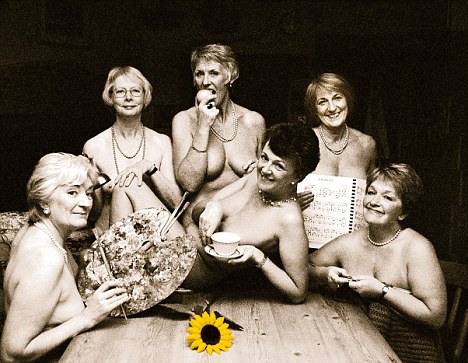
The dangerously stupid and macho Scottish broom game of Creaothceann is a clear reference to Highland Games such as tossing the caber and weight-throwing, which are tests primarily of muscular strength. As for Swivenhodge, JK Rowling is less than six years younger than me, and Swivenhodge sounds suspiciously like a game which was popular among students when I was at university and involved throwing an egg - or sometimes a china mug or a drinking glass - back and forth until somebody dropped it; although there are also echoes of tennis there. At either end of the pitch were three golden poles with hoops on the end. [cut] they were fifty feet high. [PS ch. #10; p. 123] 'The Bludgers rocket around trying to knock players off their brooms. That's why you have two Beaters on each team [cut] it's their job to protect their side from the Bludgers and try and knock them towards the other team.' [PS ch. #10; p. 125] Quidditch itself, with its Bludgers and dangers and its high goal-posts, bears some resemblance to the popular British sport of rugby. This is basically American Football without any body-armour or helmets (except for optional ear-guards) - and yes, it's very dangerous, although the fact that rugby players are traditionally gentle and civilised (when not trying to bite an opposing team-member's ear off) reduces the injury-rate slightly. The United States has not produced as many world-class Quidditch teams as other nations because the game has had to compete with the American broom game Quodpot. [cut] There are eleven players a side in the game of Quodpot. They throw the Quod, or modified Quaffle, from team member to team member, attempting to get it into the 'pot' at the end of the pitch before it explodes. [cut] Quodpot has had some success as a minority sport in Europe, although the vast majority of wizards remain faithful to Quidditch. [QTtA ch. #08; p. 44/45] As for Quodpot, Rowling is making an obvious joke about the way the rest of the world views the U.S.'s love of baseball - which in the U.K. is primarily seen as a game for primary-school children - and its lack of interest in "proper" football (soccer). The Salem Witches' Institute [cut] a group of middle-aged American witches sat gossiping happily beneath a spangled banner stretched between their tents that read: The Salem Witches' Institute. [GoF ch. #07; p. 76] This is a reference to the nationwide association of English and Welsh social clubs called the [place-name] Women's Institute. These are groups of women in rural areas who organise social, educational and charity fund-raising events, often involving them making and selling craft or edible items. They acquired a rather racy reputation in 1999, about the time JK Rowling was working on Goblet of Fire, when a group of middle-aged ladies from the Rylstone Women's Institute posed for a very refined, arty nude calender, wearing pearl necklaces and nothing else, in order to raise money for leukaemia research. This incident was later the subject of a 2003 film, Calender Girls, and several of the ladies came together again in 2009 to make another calender. Salem, Massachusetts is of course the site of a famous series of late 17th C witch trials, immortalised in Arthur Miller's popular play The Crucible. Rowling is presumably implying that the Salem witches were for real. Hallowe'en
'The Bludgers rocket around trying to knock players off their brooms. That's why you have two Beaters on each team [cut] it's their job to protect their side from the Bludgers and try and knock them towards the other team.' [PS ch. #10; p. 125]
Quidditch itself, with its Bludgers and dangers and its high goal-posts, bears some resemblance to the popular British sport of rugby. This is basically American Football without any body-armour or helmets (except for optional ear-guards) - and yes, it's very dangerous, although the fact that rugby players are traditionally gentle and civilised (when not trying to bite an opposing team-member's ear off) reduces the injury-rate slightly. The United States has not produced as many world-class Quidditch teams as other nations because the game has had to compete with the American broom game Quodpot. [cut] There are eleven players a side in the game of Quodpot. They throw the Quod, or modified Quaffle, from team member to team member, attempting to get it into the 'pot' at the end of the pitch before it explodes. [cut] Quodpot has had some success as a minority sport in Europe, although the vast majority of wizards remain faithful to Quidditch. [QTtA ch. #08; p. 44/45] As for Quodpot, Rowling is making an obvious joke about the way the rest of the world views the U.S.'s love of baseball - which in the U.K. is primarily seen as a game for primary-school children - and its lack of interest in "proper" football (soccer). The Salem Witches' Institute
As for Quodpot, Rowling is making an obvious joke about the way the rest of the world views the U.S.'s love of baseball - which in the U.K. is primarily seen as a game for primary-school children - and its lack of interest in "proper" football (soccer).
This is a reference to the nationwide association of English and Welsh social clubs called the [place-name] Women's Institute. These are groups of women in rural areas who organise social, educational and charity fund-raising events, often involving them making and selling craft or edible items.
They acquired a rather racy reputation in 1999, about the time JK Rowling was working on Goblet of Fire, when a group of middle-aged ladies from the Rylstone Women's Institute posed for a very refined, arty nude calender, wearing pearl necklaces and nothing else, in order to raise money for leukaemia research. This incident was later the subject of a 2003 film, Calender Girls, and several of the ladies came together again in 2009 to make another calender.
Salem, Massachusetts is of course the site of a famous series of late 17th C witch trials, immortalised in Arthur Miller's popular play The Crucible. Rowling is presumably implying that the Salem witches were for real.
American-style trick-or-treating is actually derived from the Scottish practice of "guising" (disguising), where children would paint their faces with patterns of black soot or grease and then go from door to door, singing in return for sweets. However, guising has almost completely died out now, and trick-or-treating is very rare here. The children that Voldemort sees in Godric's Hollow, dressed as pumpkins, would probably have come from a Hallowe'en-themed fancy-dress party.
They were standing instead in a dark and overgrown graveyard; the black outline of a small church was visible beyond a large yew tree to their right. [GoF ch. #32; p. 552]
"The graveyard is full of the names of ancient magical families, and this accounts, no doubt, for the stories of hauntings that have dogged the little church [US version inserts 'beside it'] for many centuries." [DH ch. #16; p. 261]
There was a kissing gate at the entrance to the graveyard. Hermione pushed it open as quietly as possible and they edged through it. On either side of the slippery path to the church doors the snow lay deep and untouched. They moved off through the snow, carving deep trenches behind them as they walked round the building, keeping to the shadows beneath the brilliant windows. Behind the church, row upon row of snowy tombstones protruded from a blanket of pale blue that was flecked with dazzling red, gold and green wherever the reflections from the stained glass hit the snow. [DH ch. #16; p. 266]
The US edition of Deathly Hallows has been edited to specify that the church in Godric's Hollow is "beside" the graveyard, which apparently is not normal practice in the US. Here it's standard for older churches to have a graveyard - often in fact called a "churchyard" - either next to or surrounding the church. The church at Godric's Hollow is probably inside rather than next to the graveyard, since the path to the church doors crosses the graveyard.
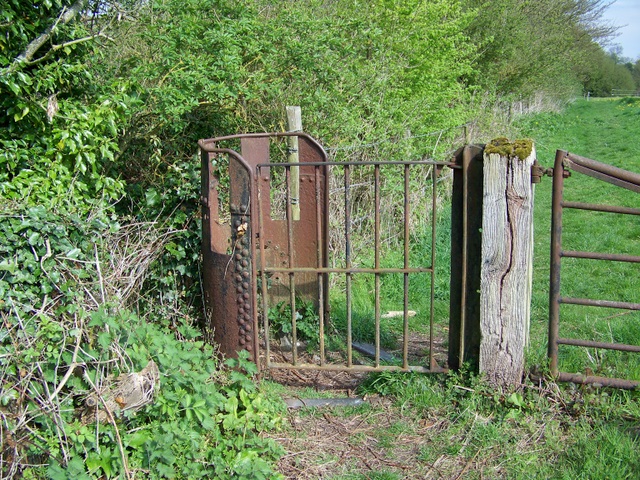
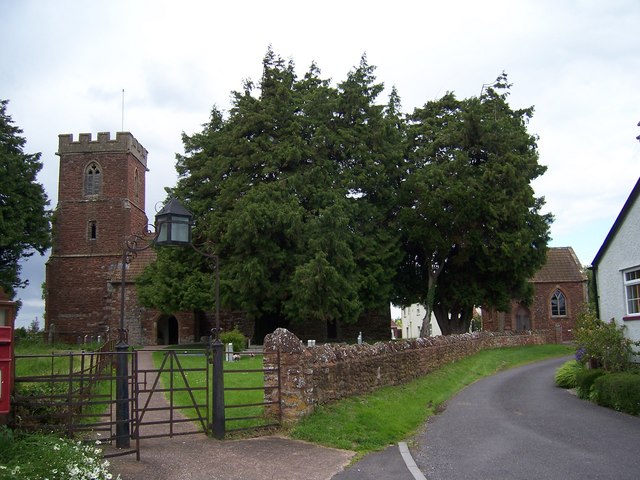
The "kissing gate" at the entrance to the churchyard in Godric's Hollow is a type of gate designed to allow humans through, but not livestock. It consists of an open-ended, usually 'C', 'U' or 'Π'-shaped fenced enclosure just about big enough for two people to stand in, built at one side of a hinged gate and placed so that the free end of the gate protrudes slightly into the open end of the enclosure. If you just push on the gate, as a sheep or cow would usually do, it jams against the far side of the enclosure and will move no further: to get through it you have to squeeze yourself into the end of the enclosure and swing the gate past yourself. There's a country tradition for the first person through the gate to refuse to let the next one through unless they pay with a kiss. Church at Chilton Trinity © Pam Goodey at Geograph The village of Chilton Trinity, in the West Country, is in just the sort of area Godric's Hollow would be (see essays on the probable location of various sites in the Potter books), and its church gives a very good idea of how the church and graveyard in Godric's Hollow might look. It even has a kissing gate - one which has a solid gate-post at one of the extremities of the loop of the enclosure-fence. There's a connection between the livestock-excluding gate into the churchyard at Godric's Hollow and the yew tree in the churchyard at Little Hangleton. In the Middle Ages, men in English villages were expected to practise at the longbow, so that if needed they could be called up for the army, as part of the following of the local lord. The best wood for making longbows is yew but yew is toxic to livestock. In those days few fields were enclosed: the churchyard was a safe place to grow yew trees behind a stone wall which could keep cattle away from the toxic foliage. Since yew trees can survive, and grow, for thousands of years, the yews in the churchyards are often the same trees that sent bows to Agincourt. Be at stile at end of road out of Hogsmeade (past Dervish & Banges) at two o'clock on Saturday afternoon. Bring as much food as you can. [GoF ch. 27; p. 443] Then they turned a corner, and saw a stile at the end of the lane. Waiting for them, its front paws on the topmost bar, was a very large, shaggy black dog, [cut] [cut] Harry, Ron and Hermione climbed over the stile and followed. [GoF ch. 27; p. 451]
The village of Chilton Trinity, in the West Country, is in just the sort of area Godric's Hollow would be (see essays on the probable location of various sites in the Potter books), and its church gives a very good idea of how the church and graveyard in Godric's Hollow might look. It even has a kissing gate - one which has a solid gate-post at one of the extremities of the loop of the enclosure-fence.
There's a connection between the livestock-excluding gate into the churchyard at Godric's Hollow and the yew tree in the churchyard at Little Hangleton. In the Middle Ages, men in English villages were expected to practise at the longbow, so that if needed they could be called up for the army, as part of the following of the local lord. The best wood for making longbows is yew but yew is toxic to livestock. In those days few fields were enclosed: the churchyard was a safe place to grow yew trees behind a stone wall which could keep cattle away from the toxic foliage. Since yew trees can survive, and grow, for thousands of years, the yews in the churchyards are often the same trees that sent bows to Agincourt.
Then they turned a corner, and saw a stile at the end of the lane. Waiting for them, its front paws on the topmost bar, was a very large, shaggy black dog, [cut] [cut] Harry, Ron and Hermione climbed over the stile and followed. [GoF ch. 27; p. 451]
I'm not sure how common stiles are in other countries, and whether all foreign readers will understand what one is: Wikipedia's article on stiles cites only British examples. A stile is a step which enables the users of a footpath to get up and over a barrier around a field whilst being - at least in theory - too fiddly for livestock to use. The simplest and probably most common design is a horizontal plank stuck through a stretch of fence more or less at right-angles about 18" up, and supported by a leg at either end to stop it tipping. If the field is surrounded by hedges or barbed wire or similar, a short stretch of fence, about as wide as a gate, will be incorporated for the purpose of accommodating the stile.
Harry had taken a large dose of Polyjuice Potion and was now the double of a redheaded Muggle boy from the local village, Ottery St Catchpole, [DH ch. 08; p. 115]
The villages of Tinworth in Cornwall, Upper Flagley in Yorkshire and Ottery St Catchpole on the south coast of England were notable homes to knots of wizarding families who lived alongside tolerant and sometimes Confunded Muggles. [DH ch. 16; p. 261]
The village of Ottery St Catchpole, on the south coast of England, is an obvious reference to the real-life village of Ottery St Mary in south Devon. The implication is that like Ottery St Mary, Ottery St Catchpole is a village in the valley of the River Otter, which rises in Somerset and flows south-west through Devon. See the essay-series Location, Location for more information about the likely real-world site of this and other places mentioned in the Harry Potter books.
Just as Ottery St Mary is based around a famously grand church of St Mary, so Ottery St Catchpole would be based around a church of St Catchpole. The problem with that is that there actually is no such saint as St Catchpole. According to Wiki, however, "catchpole" was a Mediaeval word for a tax-collector and a 12th C quote applies it to the apostle Matthew, who was said to have been a tax-collector before he became a gospel author - "Matheus thet wes cachepol thene he iwende to god-spellere". The church of St Catchpole therefore is probably a church of St Matthew under an odd name.
'Bill and Fleur's,' said Ron. 'Shell Cottage on the outskirts of Tinworth!' [DH ch. #23; p. 379]
The name is an obvious reference to Cornwall's most famous historical industry, tin-mining. Tinworth is also the name of a fictional Cornish village in the novella Safer Than Love, a murder-mystery set in a boys' boarding school, written by the famous early 20th C British crime-fiction writer Margery Allingham. See the essay-series Location, Location for more information about the likely real-world site of this and other places mentioned in the Harry Potter books.
[cut] he saw his father's old cooking pot: it had sprouted a single foot of brass, and was hopping on the spot, [BtB ch. #01; p. 5]
The pot burped out the single slipper he had thrown into it, and permitted him to fit it on to the brass foot. [BtB ch. #01; p. 5]
In the revised story, the Hopping Pot protects an innocent wizard from his torch-bearing, pitchfork-toting neighbours by chasing them away from the wizard's cottage, catching them and swallowing them whole. At the end of the story, by which time the Pot has consumned most of his neighbours, the wizard gains a promise from the few remaining villagers that he will be left in peace to practise magic. In return, he instructs the Pot to render up its victims, who are duly burped out of its depths, slightly mangled. [BtB ch. #01 (notes); p. 14]
Beedle the Bard's story of the Hopping Pot, with its little foot which is human-like enough to fit a slipper and (in the unauthorised version) its mouth that can swallow witch-hunters whole, is an obvious reference to Rincewind's Luggage in British author Terry Pratchett's Discworld books: a magic trunk on lots of little human legs, which opens to display a variety of alternative interiors one of which has a tongue and teeth, and eats people who threaten its master. Pratchett and Rowling are playing some kind of weird literary game with each other: Pratchett's 2007 collectors'-diary, the Ankh-Morpork Post Office Handbook, speculates at length on what condition post which had been carried by owls would be likely to arrive in, and in his 2005 novel Thud! he managed to have his rather Snapey character Sam Vimes end up with something remarkably like the Dark Mark branded on the inside of his left wrist.
The whole idea of the Horcruxes relates to a traditional European folk motif about an evil wizard or ogre who gains immortality by taking his soul, life or heart out and hiding it in an object, often an eggshell. The most famous of these is probably the evil Russian wizard Koschei the Deathless, who hid his soul in a needle, in an egg, in a succession of animals, in a chest, under an oak, on an island, although the version I know is the Celtic/West Highland tale The Young King of Easaidh Ruadh, about (among other things) a giant who took his soul out, put it into an egg and buried it under the threshold of his house. The language of this latter story was slightly modernised by the well-known Scots folklorist Andrew Lang (1844-1912) and the revised version was included as The King of the Waterfalls in his popular books of fairy stories for children, which is where I - and probably JK Rowling - got the idea from.
The idea exists in the general folk subconscious, in any case. I recently came across a discussion list where somebody was commenting on the way conservatism in the US keeps on being declared dead but always bounces back, and somebody said "Does it keep its soul in an eggshell or something?" and someone else replied "actually, it keeps it in a briefcase."
The Hallows relate to an idea in the Celtic/Arthurian mythos that there were a number of magical objects (varying between three and thirteen, if I remember correctly, according to which story you read) which were "hallowed", that is, holy, and which were of great importance to the mystical underpinnings of Britain. Sometimes these were of Christian significance, such as the lance which wounded Christ on the cross; sometimes they were more pagan or obscure, such as a chess-board which represented the land, and which played itself. The Thirteen Treasures of Britain listed in the Mediaeval Welsh tale Culhwch and Olwen include "The mantle of Arthur; whosoever was beneath it could see everything, while no one could see him."
Some later, variant versions of the list include the Mantle of Tegau Eurfon, which fit perfectly if a woman was faithful but would magically become too short if she was adulterous, and Eluned's Stone and Ring: if the wearer rotated the ring so that the stone lay towards the palm, and then closed their fist over it, so long as they concealed the stone within their fist the stone would likewise conceal them.
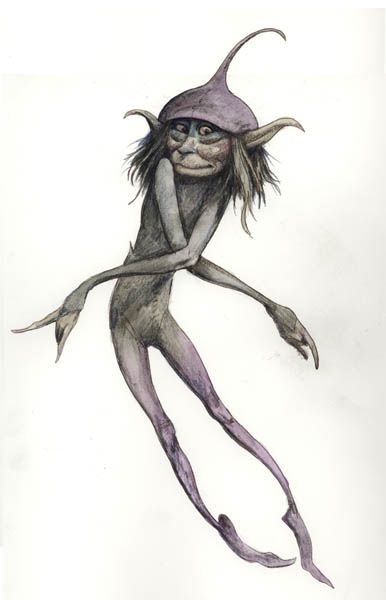
The house-elves are another bit of British folklore, since they seem to be based mainly on a mythological British sprite called a house brownie, urisk or gruagach in Scotland and a hob in England. See for example this article on traditional Scottish brownie lore. Brownies/hobs are attached to a particular house rather than a person, perform chores around the house during the night, rarely allow themselves to be seen, socialise amongst themselves (just as Winky and Dobby know each other before they both come to work at Hogwarts), and appreciate offerings of cream and honey or porridge but leave in an offended huff, taking the luck of the house with them, if they are offered clothes, or anything resembling formal payment, such as money or too-luxurious food.
'House-elves come with big old manors and castles and places like that, you wouldn't catch one in our house ...' [CoS ch. #03; p. 28]
'Dobby can only be freed if his masters present him with clothes, sir. The family is careful not to pass Dobby even a sock, sir, for then he would be free to leave their house forever.' [CoS ch. #10; p. 133]
'Got a sock,' said Dobby in disbelief. 'Master threw it, and Dobby caught it, and Dobby – Dobby is free.' [CoS ch. #18; p. 248]
The creature, whose legs were so short they stuck out in front of it on the chair, was wearing a tea-towel draped like a toga, and it had its face hidden in its hands. Yet those long, bat-like ears were oddly familiar ... [cut] The tiny creature looked up and parted its fingers, revealing enormous brown eyes and a nose the exact size and shape of a large tomato. It wasn't Dobby -- it was, however, unmistakably a house-elf, [cut] 'Freedom is going to Dobby's head, sir,' said Winky sadly. 'Ideas above his station, sir. Can't get another position, sir.' [cut] [cut] 'He is wanting paying for his work, sir.' [cut] 'House-elves is not paid, sir!' she said in a muffled squeak. 'No, no, no. I says to Dobby, I says, go find yourself a nice family and settle down, Dobby. He is getting up to all sorts of high jinks, sir, what is unbecoming to a house-elf. You goes racketing around like this, Dobby, I says, and next thing I hear you's up in front of the Department for the Regulation and Control of Magical Creatures, like some common goblin.' [GoF ch. #08; p. 88-90]
'I told her to remain in the tent. I told her to stay there while I went to sort out the trouble. And I find that she disobeyed me. This means clothes.' 'No!' shrieked Winky, prostrating herself at Mr Crouch's feet. 'No, master! Not clothes, not clothes!' [GoF ch. #09; p. 124]
'Well, they hardly ever leave the kitchen by day, do they?' said Nearly Headless Nick. 'They come out at night to do a bit of cleaning ... see to the fires and so on ... I mean, you're not supposed to see them, are you? That's the mark of a good house-elf, isn't it, that you don't know it's there?' [GoF ch. #12; p. 161]
'It's in their nature ter look after humans, that's what they like, see? Yeh'd be makin' 'em unhappy ter take away their work, an' insultin' 'em if yeh tried ter pay 'em.' 'But Harry set Dobby free, and he was over the moon about it!' said Hermione. 'And we heard he’s asking for wages now!' 'Yeah, well, yeh get weirdos in every breed. I'm not sayin' there isn't the odd elf who'd take freedom, but yeh'll never persuade most of 'em ter do it' [GoF ch. #16; p. 233]
Dobby let go and stepped back a few paces, beaming up at Harry, his enormous, green, tennis-ball-shaped eyes brimming with tears of happiness. He looked almost exactly as Harry remembered him; the pencil-shaped nose, the bat-like ears, the long fingers and feet [GoF ch. #21; p. 327]
'And then, Harry Potter, Dobby goes to visit Winky, and finds out Winky has been freed, too, sir!' said Dobby delightedly. [cut] 'And Professor Dumbledore says he will pay Dobby, sir, if Dobby wants paying! And so Dobby is a free elf, sir, and Dobby gets a Galleon a week and one day off a month!' [cut] 'Professor Dumbledore offered Dobby ten Galleons a week, and weekends off,' said Dobby, suddenly giving a little shiver, as though the prospect of so much leisure and riches were frightening, 'but Dobby beat him down, miss ... Dobby likes freedom, miss, but he isn’t wanting too much, miss, he likes work better.' 'And how much is Professor Dumbledore paying you, Winky?' Hermione asked kindly. If she had thought this would cheer Winky up, she was wildly mistaken. Winky did stop crying, but when she sat up she was glaring at Hermione through her massive brown eyes, her whole face sopping wet and suddenly furious. 'Winky is a disgraced elf, but Winky is not yet getting paid!' she squeaked. 'Winky is not sunk so low as that! Winky is properly ashamed of being freed!' [GoF ch. #21; p. 330/331]
[cut] a house-elf edged into the room. Except for the filthy rag tied like a loincloth around its middle, it was completely naked. It looked very old. Its skin seemed to be several times too big for it and, though it was bald like all house-elves, there was a quantity of white hair growing out of its large, batlike ears. Its eyes were a bloodshot and watery grey and its fleshy nose was large and rather snoutlike. [OotP ch. #06; p. 100]
Brownies, however, are covered in curly brown fur. The appearance of Rowling's house-elves may owe something to the huldufólk of Icelandic folklore, who are small enough to sleep in miniature houses placed in Icelandic gardens, and are said to have proportionately long, skinny legs and big ears. House-elves have quite short legs - Winky does, anyway - but Dobby's hands and feet are long. With their giant eyes and ears they may also owe something to tarsiers - and to the big-eared, big-eyed brownies of Brian Froud, whose illustrated book Faeries was published in 1995 and was prominently displayed in Edinburgh shop-windows at the time.
The servility of the house-elves, however, and their willingness to punish themselves, seems to be entirely Rowling's own invention. Traditional house brownies/hobs are mischievous, and can turn nasty if offended - and urisks and gruagachs in particular may have houses of their own, instead of living in human ones, and are portrayed as a minor sort of ogre and a dangerous enemy. Perhaps we are to assume that wizards enslaved the house-elves to make them safer to be around.
British humour - whether as stage-performance or witty private conversation - often plays with sexual innuendo, and even though they are primarily aimed at children there are a number of rather risqué jokes in the Potter books, which may pass some foreign readers by.
In Goblet of Fire, Dumbledore attempts to cheer Hagrid up by, among other things, making a catty joke about his brother Aberforth (whom Hagrid of course knows, since they were in the Order together in Vold War One, albeit Aberforth rarely attended meetings). To British ears the unexpanded reference to Aberforth "practising inappropriate charms on a goat" suggests bestiality, or at least that Dumbledore wishes his hearers (Hagrid and the Trio) immediately to imagine bestiality. We know this is intentional because Rowling herself then made an arch joke about it during an interview.
This does not mean, however, that Albus really thinks his brother has sex with goats, or wants his hearers to think either that Aberforth has sex with goats, or that Albus thinks he does. Jokes which imply, either directly or subtly, that this or that isolated rural group are "sheep-shaggers" are a standard element of British humour. When I was a student in the late 1970s, for example, in the days when I was contemplating converting to Judaism (eventually put paid to by a pagan revelation - at a Jewish summer school, which was embarrassing), I was a member of the Northern Region (Scotland and northern England) branch of the Union of Jewish Students. It was a standing joke for the more southerly members to make sheep-shagger jokes and yell "Sheep! Sheep!" at us. Not only were we not offended, we played up to it - I still have the little plastic sheep pendant I used to wear to meetings. Two stone gargoyles flanked the staff-room door. As Harry approached, one of them croaked, 'You should be in class, Sonny Jim.' 'This is urgent,' said Harry curtly. 'Ooooh, urgent, is it?' said the other gargoyle in a high-pitched voice. 'Well, that's put us in our place, hasn't it?' Harry knocked. He heard footsteps, then the door opened and he found himself face to face with Professor McGonagall. 'You haven't been given another detention!' she said at once, her square spectacles flashing alarmingly. 'No, Professor!' said Harry hastily. 'Well then, why are you out of class?' 'It's urgent, apparently,' said the second gargoyle snidely. [OotP ch. #17; p. near start] The first casualties of the battle were already strewn across the passage ahead: the two stone gargoyles that usually guarded the entrance to the staff room had been smashed apart by a jinx that had sailed through another broken window. Their remains stirred feebly on the floor, and as Harry leapt over one of their disembodied heads it moaned faintly, 'Oh, don't mind me ... I'll just lie here and crumble ...' [DH ch. #31; p. 498] So, Albus knows that his listeners will think he is hinting that Aberforth has sex with goats, but he also knows that they will know he is referring to a common trope in British humour. He knows they will not take him seriously or think for a moment that Aberforth really shags goats. If he wanted them to think that it was true, he'd need to say so outright - not make a veiled reference to a standard joke which all culturally-native Britons know is a joke. Then, there are the gargoyles who guard the staff-room. It probably passes most foreign readers by, but their manner is very obviously based on the rather stylised camp delivery used by many famously gay British comedians, such as e.g. Frankie Howerd, Julian Clary or Kenneth Williams, and which is a standard form of British humour which has been traditional at least since about 1930. [cut]the Fat Lady was back. She had been expertly restored, but was still extremely nervous, and had only agreed to return to her job on condition that she was given extra protection. A bunch of surly security trolls had been hired to guard her. They paced the corridor in a menacing group, talking in grunts and comparing the size of their clubs. [PoA ch. #14; p. 199] Then, there's the bit about trolls comparing club-sizes. This is an obvious reference to a standard British humourous idea that swaggering, would-be macho men spend a lot of time comparing penis-sizes. There was already a small queue for the tap in the corner of the field. Harry, Ron and Hermione joined it, right behind a pair of men who were having a heated argument. One of them was a very old wizard who was wearing a long flowery nightgown. The other was clearly a Ministry wizard; he was holding out a pair of pinstriped trousers and almost crying with exasperation. 'Just put them on, Archie, there's a good chap, you can't walk around like that, the Muggle at the gate's already getting suspicious --' 'I bought this in a Muggle shop,' said the old wizard stubbornly. 'Muggles wear them.' 'Muggle women wear them, Archie, not the men, they wear these,' said the Ministry wizard, and he brandished the pinstriped trousers. 'I'm not putting them on,' said old Archie in indignation. 'I like a healthy breeze round my privates, thanks.' Hermione was overcome with such a strong fit of the giggles at this point that she had to duck out of the queue, [GoF ch. #07; p. 77/78] The scene in Goblet of Fire where an elderly wizard declares that he is wearing a women's nightie because he likes "a healthy breeze round my privates" isn't even a double entendre, since it's absolutely open and explicit. Even so, some non-native-English-speaking readers may miss the point that "privates" is an old-fashioned, polite euphemism for genitalia. Gits I've been told that some foreign fen assume that the British insult "git" - applied four times to Draco in the books, and occasionally to other people (including Harry) - must be some terrible insult, but in fact it's just about the mildest term you can use and it still be an insult at all. It means something like "annoying person", and is probably derived from "get", which just means "offspring". [N.B. the oft'-quoted expression "greasy git" for Snape is pure fanon; it does not occur in either the books or the films.] Harry and Ron were delighted to hear Hagrid call Filch 'that old git.' [PS ch. #08; p. 105] 'It's -- all -- my -- ruddy -- fault!' he sobbed, his face in his hands. I told the evil git how ter get past Fluffy! [PS ch. #17; p. 219] 'That's because [Lockhart's] a brainless git,' said Ron. 'But who cares, we've got what we needed.' 'He is not a brainless git,' said Hermione shrilly as they half ran towards the library. [CoS ch. #10; p. 123] 'I'm here!' came Ron's muffled voice from behind the rockfall. 'I'm OK. This git's not, though -- he got blasted by the wand.' [CoS ch. #16; p. 224] 'That little git,' he said calmly. 'He [Draco] wasn't so cocky last night when the Dementors were down our end of the train.' [PoA ch. #06; p. 75] 'That's why he wouldn't say it was from him!' said Ron. 'In case some git like Malfoy said it was favouritism.' [PoA ch. #11; p. 166] 'Mr Prongs agrees with Mr Moony, and would like to add that Professor Snape is an ugly git.' [PoA ch. #14; p. 211] 'No, we gave it to [Dudley] because he's a great bullying git,' said George. [GoF ch. #05; p. 51] 'Slimy gits,' Ron muttered [referring to the Malfoys] as he, Harry and Hermione turned to face the pitch again. [GoF ch. #08; p. 93] 'What's a bummer?' Ron asked George. 'Having a nosy git like you for a brother,' said George. [GoF ch. #15; p. 209] 'Stupid little feathery git!' Ron hissed, hurrying up the stairs and snatching up Pigwidgeon. [GoF ch. #23; p. 353] 'We weren't trying to hear him!' said Ron indignantly. 'We didn't have any choice! The stupid git, talking about his giantess mother where anyone could have heard him!' [GoF ch. #24; p. 384] 'Bagman?' said Harry sharply. 'Are you saying he was involved in --' 'Nah,' said George gloomily. 'Nothing like that. Stupid git. He wouldn't have the brains.' [cut] 'Well, the git paid us in leprechaun gold he'd caught from the Irish mascots.' [GoF ch. #37; p. 633/634] 'Snape!' said Harry quickly. 'Is he here?' 'Yeah,' said George, carefully closing the door and sitting down on one of the beds; Fred and Ginny followed. 'Giving a report. Top secret.' 'Git,' said Fred idly. 'He's on our side now,' said Hermione reprovingly. Ron snorted. 'Doesn't stop him being a git. The way he looks at us when he sees us.' [OotP ch. #04; p. 67] 'Manners, Potter, or I'll have to give you a detention,' drawled Malfoy, whose sleek blond hair and pointed chin were just like his father's. 'You see, I, unlike you, have been made a prefect, which means that I, unlike you, have the power to hand out punishments.' 'Yeah,' said Harry, 'but you, unlike me, are a git, so get out and leave us alone.' [OotP ch. #10; p. 175] 'Give it back,' said Ron, holding out his hand. 'He is --' Ron said jerkily, tearing Percy's letter in half 'the world's --' he tore it into quarters 'biggest --' he tore it into eighths 'git.' [OotP ch. #14; p. 268] 'Oi!' bellowed Ron, finally losing patience and sticking his head out of the window, 'I am a prefect and if one more snowball hits this window -- OUCH!' He withdrew his head sharply, his face covered in snow. 'It's Fred and George,' he said bitterly, slamming the window behind him. 'Gits ...' [OotP ch. #21; p. 390] 'Yeah, but apart from that,' said Ron, sounding aggravated. 'I mean, [Krum's] a grouchy git, isn't he?' [OotP ch. #21; p. 407] 'Gits,' said Ron darkly, watching Fred and George setting off across the snowy yard. [HBP ch. #16; p. 307] 'This is different, pretending to be me --' 'Well, none of us really fancy it, Harry,' said Fred earnestly. 'Imagine if something went wrong and we were stuck as specky, scrawny gits forever.' [DH ch. #04; p. 46] 'We woke up and didn't know where you were!' she said breathlessly. She turned and shouted over her shoulder, 'Ron! I've found [Harry]!' Ron's annoyed voice echoed distantly from several floors below. 'Good! Tell him from me he's a git!' [DH ch. #10; p. 151] 'Marvolo Gaunt was an ignorant old git who lived like a pig, all he cared about was his ancestry. ' [DH ch. #22; p. 347] Griphook did not protest, but Harry thought he saw resentment in the goblin's eyes as he closed the door upon him. 'Little git,' whispered Ron. 'He's enjoying keeping us hanging.' [DH ch. #24; p. 396] Heroes MV: Was Snape always intended to be a hero?JKR: [sharp intake of breath] Is he a hero? You see I don't see him really as a hero.MV: Really?JKR: Yeh. He's spiteful. He's a bully. All these things are still true of Snape, even at the end of this book. But, was he brave? Yes, immensely. [Today show (NBC), 26/07/2007] Lechicaneuronline: Do you think snape is a heroJ.K. Rowling: Yes, I do; though a very flawed hero. An anti-hero, perhaps. He is not a particularly likeable man in many ways. He remains rather cruel, a bully, riddled with bitterness and insecurity - and yet he loved, and showed loyalty to that love and, ultimately, laid down his life because of it. That's pretty heroic![cut]Annie: Does the wizarding world now know that snape was dumbledores man, or do they still think he did a bunkJ.K. Rowling: Harry would ensure that Snape's heroism was known. Of course, that would not stop Rita Skeeter writing 'Snape: Scoundrel or Saint?'[cut]Barbara: I was very disappointed to see harry use crucio and seem to enjoy it his failure to perform that kind of curse in the past has been a credit to his character why the change, and did harry later regret having enjoyed deliberately causing painJ.K. Rowling: Harry is not, and never has been, a saint. Like Snape, he is flawed and mortal. Harry's faults are primarily anger and occasional arrogance. On this occasion, he is very angry and acts accordingly. [Bloomsbury Live Chat, 30/07/2007] Much has been made of the fact that when an American interviewer called Snape a hero JKR initially said that she didn't see him as a hero, although she later said that he was one, or perhaps an anti-hero, and linked his flawed heroism to Harry's. This caused a lot of argument, but it seems pretty clear that she was simply suffering from linguistic confusion. In Britain, the word "hero" nowadays is most commonly used to mean "rôle model", rather than "person who acts heroically". For example, the Guardian (a very serious left-wing broadsheet newspaper) used the term "hero" to describe the admiration which children feel for the footballer David Beckham, who has never done anything especially heroic, but who is considered a "hero" because he combines his footballing career with being an attentive father. Even more strikingly, on 7th August 2008 it was reported in the Daily Mail (a right-wing British tabloid which is also fairly serious-minded, as tabloids go, and aimed mainly at a middle-aged and older readership), that Prime Minister Gordon Brown had named Scott of the Antarctic as his hero, and the reporter commented: "His journey is the stuff of legend. But given his cold and lonely death, Captain Scott is unlikely to be a character many would seek to emulate. // However, for Gordon Brown, the ill-fated explorer is a hero." Note that "however": the Mail's reporter is actually surprised that anybody would choose, as a hero, a person who performed heroic deeds but whose manner of death was a tragic one, and they assume that "hero" is synonymous with "person I wish to emulate". Not only are they using "hero" to mean "rôle model", but they seem to have forgotten that it ever had any other meaning. The reasons JKR initially gave for saying that she did not see Snape as a hero were relevant to whether or not he was a good rôle model, but not relevant to whether or not he behaved heroically. "Spiteful and a bully" would fit a high proportion of both real-life and legendary British heroes (in the old sense of "heoic persons"), and Rowling is educated enough to know that. Therefore, it seems virtually certain that she never meant to say that Snape was not heroic: she had simply understood "Is he a hero?" to mean "Is he a good rôle model?", because that's what it usually means in Britain nowadays. Nor does her later calling him an anti-hero mean that she thinks he was not heroic. In British usage, an anti-hero is not a person who is the antithesis of heroism, but a person who is heroic but who is also dark or dodgy in some way, such as e.g. Francis Drake or Rob Roy Macgregor. [It would probably be wrong to read too much into Rowling calling Snape "rather cruel", incidentally, since she has also called the Twins cruel - specifically, she said that she decided to kill Fred because he was the more cruel of the two. Calling Snape "rather cruel" therefore probably means nothing stronger than that he has a rather nasty sense of humour, similar to the Twins' but probably milder, since they are "cruel" and he is only "rather" cruel - and we already knew that.] Clichés There are certain situations in the books which repeat common British fictional clichés or tropes. Perhaps the most striking of these is the way both Dumbledore and, later, Dobby and Snape are accepted as being dead because the plot requires them to be dead, without anybody actually checking them for vital signs. This lazy bit of shorthand is common in British TV shows where e.g. somebody is bumped by a car and suddenly everyone around them mysteriously knows that they are dead, without checking. For example, I'm writing this in mid March 2010 and yesterday I saw not one but two British TV stories in which a character was knocked out after falling a moderate distance without obvious injury, and the other characters who found them (a serving policman in one case, an ex policewoman and a detective in the other) stood with bowed heads, mourning the death, rather than calling an ambulance and then checking for signs of life. Another common British fictional cliché is the one where some famous, rare, valuable artefact or hoard of archaeological treasure is discovered only to be destroyed before the end of the story. We see this happen not only with all the Founders' artefacts which Tom turned into Horcruxes, but also with the store of ancient objects in the Room of Requirement. [cut] Harry [cut] saw his father: slight, black-haired like Snape, but with that indefinable air of having been well cared for, even adored, that Snape so conspicuously lacked. [DH ch. #33; p. 538] Another one is that it is almost invariable, in modern British literature and especially in children's literature, that ambition will be seen as a fault, any wealthy or aristocratic characters will be villains and nearly all poor characters will be virtuous. Rowling bucks the trend by having Justin Finch-Fletchley be rather a nice boy and allowing Harry to inherit money, but still it was inevitable that the Dursleys would be bourgeois and the Malfoys rich. To British ears the way she points up the fact that Severus on the Hogwarts Express is poor and neglected whilst James is pampered is a clear signal that our sympathies are meant to be with Severus. Lucius's lapdog "I fell much easier in my mind now that I know Dumbledore is being subjected to fair and objective evaluation," said Mr Lucius Malfoy, 41 [OotP ch. #15; p. 275] 'Sit down, Potter.' 'You know,' said Sirius loudly, leaning back on his rear chair legs and speaking to the ceiling, 'I think I'd prefer it if you didn't give orders here, Snape. It's my house, you see.' [cut] 'I am here on Dumbledore's orders,' said Snape, whose voice, by contrast, was becoming more and more quietly waspish, 'but by all means stay, Black, I know you like to feel ... involved.' [cut] '[cut] I am sure you must feel -- ah -- frustrated by the fact that you can do nothing useful,' Snape laid a delicate stress on the word, 'for the Order.' [cut] 'I've warned you, Snivellus,’ said Sirius, his face barely a foot from Snape's, 'I don't care if Dumbledore thinks you've reformed, I know better --' 'Oh, but why don't you tell him so?' whispered Snape. 'Or are you afraid he might not take very seriously the advice of a man who has been hiding inside his mother's house for six months?' 'Tell me, how is Lucius Malfoy these days? I expect he's delighted his lapdog's working at Hogwarts, isn't he?' 'Speaking of dogs,' said Snape softly, 'did you know that Lucius Malfoy recognised you last time you risked a little jaunt outside? Clever idea, Black, getting yourself seen on a safe station platform ... gave you a cast-iron excuse not to leave your hidey-hole in future, didn’t it?' [OotP ch. #24; p. 458-460] James Potter, born 27 March 1960, died 31 October 1981Lily Potter, born 30 January 1960, died 31 October 1981[DH ch. #16; p. 268] 'Slytherin!' cried the Sorting Hat. And Severus Snape moved off to the other side of the Hall [cut] to where Lucius Malfoy, a prefect badge gleaming upon his chest, patted Snape on the back as he sat down beside him ... [DH ch. #33; p. 540] When Snape and Sirius argue in the kitchen at Grimmauld Place in OotP, it begins with Snape telling Harry to sit down, and Sirius objecting to Snape "giving orders in his house" - despite the fact that his house is at the moment doubling as Order HQ and Snape is on Order business. Snape responds by making a remark which is neither insulting nor untrue - that Sirius must find it frustrating that circumstances prevent him from doing anything active for the Order's cause - although he states it in a barbed-sounding way which Sirius reacts to. After some conversation about Occlumency lessons, Sirius insults Snape by calling him "Snivellus", and questions his loyalty to the Order. Snape then accuses Sirius of actually hiding - that is, of wanting to opt out of the active struggle, rather than being forced to by circumstances. Sirius then calls Snape Lucius's "lapdog", and Snape escalates by accusing Sirius of intentionally manufacturing an excuse to stay in hiding. So, the "lapdog" comment forms part of an escalation of hostilities on both sides. This sounds like it may well be a reference to the custom of homosexual relationships among boys in British boarding schools - fairly common in reality, and even more common in the popular imagination, to the point that it's one of the first things people think of when they think of boys at boarding school. Lucius was already a prefect when young Severus was Sorted, and he was forty-one in September 1995, according to the Daily Prophet, while Snape was in the same academic year as James and Lily - who were born in 1960 - and JK has given Snape's birthday as 9th January on her website. Even the youngest Lucius could be - if he had only just turned forty-one a few days before the Prophet interviewed him - would make him five and a half years older than Snape, so if there was a sexual relationship between them at school it would have to have been at least partially abusive, as Severus would still only have been thirteen when Lucius left school. If this is what Sirius means then he's accusing Snape of being Lucius's catamite, which would explain why it's part of a serious escalation of hostilities. It's also possible that young Severus was Lucius's "fag" at school - a younger boy who acts as a gopher and secretary to an older boy in return for patronage and protection both at school and in later life - or that Sirius is simply questioning his loyalties again. But it reads as if Sirius means the remark to be very offensive, and Snape takes it as such - and Rowling was writing for a British audience she knows will connect boys at boarding school with homosexual experimentation. Violence
The first casualties of the battle were already strewn across the passage ahead: the two stone gargoyles that usually guarded the entrance to the staff room had been smashed apart by a jinx that had sailed through another broken window. Their remains stirred feebly on the floor, and as Harry leapt over one of their disembodied heads it moaned faintly, 'Oh, don't mind me ... I'll just lie here and crumble ...' [DH ch. #31; p. 498]
So, Albus knows that his listeners will think he is hinting that Aberforth has sex with goats, but he also knows that they will know he is referring to a common trope in British humour. He knows they will not take him seriously or think for a moment that Aberforth really shags goats. If he wanted them to think that it was true, he'd need to say so outright - not make a veiled reference to a standard joke which all culturally-native Britons know is a joke.
Then, there are the gargoyles who guard the staff-room. It probably passes most foreign readers by, but their manner is very obviously based on the rather stylised camp delivery used by many famously gay British comedians, such as e.g. Frankie Howerd, Julian Clary or Kenneth Williams, and which is a standard form of British humour which has been traditional at least since about 1930. [cut]the Fat Lady was back. She had been expertly restored, but was still extremely nervous, and had only agreed to return to her job on condition that she was given extra protection. A bunch of surly security trolls had been hired to guard her. They paced the corridor in a menacing group, talking in grunts and comparing the size of their clubs. [PoA ch. #14; p. 199] Then, there's the bit about trolls comparing club-sizes. This is an obvious reference to a standard British humourous idea that swaggering, would-be macho men spend a lot of time comparing penis-sizes. There was already a small queue for the tap in the corner of the field. Harry, Ron and Hermione joined it, right behind a pair of men who were having a heated argument. One of them was a very old wizard who was wearing a long flowery nightgown. The other was clearly a Ministry wizard; he was holding out a pair of pinstriped trousers and almost crying with exasperation. 'Just put them on, Archie, there's a good chap, you can't walk around like that, the Muggle at the gate's already getting suspicious --' 'I bought this in a Muggle shop,' said the old wizard stubbornly. 'Muggles wear them.' 'Muggle women wear them, Archie, not the men, they wear these,' said the Ministry wizard, and he brandished the pinstriped trousers. 'I'm not putting them on,' said old Archie in indignation. 'I like a healthy breeze round my privates, thanks.' Hermione was overcome with such a strong fit of the giggles at this point that she had to duck out of the queue, [GoF ch. #07; p. 77/78] The scene in Goblet of Fire where an elderly wizard declares that he is wearing a women's nightie because he likes "a healthy breeze round my privates" isn't even a double entendre, since it's absolutely open and explicit. Even so, some non-native-English-speaking readers may miss the point that "privates" is an old-fashioned, polite euphemism for genitalia. Gits I've been told that some foreign fen assume that the British insult "git" - applied four times to Draco in the books, and occasionally to other people (including Harry) - must be some terrible insult, but in fact it's just about the mildest term you can use and it still be an insult at all. It means something like "annoying person", and is probably derived from "get", which just means "offspring". [N.B. the oft'-quoted expression "greasy git" for Snape is pure fanon; it does not occur in either the books or the films.] Harry and Ron were delighted to hear Hagrid call Filch 'that old git.' [PS ch. #08; p. 105] 'It's -- all -- my -- ruddy -- fault!' he sobbed, his face in his hands. I told the evil git how ter get past Fluffy! [PS ch. #17; p. 219] 'That's because [Lockhart's] a brainless git,' said Ron. 'But who cares, we've got what we needed.' 'He is not a brainless git,' said Hermione shrilly as they half ran towards the library. [CoS ch. #10; p. 123] 'I'm here!' came Ron's muffled voice from behind the rockfall. 'I'm OK. This git's not, though -- he got blasted by the wand.' [CoS ch. #16; p. 224] 'That little git,' he said calmly. 'He [Draco] wasn't so cocky last night when the Dementors were down our end of the train.' [PoA ch. #06; p. 75] 'That's why he wouldn't say it was from him!' said Ron. 'In case some git like Malfoy said it was favouritism.' [PoA ch. #11; p. 166] 'Mr Prongs agrees with Mr Moony, and would like to add that Professor Snape is an ugly git.' [PoA ch. #14; p. 211] 'No, we gave it to [Dudley] because he's a great bullying git,' said George. [GoF ch. #05; p. 51] 'Slimy gits,' Ron muttered [referring to the Malfoys] as he, Harry and Hermione turned to face the pitch again. [GoF ch. #08; p. 93] 'What's a bummer?' Ron asked George. 'Having a nosy git like you for a brother,' said George. [GoF ch. #15; p. 209] 'Stupid little feathery git!' Ron hissed, hurrying up the stairs and snatching up Pigwidgeon. [GoF ch. #23; p. 353] 'We weren't trying to hear him!' said Ron indignantly. 'We didn't have any choice! The stupid git, talking about his giantess mother where anyone could have heard him!' [GoF ch. #24; p. 384] 'Bagman?' said Harry sharply. 'Are you saying he was involved in --' 'Nah,' said George gloomily. 'Nothing like that. Stupid git. He wouldn't have the brains.' [cut] 'Well, the git paid us in leprechaun gold he'd caught from the Irish mascots.' [GoF ch. #37; p. 633/634] 'Snape!' said Harry quickly. 'Is he here?' 'Yeah,' said George, carefully closing the door and sitting down on one of the beds; Fred and Ginny followed. 'Giving a report. Top secret.' 'Git,' said Fred idly. 'He's on our side now,' said Hermione reprovingly. Ron snorted. 'Doesn't stop him being a git. The way he looks at us when he sees us.' [OotP ch. #04; p. 67] 'Manners, Potter, or I'll have to give you a detention,' drawled Malfoy, whose sleek blond hair and pointed chin were just like his father's. 'You see, I, unlike you, have been made a prefect, which means that I, unlike you, have the power to hand out punishments.' 'Yeah,' said Harry, 'but you, unlike me, are a git, so get out and leave us alone.' [OotP ch. #10; p. 175] 'Give it back,' said Ron, holding out his hand. 'He is --' Ron said jerkily, tearing Percy's letter in half 'the world's --' he tore it into quarters 'biggest --' he tore it into eighths 'git.' [OotP ch. #14; p. 268] 'Oi!' bellowed Ron, finally losing patience and sticking his head out of the window, 'I am a prefect and if one more snowball hits this window -- OUCH!' He withdrew his head sharply, his face covered in snow. 'It's Fred and George,' he said bitterly, slamming the window behind him. 'Gits ...' [OotP ch. #21; p. 390] 'Yeah, but apart from that,' said Ron, sounding aggravated. 'I mean, [Krum's] a grouchy git, isn't he?' [OotP ch. #21; p. 407] 'Gits,' said Ron darkly, watching Fred and George setting off across the snowy yard. [HBP ch. #16; p. 307] 'This is different, pretending to be me --' 'Well, none of us really fancy it, Harry,' said Fred earnestly. 'Imagine if something went wrong and we were stuck as specky, scrawny gits forever.' [DH ch. #04; p. 46] 'We woke up and didn't know where you were!' she said breathlessly. She turned and shouted over her shoulder, 'Ron! I've found [Harry]!' Ron's annoyed voice echoed distantly from several floors below. 'Good! Tell him from me he's a git!' [DH ch. #10; p. 151] 'Marvolo Gaunt was an ignorant old git who lived like a pig, all he cared about was his ancestry. ' [DH ch. #22; p. 347] Griphook did not protest, but Harry thought he saw resentment in the goblin's eyes as he closed the door upon him. 'Little git,' whispered Ron. 'He's enjoying keeping us hanging.' [DH ch. #24; p. 396] Heroes MV: Was Snape always intended to be a hero?JKR: [sharp intake of breath] Is he a hero? You see I don't see him really as a hero.MV: Really?JKR: Yeh. He's spiteful. He's a bully. All these things are still true of Snape, even at the end of this book. But, was he brave? Yes, immensely. [Today show (NBC), 26/07/2007] Lechicaneuronline: Do you think snape is a heroJ.K. Rowling: Yes, I do; though a very flawed hero. An anti-hero, perhaps. He is not a particularly likeable man in many ways. He remains rather cruel, a bully, riddled with bitterness and insecurity - and yet he loved, and showed loyalty to that love and, ultimately, laid down his life because of it. That's pretty heroic![cut]Annie: Does the wizarding world now know that snape was dumbledores man, or do they still think he did a bunkJ.K. Rowling: Harry would ensure that Snape's heroism was known. Of course, that would not stop Rita Skeeter writing 'Snape: Scoundrel or Saint?'[cut]Barbara: I was very disappointed to see harry use crucio and seem to enjoy it his failure to perform that kind of curse in the past has been a credit to his character why the change, and did harry later regret having enjoyed deliberately causing painJ.K. Rowling: Harry is not, and never has been, a saint. Like Snape, he is flawed and mortal. Harry's faults are primarily anger and occasional arrogance. On this occasion, he is very angry and acts accordingly. [Bloomsbury Live Chat, 30/07/2007] Much has been made of the fact that when an American interviewer called Snape a hero JKR initially said that she didn't see him as a hero, although she later said that he was one, or perhaps an anti-hero, and linked his flawed heroism to Harry's. This caused a lot of argument, but it seems pretty clear that she was simply suffering from linguistic confusion. In Britain, the word "hero" nowadays is most commonly used to mean "rôle model", rather than "person who acts heroically". For example, the Guardian (a very serious left-wing broadsheet newspaper) used the term "hero" to describe the admiration which children feel for the footballer David Beckham, who has never done anything especially heroic, but who is considered a "hero" because he combines his footballing career with being an attentive father. Even more strikingly, on 7th August 2008 it was reported in the Daily Mail (a right-wing British tabloid which is also fairly serious-minded, as tabloids go, and aimed mainly at a middle-aged and older readership), that Prime Minister Gordon Brown had named Scott of the Antarctic as his hero, and the reporter commented: "His journey is the stuff of legend. But given his cold and lonely death, Captain Scott is unlikely to be a character many would seek to emulate. // However, for Gordon Brown, the ill-fated explorer is a hero." Note that "however": the Mail's reporter is actually surprised that anybody would choose, as a hero, a person who performed heroic deeds but whose manner of death was a tragic one, and they assume that "hero" is synonymous with "person I wish to emulate". Not only are they using "hero" to mean "rôle model", but they seem to have forgotten that it ever had any other meaning. The reasons JKR initially gave for saying that she did not see Snape as a hero were relevant to whether or not he was a good rôle model, but not relevant to whether or not he behaved heroically. "Spiteful and a bully" would fit a high proportion of both real-life and legendary British heroes (in the old sense of "heoic persons"), and Rowling is educated enough to know that. Therefore, it seems virtually certain that she never meant to say that Snape was not heroic: she had simply understood "Is he a hero?" to mean "Is he a good rôle model?", because that's what it usually means in Britain nowadays. Nor does her later calling him an anti-hero mean that she thinks he was not heroic. In British usage, an anti-hero is not a person who is the antithesis of heroism, but a person who is heroic but who is also dark or dodgy in some way, such as e.g. Francis Drake or Rob Roy Macgregor. [It would probably be wrong to read too much into Rowling calling Snape "rather cruel", incidentally, since she has also called the Twins cruel - specifically, she said that she decided to kill Fred because he was the more cruel of the two. Calling Snape "rather cruel" therefore probably means nothing stronger than that he has a rather nasty sense of humour, similar to the Twins' but probably milder, since they are "cruel" and he is only "rather" cruel - and we already knew that.] Clichés There are certain situations in the books which repeat common British fictional clichés or tropes. Perhaps the most striking of these is the way both Dumbledore and, later, Dobby and Snape are accepted as being dead because the plot requires them to be dead, without anybody actually checking them for vital signs. This lazy bit of shorthand is common in British TV shows where e.g. somebody is bumped by a car and suddenly everyone around them mysteriously knows that they are dead, without checking. For example, I'm writing this in mid March 2010 and yesterday I saw not one but two British TV stories in which a character was knocked out after falling a moderate distance without obvious injury, and the other characters who found them (a serving policman in one case, an ex policewoman and a detective in the other) stood with bowed heads, mourning the death, rather than calling an ambulance and then checking for signs of life. Another common British fictional cliché is the one where some famous, rare, valuable artefact or hoard of archaeological treasure is discovered only to be destroyed before the end of the story. We see this happen not only with all the Founders' artefacts which Tom turned into Horcruxes, but also with the store of ancient objects in the Room of Requirement. [cut] Harry [cut] saw his father: slight, black-haired like Snape, but with that indefinable air of having been well cared for, even adored, that Snape so conspicuously lacked. [DH ch. #33; p. 538] Another one is that it is almost invariable, in modern British literature and especially in children's literature, that ambition will be seen as a fault, any wealthy or aristocratic characters will be villains and nearly all poor characters will be virtuous. Rowling bucks the trend by having Justin Finch-Fletchley be rather a nice boy and allowing Harry to inherit money, but still it was inevitable that the Dursleys would be bourgeois and the Malfoys rich. To British ears the way she points up the fact that Severus on the Hogwarts Express is poor and neglected whilst James is pampered is a clear signal that our sympathies are meant to be with Severus. Lucius's lapdog
Then, there's the bit about trolls comparing club-sizes. This is an obvious reference to a standard British humourous idea that swaggering, would-be macho men spend a lot of time comparing penis-sizes. There was already a small queue for the tap in the corner of the field. Harry, Ron and Hermione joined it, right behind a pair of men who were having a heated argument. One of them was a very old wizard who was wearing a long flowery nightgown. The other was clearly a Ministry wizard; he was holding out a pair of pinstriped trousers and almost crying with exasperation. 'Just put them on, Archie, there's a good chap, you can't walk around like that, the Muggle at the gate's already getting suspicious --' 'I bought this in a Muggle shop,' said the old wizard stubbornly. 'Muggles wear them.' 'Muggle women wear them, Archie, not the men, they wear these,' said the Ministry wizard, and he brandished the pinstriped trousers. 'I'm not putting them on,' said old Archie in indignation. 'I like a healthy breeze round my privates, thanks.' Hermione was overcome with such a strong fit of the giggles at this point that she had to duck out of the queue, [GoF ch. #07; p. 77/78] The scene in Goblet of Fire where an elderly wizard declares that he is wearing a women's nightie because he likes "a healthy breeze round my privates" isn't even a double entendre, since it's absolutely open and explicit. Even so, some non-native-English-speaking readers may miss the point that "privates" is an old-fashioned, polite euphemism for genitalia. Gits I've been told that some foreign fen assume that the British insult "git" - applied four times to Draco in the books, and occasionally to other people (including Harry) - must be some terrible insult, but in fact it's just about the mildest term you can use and it still be an insult at all. It means something like "annoying person", and is probably derived from "get", which just means "offspring". [N.B. the oft'-quoted expression "greasy git" for Snape is pure fanon; it does not occur in either the books or the films.] Harry and Ron were delighted to hear Hagrid call Filch 'that old git.' [PS ch. #08; p. 105] 'It's -- all -- my -- ruddy -- fault!' he sobbed, his face in his hands. I told the evil git how ter get past Fluffy! [PS ch. #17; p. 219] 'That's because [Lockhart's] a brainless git,' said Ron. 'But who cares, we've got what we needed.' 'He is not a brainless git,' said Hermione shrilly as they half ran towards the library. [CoS ch. #10; p. 123] 'I'm here!' came Ron's muffled voice from behind the rockfall. 'I'm OK. This git's not, though -- he got blasted by the wand.' [CoS ch. #16; p. 224] 'That little git,' he said calmly. 'He [Draco] wasn't so cocky last night when the Dementors were down our end of the train.' [PoA ch. #06; p. 75] 'That's why he wouldn't say it was from him!' said Ron. 'In case some git like Malfoy said it was favouritism.' [PoA ch. #11; p. 166] 'Mr Prongs agrees with Mr Moony, and would like to add that Professor Snape is an ugly git.' [PoA ch. #14; p. 211] 'No, we gave it to [Dudley] because he's a great bullying git,' said George. [GoF ch. #05; p. 51] 'Slimy gits,' Ron muttered [referring to the Malfoys] as he, Harry and Hermione turned to face the pitch again. [GoF ch. #08; p. 93] 'What's a bummer?' Ron asked George. 'Having a nosy git like you for a brother,' said George. [GoF ch. #15; p. 209] 'Stupid little feathery git!' Ron hissed, hurrying up the stairs and snatching up Pigwidgeon. [GoF ch. #23; p. 353] 'We weren't trying to hear him!' said Ron indignantly. 'We didn't have any choice! The stupid git, talking about his giantess mother where anyone could have heard him!' [GoF ch. #24; p. 384] 'Bagman?' said Harry sharply. 'Are you saying he was involved in --' 'Nah,' said George gloomily. 'Nothing like that. Stupid git. He wouldn't have the brains.' [cut] 'Well, the git paid us in leprechaun gold he'd caught from the Irish mascots.' [GoF ch. #37; p. 633/634] 'Snape!' said Harry quickly. 'Is he here?' 'Yeah,' said George, carefully closing the door and sitting down on one of the beds; Fred and Ginny followed. 'Giving a report. Top secret.' 'Git,' said Fred idly. 'He's on our side now,' said Hermione reprovingly. Ron snorted. 'Doesn't stop him being a git. The way he looks at us when he sees us.' [OotP ch. #04; p. 67] 'Manners, Potter, or I'll have to give you a detention,' drawled Malfoy, whose sleek blond hair and pointed chin were just like his father's. 'You see, I, unlike you, have been made a prefect, which means that I, unlike you, have the power to hand out punishments.' 'Yeah,' said Harry, 'but you, unlike me, are a git, so get out and leave us alone.' [OotP ch. #10; p. 175] 'Give it back,' said Ron, holding out his hand. 'He is --' Ron said jerkily, tearing Percy's letter in half 'the world's --' he tore it into quarters 'biggest --' he tore it into eighths 'git.' [OotP ch. #14; p. 268] 'Oi!' bellowed Ron, finally losing patience and sticking his head out of the window, 'I am a prefect and if one more snowball hits this window -- OUCH!' He withdrew his head sharply, his face covered in snow. 'It's Fred and George,' he said bitterly, slamming the window behind him. 'Gits ...' [OotP ch. #21; p. 390] 'Yeah, but apart from that,' said Ron, sounding aggravated. 'I mean, [Krum's] a grouchy git, isn't he?' [OotP ch. #21; p. 407] 'Gits,' said Ron darkly, watching Fred and George setting off across the snowy yard. [HBP ch. #16; p. 307] 'This is different, pretending to be me --' 'Well, none of us really fancy it, Harry,' said Fred earnestly. 'Imagine if something went wrong and we were stuck as specky, scrawny gits forever.' [DH ch. #04; p. 46] 'We woke up and didn't know where you were!' she said breathlessly. She turned and shouted over her shoulder, 'Ron! I've found [Harry]!' Ron's annoyed voice echoed distantly from several floors below. 'Good! Tell him from me he's a git!' [DH ch. #10; p. 151] 'Marvolo Gaunt was an ignorant old git who lived like a pig, all he cared about was his ancestry. ' [DH ch. #22; p. 347] Griphook did not protest, but Harry thought he saw resentment in the goblin's eyes as he closed the door upon him. 'Little git,' whispered Ron. 'He's enjoying keeping us hanging.' [DH ch. #24; p. 396] Heroes
The scene in Goblet of Fire where an elderly wizard declares that he is wearing a women's nightie because he likes "a healthy breeze round my privates" isn't even a double entendre, since it's absolutely open and explicit. Even so, some non-native-English-speaking readers may miss the point that "privates" is an old-fashioned, polite euphemism for genitalia.
I've been told that some foreign fen assume that the British insult "git" - applied four times to Draco in the books, and occasionally to other people (including Harry) - must be some terrible insult, but in fact it's just about the mildest term you can use and it still be an insult at all. It means something like "annoying person", and is probably derived from "get", which just means "offspring".
[N.B. the oft'-quoted expression "greasy git" for Snape is pure fanon; it does not occur in either the books or the films.]
'It's -- all -- my -- ruddy -- fault!' he sobbed, his face in his hands. I told the evil git how ter get past Fluffy! [PS ch. #17; p. 219]
'That's because [Lockhart's] a brainless git,' said Ron. 'But who cares, we've got what we needed.' 'He is not a brainless git,' said Hermione shrilly as they half ran towards the library. [CoS ch. #10; p. 123]
'I'm here!' came Ron's muffled voice from behind the rockfall. 'I'm OK. This git's not, though -- he got blasted by the wand.' [CoS ch. #16; p. 224]
'That little git,' he said calmly. 'He [Draco] wasn't so cocky last night when the Dementors were down our end of the train.' [PoA ch. #06; p. 75]
'That's why he wouldn't say it was from him!' said Ron. 'In case some git like Malfoy said it was favouritism.' [PoA ch. #11; p. 166]
'Mr Prongs agrees with Mr Moony, and would like to add that Professor Snape is an ugly git.' [PoA ch. #14; p. 211]
'No, we gave it to [Dudley] because he's a great bullying git,' said George. [GoF ch. #05; p. 51]
'Slimy gits,' Ron muttered [referring to the Malfoys] as he, Harry and Hermione turned to face the pitch again. [GoF ch. #08; p. 93]
'What's a bummer?' Ron asked George. 'Having a nosy git like you for a brother,' said George. [GoF ch. #15; p. 209]
'Stupid little feathery git!' Ron hissed, hurrying up the stairs and snatching up Pigwidgeon. [GoF ch. #23; p. 353]
'We weren't trying to hear him!' said Ron indignantly. 'We didn't have any choice! The stupid git, talking about his giantess mother where anyone could have heard him!' [GoF ch. #24; p. 384]
'Bagman?' said Harry sharply. 'Are you saying he was involved in --' 'Nah,' said George gloomily. 'Nothing like that. Stupid git. He wouldn't have the brains.' [cut] 'Well, the git paid us in leprechaun gold he'd caught from the Irish mascots.' [GoF ch. #37; p. 633/634]
'Snape!' said Harry quickly. 'Is he here?' 'Yeah,' said George, carefully closing the door and sitting down on one of the beds; Fred and Ginny followed. 'Giving a report. Top secret.' 'Git,' said Fred idly. 'He's on our side now,' said Hermione reprovingly. Ron snorted. 'Doesn't stop him being a git. The way he looks at us when he sees us.' [OotP ch. #04; p. 67]
'Manners, Potter, or I'll have to give you a detention,' drawled Malfoy, whose sleek blond hair and pointed chin were just like his father's. 'You see, I, unlike you, have been made a prefect, which means that I, unlike you, have the power to hand out punishments.' 'Yeah,' said Harry, 'but you, unlike me, are a git, so get out and leave us alone.' [OotP ch. #10; p. 175]
'Give it back,' said Ron, holding out his hand. 'He is --' Ron said jerkily, tearing Percy's letter in half 'the world's --' he tore it into quarters 'biggest --' he tore it into eighths 'git.' [OotP ch. #14; p. 268]
'Oi!' bellowed Ron, finally losing patience and sticking his head out of the window, 'I am a prefect and if one more snowball hits this window -- OUCH!' He withdrew his head sharply, his face covered in snow. 'It's Fred and George,' he said bitterly, slamming the window behind him. 'Gits ...' [OotP ch. #21; p. 390]
'Yeah, but apart from that,' said Ron, sounding aggravated. 'I mean, [Krum's] a grouchy git, isn't he?' [OotP ch. #21; p. 407]
'Gits,' said Ron darkly, watching Fred and George setting off across the snowy yard. [HBP ch. #16; p. 307]
'This is different, pretending to be me --' 'Well, none of us really fancy it, Harry,' said Fred earnestly. 'Imagine if something went wrong and we were stuck as specky, scrawny gits forever.' [DH ch. #04; p. 46]
'We woke up and didn't know where you were!' she said breathlessly. She turned and shouted over her shoulder, 'Ron! I've found [Harry]!' Ron's annoyed voice echoed distantly from several floors below. 'Good! Tell him from me he's a git!' [DH ch. #10; p. 151]
'Marvolo Gaunt was an ignorant old git who lived like a pig, all he cared about was his ancestry. ' [DH ch. #22; p. 347]
Griphook did not protest, but Harry thought he saw resentment in the goblin's eyes as he closed the door upon him. 'Little git,' whispered Ron. 'He's enjoying keeping us hanging.' [DH ch. #24; p. 396]
Lechicaneuronline: Do you think snape is a heroJ.K. Rowling: Yes, I do; though a very flawed hero. An anti-hero, perhaps. He is not a particularly likeable man in many ways. He remains rather cruel, a bully, riddled with bitterness and insecurity - and yet he loved, and showed loyalty to that love and, ultimately, laid down his life because of it. That's pretty heroic![cut]Annie: Does the wizarding world now know that snape was dumbledores man, or do they still think he did a bunkJ.K. Rowling: Harry would ensure that Snape's heroism was known. Of course, that would not stop Rita Skeeter writing 'Snape: Scoundrel or Saint?'[cut]Barbara: I was very disappointed to see harry use crucio and seem to enjoy it his failure to perform that kind of curse in the past has been a credit to his character why the change, and did harry later regret having enjoyed deliberately causing painJ.K. Rowling: Harry is not, and never has been, a saint. Like Snape, he is flawed and mortal. Harry's faults are primarily anger and occasional arrogance. On this occasion, he is very angry and acts accordingly. [Bloomsbury Live Chat, 30/07/2007]
Much has been made of the fact that when an American interviewer called Snape a hero JKR initially said that she didn't see him as a hero, although she later said that he was one, or perhaps an anti-hero, and linked his flawed heroism to Harry's. This caused a lot of argument, but it seems pretty clear that she was simply suffering from linguistic confusion.
In Britain, the word "hero" nowadays is most commonly used to mean "rôle model", rather than "person who acts heroically". For example, the Guardian (a very serious left-wing broadsheet newspaper) used the term "hero" to describe the admiration which children feel for the footballer David Beckham, who has never done anything especially heroic, but who is considered a "hero" because he combines his footballing career with being an attentive father.
Even more strikingly, on 7th August 2008 it was reported in the Daily Mail (a right-wing British tabloid which is also fairly serious-minded, as tabloids go, and aimed mainly at a middle-aged and older readership), that Prime Minister Gordon Brown had named Scott of the Antarctic as his hero, and the reporter commented: "His journey is the stuff of legend. But given his cold and lonely death, Captain Scott is unlikely to be a character many would seek to emulate. // However, for Gordon Brown, the ill-fated explorer is a hero." Note that "however": the Mail's reporter is actually surprised that anybody would choose, as a hero, a person who performed heroic deeds but whose manner of death was a tragic one, and they assume that "hero" is synonymous with "person I wish to emulate". Not only are they using "hero" to mean "rôle model", but they seem to have forgotten that it ever had any other meaning.
The reasons JKR initially gave for saying that she did not see Snape as a hero were relevant to whether or not he was a good rôle model, but not relevant to whether or not he behaved heroically. "Spiteful and a bully" would fit a high proportion of both real-life and legendary British heroes (in the old sense of "heoic persons"), and Rowling is educated enough to know that. Therefore, it seems virtually certain that she never meant to say that Snape was not heroic: she had simply understood "Is he a hero?" to mean "Is he a good rôle model?", because that's what it usually means in Britain nowadays.
Nor does her later calling him an anti-hero mean that she thinks he was not heroic. In British usage, an anti-hero is not a person who is the antithesis of heroism, but a person who is heroic but who is also dark or dodgy in some way, such as e.g. Francis Drake or Rob Roy Macgregor.
[It would probably be wrong to read too much into Rowling calling Snape "rather cruel", incidentally, since she has also called the Twins cruel - specifically, she said that she decided to kill Fred because he was the more cruel of the two. Calling Snape "rather cruel" therefore probably means nothing stronger than that he has a rather nasty sense of humour, similar to the Twins' but probably milder, since they are "cruel" and he is only "rather" cruel - and we already knew that.]
There are certain situations in the books which repeat common British fictional clichés or tropes. Perhaps the most striking of these is the way both Dumbledore and, later, Dobby and Snape are accepted as being dead because the plot requires them to be dead, without anybody actually checking them for vital signs. This lazy bit of shorthand is common in British TV shows where e.g. somebody is bumped by a car and suddenly everyone around them mysteriously knows that they are dead, without checking. For example, I'm writing this in mid March 2010 and yesterday I saw not one but two British TV stories in which a character was knocked out after falling a moderate distance without obvious injury, and the other characters who found them (a serving policman in one case, an ex policewoman and a detective in the other) stood with bowed heads, mourning the death, rather than calling an ambulance and then checking for signs of life.
Another common British fictional cliché is the one where some famous, rare, valuable artefact or hoard of archaeological treasure is discovered only to be destroyed before the end of the story. We see this happen not only with all the Founders' artefacts which Tom turned into Horcruxes, but also with the store of ancient objects in the Room of Requirement.
Another one is that it is almost invariable, in modern British literature and especially in children's literature, that ambition will be seen as a fault, any wealthy or aristocratic characters will be villains and nearly all poor characters will be virtuous. Rowling bucks the trend by having Justin Finch-Fletchley be rather a nice boy and allowing Harry to inherit money, but still it was inevitable that the Dursleys would be bourgeois and the Malfoys rich. To British ears the way she points up the fact that Severus on the Hogwarts Express is poor and neglected whilst James is pampered is a clear signal that our sympathies are meant to be with Severus.
'Sit down, Potter.' 'You know,' said Sirius loudly, leaning back on his rear chair legs and speaking to the ceiling, 'I think I'd prefer it if you didn't give orders here, Snape. It's my house, you see.' [cut] 'I am here on Dumbledore's orders,' said Snape, whose voice, by contrast, was becoming more and more quietly waspish, 'but by all means stay, Black, I know you like to feel ... involved.' [cut] '[cut] I am sure you must feel -- ah -- frustrated by the fact that you can do nothing useful,' Snape laid a delicate stress on the word, 'for the Order.' [cut] 'I've warned you, Snivellus,’ said Sirius, his face barely a foot from Snape's, 'I don't care if Dumbledore thinks you've reformed, I know better --' 'Oh, but why don't you tell him so?' whispered Snape. 'Or are you afraid he might not take very seriously the advice of a man who has been hiding inside his mother's house for six months?' 'Tell me, how is Lucius Malfoy these days? I expect he's delighted his lapdog's working at Hogwarts, isn't he?' 'Speaking of dogs,' said Snape softly, 'did you know that Lucius Malfoy recognised you last time you risked a little jaunt outside? Clever idea, Black, getting yourself seen on a safe station platform ... gave you a cast-iron excuse not to leave your hidey-hole in future, didn’t it?' [OotP ch. #24; p. 458-460]
James Potter, born 27 March 1960, died 31 October 1981Lily Potter, born 30 January 1960, died 31 October 1981[DH ch. #16; p. 268]
'Slytherin!' cried the Sorting Hat. And Severus Snape moved off to the other side of the Hall [cut] to where Lucius Malfoy, a prefect badge gleaming upon his chest, patted Snape on the back as he sat down beside him ... [DH ch. #33; p. 540]
When Snape and Sirius argue in the kitchen at Grimmauld Place in OotP, it begins with Snape telling Harry to sit down, and Sirius objecting to Snape "giving orders in his house" - despite the fact that his house is at the moment doubling as Order HQ and Snape is on Order business. Snape responds by making a remark which is neither insulting nor untrue - that Sirius must find it frustrating that circumstances prevent him from doing anything active for the Order's cause - although he states it in a barbed-sounding way which Sirius reacts to. After some conversation about Occlumency lessons, Sirius insults Snape by calling him "Snivellus", and questions his loyalty to the Order. Snape then accuses Sirius of actually hiding - that is, of wanting to opt out of the active struggle, rather than being forced to by circumstances. Sirius then calls Snape Lucius's "lapdog", and Snape escalates by accusing Sirius of intentionally manufacturing an excuse to stay in hiding.
So, the "lapdog" comment forms part of an escalation of hostilities on both sides. This sounds like it may well be a reference to the custom of homosexual relationships among boys in British boarding schools - fairly common in reality, and even more common in the popular imagination, to the point that it's one of the first things people think of when they think of boys at boarding school.
Lucius was already a prefect when young Severus was Sorted, and he was forty-one in September 1995, according to the Daily Prophet, while Snape was in the same academic year as James and Lily - who were born in 1960 - and JK has given Snape's birthday as 9th January on her website. Even the youngest Lucius could be - if he had only just turned forty-one a few days before the Prophet interviewed him - would make him five and a half years older than Snape, so if there was a sexual relationship between them at school it would have to have been at least partially abusive, as Severus would still only have been thirteen when Lucius left school. If this is what Sirius means then he's accusing Snape of being Lucius's catamite, which would explain why it's part of a serious escalation of hostilities.
It's also possible that young Severus was Lucius's "fag" at school - a younger boy who acts as a gopher and secretary to an older boy in return for patronage and protection both at school and in later life - or that Sirius is simply questioning his loyalties again. But it reads as if Sirius means the remark to be very offensive, and Snape takes it as such - and Rowling was writing for a British audience she knows will connect boys at boarding school with homosexual experimentation.
The scene in HBP where Draco stamps on Harry's face and breaks his nose is a very obvious reference to a widely-publicised spate of attacks in real-life Scotland whilst Rowling was working on the book - although in the real world such attacks usually involved the attacker actually jumping full-force on the victim's head, and ended with a broken skull and death or brain-damage. In fairness to Draco, though, Harry and his friends had twice left Draco, Crabbe and Goyle to lie on the train with serious and probably very painful magical injuries for many hours of the journey without medical treatment, food, water or a lavatory break, the second time only two months before Draco's assault on Harry, and we see the Twins intentionally tread on them. And yes, Harry and his friends were provoked - but so was Draco.
The rest of the journey passed pleasantly enough; [cut] all too soon the Hogwarts Express was slowing down at platform nine and three-quarters. [cut] Ron and Hermione struggled out past Malfoy, Crabbe and Goyle, carrying their trunks. [cut] [Harry] left the compatment [cut], stepping over Malfoy, Crabbe and Goyle, who were still lying on the floor, covered in hex marks. [GoF ch.#37; p. 635/636]
By the time Ernie Macmillan, Hannah Abott, Susan Bones, Justin Finch-Fletchley, Anthony Goldstein and Terry Boot had finished using a wide variety of the the hexes and jinxes Harry had taught them, Malfoy, Crabbe and Goyle resembled nothing so much as three gigantic slugs squeezed into Hogwarts uniform as Harry, Ernie and Justin hoisted them into the luggage rack and left them there to ooze. 'I must say, I'm looking forward to seeing Malfoy's mother's face when he gets off the train,' said Ernie, with some satisfaction, as he watched Malfoy squirm above him. [OotP ch.#38; p. 761/762]
Issued on Behalf of the Ministry of MagicPROTECTING YOUR HOME AND FAMILYAGAINST DARK FORCES [HBP ch.#03; p. 45]
The purple protect-yourself-from-dark-forces leaflet which the Ministry of Magic distributes in response to Voldemort's return has strong echoes of the famous, terracotta-coloured "Protect and Survive" pamphlet which the British government produced in the early 1980s, advising citizens on how to improve their chances of surviving a nuclear war. It was widely mocked - somewhat unfairly, since although the advice given would be as much use as tissue-paper in a hurricane in the event of a full-on nuclear war, it would have been perfectly sound advice if some terrorist had let off a small tactical nuke - and widely parodied, becoming among other things the title of a song by Gaelic rock band Runrig.
Fanon - and fanart - often presents the Death Eaters as resembling either Islamist terrorists or the Klu Klux Klan. However, for a variety of more or less complicated reasons I am quite sure that they are in fact derived, largely if not wholly, from home-grown British terrorist organisations of the second half of the twentieth century.
Firstly, there's the simple fact of timing. Since the first book was published in 1997, Rowling must have written it, and done a lot of plotting of future books, in the early to mid 1990s. It's clear from details like Dumbledore's possession of the Invisibility Cloak, mentioned in the first book and not explained till the seventh, that she had the main points of the story mapped out from the outset; and since the Death Eaters are such a major part of the story they too must have been at least roughed-out in the early to mid 1990s. At that point Islamist terrorism had not impinged on Britain at all, and there's no reason why Rowling should base a fictional British terrorist organisation on other foreign groups such as e.g. the Klu Klux Klan, Aum Shinrikyo or the Tamil Tigers, who would have little relevance or resonance for a British audience, when we had so many terrorist organisations of our own, and Britain was in the middle of a particularly intense terrorist campaign at the time (intense by local standards, anyway).
Every Briton of my/Rowling's generation (Snape's too, if he were real) grew up with terrorism as a constant part of the background of our lives, from the late '60s through into the late '90s. It wasn't nearly as bad here on the mainland as it was in some parts of Northern Ireland, where bombs, beatings, shootings by both terrorists and security forces, arson attacks, assassinations etc. occurred on a regular basis for decades; but there were around twenty major explosions, assassinations and mass murders on the mainland too, as well as numerous smaller incidents, and we all grew up with reports of terrorist attacks on the news almost every week, and being frisked every time we went into a public building in case we were carrying a bomb, and notices everywhere asking us to be on the look-out for unattended packages and report them to the police at once, and warning us not to leave our own bags unattended because they would be detonated by the army if we did.
[The closest I personally have come to terrorism, however, is having to field a call from somebody (probably a hoaxer) who claimed to have planted a package of anthrax spores at the Ministry of Defence; and ferrying documents in and out of the Ministry of Defence in the years when it was permanently on black alert; and having the (very large) building I used to work in destroyed by a terrorist bomb a few years after I had stopped working there; and being chivvied round London, trying to find an open train station, because every time I got to a station there was another bomb-scare and the police were moving everybody on again - and of course the periodic bomb-scares at my secondary school in the 1970s, which were just routine in those days.]
So: in what way do the Death Eaters resemble British/Irish terrorist groups such as the Irish Republican Army, Irish National Liberation Army, Ulster Defence Association and Ulster Volunteer Force and their numerous splinter groups?
To begin with, there's the time scale. Post World War Two, "The Troubles" in Northern Ireland started in a small way in 1966, and officially ran from 1968 to 1998. The last really large-scale terrorist event in Ireland was the Omagh bomb which killed twenty-nine people in August 1998, but small-scale disturbances continue sporadically to this day. As I write this it's late January 2010 and the most recent terrorist attack was a couple of weeks ago, when a policeman in Northern Ireland was seriously injured by a car bomb.
As a result of political machinations also dating back to the early Middle Ages Ireland fell increasingly under mainland English/British rule, but after a great deal of unrest, especially in the early 20th C, most of Ireland became the fully independent state of Éire in 1949. Most of the Northern Irish province of Ulster, however, was allowed to remain as part of the United Kingdom, because there was a Protestant majority in Ulster and that was what they wanted.
Ulster had its own laws, including the fact that initially, and for many years after the split, you had to have a certain income and social status in order to be allowed to vote there. Catholics had larger families and hence tended to be poorer and more likely to be deprived of the vote and they felt, with considerable justification, that they were being deliberately disenfranchised and treated as second-class citizens. This fuelled a powerful Catholic "Republican" movement to take Ulster out of the UK and reunite it with Éire. The Protestant "Loyalists", on the other hand, wanted to remain under the British Crown, felt that as they had been in Ulster for rather longer than the white man has been in the Americas they had a right to a say in their own future, and were understandably unkeen on being absorbed into a Catholic theocracy where, among other things, birth-control was illegal.
Both the Republican and Loyalist movements generated both peaceful political pressure groups and frothing fanatics, who increasingly included outright terrorists. There was also an element of more general extremist politics. During World War Two the Republican extremists had had links with German secret services, on the grounds that any enemy of the UK was a friend of theirs. By the time of The Troubles, however, many Republican extremists were Marxists and had links with the KGB, while many Loyalist extremists were fascists and had links with the Nazi movement - although the KGB was reported to have complained that the IRA appeared to have given up on the Marxist political struggle, and was pursuing guerilla warfare for its own sake.
The groups also tended to schism. For example the Marxist Official IRA officially retired from terrorism in 1972, although it continued to feud with its less politicised terrorist splinter group, the Provisional IRA or "Provos", and was accused of involvement in organised crime. In 1974 another Marxist Republican group, the INLA, split off in order to pursue the Marxist struggle through violence, which they did with some vigour until they finally declared a ceasefire in 1998. In 2009 the INLA formally renounced violence in favour of peaceful political campaigning. Meanwhile, when the Provisional IRA began to move towards a peace treaty in 1997, a more violent splinter-group called the Real IRA split off in order to continue the terrorist campaign. The Loyalist paramilitary faction was equally fractured and layered.
The first attack on the mainland occurred in 1972, and bombs, assassinations etc. continued for nearly thirty years. There were three minor attacks on the mainland in 2000 and 2001, but the last major event was in 1996, when Rowling must have been working on the first Harry Potter book. Indeed, 1996 was an especially busy year for terrorism, including two very large explosions on the mainland: these explosions only caused two deaths, but hundreds of injuries and a fortune in damage. There were six bombs in London in ten weeks, including the one which destroyed part of the Docklands financial district (including the office block where I used to work), and another took out a substantial chunk of central Manchester.
In Northern Ireland there were numerous major terrorist events in the early to mid 1970s, but none apparently in 1977. Then 1978 and '79 were especially busy, 1980 not so much. 1981 saw few terrorist attacks, but terrorists were very much in the news because of a hunger-strike by IRA prisoners demanding to be given political status. Terrorist incidents continued through the '80s and '90s but were never again quite as busy as in 1978 and '79, when exploding bombs in Ulster were being counted in so many dozens per year.
[cut] 'one of the most powerful wizards of all time, a wizard who has eluded capture for almost three decades!' [HBP ch. #01; p. 18]
In the case of the Death Eaters, we know that they and/or Tom Riddle must have begun to cause trouble, in a way that affected the sense of well-being of the wizarding world, round about 1970: right in between the start of The Troubles in Ulster in 1968 and the first attack on the mainland in 1972. In November 1981, just after Voldemort's first downfall, Dumbledore says the wizarding world has had little to celebrate for eleven years, and in July 1996 Fudge tells the Muggle Prime Minister (which at that time would have been John Major) that Voldemort has evaded capture for almost thirty years. 'Crouch used to be Head of the Departmnent of Magical Law Enforcement, didn't you know? [cut] 'He was tipped as the next Minister for Magic,' [GoF ch.#27; p. 456] 'Imagine that Voldemort's powerful now. [cut] Every week, news comes of more deaths, more disappearances, more torturing ... the Ministry of Magic's in disarray, they don't know what to do, they're trying to keep everything hidden from the Muggles, but meanwhile, Muggles are dying too. Terror everywhere ... panic ... confusion ... that's how it used to be. 'Well, times like that bring out the best in some people, and the worst in others. Crouch's principles might've been good in the beginning -- I wouldn't know. He rose quickly through the Ministry, and he started ordering very harsh measures against Voldemort's supporters. [cut] there were a lot of witches and wizards clamouring for him to take over as Minister for Magic. When Voldemort disappeared, it looked like only a matter of time until Crouch got the top job. But then something rather unfortunate happened ...' Sirius smiled grimly. 'Crouch's own son was caught with a group of Death Eaters who'd managed to talk their way out of Azkaban. Apparently they were trying to find Voldemort and return him to power.' [GoF ch.#27; p. 457] 'The Longbottoms were very popular,' said Dumbledore. 'The attacks on them came after Voldemort's fall from power, just when everyone thought they were safe. Those attacks caused a wave of fury such as I have never known. The Ministry was under great pressure to catch those who had done it.' [GoF ch.#30; p. 524] 'Level Two, Department of Magical Law Enforcement, including the Improper Use of Magic Office, Auror Headquarters and Wizengamot Administration Services.' [OotP ch. #07; p. 120] In addition, we know that there was probably an escalation of terrorism a few years before the end of Vold War One, although the exact timing is ambiguous. Sirius speaks of a time when Voldemort was powerful and there was a high level of terrorist attacks. It's not clear how long this level of terrorism had been going on, or whether Voldemort had been powerful - and attacks frequent - ever since 1970. However, Sirius speaks of Barty Crouch's rapid rise through the ranks at the Ministry as if it was a direct consequence of the intense level of terrorism, which implies that the two things probably occurred close together. The Ministry doesn't seem to be big enough to have an enormous number of ranks or of branches elsewhere - the Department of Magical Law Enforcement occupies just one floor - so Crouch's rapid rise probably took in the vicinity of one to two years. Longer than that and it probably wouldn't look all that rapid. Then, we know that the Longbottoms were attacked after Voldemort's downfall, and at a time when people had started to feel safe - so probably not immediately after. Indeed, there had been time for the Lestranges to be investigated and to "talk their way out of Azkaban", prior to the attack. We don't know for certain that this investigation took place after Voldemort was disembodied, but you would think that if it had been beforehand, their Dark Marks would have been visible enough to attract attention. The Longbottoms' torturers were not caught in the act, but had to be hunted down, and it took long enough to catch them that there was time for there to be a public outcry about it; so the trial of Barty Jnr must have been at least some months after the end of the war. As at that point, Barty Snr had been Head of the Department of Magical Law Enforcement for long enough to have made a considerable impact on their operations. At the same time, it was thought to be "only a matter of time" before he became Minister for Magic, and that means that he hadn't been in his current post for long enough for it to look as if his rapid rise had stalled. So he had probably been Head of the Department of Magical Law Enforcement for somewhere roughly between six months and two years, as at a point some months after the end of the war. But we know he was already Head of Department when Sirius was captured, so he was in the post prior to the fall of Voldemort - and if he'd only just been appointed Sirius would probably have mentioned it. So we can push it back and say he had probably been Head of Department for between one and two years, as at his son's trial. If we assume six months between the beginning of the intensified terrorism and the start of Crouch's rise to power, that gives us a range for the onset of the increased terrorism of between two and a half and four and a half years prior to the trial of the Lestranges and Barty Crouch Jnr, or roughly between two and four years prior to the fall of Voldemort in autumn 1981. That puts the escalation of Death Eater terrorism into the same time-frame as the escalation of The Troubles in 1978/79. When Harry was born, it was at the very height of Voldemort fever last time so his christening was a very hurried, quiet affair with just Sirius, just the best friend. [JK Rowling, Edinburgh Book Festival, 15th August 2004] Further corroboration of this comes from interview canon. Rowling has stated that Harry's birth and christening (which if they were following usual British practice would have been about six months later) were "at the very height of Voldemort fever" - strongly implying that for most of the time that Voldemort had been in evidence, the "fever" had not been so intense. Vold War Two runs from mid 1996 to early 1998, overlapping slightly with the fierce burst of real-world terrorism on the mainland in early to mid 1996. The downfall of Voldemort in 1981, however, does not seem to coincide with any real-word events, other than the fact that the IRA hunger-strikers were very much in the news that year. In the real world, terrorism in Britain continued to rumble on throughout the eighties and nineties.
'Imagine that Voldemort's powerful now. [cut] Every week, news comes of more deaths, more disappearances, more torturing ... the Ministry of Magic's in disarray, they don't know what to do, they're trying to keep everything hidden from the Muggles, but meanwhile, Muggles are dying too. Terror everywhere ... panic ... confusion ... that's how it used to be. 'Well, times like that bring out the best in some people, and the worst in others. Crouch's principles might've been good in the beginning -- I wouldn't know. He rose quickly through the Ministry, and he started ordering very harsh measures against Voldemort's supporters. [cut] there were a lot of witches and wizards clamouring for him to take over as Minister for Magic. When Voldemort disappeared, it looked like only a matter of time until Crouch got the top job. But then something rather unfortunate happened ...' Sirius smiled grimly. 'Crouch's own son was caught with a group of Death Eaters who'd managed to talk their way out of Azkaban. Apparently they were trying to find Voldemort and return him to power.' [GoF ch.#27; p. 457]
'The Longbottoms were very popular,' said Dumbledore. 'The attacks on them came after Voldemort's fall from power, just when everyone thought they were safe. Those attacks caused a wave of fury such as I have never known. The Ministry was under great pressure to catch those who had done it.' [GoF ch.#30; p. 524]
'Level Two, Department of Magical Law Enforcement, including the Improper Use of Magic Office, Auror Headquarters and Wizengamot Administration Services.' [OotP ch. #07; p. 120]
In addition, we know that there was probably an escalation of terrorism a few years before the end of Vold War One, although the exact timing is ambiguous.
Sirius speaks of a time when Voldemort was powerful and there was a high level of terrorist attacks. It's not clear how long this level of terrorism had been going on, or whether Voldemort had been powerful - and attacks frequent - ever since 1970. However, Sirius speaks of Barty Crouch's rapid rise through the ranks at the Ministry as if it was a direct consequence of the intense level of terrorism, which implies that the two things probably occurred close together. The Ministry doesn't seem to be big enough to have an enormous number of ranks or of branches elsewhere - the Department of Magical Law Enforcement occupies just one floor - so Crouch's rapid rise probably took in the vicinity of one to two years. Longer than that and it probably wouldn't look all that rapid.
Then, we know that the Longbottoms were attacked after Voldemort's downfall, and at a time when people had started to feel safe - so probably not immediately after. Indeed, there had been time for the Lestranges to be investigated and to "talk their way out of Azkaban", prior to the attack. We don't know for certain that this investigation took place after Voldemort was disembodied, but you would think that if it had been beforehand, their Dark Marks would have been visible enough to attract attention. The Longbottoms' torturers were not caught in the act, but had to be hunted down, and it took long enough to catch them that there was time for there to be a public outcry about it; so the trial of Barty Jnr must have been at least some months after the end of the war.
As at that point, Barty Snr had been Head of the Department of Magical Law Enforcement for long enough to have made a considerable impact on their operations. At the same time, it was thought to be "only a matter of time" before he became Minister for Magic, and that means that he hadn't been in his current post for long enough for it to look as if his rapid rise had stalled. So he had probably been Head of the Department of Magical Law Enforcement for somewhere roughly between six months and two years, as at a point some months after the end of the war.
But we know he was already Head of Department when Sirius was captured, so he was in the post prior to the fall of Voldemort - and if he'd only just been appointed Sirius would probably have mentioned it. So we can push it back and say he had probably been Head of Department for between one and two years, as at his son's trial.
If we assume six months between the beginning of the intensified terrorism and the start of Crouch's rise to power, that gives us a range for the onset of the increased terrorism of between two and a half and four and a half years prior to the trial of the Lestranges and Barty Crouch Jnr, or roughly between two and four years prior to the fall of Voldemort in autumn 1981. That puts the escalation of Death Eater terrorism into the same time-frame as the escalation of The Troubles in 1978/79.
Further corroboration of this comes from interview canon. Rowling has stated that Harry's birth and christening (which if they were following usual British practice would have been about six months later) were "at the very height of Voldemort fever" - strongly implying that for most of the time that Voldemort had been in evidence, the "fever" had not been so intense.
Vold War Two runs from mid 1996 to early 1998, overlapping slightly with the fierce burst of real-world terrorism on the mainland in early to mid 1996. The downfall of Voldemort in 1981, however, does not seem to coincide with any real-word events, other than the fact that the IRA hunger-strikers were very much in the news that year. In the real world, terrorism in Britain continued to rumble on throughout the eighties and nineties.
'Most go mad in there, and plenty stop eating in the end. They lose the will to live. You could always tell when a death was coming, because the Dementors could sense it, they got excited.' [GoF ch.#27; p. 459]
MASS BREAKOUT FROM AZKABANMINISTRY FEARS BLACK IS 'RALLYING POINT'FOR OLD DEATH EATERS [OotP ch.#25; p. 108]
[cut] Fudge had errupted out of the fire yet again, this time with the news that there had been a mass breakout from Azkaban. [HBP ch. #01; p. 15]
Certain specific events in the Potterverse mirror real-world events to do with the IRA. For example, Vernon jokes that Harry may be checking for letter-bombs. These really were widely used by Irish terrorists (although I don't think anyone was killed by them - just injured). In 1991, when Vernon said this, terrorist attacks were a real threat: the joke was that it was very unlikely anybody would bother to send a letter-bomb to a private family who made drills for a living, rather than that a letter-bomb was improbable in itself.
The name of Azkaban appears to be inspired both by Alcatraz, the American prison-fortress on an island in San Francisco Bay, and by The Maze, the prison in Northern Ireland where most terrorist prisoners were held. The mass break-out of Death Eater prisoners from Azkaban is a very obvious reference to the very famous mass break-out of thirty-eight Republican prisoners from The Maze in September 1983. Slightly less obviously, the idea that many prisoners in Azkaban stop eating may be a reference to the IRA hunger-strikers in The Maze, at least one of whom died - although the generally death-camp-like nature of Azkaban seems to be modelled on the Soviet Gulag and/or Mediaeval prisons.
'Terror everywhere ... panic ... confusion ... that's how it used to be. 'Well, times like that bring out the best in some people, and the worst in others. Crouch's principles might've been good in the beginning -- I wouldn't know. He rose quickly through the Ministry, and he started ordering very harsh measures against Voldemort's supporters. The Aurors were given new powers -- powers to kill rather than capture, for instance. And I wasn't the only one who was handed straight to the Dementors without trial. Crouch fought violence with violence, and authorised the use of the Unforgiveable Curses against suspects. I would say he became as ruthless and cruel as many on the Dark side.' [GoF ch.#27; p. 457]
The policy changes which Barty Crouch Snr introduces at the Department of Magical Law Enforcement closely mirror debates at the time about the conduct of British security forces in Northern Ireland. There are clear references to the controversial introduction in 1971 of internment without trial for terrorist suspects - although since internment only ran from August 1971 to December 1975, nobody ended up being held for twelve years without trial as Sirius was.
There are equally clear references to the allegations, investigated by a formal inquiry in 1984, that police in Northern Ireland had been operating a secret shoot-to-kill policy, as well as to repeated allegations of torture by British security forces, and the general sense that those security forces had become not much better than the terrorists they were fighting. It probably passes a lot of American readers by that normal British police aren't even armed, and that the idea of British police, wizarding or otherwise, killing a suspect who isn't engaged in an armed siege at the time is very jarring and relates to strikingly abnormal real-world events.
'The Brockdale bridge -- he did it. Prime Minister, he threatened a mass Muggle killing unless I stood aside for him and --' 'Good grief, so it's your fault those people were killed' [HBP ch. #01; p. 17]
'So I suppose you're going to tell me he caused the hurricane in the West Country, too?' said the Prime Minister, [cut] [cut] 'Trees uprooted, roofs ripped off, lampposts bent, horrible injuries --' 'It was the Death Eaters,' said Fudge. 'He Who Must Not Be Named's followers. And ... and we suspect giant involvement.' [cut] [cut] 'We've got most of the Department for the Regulation and Control of Magical Creatures running around Somerset, but we can't find the giant --' [HBP ch. #01; p. 18/19]
'My dear Prime Minister, you can't honestly think I'm still Minister for Magic after all this? I was sacked three days ago! The whole wizarding community has been screaming for my resignation for a fortnight.' [HBP ch. #01; p. 20]
We know the fight at the Department of Mysteries happened just after Harry had finished his OWLs, so in mid to late June 1996. That presumably was when people started clamouring for Fudge's resignation, and when he speaks to the Muggle Prime Minister it's two weeks later. The attack on the Brockdale bridge and the fake hurricane in the West Country both happen some time in those two weeks, so they coincide closely with the real-world IRA bomb which caused £700 million (well over a billion dollars) of damage in central Manchester on 15th June of that year; although its effects more closely resemble the Docklands bomb in February, which destroyed part of the bridge which carries the Docklands Light Railway across the water-filled docks, killed two people (by accident - the IRA warned the police in time to evacuate the area, but the police overlooked two workers in a newsagent's) and did a further £85 million of damage.
In both the real world and the Potterverse there was one attack which damaged a bridge and killed people (although the Death Eater attack was more intentionally murderous and probably caused more deaths), and one which did huge damage to a wide area but killed nobody. It looks as though in the Potterverse the Brockdale incident and the hurricane happened instead of the Manchester and Docklands explosions, and the attack by Voldemort was passed off to the Muggle public as an IRA bomb.
Somewhat less directly, the way the Death Eaters infiltrate and gradually take over the Ministry may be a reference to the controversial acceptance into government of politicians who had obvious terrorist links - most notably members of the Sinn Fein political party, which is basically the civilian wing of the IRA - provided they weren't outright terrorists themselves.
Then one of the Death Eaters fell to his knees, crawled towards Voldemort, and kissed the hem of his black robes. [GoF ch.#33; p. 561]
Tall, thin and black-hooded, his terrible snakelike face white and gaunt, his scarlet, slit-pupilled eyes staring ... Lord Voldemort had appeared in the middle of the hall, [OotP ch.#36; p. 716]
he was no longer handsome Tom Riddle. It was as though his features had been burned and blurred; they were waxy and oddly distorted, and the whites of the eyes now had a permanently bloody look, though the pupils were not yet the slits that Harry knew they would become. He was wearing a long black cloak and his face was as pale as the snow glistening on his shoulders. [HBP ch.#20; p. 413]
Beyond the chair, in a pool of light cast upon the floor by the candles, knelt a man in black robes. [cut] 'Master, I crave your pardon,' croaked the man kneeling on the floor.[cut] 'I do not blame you, Rookwood,' [OotP ch.#26; p. 515]
Black shapes were emerging out of thin air all around them, blocking their way left and right, eyes glinting through slits in hoods, a dozen lit wand tips were pointing directly at their hearts; [OotP ch.#35; p. 689]
But suddenly footsteps were thundering up the stairs and a second later Malfoy was buffeted out of the way as four people in black robes burst through the door on to the ramparts. [cut] 'Do it,' said the stranger standing nearest to Harry, a big, rangy man with matted grey hair and whiskers, whose black Death Eater's robes looked uncomfortably tight. [HBP ch.#27; p. 553/554]
Then, there are the costumes they wear - although these are far less clearly established than fanon tends to assume. The idea that Death Eaters neccessarily dress in black is only semi-canonical. Voldemort wears black robes at his resurrection, and he wears a black cloak when he applies for the DADA job and a black hood at the Ministry of Magic. We know Snape habitually wears black anyway. Wormtail at least has a black cloak. Rookwood and the four people (Snape, Amycus Carrow, Thorfinn Rowle and Greyback) who run up to the Astronomy Tower in HBP are all wearing black, and Greyback's outfit on that occasion is referred to as "black Death Eater's robes". The dozen Death Eaters who appear at the Department of Mysteries in OotP are "black shapes" although it's not clear whether this means they are wearing black, or just make a black bulk in the poor lighting.
None of this definitely proves that all Death Eaters wear black, or rules out the possibility that other members may prefer Death Eater robes in a fetching cerise. However, what we can say is that on the very few occasions when the colour of a Death Eater's outfit is mentioned, it's black.
However, wearing black does not in itself set them apart because it's quite a common colour for wizarding attire. Snape, Hagrid, Dumbledore, Scrimgeour, false!Moody (who presumably is wearing real!Moody's clothes) and Runcorn, the Ministry official Harry impersonates in DH, are all mentioned as having black cloaks. Snape habitually wears black robes, and Scrimgeour also wears them on occasion, as does the official who presides over Dumbledore's funeral.
Between graves, behind the yew tree, in every shadowy space, wizards were Apparating. All of them were hooded and masked. [GoF ch.#33; p. 561]
'My Lord, I was constantly on the alert,' came Lucius Malfoy's voice swiftly from beneath the hood. [GoF ch.#33; p. 564]
The Death Eaters stirred; Harry saw their eyes dart sideways at each other through their masks. [GoF ch.#33; p. 565]
[cut] Lucius Malfoy's voice spoke from under the mask. [GoF ch.#33; p. 565]
The Death Eaters were quite motionless, the glittering eyes in their masks fixed upon Voldemort, and upon Harry. [GoF ch.#33; p. 567]
'Well, well, well ... Patronus Potter,' said Lucius Malfoy coolly. Harry felt winded, as though he had just walked into something solid. He had last seen those cold grey eyes through slits in a Death Eater's hood, [OotP ch.#09; p. 140]
Black shapes were emerging out of thin air all around them, blocking their way left and right, eyes glinting through slits in hoods, [OotP ch.#35; p. 689]
The woman stepped forward, away from her fellows, and pulled off her hood. Azkaban had hollowed Bellatrix Lestrange's face, [OotP ch.#35; p. 691]
Harry stared into the slitted eye-holes through which Malfoy’s grey eyes were gleaming. [OotP ch.#35; p. 693]
A Death Eater lunged forwards through the cloud of dust and Harry elbowed him hard in the masked face; [OotP ch.#35; p. 694]
Harry ducked down behind another desk as the man turned; his mask had slipped so that he couldn’t see. [OotP ch.#35; p. 696]
At least thirty hooded figures, suspended in mid-air, formed a vast circle in the midst of which the Order members had risen, oblivious --' [DH ch. #04; p. 52]
[cut] the closest Death eater swerved to avoid it and his hood slipped, and by the red light of his next Stunning Spell, Harry saw the strangely blank face of Stanley Shunpike --' [DH ch. #04; p. 55]
'Snape?' shouted Harry. 'You didn't say --' 'He lost his hood during the chase.' [DH ch. #05; p. 66]
Fred and Percy had just backed into view, both of them duelling masked and hooded men, [cut] the man duelling Percy backed off, fast: then his hood slipped and they saw a high forehead and streaked hair -- 'Hello, Minister!' bellowed Percy, sending a neat jinx straight at Thicknesse, [DH ch. #31; p. 511]
A fire burned in the middle of the clearing, and its flickering light fell over a crowd of completely silent, watchful Death Eaters. Some of them were still masked and hooded, others showed their faces. [DH ch. #34; p. 562]
The description of the masks and hoods is equally indefinite. At times we are told that the Death Eaters are wearing hoods and masks; at others they seem to be wearing only hoods, which can fall back and reveal their faces plainly.
Lucius's mask seems to be a part of his hood in some way, because in GoF we are told that all the Death Eaters present (which must therefore include Lucius) are wearing masks, through which Harry sees their eyes glittering; then in OotP he remembers that night and recalls seeing Lucius's eyes looking through slits in his hood. It sounds as though Lucius is simply wearing a hood which covers his face and has eyeholes, and the hoods/masks worn by the twelve Death Eaters at the Department of Mysteries are described in the same way, as hoods with eyehole-slits. Bellatrix has to pull her hood off to show her face, and when she does it shows her whole face. But when Pius Thicknesse's hood slips back it reveals his forehead, although he is apparently still masked, which couldn't happen if mask and hood were the same; and the Death Eaters are several times spoken of as "masked and hooded" as if they were separate things.
We can certainly say that the masks have large eyeholes: Harry can see the colour of Lucius's eyes within his mask, and see the movement of the eyes of the Death Eaters in the graveyard, although both scenes take place in poor light. They also either have mouth-holes or they don't cover the lower part of the face, because one of the Death Eaters is able to kiss the Dark Lord's robes, while masked.
So we have at least twelve Death Eaters, including Lucius, wearing hoods/masks which are all one piece, yet several mentions of Death Eaters being "masked and hooded", which at least implies that they are separate - although it's just about possible to read it as "wearing hoods which also mask their faces". 'My Lord, I have good news on that score. I have -- with difficulty, and after great effort – succeeded in placing an Imperius Curse upon Pius Thicknesse.' [DH ch. #01; p. 12] We have Pius Thicknesse wearing something which sounds like a bandit mask, separate from his hood, since his hood is able to slip backwards and bare his forehead without apparently pulling his mask up over his eyes and blinding him - although since we are told he is Imperiused, not a proper Death Eater, he may be making do with what he could get. We have the Death Eaters in the aerial battle in DH who are evidently not wearing masks at all, since their hoods are able to slip in a way that reveals their whole face, again without pulling the cloth up over their eyes en route and blinding them - and the fact that these hoods do fall away in flight suggests they are just loose cloak-hoods which catch the wind, not close-fitting.
Their saviour, whom Harry now recognised as the Hog's Head barman, was the only person not wearing a hood. 'So what?' he was bellowing into one of the hooded faces. [DH ch. #28; p. 449]
The descriptions are so inconsistent that it may well be the case that each Death Eater wears a mask and a hood, but not all the same pattern: just whatever they happen to have at home. At the same time they must have at least a certain identifiable group style, because in DH Harry sees a group of Death Eaters burst out of the Three Broomsticks and immediately identifies them as Death Eaters - he doesn't just think "guys in cloaks", even though we aren't told that they are masked.
If they do have a regular uniform then it must work like this. The usual Death Eater mask is a close hood which comes down over the face and has large, slitted eye-holes, and either a mouth-hole or the lower part of the face left bare. However, some fellow travellers (voluntary or otherwise) make do with whatever mask they can find, and the Death Eaters themselves sometimes leave their faces bare and wear ordinary hoods that overshadow the face, but don't mask it.
If the Death Eaters who burst out of the Three Broomsticks weren't masked, then the maskless version of their outfits must still have some kind of identifying look that marks them as more than just black robes. However, if their masks and hoods are sometimes the same thing, it may be that when Rowling says that the Death Eaters in Hogsmeade are hooded she means they are wearing hood-like masks - even though the ones in the aerial battle definitely aren't.
I've seen some fan artists draw the Death Eaters in a black version of Klu Klux Klan pointed hoods, and that's possible if their masks are indeed all-in-one hood-and-mask combinations. However, the most striking thing about KKK hoods to British eyes is the dunce's cap points, yet there's never any mention of points on Death Eater hoods. And because of the stupid-looking outfits they wear, the KKK tend to be seen as figures of fun here (even though they must be very un-funny if they live near you), so they are not an image a British author would be likely to use for what are presumably meant to be fairly frightening figures.
I'm pretty sure that Rowling was in fact thinking (probably quite vaguely, to judge from the inconsistencies) of the masks worn by the IRA. These were usually black, knitted Balaclava helmets - that is, a black cloth hood closely covering the whole head, with large, open slits for the eyes and mouth.
Even the fact that the Death Eater uniforms aren't entirely consistent fits with the IRA, whose working outfits were a bit ad hoc, consisting of jeans, camouflage jackets, black gloves and usually a black Balaclava, although some of them made do with a sock with eyeholes cut in it and the toe bit sticking up on top of their heads. They had a look, more than an organised uniform.
Despite the fanon idea of the Death Eaters as wholesale killers with an openly racist agenda, the canon evidence for this is weak. This too ties in with the behaviour of the IRA, INLA, UDA and UVF. As threatening and all-pervasive as the Irish terror campaigns were, nevertheless these groups did not usually target innocent bystanders except by accident, and apart from a notorious gang of Loyalists known as the Shankhill Butchers they were seldom gratuitously cruel.
The Provisional IRA, for example, the best-known and most effective and prolific group, freely murdered soldiers, policemen, members of rival terrorist factions, members of the Royal Family and politicians. At one point they blew up the entire senior British government in their beds (during a political conference at which they were all staying at the same hotel), killing or crippling several of them. They set themselves up as a second police-force and infamously crippled hundrds of juvenile delinquents, drug-dealers and other petty criminals by shooting them through the kneecaps, to the point that "to kneecap" became a verb in common use. They carried out many punishment beatings and many acts of sabotage - blowing up power stations and so on. They were prepared to sacrifice bystanders as collateral damage: when they murdered Lord Mountbatten, the Queen's cousin, for example, they incidentally blew up several civilians who were on the same boat, killing two young boys and an old woman. A few of them were deranged sadists who tortured to death the soldiers they captured, although it was in the course of interrogations rather than done for fun. But they rarely actually set out deliberately to kill civilians, at least on the mainland, and when they blew up buildings they usually warned the police in advance, allowing them just time to evacuate the building but not to find the bomb.
Sometimes they made bomb-warnings where no bombs were, causing nearly as much disruption as real bombs for a lot less effort, since the police were still obliged to evacuate the area. And some attacks in Ireland may have been fake in another sense: I've been told independently by two different people from Belfast that some apparent terrorist incidents were insurance frauds, and that you could actually hire real terrorists to torch your failing business in a convincing way.
'I'll say this for Moody, though, he never killed if he could help it. Always brought people in alive where possible. He was tough, but he never descended to the level of the Death Eaters. Crouch, though ... he's a different matter ...' [GoF ch.#27; p. 462]
What do we actually know for sure about the public conduct of the Death Eaters? We know that Sirius - who generally speaking is biased but very honest, and who was an Order member at the time - believes that during Vold War One the Death Eaters often killed when it wasn't absolutely necessary, because he says that the fact that Moody didn't kill if he could avoid it made him better than the Death Eaters.
At the same time, he implies that other Aurors did descend to the level of the Death Eaters, and says that (in his opinion) Crouch was "as ruthless and cruel as many on the Dark side" - which means that many on the Dark side were no more ruthless and cruel than Crouch. And whilst Crouch authorised a shoot-to-kill policy and at least one out of Cruciatus and Imperius, he did so because he thought it was politically and militarily necessary in order to protect the people he represented (and possibly to serve his own ambition), and he presumably thought that the suspects who were being ill-treated were probably guilty.
No one has ever suggested that Crouch, who was at the same level of badness as many of the Death Eaters, authorised the random killing or torturing of people he knew to be innocent bystanders. The strong implication is that although the Death Eaters also killed, tortured and Imperiused, many of them, like Crouch, only did so to people they had reason to think were a real threat to their cause, although they were generally more willing than Moody to kill when there were other options.
'If they really were Death Eaters, they worked really hard to keep out of Azkaban when You-Know-Who lost power, and told all sorts of lies about him forcing them to kill and torture people.' [GoF ch. 09; p. 128]
'Every week, news comes of more deaths, more disappearances, more torturing ... the Ministry of Magic's in disarray, they don't know what to do, they're trying to keep everything hidden from the Muggles, but meanwhile, Muggles are dying too. Terror everywhere ... panic ... confusion ... that's how it used to be.' [GoF ch.#27 ; p. 457]
'There was Antonin Dolohov,' he said. 'I -- I saw him torture countless Muggles and -- and non-supporters of the Dark Lord.' [GoF ch.#30 ; p. 511]
[cut] 'that's Marlene McKinnon, she was killed two weeks after this was taken, they got her whole family. That's Frank and Alice Longbottom --' [cut] '-- poor devils,' growled Moody. 'Better dead than what happened to them ... [cut] Benjy Fenwick, he copped it too, we only ever found bits of him ... ' [cut] 'That's Edgar Bones ... brother of Amelia Bones, they got him and his family, too, he was a great wizard ... [cut] Caradoc Dearborn, vanished six months after this, we never found his body ... [cut] Gideon Prewett, it took five Death Eaters to kill him and his brother Fabian, they fought like heroes ... [cut] [cut] '... that's Dorcas Meadowes, Voldemort killed her personally ... ' [OotP ch. #09; p. 158]
'You weren't in the Order then, you don't understand. Last time we were outnumbered twenty to one by the Death Eaters and they were picking us off one by one ...' [OotP ch. #09; p. 161]
We know that during Vold War One - at least during the last couple of years, coinciding with the rise of Barty Crouch - there were enough fatal attacks on wizards to inspire widespread panic. At least some Muggles were killed as well and there were many non-fatal torturings of both Muggles and magical folk. Karkaroff says that "non-supporters of the Dark Lord" were tortured - it's not clear whether he means people who were uninvolved, or people who were specifically againt Voldemort.
'They were Aurors, you know, and very well respected within the wizarding community,' Mrs Longbottom went on. 'Highly gifted, the pair of them.' [OotP ch. #23; p. 454]
'Lucius, my slippery friend,' he whispered, halting before him. 'I am told that you have not renounced the old ways, though to the world you present a respectable face. You are still ready to take the lead in a spot of Muggle-torture, I believe? Yet you never tried to find me, Lucius ... your exploits at the Quidditch World Cup were fun, I daresay ... but might not your energies have been better directed towards finding and aiding your master?' [GoF ch. 33; p. 564]
We don't actually know how serious were the tortures carried out as part of VWI terrorism. The Longbottoms were tortured so severely they went irretrievably mad (or more likely, given their symptoms, they suffered irreversible brain-damage), but that attack wasn't terrorism as such but a genuine, and desperate, attempt to get information. It was performed at least in part by Bellatrix Lestrange who might already have been mad, who was passionately devoted to Voldemort in a way that suggests she was actually in love with him, and who presumably believed that he was being held - and tortured - by the Aurors. Nor were the Longbottoms civilian targets. Dumbledore says that Frank was an Auror, while Augusta Longbottom says they both were, which I take to mean that Alice had been an Auror but had taken time off to raise Neville. Given the way the Aurors were behaving during the last year or so of the war, either or both of them may have been torturers themselves (although it's possible Alice had resigned in protest at what the Aurors were becoming), and Frank at least will certainly have worked with colleagues who were.
On the other hand, the attack on the Roberts family at the Quidditch World Cup, which Voldemort characterises as "Muggle-torture", wasn't much worse than what the Marauders did to young Severus by the lake. The Robertses were suspended much higher in the air, making the experience more frightening, and they would have been extra-scared because they didn't understand what was happening (although they may have thought it was a bad dream): on the other hand James threatened to strip Severus and publicly expose his genitals, and probably actually did so, while Mrs Roberts only had her pants exposed. So when we hear of Dolohov torturing "countless Muggles and non-supporters of the Dark Lord", we don't know whether that means vicious, mind-destroying agonies, or spiteful schoolboy pranks designed to say "Hahah, I can do what I like with you".
Other than Muggles, we don't actually know whether any uninvolved civilians were targeted. We know of eight Order members, plus some members of their families, who were killed or tortured after the Order group photograph was taken in mid July 1981 (see When did the Potters go into hiding?), and Remus says that the Order were being picked off "one by one". We don't know if any wizards other than direct opponents of the Dark Lord (Order members, Aurors, Ministry officials etc) and their families were killed, and we don't know whether family members were killed deliberately, to make a terrorist point, or accidentally as collateral damage, like the civilians who died with Lord Mountbatten. Attacks on Order members alone were frequent and brutal enough to inspire general alarm, especially if the public didn't know that the victims were Order members, and thought they were private citizens.
It may seem strange, in the light of the Al Qaeda attacks, to suggest that a terrorist organisation might not deliberately target bystanders - but that was the usual practice with British terrorist organisations.
How on earth was his government supposed to have stopped that bridge collapsing? It was outrageous for anybody to suggest that they were not spending enough on bridges. The bridge was less than ten years old, and the best experts were at a loss to explain why it had snapped cleanly in two, sending a dozen cars into the watery depths of the river below. And how dared anyone suggest that it was lack of policemen that had resulted in those two very nasty and well-publicised murders? Or that the government should have somehow foreseen the freak hurricane in the West Country that had caused so much damage to both people and property? And was it his fault that one of his Junior Ministers, Herbert Chorley, had chosen this week to act so peculiarly that he was now going to be spending a lot more time with his family? [HBP ch. #01; p. 7/8]
'The Brockdale bridge ... the Bones and Vance murders ... not to mention the ruckus in the West County ...' [HBP ch. #01; p. 10]
'We have the same concerns,' Fudge interrupted. 'The Brockdale bridge didn't wear out. That wasn't really a hurricane. Those murders were not the work of Muggles. And Herbert Chorley's family would be safer without him. We are currently making arrangements to have him transferred to St Mungo's Hospital for Magical Maladies and Injuries. The move should be effected tonight.' [HBP ch. #01; p. 16]
'I won't deny that morale is pretty low at the Ministry,' said Fudge. 'What with all that, and then losing Amelia Bones.' [cut] 'Amelia Bones. Head of the Department of Magical Law Enforcement. We think He Who Must Not Be Named may have murdered her in person, because she was a very gifted witch and -- and all the evidence was that she put up a real fight.' [cut] 'But that murder was in the newspapers,' said the Prime Minister, momentarily diverted from his anger. 'Our newspapers. Amelia Bones ... it just said she was a middle-aged woman who lived alone. It was a -- a nasty killing, wasn't it? It's had rather a lot of publicity. The police are baffled, you see.' Fudge sighed. 'Well, of course they are. Killed in a room that was locked from the inside, wasn't she? We, on the other hand, know exactly who did it, not that that gets us any further towards catching him. And then there was Emmeline Vance, maybe you didn't hear about that one --' 'Oh yes I did!' said the Prime Minister. 'It happened just round the comer from here, as a matter of fact.' [HBP ch. #01; p. 19]
'Now, about Herbert Chorley -- your Junior Minister,' he continued. 'The one who has been entertaining the public by impersonating a duck.' [cut] 'He has clearly reacted to a poorly performed Imperius Curse,' said Scrimgeour. 'It's addled his brains, but he could still be dangerous.' [cut] 'A team of Healers from St Mungo's Hospital for Magical Maladies and Injuries is examining him as we speak. So far he has attempted to strangle three of them,' said Scrimgeour. 'I think it best that we remove him from Muggle society for a while.' [HBP ch. #01; p. 23]
'The Dark Lord is satisfied with the information I have passed him on the Order. It led, as perhaps you ahv guessed, to the recent capture and murder of Emmeline Vance,' [HBP ch. #02; p. 35]
It would have been a happy, peaceful holiday had it not been for the stories of disappearances, odd accidents, even of deaths now appearing almost daily in the Prophet. [HBP ch. #06; p. 103]
'Did you hear about Florean Fortescue, Remus?' asked Bill, who was being plied with wine by Fleur. 'The man who ran --' '-- the ice-cream place in Diagon Alley?' Harry interrupted, [cut] 'He used to give me free ice creams. What's happened to him?' 'Dragged off, by the look of his place.' [cut] 'Talking of Diagon Alley,' said Mr Weasley, 'looks like Ollivander's gone too.' [HBP ch. #06; p. 104]
'Anyone we know dead?' asked Ron in a determinedly casual voice; he posed the questione very time Hermione opened her paper. 'No, but there have been more Dementor attacks,' [HBP ch. #11; p. 208]
There had been a horrible incident the day before, when Hannah Abbott had been taken out of Herbology to be told her mother had been found dead. [HBP ch. #11; p. 210]
'They're the Montgomery sisters and of course they don't look happy, didn't you hear what happened to their little brother?' said Hermione. 'I'm losing track of what's happening to everyone's relatives, to be honest,' said Ron. 'Well, their brother was attacked by a werewolf. The rumour is that their mother refused to help the Death Eaters. Anyway, the boy was only five and he died in St Mungo's, they couldn't save him.' [HBP ch. #22; p. 442]
'Muggles remain ignorant of the cause of their suffering as they continue to sustain heavy casualties,' said Kingsley. 'However, we continue to hear truly inspirational stories of wizards and witches risking their own safety to protect Muggle friends and neighbours, often without the Muggles' knowledge. I'd like to appeal to all our listeners to emulate their example, perhaps by casting a protective charm over any Muggle dwellings in your street. Many lives could be saved if such simple measures are taken.' [DH ch. #22; p. 357]
'The battle is won. You have lost half of your fighters. My Death Eaters outnumber you and the Boy Who Lived is finished. There must be no more war. Anyone who continues to resist, man, woman or child, will be slaughtered, as will every member of their family. Come out of the castle, now, kneel before me, and you shall be spared. Your parents and children, your brothers and sisters will live, and be forgiven, and you will join me in the new world we shall build together.' [DH ch. #36; p. 583/584]
In Vold War Two, we know that the Death Eaters damaged a Muggle bridge, killing at least two people: probably more, since Fudge said Voldemort had threatened a "mass Muggle killing" and twelve cars went into the water, but we don't know for sure that there were more than two deaths. What we do know is that the killing was a deliberate act of blackmail - not just random violence.
[This attack on the bridge has echoes of the Docklands IRA bomb in February 1996, which killed two people and destroyed part of one of the bridges which carry the Docklands Light Railway, as well as three office blocks. But I suspect Rowling's inspiration also has a lot to do with London's Millenium Bridge, aka the Wobbly Bridge, which opened in June 2000 and then immediately closed again for two years' worth of alterrations after it was found to sway alarmingly when large numbers of people walked aross it; and with the famous Scottish Tay Bridge Disaster of 1879, when a rail bridge broke apart and pitched a train into the River Tay, killing all seventy-five people on board.]
We also know that they organised a fake hurricane in Somerset which did a lot of damage and injuries, but there's no mention of it having killed anybody - although presumably there could have been plenty of deaths if deaths were what they wanted. This is a reference both to the real-life 1987 hurricane in southern England and to the many IRA attacks which followed this pattern (including the two big ones in 1996), causing a spectacular amount of damage but little or no loss of life.
[The MP who behaved in such an embarrassingly bizarre manner that he had to be sent home to rest may be a toned-down reference to Stephen Milligan, the real-life MP who in 1994 accidentally strangled himself during a solitary sex session involving stockings, suspenders, a black bin bag, a length of electric flex and an orange (in his mouth).]
We know that there are enough deaths that Ron feels the need to keep asking about them, although the way he does it suggests a degree of gallows-humour. There are stories of definite or possible terrorist incidents in the Prophet "almost daily", although that doesn't necessarily mean every story deals with a new incident - you would expect that each serious incident would generate a chain of stories about the progress of Auror investigations etc. On the other hand, some days there will be more than one such report.
We are told that there are "stories of disappearances, odd accidents, even of deaths", which implies that stories about deaths are significantly less frequent than the other two options. Some of the disappearances will also be fatal, of course, but on the other hand, since the Prophet is such a hysterical paper, some of the events it attributes to Death Eater attacks will have other causes. If we have, let's say, six reports a week, of which one relates to a death but not necessarily to a new death, whilst some of the disappearances will also be deaths and some of the reported deaths will turn out to be natural, we're probably looking at around two deaths a month - say twenty-five over the year between Voldemort's coming into the open and his taking over.
I make the population of wizarding Britain about ten thousand (see Population and Pupils), so twenty-five deaths in a year would be about one in every four hundred people. If we take VWI as nine years of less intense terrorism - say ten deaths a year - followed by two years of very intense terrorism - say forty a year on both sides - that would give us 170 deaths in VWI, and then in VWII we have twenty-five prior to Voldemort's taking over the Ministry and probably thirty-five again including all those killed in the final battle: judging from the treatment of the Weasleys the Death Eaters weren't especially eager to kill once they took power. That would make about 230 deaths overall, or a bit less than one person in forty, which is slightly less than the percentage loss of life in Chekoslovakia during WWII - high but not insupportable.
According to the CAIN project, deaths due to the Northern Irish conflict worked out at around 3,700 between 1969 and 2003, most of them in Northern Ireland itself, which had a population of about one and a half million at the time (backtracking from Wiki figures of 1,685,000 in 2001 and 1,759,000 in 2008). That's a death rate due to The Troubles of about one in four hundred over the whole period. That would make the death rate in the wizarding world nearly ten times higher: but then the conflict in Northern Ireland tended to be concentrated in particular districts, so the death rate in those areas was probably more like one in two hundred. That still leaves proportionate deaths in the wizarding world around five times higher but the actual numbers involved are not vast.
Considering the numbers involved, the death rate due to Death Eater attacks was actually rather low. One way in which Voldemort's army differed markedly from the British terrorist/paramilitary groups is in proportionate size.
According to Queen's University Belfast, there were only ever a few hundred active Irish paramilitaries, out of a total UK population of around fifty-six million. On the other hand, there are between three-and-a-half and ten thousand British witches and wizards (see Population and Pupils), and the active Death Eater army during Vold War One was around four hundred, out of this tiny population.
We know this because Remus says that in VWI the Death Eaters outnumbered the Order of the Phoenix about twenty to one. The Order group photograph which Moody shows to Harry was taken some time in July 1981 (see When did the Potters go into hiding?) and at that point there were at least twenty-three Order members - not counting Snape, since Remus probably didn't know about him, and assuming that McGonagall didn't join until Vold War Two. In the photograph we see Moody himself; the two Dumbledore brothers; James and Lily Potter; Frank and Alice Longbottom; Dedalus Diggle; Marlene McKinnon; Emmeline Vance; Remus Lupin; Benjy Fenwick; Edgar Bones (and possibly Amelia Bones too); Sturgis Podmore; Caradoc Dearborn; Hagrid; Elphias Doge; Gideon Prewett (and possibly Fabian Prewett too); Dorcas Meadowes; Sirius Black and Peter Pettigrew; plus we know that Mundungus Fletcher and Arabella Figg were also part of the "old crowd" to be alerted about Order business. By the end of the war, three months after the photo' was taken and just before the Potters were killed, there were at least eighteen - seventeen if you don't count Wormtail. So depending on exactly when Remus is thinking of, towards the end of the war the Death Eater army numbered between about three hundred and forty and four hundred and sixty. 'You are to alert Remus Lupin, Arabella Figg, Mundungus Fletcher -- the old crowd.' [GoF ch. #36; p. 618] 'There's me,' said Moody, unnecessarily pointing at himself. [cut] 'And there's Dumbledore beside me, Dedalus Diggle on the other side ... that's Marlene McKinnon, she was killed two weeks after this was taken, they got her whole family. That's Frank and Alice Longbottom --' [cut] [cut]'... and that's Emmeline Vance, you've met her, and that there's Lupin, obviously ... Benjy Fenwick, he copped it too, [cut] [cut]'That's Edgar Bones ... brother of Amelia Bones, they got him and his family, too, [cut] ... Sturgis Podmore, [cut] ... Caradoc Dearborn, vanished six months after this, [cut] ... Hagrid, of course, [cut] ... Elphias Doge, [cut] ... Gideon Prewett, it took five Death Eaters to kill him and his brother Fabian, [cut] [cut]'That's Dumbledore's brother Aberforth, [cut] strange bloke ... that's Dorcas Meadowes, Voldemort killed her personally ... Sirius, when he still had short hair ... and ... [cut] Harry's heart turned over. His mother and father were beaming up at him, sitting on either side of a small, watery-eyed man whom Harry recognised at once as Wormtail, [OotP ch. #09; p. 158] 'You weren't in the Order then, you don't understand. Last time we were outnumbered twenty to one by the Death Eaters and they were picking us off one by one ...' [OotP ch. #09; p. 161] Even if the wizarding population numbers ten thousand, and even Remus was taking his sample right at the end of the war and discounting Wormtail, three hundred and forty Death Eaters or active Death Eater supporters out of a population of ten thousand would be equivalent to an army of nearly two million if scaled up proportionately to the population of real-life Britain (or over ten million in the U.S.). Considering how much damage was really done by a few hundred paramilitary terrorists, and how much might have been done by two million paramilitary terrorists, the proportionate death rate due to Death Eater activity is rather low. They cause, in proportion to population-size, five times as many deaths as those caused by the real-life Irish paramilitaties, but the size of their army is, in proportion, around five thousand times greater, so their death rate per capita is a thousand times less than that of the IRA, UDA etc.. Again, apart from Hannah Abbott's mother, about whom we know nothing, all the deaths or disappearances of magical folk which we actually know about in VWII, at least prior to the takeover of the Ministry, are definitely non-random. Amelia Bones is Head of Magical Law Enforcement; Emmeline Vance is an Order member, and is killed in the heart of the Muggle government area, as if to make a point about how easy it would be to kill the Prime Minister next time; Ollivander was taken because of his specialised wand-knowledge; Rowling has indicated at interview that Florean Fortesque's disappearance and death was connected with the Deathly Hallows (in a sub-plot which she decided not to pursue); and even the child killed by a werewolf was targeted because his mother had defied the Death Eaters personally. During the Battle of Hogwarts Voldemort offers an amnesty and future recruitment to those who surrender, whilst promising death to those who resist and their families. He could be lying, but assuming he's telling the truth that means he's extravagantly willing to kill anyone who thwarts him, but he doesn't seek to kill for killing's sake. Once again, this all follows the same pattern as British terrorism of the late 20th C. There are many assassinations of named targets, some of them brutal, and punishment of people who defy the terrorists, but fatal attacks on uninvolved civilians are limited, and at least one attack is designed to create a lot of alarm and damage without actually killing. In the real world, terrorist attacks which destroyed buildings and infrastructure but not people were quite common. You can see a series of images of the devastation caused by the Manchester bomb here, which injured 212 people and caused £700 million of damage but killed nobody, because the IRA warned the police an hour in advance and enabled the evacuation of eighty thousand people. [cut] 'we've got Dementors swarming all over the place, attacking people left right and centre ...' [cut] [cut] And they're breeding. That's what's causing all this mist.' [HBP ch. #01 p. 19/20] After the takeover of the Ministry, there's a reference to heavy Muggle casualties and a need to set protective charms on Muggle houses. We are not told, however, whether these casualties are due to Death Eater attacks, Umbridge's blood-purity mania, Greyback's mob or out-of-control Dementors. We know that Dementors were breeding en masse and attacking people at the start of HBP and we're not told of any arrangements to feed them, so it seems very likely that many if not all of these Muggle casualties were due to Voldemort's inability to control his Dementor followers, rather than a deliberate policy of murder. 'Anyway, this - this wizard, about twenty years ago now, started lookin' fer followers. Got 'em, too - some were afraid, some just wanted a bit o' his power, 'cause he was gettin' himself power, all right. Dark days, Harry. Didn't know who ter trust, didn't dare get friendly with strange wizards or witches ... terrible things happened. He was takin' over. 'Course, some stood up to him - an' he killed 'em. Horribly.' [cut] 'Now, yer mum an' dad were as good a witch an' wizard as I ever knew. Head Boy an' Girl at Hogwarts in their day! Suppose the myst'ry is why You-Know-Who never tried to get 'em on his side before ... probably knew they were too close ter Dumbledore ter want anythin' ter do with the Dark Side.' [PS ch. #04; p. 45] 'Were - were your parents Death Eaters as well?' 'No, no, but believe me, they thought Voldemort had the right idea, they were all for the purification of the wizarding race, getting rid of Muggle-borns and having pure-bloods in charge. They weren't alone, either, there were quite a few people, before Voldemort showed his true colours, who thought he had the right idea about things ... they got cold feet when they saw what he was prepared to do to get power, though. But I bet my parents thought Regulus was a right little hero for joining up at first.' [cut] [cut] 'From what I found out after he died, he got in so far, then panicked about what he was being asked to do and tried to back out. Well, you don't just hand in your resignation to Voldemort. It's a lifetime of service or death.' [OotP ch. #06; p. 104] 'But Master Regulus had proper pride; he knew what was due to the name of Black and the dignity of his pure blood. For years he talked of the Dark Lord, who was going to bring the wizards out of hiding to rule the Muggles and the Muggle-borns ... and when he was sixteen years old, Master Regulus joined the Dark Lord. So proud, so proud, so happy to serve ...' [DH ch. #10; p. 159] 'You and your precious little Death Eater friends -- you see, you don't even deny it! You don't even deny that's what you're all aiming to be! You can't wait to join You-Know-Who, can you?' [cut] 'No -- listen, I didn't mean --' '-- to call me Mudblood? But you call everyone of my birth Mudblood,' [DH ch. #33 p. 542] Canon evidence also suggests that prior to Umbridge getting in on the act, the Death Eaters were not as murderously racist (using the term "racism" loosely to mean "prejudice based on genetic background") as fanon usually assumes. Sirius says that his family thought the Death Eaters were the party for "getting rid of Muggle-borns and having pure-bloods in charge", which might suggest actual violence against Muggle-borns, although it may just mean excluding them from power. But Kreacher says that Regulus - who had followed Voldemort's doings with great attention for years - thought that the Death Eaters intended the pure-blood wizards "to rule the Muggles and the Muggle-borns", which definitely suggests demoting the Muggle-borns to second-class citizens rather than killing them. Lily is possibly coupling Severus's use of the racist insult "Mudblood" with his interest in the Death Eaters, although that's not entirely clear: if she is linking them, that means she considers the Death Eaters to be racists, of the kind who would use racial abuse to or of a Muggle-born. But Hagrid - an Order member of long standing - finds it surprising that Voldemort didn't try to recruit Harry's parents. It doesn't seem at all likely that Hagrid could have been in the Order with Lily and not known she was Muggle-born, so that means that an Order member who lived through the height of the terrorist campaign in Vold War One does not know of any good reason why Voldemort wouldn't try to recruit a talented Muggle-born or the "blood-traitor" who married her. And in fact, JK Rowling has said at interview that Voldemort did try to recruit James and Lily, and refusing to be recruited was one of the ways they defied him. This suggests that as far as Hagrid (and Rowling!) knows, Muggle-borns might be going to be down-graded if Voldemort won, but not to the point where it would be impossible for a talented Muggle-born to find work in the wizarding world. The intention seems to be apartheid, rather than Nazi-style genocide. 'But Master Regulus had proper pride; he knew what was due to the name of Black and the dignity of his pure blood. For years he talked of the Dark Lord, who was going to bring the wizards out of hiding to rule the Muggles and the Muggle-borns ...' [DH ch. #10; p. 159] The persecution of witches and wizards was gathering pace all over Europe in the early fifteenth century. Many of the magical community felt, and with good reason, that offering to cast a spell on the Muggle-next-door's sickly pig was tantamount to volunteering to fetch the firewood for one's own funeral pyre. (It is true, of course, that genuine witches and wizards were reasonably adept at escaping the stake, block and noose [cut] However, a number of deaths did occur: [cut]) 'Let the Muggles manage without us!' was the cry, as the wizards drew further and further apart from their non-magical brethren, culminating in the institution of the International Statue of Wizarding Secrecy in 1689, when wizardkind voluntarily went underground. [cut] by the middle of the sixteenth century a different version of the tale was in wide circulation among wizarding families. In the revised story, the Hopping Pot protects an innocent wizard from his torch-bearing, pitchfork-toting neighbours by chasing them away from the wizard's cottage, catching them and swallowing them whole. At the end of the story, by which time the Pot has consumed most of his neighbours, the wizard gains a promise from the few remaining villagers that he will be left in peace to practise magic. In return, he instructs the Pot to render up its victims, who are duly burped out of its depths, slightly mangled. To this day, some wizarding children are only told the revised version of the story by their (generally anti-Muggle) parents, [BtB ch. #01 (notes); p. 13/14] The Death Eaters were certainly willing to kill Muggles who weren't directly involved, in order to exert pressure on Fudge. But they may regard Muggles as automatically threatening, and therefore not bystanders. Professor Binns may claim that witch-hunts were harmless to real magical folk, but we know wizards went into hiding out of fear of Muggles and that some wizarding children are still raised on fairy-stories about witch-hunters - and if they know about things like nuclear weapons and germ warfare that isn't going to help. If the Death Eaters want wizards to come out of hiding then they will think (probably correctly) that they will need to get control over Muggles, who after all outnumber them about six thousand to one (see Population and Pupils). Although the Death Eaters were fairly casual about killing Muggles when it seemed expedient, then, and definitely intended to make Muggle-borns second-class citizens to be ruled over, and although there's some evidence of the use of racist, insulting terms for Muggle-borns by Death Eaters, there seems to be no evidence that Muggle-borns were singled out for attack in Vold War One, or that the Death Eaters - as opposed to Umbridge - wished to outright kill them or exclude them from wizarding society. The model again seems to be Irish terrorist groups - specifically, the attitude of Loyalist groups to Catholics. The Protestant/Loyalist groups, the UDA and UVF, were slightly worse than the Republicans in that they were much more sectarian. The IRA and INLA wanted Northern Ireland to split away from the UK and the Loyalists didn't, but the Loyalists also had an anti-Catholic agenda. They didn't intend to murder all Catholics but they did intend to make them second-class citizens and rule over them, and they did occasionally kill people just for being Catholic, or for being Protestants who had Catholic friends or lovers. This seems to be the model for the Death Eaters' attitude to Muggles and Muggle-borns. Like the Death Eaters and Umbridge, the Loyalists consorted with people more racist than themselves - in their case, with Nazi groups on the continent - and had they come to power they might well have drifted towards more murderous forms of oppression. So how did basically decent types like Regulus and Severus end up as Death Eaters? To begin with, we know that in both the Potterverse and the real world terrorists aren't necessarily outright evil. Indeed, they generally see themselves as the only guardians of virtue and morality in a corrupt world. When Chechen terrorists took over a thousand people hostage at a school in Beslan in 2004, including 777 children, all the terrorists presumably agreed to hostage-taking but two refused to countenance child hostages being killed, and were executed by their own leader for their defiance. Even though they were terrorists, and presumably believed passionately in their cause, like Regulus they still had limits to how far they were prepared to think that the end justified the means. He glanced down at the man Ron had just Stunned. 'How did it offend you?' 'It does not matter, it will not do so again,' said Hermione coolly. 'Some of these Wandless can be troublesome,' said Travers. 'While they do nothing but beg I have no objection, but one of them actually asked me to plead her case at the Ministry last week. "I'm a witch, sir, I'm a witch, let me prove it to you!"' he said, in a squeaky impersonation. 'As if I was going to give her my wand --' [DH ch. #26; p. 425/426] In the Potterverse, we see that Travers is callous and dismissive about wandless Muggle-borns, calling one of them "it", but at the same time he's tolerant of them so long as they stick to begging - and he freely admits this to what he thinks is Bellatrix "Die blood-traitor, die!" Lestrange, so he's certainly not saying it because he thinks that's what she wants to hear. Clearly, there's a whole spectrum of shades of brutality between Severus and Regulus at one end and Bellatrix at the other. 'You weren't in the Order then, you don't understand. Last time we were outnumbered twenty to one by the Death Eaters and they were picking us off one by one ...' [OotP ch. #09; p. 161] Many members of the Irish terrorist organisations were engaged in indirect things like gun-smuggling or intelligence-gathering, rather than outright murder. That was probably true of the Death Eaters as well, at least during VWI, because - as explained above - going from what Remus said about the Order being outnumbered twenty to one, there must have been about four hundred Death Eaters or active Death Eater supporters. Even if he's speaking loosely, they had a lot of surplus manpower. All the Irish terrorists must have been willing to accept the idea of murder by their colleagues, whether they got their own hands bloody or not, but both sides had genuine grievances, and they believed that those grievances justified their actions. Many outgrew violence and went into democratic politics, where they were not obviously worse than other politicians. 'From what I found out after he died, he got in so far, then panicked about what he was being asked to do and tried to back out. Well, you don't just hand in your resignation to Voldemort. It's a lifetime of service or death.' [OotP ch. #06; p. 104] 'But Master Regulus had proper pride; he knew what was due to the name of Black and the dignity of his pure blood. For years he talked of the Dark Lord, who was going to bring the wizards out of hiding to rule the Muggles and the Muggle-borns ... and when he was sixteen years old, Master Regulus joined the Dark Lord. So proud, so proud, so happy to serve ... 'And one day, a year after he had joined, Master Regulus came down to the kitchen to see Kreacher.' [DH ch. #10; p. 159] Kreacher presents Regulus's passion for the Death Eaters as a matter of teenage pride and dark romanticism, and Sirius thinks that Regulus really didn't know what being a Death Eater would really involve. If, as seems likely, the really intense phase of terrorism which coincided with Barty Crouch's rise to power began circa 1978/79, in line with the real-world increase in IRA terrorism, then that may well have been after Severus or Regulus joined (especially if you go with Regulus dying in 1979, in line with the dodgy tapestry, rather than in 1980 as stated in OotP). What minute amount of evidence we have suggests that Snape probably joined the Death Eaters in early 1979, and Regulus died in either 1979 or 1980, having been a Death Eater for just over a year. We can say that Barty Crouch probably didn't become Head of the Department of Magical Law Enforcement prior to early 1980, because he wasn't in the post for long enough for it to look as if his meteoric rise had stalled. But we don't know at what stage he authorised the shoot-to-kill policy, internment without trial and (probably) torture: he may have done so before he became Head of Department, especially if he was a senior Auror. If the rise in terrorism in fact began before Severus or Regulus joined, then heightened Auror-brutality may have done so as well, making it much easier to see the Death Eaters as victims. 'They call it the Dementor's Kiss,' said Lupin, with a slightly twisted smile. 'It's what Dementors do to those they wish to destroy utterly. I suppose there must be some kind of mouth under there, because they clamp their jaws upon the mouth of the victim and -- and suck out his soul.' [cut] [cut] 'You can exist without your soul, you know, as long as your brain and heart are still working. But you'll have no sense of self anymore, no memory, no ... anything. There's no chance at all of recovery. You'll just -- exist. As an empty shell. And your soul is gone forever ... lost.' Lupin drank a little more Butterbeer, then said, 'It's the fate that awaits Sirius Black. It was in the Daily Prophet this morning. The Ministry have given the Dementors permission to perform it if they find him.' [PoA ch.#12; p. 183] 'They've got Black. He's locked away upstairs. The Dementors will be performing the Kiss any moment now --' [PoA ch.#21; p. 285] 'They took him into a cell near mine. He was screaming for his mother by nightfall. He went quiet after a few days, though ... they all went quiet in the end ... except when they shrieked in their sleep ...' [cut] [cut] 'Most go mad in there, and plenty stop eating in the end. They lose the will to live. You could always tell when a death was coming, because the Dementors could sense it, they got excited. [cut] Crouch being an important Ministry member, he and his wife were allowed a deathbed visit.' [GoF ch.#27; p. 458/459] Auror-brutality would certainly have made it easier, ethically, to stay a Death Eater. We think from our perspective that it ought to have been obvious to these boys that the Death Eaters were evil, but they were operating in a world where even at the best of times the government condemned prisoners to a death camp where they would be psychologically tortured until many went mad and starved to death, forbidden visitors even as they died unless they were from important families. This is a society which executes prisoners by sucking out - and perhaps destroying - their very souls, leaving their empty bodies to haunt their families. [We don't know how common the use of the Dementor's Kiss was, but the fact that Sirius was captured, imprisoned and then slated to receive the Kiss as a captive suggests that it was used as a form of execution, not just a means of neutralising a free-running enemy. Although the proposed use of the Kiss on Sirius is obviously an unusual step, no-one gives any indication that it is unprecedented: and Remus seems very clear about the effects of the Kiss, despite the fact that the Dementors are supposedly all under Ministry control. It doesn't sound as if he's speaking about a matter of distant legend.] It was already moot whether the Death Eaters were all that obviously worse than the Ministry even before the Aurors were given the power to shoot to kill, to torture suspects and to condemn them to a death camp without trial. Teenage boys are prone to idiot politics anyway (teenage Dumbledore actually wanted to be a dictator, not just follow one) and it would be easy, under the circumstances, for a naive boy to see the Death Eaters as romantically wronged instead of brutally wrong. Severus, in any case, was Muggle-raised and would have grown up with a steady drizzle of real-world terrorism, as we all did. He would be pre-disposed to expect the Death Eaters to be like the IRA - and therefore not to kill civilians gratuitously - whether they really were like them or not. And as far as we know he had no contact with the wizarding world outside of the protected zone of Hogwarts, at least until he was eighteen - all he knew about the Death Eaters was what he heard from his schoolmates or read in the Prophet, and for obvious reasons few intelligent Britons trust what they read in the papers. In the real world, both sides in Ulster had a sort of romantic cachet for many members of the Northern Irish Catholic or Protestant communities, even among people who disagreed with their methods. The walls of Belfast and Derry were covered with beautifully-painted murals glorifying this or that terrorist group and their martyred dead, killed by the British security forces. My own family, I should say, are mostly Southern Irish Catholics, so we knew about all this stuff without being closely concerned in it. Even so, and despite the fact that nobody in my family supports terrorism, I still grew up with this vague feeling that the IRA were bastards but they were our bastards, and their grievances were ours. And it's demonstrably true that even at the height of the terrorist campaign in Britain, many people did not realise how murderous these groups were: because while our government was being murdered in their beds and our soldiers and policemen kidnapped and beaten to death in the woods, many, many Irish Americans were marching with banners in the streets - ironically, especially in New York - raising money to support the terrorists and help them to buy arms. Even nowadays, post 9/11, I sometimes find myself speaking to people from the US or from continental Europe who tell me the IRA were all simply gallant freedom-fighters waging a just war against the British oppressor, and who think the Protestant Irish are invaders who should all be thrown out, despite the fact that their roots in Ireland go back many hundreds of years.
'There's me,' said Moody, unnecessarily pointing at himself. [cut] 'And there's Dumbledore beside me, Dedalus Diggle on the other side ... that's Marlene McKinnon, she was killed two weeks after this was taken, they got her whole family. That's Frank and Alice Longbottom --' [cut] [cut]'... and that's Emmeline Vance, you've met her, and that there's Lupin, obviously ... Benjy Fenwick, he copped it too, [cut] [cut]'That's Edgar Bones ... brother of Amelia Bones, they got him and his family, too, [cut] ... Sturgis Podmore, [cut] ... Caradoc Dearborn, vanished six months after this, [cut] ... Hagrid, of course, [cut] ... Elphias Doge, [cut] ... Gideon Prewett, it took five Death Eaters to kill him and his brother Fabian, [cut] [cut]'That's Dumbledore's brother Aberforth, [cut] strange bloke ... that's Dorcas Meadowes, Voldemort killed her personally ... Sirius, when he still had short hair ... and ... [cut] Harry's heart turned over. His mother and father were beaming up at him, sitting on either side of a small, watery-eyed man whom Harry recognised at once as Wormtail, [OotP ch. #09; p. 158]
Even if the wizarding population numbers ten thousand, and even Remus was taking his sample right at the end of the war and discounting Wormtail, three hundred and forty Death Eaters or active Death Eater supporters out of a population of ten thousand would be equivalent to an army of nearly two million if scaled up proportionately to the population of real-life Britain (or over ten million in the U.S.). Considering how much damage was really done by a few hundred paramilitary terrorists, and how much might have been done by two million paramilitary terrorists, the proportionate death rate due to Death Eater activity is rather low. They cause, in proportion to population-size, five times as many deaths as those caused by the real-life Irish paramilitaties, but the size of their army is, in proportion, around five thousand times greater, so their death rate per capita is a thousand times less than that of the IRA, UDA etc..
Again, apart from Hannah Abbott's mother, about whom we know nothing, all the deaths or disappearances of magical folk which we actually know about in VWII, at least prior to the takeover of the Ministry, are definitely non-random. Amelia Bones is Head of Magical Law Enforcement; Emmeline Vance is an Order member, and is killed in the heart of the Muggle government area, as if to make a point about how easy it would be to kill the Prime Minister next time; Ollivander was taken because of his specialised wand-knowledge; Rowling has indicated at interview that Florean Fortesque's disappearance and death was connected with the Deathly Hallows (in a sub-plot which she decided not to pursue); and even the child killed by a werewolf was targeted because his mother had defied the Death Eaters personally.
During the Battle of Hogwarts Voldemort offers an amnesty and future recruitment to those who surrender, whilst promising death to those who resist and their families. He could be lying, but assuming he's telling the truth that means he's extravagantly willing to kill anyone who thwarts him, but he doesn't seek to kill for killing's sake.
Once again, this all follows the same pattern as British terrorism of the late 20th C. There are many assassinations of named targets, some of them brutal, and punishment of people who defy the terrorists, but fatal attacks on uninvolved civilians are limited, and at least one attack is designed to create a lot of alarm and damage without actually killing. In the real world, terrorist attacks which destroyed buildings and infrastructure but not people were quite common. You can see a series of images of the devastation caused by the Manchester bomb here, which injured 212 people and caused £700 million of damage but killed nobody, because the IRA warned the police an hour in advance and enabled the evacuation of eighty thousand people.
[cut] 'we've got Dementors swarming all over the place, attacking people left right and centre ...' [cut] [cut] And they're breeding. That's what's causing all this mist.' [HBP ch. #01 p. 19/20]
After the takeover of the Ministry, there's a reference to heavy Muggle casualties and a need to set protective charms on Muggle houses. We are not told, however, whether these casualties are due to Death Eater attacks, Umbridge's blood-purity mania, Greyback's mob or out-of-control Dementors. We know that Dementors were breeding en masse and attacking people at the start of HBP and we're not told of any arrangements to feed them, so it seems very likely that many if not all of these Muggle casualties were due to Voldemort's inability to control his Dementor followers, rather than a deliberate policy of murder.
'Were - were your parents Death Eaters as well?' 'No, no, but believe me, they thought Voldemort had the right idea, they were all for the purification of the wizarding race, getting rid of Muggle-borns and having pure-bloods in charge. They weren't alone, either, there were quite a few people, before Voldemort showed his true colours, who thought he had the right idea about things ... they got cold feet when they saw what he was prepared to do to get power, though. But I bet my parents thought Regulus was a right little hero for joining up at first.' [cut] [cut] 'From what I found out after he died, he got in so far, then panicked about what he was being asked to do and tried to back out. Well, you don't just hand in your resignation to Voldemort. It's a lifetime of service or death.' [OotP ch. #06; p. 104]
'But Master Regulus had proper pride; he knew what was due to the name of Black and the dignity of his pure blood. For years he talked of the Dark Lord, who was going to bring the wizards out of hiding to rule the Muggles and the Muggle-borns ... and when he was sixteen years old, Master Regulus joined the Dark Lord. So proud, so proud, so happy to serve ...' [DH ch. #10; p. 159]
'You and your precious little Death Eater friends -- you see, you don't even deny it! You don't even deny that's what you're all aiming to be! You can't wait to join You-Know-Who, can you?' [cut] 'No -- listen, I didn't mean --' '-- to call me Mudblood? But you call everyone of my birth Mudblood,' [DH ch. #33 p. 542]
Canon evidence also suggests that prior to Umbridge getting in on the act, the Death Eaters were not as murderously racist (using the term "racism" loosely to mean "prejudice based on genetic background") as fanon usually assumes. Sirius says that his family thought the Death Eaters were the party for "getting rid of Muggle-borns and having pure-bloods in charge", which might suggest actual violence against Muggle-borns, although it may just mean excluding them from power. But Kreacher says that Regulus - who had followed Voldemort's doings with great attention for years - thought that the Death Eaters intended the pure-blood wizards "to rule the Muggles and the Muggle-borns", which definitely suggests demoting the Muggle-borns to second-class citizens rather than killing them.
Lily is possibly coupling Severus's use of the racist insult "Mudblood" with his interest in the Death Eaters, although that's not entirely clear: if she is linking them, that means she considers the Death Eaters to be racists, of the kind who would use racial abuse to or of a Muggle-born. But Hagrid - an Order member of long standing - finds it surprising that Voldemort didn't try to recruit Harry's parents. It doesn't seem at all likely that Hagrid could have been in the Order with Lily and not known she was Muggle-born, so that means that an Order member who lived through the height of the terrorist campaign in Vold War One does not know of any good reason why Voldemort wouldn't try to recruit a talented Muggle-born or the "blood-traitor" who married her. And in fact, JK Rowling has said at interview that Voldemort did try to recruit James and Lily, and refusing to be recruited was one of the ways they defied him. This suggests that as far as Hagrid (and Rowling!) knows, Muggle-borns might be going to be down-graded if Voldemort won, but not to the point where it would be impossible for a talented Muggle-born to find work in the wizarding world. The intention seems to be apartheid, rather than Nazi-style genocide.
The persecution of witches and wizards was gathering pace all over Europe in the early fifteenth century. Many of the magical community felt, and with good reason, that offering to cast a spell on the Muggle-next-door's sickly pig was tantamount to volunteering to fetch the firewood for one's own funeral pyre. (It is true, of course, that genuine witches and wizards were reasonably adept at escaping the stake, block and noose [cut] However, a number of deaths did occur: [cut]) 'Let the Muggles manage without us!' was the cry, as the wizards drew further and further apart from their non-magical brethren, culminating in the institution of the International Statue of Wizarding Secrecy in 1689, when wizardkind voluntarily went underground. [cut] by the middle of the sixteenth century a different version of the tale was in wide circulation among wizarding families. In the revised story, the Hopping Pot protects an innocent wizard from his torch-bearing, pitchfork-toting neighbours by chasing them away from the wizard's cottage, catching them and swallowing them whole. At the end of the story, by which time the Pot has consumed most of his neighbours, the wizard gains a promise from the few remaining villagers that he will be left in peace to practise magic. In return, he instructs the Pot to render up its victims, who are duly burped out of its depths, slightly mangled. To this day, some wizarding children are only told the revised version of the story by their (generally anti-Muggle) parents, [BtB ch. #01 (notes); p. 13/14]
The Death Eaters were certainly willing to kill Muggles who weren't directly involved, in order to exert pressure on Fudge. But they may regard Muggles as automatically threatening, and therefore not bystanders. Professor Binns may claim that witch-hunts were harmless to real magical folk, but we know wizards went into hiding out of fear of Muggles and that some wizarding children are still raised on fairy-stories about witch-hunters - and if they know about things like nuclear weapons and germ warfare that isn't going to help. If the Death Eaters want wizards to come out of hiding then they will think (probably correctly) that they will need to get control over Muggles, who after all outnumber them about six thousand to one (see Population and Pupils).
Although the Death Eaters were fairly casual about killing Muggles when it seemed expedient, then, and definitely intended to make Muggle-borns second-class citizens to be ruled over, and although there's some evidence of the use of racist, insulting terms for Muggle-borns by Death Eaters, there seems to be no evidence that Muggle-borns were singled out for attack in Vold War One, or that the Death Eaters - as opposed to Umbridge - wished to outright kill them or exclude them from wizarding society. The model again seems to be Irish terrorist groups - specifically, the attitude of Loyalist groups to Catholics.
The Protestant/Loyalist groups, the UDA and UVF, were slightly worse than the Republicans in that they were much more sectarian. The IRA and INLA wanted Northern Ireland to split away from the UK and the Loyalists didn't, but the Loyalists also had an anti-Catholic agenda. They didn't intend to murder all Catholics but they did intend to make them second-class citizens and rule over them, and they did occasionally kill people just for being Catholic, or for being Protestants who had Catholic friends or lovers. This seems to be the model for the Death Eaters' attitude to Muggles and Muggle-borns. Like the Death Eaters and Umbridge, the Loyalists consorted with people more racist than themselves - in their case, with Nazi groups on the continent - and had they come to power they might well have drifted towards more murderous forms of oppression.
So how did basically decent types like Regulus and Severus end up as Death Eaters?
To begin with, we know that in both the Potterverse and the real world terrorists aren't necessarily outright evil. Indeed, they generally see themselves as the only guardians of virtue and morality in a corrupt world. When Chechen terrorists took over a thousand people hostage at a school in Beslan in 2004, including 777 children, all the terrorists presumably agreed to hostage-taking but two refused to countenance child hostages being killed, and were executed by their own leader for their defiance. Even though they were terrorists, and presumably believed passionately in their cause, like Regulus they still had limits to how far they were prepared to think that the end justified the means.
In the Potterverse, we see that Travers is callous and dismissive about wandless Muggle-borns, calling one of them "it", but at the same time he's tolerant of them so long as they stick to begging - and he freely admits this to what he thinks is Bellatrix "Die blood-traitor, die!" Lestrange, so he's certainly not saying it because he thinks that's what she wants to hear. Clearly, there's a whole spectrum of shades of brutality between Severus and Regulus at one end and Bellatrix at the other.
Many members of the Irish terrorist organisations were engaged in indirect things like gun-smuggling or intelligence-gathering, rather than outright murder. That was probably true of the Death Eaters as well, at least during VWI, because - as explained above - going from what Remus said about the Order being outnumbered twenty to one, there must have been about four hundred Death Eaters or active Death Eater supporters. Even if he's speaking loosely, they had a lot of surplus manpower.
All the Irish terrorists must have been willing to accept the idea of murder by their colleagues, whether they got their own hands bloody or not, but both sides had genuine grievances, and they believed that those grievances justified their actions. Many outgrew violence and went into democratic politics, where they were not obviously worse than other politicians.
'But Master Regulus had proper pride; he knew what was due to the name of Black and the dignity of his pure blood. For years he talked of the Dark Lord, who was going to bring the wizards out of hiding to rule the Muggles and the Muggle-borns ... and when he was sixteen years old, Master Regulus joined the Dark Lord. So proud, so proud, so happy to serve ... 'And one day, a year after he had joined, Master Regulus came down to the kitchen to see Kreacher.' [DH ch. #10; p. 159]
Kreacher presents Regulus's passion for the Death Eaters as a matter of teenage pride and dark romanticism, and Sirius thinks that Regulus really didn't know what being a Death Eater would really involve. If, as seems likely, the really intense phase of terrorism which coincided with Barty Crouch's rise to power began circa 1978/79, in line with the real-world increase in IRA terrorism, then that may well have been after Severus or Regulus joined (especially if you go with Regulus dying in 1979, in line with the dodgy tapestry, rather than in 1980 as stated in OotP). What minute amount of evidence we have suggests that Snape probably joined the Death Eaters in early 1979, and Regulus died in either 1979 or 1980, having been a Death Eater for just over a year.
We can say that Barty Crouch probably didn't become Head of the Department of Magical Law Enforcement prior to early 1980, because he wasn't in the post for long enough for it to look as if his meteoric rise had stalled. But we don't know at what stage he authorised the shoot-to-kill policy, internment without trial and (probably) torture: he may have done so before he became Head of Department, especially if he was a senior Auror. If the rise in terrorism in fact began before Severus or Regulus joined, then heightened Auror-brutality may have done so as well, making it much easier to see the Death Eaters as victims.
'They've got Black. He's locked away upstairs. The Dementors will be performing the Kiss any moment now --' [PoA ch.#21; p. 285]
'They took him into a cell near mine. He was screaming for his mother by nightfall. He went quiet after a few days, though ... they all went quiet in the end ... except when they shrieked in their sleep ...' [cut] [cut] 'Most go mad in there, and plenty stop eating in the end. They lose the will to live. You could always tell when a death was coming, because the Dementors could sense it, they got excited. [cut] Crouch being an important Ministry member, he and his wife were allowed a deathbed visit.' [GoF ch.#27; p. 458/459]
Auror-brutality would certainly have made it easier, ethically, to stay a Death Eater. We think from our perspective that it ought to have been obvious to these boys that the Death Eaters were evil, but they were operating in a world where even at the best of times the government condemned prisoners to a death camp where they would be psychologically tortured until many went mad and starved to death, forbidden visitors even as they died unless they were from important families. This is a society which executes prisoners by sucking out - and perhaps destroying - their very souls, leaving their empty bodies to haunt their families.
[We don't know how common the use of the Dementor's Kiss was, but the fact that Sirius was captured, imprisoned and then slated to receive the Kiss as a captive suggests that it was used as a form of execution, not just a means of neutralising a free-running enemy. Although the proposed use of the Kiss on Sirius is obviously an unusual step, no-one gives any indication that it is unprecedented: and Remus seems very clear about the effects of the Kiss, despite the fact that the Dementors are supposedly all under Ministry control. It doesn't sound as if he's speaking about a matter of distant legend.]
It was already moot whether the Death Eaters were all that obviously worse than the Ministry even before the Aurors were given the power to shoot to kill, to torture suspects and to condemn them to a death camp without trial. Teenage boys are prone to idiot politics anyway (teenage Dumbledore actually wanted to be a dictator, not just follow one) and it would be easy, under the circumstances, for a naive boy to see the Death Eaters as romantically wronged instead of brutally wrong.
Severus, in any case, was Muggle-raised and would have grown up with a steady drizzle of real-world terrorism, as we all did. He would be pre-disposed to expect the Death Eaters to be like the IRA - and therefore not to kill civilians gratuitously - whether they really were like them or not. And as far as we know he had no contact with the wizarding world outside of the protected zone of Hogwarts, at least until he was eighteen - all he knew about the Death Eaters was what he heard from his schoolmates or read in the Prophet, and for obvious reasons few intelligent Britons trust what they read in the papers.
In the real world, both sides in Ulster had a sort of romantic cachet for many members of the Northern Irish Catholic or Protestant communities, even among people who disagreed with their methods. The walls of Belfast and Derry were covered with beautifully-painted murals glorifying this or that terrorist group and their martyred dead, killed by the British security forces.
My own family, I should say, are mostly Southern Irish Catholics, so we knew about all this stuff without being closely concerned in it. Even so, and despite the fact that nobody in my family supports terrorism, I still grew up with this vague feeling that the IRA were bastards but they were our bastards, and their grievances were ours.
And it's demonstrably true that even at the height of the terrorist campaign in Britain, many people did not realise how murderous these groups were: because while our government was being murdered in their beds and our soldiers and policemen kidnapped and beaten to death in the woods, many, many Irish Americans were marching with banners in the streets - ironically, especially in New York - raising money to support the terrorists and help them to buy arms. Even nowadays, post 9/11, I sometimes find myself speaking to people from the US or from continental Europe who tell me the IRA were all simply gallant freedom-fighters waging a just war against the British oppressor, and who think the Protestant Irish are invaders who should all be thrown out, despite the fact that their roots in Ireland go back many hundreds of years.